

EN 12350-7:2009
(Main)Testing fresh concrete - Part 7: Air content - Pressure methods
General Information
- Abstract
This European Standard describes two methods for determination of air content of compacted fresh concrete,
made with normal weight or relatively dense aggregate of maximum size up to 63 mm.
NOTE Neither method is applicable to concretes made with lightweight aggregates, air cooled blast-furnace slag, or
aggregates with high porosity, because of the magnitude of the aggregate correction factor, compared with the entrained
air content of the concrete.
- Status
- Withdrawn
- Publication Date
- 07-Apr-2009
- Withdrawal Date
- 29-Sep-2026
- Technical Committee
- CEN/TC 104 - Concrete ( performance, production, placing and compliance criteria )
- Drafting Committee
- CEN/TC 104/SC 1 - Revision of ENV 206
- Current Stage
- 9960 - Withdrawal effective - Withdrawal
- Start Date
- 19-Jun-2019
- Completion Date
- 30-Sep-2026
Buy Documents


Relations
- Effective Date
- 22-Dec-2008
- Effective Date
- 01-Feb-2017
- Effective Date
- 28-Jan-2026
- Effective Date
- 28-Jan-2026
Buy Documents
Get Certified
Connect with accredited certification bodies for this standard

DIBt (Deutsches Institut für Bautechnik)
German Institute for Building Technology.
DIN CERTCO
DIN Group product certification.

Aboma Certification B.V.
Specialized in construction, metal, and transport sectors.
Sponsored listings
Frequently Asked Questions
EN 12350-7:2009 is a standard published by the European Committee for Standardization (CEN). Its full title is "Testing fresh concrete - Part 7: Air content - Pressure methods". This standard covers: This European Standard describes two methods for determination of air content of compacted fresh concrete, made with normal weight or relatively dense aggregate of maximum size up to 63 mm. NOTE Neither method is applicable to concretes made with lightweight aggregates, air cooled blast-furnace slag, or aggregates with high porosity, because of the magnitude of the aggregate correction factor, compared with the entrained air content of the concrete.
This European Standard describes two methods for determination of air content of compacted fresh concrete, made with normal weight or relatively dense aggregate of maximum size up to 63 mm. NOTE Neither method is applicable to concretes made with lightweight aggregates, air cooled blast-furnace slag, or aggregates with high porosity, because of the magnitude of the aggregate correction factor, compared with the entrained air content of the concrete.
EN 12350-7:2009 is classified under the following ICS (International Classification for Standards) categories: 91.100.30 - Concrete and concrete products. The ICS classification helps identify the subject area and facilitates finding related standards.
EN 12350-7:2009 has the following relationships with other standards: It is inter standard links to EN 12350-7:2000, EN 12350-7:2019, EN 12350-6:2019, EN 12350-1:2019. Understanding these relationships helps ensure you are using the most current and applicable version of the standard.
EN 12350-7:2009 is associated with the following European legislation: EU Directives/Regulations: 305/2011, 89/106/EEC. When a standard is cited in the Official Journal of the European Union, products manufactured in conformity with it benefit from a presumption of conformity with the essential requirements of the corresponding EU directive or regulation.
EN 12350-7:2009 is available in PDF format for immediate download after purchase. The document can be added to your cart and obtained through the secure checkout process. Digital delivery ensures instant access to the complete standard document.
Standards Content (Sample)
2003-01.Slovenski inštitut za standardizacijo. Razmnoževanje celote ali delov tega standarda ni dovoljeno.Preskušanje svežega betona - 7. del: Vsebnost zraka - Metode s pritiskomPrüfung von Frischbeton - Teil 7: Luftgehalte - DruckverfahrenEssais sur béton frais - Partie 7 : Détermination de la teneur en air - Méthode de la compressibilitéTesting fresh concrete - Part 7: Air content - Pressure methods91.100.30Beton in betonski izdelkiConcrete and concrete productsICS:Ta slovenski standard je istoveten z:EN 12350-7:2009SIST EN 12350-7:2009en,fr01-julij-2009SIST EN 12350-7:2009SLOVENSKI
STANDARDSIST EN 12350-7:20011DGRPHãþD
EUROPEAN STANDARDNORME EUROPÉENNEEUROPÄISCHE NORMEN 12350-7April 2009ICS 91.100.30Supersedes EN 12350-7:2000
English VersionTesting fresh concrete - Part 7: Air content - Pressure methodsEssais pour béton frais - Partie 7 : Teneur en air - Méthodede la compressibilitéPrüfung von Frischbeton - Teil 7: Luftgehalte -DruckverfahrenThis European Standard was approved by CEN on 20 January 2009.CEN members are bound to comply with the CEN/CENELEC Internal Regulations which stipulate the conditions for giving this EuropeanStandard the status of a national standard without any alteration. Up-to-date lists and bibliographical references concerning such nationalstandards may be obtained on application to the CEN Management Centre or to any CEN member.This European Standard exists in three official versions (English, French, German). A version in any other language made by translationunder the responsibility of a CEN member into its own language and notified to the CEN Management Centre has the same status as theofficial versions.CEN members are the national standards bodies of Austria, Belgium, Bulgaria, Cyprus, Czech Republic, Denmark, Estonia, Finland,France, Germany, Greece, Hungary, Iceland, Ireland, Italy, Latvia, Lithuania, Luxembourg, Malta, Netherlands, Norway, Poland, Portugal,Romania, Slovakia, Slovenia, Spain, Sweden, Switzerland and United Kingdom.EUROPEAN COMMITTEE FOR STANDARDIZATIONCOMITÉ EUROPÉEN DE NORMALISATIONEUROPÄISCHES KOMITEE FÜR NORMUNGManagement Centre:
Avenue Marnix 17,
B-1000 Brussels© 2009 CENAll rights of exploitation in any form and by any means reservedworldwide for CEN national Members.Ref. No. EN 12350-7:2009: ESIST EN 12350-7:2009
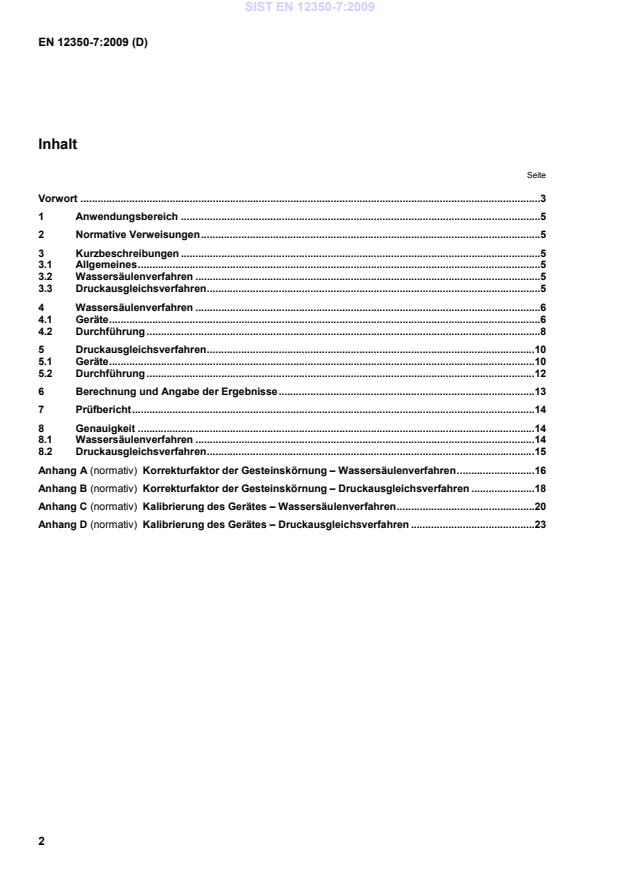
Aggregate correction factor – water column method . 16 Annex B (Normative)
Aggregate correction factor – pressure gauge method . 18 Annex C (Normative)
Calibration of apparatus – water column method . 20 Annex D (Normative)
Calibration of apparatus – pressure gauge method . 23
EN 12350 Testing fresh concrete Part 1: Sampling; Part 2: Slump-test;
Part 3: Vebe test;
Part 4: Degree of compactability; Part 5: Flow table test;
Part 6: Density;
Part 7: Air content — Pressure methods; Part 8: Self-compacting concrete - Slump-flow test (in preparation); Part 9: Self-compacting concrete - V-funnel test (in preparation); Part 10: Self-compacting concrete - L-box test (in preparation); Part 11: Self-compacting concrete - Sieve segregation test (in preparation); Part 12: Self-compacting concrete - J-ring test (in preparation). SIST EN 12350-7:2009
1 Scope This European Standard describes two methods for determination of air content of compacted fresh concrete, made with normal weight or relatively dense aggregate of maximum size up to 63 mm. NOTE Neither method is applicable to concretes made with lightweight aggregates, air cooled blast-furnace slag, or aggregates with high porosity, because of the magnitude of the aggregate correction factor, compared with the entrained air content of the concrete. 2 Normative references The following referenced documents are indispensable for the application of this document. For dated references, only the edition cited applies. For undated references, the latest edition of the referenced document (including any amendments) applies. EN 12350-1, Testing fresh concrete – Part 1: Sampling EN 12350-6, Testing fresh concrete – Part 6: Density 3 Principles 3.1 General There are two test methods, both of which use apparatus which employ the principle of Boyle-Mariotte's law. For the purpose of reference, the two methods are referred to as the water column method and the pressure gauge method and the apparatus as a water column meter and a pressure gauge meter. 3.2 Water column method Water is introduced to a predetermined height above a sample of compacted concrete of known volume in a sealed container and a predetermined air pressure is applied over the water. The reduction in volume of the air in the concrete sample is measured by observing the amount by which the water level is lowered, the water column being calibrated in terms of percentage of air in the concrete sample. 3.3 Pressure gauge method A known volume of air at a known pressure is merged in a sealed container with the unknown volume of air in the concrete sample. The dial on the pressure gauge is calibrated in terms of percentage of air for the resulting pressure. 4 Water column method 4.1 Apparatus 4.1.1 Water column meter, (see Figure 1), consisting of: a) Container, a cylindrical vessel of steel or other hard metal, not readily attacked by cement paste, having a nominal capacity of at least 5 l and a ratio of diameter to height of not less than 0,75 nor more than 1,25. The outer rim and upper surface of the flange and the interior surfaces of the vessel shall be machined to a smooth finish. The container shall be watertight and in addition it, and the cover assembly, SIST EN 12350-7:2009
a) Zero pressure
b) System operating at pressure P
c) Zero pressure release of pressure P Key: 1 Non-return valve 2 Air vent or valve 3 Bleed valve 4 Mark 5 Water 6 Clamp 7 Concrete 8 Air pump 9 Pressure lowered level h1 (reading at pressure P) h2 (reading at zero pressure after release of pressure P)
Figure 1 — Water column method apparatus NOTE h1 – h2 = A1 when the container holds concrete as shown in Figure 1
h1 – h2 = G (aggregate correction factor) when the container holds only aggregate and water
A1 – G = Ac (air content of concrete)
4.1.2 Means of compacting the concrete, which may be one of the following: a) Internal (poker) vibrator, with a minimum frequency of approximately 120 Hz (7 200 cycles per exceeding approximately one-quarter of the smallest dimension of the test specimen); b) Vibrating table, with a minimum frequency of approximately 40 Hz (2 400 cycles per minute); c) Compacting rod, of circular cross-section, straight, made of steel, having a diameter of approximately 16 mm, length of approximately 600 mm and with rounded ends; d) Compacting bar, straight, made of steel having a square cross-section of approximately
25 mm × 25 mm and length of approximately 380 mm. SIST EN 12350-7:2009
4.2 Procedure 4.2.1 Sampling Obtain the sample of fresh concrete in accordance with EN 12350-1. Remix the sample before carrying out the test 4.2.2 Filling the container and compacting the concrete Using the scoop, place the concrete in the container in such a way as to remove as much entrapped air as possible.
Depending on the consistence of the concrete and the method of compaction, the container shall be filled in one or more layers to achieve full compaction by using one of the methods described in 4.2.3 or 4.2.4.
Typically, concrete having a consistence equivalent to slump class S3 or greater will only require one layer.
In the case of self-compacting concrete, the container shall be filled in one operation and no mechanical compaction shall be applied during filling or after the container is filled. NOTE 1 Full compaction is achieved using mechanical vibration, when there is no further appearance of large air bubbles on the surface of the concrete and the surface becomes relatively smooth with a glazed appearance, without excessive segregation. NOTE 2 The number of strokes per layer required to produce full compaction by hand will depend upon the consistency of the concrete. NOTE 3 Further guidance on methods of compaction for concretes having different consistencies or cast in different sizes of moulds may be given in national annex NA. NOTE 4 The quantity of material used in the final layer shall be sufficient to fill the container without having to remove excess material. A small quantity of additional concrete may be added if necessary and further compacted in order to fill the container, but the removal of excess material should be avoided. SIST EN 12350-7:2009
Key 1 Valve A 2 Valve B 3 Pump 4 Main air valve 5 Pressure gauge 6 Air chamber 7 Air bleeder valve 8 Clamping device 9 Extension tubing for calibration checks 10 Container
Figure 2 — Pressure gauge method apparatus 5.1.2 Means of compacting the concrete, which may be one of the following: a) Internal (poker) vibrator, with a minimum frequency of approximately 120 Hz (7 200 cycles per minute), the diameter of the tube not exceeding approximately one-quarter of the smallest dimension of the test specimen; b) Vibrating table, with a minimum frequency of approximately 40 Hz (2 400 cycles per minute); c) Compacting rod, of circular cross-section, straight, made of steel, with a diameter of approximately 16 mm, length of approximately 600 mm and with rounded ends; d) Compacting bar, straight, made of steel having a square cross-section of approximately
25 mm × 25 mm and length of approximately 380 mm; SIST EN 12350-7:2009
Depending on the consistence of the concrete and the method of compaction, the container shall be filled in one or more layers to achieve full compaction by using one of the methods described in 5.2.3 or 5.2.4.
Typically, concrete having a consistence equivalent to slump class S3 or greater will only require one layer.
In the case of self-compacting concrete, the container shall be filled in one operation and no mechanical compaction shall be applied during filling or after the container is filled. NOTE 1 Full compaction is achieved using mechanical vibration when there is no further appearance of large air bubbles on the surface of the concrete and the surface becomes relatively smooth with a glazed appearance, without excessive segregation. NOTE 2 The number of strokes per layer required to produce full compaction by hand will depend upon the consistency of the concrete. NOTE 3 Further guidance on methods of compaction for concretes having different consistencies or cast in different sizes of moulds may be given in national annex NA. NOTE 4 The qu
...
2003-01.Slovenski inštitut za standardizacijo. Razmnoževanje celote ali delov tega standarda ni dovoljeno.Preskušanje svežega betona - 7. del: Vsebnost zraka - Metode s pritiskomPrüfung von Frischbeton - Teil 7: Luftgehalte - DruckverfahrenEssais sur béton frais - Partie 7 : Détermination de la teneur en air - Méthode de la compressibilitéTesting fresh concrete - Part 7: Air content - Pressure methods91.100.30Beton in betonski izdelkiConcrete and concrete productsICS:Ta slovenski standard je istoveten z:EN 12350-7:2009SIST EN 12350-7:2009de01-julij-2009SIST EN 12350-7:2009SLOVENSKI
STANDARDSIST EN 12350-7:20011DGRPHãþD
EUROPÄISCHE NORMEUROPEAN STANDARDNORME EUROPÉENNEEN 12350-7April 2009ICS 91.100.30Ersatz für EN 12350-7:2000
Deutsche FassungPrüfung von Frischbeton - Teil 7: Luftgehalt - DruckverfahrenTesting fresh concrete - Part 7: Air content - PressuremethodsEssais pour béton frais - Partie 7 : Teneur en air - Méthodede la compressibilitéDiese Europäische Norm wurde vom CEN am 20.Januar 2009 angenommen.Die CEN-Mitglieder sind gehalten, die CEN/CENELEC-Geschäftsordnung zu erfüllen, in der die Bedingungen festgelegt sind, unter denendieser Europäischen Norm ohne jede Änderung der Status einer nationalen Norm zu geben ist. Auf dem letzen Stand befindliche Listendieser nationalen Normen mit ihren bibliographischen Angaben sind beim Management-Zentrum des CEN oder bei jedem CEN-Mitglied aufAnfrage erhältlich.Diese Europäische Norm besteht in drei offiziellen Fassungen (Deutsch, Englisch, Französisch). Eine Fassung in einer anderen Sprache,die von einem CEN-Mitglied in eigener Verantwortung durch Übersetzung in seine Landessprache gemacht und dem Zentralsekretariatmitgeteilt worden ist, hat den gleichen Status wie die offiziellen Fassungen.CEN-Mitglieder sind die nationalen Normungsinstitute von Belgien, Bulgarien, Dänemark, Deutschland, Estland, Finnland, Frankreich,Griechenland, Irland, Island, Italien, Lettland, Litauen, Luxemburg, Malta, den Niederlanden, Norwegen, Österreich, Polen, Portugal,Rumänien, Schweden, der Schweiz, der Slowakei, Slowenien, Spanien, der Tschechischen Republik, Ungarn, dem Vereinigten Königreichund Zypern.EUROPÄISCHES KOMITEE FÜR NORMUNGEUROPEAN COMMITTEE FOR STANDARDIZATIONCOMITÉ EUROPÉEN DE NORMALISATIONManagement-Zentrum:
Avenue Marnix 17,
B-1000 Brüssel© 2009 CENAlle Rechte der Verwertung, gleich in welcher Form und in welchemVerfahren, sind weltweit den nationalen Mitgliedern von CEN vorbehalten.Ref. Nr. EN 12350-7:2009 DSIST EN 12350-7:2009
Korrekturfaktor der Gesteinskörnung – Wassersäulenverfahren.16 Anhang B (normativ)
Korrekturfaktor der Gesteinskörnung – Druckausgleichsverfahren.18 Anhang C (normativ)
Kalibrierung des Gerätes – Wassersäulenverfahren.20 Anhang D (normativ)
Kalibrierung des Gerätes – Druckausgleichsverfahren.23
2 SIST EN 12350-7:2009
⎯ Teil 4: Verdichtungsmaß
⎯ Teil 5: Ausbreitmaß
⎯ Teil 6: Frischbetonrohdichte ⎯ Teil 7: Luftgehalt — Druckverfahren ⎯ Teil 8: Selbstverdichtender Beton — Setzfließversuch (in Vorbereitung) ⎯ Teil 9: Selbstverdichtender Beton — Auslauftrichterversuch (in Vorbereitung) ⎯ Teil 10: Selbstverdichtender Beton — L-Kasten-Versuch (in Vorbereitung) ⎯ Teil 11: Selbstverdichtender Beton — Bestimmung der Sedimentationsstabilität im Siebversuch (in Vorbe-reitung) ⎯ Teil 12: Selbstverdichtender Beton — Blockierring-Versuch (in Vorbereitung) ACHTUNG — Beim Mischen des Zements mit Wasser werden Alkalien freigesetzt. Es sind Vorsichts-maßnahmen zu ergreifen, um zu verhindern, dass beim Mischen von Beton trockener Zement in Augen, Mund und Nase gelangt. Der Hautkontakt mit feuchtem Zement oder Beton ist durch das Tragen geeigneter Schutzkleidung zu vermeiden. Wenn Zement oder Beton in die Augen gelangt ist, sind diese sofort mit sauberem Wasser sorgfältig auszuwaschen und unverzüglich medizinische Hilfe in Anspruch zu nehmen. Nasser Beton ist sofort von der Haut abzuwaschen. 3 SIST EN 12350-7:2009
4 SIST EN 12350-7:2009
EN 12350-1, Prüfung von Frischbeton — Teil 1: Probenahme EN 12350-6, Prüfung von Frischbeton — Teil 6: Frischbetonrohdichte 3 Kurzbeschreibungen 3.1 Allgemeines Es gibt zwei Prüfverfahren, bei denen Geräte verwendet werden, die nach dem Prinzip des Boyle-Mariotte-schen-Gesetzes arbeiten. Für Vergleichszwecke werden die beiden Verfahren als Wassersäulenverfahren und Druckausgleichsverfahren und die Geräte als Wassersäulenmessgerät und Druckmessgerät bezeichnet. 3.2 Wassersäulenverfahren Wasser wird über eine verdichtete Betonprobe bekannten Volumens bis auf eine festgelegte Höhe eingefüllt und ein festgelegter Luftdruck über dem Wasser aufgebracht. Die Abnahme des Luftvolumens in der Betonprobe wird durch Beobachten der Verringerung des Wasserpegels gemessen, die Wassersäule ist dabei auf den prozentualen Luftgehalt der Betonprobe kalibriert. 3.3 Druckausgleichsverfahren Ein bekanntes Luftvolumen wird bei bekanntem Druck in einer dicht verschlossenen Kammer mit dem unbekannten Luftvolumen in der Betonprobe ausgeglichen. Dabei ist die Skalenteilung des Druckmessers (Manometer) für den resultierenden Druck auf den prozentualen Luftgehalt der Betonprobe kalibriert. 5 SIST EN 12350-7:2009
a) Nulldruck b) System unter Druck P
c) Nulldruck nach Ablass
des Drucks P Legende 1 Ventilverschluss
2 Lufteinlassventil
3 Ablassventil 4 Markierung 5 Wasser 6 Klemmverschluss 7 Beton 8 Luftpumpe 9 durch Druck verringertes Niveau
h1 (Ablesung beim Druck P) h2 (Ablesung bei Nulldruck nach Ablass des Drucks P) Bild 1 — Prüfgerät für das Wassersäulenverfahren ANMERKUNG h1 − h2 = A1, wenn der Behälter, wie in Bild 1 gezeigt, Beton enthält;
h1 − h2 = G (Korrekturfaktor des Zuschlags), wenn der Behälter nur Zuschlag und Wasser enthält;
A1 − G = Ac (Luftgehalt des Betons).
4.1.2 Hilfsmittel für die Verdichtung, welches eines der Folgenden sein kann: a) Innenrüttler mit einer Mindestfrequenz von 120 Hz (7 200 Umdrehungen je Minute), der Durchmesser des Rüttlers darf ein Viertel der kleinsten Abmessung des Behälters nicht überschreiten; b) Rütteltisch mit einer Mindestfrequenz von 40 Hz (2 400 Umdrehungen je Minute); c) Stab aus Stahl, mit kreisförmigem Querschnitt, gerade, mit einem Durchmesser von ungefähr 16 mm, einer Länge von ungefähr 600 mm und abgerundeten Enden; d) Stampfer aus Stahl, mit quadratischem Querschnitt von ungefähr 25 mm × 25 mm und einer Länge von ungefähr 380 mm. 7 SIST EN 12350-7:2009
Behälter mit Ausguss, mit einem Fassungsvermögen von 2 l bis 5 l zum Füllen des Gerätes mit Wasser. 4.1.9 Schlegel aus Weichholz 4.2 Durchführung 4.2.1 Probenahme Die Probenahme des Frischbetons ist nach EN 12350-1 durchzuführen. Vor der Prüfung ist die Probe durchzumischen. 4.2.2 Befüllen des Behälters und Verdichten des Betons Der Beton ist mit der Probenahmeschaufel so in den Behälter einzufüllen, dass möglichst wenig Luft eingeschlossen wird. Der Behälter ist unter Berücksichtigung der Konsistenz des Betons und des Verdichtungsverfahrens in einer oder mehreren Lagen zu füllen, um eine völlige Verdichtung durch Anwendung einer der in 4.2.3 oder 4.2.4 beschriebenen Verfahren zu erzielen. Üblicherweise erfordert Beton mit einer Konsistenz, die der Slump-Klasse S3 oder größer entspricht, nur eine Lage. Im Falle selbstverdichtenden Betons, muss der Behälter in einem Arbeitsgang gefüllt werden, ohne eine mechanische Verdichtung während oder nach dem Füllen des Behälters zu bewirken. ANMERKUNG 1 Die vollständige Verdichtung ist bei mechanischer Rütteleinwirkung erreicht, wenn keine großen Luft-blasen an der Betonoberfläche mehr erscheinen und die Oberfläche relativ glatt und eben erscheint, ohne übermäßiges Entmischen. ANMERKUNG 2 Die für jede Schicht erforderliche Anzahl der Stöße, um eine vollständige Verdichtung durch Stampfen zu erreichen, hängt von der Konsistenz des Betons ab. ANMERKUNG 3 Weitere Anleitungen zum Verdichten von Betonen mit unterschiedlicher Konsistenz oder bei Anwen-dung von Formen und abweichender Größe dürfen in einem Nationalen Anhang angegeben werden. ANMERKUNG 4 Die Materialmenge für die letzte Schicht muss möglichst so bemessen sein, dass der Behälter gerade ausreichend gefüllt wird, aber kein überschüssiger Beton entfernt werden muss. Eine kleine Menge zusätzlichen Betons kann zugefügt und verdichtet werden, um den Behälter zu füllen, jedoch sollte das Entfernen überschüssigen Materials vermieden werden. 8 SIST EN 12350-7:2009
0 % bis 3 %
0,1 %
3 % bis 6 %
0,2 %
6 % bis 10 %
0,5 % d) Luftpumpe: Druckpumpe, die in das Verschlussaggregat eingebaut sein darf. Das Druckmessgerät muss bei der Prüfung nach Anhang D kalibriert sein.
10 SIST EN 12350-7:2009
Legende 1 Ventil A 2 Ventil B 3 Pumpe 4 Hauptluftventil 5 Druckmessuhr 6 Luftkammer 7 Luftablassventil 8 Klemmverschluss 9 Ausdehnröhre für Überprüfungen beim Kalibrieren 10 Behälter Bild 2 — Prüfgerät für das Druckausgleichsverfahren
5.1.2 Hilfsmittel für die Verdichtung, welches eines der Folgenden sein kann: e) Innenrüttler mit einer Mindestfrequenz von 120 Hz (7 200 Umdrehungen je Minute), der Durchmesser des Rüttlers darf ein Viertel der kleinsten Abmessung des Behälters nicht überschreiten; f) Rütteltisch mit einer Mindestfrequenz von 40 Hz (2 400 Umdrehungen je Minute); g) Stab aus Stahl, mit kreisförmigem Querschnitt, gerade, mit einem Durchmesser von ungefähr 16 mm, einer Länge von ungefähr 600 mm und abgerundeten Enden; h) Stampfer aus Stahl, mit quadratischem Querschnitt von etwa 25 mm × 25 mm und einer Länge von etwa 380 mm. 5.1.3 Probenahmeschaufel, etwa 100 mm breit. 5.1.4 Glättkelle aus Stahl 5.1.5 Mischbehälter: Flache Schale fester Bauart aus nicht absorbierendem Material, das nicht mit dem Zementleim reagiert. Er muss solche Abmessungen haben, dass der Beton gründlich mit einer rechteckig geöffneten Schaufel durchgemischt werden kann. 5.1.6 Rechteckig geöffnete Handschaufel ANMERKUNG Die rechteckig geöffnete Schaufel ist notwendig, um das Material im Mischbehälter angemessen zu mischen. 11 SIST EN 12350-7:2009
Üblicherweise erfordert Beton mit einer Konsistenz, die der Slump-Klasse S3 oder größer entspricht, nur eine Lage. Im Falle selbstverdichtenden Betons, muss der Behälter in einem Arbeitsgang gefüllt werden, ohne eine mechanische Verdichtung während oder nach dem Füllen des Behälters zu bewirken. ANMERKUNG 1 Die vollständige Verdichtung ist bei mechanischer Rütteleinwirkung erreicht, wenn keine g
...