

EN 15221-2:2006
(Main)Facility Management - Part 2: Guidance on how to prepare Facility Management agreements
- Abstract
This European standard provides guidance on the preparation of agreements for Facility Management work.
This European standard is applicable to:
Facility Management agreements for both public and private European Union cross-border, as well as domestic, client/Facility Management service provider relationships;
full range of facility services;
both types of Facility Management service providers (internal and external);
all types of working environments (e.g. industrial, commercial, administration, military, health etc.).
This European standard is applicable to services that are primarily characterised by the following properties:
business to business services;
managed by the Facility Management service provider;
recurring type operations greater than a one year duration;
performance oriented;
prices or mechanisms to determine prices for services, which are closely linked to performance.
In EN 15221-1 the scope of Facility Management is described.
This standard is primarily written for Facility Management agreements between a client and an external Facility Management service provider. However, a large part of this standard can be applied to cases where the Facility management service provider is an internal entity within the client's organisation and be very helpful to set up an approach based on Services Level Agreements (SLA).
This standard does not replace any specialized standards related to services within the scope of the Facility Management agreement. Applicable standards should be followed.
The standard does not:
provide standard forms for Facility Management agreements;
determine rights and obligations between the client and the Facility Management service provider;
detail employment conditions in regard to Facility Management agreements, although such details are extremely important;
give detail concerning the management of environmental issues.
- Status
- Withdrawn
- Publication Date
- 24-Oct-2006
- Withdrawal Date
- 06-Oct-2026
- Technical Committee
- CEN/TC 348 - Facility management
- Drafting Committee
- CEN/TC 348/WG 2 - Facility Management Agreements
- Current Stage
- 9960 - Withdrawal effective - Withdrawal
- Start Date
- 27-Jun-2018
- Completion Date
- 07-Oct-2026

Relations
- Effective Date
- 07-Mar-2023
- Effective Date
- 15-Jul-2018
- Effective Date
- 28-Jan-2026
- Referred By
EN 15221-3:2011 - Facility Management - Part 3: Guidance on quality in Facility Management - Effective Date
- 28-Jan-2026
- Effective Date
- 22-Dec-2008
Get Certified
Connect with accredited certification bodies for this standard

DIBt (Deutsches Institut für Bautechnik)
German Institute for Building Technology.
DIN CERTCO
DIN Group product certification.

Aboma Certification B.V.
Specialized in construction, metal, and transport sectors.
Sponsored listings
Frequently Asked Questions
EN 15221-2:2006 is a standard published by the European Committee for Standardization (CEN). Its full title is "Facility Management - Part 2: Guidance on how to prepare Facility Management agreements". This standard covers: This European standard provides guidance on the preparation of agreements for Facility Management work. This European standard is applicable to: Facility Management agreements for both public and private European Union cross-border, as well as domestic, client/Facility Management service provider relationships; full range of facility services; both types of Facility Management service providers (internal and external); all types of working environments (e.g. industrial, commercial, administration, military, health etc.). This European standard is applicable to services that are primarily characterised by the following properties: business to business services; managed by the Facility Management service provider; recurring type operations greater than a one year duration; performance oriented; prices or mechanisms to determine prices for services, which are closely linked to performance. In EN 15221-1 the scope of Facility Management is described. This standard is primarily written for Facility Management agreements between a client and an external Facility Management service provider. However, a large part of this standard can be applied to cases where the Facility management service provider is an internal entity within the client's organisation and be very helpful to set up an approach based on Services Level Agreements (SLA). This standard does not replace any specialized standards related to services within the scope of the Facility Management agreement. Applicable standards should be followed. The standard does not: provide standard forms for Facility Management agreements; determine rights and obligations between the client and the Facility Management service provider; detail employment conditions in regard to Facility Management agreements, although such details are extremely important; give detail concerning the management of environmental issues.
This European standard provides guidance on the preparation of agreements for Facility Management work. This European standard is applicable to: Facility Management agreements for both public and private European Union cross-border, as well as domestic, client/Facility Management service provider relationships; full range of facility services; both types of Facility Management service providers (internal and external); all types of working environments (e.g. industrial, commercial, administration, military, health etc.). This European standard is applicable to services that are primarily characterised by the following properties: business to business services; managed by the Facility Management service provider; recurring type operations greater than a one year duration; performance oriented; prices or mechanisms to determine prices for services, which are closely linked to performance. In EN 15221-1 the scope of Facility Management is described. This standard is primarily written for Facility Management agreements between a client and an external Facility Management service provider. However, a large part of this standard can be applied to cases where the Facility management service provider is an internal entity within the client's organisation and be very helpful to set up an approach based on Services Level Agreements (SLA). This standard does not replace any specialized standards related to services within the scope of the Facility Management agreement. Applicable standards should be followed. The standard does not: provide standard forms for Facility Management agreements; determine rights and obligations between the client and the Facility Management service provider; detail employment conditions in regard to Facility Management agreements, although such details are extremely important; give detail concerning the management of environmental issues.
EN 15221-2:2006 is classified under the following ICS (International Classification for Standards) categories: 03.080.99 - Other services; 91.040.01 - Buildings in general. The ICS classification helps identify the subject area and facilitates finding related standards.
EN 15221-2:2006 has the following relationships with other standards: It is inter standard links to prEN 15221, EN ISO 41012:2018, EN 15221-1:2006, EN 15221-3:2011; is excused to prEN 15221. Understanding these relationships helps ensure you are using the most current and applicable version of the standard.
EN 15221-2:2006 is available in PDF format for immediate download after purchase. The document can be added to your cart and obtained through the secure checkout process. Digital delivery ensures instant access to the complete standard document.
Standards Content (Sample)
2003-01.Slovenski inštitut za standardizacijo. Razmnoževanje celote ali delov tega standarda ni dovoljeno.Facility Management - Part 2: Guidance on how to prepare Facility Management agreementsUpravljanje objektov in storitev - 2. del: Smernice za pripravo dogovora o upravljanju objektov in storitevFacilities management - Partie 2 : Lignes directrices sur la façon d'élaborer des accords de facilities managementFacility Management - Teil 2: Leitfaden zur Ausarbeitung von Facility Management-VereinbarungenTa slovenski standard je istoveten z:EN 15221-2:2006SIST EN 15221-2:2007en91.040.01Stavbe na splošnoBuildings in general03.080.99Druge storitveOther servicesICS:SLOVENSKI
STANDARDSIST EN 15221-2:200701-januar-2007
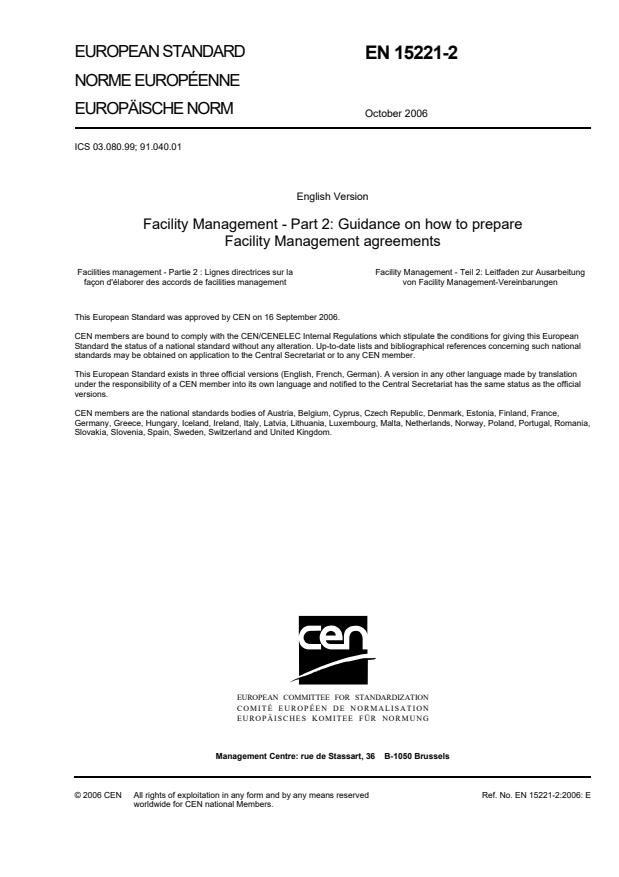
EUROPEAN STANDARDNORME EUROPÉENNEEUROPÄISCHE NORMEN 15221-2October 2006ICS 03.080.99; 91.040.01 English VersionFacility Management - Part 2: Guidance on how to prepareFacility Management agreementsFacilities management - Partie 2 : Lignes directrices sur lafaçon d'élaborer des accords de facilities managementFacility Management - Teil 2: Leitfaden zur Ausarbeitungvon Facility Management-VereinbarungenThis European Standard was approved by CEN on 16 September 2006.CEN members are bound to comply with the CEN/CENELEC Internal Regulations which stipulate the conditions for giving this EuropeanStandard the status of a national standard without any alteration. Up-to-date lists and bibliographical references concerning such nationalstandards may be obtained on application to the Central Secretariat or to any CEN member.This European Standard exists in three official versions (English, French, German). A version in any other language made by translationunder the responsibility of a CEN member into its own language and notified to the Central Secretariat has the same status as the officialversions.CEN members are the national standards bodies of Austria, Belgium, Cyprus, Czech Republic, Denmark, Estonia, Finland, France,Germany, Greece, Hungary, Iceland, Ireland, Italy, Latvia, Lithuania, Luxembourg, Malta, Netherlands, Norway, Poland, Portugal, Romania,Slovakia, Slovenia, Spain, Sweden, Switzerland and United Kingdom.EUROPEAN COMMITTEE FOR STANDARDIZATIONCOMITÉ EUROPÉEN DE NORMALISATIONEUROPÄISCHES KOMITEE FÜR NORMUNGManagement Centre: rue de Stassart, 36
B-1050 Brussels© 2006 CENAll rights of exploitation in any form and by any means reservedworldwide for CEN national Members.Ref. No. EN 15221-2:2006: E
2 Contents
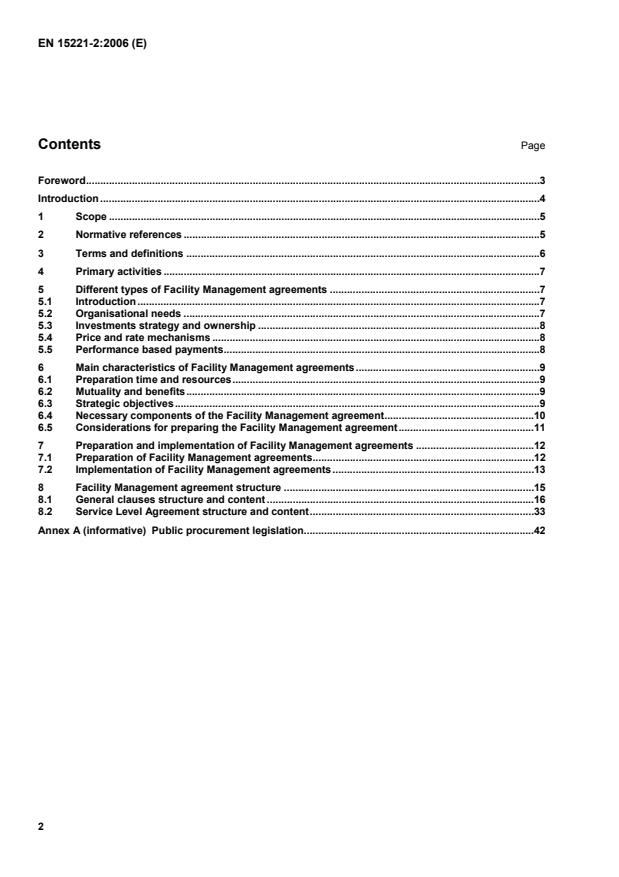
Page Foreword.3 Introduction.4 1 Scope.5 2 Normative references.5 3 Terms and definitions.6 4 Primary activities.7 5 Different types of Facility Management agreements.7 5.1 Introduction.7 5.2 Organisational needs.7 5.3 Investments strategy and ownership.8 5.4 Price and rate mechanisms.8 5.5 Performance based payments.8 6 Main characteristics of Facility Management agreements.9 6.1 Preparation time and resources.9 6.2 Mutuality and benefits.9 6.3 Strategic objectives.9 6.4 Necessary components of the Facility Management agreement.10 6.5 Considerations for preparing the Facility Management agreement.11 7 Preparation and implementation of Facility Management agreements.12 7.1 Preparation of Facility Management agreements.12 7.2 Implementation of Facility Management agreements.13 8 Facility Management agreement structure.15 8.1 General clauses structure and content.16 8.2 Service Level Agreement structure and content.33 Annex A (informative)
Public procurement legislation.42
3Foreword This document (EN 15221-2:2006) has been prepared by Technical Committee CEN/TC 348 “Facility Management”, the secretariat of which is held by NEN. This European Standard shall be given the status of a national standard, either by publication of an identical text or by endorsement, at the latest by April 2007, and conflicting national standards shall be withdrawn at the latest by April 2007. According to the CEN/CENELEC Internal Regulations, the national standards organizations of the following countries are bound to implement this European Standard : Austria, Belgium, Cyprus, Czech Republic, Denmark, Estonia, Finland, France, Germany, Greece, Hungary, Iceland, Ireland, Italy, Latvia, Lithuania, Luxembourg, Malta, Netherlands, Norway, Poland, Portugal, Romania, Slovakia, Slovenia, Spain, Sweden, Switzerland and United Kingdom.
4 Introduction Effective Facility Management brings value to an organisation and all associated stakeholders.
The objective of this European Standard is to provide guidance for preparing an effective Facility Management agreement. Such an agreement by nature, defines the relationship between an organisation that procures facility services (client) and an organisation that provides these services (Facility Management service provider).
Although Facility Management can vary from a combination of single facility services e.g. 'security' and 'cleaning' to fully integrated facility services and/or a functional approach to an organisation e.g. 'workplace' or 'mobility', this European standard is primarily written for organisations that adopt integrated facility services and/or a functional approach. In addition, as technical developments increase and economic systems mature, the demand for this type of facility services, both nationally and internationally, will increase.
It is therefore important that Facility Management agreements are approached in a structured and careful manner. The purpose of this standard is to: – Promote cross-border client/Facility Management service provider relationships within the European Union and to produce a clear interface between the client and the Facility Management service provider. – Improve the quality of Facility Management agreements so that disputes and adjustments are minimised. – Assist in the selection and scope of facility services and to identify options for their provision. – Give assistance in, and advice on, the drafting and negotiation of Facility Management agreements and specify arrangements in case of dispute. – Identify types of Facility Management agreements and make recommendations for the attribution of rights and obligations between the parties of the agreement. – Simplify comparisons between Facility Management agreements. This document is a working and standardised tool intended for parties who wish to draw up the Facility Management agreement within the European Common Market. It offers headings, which are not exhaustive. Parties may or may not include, exclude, modify and adapt these headings to their own agreements. EN 15221-1 is a lead document in terms of standards in Facility Management as it gives relevant terms and definitions in the area of Facility Management and also provides insight into the scope of Facility Management. This standard is a guidance document and does not oblige the parties to use any part of its content. Not all the clauses discussed in this standard will be applicable to every Facility Management agreement. The Facility Management agreement shall follow the European, national and local legal and fiscal rules and should consider social issues where the agreement will apply. Each individual agreement should be drafted, and negotiated where appropriate, to take into account the requirements of the parties involved.
51 Scope This European standard provides guidance on the preparation of agreements for Facility Management work. This European standard is applicable to: – Facility Management agreements for both public and private European Union cross-border, as well as domestic, client/Facility Management service provider relationships; – full range of facility services;
– both types of Facility Management service providers (internal and external); – all types of working environments (e.g. industrial, commercial, administration, military, health etc.).
This European standard is applicable to services that are primarily characterised by the following properties:
– business to business services; – managed by the Facility Management service provider;
– recurring type operations greater than a one year duration;
– performance oriented;
– prices or mechanisms to determine prices for services, which are closely linked to performance.
In EN 15221-1 the scope of Facility Management is described.
This standard is primarily written for Facility Management agreements between a client and an external Facility Management service provider. However, a large part of this standard can be applied to cases where the Facility management service provider is an internal entity within the client's organisation and be very helpful to set up an approach based on Services Level Agreements (SLA). This standard does not replace any specialized standards related to services within the scope of the Facility Management agreement. Applicable standards should be followed. The standard does not: – provide standard forms for Facility Management agreements; –
determine rights and obligations between the client and the Facility Management service provider; – detail employment conditions in regard to Facility Management agreements, although such details are extremely important; – give detail concerning the management of environmental issues. 2 Normative references The following referenced documents are indispensable for the application of this document. For dated references, only the edition cited applies. For undated references, the latest edition of the referenced document (including any amendments) applies. EN 15221-1:2006, Facility Management – Part 1: Terms and definitions
6 3 Terms and definitions For the purposes of this European Standard, the terms and definitions given in EN 15221-1:2006 and the following apply. 3.1 asset
anything considered by an organisation as having a positive value, especially financial
3.2 demobilisation phase to transfer facility services back to the client or to a new Facility Management service provider as specified in the Facility Management agreement 3.3 due diligence compilation, comprehensive appraisal and validation of information of an organisation at the appropriate stage of the Facility Management agreement required for assessing accuracy and integrity at the appropriate stage of the agreement process 3.4 escalation path procedure to ensure that when problems can't be resolved within an agreed time frame, they are rapidly brought to the appropriate level of responsibility for adequate resolution 3.5 exclusivity fact that the client, within the framework of the Facility Management agreement, grants to its partner a single and exclusive right to provide the facility service concerned
3.6 functional approach approach to Facility Management that focuses on integration of individual services to attain the required output
3.7 letter of intent note or memorandum setting a clear intention to take a certain course of action or enter into a formal agreement
3.8 mobilisation phase to establish and implement all resources, systems, data and procedures prior to taking full responsibility for the facility services to be delivered as specified in the Facility Management agreement
3.9 open-book transparent exchange of relevant information between the client and the Facility management service provider
3.10 performance based payment system
method of payment based on agreed output criteria 3.11 reversibility when the client decides to end the Facility Management agreement with the existing provider and receive facility services from an internal provider
73.12 sub-contractor organisation engaged by the Facility Management service provider to perform a specific portion of a facility service 3.13 transferability when the client decides to end the Facility Management agreement with the existing provider and sign a new Facility Management agreement with a new provider
4 Primary activities
In Facility Management agreements it is fundamental that the Facility Management service provider has an appreciation and understanding of the client's primary activities, stakeholders, relevant organisation strategies and organisational structure at its inception and during the period of the agreement.
The primary activities description should include: – description of the client’s intended corporate image and trademark; – description of the client’s products and services; – description of the client’s customers. The distinction between the primary activities and support services is decided by each organisation individually; this distinction has to be continuously updated. 5 Different types of Facility Management agreements 5.1 Introduction It is recommended that the two parties, before finalizing the details of the Facility Management agreement, ensure they have a common understanding of the type of Facility Management agreement intended, according to the types described in this section. 5.2 Organisational needs
The relative responsibility of each party for facility services listed in the Facility Management agreement should be determined in the following areas. Reference to Annex A in EN 15221-1:2006 (Facility Management model) may be useful at this stage. a) Facility Management on a strategic level; b) Facility Management on a tactical level; c) Facility Management on an operational level. This determination will lead to the consideration of two main types of Facility Management agreements.
– Facility Management agreements which includes a), b) and c). This includes a degree of responsibility for defining the overall Facility Management strategy in line with primary activity strategy. – Facility Management agreements, which only includes b) and c).
A careful analysis of this relationship will assist in the determination of all subsequent clauses in the Facility Management agreement.
8 5.3 Investments strategy and ownership Clients should determine the required facility operating model to meet their asset/equipment investment strategy. There are typically three generic types of investment strategies envisaged within Facility Management agreements by this document, although others might emerge over time: – client provides all investments and has the ownership; – investment (usually for limited elements) is provided by the Facility Management service provider, including necessary financing and guarantees. This investment is usually associated with services provided within the Facility Management agreement; – comprehensive agreement that incorporates necessary financing, guarantees, planning, asset replacement, construction, management and service operation including the full responsibility for all Facility Management costs and risks, commonly named the Build Operate and Transfer agreement (BOT).
NOTE This standard is not considered applicable for construction agreements. The implications of this decision should be discussed with the Facility Management service provider, including the ownership, right of use, operation, maintenance and ending of obligations that need to be agreed upon for the investment, in relation to the terms of the Facility Management agreement. 5.4 Price and rate mechanisms
There are three main methods of price mechanisms and their combinations that can be considered:
– Lump sum: Facility Management service provider is fully responsible for a defined performance and quality at an agreed total amount for the agreed facility services.
– Unit rate: Facility Management service provider is fully responsible for a defined performance and quality at an agreed unit rate for the agreed facility service quantities within an agreed range. – Cost plus: Facility Management service provider is fully responsible for a defined performance and quality at actual costs plus the agreed fee for the agreed facility services. In this case, the actual costs for the agreed facility services have to be made available to the client.
These prices may be fixed (fixed price) over a period of time, may be capped at a guaranteed maximum price or adjusted based agreed criteria (variable price). For all the above pricing mechanisms an open-book clause can be used. In this case the details of all relevant financial transactions are available to the client. Financial accountability should be agreed in accordance with the type of price mechanism chosen stating precisely what financial documentation or information is available for the client. 5.5 Performance based payments
5.5.1 Incentives within the scope of the Facility Management agreement The client and Facility Management service provider should agree if the performance based payment system will operate to cover incentives and non-performance. 5.5.2 Incentives on added value to primary activities Where the two parties recognise that the client’s primary activity performance may improve resulting from the positive performance of the Facility Management service provider, the principles for establishing an incentive may be added to the Facility Management agreement.
95.5.3 Incentives about savings Where the Facility Management service provider identifies opportunities for savings, the principles for establishing and sharing the savings may be added to the Facility Management agreement. 6 Main characteristics of Facility Management agreements 6.1 Preparation time and resources
Time and resources should be dedicated to the preparation of the Facility Management agreement in proportion to size, importance, and complexity.
Several different phases should be followed to prepare Facility Management agreements and to ensure that the expectations of different stakeholders are taken into account. These stages are summarised in clause 7. 6.2 Mutuality and benefits Both the client and Facility Management service provider should share a mutual vision and understand the desired outcome and objectives of the client. Specifically: – Facility Management service provider should recognise the operational and strategic importance of its own operation to the client’s organisation. – Client should recognise that it has a direct interest in the performance of its Facility Management service provider in financial, operational and other ways. Consideration should be given to the primary activity requirements and change management processes to ensure that mutuality and benefits are sustained throughout the term of the Facility Management agreement. It is important that, before deciding to move towards the signature of the Facility Management agreement, each of the two concerned parties perform their own financial profitability analysis of activities considered. 6.3 Strategic objectives The Facility Management service provider should fully understand and support the client's (Facility Management) strategy relevant to the Facility Management agreement. Where the client's Facility Management strategy has not been fully determined, both parties should develop and document a sufficient understanding of this strategy for the purposes of the agreement. The client and Facility Management service provider are expected to address their relevant knowledge before signing the Facility Management agreement.
The client and Facility Management service provider should have a mutual understanding of the others’ internal cultures and processes. The respective management structures of the client and the Facility Management service provider should be considered before the Facility Management agreement has been signed. The degree of organisational overlap and control points/interfaces should be agreed together with an explicit consideration of the structure of the management information flow between the two parties.
The objective/preamble should be included in the Facility Management agreement. Stating the general intention of the parties and the purposes of the Facility Management agreement may be especially important for long-term agreements when changing conditions may make adjustments to the agreement necessary. The preamble helps with the interpretation of the Facility Management agreement in case of dispute, and wording of amendments in case of future variation to agreement.
10 6.4 Necessary components of the Facility Management agreement 6.4.1 Term of the Facility Management agreement
The Facility Management agreement should be over a sufficient term to enable all parties to benefit. The term should be fixed taking into account criteria of the type of the Facility Management agreement, the scope and the market.
The way the two parties may agree to extend the duration of the agreement should be defined within the agreement. In non-public works agreements, the parties should consider the desirability of not imposing a fixed term in the agreement.
NOTE The Facility Management agreement should normally last a minimum of three years.
The Facility Management agreement should explicitly contain reference to the notice period to which the Facility Management service provider will be subject under the agreement. 6.4.2 Exclusivity The degree to which exclusivity will be granted to the Facility Management service provider for any particular facility service should be determined. 6.4.3 Management of client procured facility services The recommended contracting method for the Facility Management agreement is for the Facility Management service provider to procure all agreed facility services on behalf of the client (acting as principle). However, there will be some elements of facility services which the client may wish to procure and instruct the Facility Management service provider to manage (acting as agent where the contract is between client and a supplier and/or service provider) If applicable, the scope of any agent related activity should be clearly defined as in clause 8.1.4.15. There may also be a need to be transitional in arrangements. 6.4.4 Sub-contracting The extent and control of sub-contracting and the type of facility services that are allowed or not allowed to be sub-contracted should be defined in the Facility Management agreement together with any specific conditions.
The Facility Management service provider should remain accountable for the sub-contracted facility services. 6.4.5 Allocation of management responsibility The management responsibilities of stakeholders, affected by the Facility Management agreement, should be clearly defined. The Facility Management agreement may include the redistribution of activities between the client and the Facility Management service provider as well as the transfer of assets and personnel.
Where the Facility Management service provider personnel are acting on behalf of the client, the level of autonomy and operational scope (policy, standards, conformance and escalation path) should be clearly defined and the legal implications fully considered.
6.4.6 Information responsibilities Both parties should ensure that the responsibilities for designing, updating and reporting of management information are fully understood and articulated in the Facility Management agreement. Procedures should be prescribed for the production of reports and performance indicators to any or all stakeholders, especially if financial penalties or inducements may be paid. If necessary, parties may consider an independent audit of such reports and performance indicators.
116.4.7 Communication
The two parties should ensure that all stakeholders affected by the Facility Management agreement are informed of the final agreement as well as any subsequent agreement modifications. 6.4.8 Regulations The Facility Management agreement shall follow the European, national and local legal and fiscal rules and should consider social issues where the agreement will apply. In multinational Facility Management agreements, the client and Facility Management service provider should define the applicable legal framework for the Facility Management agreement and its parts. 6.4.9 Client's standards The Facility Management agreement should take account of the client's relevant organisation governance and standards.
6.4.10 Preparation for ending the Facility Management agreement
Explicit attention should be paid to ending the Facility Management agreement in terms of remuneration, personnel and other matters. 6.5 Considerations for preparing the Facility Management agreement
6.5.1 General The Facility Management agreement should consider the principles outlined below as key considerations: – flexibility (6.5.2); – performance criteria (6.5.3); – reporting and auditing procedures (6.5.4); – continuous improvement, best practice and innovation (6.5.5); – asset replacement and project activity (6.5.6). 6.5.2 Flexibility The degree of flexibility included in the Facility Management agreement should be a product of the duration, extent of change anticipated and the degree of cost certainty required by the client.
The more flexible the Facility Management agreement scope, the greater the need to carefully document change and cost management methodologies. Where it is anticipated that the scope of the change will impact all stakeholders, the method for handling the impact on profitability, mobilisation, redundancy and unrecoverable costs should be considered.
The Facility Management agreement should explain the methodology and approach through which unforeseen events and conflicts will be dealt with.
The Facility Management agreement should contain a procedure for amendments (additions, omissions, variations).
12 6.5.3 Performance criteria The Facility Management agreement should define the output result requirements (e.g. key performance indicators, service levels) and constraints, not detailed descriptions of tasks to be fulfilled. Apart from very specific facility services for which the client within the Facility Management agreement should precisely specify a minimum level of resources, the Facility Management service provider should be free to choose the resources by which the performance criteria are met. It is important to let the Facility Management service provider find the most effective way to achieve and the service levels required. However, it is important for the client to identify the process and methodology to be used for measuring the output from each facility service as part of the Facility Management agreement and specify the validation and testing criteria.
NOTE It is generally possible to construct output requirements, however, there may be some services where the output is not suitable for output-based descriptions. An example may be manned security, where job tasks fulfilled will mitigate against security risk but cannot eliminate it. Therefore an output description of 'no security breaches' may be an aim, but is not satisfactory. 6.5.4 Reporting and auditing procedures The extent of reporting, validation, testing, financial reconciliation and auditing should be outlined in the Facility Management agreement. Any requirement for the Facility Management service provider to support audits and qualitative testing should also be documented. Any requirement for the formatting documentation or integrating IT systems data should also be identified.
Consideration should be given at the initial stages of the Facility of Management agreement for any linkages with performance measurement and quality assurance systems. 6.5.5 Continuous improvement, best practice and innovation The Facility Management agreement should define the methodology by which continuous improvement, best practice and innovation are initiated or developed and mutual benefit is agreed and apportioned, in a coherent manner with the price and rate mechanisms defined in 5.4. 6.5.6 Asset replacement and project activity For the more comprehensive Facility Management agreement types outlined in clause 5, it is probable that clients will require Facility Management service providers to undertake elements of the asset replacement and project activity. The client should consider the scope, criticality and the complexity of the activity required in this area and determine if the Facility Management agreement can be adequately extended to cover the investigation, planning, feasibility, design, contracting and contingent liabilities.
If this type of activity is included in the overall Facility Management agreement, it should reference the relevant aspects. It is recommended that the specific elements required for this activity are included as an SLA covering the output.
The relationship between Facility Management and project management activity needs to be clearly documented within the Facility Management agreement. This should cover the support required by the Facility Management service provider asset replacement and project activity, and if not included within the Facility Management agreement, to any project management activity completed by a third party.
7 Preparation and implementation of Facility Management agreements 7.1 Preparation of Facility Management agreements 7.1.1 Client preparation phase
Stage 1: Client should document the outcome of the information determined in clauses 4 and 5.
13Stage 2: Client should define the overall objectives for the Facility Management agreement and the contribution of those objectives to the organisation performance of the organisation.
Stage 3: Client is responsible for initial collation and integrity of data. It is important that the client allocates sufficient time in the pre agreement process to ensure that its management information system is robust so as to enable accurate updating and validation.
Stage 4: Client will define the facility services that need to be provided. An example of the scope of Facility Management is included in EN 15221-1. The performance requirements of the services to be provided should be determined in accordance with clause 6.5.3. Stage 5: Client should ensure an appropriate procurement and management process/organisation to manage the phases in the preparation of Facility Management agreements. 7.1.2 Pre-qualification and selection phase Stage 1: Identification of a limited number of qualified (competence and capability) Facility Management service providers. Stage 2: Preparation of documentation highlighting key selection criteria including any weighting system and issued through an appropriate medium e.g. when appropriate advertisement according the European Commission’s Directives (see Annex A). Stage 3: Provision the potential providers necessary information to enable them to participate in this pre-qualification phase. Stage 4: Evaluation of the Facility Management service provider's responses and selection of a short-list. If appropriate, all potential providers should be informed of the outcome.
7.1.3 Tender/negotiation phase Stage 1: Preparation and issue by the client of the Facility Management agreement and tender documentation where appropriate. Stage 2: Facility Management service providers make an offer for the requested facility services. Stage 3: Evaluation and selection of the Facility Management service provider. The output from this phase will usually result in the selection of a preferred Facility Management service provider. If appropriate, a letter of intent may be issued at this stage and only when a formal Facility Management agreement cannot be immediately entered into. 7.1.4 Facility Management agreement preparation phase Detailed preparation of the contract documentation and completion of any due diligence activity. Both parties should agree to a methodology for resolving issues of non-compliance with the conditions of the Facility Management agreement. 7.1.5 Signature phase Signing of the Facility Management agreement. 7.2 Implementation of Facility Management agreements 7.2.1 Mobilisation phase Implementation of the mobilisation phase as agreed.
14 This includes the preparation and mobilisation of all resources, systems, data, authorizations and procedures prior to taking full responsibility of the facility services to be delivered according to the Facility Management agreement.
Any degree of parallel operation should be clearly defined including access to the existing data, as agreed upon, supplier information, measurements and attendance at meetings. Both parties should ensure that adequate contingency plans are in place to cover all predictable issues that may emerge on the day the facility service is transferred.
During the mobilisation phase, the Facility Management service provider should consider the condition of key assets and their ability to meet the desired performance. This is essential where a performance-based approach is adopted, as the service provider will need to ensure that all installed systems covered by the Facility Management agreement meet the desired output at commencement. Any discrepancy will need to be documented.
7.2.2 Validation phase If not substantiated through due diligence, during the Facility Management agreement preparation phase of implementation (see 7.1.4) both parties should confirm the validity of the information which were given to the other party to build the Facility Management agreement. Any validation associated with prequalification of Facility Management service providers should be completed as indicated in 7.1.2. NOTE Validation of data can be improved by use of ratios (such as
'cost per unit floor area').
A period of time should be defined for verification of data, services and systems by the Facility Management service provider where validation can't occur at the implementation date of the Facility Management agreement. A predetermined mechanism shall be defined and agreed to manage discrepancies where the outcome of the verification phase does not match the agreed criteria. 7.2.3 Operational phase
Stage 1: Implementation and stabilization The Facility Management agreement should define a period of time for the implementation phase. Consideration should be given to apportionment of risk in terms of facility service delivery. On the basis of transfer documentation issued by the client, the Facility Management service provider takes full operational control and becomes accountable for the facility services as specified by the Facility Management agreement. Stage 2: Optimization In this stage the facility services are delivered as agreed and also in this phase the methodology for optimization agreed upon is applied. Stage 3: Preparation for ending the Facility Management agreement A defined period of time and the methodology for executing the expiration phase should be given in the Facility Management agreement. Data, information and documentation required by the Facility Management agreement should be compiled, collated and handed over to the client in the agreed format.
7.2.4 Ending phase The client and Facility Management service provider should implement the activities for conclusion of the Facility Management agreement. The period for finalising any outstanding actions should be documented.
158 Facility Management agreement structure In order to facilitate a stable Facility Management agreement and also allow for dynamic adjustment of individual facility services to the needs of the client’s primary activities, the following structure is recommended: – general clauses, which are intended to be valid and applicable for the totality of the Facility Management agreement;
– Service Level Agreements clauses for each individual facility service. General clauses contain legal and business aspects of the Facility Management agreement.
Service Level Agreements clauses focus on the technical and operational aspects. The applicability of clauses will vary between different facility services taking into account the demands, circumstances and locations. Therefore clauses which are generally applicable, may be grouped together in a document referred to as general clauses.
The individual clauses of the various Service Level Agreements clauses (one for each type of facility service) should be linked by the corresponding numbering of the general clauses, so that both documents together comprise the conditions governing the rights and obligations of the parties.
The following elements are described in 8.1 and 8.2. 8.1 General Clauses
8.2 Service Level Agreement specific clauses 8.1.1
General description
8.2.1 General description 8.1.2 Primary activities requirements
8.2.2 Common organisation processes 8.1.3 General conditions
8.2.3 General conditions 8.1.4 General provisions
8.2.4 Structure and communication 8.1.5 Ending conditions
8.2.5 Definition and clarification 8.1.6 General obligations of the client
8.2.6 Obligations and requirements 8.1.7 General obligations of the Facility Management service provider
8.2.7 Price, payment and accounting 8.1.8 Transfer of personnel
8.2.8 Appendices 8.1.9 Timing and main dates
8.1.10 Agreement price, payment and accounting
8.1.11 Changes of the agreement
8.1.12 Default by a party
8.1.13 Auditing
8.1.14 Risks and responsibilities
8.1.15 Insurances
8.1.16 Force majeure
8.1.17 Dispute and dispute resolution (settlement) process and methods
8.1.18 Asset replacement and project activity
8.1 General clauses structure and content
The following table sets out what should be considered in terms of detail within the Facility Management agreement. Headings and sub-headings are presented along with the intent of such a clause within the agreement. For each heading and sub-heading proposed content suggestions are provided. Much of what is contained in the table may already have been mentioned in the preceding clauses of this agreement guidance document but is presented in a tabular form in order to assist in the process of selection of what will be the basis of a contractual agreement.
Conditions of the Facility Management agreement - General clauses
Element of agreement Intention Proposed content 8.1.1 General description
8.1.1.1 Heading Identification of the Facility Management agreement. Notion of "Facility Management agreement" in the heading. Further specifications should be made in a subtitle.
8.1.1.2 Contracting parties Definition of the parties of the Facility Management agreement.
Correct legal company name, address. If necessary: Represented by:
Short form of the company name used within the agreement. 8.1.1.3 Objective/preamble Definition of the general intention of the parties.
Specific statements of agreeing parties intentions.
Name the type of Facility Management agreement.
Statements concerning the risks associated with the Facility Management agreement.
8.1.1.4 Description of the organisation and general environment with agreed output/targets
Mutual understanding between both parties. Desired objectives, with respect to mutual benefit and what has to be achieved with the facility services including overall performance criteria.
17 8.1.1.5 Strategic Facility Management objectives
Harmonization on a strategic level. Facility Management strategy of the client and the strategy of the Facility Management service provider to achieve the objectives during the term of the Facility Management agreement. If the Facility Management service provider, in addition to performing his normal operations has other motivations for entering the concerned agreement (e.g. entering a new area of activity), this should be mentioned.
8.1.1.6 Nature/scope of facility services Mutual understanding of the scope. List of the facility services.
8.1.1.7 Contracting parties and organisations involved
Understanding of: – who is who; – who is affected; – organisational interfaces; – principle function roles;
– management responsibilities.
In general terms: – list of the stakeholders; – organisations (including management structures, geographical situations); – internal culture; – embedment of services providers in the client’s organisation; – client’s and Facility Management services provider’s authorised representatives, as well as the end in their principle functions and responsibilities; – other suppliers and service providers interfacing with Facility Management service provider's services.
8.1.2 Primary activities requirements
8.1.2.1 Primary activities Understanding of the client’s primary activities by the Facility Management service provider, including the influences on these activities
Description of the client's primary activities, the client's organisation strategy as well as the client's main processes.
8.1.3 General conditions
8.1.3.1 Definitions Clear understanding of
the used terms in the Facility Management agreement and related documents.
A glossary of terms and definitions as well as the acronyms used in the Facility Management agreement (may also be attached in an appendix).
If available, it is recommended that adopted national, European or international standards are used instead of the parties own definitions.
18 8.1.4 General provisions
8.1.4.1 Applicable law and place of court Clarification of jurisdiction. Governing law and place of dispute settlement.
Relation between European law and country specific law, which may have an impact on the Facility Management agreement.
List of applicable regions/countries.
Undertaking of parties to attain intent of Facility Management agreement if laws cause invalidity in part(s) or as a whole.
8.1.4.2 Statutory regulations, permits, ordinances
Identification of all obligatory references. Document references. 8.1.4.3 Applicable standards, industry and client's standards
Identification and understanding of all references that shall be applied. Document applicability and reference. 8.1.4.4 Applicable taxation rules Identification and clarification of potential impacts of taxation rules.
List the taxation rules which may apply and the responsibilities of the parties (e.g. recording and archiving of data for accounting). 8.1.4.5 Language Identification of the language of the Facility Management agreement and any subsequent language/translation requirements.
Identification of which language is legally binding.
Language to be used for the following communication types:
– correspondence; – technical documents;
– other documentation used by the parties.
8.1.4.6 Agreement documents Identification of all documentation applicable to the Facility Management agre
...