

EN 12353:2006
(Main)Chemical disinfectants and antiseptics - Preservation of test organisms used for the determination of bactericidal, mycobactericidal, sporicidal and fungicidal activity
- Abstract
This European Standard specifies methods for keeping test organisms used and defined in European Standards for the determination of bactericidal, mycobactericidal, sporicidal and fungicidal activity of chemical disinfectants and antiseptics drawn up by CEN/TC 216. These methods for keeping test organisms can only be carried out in connection with at least one of those standards where a reference to this standard is established.
NOTE Annex A (informative) contains a non-exhaustive list of test organisms for which this standard can be applied.
- Status
- Withdrawn
- Publication Date
- 31-May-2006
- Withdrawal Date
- 05-Feb-2013
- Technical Committee
- CEN/TC 216 - Chemical disinfectants and antiseptics
- Drafting Committee
- CEN/TC 216/WG 4 - Horizontal working group
- Current Stage
- 9960 - Withdrawal effective - Withdrawal
- Start Date
- 06-Feb-2013
- Completion Date
- 06-Feb-2013



Relations
- Effective Date
- 22-Dec-2008
- Effective Date
- 13-Feb-2013
- Effective Date
- 25-Aug-2026
Get Certified
Connect with accredited certification bodies for this standard

BSI Group
BSI (British Standards Institution) is the business standards company that helps organizations make excellence a habit.

TÜV Rheinland
TÜV Rheinland is a leading international provider of technical services.

TÜV SÜD
TÜV SÜD is a trusted partner of choice for safety, security and sustainability solutions.
Sponsored listings
Frequently Asked Questions
EN 12353:2006 is a standard published by the European Committee for Standardization (CEN). Its full title is "Chemical disinfectants and antiseptics - Preservation of test organisms used for the determination of bactericidal, mycobactericidal, sporicidal and fungicidal activity". This standard covers: This European Standard specifies methods for keeping test organisms used and defined in European Standards for the determination of bactericidal, mycobactericidal, sporicidal and fungicidal activity of chemical disinfectants and antiseptics drawn up by CEN/TC 216. These methods for keeping test organisms can only be carried out in connection with at least one of those standards where a reference to this standard is established. NOTE Annex A (informative) contains a non-exhaustive list of test organisms for which this standard can be applied.
This European Standard specifies methods for keeping test organisms used and defined in European Standards for the determination of bactericidal, mycobactericidal, sporicidal and fungicidal activity of chemical disinfectants and antiseptics drawn up by CEN/TC 216. These methods for keeping test organisms can only be carried out in connection with at least one of those standards where a reference to this standard is established. NOTE Annex A (informative) contains a non-exhaustive list of test organisms for which this standard can be applied.
EN 12353:2006 is classified under the following ICS (International Classification for Standards) categories: 07.100.99 - Other standards related to microbiology; 11.080.20 - Disinfectants and antiseptics; 71.100.35 - Chemicals for industrial and domestic disinfection purposes. The ICS classification helps identify the subject area and facilitates finding related standards.
EN 12353:2006 has the following relationships with other standards: It is inter standard links to EN 12353:1999, EN 12353:2013, ISO 4793:1980. Understanding these relationships helps ensure you are using the most current and applicable version of the standard.
EN 12353:2006 is available in PDF format for immediate download after purchase. The document can be added to your cart and obtained through the secure checkout process. Digital delivery ensures instant access to the complete standard document.
Standards Content (Sample)
2003-01.Slovenski inštitut za standardizacijo. Razmnoževanje celote ali delov tega standarda ni dovoljeno.Chemische Desinfektionsmittel und Antiseptika - Aufbewahrung von Testorganismen für die Prüfung der bakteriziden, mykobakteriziden, sporiziden und fungiziden WirkungAntiseptiques et désinfectants chimiques - Conservation des microorganismes d'essai utilisés pour la détermination de l'activité bactéricide, mycobactéricide, sporicide et fongicideChemical disinfectants and antiseptics - Preservation of test organisms used for the determination of bactericidal, mycobactericidal, sporicidal and fungicidal activity71.100.35Kemikalije za dezinfekcijo v industriji in domaChemicals for industrial and domestic disinfection purposes07.100.99Drugi standardi v zvezi z mikrobiologijoOther standards related to microbiologyICS:Ta slovenski standard je istoveten z:EN 12353:2006SIST EN 12353:2006en,fr,de01-september-2006SIST EN 12353:2006SLOVENSKI
STANDARDSIST EN 12353:20011DGRPHãþD
EUROPEAN STANDARDNORME EUROPÉENNEEUROPÄISCHE NORMEN 12353June 2006ICS 07.100.99; 11.080.20; 71.100.35Supersedes EN 12353:1999
English VersionChemical disinfectants and antiseptics - Preservation of testorganisms used for the determination of bactericidal,mycobactericidal, sporicidal and fungicidal activityAntiseptiques et désinfectants chimiques - Conservationdes microorganismes d'essai utilisés pour la déterminationde l'activité bactéricide, mycobactéricide, sporicide etfongicideChemische Desinfektionsmittel und Antiseptika -Aufbewahrung von Testorganismen für die Prüfung derbakteriziden, mykobakteriziden, sporiziden und fungizidenWirkungThis European Standard was approved by CEN on 23 February 2006.CEN members are bound to comply with the CEN/CENELEC Internal Regulations which stipulate the conditions for giving this EuropeanStandard the status of a national standard without any alteration. Up-to-date lists and bibliographical references concerning such nationalstandards may be obtained on application to the Central Secretariat or to any CEN member.This European Standard exists in three official versions (English, French, German). A version in any other language made by translationunder the responsibility of a CEN member into its own language and notified to the Central Secretariat has the same status as the officialversions.CEN members are the national standards bodies of Austria, Belgium, Cyprus, Czech Republic, Denmark, Estonia, Finland, France,Germany, Greece, Hungary, Iceland, Ireland, Italy, Latvia, Lithuania, Luxembourg, Malta, Netherlands, Norway, Poland, Portugal, Romania,Slovakia, Slovenia, Spain, Sweden, Switzerland and United Kingdom.EUROPEAN COMMITTEE FOR STANDARDIZATIONCOMITÉ EUROPÉEN DE NORMALISATIONEUROPÄISCHES KOMITEE FÜR NORMUNGManagement Centre: rue de Stassart, 36
B-1050 Brussels© 2006 CENAll rights of exploitation in any form and by any means reservedworldwide for CEN national Members.Ref. No. EN 12353:2006: ESIST EN 12353:2006
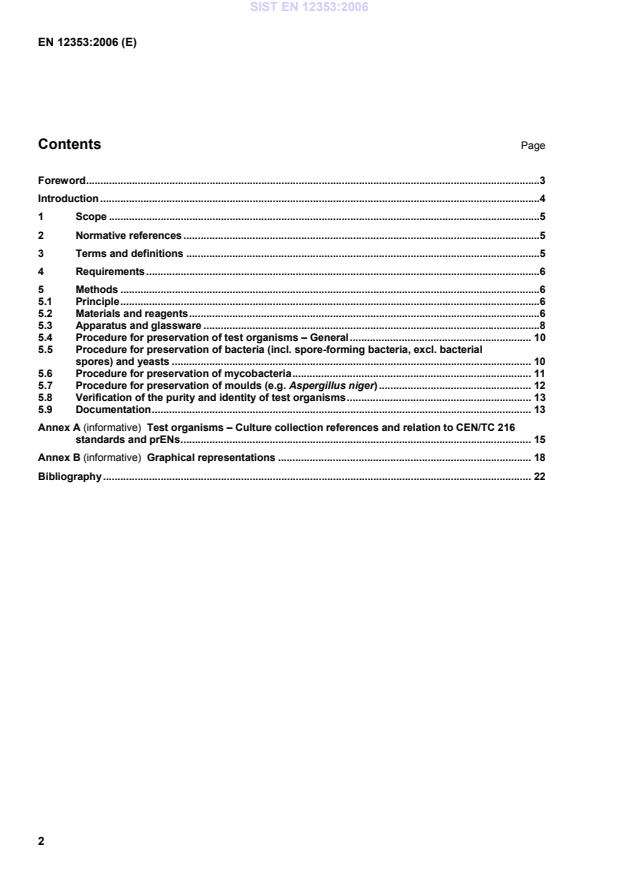
Test organisms – Culture collection references and relation to CEN/TC 216 standards and prENs.15 Annex B (informative)
Graphical representations.18 Bibliography.22
This European Standard aims at describing methods for preservation of test organisms used for such purposes. SIST EN 12353:2006
5.1 Principle A freeze dried sample of the test organism is obtained from a culture collection. This sample is cultured, prepared for storage, filled into storage vessels and placed in the deep freeze.
From the deep freeze samples a stock culture is prepared and subsequently used to prepare working cultures for the test procedure. In some cases the working cultures are directly prepared from the deep freeze samples. 5.2 Materials and reagents 5.2.1 Test organisms See Annex A for examples of test organisms.
The origin (culture collection), taxonomic name and reference number, date of receipt and batch number of the freeze dried test organisms shall be recorded (5.9.2). 5.2.2 Culture media and reagents 5.2.2.1 General All weights of chemical substances given in this European Standard refer to the anhydrous salts. Hydrated forms may be used as an alternative, but the weights required shall be adjusted to allow for consequent molecular weight differences. The reagents shall be of analytical grade and/or appropriate for microbiological purposes. They shall be free from substances that are toxic or inhibitory to the test organisms. SIST EN 12353:2006
NOTE 2 For each culture medium and reagent a limitation for use should be fixed. 5.2.2.2 Water The water shall be freshly glass distilled water and not demineralized water. Sterilize in the autoclave [5.3.2.1a)]. NOTE 1 Sterilization is not necessary if the water is used for e.g. preparation of culture media and subsequently sterilized. NOTE 2 If distilled water of adequate quality is not available, water for injections (see bibliographic reference [1]) can be used. 5.2.2.3 Tryptone Soya Broth (TSB) for bacteria Tryptone soya broth, consisting of: Tryptone, pancreatic digest of casein
17,0 g Soya peptone, papaic digest of Soybean meal
3,0 g Sodium chloride (NaCl)
5,0 g Water (5.2.2.2)
800,0 ml Dipotassium phosphate (K2HPO4)
2,5 g Glucose
2,5 g Water (5.2.2.2)
to 1 000,0 ml Sterilize in the autoclave [5.3.2.1a)]. After sterilization the pH of the medium shall be equivalent to 7,2 ± 0,2 when measured at 20 °C ± 1 °C. 5.2.2.4 Malt Extract Broth (MEB) for fungi Malt extract broth, consisting of: Malt extract
20,0 g Water (5.2.2.2)
to 1 000,0 ml Sterilize in the autoclave [5.3.2.1a)]. After sterilization the pH of the medium shall be equivalent to 6,9 ± 0,2 when measured at 20 °C ± 1 °C
5.2.2.5 Cryoprotectant solution for bacteria, spore-forming bacteria, fungi Cryoprotectant solution, consisting of: Beef extract
3,0 g Tryptone, pancreatic digest of casein
5,0 g SIST EN 12353:2006
150,0 g Water (5.2.2.2)
to 1 000,0 ml Dissolve the constituents in boiling water. Sterilize in the autoclave [5.3.2.1a)]. After sterilization the pH of the solution shall be equivalent to 6,9 ± 0,2 when measured at 20 °C ± 1 °C. NOTE 1 Any commercially available cryoprotectant containing glycerol for preservation of test organisms equivalent to the solution described above may be used. NOTE 2 If justified, any other equivalent cryoprotectant solution may be used. 5.2.2.6 Middlebrook 7 H 9 broth with 10 % ADC enrichment and glycerol as reconstituent and cryoprotectant solution for mycobacteria (MADC) Middlebrook 7 H 9 broth, consisting of: Middlebrook 7 H 9 broth powder
4,7 g Glycerol (C3H8O3) [2]
100,0 ml Water (5.2.2.2)
750,0 ml Treat in the autoclave [5.3.2.1a)] for a holding time of only 10 min and cool to 45 °C. Add under aseptic conditions 100 ml Middlebrook ADC enrichment and then sterilized water (5.2.2.2) to 1 000,0 ml. The pH of the medium shall be equivalent to 6,6 ± 0,2 when measured at 20 °C ± 1 °C.
5.2.2.7 Polysorbate 80 solution Polysorbate 80 solution, consisting of: Polysorbate 80
0,5 g Water (5.2.2.2)
to 1 000,0 ml Sterilize in the autoclave [5.3.2.1a)]. 5.3 Apparatus and glassware 5.3.1 General Sterilize all glassware and parts of the apparatus that will come into contact with the culture media and reagents or the sample, except those which are supplied sterile, by one of the following methods: a) by moist heat, in the autoclave [5.3.2.1a)]; b) by dry heat, in the hot air oven [5.3.2.1b)]. SIST EN 12353:2006
1213 0°+ for a minimum holding time of 15 min; b) for dry heat sterilization, a hot air oven capable of being maintained at ()C 1805 0°+ for a minimum holding time of 30 min, at ()C1705 0°+ for a minimum holding time of 1 h or at ()C1605 0°+for a minimum holding time of 2 h. 5.3.2.2 Water baths, capable of being controlled at 20 °C ± 1 °C and at 45 °C ± 1 °C if pour plate technique is used. 5.3.2.3 Incubator, capable of being controlled at either 36 °C ± 1 °C or at 37 °C ± 1 °C (for bacteria and mycobacteria) or at 30 °C ± 1 °C (for fungi). NOTE For mycobacteria a CO2 – incubator and a temperature of 36 ºC ± 1 ºC is better suited. If a CO2 – incubator is not used, the inoculated plates should be protected from drying by sealing with insulating tape or packing them into polyethylene bags. 5.3.2.4 pH-meter, having an inaccuracy of calibration of no more than ± 0,1 pH units at 20 °C ± 1 °C.
NOTE A puncture electrode or a flat membrane electrode should be used for measuring the pH of the agar media (5.4.2).
5.3.2.5 Fritted filter: porosity of 40 µm to 100 µm (ISO 4793). 5.3.2.6 Electromechanical agitator e.g. Vortex® mixer2). 5.3.2.7 Forceps or wire. 5.3.2.8 Refrigerator, capable of being controlled at 2 °C to 8 °C. 5.3.2.9 Graduated pipettes, of nominal capacities 10 ml and 1 ml and 0,1 ml. Calibrated automatic pipettes may be used. 5.3.2.10 Petri dishes (plates), of size 90 mm to 100 mm. 5.3.2.11 Glass or ceramic beads, (3 mm to 4 mm in diameter). 5.3.2.12 Volumetric flasks. 5.3.2.13 Equipment for deep freezing test organisms, at a temperature of –70 °C or less – including cryovials of nominal capacity of 0,5 ml (min) to 2,0 ml (max). 5.3.2.14 Centrifuge (2 000 gN).
1) Disposable equipment is an acceptable alternative to reusable glassware. 2) Vortex® is an example of a suitable product available commercially. This information is given for the convenience of users of this standard and does not constitute an endorsement by CEN of this product. SIST EN 12353:2006
5.4.1 Handling of freeze dried test organisms from culture collections Follow for reconstitution of the freeze dried samples of the test organisms the procedures described in section 5.5. If in special cases it is not possible or appropriate, follow the supplier's recommendations. 5.4.2 Choice of incubation procedure and agar medium Apply always the same incubation procedure (temperature, time and type of incubator) and use the same agar as prescribed for the preparation of the working cultures / test suspension (e.g. “N”) of test organisms in the corresponding European Standard. NOTE In most of the CEN/TC 216 standards you will find this informa
...