

EN 17176-2:2019+A1:2022
(Main + Amendment)Plastics piping systems for water supply and for buried and above ground drainage, sewerage and irrigation under pressure - Oriented unplasticized poly(vinyl chloride) (PVC-O) - Part 2: Pipes
- Abstract
This part of FprEN 17176 specifies the characteristics of solid-wall pipes made of oriented unplasticized poly(vinyl chloride) (PVC-O) for piping systems intended for water supply and for buried drainage, sewerage, treated waste water and irrigation under pressure or above-ground where protected from direct sunlight. It also specifies the test parameters for the test methods referred to in this document.
In conjunction with FprEN 17176-1 and FprEN 17176-5, it is applicable to oriented PVC-O pipes with or without integral socket intended to be used for the following:
a) water mains and services lines;
b) conveyance of water for both outside and inside buildings;
c) drainage, sewerage and treated waste water under pressure;
d) irrigation under pressure.
It is applicable to piping systems intended for the supply of water with a maximum allowable operating pressure (PFA) up to and including 25 bar . The piping system according to this document is intended for the conveyance of cold water up to and including 45 °C and especially in those applications where special performance requirements are needed, such as impact loads and pressure fluctuations.
For temperatures between 25 °C and 45 °C, Figure C.1 of this document applies.
This part of FprEN 17176 specifies a range of pipe sizes and pressure classes and gives a requirement and recommendations concerning colours.
NOTE It is the responsibility of the purchaser or specifier to make the appropriate selections from these aspects, taking into account their particular requirements and any relevant national regulations and installation practices or codes.
- Status
- Published
- Publication Date
- 11-Oct-2022
- Technical Committee
- CEN/TC 155 - Plastics piping systems and ducting systems
- Current Stage
- 9093 - Decision to confirm - Review Enquiry
- Start Date
- 08-May-2025
- Completion Date
- 07-Oct-2026

Overview
EN 17176-2:2019+A1:2022 is the CEN standard that specifies requirements for solid‑wall oriented unplasticized poly(vinyl chloride) (PVC‑O) pipes used in pressured water systems and buried or above‑ground drainage, sewerage, treated wastewater and irrigation (when protected from direct sunlight). This Part 2 document defines the pipe characteristics, geometrical and mechanical requirements, and the test parameters for the referenced test methods. It is part of the EN 17176 PVC‑O system series and includes Amendment A1 (2022).
Key topics and technical requirements
- Material and classification: Requirements for PVC‑O feedstock, density, MRS class and orientation factor (axial and circumferential). Amendment A1 corrects MRS classification and clarifies material classification procedures.
- Scope limits: Applicable for piping systems with a maximum allowable operating pressure (PFA) up to and including 25 bar and for conveyance of cold water up to and including 45 °C (with a derating rule for 25–45 °C referenced in Figure C.1).
- Geometrical characteristics: Nominal outside diameters, wall thicknesses, pipe lengths and tolerances, plain ends, and pipes with integral sockets (including socket dimensions and minimum engagement depths).
- Mechanical requirements: Tests and performance criteria for resistance to hydrostatic pressure, impact strength, and ring stiffness.
- Physical and jointing aspects: Sealing ring requirements, adhesives (for solvent‑cement joints), opacity/colour recommendations, and minimum marking information.
- Test methods and annexes: Includes normative annexes for material classification (Annex A), socket engagement depth (Annex B), temperature derating (Annex C), negative pressure capability (Annex D), and a test procedure for determining orientation factor (Annex E).
Practical applications and users
EN 17176-2 is intended for professionals involved in the design, manufacture, specification and installation of PVC‑O piping systems:
- Pipe manufacturers (product design, testing, marking)
- Engineers and specifiers (water mains, service lines, irrigation, pressurized drainage)
- Contractors and installers (selection of socket types, joints and installation practices)
- Asset owners and utilities (material selection for pressure resilience and impact resistance)
- Conformity assessors and regulators (verifying compliance with CEN requirements)
Note: The purchaser/specifier is responsible for selecting pipe size, pressure class, colour and other options in line with national regulations and installation practices.
Related standards
- EN 17176-1 (General requirements)
- EN 17176-3 (Fittings - Technical Specification)
- EN 17176-5 (Fitness for purpose of the system)
- EN ISO 1452 series (PVC‑U components referenced for non‑PVC‑O parts)
- Annexes within EN 17176‑2 provide test procedures and classification methods relevant to product certification and quality control.
Keywords: EN 17176-2, PVC‑O pipes, plastics piping systems, water supply, drainage, sewerage, irrigation, pressure classes, MRS class, orientation factor, hydrostatic resistance, ring stiffness.
Relations
- Effective Date
- 19-Jan-2023
- Effective Date
- 20-Jul-2022
- Effective Date
- 25-Aug-2026
- Effective Date
- 25-Aug-2026
- Refers
ISO 2531:2009 - Ductile iron pipes, fittings, accessories and their joints for water applications - Effective Date
- 25-Aug-2026
- Effective Date
- 25-Aug-2026
- Effective Date
- 25-Aug-2026
- Effective Date
- 09-Feb-2026
- Effective Date
- 09-Feb-2026
- Effective Date
- 09-Feb-2026
- Effective Date
- 09-Feb-2026
- Effective Date
- 28-Jan-2026
- Effective Date
- 28-Jan-2026
- Effective Date
- 28-Jan-2026
- Effective Date
- 28-Jan-2026
Get Certified
Connect with accredited certification bodies for this standard

Institut za varilstvo d.o.o. (Welding Institute)
Slovenia's leading welding institute since 1952. ISO 3834, EN 1090, pressure equipment certification, NDT personnel, welder qualification. Only IIW Au
Sponsored listings
Frequently Asked Questions
EN 17176-2:2019+A1:2022 is a standard published by the European Committee for Standardization (CEN). Its full title is "Plastics piping systems for water supply and for buried and above ground drainage, sewerage and irrigation under pressure - Oriented unplasticized poly(vinyl chloride) (PVC-O) - Part 2: Pipes". This standard covers: This part of FprEN 17176 specifies the characteristics of solid-wall pipes made of oriented unplasticized poly(vinyl chloride) (PVC-O) for piping systems intended for water supply and for buried drainage, sewerage, treated waste water and irrigation under pressure or above-ground where protected from direct sunlight. It also specifies the test parameters for the test methods referred to in this document. In conjunction with FprEN 17176-1 and FprEN 17176-5, it is applicable to oriented PVC-O pipes with or without integral socket intended to be used for the following: a) water mains and services lines; b) conveyance of water for both outside and inside buildings; c) drainage, sewerage and treated waste water under pressure; d) irrigation under pressure. It is applicable to piping systems intended for the supply of water with a maximum allowable operating pressure (PFA) up to and including 25 bar . The piping system according to this document is intended for the conveyance of cold water up to and including 45 °C and especially in those applications where special performance requirements are needed, such as impact loads and pressure fluctuations. For temperatures between 25 °C and 45 °C, Figure C.1 of this document applies. This part of FprEN 17176 specifies a range of pipe sizes and pressure classes and gives a requirement and recommendations concerning colours. NOTE It is the responsibility of the purchaser or specifier to make the appropriate selections from these aspects, taking into account their particular requirements and any relevant national regulations and installation practices or codes.
This part of FprEN 17176 specifies the characteristics of solid-wall pipes made of oriented unplasticized poly(vinyl chloride) (PVC-O) for piping systems intended for water supply and for buried drainage, sewerage, treated waste water and irrigation under pressure or above-ground where protected from direct sunlight. It also specifies the test parameters for the test methods referred to in this document. In conjunction with FprEN 17176-1 and FprEN 17176-5, it is applicable to oriented PVC-O pipes with or without integral socket intended to be used for the following: a) water mains and services lines; b) conveyance of water for both outside and inside buildings; c) drainage, sewerage and treated waste water under pressure; d) irrigation under pressure. It is applicable to piping systems intended for the supply of water with a maximum allowable operating pressure (PFA) up to and including 25 bar . The piping system according to this document is intended for the conveyance of cold water up to and including 45 °C and especially in those applications where special performance requirements are needed, such as impact loads and pressure fluctuations. For temperatures between 25 °C and 45 °C, Figure C.1 of this document applies. This part of FprEN 17176 specifies a range of pipe sizes and pressure classes and gives a requirement and recommendations concerning colours. NOTE It is the responsibility of the purchaser or specifier to make the appropriate selections from these aspects, taking into account their particular requirements and any relevant national regulations and installation practices or codes.
EN 17176-2:2019+A1:2022 is classified under the following ICS (International Classification for Standards) categories: 23.040.20 - Plastics pipes. The ICS classification helps identify the subject area and facilitates finding related standards.
EN 17176-2:2019+A1:2022 has the following relationships with other standards: It is inter standard links to EN 17176-2:2019/prA1, EN 17176-2:2019, ISO 2507-1:1995, ISO 6259-2:2020, ISO 2531:2009, ISO 3:1973, ISO 7387-1:1983, ISO 18373-1:2007, ISO 4065:2018, ISO 11922-1:2018, ISO 161-1:2018, EN ISO 1183-1:2025, EN ISO 3127:2017, EN ISO 9311-1:2005, EN ISO 3126:2005. Understanding these relationships helps ensure you are using the most current and applicable version of the standard.
EN 17176-2:2019+A1:2022 is available in PDF format for immediate download after purchase. The document can be added to your cart and obtained through the secure checkout process. Digital delivery ensures instant access to the complete standard document.
Standards Content (Sample)
SLOVENSKI STANDARD
01-december-2022
Cevni sistemi iz polimernih materialov za oskrbo z vodo in za podzemne in
nadzemne sisteme odvodnjavanja, kanalizacije ter namakanja pod tlakom -
Orientiran nemehčan polivinilklorid (PVC-O) - 2. del: Cevi (vključno z dopolnilom
A1)
Plastics piping systems for water supply and for buried and above ground drainage,
sewerage and irrigation under pressure - Oriented unplasticized poly(vinyl chloride)
(PVC-O) - Part 2: Pipes
Kunststoff-Rohrleitungssysteme für die Wasserversorgung und für erdverlegte und nicht
erdverlegte Entwässerungs-, Abwasser- und Bewässerungsdruckleitungen - Orientiertes
weichmacherfreies Polyvinylchlorid (PVC-O) - Teil 2: Rohre - Änderung 1
Systèmes de canalisations en plastique pour l'alimentation en eau, les branchements et
collecteurs d'assainissement et les systèmes d'irrigation sous pression, enterrés ou
aériens - Poly(chlorure de vinyle) non plastifié orienté (PVC-O) - Partie 2 : Tubes
Ta slovenski standard je istoveten z: EN 17176-2:2019+A1:2022
ICS:
23.040.20 Cevi iz polimernih materialov Plastics pipes
91.140.80 Drenažni sistemi Drainage systems
93.030 Zunanji sistemi za odpadno External sewage systems
vodo
2003-01.Slovenski inštitut za standardizacijo. Razmnoževanje celote ali delov tega standarda ni dovoljeno.
EN 17176-2:2019+A1
EUROPEAN STANDARD
NORME EUROPÉENNE
October 2022
EUROPÄISCHE NORM
ICS 23.040.20 Supersedes EN 17176-2:2019
English Version
Plastics piping systems for water supply and for buried
and above ground drainage, sewerage and irrigation under
pressure - Oriented unplasticized poly(vinyl chloride)
(PVC-O) - Part 2: Pipes
Systèmes de canalisations en plastique pour Kunststoff-Rohrleitungssysteme für die
l'alimentation en eau, les branchements et collecteurs Wasserversorgung und für erdverlegte und nicht
d'assainissement et les systèmes d'irrigation sous erdverlegte Entwässerungs-, Abwasser- und
pression, enterrés ou aériens - Poly(chlorure de vinyle) Bewässerungsdruckleitungen - Orientiertes
non plastifié orienté (PVC-O) - Partie 2 : Tubes weichmacherfreies Polyvinylchlorid (PVC-O) - Teil 2:
Rohre - Änderung 1
This European Standard was approved by CEN on 14 January 2019 and includes Amendment 1 approved by CEN on 8 August
2022.
CEN members are bound to comply with the CEN/CENELEC Internal Regulations which stipulate the conditions for giving this
European Standard the status of a national standard without any alteration. Up-to-date lists and bibliographical references
concerning such national standards may be obtained on application to the CEN-CENELEC Management Centre or to any CEN
member.
This European Standard exists in three official versions (English, French, German). A version in any other language made by
translation under the responsibility of a CEN member into its own language and notified to the CEN-CENELEC Management
Centre has the same status as the official versions.
CEN members are the national standards bodies of Austria, Belgium, Bulgaria, Croatia, Cyprus, Czech Republic, Denmark, Estonia,
Finland, France, Germany, Greece, Hungary, Iceland, Ireland, Italy, Latvia, Lithuania, Luxembourg, Malta, Netherlands, Norway,
Poland, Portugal, Republic of North Macedonia, Romania, Serbia, Slovakia, Slovenia, Spain, Sweden, Switzerland, Türkiye and
United Kingdom.
EUROPEAN COMMITTEE FOR STANDARDIZATION
COMITÉ EUROPÉEN DE NORMALISATION
EUROPÄISCHES KOMITEE FÜR NORMUNG
CEN-CENELEC Management Centre: Rue de la Science 23, B-1040 Brussels
© 2022 CEN All rights of exploitation in any form and by any means reserved Ref. No. EN 17176-2:2019+A1:2022 E
worldwide for CEN national Members.
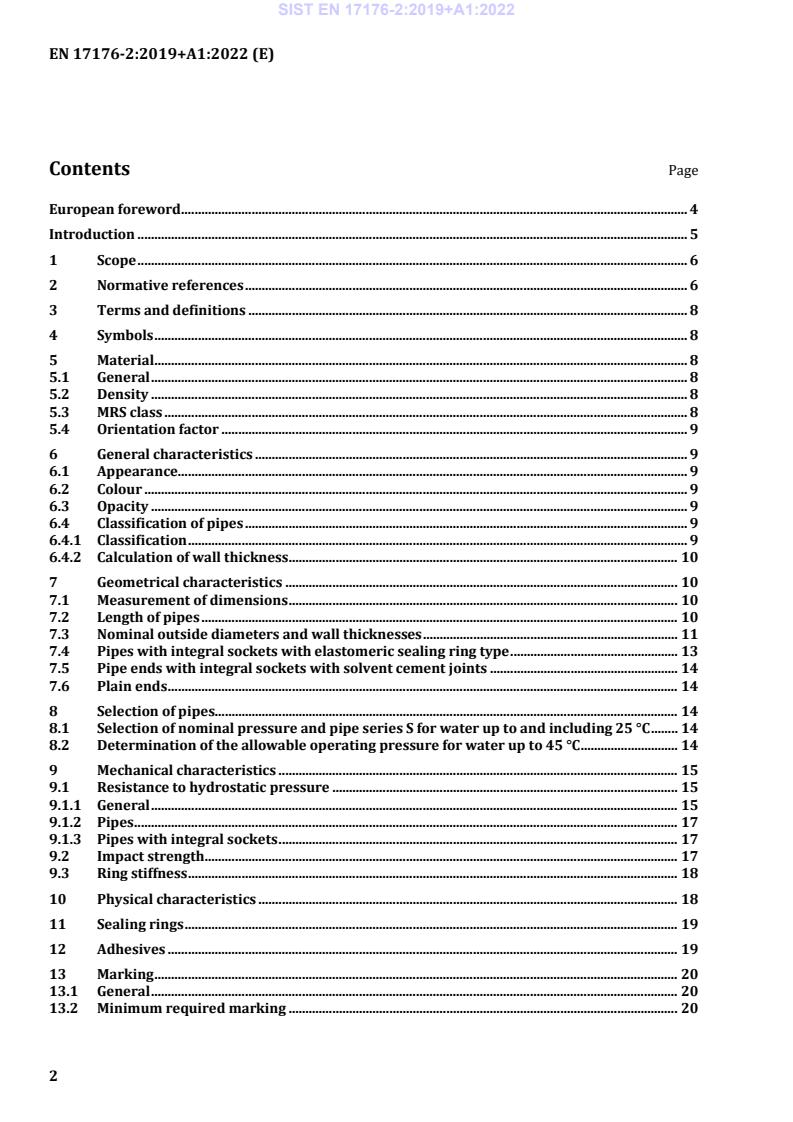
Contents Page
European foreword . 4
Introduction . 5
1 Scope . 6
2 Normative references . 6
3 Terms and definitions . 8
4 Symbols . 8
5 Material . 8
5.1 General . 8
5.2 Density . 8
5.3 MRS class . 8
5.4 Orientation factor . 9
6 General characteristics . 9
6.1 Appearance . 9
6.2 Colour . 9
6.3 Opacity . 9
6.4 Classification of pipes . 9
6.4.1 Classification . 9
6.4.2 Calculation of wall thickness . 10
7 Geometrical characteristics . 10
7.1 Measurement of dimensions . 10
7.2 Length of pipes . 10
7.3 Nominal outside diameters and wall thicknesses . 11
7.4 Pipes with integral sockets with elastomeric sealing ring type . 13
7.5 Pipe ends with integral sockets with solvent cement joints . 14
7.6 Plain ends . 14
8 Selection of pipes. 14
8.1 Selection of nominal pressure and pipe series S for water up to and including 25 °C . 14
8.2 Determination of the allowable operating pressure for water up to 45 °C . 14
9 Mechanical characteristics . 15
9.1 Resistance to hydrostatic pressure . 15
9.1.1 General . 15
9.1.2 Pipes . 17
9.1.3 Pipes with integral sockets . 17
9.2 Impact strength . 17
9.3 Ring stiffness . 18
10 Physical characteristics . 18
11 Sealing rings . 19
12 Adhesives . 19
13 Marking . 20
13.1 General . 20
13.2 Minimum required marking . 20
13.3 Additional marking . 20
Annex A (normative) Establishment of the pipe material classification . 21
A.1 General . 21
A.2 Determination of PVC-O pipe material classification . 21
A.2.1 Procedure . 21
A.2.2 Classified feedstock material . 22
A.2.3 Not classified feedstock material . 22
Annex B (normative) Minimum depth of engagement of sockets . 23
B.1 General . 23
B.2 Calculation of depth of engagement . 23
Annex C (normative) Temperature derating factor . 26
Annex D (informative) Calculation of negative pressure capability of pipes . 27
D.1 Negative pressure capability of pipes . 27
Annex E (normative) Determination of axial and circumferential orientation factor . 28
E.1 Principle . 28
E.2 Method . 28
E.3 Test parameters . 28
E.4 Test procedure . 28
E.5 Test report . 29
Bibliography . 30
European foreword
This document (EN 17176-2:2019+A1:2022) has been prepared by Technical Committee CEN/TC 155
“Plastics piping systems and ducting systems”, the secretariat of which is held by NEN.
This European Standard shall be given the status of a national standard, either by publication of an
identical text or by endorsement, at the latest by April 2023 and conflicting national standards shall be
withdrawn at the latest by April 2023.
Attention is drawn to the possibility that some of the elements of this document may be the subject of
patent rights. CEN shall not be held responsible for identifying any or all such patent rights.
This document includes Amendment 1 approved by CEN on 8 August 2022.
This document supersedes EN 17176-2:2019.
The start and finish of text introduced or altered by amendment is indicated in the text by tags !" .
The main amendments to EN 17176-2:2019 are as follows:
— Correct MRS classification;
— Amend text nominal length (7.2) and tolerance Table 2;
— Revision of Annex A, addition of alternative interpretation reference lines (A.2.2 and A.2.3);
— Including clause test method in Annex E;
— Mistakes corrected in Table E and Annex E.
EN 17176 consists of the following parts, under the general title Plastics piping systems for water supply
and for buried and above ground drainage, sewerage and irrigation under pressure — Oriented
unplasticized poly(vinyl chloride) (PVC-O):
— Part 1: General;
— Part 2: Pipes (this document);
— Part 3: Fittings (Technical Specification);
— Part 5: Fitness for purpose of the system;
— Part 7: Guidance for assessment of conformity (in preparation).
For valves, see EN ISO 1452-4 [3].
Guidance for installation is given in ISO/TR 4191 [4].
Any feedback and questions on this document should be directed to the users’ national standards body.
A complete listing of these bodies can be found on the CEN website.
According to the CEN-CENELEC Internal Regulations, the national standards organizations of the
following countries are bound to implement this European Standard: Austria, Belgium, Bulgaria, Croatia,
Cyprus, Czech Republic, Denmark, Estonia, Finland, Former Yugoslav Republic of Macedonia, France,
Germany, Greece, Hungary, Iceland, Ireland, Italy, Latvia, Lithuania, Luxembourg, Malta, Netherlands,
Norway, Poland, Portugal, Romania, Serbia, Slovakia, Slovenia, Spain, Sweden, Switzerland, Türkiye and
the United Kingdom.
Introduction
The System Standard, of which this is Part 2, specifies the requirements for a piping system made from
oriented unplasticized poly(vinyl chloride) (PVC-O) pipes and its components. The piping system is
intended to be used for water supply, pressurized drainage, sewerage, treated waste water and irrigation
systems to be used underground or above ground where protected from direct sunlight.
In respect of potential adverse effects on the quality of water intended for human consumption, caused
by the products covered by this part of EN 17176, the following is relevant:
a) This part of EN 17176 provides no information as to whether or not the products can be used without
restriction.
b) Existing national regulations concerning the use and/or the characteristics of these products remain
in force.
Requirements and test methods for PVC-O components are specified in EN 17176-1 and
CEN/TS 17176-3. For other components (not manufactured from PVC-O) reference is made to the
following standards: EN ISO 1452-3 (PVC-U) [2] and EN 12842 (Cast Iron) [1]. Characteristics for fitness
for purpose (mainly for joints) are established in EN 17176-5.
This part of EN 17176 specifies the characteristics of PVC-O pipes.
1 Scope
This part of EN 17176 specifies the characteristics of solid-wall pipes made of oriented unplasticized
poly(vinyl chloride) (PVC-O) for piping systems intended for water supply and for buried drainage,
sewerage, treated waste water and irrigation under pressure or above-ground where protected from
direct sunlight. It also specifies the test parameters for the test methods referred to in this document.
In conjunction with EN 17176-1 and EN 17176-5, it is applicable to oriented PVC-O pipes with or without
integral socket intended to be used for the following:
a) water mains and services lines;
b) conveyance of water for both outside and inside buildings;
c) drainage, sewerage and treated waste water under pressure;
d) irrigation under pressure.
It is applicable to piping systems intended for the supply of water with a maximum allowable operating
1)
pressure (PFA) up to and including 25 bar . The piping system according to this document is intended
for the conveyance of cold water up to and including 45 °C and especially in those applications where
special performance requirements are needed, such as impact loads and pressure fluctuations.
For temperatures between 25 °C and 45 °C, Figure C.1 of this document applies.
This part of EN 17176 specifies a range of pipe sizes and pressure classes and gives a requirement and
recommendations concerning colours.
NOTE It is the responsibility of the purchaser or specifier to make the appropriate selections from these
aspects, taking into account their particular requirements and any relevant national regulations and installation
practices or codes.
2 Normative references
The following documents are referred to in the text in such a way that some or all of their content
constitutes requirements of this document. For dated references, only the edition cited applies. For
undated references, the latest edition of the referenced document (including any amendments) applies.
EN 681-1, Elastomeric seals — Materials requirements for pipe joint seals used in water and drainage
applications — Part 1: Vulcanized rubber
EN 14814, Adhesives for thermoplastic piping systems for fluids under pressure - Specifications
EN 17176-1:2019, Plastics piping systems for water supply and for buried and above ground drainage,
sewerage and irrigation under pressure — Oriented unplasticized poly(vinyl chloride) (PVC-O) — Part 1:
General
EN 17176-5, Plastic piping systems for water supply and for buried and above ground drainage, sewerage
and irrigation under pressure — Oriented unplasticized poly(vinyl chloride) (PVC-O) — Part 5: Fitness for
purpose of the system
5 2
1) 1 bar = 0,1 MPa = 10 Pa; 1 MPa = 1 N/mm .
EN ISO 1167-1, Thermoplastics pipes, fittings and assemblies for the conveyance of fluids — Determination
of the resistance to internal pressure — Part 1: General method (ISO 1167-1)
EN ISO 1167-2, Thermoplastics pipes, fittings and assemblies for the conveyance of fluids — Determination
of the resistance to internal pressure — Part 2: Preparation of pipe test pieces (ISO 1167-2)
EN ISO 1183-1, Plastics — Methods for determining the density of non-cellular plastics — Part 1: Immersion
method, liquid pyknometer method and titration method (ISO 1183-1)
EN ISO 1452-2:2009, Plastics piping systems for water supply and for buried and above-ground drainage
and sewerage under pressure — Unplasticized poly(vinyl chloride) (PVC-U) — Part 2: Pipes (ISO 1452-
2:2009)
EN ISO 2505, Thermoplastics pipes — Longitudinal reversion — Test method and parameters (ISO 2505)
EN ISO 3126, Plastics piping systems — Plastics components — Determination of dimensions (ISO 3126)
EN ISO 3127, Thermoplastics pipes — Determination of resistance to external blows — Round-the-clock
method (ISO 3127)
EN ISO 6259-1, Thermoplastics pipes — Determination of tensile properties — Part 1: General test method
(ISO 6259-1
EN ISO 7686, Plastics pipes and fittings — Determination of opacity (ISO 7686)
EN ISO 9080, Plastics piping and ducting systems — Determination of the long-term hydrostatic strength of
thermoplastics materials in pipe form by extrapolation (ISO 9080)
EN ISO 9311-1, Adhesives for thermoplastic piping systems — Part 1: Determination of film properties (ISO
9311-1)
EN ISO 9852, Unplasticized poly(vinyl chloride) (PVC-U) pipes — Dichloromethane resistance at specified
temperature (DCMT) — Test method (ISO 9852)
EN ISO 9969, Thermoplastics pipes — Determination of ring stiffness (ISO 9969)
EN ISO 12162, Thermoplastics materials for pipes and fittings for pressure applications — Classification,
designation and design coefficient (ISO 12162)
ISO 3, Preferred numbers — Series of preferred numbers
ISO 161-1, Thermoplastics pipes for the conveyance of fluids — Nominal outside diameters and nominal
pressures — Part 1: Metric series
ISO 2531, Ductile iron pipes, fittings, accessories and their joints for water applications
ISO 2507-1, Thermoplastics pipes and fittings — Vicat softening temperature — Part 1: General test
method
ISO 4065, Thermoplastics pipes — Universal wall thickness table
ISO 6259-2, Thermoplastics pipes — Determination of tensile properties — Part 2: Pipes made of
unplasticized poly(vinyl chloride) (PVC-U), chlorinated poly (vinyl chloride) (PVC-C) and high-impact poly
(vinyl chloride) (PVC-HI)
ISO 7387-1, Adhesives with solvents for assembly of PVC-U pipe elements — Characterization — Part 1:
Basic test methods
ISO 11922-1:2018, Thermoplastics pipes for the conveyance of fluids — Dimensions and tolerances —
Part 1: Metric series
ISO 18373-1, Rigid PVC pipes — Differential scanning calorimetry (DSC) method — Part 1: Measurement
of the processing temperature
3 Terms and definitions
For the purposes of this document, the terms and definitions given in EN 17176-1 apply.
ISO and IEC maintain terminological databases for use in standardization at the following addresses:
— IEC Electropedia: available at https://www.electropedia.org/
— ISO Online browsing platform: available at https://www.iso.org/obp
4 Symbols
For the purposes of this document, the following symbols apply.
l is the length of socket (mm)
s
m is the depth of engagement (mm)
S is the calculated preferred value of the nominal S series number of the pipe from 6.4.2
o
β minimum angle chamfer
5 Material
5.1 General
The material from which the pipes are made shall conform to EN 17176-1 and to the requirements given
in 5.2 and 5.4.
5.2 Density
The density, ρ, at 23 °C of the pipe, when measured in accordance with EN ISO 1183-1, shall be within the
following limits:
3 3
1 350 kg/m < ρ < 1 460 kg/m
5.3 MRS class
Oriented pipes made from a defined PVC compound/formulation and with a well-defined orientation
level in circumferential and axial direction, shall be evaluated according to the procedures of Annex A.
The MRS value shall be classified in accordance with EN 17176-1.
The MRS class shall be declared by the manufacturer.
5.4 Orientation factor
The level of orientation, is an indirect parameter for the material classification of the pipes and is
depending of the production process.
The orientation factor, circumferential and axial shall be declared by the manufacturer and comply with
the minimum values as defined in Table 1.
The orientation factors shall be measured according to Annex E and specified by the manufacturer to be
within – 5 % and + 15 % deviation from the declared values.
!
Table1 — Minimum declared orientation factor
Minimum required
31,5 35,5 40,0 45,0 50,0
strength (MRS)-MPa
Axial 1,0
Circumferential 1,5 1,6 1,7 1,8 1,9
"
6 General characteristics
6.1 Appearance
When viewed without magnification the internal and external surfaces of pipes shall be smooth, clean
and free from scoring, cavities and other surface defects to an extent that would prevent conformity to
this part of EN 17176. The material shall not contain any impurities visible without magnification. The
ends of the pipe shall be cut cleanly and square to the axis of the pipe.
6.2 Colour
The colour of the pipes shall be uniform throughout the wall.
The preferred colour of pipes shall be as follows:
a) for water supply cream, blue, white or white with blue striping;
b) for irrigation under pressure blue or white;
c) for pressurized drainage and sewerage grey, brown or white with brown stripes;
d) for treated waste water purple.
NOTE Attention is drawn to the fact that the colouring of pipes for the supply of water for human consumption
can be part of national regulation.
6.3 Opacity
If a pipe is required to be opaque for use in above ground applications the wall of the pipe shall transmit
not more than 0,2 % of visible light falling on it when tested in accordance with EN ISO 7686.
6.4 Classification of pipes
6.4.1 Classification
Pipes shall be classified to their nominal pressure PN.
The nominal pressure PN, the pipe series S and the design stress, σ , are connected by the following
s
relationship:
10σ
s
PN≅ (1)
S
SDR− 1
S= (2)
d
n
SDR= (3)
e
n
MRS
(4)
σ =
s
C
6.4.2 Calculation of wall thickness
The relationship between the nominal wall thickness e and the nominal outside diameter d is specified
n n
in ISO 4065. The values for nominal pipe wall thickness e for nominal pressure ratings PN, can be
n
calculated by substituting the values for MRS, C, and d in the formula:
n
d
n
e = (5)
n
21S +
o
Values shall be rounded to one decimal place according to the rules of ISO 4065.
Nominal S numbers and their calculated values are given in ISO 4065 for the R10 series of preferred
numbers. For the R20 series required for this European Standard, refer to ISO 3.
The nominal outside diameter and nominal wall thickness for the relevant nominal pressure and material
classes are specified in Table 3.
7 Geometrical characteristics
7.1 Measurement of dimensions
Dimensions shall be measured in accordance with EN ISO 3126.
7.2 Length of pipes
!The
...