

EN 13126-2:2011
(Main)Building hardware - Requirements and test methods for windows and doors height windows - Part 2: Window fastener handles
- Abstract
This European Standard specifies requirements and test methods for durability, strength, security and functionality of window fastener handles.
This European Standard does not apply to the following hardware:
a) handles - primarily for Tilt & Turn, Tilt-First and Turn-Only hardware, refer to EN 13126-3;
b) electromechanical hardware.
- Status
- Withdrawn
- Publication Date
- 11-Oct-2011
- Withdrawal Date
- 06-Oct-2026
- Technical Committee
- CEN/TC 33 - Doors, windows, shutters and building hardware
- Drafting Committee
- CEN/TC 33/WG 4 - Building hardware
- Current Stage
- 9960 - Withdrawal effective - Withdrawal
- Start Date
- 31-Mar-2021
- Completion Date
- 07-Oct-2026

Relations
- Effective Date
- 15-Oct-2011
- Effective Date
- 07-Apr-2021
- Effective Date
- 28-Jan-2026
- Effective Date
- 28-Jan-2026
- Effective Date
- 28-Jan-2026
- Effective Date
- 28-Jan-2026
- Effective Date
- 28-Jan-2026
Get Certified
Connect with accredited certification bodies for this standard

DIBt (Deutsches Institut für Bautechnik)
German Institute for Building Technology.
DIN CERTCO
DIN Group product certification.

Aboma Certification B.V.
Specialized in construction, metal, and transport sectors.
Sponsored listings
Frequently Asked Questions
EN 13126-2:2011 is a standard published by the European Committee for Standardization (CEN). Its full title is "Building hardware - Requirements and test methods for windows and doors height windows - Part 2: Window fastener handles". This standard covers: This European Standard specifies requirements and test methods for durability, strength, security and functionality of window fastener handles. This European Standard does not apply to the following hardware: a) handles - primarily for Tilt & Turn, Tilt-First and Turn-Only hardware, refer to EN 13126-3; b) electromechanical hardware.
This European Standard specifies requirements and test methods for durability, strength, security and functionality of window fastener handles. This European Standard does not apply to the following hardware: a) handles - primarily for Tilt & Turn, Tilt-First and Turn-Only hardware, refer to EN 13126-3; b) electromechanical hardware.
EN 13126-2:2011 is classified under the following ICS (International Classification for Standards) categories: 91.190 - Building accessories. The ICS classification helps identify the subject area and facilitates finding related standards.
EN 13126-2:2011 has the following relationships with other standards: It is inter standard links to CEN/TS 13126-2:2004, EN 13126-2:2021, EN 1670:2007, EN 12519:2004, EN 13126-1:2006, EN ISO 11252:2013, EN ISO 11252:2008. Understanding these relationships helps ensure you are using the most current and applicable version of the standard.
EN 13126-2:2011 is available in PDF format for immediate download after purchase. The document can be added to your cart and obtained through the secure checkout process. Digital delivery ensures instant access to the complete standard document.
Standards Content (Sample)
2003-01.Slovenski inštitut za standardizacijo. Razmnoževanje celote ali delov tega standarda ni dovoljeno.Stavbno okovje - Zahteve in preskusne metode za okna in zastekljena vrata - 2. del: Okenska zapiralaBaubeschläge - Beschläge für Fenster und Fenstertüren - Anforderungen und Prüfverfahren - Teil 2: FenstergriffeQuincaillerie pour le bâtiment - Exigences et méthodes d'essai des ferrures de fenêtres et portes-fenêtres - Partie 2: Poignées à ergot de verrouillageBuilding hardware - Requirements and test methods for windows and doors height windows - Part 2: Window fastener handles91.190Stavbna opremaBuilding accessoriesICS:Ta slovenski standard je istoveten z:EN 13126-2:2011SIST EN 13126-2:2011en,fr,de01-december-2011SIST EN 13126-2:2011SLOVENSKI
STANDARDSIST-TS CEN/TS 13126-2:20051DGRPHãþD
EUROPEAN STANDARD NORME EUROPÉENNE EUROPÄISCHE NORM
EN 13126-2
October 2011 ICS 91.190 Supersedes CEN/TS 13126-2:2004English Version
Building hardware - Requirements and test methods for windows and doors height windows - Part 2: Window fastener handles
Quincaillerie pour le bâtiment - Exigences et méthodes d'essai des ferrures de fenêtres et portes-fenêtres - Partie 2: Poignées à ergot de verrouillage
Baubeschläge - Beschläge für Fenster und Fenstertüren - Anforderungen und Prüfverfahren - Teil 2: Einreibverschlüsse This European Standard was approved by CEN on 26 August 2011.
CEN members are bound to comply with the CEN/CENELEC Internal Regulations which stipulate the conditions for giving this European Standard the status of a national standard without any alteration. Up-to-date lists and bibliographical references concerning such national standards may be obtained on application to the CEN-CENELEC Management Centre or to any CEN member.
This European Standard exists in three official versions (English, French, German). A version in any other language made by translation under the responsibility of a CEN member into its own language and notified to the CEN-CENELEC Management Centre has the same status as the official versions.
CEN members are the national standards bodies of Austria, Belgium, Bulgaria, Croatia, Cyprus, Czech Republic, Denmark, Estonia, Finland, France, Germany, Greece, Hungary, Iceland, Ireland, Italy, Latvia, Lithuania, Luxembourg, Malta, Netherlands, Norway, Poland, Portugal, Romania, Slovakia, Slovenia, Spain, Sweden, Switzerland and United Kingdom.
EUROPEAN COMMITTEE FOR STANDARDIZATION
COMITÉ EUROPÉEN DE NORMALISATION EUROPÄISCHES KOMITEE FÜR NORMUNG
Management Centre:
Avenue Marnix 17,
B-1000 Brussels © 2011 CEN All rights of exploitation in any form and by any means reserved worldwide for CEN national Members. Ref. No. EN 13126-2:2011: ESIST EN 13126-2:2011
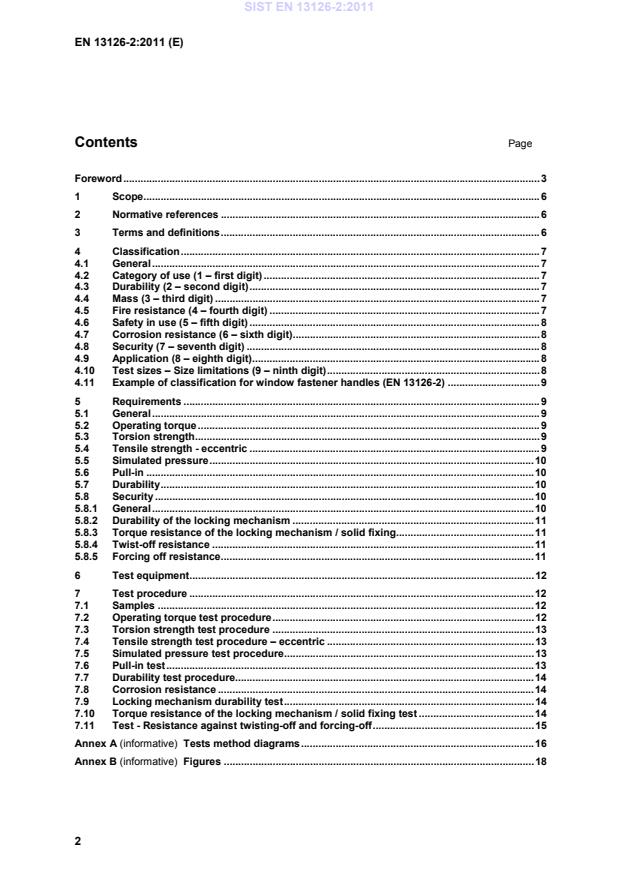
Tests method diagrams . 16Annex B (informative)
Figures . 18 SIST EN 13126-2:2011
three grades and three extensions
for the security - the addition of security requirements and the corresponding tests - the modification of the number of test samples (8 instead of 3) - the increase to 550 cycles/h rate for the durability test. 4.8 Security (7 – seventh digit) Three grades have been added into this draft to give similarity with prEN13126-3, three extensions have also been added for the locking style of the handle. Grade 0: Without security Grade 1: 35 Nm resistance against twisting-off and forcing-off Grade 2: 100 Nm resistance against twisting-off and forcing-off Extension 0: No locking mechanism Extension 1: Non-key operated locking mechanism (e.g. ‘PTO’: Push-to-open) Extension 2: Key-operated locking mechanism
Durability Test Procedure, the rate that the cycle test is carried out has been increased to 550 cycles/h in line with prEN13126-3 7.9
Locking Mechanism durability test – new requirement 7.10 Torque resistance of the locking mechanism / solid fixing test – new requirement 7.11 Test – Resistance against twisting-off and forcing-off – new requirement In general there has been a reduction in the tolerance band within the draft over the last published standard. A full contribution to the preparation of this European Standard has been made by the European manufacturers´ organization ‘ARGE’ and national standards bodies. EN 13126 Building hardware — Requirements and test methods for windows and doors height windows consists of the following parts: Part 1: Requirements common to all types of hardware SIST EN 13126-2:2011
1) Under revision currently on Technical specification. SIST EN 13126-2:2011
EN 12519:2004 and the following apply. 3.1 window fastener handle operating device, where applicable with releasable and / or locking mechanism, to hold the window in a closed position NOTE
Also known as Cockspur handles. 3.2 spur device projecting from the handle that interacts with the compression wedge / keeper to close the window to give the desired pull-in 3.3 pull-in distance the sash is moved towards the frame during operation of a window fastener handle from the initial contact of the handle spur to the fully closed position 3.4 non-key operated locking mechanism device within the handle assembly that when engaged prevents movement of the handle from the locked position EXAMPLE ‘push-to-open’, button, thumb turn SIST EN 13126-2:2011
...