


EN 17334:2021
(Main)Glued-in rods in glued structural timber products - Testing, requirements and bond shear strength classification
General Information
- Abstract
This document specifies test methods for the determination of the suitability of two component epoxy and two component polyurethane adhesives for glued-in steel rods in glued laminated timber (GLT) and glued solid timber (GST) according to EN 14080, cross laminated timber (CLT) according to EN 16351 and laminated veneer lumber (LVL) according to EN 14374.
NOTE 1 The English term "glued-in rods" has been chosen as the established term instead of "bonded-in rods".
It specifies performance requirements and the determination of characteristic bond strength values for such adhesives for the prefabrication under factory or factory-like conditions of joints between load-bearing timber products and steel rods only. This document does not cover the performance of adhesives for on-site gluing (except for factory-like conditions).
NOTE 2 Factory like conditions provide shelter from direct weathering and dirt, prevent undue movement of the joints during curing of the adhesive and provide temperature and relative humidity conditions and control as in factory production environment.
This document also covers glued-in rods in surface treated wood. It does not cover glued-in rods in modified and stabilized wood with considerably reduced swelling and shrinkage properties, e.g. acetylated wood, heat treated wood, polymer impregnated wood and preservative treated wood.
The joints are intended for load-bearing timber structures in service classes 1 and 2 according to EN 1995-1-1 which are loaded predominantly static or quasi static according to EN 1990 and EN 1991-1-1. The joints are intended for load-bearing timber structures which are not subjected to a prolonged exposure to temperatures over 60 °C.
A design procedure for glued-in rods in glued structural timber products is given in the informative Annex A.
NOTE 3 Several provisions of this document can apply to in situ repair and upgrading of existing timber structures including (cracked/fissured) solid wood beams. For adhesives for glued-in rods used in on-site repair or applications with solid timber additional provisions apply, e.g. related to rheology and site temperature conditions. Such provisions are not part of this document.
- Status
- Published
- Publication Date
- 23-Mar-2021
- Withdrawal Date
- 29-Sep-2021
- Technical Committee
- CEN/TC 193 - Adhesives
- Drafting Committee
- CEN/TC 193/SC 1/WG 6 - Tests for adhesives for glued in rods
- Current Stage
- 9060 - Closure of 2 Year Review Enquiry - Review Enquiry
- Start Date
- 02-Sep-2026
- Completion Date
- 02-Sep-2026



Overview
EN 17334:2021 - "Glued‑in rods in glued structural timber products" (CEN) specifies test methods, performance requirements and bond shear strength classification for two‑component epoxy and polyurethane adhesives used to glue steel rods into prefabricated timber products. The standard applies to glued laminated timber (GLT/GST), cross‑laminated timber (CLT) and laminated veneer lumber (LVL) produced under factory or factory‑like conditions. It covers glued‑in rods in surface‑treated wood but excludes modified/stabilized wood (e.g., acetylated, heat treated, polymer‑impregnated or preservative treated). Joints are intended for load‑bearing structures in service classes 1 and 2 and for temperatures below 60 °C.
Key topics and technical requirements
EN 17334:2021 focuses on practical test methods and classification rather than on-site procedures. Main technical topics include:
- Adhesive scope: two‑component epoxy and polyurethane systems suitable for glued‑in rods.
- Bond strength testing: determination of characteristic bond shear strength (including longitudinal tensile shear tests).
- Durability tests: resistance to delamination, effects of wood shrinkage, compression shear and climatic changes.
- Specimen and test procedure requirements: detailed specimen build‑up, timber material and steel rod specifications, manufacturing of the bond and test schemes.
- Temperature and moisture resistance: bond temperature resistance tests and creep rupture tests at very high/low moisture content.
- Working properties: working life, open assembly time, curing time and determination of time to fully cured state under reference conditions.
- Results & reporting: expression of results, determination of declared characteristic bond shear strength values and mandatory test report contents.
- Informative design guidance: Annex A provides a design procedure for glued‑in rods in GLT, GST, LVL and CLT.
Applications and who uses EN 17334:2021
This standard is essential for stakeholders involved in prefabricated timber connections and adhesive qualification:
- Adhesive manufacturers validating two‑component epoxy and polyurethane formulas for glued‑in rod applications.
- Timber product manufacturers (GLT, CLT, LVL, GST) seeking certified adhesive systems for factory production.
- Testing laboratories and certification bodies performing bond shear strength, temperature and durability tests.
- Structural engineers and designers using declared characteristic bond strengths and the Annex A design procedure for specifying glued‑in rod joints.
- Contractors and restoration specialists for guidance on prefabricated glued‑in repairs (note: on‑site repairs may require additional provisions beyond EN 17334).
Related standards
Relevant cross‑references for specifications and test methods:
- EN 14080 (GLT/GST), EN 16351 (CLT), EN 14374 (LVL)
- EN 302 series (adhesive test methods)
- EN 1995‑1‑1 (timber design / service classes)
- EN 923 (adhesive terminology), EN 13183‑1 (moisture content)
- EN ISO 898‑1, EN ISO 3506‑1 (fastener/rod properties)
Keywords: EN 17334:2021, glued‑in rods, glued structural timber products, bond shear strength, epoxy adhesives, polyurethane adhesives, GLT, CLT, LVL, testing requirements, factory conditions.
Relations
- Effective Date
- 18-Mar-2026
- Effective Date
- 28-Jan-2026
- Effective Date
- 28-Jan-2026
- Refers
EN 10080:2005 - Steel for the reinforcement of concrete - Weldable reinforcing steel - General - Effective Date
- 28-Jan-2026
- Effective Date
- 28-Jan-2026
- Effective Date
- 28-Jan-2026
- Effective Date
- 28-Jan-2026
- Effective Date
- 28-Jan-2026
- Effective Date
- 28-Jan-2026
- Effective Date
- 28-Jan-2026
- Effective Date
- 28-Jan-2026
- Effective Date
- 28-Jan-2026
- Refers
EN 14080:2013 - Timber structures - Glued laminated timber and glued solid timber - Requirements - Effective Date
- 28-Jan-2026
- Effective Date
- 28-Jan-2026
- Effective Date
- 28-Jan-2026
Get Certified
Connect with accredited certification bodies for this standard

Smithers Quality Assessments
US management systems and product certification.

DIN CERTCO
DIN Group product certification.
Sponsored listings
Frequently Asked Questions
EN 17334:2021 is a standard published by the European Committee for Standardization (CEN). Its full title is "Glued-in rods in glued structural timber products - Testing, requirements and bond shear strength classification". This standard covers: This document specifies test methods for the determination of the suitability of two component epoxy and two component polyurethane adhesives for glued-in steel rods in glued laminated timber (GLT) and glued solid timber (GST) according to EN 14080, cross laminated timber (CLT) according to EN 16351 and laminated veneer lumber (LVL) according to EN 14374. NOTE 1 The English term "glued-in rods" has been chosen as the established term instead of "bonded-in rods". It specifies performance requirements and the determination of characteristic bond strength values for such adhesives for the prefabrication under factory or factory-like conditions of joints between load-bearing timber products and steel rods only. This document does not cover the performance of adhesives for on-site gluing (except for factory-like conditions). NOTE 2 Factory like conditions provide shelter from direct weathering and dirt, prevent undue movement of the joints during curing of the adhesive and provide temperature and relative humidity conditions and control as in factory production environment. This document also covers glued-in rods in surface treated wood. It does not cover glued-in rods in modified and stabilized wood with considerably reduced swelling and shrinkage properties, e.g. acetylated wood, heat treated wood, polymer impregnated wood and preservative treated wood. The joints are intended for load-bearing timber structures in service classes 1 and 2 according to EN 1995-1-1 which are loaded predominantly static or quasi static according to EN 1990 and EN 1991-1-1. The joints are intended for load-bearing timber structures which are not subjected to a prolonged exposure to temperatures over 60 °C. A design procedure for glued-in rods in glued structural timber products is given in the informative Annex A. NOTE 3 Several provisions of this document can apply to in situ repair and upgrading of existing timber structures including (cracked/fissured) solid wood beams. For adhesives for glued-in rods used in on-site repair or applications with solid timber additional provisions apply, e.g. related to rheology and site temperature conditions. Such provisions are not part of this document.
This document specifies test methods for the determination of the suitability of two component epoxy and two component polyurethane adhesives for glued-in steel rods in glued laminated timber (GLT) and glued solid timber (GST) according to EN 14080, cross laminated timber (CLT) according to EN 16351 and laminated veneer lumber (LVL) according to EN 14374. NOTE 1 The English term "glued-in rods" has been chosen as the established term instead of "bonded-in rods". It specifies performance requirements and the determination of characteristic bond strength values for such adhesives for the prefabrication under factory or factory-like conditions of joints between load-bearing timber products and steel rods only. This document does not cover the performance of adhesives for on-site gluing (except for factory-like conditions). NOTE 2 Factory like conditions provide shelter from direct weathering and dirt, prevent undue movement of the joints during curing of the adhesive and provide temperature and relative humidity conditions and control as in factory production environment. This document also covers glued-in rods in surface treated wood. It does not cover glued-in rods in modified and stabilized wood with considerably reduced swelling and shrinkage properties, e.g. acetylated wood, heat treated wood, polymer impregnated wood and preservative treated wood. The joints are intended for load-bearing timber structures in service classes 1 and 2 according to EN 1995-1-1 which are loaded predominantly static or quasi static according to EN 1990 and EN 1991-1-1. The joints are intended for load-bearing timber structures which are not subjected to a prolonged exposure to temperatures over 60 °C. A design procedure for glued-in rods in glued structural timber products is given in the informative Annex A. NOTE 3 Several provisions of this document can apply to in situ repair and upgrading of existing timber structures including (cracked/fissured) solid wood beams. For adhesives for glued-in rods used in on-site repair or applications with solid timber additional provisions apply, e.g. related to rheology and site temperature conditions. Such provisions are not part of this document.
EN 17334:2021 is classified under the following ICS (International Classification for Standards) categories: 83.180 - Adhesives. The ICS classification helps identify the subject area and facilitates finding related standards.
EN 17334:2021 has the following relationships with other standards: It is inter standard links to EN 302-8:2023+A1:2026, EN 302-7:2023, EN 16351:2021, EN 10080:2005, EN 302-1:2023, EN 13183-1:2002, EN 14374:2004, EN ISO 3506-1:2020, EN 923:2015, EN 302-2:2023, EN ISO 898-1:2013, EN 302-5:2023, EN 14080:2013, EN 14358:2016, EN 302-6:2023. Understanding these relationships helps ensure you are using the most current and applicable version of the standard.
EN 17334:2021 is associated with the following European legislation: EU Directives/Regulations: 305/2011; Standardization Mandates: M/112, M/127. When a standard is cited in the Official Journal of the European Union, products manufactured in conformity with it benefit from a presumption of conformity with the essential requirements of the corresponding EU directive or regulation.
EN 17334:2021 is available in PDF format for immediate download after purchase. The document can be added to your cart and obtained through the secure checkout process. Digital delivery ensures instant access to the complete standard document.
Standards Content (Sample)
SLOVENSKI STANDARD
01-maj-2021
Vlepljene palice v lepljenih lesenih gradbenih proizvodih - Preskušanje, zahteve in
klasifikacija strižne trdnosti spojev
Glued-in rods in glued structural timber products - Testing, requirements and bond shear
strength classification
Eingeklebte Stangen in tragenden geklebten Holzprodukten - Prüfung, Anforderungen
und Scherfestigkeitsklassifizierung
Goujons collés dans les produits en bois de structure collé - Essais, exigences et
classification de la résistance au cisaillement du joint
Ta slovenski standard je istoveten z: EN 17334:2021
ICS:
83.180 Lepila Adhesives
91.080.20 Lesene konstrukcije Timber structures
2003-01.Slovenski inštitut za standardizacijo. Razmnoževanje celote ali delov tega standarda ni dovoljeno.
EN 17334
EUROPEAN STANDARD
NORME EUROPÉENNE
March 2021
EUROPÄISCHE NORM
ICS 83.180
English Version
Glued-in rods in glued structural timber products -
Testing, requirements and bond shear strength
classification
Goujons collés dans les produits en bois de structure Eingeklebte Stangen in tragenden geklebten
collé - Essais, exigences et classification de la résistance Holzprodukten - Prüfung, Anforderungen und
au cisaillement du joint Scherfestigkeitsklassifizierung
This European Standard was approved by CEN on 8 February 2021.
CEN members are bound to comply with the CEN/CENELEC Internal Regulations which stipulate the conditions for giving this
European Standard the status of a national standard without any alteration. Up-to-date lists and bibliographical references
concerning such national standards may be obtained on application to the CEN-CENELEC Management Centre or to any CEN
member.
This European Standard exists in three official versions (English, French, German). A version in any other language made by
translation under the responsibility of a CEN member into its own language and notified to the CEN-CENELEC Management
Centre has the same status as the official versions.
CEN members are the national standards bodies of Austria, Belgium, Bulgaria, Croatia, Cyprus, Czech Republic, Denmark, Estonia,
Finland, France, Germany, Greece, Hungary, Iceland, Ireland, Italy, Latvia, Lithuania, Luxembourg, Malta, Netherlands, Norway,
Poland, Portugal, Republic of North Macedonia, Romania, Serbia, Slovakia, Slovenia, Spain, Sweden, Switzerland, Turkey and
United Kingdom.
EUROPEAN COMMITTEE FOR STANDARDIZATION
COMITÉ EUROPÉEN DE NORMALISATION
EUROPÄISCHES KOMITEE FÜR NORMUNG
CEN-CENELEC Management Centre: Rue de la Science 23, B-1040 Brussels
© 2021 CEN All rights of exploitation in any form and by any means reserved Ref. No. EN 17334:2021 E
worldwide for CEN national Members.
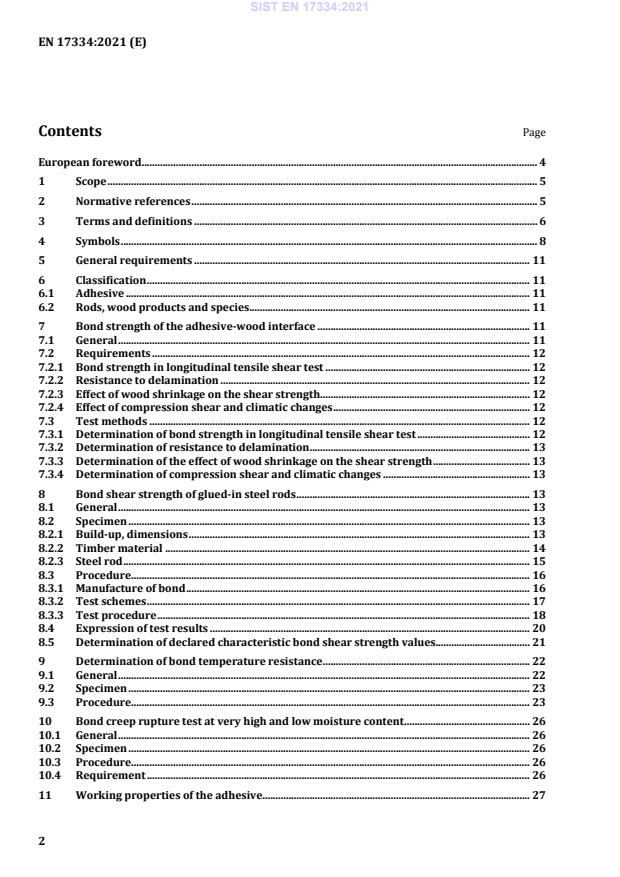
Contents Page
European foreword . 4
1 Scope . 5
2 Normative references . 5
3 Terms and definitions . 6
4 Symbols . 8
5 General requirements . 11
6 Classification . 11
6.1 Adhesive . 11
6.2 Rods, wood products and species. 11
7 Bond strength of the adhesive-wood interface . 11
7.1 General . 11
7.2 Requirements . 12
7.2.1 Bond strength in longitudinal tensile shear test . 12
7.2.2 Resistance to delamination . 12
7.2.3 Effect of wood shrinkage on the shear strength. 12
7.2.4 Effect of compression shear and climatic changes . 12
7.3 Test methods . 12
7.3.1 Determination of bond strength in longitudinal tensile shear test . 12
7.3.2 Determination of resistance to delamination . 13
7.3.3 Determination of the effect of wood shrinkage on the shear strength . 13
7.3.4 Determination of compression shear and climatic changes . 13
8 Bond shear strength of glued-in steel rods . 13
8.1 General . 13
8.2 Specimen . 13
8.2.1 Build-up, dimensions . 13
8.2.2 Timber material . 14
8.2.3 Steel rod . 15
8.3 Procedure. 16
8.3.1 Manufacture of bond . 16
8.3.2 Test schemes . 17
8.3.3 Test procedure . 18
8.4 Expression of test results . 20
8.5 Determination of declared characteristic bond shear strength values. 21
9 Determination of bond temperature resistance . 22
9.1 General . 22
9.2 Specimen . 23
9.3 Procedure. 23
10 Bond creep rupture test at very high and low moisture content . 26
10.1 General . 26
10.2 Specimen . 26
10.3 Procedure. 26
10.4 Requirement . 26
11 Working properties of the adhesive . 27
11.1 General . 27
11.2 Determination of working life under reference conditions . 27
11.3 Determination of open assembly time . 27
11.4 Determination of curing time under reference conditions . 27
11.5 Determination of time to fully cured state . 28
11.5.1 General . 28
11.5.2 Specimens and manufacture . 28
11.5.3 Number and treatment of the specimens . 30
11.5.4 Test procedures . 30
11.5.5 Expression of results . 31
11.5.6 Determination of time to fully cured state . 31
11.5.7 Declared time to fully cured state . 32
12 Test report . 32
12.1 The adhesive . 32
12.2 Preparation of specimens and testing procedure . 33
12.3 Test results . 33
Annex A (informative) Design procedure for glued in rods in GLT, GST, LVL and CLT. 34
Annex B (informative) Common alternatives for adhesive infill in drilled holes . 41
Bibliography . 42
European foreword
This document (EN 17334:2021) has been prepared by Technical Committee CEN/TC 193 “Adhesives”,
the secretariat of which is held by UNE.
This European Standard shall be given the status of a national standard, either by publication of an
identical text or by endorsement, at the latest by September 2021, and conflicting national standards shall
be withdrawn at the latest by September 2021.
Attention is drawn to the possibility that some of the elements of this document may be the subject of
patent rights. CEN shall not be held responsible for identifying any or all such patent rights.
According to the CEN-CENELEC Internal Regulations, the national standards organisations of the
following countries are bound to implement this European Standard: Austria, Belgium, Bulgaria, Croatia,
Cyprus, Czech Republic, Denmark, Estonia, Finland, France, Germany, Greece, Hungary, Iceland, Ireland,
Italy, Latvia, Lithuania, Luxembourg, Malta, Netherlands, Norway, Poland, Portugal, Republic of North
Macedonia, Romania, Serbia, Slovakia, Slovenia, Spain, Sweden, Switzerland, Turkey and the United
Kingdom.
1 Scope
This document specifies test methods for the determination of the suitability of two component epoxy
and two component polyurethane adhesives for glued-in steel rods in glued laminated timber (GLT) and
glued solid timber (GST) according to EN 14080, cross laminated timber (CLT) according to EN 16351
and laminated veneer lumber (LVL) according to EN 14374.
NOTE 1 The English term “glued-in rods” has been chosen as the established term instead of “bonded-in rods”.
It specifies performance requirements and the determination of characteristic bond strength values for
such adhesives for the prefabrication under factory or factory-like conditions of joints between load-
bearing timber products and steel rods only. This document does not cover the performance of adhesives
for on-site gluing (except for factory-like conditions).
NOTE 2 Factory like conditions provide shelter from direct weathering and dirt, prevent undue movement of the
joints during curing of the adhesive and provide temperature and relative humidity conditions and control as in
factory production environment.
This document also covers glued–in rods in surface treated wood. It does not cover glued-in rods in
modified and stabilized wood with considerably reduced swelling and shrinkage properties, e.g.
acetylated wood, heat treated wood, polymer impregnated wood and preservative treated wood.
The joints are intended for load-bearing timber structures in service classes 1 and 2 according to
EN 1995-1-1 which are loaded predominantly static or quasi static according to EN 1990 and
EN 1991-1-1. The joints are intended for load-bearing timber structures which are not subjected to a
prolonged exposure to temperatures over 60 °C.
A design procedure for glued-in rods in glued structural timber products is given in the informative
Annex A.
NOTE 3 Several provisions of this document can apply to in situ repair and upgrading of existing timber
structures including (cracked/fissured) solid wood beams. For adhesives for glued-in rods used in on-site repair or
applications with solid timber additional provisions apply, e.g. related to rheology and site temperature conditions.
Such provisions are not part of this document.
2 Normative references
The following documents are referred to in the text in such a way that some or all of their content
constitutes requirements of this document. For dated references, only the edition cited applies. For
undated references, the latest edition of the referenced document (including any amendments) applies.
EN 302-1, Adhesives for load-bearing timber structures — Test methods — Part 1: Determination of
longitudinal tensile shear strength
EN 302-2, Adhesives for load-bearing timber structures — Test methods — Part 2: Determination of
resistance to delamination
EN 302-4, Adhesives for load-bearing timber structures — Test methods — Part 4: Determination of the
effects of wood shrinkage on the shear strength
EN 302-5, Adhesives for load-bearing timber structures — Test methods — Part 5: Determination of
maximum assembly time under referenced conditions
EN 302-6, Adhesives for load-bearing timber structures — Test methods — Part 6: Determination of the
minimum pressing time under referenced conditions
EN 302-7, Adhesives for load-bearing timber structures — Test methods — Part 7: Determination of the
working life under referenced conditions
EN 302-8, Adhesives for load-bearing timber structures — Test methods — Part 8: Static load test of
multiple bond line specimens in compression shear
EN 923, Adhesives — Terms and definitions
EN 10080, Steel for the reinforcement of concrete — Weldable reinforcing steel — General
EN 13183-1, Moisture content of a piece of sawn timber — Part 1: Determination by oven dry method
EN 14080:2013, Timber structures — Glued laminated timber and glued solid timber — Requirements
EN 14358, Timber structures — Calculation and verification of characteristic values
EN 14374, Timber structures — Structural laminated veneer lumber — Requirements
EN 16351, Timber structures — Cross laminated timber — Requirements
EN ISO 898-1, Mechanical properties of fasteners made of carbon steel and alloy steel — Part 1: Bolts,
screws and studs with specified property classes — Coarse thread and fine pitch thread (ISO 898-1)
EN ISO 3506-1, Fasteners — Mechanical properties of corrosion-resistant stainless steel fasteners — Part 1:
Bolts, screws and studs with specified grades and property classes (ISO 3506-1)
3 Terms and definitions
For the purposes of this document, the terms and definitions given in EN 923 and the following apply.
ISO and IEC maintain terminological databases for use in standardization at the following addresses:
— IEC Electropedia: available at http://www.electropedia.org/
— ISO Online browsing platform: available at https://www.iso.org/obp
3.1
two component epoxy adhesive
thermosetting synthetic resin derived from a exothermic polymerization reaction of an epoxide group
with amines, acid anhydrides, phenols, alcohols or thiols
3.2
two component polyurethane adhesive
urethane polymers which are cross-linked by the reaction between polyol or polyamine with isocyanate
3.3
service class 1
climatic conditions characterized by a moisture content in the materials corresponding to a temperature
of 20 °C and the relative humidity of the surrounding air only exceeding 65 % for a few weeks per year
Note 1 to entry: In service class 1, which comprises typical indoor conditions, the average moisture content in
most softwoods will not exceed 12 %.
[SOURCE: EN 1995-1-1:2004, 2.3.1.3, modified – Indoor conditions added in Note 1 to entry]
3.4
service class 2
climatic conditions characterized by a moisture content in the materials corresponding to a temperature
of 20 °C and the relative humidity of the surrounding air only exceeding 85 % for a few weeks per year
Note 1 to entry: In service class 2, to which most covered exterior conditions belong, the average moisture
content in most softwoods will not exceed 20 %.
[SOURCE: EN 1995-1-1:2004, 2.3.1.3, modified – Covered exterior conditions added in Note 1 to entry]
3.5
glue line
adhesive layer between the wood members
[SOURCE: EN 301:2017, 3.7]
3.6
thick glue line
glue line of nominal thickness in the range of 0,3 mm to 4,0 mm at the time of bonding
Note 1 to entry: Thick glue lines are achieved by using spacers, grooves or similar devices with a thickness of
0,3 mm to 4,0 mm when two plain members are glued together.
[SOURCE: EN 301:2017, 3.8, modified — Maximum thickness has been increased to 4 mm.]
3.7
close contact glue line
glue line thickness of maximum 0,1 mm
Note 1 to entry: Close contact glue line is considered to be achieved by pressing together two plane wood
members with a clamping pressure of (0,8 ± 0,1) N/mm without grooves, spacers or similar device.
[SOURCE: EN 301:2017, 3.9, modified — “considered to be” has been added.]
3.8
bond line
glue line including the two intermediate zones between adhesive and wood
[SOURCE: EN 15425:2017, 3.6]
4 Symbols
a cross-section length of specimen, in millimetres (mm)
a equation parameter, in newtons per square millimetre (N/mm )
0,250
a equation parameter, in newtons per square millimetre (N/mm )
0,500
a equation parameter, in newtons per square millimetre (N/mm )
a equation parameter, in newtons per square millimetre (N/mm )
a equation parameter, in newtons per square millimetre (N/mm )
a equation parameter, in newtons per square millimetre (N/mm )
b edge lengths of the net cross-section, in millimetres (mm)
c equation parameter, in newtons per cubic millimetre (N/mm )
c equation parameter, in newtons per cubic millimetre (N/mm )
d nominal rod diameter, in millimetres (mm)
d distance of displacement sensor to rod axis, in millimetre (mm)
d distance of displacement sensor fixation vs. specimen and grain face, in millimetre
(mm)
d diameter of drilled hole, in millimetres (mm)
drill
f apparent tensile strength, in newtons per square millimetre (N/mm )
t,app
F tension load in newtons (N)
t
F maximum load in tensile test, in newtons (N)
t,max
F maximum load in block shear test, in newtons (N)
v,max
F target load (temperature resistance test), in newtons (N)
target
F target load (creep rupture test at very high and low moisture content), in newtons
t,DOL
(N)
f block shear strength (monolithic adhesive specimen), in newtons per square
v
millimetre (N/mm )
f bond strength, in newtons per square millimetre (N/mm )
vr
f characteristic bond strength value of bond length of 200 mm
vr,200,k
f declared characteristic bond strength value (5 % quantile) of bond length range
vr,250,k,dc
l ≤ 250 mm, in newtons per square millimetre (N/mm )
a
f characteristic bond strength value of bond length of 400 mm
vr,400,k
declared characteristic bond strength value (5 % quantile) of bond length range
f
vr,la 500,≤ k,dc
250 mm < la ≤ 500 mm, in newtons per square millimetre (N/mm )
f characteristic bond strength value of bond length of 600 mm
vr,600,k
declared characteristic bond strength value (5 % quantile) of bond length range
f
vr,la 1000,≤ k,dc
500 mm < l ≤ 1 000 mm
a
f characteristic bond strength value of bond length range l
vr,la,k a
f mean bond strength for a bond line thickness of 2 mm, in newtons per square
vr,la,2mm,mean
millimetre (N/mm )
f mean bond strength for a bond line thickness of 4 mm, in newtons per square
vr,la,4mm,mean
millimetre (N/mm )
f mean bond strength for a bond line thickness of 6 mm, in newtons per square
vr,la,6mm,mean
millimetre (N/mm )
f characteristic bond strength value (5 % quantile), in newtons per square millimetre
vr,la,tB,k
(N/mm )
f arithmetic mean bond strength value in newtons per square millimetre (N/mm )
vr,la,tB,mean
f declared characteristic bond shear strength (5 % quantile), in newtons per square
vr,k,dc
millimetre (N/mm )
f density influenced bond shear strength, in newtons per square millimetre (N/mm )
vr,ρ
f density corrected bond shear strength, in newtons per square millimetre (N/mm )
vr,ρref
k bond strength ratio between two bond line thicknesses
d,la
l total length of timber specimen, in millimetres (mm)
l nominal bonded length of steel rod, in millimetres (mm)
a
l maximum declared rod length, in millimetres (mm)
a,dc,max
l minimum declared rod length, in millimetres (mm)
a,dc,min
l length to fix the rod in the grips of the test machine, in millimetres (mm)
clamping
l length of drill hole, in millimetres (mm)
drill
l length of the rod inside the drill hole that is not able to take load (e.g. spacers), in
not bonded
millimetres (mm)
l distance between the grounds of the drilled holes in the specimen, in millimetres
m
(mm)
l edge lengths of the net cross-section, in millimetres (mm)
v
l total rod length, in millimetres (mm)
rod,tot
𝜌𝜌 density of the timber specimen at 12 % moisture content, in kilograms per cubic
metre (kg/m )
𝜌𝜌 reference density, in kilograms per cubic metre (kg/m )
ref
s slip displacement
t bond line thickness, in millimetres (mm) (t = (d − d)/2)
b b drill
t total bond line thickness, in millimetres (mm) (t = 2 t )
B B b
T Temperature, in degrees Celsius (°C)
T applied temperature, in degrees Celsius (°C)
app
T target temperature at bond line, in degrees Celsius (°C)
bond,target
t loading time
t cooling down period, in hours (h)
cool
tcycle,1 time of first heating-cooling-load-cycle, in hours (h)
t time of second heating-cooling-load-cycle, in hours (h)
cycle,2
t heating period, in hours (h)
heat
t total time of both temperature-load cycles, in hours (h)
total
t time of the attainment of the target load, in minutes
ramp
t constant temperature period, in hours (h)
rod60
u percentage target wood moisture content (%)
target
V density correction exponent
Δu difference in average moisture contents between the moist and dry state, in percent
(%)
Additional symbols of Annex A:
A stress design relevant cross-section of steel rod, in square millimetres (mm )
ef
a minimum distance of axially loaded glued-in rods (in grain direction), in millimetres
(mm)
a minimum distance of axially loaded glued-in rods (perpendicular grain direction), in
millimetres (mm)
a , a minimum edge distance of axially loaded glued-in rods, in millimetres (mm)
1,c 2,c
a minimum distance of axially loaded glued-in rods (loaded end grain face), in
3,t
millimetres (mm)
a minimum distance of axially loaded glued-in rods (unloaded end grain face), in
3,c
millimetres (mm)
a minimum distance of axially loaded glued-in rods (loaded edge), in millimetres
4,t
(mm)
a minimum distance of axially loaded glued-in rods (unloaded edge), in millimetres
4,c
(mm)
γ partial factor for material properties, also accounting for model uncertainties and
M
dimensional variations
F design value for the withdrawal (pull-out) capacity, in newtons (N)
ax,Rd
F , F design values of shear force at both sides of the connection, in newtons (N)
v,Ed,1 v,Ed,2
f design value of bond shear strength, in newtons per square millimetre (N/mm )
vr,d
f declared characteristic bond strength value (5 % quantile) of bond length range l ,
vr,la,dc,k a
in newtons per square millimetre (N/mm )
f design value of yield strength of steel rod, in newtons per square millimetre
y,d
(N/mm )
F , F design value and characteristic value of resistance to tension perpendicular to grain
90,Rd 90,Rk
of the loaded member, in newtons (N)
h, b depth and width of timber member, in millimetres (mm)
h projected rod embedment length perpendicular to grain, in millimetres (mm)
e
kmod modification factor for duration of load and moisture content
l minimum bond length, in millimetres (mm)
a,min
5 General requirements
Adhesives for structural purpose shall produce joints of such strength and durability that the integrity of
the bond in the glued-in rod joint is maintained throughout the expected lifetime of the structure.
6 Classification
6.1 Adhesive
If the adhesive meets the requirements of Clause 7 to Clause 10 it shall be classified as type I. The
classification of the adhesive consists of:
— number of this document and year of publication;
— type of adhesive (I);
— bond temperature resistance, in degrees Celsius °C;
— maximum bond length, in millimetres;
— maximum bond line thickness, in millimetres;
— working properties (adhesives tested for working properties according to Clause 11 are specified by
the letter “w” at the end of the designation code).
EXAMPLE EN 17334:2021-I-60-500-4 w.
6.2 Rods, wood products and species
The type of rod (rebars, rods with metric thread), the tested rod dimensions d and l , the applicable wood
a
product (GLT, GST, CLT including lay-up and LVL including lay-up) and wood species shall be declared.
7 Bond strength of the adhesive-wood interface
7.1 General
Adhesives complying with this document shall meet the performance requirements specified in 7.2.1 to
7.2.4 when tested in accordance with the following test methods:
a) tensile shear test (see 7.3.1) using bonded specimens made from beech (Fagus sylvatica L.);
b) delamination test (see 7.3.2) on bonded specimens made from Norway spruce (Picea abies L.). The
test with Norway spruce also covers silver fir (Abies alba) and Scots pine (Pinus sylvestris). If the
adhesive is to be used on wood from other conifers species, also prepare four laminated members
using representative samples from those species and perform the delamination test according to
7.3.2;
c) shrinkage stress test (see 7.3.3) on bonded specimens made from Norway spruce (Picea abies L.);
d) multiple compression shear test (see 7.3.4) on bonded specimens made from beech (Fagus
sylvatica L.).
These adhesives shall be applied according to the manufacturer's instructions.
7.2 Requirements
7.2.1 Bond strength in longitudinal tensile shear test
When tested in accordance with 7.3.1, the tensile shear strength values of close contact glue lines and
thick glue lines shall meet the requirements given in Table 1.
Table 1 — Minimum mean tensile shear strengths for close contact and thick glue lines on beech
specimens (in N/mm )
Thick glue line Thick glue line Thick glue line
Close contact
Treatment
glue line
1,0 mm 3,0 mm 4,0 mm
Designation according
Type Ι Type Ι Type I Type Ι
to EN 302-1
A1 10,0 8,0 7,0 6,0
A2 6,0 4,0 3,5 3,0
A3 8,0 6,4 5,6 4,8
A4 6,0 4,0 3,5 3,0
A5 8,0 6,4 5,6 4,8
A7 8,0 5,5 5,0 4,5
NOTE Treatment A8 is not included in Table 1 due to the temperature limitation given in the scope.
7.2.2 Resistance to delamination
When tested in accordance with 7.3.2 the limits on delamination for specimens of any bond line thickness
shall be less or equal than 5 % in any specimen.
7.2.3 Effect of wood shrinkage on the shear strength
When tested in accordance with 7.3.3 the average shear strength after climatic treatment shall not be
lower than 1,5 N/mm .
7.2.4 Effect of compression shear and climatic changes
When tested in accordance with 7.3.4, not more than one of six specimens is allowed to fail during the
test period. The mean creep deformation of all the bond lines in each of the remaining test specimens
shall not exceed 0,05 mm after the test.
If a failure within a specimen occurs as a solid wood failure without any interference with the bond line,
the specimen shall not be counted and four of the five remaining specimens shall fulfil the requirements.
In case more than two specimens in a test series collapse due to solid wood failure (low wood quality),
the whole test shall be repeated.
7.3 Test methods
7.3.1 Determination of bond strength in longitudinal tensile shear test
The tests shall be made in accordance with EN 302-1, but with glue line thicknesses close contact, 1,0 mm
and 4,0 mm. In case the glue line thickness t in use is ≤ 1 mm the tests shall be made with a glue line
b
thickness of 3 mm instead of 4 mm. The specimens with thick glue lines shall be prepared with a
pressureless preparation of the specimens.
7.3.2 Determination of resistance to delamination
The tests shall be made in accordance with EN 302-2, with the following exceptions: the test with close
contact glueline may be replaced by a test with a defined glue line thickness of 0,2 mm achieved by
spacers.
The tests with a glueline thickness of 4 mm shall be performed except for the case that the glue line
thickness in use t is ≤ 1 mm where the tests shall be made with a glue line thickness of 3 mm instead of
b
4 mm.
The specimens with thick glue lines shall be prepared with a pressureless preparation of the specimens.
Different from EN 302-2 the tests with bonded members with close contact glue line or a glue line
thickness of 0,2 mm shall be performed exclusively with two specimens with long assembly time.
7.3.3 Determination of the effect of wood shrinkage on the shear strength
The tests shall be made in accordance with EN 302-4, but with a glue line thickness of 2 mm.
7.3.4 Determination of compression shear and climatic changes
The tests shall be made in accordance with EN 302-8 but with a temperature of 60 °C in the first cycle.
8 Bond shear strength of glued-in steel rods
8.1 General
The bond shear strength of the glued-in rod which depends essentially on the bond length shall be
determined by single rod pull-out tests with symmetrically built-up specimens. Different ranges of glued-
in rod lengths and bond line thicknesses, if relevant, shall be tested for the intended wood products,
species, rod types and hole dimensions for determination and declaration of characteristic bond strength
values.
The adhesives shall be used as recommended by the manufacturer.
8.2 Specimen
8.2.1 Build-up, dimensions
The specimen consists of a quadratic cross-section of timber into the ends of which two steel rods are
glued-in parallel to grain centrically at the opposite end grain faces (see Figure 1). The absolute size of
the specimen depends on the nominal rod diameter d, and on the bond length l . The cross-section edge
a
length a and the total length l of the timber piece shall be determined according to Formula (1) and
Formula (2):
ad≥ 7,5 (1)
l=2 +l l =3,4 l (2)
am a
where
d is the nominal rod diameter;
l is the nominal bonded length of steel rod;
a
l is the distance between the tips of the opposite rods.
m
Dimensions in millimetres
Key
a) GLT-side view 1 test rod
b) GLT-cross section 2 fibre direction
c) CLT-side view
d) CLT-cross section
Figure 1 — Geometry and loading scheme of GLT, GST, LVL and CLT ramp load specimens.
Examples of cross-sectional dimensions
In the case that the rod is not glued-in over the total length embedded in the timber specimen, then the
bond length l in Formula (2) shall be replaced by l (see 8.3.1).
a drill
8.2.2 Timber material
8.2.2.1 Moisture content
The timber materials specified in 8.2.2.2 to 8.2.2.4 shall have an average moisture content of (12 ± 2) %
at time of the rod bonding process and at testing unless specified differently in Clause 9 and Clause 10.
8.2.2.2 Glulam and glued solid timber
The glulam (GLT) and glued solid timber (GST) shall conform to EN 14080 and shall be of strength class
GL 24h or C24. Test results for glued solid timber may also be applied to glulam.
Tests shall be carried out with all species for which the adhesive is intended to be classified. Norway
spruce (Picea abies, PCAB) and silver fir (Abies alba, ABAL) may be taken as one species. Test results
obtained for species PCAB/ABAL apply also to glued-in rods in GLT and/or GST made of Scots pine (Pinus
sylvestris PNSY). The use of softwoods with coloured heartwood, e.g. Douglas fir (PSMN) and European
or Sibirian larch (Larix decidua (SADC), Larix Sibirica (LASI)) has to be tested separately.
The cross-sectional build-up of the specimen shall be symmetric with regard to lamination thicknesses.
The thickness t of the centre lamination containing the glued-in rod shall be in the range of 38 mm to
45 mm for GLT and minimally 60 mm in case of GST. All laminations of the timber piece may have finger
joints at any location except for the centre lamination which shall have no finger joints within the bond
length l .
a
8.2.2.3 Cross laminated timber
Cross laminated timber (CLT) shall conform to EN 16351 and shall be built up from timber layers of
class C24. Concerning the wood species see 8.2.2.2. The built-up shall be symmetric, either 3- or 5-layer.
In case of non edge-bonded cross layers the ratio of width to thickness of the boards shall be at least 4.
The thickness of the inner cross-layer containing centrically the glued-in rod shall exceed the drill hole
diameter by at least 16 mm.
In case of glued-in rods in CLT it can be differentiated between products with glued narrow edges and
unglued narrow edges with permissible gaps. In case of non-edge-bonded layers further provisions shall
be fulfilled in order to prevent leakage of the adhesive through unbonded edges:
— steel rods shall be bonded parallel to the fibre in the middle third of the width of a single board;
— grooves in the boards are not permissible;
— the length of the drill hole l shall not exceed 250 mm.
drill
In the case that there is evidence of adhesive leakage into internal grooves, cracks, etc. the bonding
process has to be adjusted and/or the specimen shall be rejected.
8.2.2.4 Laminated veneer lumber
Laminated veneer lumber (LVL) shall conform to EN 14374. Concerning the wood species see 8.2.2.2. The
test results apply to the specifically tested built-up and strength class as given in the Declaration of
Performance (DoP) of the tested material.
8.2.3 Steel rod
Weldable reinforcing steel bars (rebars) shall conform to EN 10080. Threaded rods made of carbon steel
shall conform to EN ISO 898-1. Threaded rods made of stainless steel shall conform to EN ISO 3506-1.
The required strength class or yield strength of the rod depends on the bond length and the rod diameter
in order to achieve a bond and/or wood failure without rod yielding.
The nominal diameter of the rods may vary from 6 mm to 30 mm.
NOTE For threaded rods made of carbon steel, strength classes 4.8, 5.6, 5.8 and 8.8 are commonly used. For
threaded rods made of stainless steel, strength classes 45, 50, 60, 70 and 80 are commonly used.
In the general case, unless requested different by the adhesive manufacturer the following rod
dimensions d and l are required:
a
d/l [in mm]: 16/200; 16/400 or 20/400; 20/600 or 24/600.
a
The total rod length may include, if requested by the manufacturer, a possibly not bonded rod length,
l , of maximally 50 mm.
not bonded
The total rod length l shall be determined according to Formula (3):
rod,tot
l = +l l + l (3)
rod,tot a not bonded clamping
where
l is the nominal bonded length of the steel rod, in millimetres (mm);
a
l is the not bonded length of up to 50 mm (including), if any, starting from the cross
not bonded
cut;
l is the clamping length ≈ 100 mm.
clamping
In case the manufacturer requests to deviate from the general specimen configuration, specified in 8.2.1
and 8.2.3 different dimensions may apply. These dimensions shall be stated according to Clause 6.
8.3 Procedure
8.3.1 Manufacture of bond
The holes for both glued-in rods shall be drilled centrically in the centre lamination or the LVL parallel to
length axis and grain direction by an apt drilling device. In case of CLT with non edge-bonded cross layers
special precautions have to be taken at the manufacture of the glued-in rod joint. The drill hole shall be
aligned parallel to the board faces and the rod shall not protrude outside of the centre board. The drilling
shall be performed at least one hour before the gluing process. No charring during drilling shall occur.
Depending on the gluing process the two drill holes of each specimen may be manufactured at different
times. After drilling, the hole shall be cleaned from chips and milling dust according to the provisions of
the manufacturer. The drill length l shall be either equal to the bond length l or, dependant on the
drill a
recommendation of the adhesive manufacturer, shall have a length of l = l + l whereby l
drill a not bonded not bonded
shall in any case be maximally 50 mm.
The diameter of the drill hole, d , depends on the nominal rod diameter d, the rod type (steel rod with
drill
metric thread, rebar) and the provisions of the manufacturer regarding bond line thickness which is
restricted to max. t ≤ 3 mm (total bond line thickness t = 2t).
B B
The diameter of the drill hole shall be minimally d + 2 mm and maximally d + 6 mm.
NOTE The bonding process and hereby the adhesive infill into the drill hole and the timing of the rod insertion
(before or after adhesive infill/injection) can vary dependent on the adhesive manufacturer’s provisions. Annex B
shows three common alternatives of the bonding process.
The bonding process is in general performed at ambient temperature of (20 + 2) °C and a relative
humidity within the range of 20 % to 70 %, unless required different by the adhesive manufacturer. In
any case the room and timber temperature shall be measured at the time of bonding and room
temperature and relative humidity shall be monitored during bonding and curing time. In specific cases
where the adhesive manufacturer wishes to use preheated timber and/or heated adhesive and to employ
elevated temperature in the premises during curing, it is required to measure and record the respective
temperatures (wood, adhesive, room).
In case of drill holes with a diameter d > d + 2 mm it is required to centre the glued-in rod during curing
drill
by specific provisions, i.e. distance holders such as wedges, or plastic rings. With regard to the verification
of an impeccable bonding, see 8.3.3.
With regard to the drilling of the holes and the bonding operation the recommendations of the
manufacturer shall be followed and documented.
8.3.2 Test schemes
8.3.2.1 Test scheme with varying configurations of rod length, rod diameter and bond line
thicknesses
Depending on the intended use of the adhesive with regard to bond length, nominal rod diameter and
maximum total bond line thickness the specimen configurations and numbers according to Table 2,
Table 3 and Table 4 apply. When performing the tests with different rod lengths according to Table 2,
Table 3 and Table 4 it is assumed that the bond strength evaluation reflects the bond strength
relationship with rod length as specified in 8.5. In case bond strength shall be specified as a single value
for a specific rod diameter, diameter of drilled hole and rod length range configuration, see 8.3.2.2.
Table 2 — Specimen configurations and minimum specimen numbers for bond shear strength
tests for total bond line thicknesses up to 6 mm
Bond length Nominal rod Minimum number of specimens dependent
Bond length
configuration diameter on total bond line thickness
l d t = 2 t
a B b
2 mm 4 mm 6 mm
– mm mm – – –
a a
short 200 16 10 5 5
a a
medium 400 16 (or 20) 10 5 5
a a
long 600 20 (or 24) 10 5 5
a
If the use of the adhesive is intended exclusively for a total bond line thickness tB = 2 mm no tests with
tB = 4 mm and 6 mm are required.
Table 3 — Specimen configurations and minimum specimen numbers for bond shear strength
tests for a total bond line thickness up to 4 mm
Bond length Bond length Nominal rod Minimum number of specimens dependent
configuration diameter on tota
...