

EN 1191:2012
(Main)Windows and doors - Resistance to repeated opening and closing - Test method
- Abstract
This European Standard specifies the method to be used to determine the resistance to repeated opening and closing of windows and pedestrian doorsets when subjected to repeated opening and closing.
It applies to all construction materials and operating systems for any window or pedestrian doorset, including gaskets and building hardware, in normal operating conditions.
The parts concerned in the testing are the frame, the opening component (including any additional moving components e.g. an inactive sash/leaf) and all essential and directly involved building hardware, including operating devices, for example, the handle.
The testing does not include any hardware whose operation is not directly involved in the opening and closing of the moving components: added-on fastening systems such as peg-stays or cabin hooks or bolts, nor, unless specified, any independently installed stops (not connected to the complete assembly) such as a wall or ground-mounted stop.
NOTE 1 The Annexes provide more details on the testing procedures that may differ from the main part of this European Standard and are mandatory:
- Annex A applies to Tilt and Turn, Tilt-First, Turn-Only, or Tilt-Only windows and door-height windows;
- Annex B applies to Sliding, Lift and Slide or Lift and Slide and Tilt windows and door-height windows;
- Annex C applies to Tilt and Slide windows and door-height windows;
- Annex D applies to Fold and Slide windows and door-height windows;
- Annex E applies to horizontal and vertical pivot windows and door-height windows;
- Annex F applies to Vertical Sliding windows;
- Annex G applies to side-hung casements and top-hung windows, opening outwards (including reversible windows);
- Annex H applies to side-hung single swing pedestrian doorsets excluding power operated doors;
- Annex I applies to power-operated (automatic) side-hung single-swing pedestrian doorsets.
NOTE 2 In this European Standard the term door-height window is used for windows that are used for the passage of pedestrians, i.e. as a pedestrian doorset.
- Status
- Published
- Publication Date
- 18-Dec-2012
- Withdrawal Date
- 29-Jun-2013
- Technical Committee
- CEN/TC 33 - Doors, windows, shutters and building hardware
- Drafting Committee
- CEN/TC 33/WG 1/2 - Windows and doors
- Current Stage
- 9093 - Decision to confirm - Review Enquiry
- Start Date
- 05-Dec-2023
- Completion Date
- 21-Oct-2026


Overview
EN 1191:2012 - published by CEN - defines a harmonized test method to determine the resistance to repeated opening and closing of windows and pedestrian doorsets. The standard applies to all construction materials and operating systems in normal operating conditions and covers the complete moving assembly (frame, opening component, gaskets, essential building hardware and operating devices such as handles). It excludes hardware not directly involved in the opening/closing action (e.g., peg-stays, cabin hooks, independent stops) unless otherwise specified.
The standard includes a main test procedure and nine normative Annexes (A–I) that specify test procedures for different product types (tilt & turn, sliding, lift-and-slide, fold-and-slide, pivots, vertical sliding, casements, pedestrian doorsets - manual and power-operated).
Key Topics
- Scope and applicability: All window and pedestrian doorset types and materials; door‑height windows used as pedestrian doorsets are covered.
- Test equipment: Requirements for test rig, operating equipment, measuring devices and velocity measurement.
- Test sequence: Pre-test operation, initial measurements, defined cycle descriptions for repeated opening/closing, maintenance/cleaning actions and final measurements.
- Performance parameters: Reference velocity (now scaled by weight), different velocities for translatory, rotatory and tilt movements, rest times and force levels for operating fastening systems.
- Termination criteria: Clear criteria for ending a test (incorporated into the 2012 revision).
- Product-specific procedures: Mandatory Annexes A–I provide adaptations for specific window and doorset types (including power-operated doors).
- Documentation: Requirements for test reporting and recording results.
Applications and Who Uses It
- Manufacturers of windows, doors and hardware - for design validation, durability claims and product development.
- Independent test laboratories - to perform standardized mechanical durability and life-cycle tests.
- Specifiers and architects - to select products meeting durability expectations for different building uses.
- Certification bodies and regulators - to verify mechanical durability requirements in product standards and construction projects.
- Quality assurance teams - to define production acceptance criteria and investigate field failures.
Practical uses include verifying mechanical durability, comparing product variants (materials, hardware, operating systems), supporting CE marking and ensuring long-term performance in residential, commercial and public buildings.
Related Standards
EN 1191 cross-references and complements other standards, for example:
- EN 12400 (Mechanical durability - requirements and classification)
- EN 12046-1 / EN 12046-2 (Operating forces)
- EN 12217 (Doors - Operating forces)
- EN 12519 (Terminology)
- EN 16005 (Powered pedestrian doorsets - safety)
- EN 179 / EN 1125 (Emergency and panic exit devices)
For manufacturers and test labs implementing product durability testing, EN 1191:2012 is the authoritative CEN method for assessing resistance to repeated opening and closing.
Relations
- Effective Date
- 26-Dec-2012
- Effective Date
- 28-Jan-2026
- Effective Date
- 28-Jan-2026
- Effective Date
- 28-Jan-2026
- Effective Date
- 28-Jan-2026
- Refers
EN 1154:1996 - Building hardware - Controlled door closing devices - Requirements and test methods - Effective Date
- 28-Jan-2026
- Effective Date
- 28-Jan-2026
- Effective Date
- 28-Jan-2026
- Effective Date
- 28-Jan-2026
- Effective Date
- 28-Jan-2026
- Effective Date
- 28-Jan-2026
- Effective Date
- 28-Jan-2026
- Effective Date
- 28-Jan-2026
- Effective Date
- 28-Jan-2026
- Effective Date
- 28-Jan-2026
Get Certified
Connect with accredited certification bodies for this standard

DIBt (Deutsches Institut für Bautechnik)
German Institute for Building Technology.
DIN CERTCO
DIN Group product certification.

Aboma Certification B.V.
Specialized in construction, metal, and transport sectors.
Sponsored listings
Frequently Asked Questions
EN 1191:2012 is a standard published by the European Committee for Standardization (CEN). Its full title is "Windows and doors - Resistance to repeated opening and closing - Test method". This standard covers: This European Standard specifies the method to be used to determine the resistance to repeated opening and closing of windows and pedestrian doorsets when subjected to repeated opening and closing. It applies to all construction materials and operating systems for any window or pedestrian doorset, including gaskets and building hardware, in normal operating conditions. The parts concerned in the testing are the frame, the opening component (including any additional moving components e.g. an inactive sash/leaf) and all essential and directly involved building hardware, including operating devices, for example, the handle. The testing does not include any hardware whose operation is not directly involved in the opening and closing of the moving components: added-on fastening systems such as peg-stays or cabin hooks or bolts, nor, unless specified, any independently installed stops (not connected to the complete assembly) such as a wall or ground-mounted stop. NOTE 1 The Annexes provide more details on the testing procedures that may differ from the main part of this European Standard and are mandatory: - Annex A applies to Tilt and Turn, Tilt-First, Turn-Only, or Tilt-Only windows and door-height windows; - Annex B applies to Sliding, Lift and Slide or Lift and Slide and Tilt windows and door-height windows; - Annex C applies to Tilt and Slide windows and door-height windows; - Annex D applies to Fold and Slide windows and door-height windows; - Annex E applies to horizontal and vertical pivot windows and door-height windows; - Annex F applies to Vertical Sliding windows; - Annex G applies to side-hung casements and top-hung windows, opening outwards (including reversible windows); - Annex H applies to side-hung single swing pedestrian doorsets excluding power operated doors; - Annex I applies to power-operated (automatic) side-hung single-swing pedestrian doorsets. NOTE 2 In this European Standard the term door-height window is used for windows that are used for the passage of pedestrians, i.e. as a pedestrian doorset.
This European Standard specifies the method to be used to determine the resistance to repeated opening and closing of windows and pedestrian doorsets when subjected to repeated opening and closing. It applies to all construction materials and operating systems for any window or pedestrian doorset, including gaskets and building hardware, in normal operating conditions. The parts concerned in the testing are the frame, the opening component (including any additional moving components e.g. an inactive sash/leaf) and all essential and directly involved building hardware, including operating devices, for example, the handle. The testing does not include any hardware whose operation is not directly involved in the opening and closing of the moving components: added-on fastening systems such as peg-stays or cabin hooks or bolts, nor, unless specified, any independently installed stops (not connected to the complete assembly) such as a wall or ground-mounted stop. NOTE 1 The Annexes provide more details on the testing procedures that may differ from the main part of this European Standard and are mandatory: - Annex A applies to Tilt and Turn, Tilt-First, Turn-Only, or Tilt-Only windows and door-height windows; - Annex B applies to Sliding, Lift and Slide or Lift and Slide and Tilt windows and door-height windows; - Annex C applies to Tilt and Slide windows and door-height windows; - Annex D applies to Fold and Slide windows and door-height windows; - Annex E applies to horizontal and vertical pivot windows and door-height windows; - Annex F applies to Vertical Sliding windows; - Annex G applies to side-hung casements and top-hung windows, opening outwards (including reversible windows); - Annex H applies to side-hung single swing pedestrian doorsets excluding power operated doors; - Annex I applies to power-operated (automatic) side-hung single-swing pedestrian doorsets. NOTE 2 In this European Standard the term door-height window is used for windows that are used for the passage of pedestrians, i.e. as a pedestrian doorset.
EN 1191:2012 is classified under the following ICS (International Classification for Standards) categories: 91.060.50 - Doors and windows. The ICS classification helps identify the subject area and facilitates finding related standards.
EN 1191:2012 has the following relationships with other standards: It is inter standard links to EN 1191:2000, EN 16005:2023+A1:2024, EN 13115:2001, EN 16361:2013+A1:2016, EN 12519:2004, EN 1154:1996, EN 12046-1:2020, EN 12217:2015, EN 12400:2002, EN 12046-2:2025, EN 1125:2008, EN 1158:1997, EN 179:2008, EN 17020-3:2022, EN 17020-1:2022. Understanding these relationships helps ensure you are using the most current and applicable version of the standard.
EN 1191:2012 is associated with the following European legislation: EU Directives/Regulations: 305/2011, 89/106/EEC; Standardization Mandates: M/101. When a standard is cited in the Official Journal of the European Union, products manufactured in conformity with it benefit from a presumption of conformity with the essential requirements of the corresponding EU directive or regulation.
EN 1191:2012 is available in PDF format for immediate download after purchase. The document can be added to your cart and obtained through the secure checkout process. Digital delivery ensures instant access to the complete standard document.
Standards Content (Sample)
2003-01.Slovenski inštitut za standardizacijo. Razmnoževanje celote ali delov tega standarda ni dovoljeno.PHWRGDFenster und Türen - Dauerfunktionssprüfung - PrüfverfahrenFenêtres et portes - Résistance à l'ouverture et fermeture répétée - Méthode d'essaiWindows and doors - Resistance to repeated opening and closing - Test method91.060.50Vrata in oknaDoors and windowsICS:Ta slovenski standard je istoveten z:EN 1191:2012SIST EN 1191:2013en,fr01-marec-2013SIST EN 1191:2013SLOVENSKI
STANDARDSIST EN 1191:20011DGRPHãþD
EUROPEAN STANDARD NORME EUROPÉENNE EUROPÄISCHE NORM
EN 1191
December 2012 ICS 91.060.50 Supersedes EN 1191:2000English Version
Windows and doors - Resistance to repeated opening and closing - Test method
Fenêtres et portes - Résistance à l'ouverture et fermeture répétée - Méthode d'essai
Fenster und Türen - Dauerfunktionsprüfung - PrüfverfahrenThis European Standard was approved by CEN on 27 October 2012.
CEN members are bound to comply with the CEN/CENELEC Internal Regulations which stipulate the conditions for giving this European Standard the status of a national standard without any alteration. Up-to-date lists and bibliographical references concerning such national standards may be obtained on application to the CEN-CENELEC Management Centre or to any CEN member.
This European Standard exists in three official versions (English, French, German). A version in any other language made by translation under the responsibility of a CEN member into its own language and notified to the CEN-CENELEC Management Centre has the same status as the official versions.
CEN members are the national standards bodies of Austria, Belgium, Bulgaria, Croatia, Cyprus, Czech Republic, Denmark, Estonia, Finland, Former Yugoslav Republic of Macedonia, France, Germany, Greece, Hungary, Iceland, Ireland, Italy, Latvia, Lithuania, Luxembourg, Malta, Netherlands, Norway, Poland, Portugal, Romania, Slovakia, Slovenia, Spain, Sweden, Switzerland, Turkey and United Kingdom.
EUROPEAN COMMITTEE FOR STANDARDIZATION
COMITÉ EUROPÉEN DE NORMALISATION EUROPÄISCHES KOMITEE FÜR NORMUNG
Management Centre:
Avenue Marnix 17,
B-1000 Brussels © 2012 CEN All rights of exploitation in any form and by any means reserved worldwide for CEN national Members. Ref. No. EN 1191:2012: ESIST EN 1191:2013
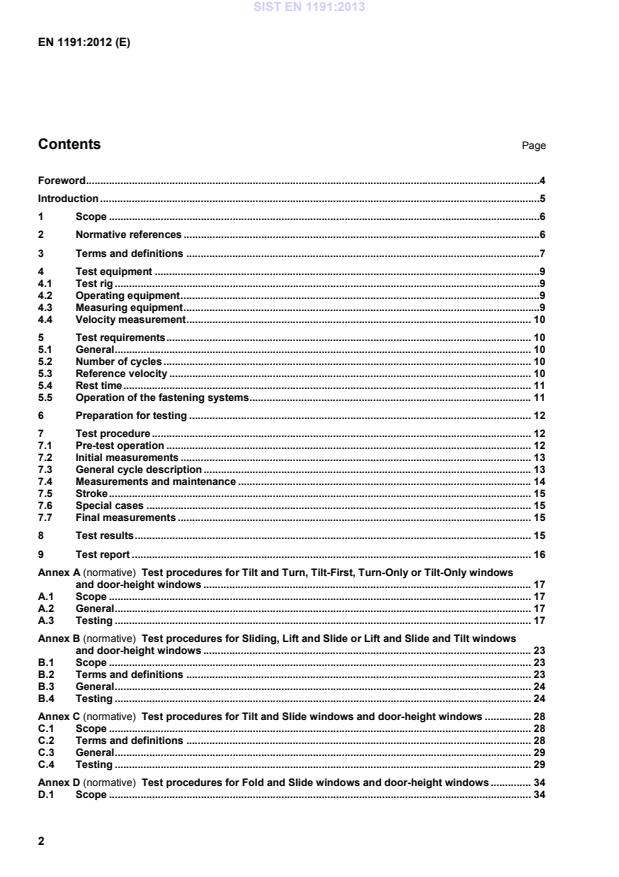
Page Foreword .4Introduction .51Scope .62Normative references .63Terms and definitions .74Test equipment .94.1Test rig .94.2Operating equipment .94.3Measuring equipment .94.4Velocity measurement . 105Test requirements . 105.1General . 105.2Number of cycles . 105.3Reference velocity . 105.4Rest time . 115.5Operation of the fastening systems. 116Preparation for testing . 127Test procedure . 127.1Pre-test operation . 127.2Initial measurements . 137.3General cycle description . 137.4Measurements and maintenance . 147.5Stroke . 157.6Special cases . 157.7Final measurements . 158Test results . 159Test report . 16Annex A (normative)
Test procedures for Tilt and Turn, Tilt-First, Turn-Only or Tilt-Only windows and door-height windows . 17A.1Scope . 17A.2General . 17A.3Testing . 17Annex B (normative)
Test procedures for Sliding, Lift and Slide or Lift and Slide and Tilt windows and door-height windows . 23B.1Scope . 23B.2Terms and definitions . 23B.3General . 24B.4Testing . 24Annex C (normative)
Test procedures for Tilt and Slide windows and door-height windows . 28C.1Scope . 28C.2Terms and definitions . 28C.3General . 29C.4Testing . 29Annex D (normative)
Test procedures for Fold and Slide windows and door-height windows . 34D.1Scope . 34SIST EN 1191:2013
Test procedures for horizontal or vertical pivot windows and door-height windows . 37E.1Scope . 37E.2Terms and definitions . 37E.3General . 38E.4Testing . 38Annex F (normative)
Test procedures for Vertical Sliding windows . 40F.1Scope . 40F.2Terms and definitions . 40F.3General . 41F.4Testing . 41Annex G (normative)
Test procedures for side-hung and top-hung windows, opening outwards (including reversible windows) . 43G.1Scope . 43G.2Terms and definitions . 43G.3General . 44G.4Testing . 44Annex H (normative)
Test procedures for side-hung pedestrian doorsets excluding power operated doors . 46H.1Scope . 46H.2Terms and definitions . 46H.3General . 47H.4Testing . 49Annex I (normative)
Test procedures for power-operated (automatic) side-hung single action pedestrian doorsets . 52I.1Scope . 52I.2Terms and definitions . 52I.3General . 52I.4Testing Test order . 52Bibliography . 54
It applies to all construction materials and operating systems for any window or pedestrian doorset, including gaskets and building hardware, in normal operating conditions.
The parts concerned in the testing are the frame, the opening component (including any additional moving components e.g. an inactive sash/leaf) and all essential and directly involved building hardware, including operating devices, for example, the handle. The testing does not include any hardware whose operation is not directly involved in the opening and closing of the moving components: added-on fastening systems such as peg-stays or cabin hooks or bolts, nor, unless specified, any independently installed stops (not connected to the complete assembly) such as a wall or ground-mounted stop. NOTE 1 The Annexes provide more details on the testing procedures that may differ from the main part of this European Standard and are mandatory: − Annex A applies to Tilt and Turn, Tilt-First, Turn-Only, or Tilt-Only windows and door-height windows; − Annex B applies to Sliding, Lift and Slide or Lift and Slide and Tilt windows and door-height windows; − Annex C applies to Tilt and Slide windows and door-height windows; − Annex D applies to Fold and Slide windows and door-height windows; − Annex E applies to horizontal and vertical pivot windows and door-height windows; − Annex F applies to Vertical Sliding windows; − Annex G applies to side-hung casements and top-hung windows, opening outwards (including reversible windows); − Annex H applies to side-hung single and double action pedestrian doorsets excluding power operated doors; − Annex I applies to power-operated (automatic) side-hung single action pedestrian doorsets. NOTE 2 In this European Standard the term door-height window is used for windows that are used for the passage of pedestrians, i.e. as a pedestrian doorset. 2 Normative references The following documents, in whole or in part, are normatively referenced in this document and are indispensable for its application. For dated references, only the edition cited applies. For undated references, the latest edition of the referenced document (including any amendments) applies. EN 179, Building hardware — Emergency exit devices operated by a lever handle or push pad, for use on escape routes — Requirements and test methods EN 1125, Building hardware — Panic exit devices operated by a horizontal bar, for use on escape routes — Requirements and test methods SIST EN 1191:2013
motion of the moving component as either translatory or rotary Note 1 to entry: Some hardware systems allow for a combination of several modes of operation, for example, Tilt and Turn windows or folding windows which combine rotary and translatory operations. 3.5 main mode of operation
intended principal type of operation and distance or angular travel as specified by the manufacturer
1) This document is impacted by the stand-alone amendment EN 1154:1996/A1:2002. 2) This document is impacted by the stand-alone amendment EN 1158:1997/A1:2002.
secondary type of operation intended for occasional use Note 1 to entry: Operating the moving component for cleaning or maintenance purposes is not considered a main or minor mode of operation. 3.7 cleaning or maintenance mode of operation
additional type of operation not in everyday use 3.8 cycle series of operations
Note 1 to entry: Involving opening a moving component, including releasing any fastening systems, moving open to the open position, returning to the closed position and re-engaging any fastening systems. The cycle might consist of several modes of operation that might be tested separately or combined. Note 2 to entry: For example, a Tilt and Slide window can be tested in a cycle combining the tilting and sliding operations or it can be tested separately by carrying out the tilt cycles first and then the sliding cycles. 3.9
part cycle series of operations applicable to a single mode of operation and/or limited distance or angular travel Note 1 to entry: If the test specimen can be operated in more than one main mode of operation, for example, tilting and sliding, the cycle may be tested in part cycles accordingly. In doing so, the part cycles need to be carried out in such a manner that no steps from the cycle are repeated. Note 2 to entry: All part cycles need to be carried out on the same test specimen. 3.10
number of cycles quantity of cycles completed applied to the cycle or part cycle accordingly Note 1 to entry: In accordance with the classification following EN 12400 or EN 14600 as appropriate. 3.11 operating device building hardware component, for example, the window or door handle, enabling the user to operate the fastening system and/or the moving component 3.12 fastening system
building hardware component or set that keeps the moving component in the closed and fastened position, i.e. latched and/or locked and/or electric systems
3.13 closing edge
outermost edge of the moving component furthest from the axis of rotation 3.14 reference velocity for translatory operation, actual velocity of the moving components; for rotary operation, velocity of the closing edge SIST EN 1191:2013
power operated pedestrian doorset and window doorset for pedestrian passage only/window with one or more moving components that is moved, at least in one direction, by an external energy supply (e.g. electrically) instead of manual or stored mechanical energy 4 Test equipment 4.1 Test rig The test rig shall be designed and constructed to be capable of adjustment for test specimens and shall be sufficiently rigid to withstand the induced forces without undue deflection.
Alternatively test specimen linked to prEN 16034 can be tested in supporting construction as described in EN 1634-1 in order to get a maximum range of direct application. A sub-frame may be used into which the test specimen is mounted. 4.2 Operating equipment 4.2.1 Motion controlled actuators — hydraulic, pneumatic or electric torque and linear cylinders or any appropriate mechanisms, having features consistent with: a) the reference velocities to be used; b) the mass of the moving component and the friction forces involved; c) the applied loads, if relevant, to produce dynamic forces; d) the duration of the test. 4.3 Measuring equipment The following equipment shall be used: cycle counter; velocity and time measurement equipment accurate to
± 5 %; force and mass measuring equipment accurate to ± 2 %; dynamometer and torque-meter accurate to ± 3 %; SIST EN 1191:2013
dial gauges and callipers accurate to ± 0,1 mm. 4.4 Velocity measurement The measurement of the reference velocity shall be carried out over a measuring distance with a maximum of 70 mm for turning and sliding and a max of 30 mm for tilting. The end of the measuring distance shall be at a distance of 505+− mm from the moving component’s position where the reference velocity shall be reached. In the case of asymmetrically positioned moving components, the reference velocity shall be measured on the main closing edge. NOTE Individual velocity measurements have been identified and are shown in the relevant Annexes. 5 Test requirements 5.1 General All specifications described in this European Standard shall be adhered to, unless stated otherwise in the Annexes. 5.2 Number of cycles The cycle is repeated either for a specified number of times or until failure occurs or the operating force set for the test is exceeded.
The number of cycles is either set prior to starting the test or the test is carried out until failure occurs. Each part cycle shall have the same number of part cycles as required for the mode of operation. NOTE The lowest number of part cycles causing failure is used for classification purposes. 5.3 Reference velocity 5.3.1 Manual operation The reference velocity of a manually operated moving component depends on its mass and on its operation which can be translatory, rotary, or tilting.
The reference velocities are specified in Table 1 with a tolerance of ± 10 %. SIST EN 1191:2013
200 < M ≤ 300 0,12 0,20 0,29
M > 300 0,10 0,18 0,25 For fire resisting and/or smoke control pedestrian doorsets and openable windows, refer to EN 14600. NOTE A consistent energy of 2,03 J (translatory), 1,56 J (rotary) and 3,125 J (tilt mode) is the basis for calculating the respective mass and velocity.
5.3.2 Mechanical operation 5.3.2.1 Self-closing devices If the moving component is mechanically operated, for example, via self-weight, springs or any other mechanism and if the velocity is adjustable, the reference velocity shall be set in accordance with the provisions laid down for opening and closing in the relevant product standard. For controlled door closing devices, opening and closing shall be set as specified in EN 1154. The uncontrolled door closing devices should refer to prEN 15887. If no product standard is available, or the product standard does not include any provisions for opening and closing, the reference velocity during a cycle or a part cycle shall be set as defined in Table 1. If not adjustable, the reference velocity shall be the actual velocity. 5.3.2.2 Power-operation The velocities for power-operated doorsets/windows shall be set to a present level by the client or stated in a relevant product standard, e.g. prEN 16361 or a supporting standard like EN 16005. 5.4 Rest time This shall be at least 1 s but shall not exceed 4 s for manually operated moving components. For motor operated moving components, the rest time shall be established with the client prior to the test. 5.5 Operation of the fastening systems For manually operated fastening systems the operating force applied by the operating equipment shall not exceed 150 % of the last measurement of the operating forces necessary to release and secure the fastening systems (see 7.4). If deemed necessary during the test, subsequent adjustments of the operating equipment may be carried out in order to enable the test to proceed. This operating force shall be determined in accordance with EN 12046-1 or EN 12046-2.
The operating forces shall be measured with moderate velocity, in a jerk-free and jolt-free manner.
The reference velocity in accordance with Table 1 shall be reached at an opening angle of 60 ° or 60 % of the stroke, and held up to an opening angle of 70° or 70 % of the stroke. Subsequently, the moving component shall be brought slowly to a halt via the operating equipment in a jerk-free and jolt-free manner by the time it has reached its designated final position. Once the predetermined opening is reached, the rest time specified in 5.4 shall be applied.
7.3.4.2 Opening system with restrictor On completion of the rest time, the moving component is set in motion accelerating in a jerk-free and jolt-free manner. The reference velocity in accordance with Table 1 shall be reached 505+− mm before the stopping/restricting position. After this, the moving component shall move freely into the stopping/restricting hardware at the open position. The rest time specified in 5.4 shall then be applied. SIST EN 1191:2013
Pedestrian doorsets or windows with latches and/or with automatic fastening devices: after reaching the closed position in the usual operating mode and during the test, the latch or fastening systems engage automatically. In this case no additional fastening system shall be engaged. b) Case B:
Pedestrian doorsets or windows without latches and/or without automatic fastening devices: after reaching the closed position in the usual operating mode and during the test, the fastening system shall be engaged by means of the operating equipment at the end of each closing cycle. The component should ‘move freely’ means that dynamic opening and closing forces should be applied. Ensure that the moving component is in the closed position, before the operation equipment applies a force on the operating device. EN 13115:2001, Table 1 specifies the resistance to operating forces for each class, for example, a hand operating device with a measured operating torque of between 5 Nm and 10 Nm, represents Class 1. Therefore, a force not greater than 100 N × 1,5 = (150 ± 10) N should be applied as the (gasket) compression force. 7.3.6 Next cycle On completion of the rest time, the next cycle or part cycle starts.
NOTE In the case of cycles, all main modes of operation are repeated to the specified number of part cycles or until failure. 7.4 Measurements and maintenance 7.4.1 General After every period, equal to 2 500 cycles or 25 % of the specified number of cycles, whichever is the greater, the test is halted and the specimen is examined and the operation forces are measured, Lubrication and adjustment of the test specimen hardware in accordance with the manufacturer's maintenance instructions can be carried out during the test, and the test is resumed in the defined conditions for the next period. 7.4.2 Termination criteria The test is completed if any of the following conditions occurs: material failure of any component that is essential to the function of the test specimen;
to the stopping position of the restrictor if this occurs at less than 70°. Moving components are operated from the closed position to at least 60 % of the fully open position, unless specified otherwise in the Annexes for other modes of operation. 7.6 Special cases 7.6.1 Minor mode of operation If in addition to the main mode of operation (see 3.5), a minor mode of operation is available within the same test specimen, this mode of operation shall be tested with 10 % of the main mode of operation’s number of cycles. The operation shall be carried out with moderate velocity as appropriate in intended use. If a relevant classification standard, for example EN 12400 or EN 14600, demands higher requirements/number of cycles, these have to be fulfilled.
7.6.2 Cleaning and maintenance mode of operation If in addition to the main and minor modes of operation (see 3.5 and 3.6), a cleaning and maintenance mode of operation is available within the same test specimen, this mode of operation shall be tested after the main and minor tests with the minimum of 2 % of the main mode of operation’s number of cycles for proper function. The reversible cycle testing shall be done with an additional 2 % of the total number of opening cycles required, up to a maximum of 250 cycles as a cleaning and maintenance mode of operation. This test can be carried out manually. 7.7 Final measurements Measurements in accordance with 7.2 shall be repeated. 8 Test results a) The number of cycles completed for each main and minor mode of operation; b) the stroke of the moving component; SIST EN 1191:2013
e) date of receipt of test item and date(s) of test; f) sampling report; g) details of the test method and any deviation from this standard; h) all necessary details to identify the window or door; i) all relevant details concerning the type, specified dimensions, materials, form and construction of the window or door, and its conformity with drawings provided by the manufacturer;
j) full details of the test specimen’s hardware, fittings and fixings; k) the mass of the tested moving component, the mode of operation; l) the dead load applied by the operating equipment on the moving component; m) whether or not the fastening system was operated; n) the frequency of lubrication and the extent of any adjustments carried out during the test; o) laboratory storage and testing conditions; p) the results expressed as in Clause 8; q) details of wear or failure of the specimen and when observed. For elements with closing devices the reference velocity of the leading edge, the time for the closing process, and closing moment of the door closing device have to be mentioned in the test report. SIST EN 1191:2013
Test procedures for Tilt and Turn, Tilt-First, Turn-Only or Tilt-Only windows and door-height windows A.1 Scope The test procedures described in this Annex shall be applied to finished manually and motor-operated elements (windows and door-height windows), in which the sashes can be brought into a Tilt-Only or Turn-Only mode as their predetermined main mode of operation. A.2 General All requirements specified in the general part of this standard shall be applied to Tilt and Turn, Tilt-First, Turn-Only and Tilt-Only windows and door-height windows, provided no deviating stipulations are listed in this Annex A. A.3 Testing A.3.1 Test order In the case of Tilt and Turn or Tilt-First windows and door-height windows, tilting the sash is the more commonly used operation mode. If the operation modes are to be tested separately, the test shall start with the tilt cycles. A.3.2 Part cycles A.3.2.1 Tilt cycles on hardware without positive control The tilt cycles shall be carried out with the following sequence: a) Initial position: The initial position of the window sash is the closed position. The fastening system is locked.
b) Standby tilt position: The fastening system is brought into the ‘standby tilt position’ via the operating device (e.g. the window handle) attached to the operating equipment. This is then followed by the rest time. c) Opening cycle; tilting: On completion of the rest time, the sash is then moved via the operating device with a reference velocity in accordance with Table 1 into the scissor-stay’s (projecting mechanism) final position, within 505+− mm before reaching the final tilt position. In this case, the sash shall move freely into the final tilt position (for example the operating device can be detached in a suitable manner: 505+− mm before reaching the final tilt position). The sash’s acceleration up to the specified reference velocity shall be carried out in a jerk-free and jolt-free manner. On reaching the final tilt position, this shall be followed by the rest time. SIST EN 1191:2013
f) On completion of the rest time, the next tilt cycle shall start. A.3.2.2 Tilt cycles on hardware with positive control Hardware with positive control can be used on Tilt and Turn, Tilt-First or Tilt-Only windows and door-height windows. On these hardware versions, the sash operation via the hardware enables manoeuvring the sash from the closed position into the tilted position respectively, from the tilted position into the closed position. The tilt cycles shall be carried out with the following sequence: a) Initial position: The initial position of the window sash is the closed position. The fastening system is locked. b) Opening cycle; tilting: The fastening system is brought into the ‘tilt position’ via the operating device (e.g. the window handle) attached to the operating equipment. The operation shall be carried out with moderate velocity as intended in use. This is then followed by the rest time.
c) Closing cycle; tilting: On completion of the rest time, the sash is moved back to its initial position via the operating device (e.g. the window handle) attached to the operating equipment. The operation shall be carried out with moderate velocity as intended in use. On reaching the closed position, this shall then be followed by the rest time. d) On completion of the rest time, the next tilt cycle shall start. On hardware systems where the sash movement cycle and the central fastening system’s operation are carried out separately, the op
...