

EN 3662-001:2024
(Main)Aerospace series - Circuit breakers, three-pole, temperature compensated, rated currents 20 A to 50 A - Part 001: Technical specification
General Information
- Abstract
This document specifies the three-pole temperature compensated circuit breakers with signal contacts, polarized or not, rated from 20 A to 50 A and used in aircraft on-board circuits. It describes specific environmental, electrical and mechanical characteristics and the stringency of tests to be applied according to test methods of EN 3841-100.
These circuit breakers are intended for use in aircraft with electrical supplies in accordance with EN 2282 (all categories).
- Status
- Published
- Publication Date
- 17-Dec-2024
- Technical Committee
- ASD-STAN - Aerospace
- Drafting Committee
- ASD-STAN/D 2/S 5 - Protection Devices
- Current Stage
- 6060 - Definitive text made available (DAV) - Publishing
- Start Date
- 18-Dec-2024
- Completion Date
- 18-Dec-2024

Overview
EN 3662-001:2024 - "Aerospace series - Circuit breakers, three-pole, temperature compensated, rated currents 20 A to 50 A - Part 001: Technical specification" is a CEN standard that defines design, performance and test requirements for three-pole, temperature‑compensated circuit breakers used in aircraft on‑board electrical circuits. The standard covers circuit breakers with signal contacts (polarized or not) rated from 20 A to 50 A, intended for electrical systems compliant with EN 2282. It supersedes EN 3662-001:2006 and references the EN 3841 test-method series.
Key topics and technical requirements
- Scope and ratings: Specifies three‑pole circuit breakers, temperature compensated, rated currents 20 A–50 A, with associated signal contacts and nominal voltages for aircraft use.
- Design requirements:
- Push‑pull single actuator with trip‑free delayed action (cannot be held engaged during overload).
- Insulating box integrating mechanism, connections and attachment.
- Corrosion‑resistant metallic parts and auto‑extinguishing/non‑flammable insulation materials.
- Indication and actuator design rules (colour coding, white strip when open, non‑removable actuator).
- Materials and safety:
- Restrictions on toxic or smoke‑generating materials; protection against galvanic corrosion (electromotive force limits).
- Prohibition of coatings that crack or flake.
- Testing and qualification:
- Uses EN 3841-100 and related EN 3841 parts for visual, mechanical, environmental and electrical tests (vibration, shock, dielectric strength, insulation resistance, short‑circuit performance, thermal and flammability tests).
- Includes sampling, material tests and periodic qualification maintenance.
- Marking, packaging and storage: Requirements for marking, delivery conditions, packaging and storage duration/conditions.
Applications and users
EN 3662-001:2024 is practical for:
- Aircraft electrical equipment manufacturers and component suppliers developing three‑pole circuit breakers for avionics and power distribution.
- Avionics and electrical system designers specifying temperature‑compensated circuit protection for aircraft operating under EN 2282 power systems.
- Quality, test and certification laboratories performing environmental, mechanical and electrical qualification per the EN 3841 test methods.
- Procurement, airworthiness and maintenance organizations ensuring compliance with European aerospace standards.
Related standards
Key referenced standards include:
- EN 3841 series (circuit breaker test methods - Parts 100–511)
- EN 2282 (aircraft electrical supplies)
- EN 2083, EN 2825, EN 2826 (material and burning/flammability tests)
- EN 3844-1 (flammability small burner test)
- Relevant MIL installation/tooling references as cited
EN 3662-001:2024 provides a comprehensive technical specification for reliable, certified three‑pole circuit breakers in modern aircraft electrical systems, helping manufacturers and engineers meet consistent safety and performance expectations.
Relations
- Effective Date
- 26-Feb-2023
- Refers
EN 3841-201:2004 - Aerospace series - Circuit breakers - Test methods - Part 201: Visual inspection - Effective Date
- 28-Jan-2026
- Refers
EN 3841-301:2004 - Aerospace series - Circuit breakers - Test methods - Part 301: Voltage drop - Effective Date
- 28-Jan-2026
- Effective Date
- 28-Jan-2026
- Effective Date
- 28-Jan-2026
- Effective Date
- 28-Jan-2026
- Refers
EN 3841-401:2004 - Aerospace series - Circuit breakers - Test methods - Part 401: Sand and dust - Effective Date
- 28-Jan-2026
- Effective Date
- 28-Jan-2026
- Refers
EN 3841-304:2004 - Aerospace series - Circuit breakers - Test methods - Part 304: Tripping points - Effective Date
- 28-Jan-2026
- Effective Date
- 28-Jan-2026
- Effective Date
- 28-Jan-2026
- Refers
EN 3841-406:2004 - Aerospace series - Circuit breakers - Test methods - Part 406: Flammability - Effective Date
- 28-Jan-2026
- Effective Date
- 28-Jan-2026
- Effective Date
- 28-Jan-2026
- Effective Date
- 28-Jan-2026
Get Certified
Connect with accredited certification bodies for this standard

BUREAU VERITAS Certification Germany
Bureau Veritas certification in Germany.

Element Materials Technology
Materials testing and product certification.

AQMS Ltd.
AQMS provides ISO certification to SMEs across the UK.
Sponsored listings
Frequently Asked Questions
EN 3662-001:2024 is a standard published by the European Committee for Standardization (CEN). Its full title is "Aerospace series - Circuit breakers, three-pole, temperature compensated, rated currents 20 A to 50 A - Part 001: Technical specification". This standard covers: This document specifies the three-pole temperature compensated circuit breakers with signal contacts, polarized or not, rated from 20 A to 50 A and used in aircraft on-board circuits. It describes specific environmental, electrical and mechanical characteristics and the stringency of tests to be applied according to test methods of EN 3841-100. These circuit breakers are intended for use in aircraft with electrical supplies in accordance with EN 2282 (all categories).
This document specifies the three-pole temperature compensated circuit breakers with signal contacts, polarized or not, rated from 20 A to 50 A and used in aircraft on-board circuits. It describes specific environmental, electrical and mechanical characteristics and the stringency of tests to be applied according to test methods of EN 3841-100. These circuit breakers are intended for use in aircraft with electrical supplies in accordance with EN 2282 (all categories).
EN 3662-001:2024 is classified under the following ICS (International Classification for Standards) categories: 49.060 - Aerospace electric equipment and systems. The ICS classification helps identify the subject area and facilitates finding related standards.
EN 3662-001:2024 has the following relationships with other standards: It is inter standard links to EN 3662-001:2006, EN 3841-201:2004, EN 3841-301:2004, EN 3841-501:2004, EN 3841-503:2004, EN 3841-505:2004, EN 3841-401:2004, EN 3841-303:2004, EN 3841-304:2004, EN 3841-511:2004, EN 3841-504:2004, EN 3841-406:2004, EN 3841-100:2024, EN 3841-308:2004, EN 3841-402:2004. Understanding these relationships helps ensure you are using the most current and applicable version of the standard.
EN 3662-001:2024 is available in PDF format for immediate download after purchase. The document can be added to your cart and obtained through the secure checkout process. Digital delivery ensures instant access to the complete standard document.
Standards Content (Sample)
SLOVENSKI STANDARD
01-marec-2025
Aeronavtika - Odklopniki, tripolni, temperaturno kompenzirani, naznačeni tok od
20 A do 50 A - 001. del: Tehnična specifikacija
Aerospace series - Circuit breakers, three-pole, temperature compensated, rated
currents 20 A to 50 A - Part 001: Technical specification
Luft- und Raumfahrt - Schutzschalter, dreipolig, Temperaturkompensiert, Nennströme
von 20 A bis 50 A - Teil 001: Technische Lieferbedingungen
Série aérospatiale - Disjoncteurs tripolaires compensés en température, intensités
nominales 20 A à 50 A - Partie 001 : Spécification technique
Ta slovenski standard je istoveten z: EN 3662-001:2024
ICS:
49.060 Letalska in vesoljska Aerospace electric
električna oprema in sistemi equipment and systems
2003-01.Slovenski inštitut za standardizacijo. Razmnoževanje celote ali delov tega standarda ni dovoljeno.
EN 3662-001
EUROPEAN STANDARD
NORME EUROPÉENNE
December 2024
EUROPÄISCHE NORM
ICS 49.060 Supersedes EN 3662-001:2006
English Version
Aerospace series - Circuit breakers, three-pole,
temperature compensated, rated currents 20 A to 50 A -
Part 001: Technical specification
Série aérospatiale - Disjoncteurs tripolaires compensés Luft- und Raumfahrt - Schutzschalter, dreipolig,
en température, intensités nominales 20 A à 50 A - temperaturkompensiert, Nennströme von 20 A bis 50
Partie 001 : Spécification technique A - Teil 001: Technische Lieferbedingungen
This European Standard was approved by CEN on 6 October 2024.
CEN members are bound to comply with the CEN/CENELEC Internal Regulations which stipulate the conditions for giving this
European Standard the status of a national standard without any alteration. Up-to-date lists and bibliographical references
concerning such national standards may be obtained on application to the CEN-CENELEC Management Centre or to any CEN
member.
This European Standard exists in three official versions (English, French, German). A version in any other language made by
translation under the responsibility of a CEN member into its own language and notified to the CEN-CENELEC Management
Centre has the same status as the official versions.
CEN members are the national standards bodies of Austria, Belgium, Bulgaria, Croatia, Cyprus, Czech Republic, Denmark, Estonia,
Finland, France, Germany, Greece, Hungary, Iceland, Ireland, Italy, Latvia, Lithuania, Luxembourg, Malta, Netherlands, Norway,
Poland, Portugal, Republic of North Macedonia, Romania, Serbia, Slovakia, Slovenia, Spain, Sweden, Switzerland, Türkiye and
United Kingdom.
EUROPEAN COMMITTEE FOR STANDARDIZATION
COMITÉ EUROPÉEN DE NORMALISATION
EUROPÄISCHES KOMITEE FÜR NORMUNG
CEN-CENELEC Management Centre: Rue de la Science 23, B-1040 Brussels
© 2024 CEN All rights of exploitation in any form and by any means reserved Ref. No. EN 3662-001:2024 E
worldwide for CEN national Members.
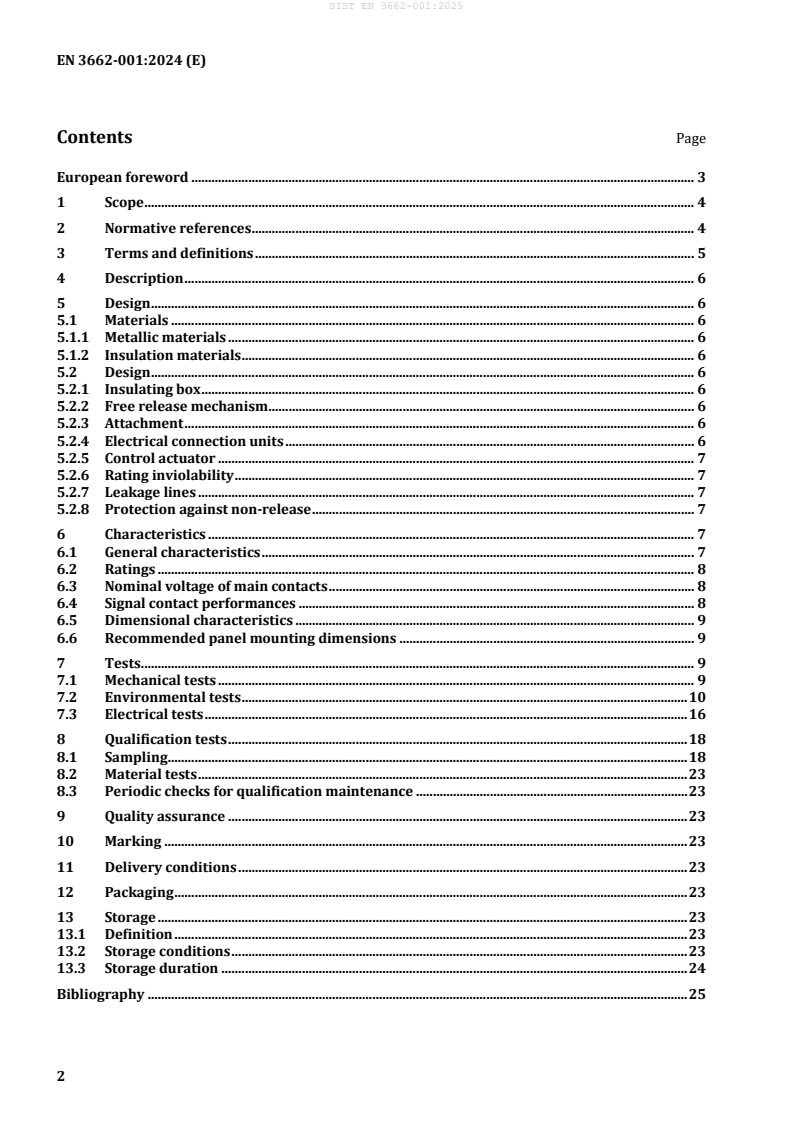
Contents Page
European foreword . 3
1 Scope . 4
2 Normative references . 4
3 Terms and definitions . 5
4 Description . 6
5 Design . 6
5.1 Materials . 6
5.1.1 Metallic materials . 6
5.1.2 Insulation materials . 6
5.2 Design . 6
5.2.1 Insulating box . 6
5.2.2 Free release mechanism . 6
5.2.3 Attachment . 6
5.2.4 Electrical connection units . 6
5.2.5 Control actuator . 7
5.2.6 Rating inviolability . 7
5.2.7 Leakage lines . 7
5.2.8 Protection against non-release . 7
6 Characteristics . 7
6.1 General characteristics . 7
6.2 Ratings . 8
6.3 Nominal voltage of main contacts . 8
6.4 Signal contact performances . 8
6.5 Dimensional characteristics . 9
6.6 Recommended panel mounting dimensions . 9
7 Tests . 9
7.1 Mechanical tests . 9
7.2 Environmental tests . 10
7.3 Electrical tests . 16
8 Qualification tests . 18
8.1 Sampling . 18
8.2 Material tests . 23
8.3 Periodic checks for qualification maintenance . 23
9 Quality assurance . 23
10 Marking . 23
11 Delivery conditions . 23
12 Packaging . 23
13 Storage . 23
13.1 Definition . 23
13.2 Storage conditions . 23
13.3 Storage duration . 24
Bibliography . 25
European foreword
This document (EN 3662-001:2024) has been prepared by ASD-STAN.
After enquiries and votes carried out in accordance with the rules of this Association, this document has
received the approval of the National Associations and the Official Services of the member countries of
ASD-STAN, prior to its presentation to CEN.
This document shall be given the status of a national standard, either by publication of an identical text
or by endorsement, at the latest by June 2025, and conflicting national standards shall be withdrawn at
the latest by June 2025.
Attention is drawn to the possibility that some of the elements of this document may be the subject of
patent rights. CEN shall not be held responsible for identifying any or all such patent rights.
This document supersedes EN 3662-001:2006.
The main changes with respect to the previous edition are as follows:
— EN 3662-001 (P4), 08/2006:
o g replaced by g-PK for sinusoidal and low frequencies;
n
o g replaced by Grms for random.
n
According to the CEN-CENELEC Internal Regulations, the national standards organizations of the
following countries are bound to implement this document: Austria, Belgium, Bulgaria, Croatia, Cyprus,
Czech Republic, Denmark, Estonia, Finland, France, Germany, Greece, Hungary, Iceland, Ireland, Italy,
Latvia, Lithuania, Luxembourg, Malta, Netherlands, Norway, Poland, Portugal, Republic of North
Macedonia, Romania, Serbia, Slovakia, Slovenia, Spain, Sweden, Switzerland, Türkiye and the
United Kingdom.
1 Scope
This document specifies the three-pole temperature compensated circuit breakers with signal contacts,
polarized or not, rated from 20 A to 50 A and used in aircraft on-board circuits. It describes specific
environmental, electrical and mechanical characteristics and the stringency of tests to be applied
according to test methods of EN 3841-100.
These circuit breakers are intended for use in aircraft with electrical supplies in accordance with
EN 2282.
2 Normative references
The following documents are referred to in the text in such a way that some or all of their content
constitutes requirements of this document. For dated references, only the edition cited applies. For
undated references, the latest edition of the referenced document (including any amendments) applies.
EN 2083, Aerospace series — Copper or copper alloy conductors for electrical cables — Product standard
EN 2825, Aerospace series — Burning behaviour of non-metallic materials under the influence of
radiating heat and flames — Determination of smoke density
EN 2826, Aerospace series — Burning behaviour of non-metallic materials under the influence of
radiating heat and flames — Determination of gas components in the smoke
EN 3841-100, Aerospace series — Circuit breakers — Test methods — Part 100: General
EN 3841-201, Aerospace series — Circuit breakers — Test methods — Part 201: Visual inspection
EN 3841-202, Aerospace series — Circuit breakers — Test methods — Part 202: Dimensions and masses
EN 3841-301:2004, Aerospace series — Circuit breakers — Test methods — Part 301: Voltage drop
EN 3841-302, Aerospace series — Circuit breakers — Test methods — Part 302: Insulation resistance
EN 3841-303, Aerospace series — Circuit breakers — Test methods — Part 303: Dielectric strength
EN 3841-304, Aerospace series — Circuit breakers — Test methods — Part 304: Tripping points
EN 3841-305, Aerospace series — Circuit breakers — Test methods — Part 305: Short-circuit performance
EN 3841-306, Aerospace series — Circuit breakers — Test methods — Part 306: Service life
EN 3841-307, Aerospace series — Circuit breakers — Test methods — Part 307: Performance with a
locked tripping system
EN 3841-308, Aerospace series — Circuit breakers — Test methods — Part 308: Lightning
EN 3841-401, Aerospace series — Circuit breakers — Test methods — Part 401: Sand and dust
EN 3841-402, Aerospace series — Circuit breakers — Test methods — Part 402: Corrosion
Published as ASD-STAN prEN at the date of publication of this document, available at:
https://www.asd-stan.org/.
EN 3841-403, Aerospace series — Circuit breakers — Test methods — Part 403: Humidity
EN 3841-405, Aerospace series — Circuit breakers — Test methods — Part 405: Fluid resistance
EN 3841-406, Aerospace series — Circuit breakers — Test methods — Part 406: Flammability
EN 3841-501, Aerospace series — Circuit breakers — Test methods — Part 501: Actuator button travel
EN 3841-502, Aerospace series — Circuit breakers — Test methods — Part 502: Operating forces
EN 3841-503, Aerospace series — Circuit breakers — Test methods — Part 503: Strength of actuating
components
EN 3841-504, Aerospace series — Circuit breakers — Test methods — Part 504: Strength of mounting elements
EN 3841-505, Aerospace series — Circuit breakers — Test methods — Part 505: Strength of main terminals
EN 3841-506, Aerospace series — Circuit breakers — Test methods — Part 506: Vibration performance
EN 3841-507, Aerospace series — Circuit breakers — Test methods — Part 507: Mechanical shocks
EN 3841-508, Aerospace series — Circuit breakers — Test methods — Part 508: Centrifugal acceleration
EN 3841-509, Aerospace series — Circuit breakers — Test methods — Part 509: Insertion and extraction
forces of signal contact terminals
EN 3841-510, Aerospace series — Circuit breakers — Test methods — Part 510: Strength of signal contact
terminals
EN 3841-511, Aerospace series — Circuit breakers — Test methods — Part 511: Combined test:
temperature, altitude and vibration
EN 3844-1, Aerospace series — Flammability of non-metallic materials — Part 1: Small burner test,
vertical — Determination of the vertical flame propagation
MIL-I-81969/1A, Installing and removal tools, connector electrical contact, type III, class 2,
composition C
MIL-I-81969/14C, Installing and removal tools, connector electrical contact, type III, class 2,
composition B
3 Terms and definitions
For the purposes of this document, the terms and definitions given in EN 3841-100 apply.
ISO and IEC maintain terminology databases for use in standardization at the following addresses:
— ISO Online browsing platform: available at https://www.iso.org/obp/
— IEC Electropedia: available at https://www.electropedia.org/
Published by Department of Defense (DOD), available at: https://assist.dla.mil/online/start/.
4 Description
These circuit breakers are operated by a “push-pull” type single push button (actuator) and with
delayed action “trip-free” tripping. Their function is ensured up to the short-circuit current.
5 Design
5.1 Materials
5.1.1 Metallic materials
All metallic parts shall be resistant to corrosion or finished against corrosion. When dissimilar materials
are in close contact, an adequate protection against corrosion shall be used so that the electromotive
force of the galvanic couple does not exceed 0,25 V.
When bimetals are used, an eventual corrosion shall not affect the good operation of the circuit breaker.
5.1.2 Insulation materials
The insulating parts shall be made of auto-extinguishing or non-flammable materials; they shall not
emit damaging or explosive vapours, even in presence of fire or internal electric arc.
They shall be insensitive to moulds and microorganisms' action.
Application of any material or protective coating, which might crack, break or flake shall be forbidden.
Materials which are not specified, or which are not specially described, shall be as light as possible for
the requested use.
Materials shall be selected according to security criteria (toxicity, smoke density) as defined in
contractual documents.
5.2 Design
5.2.1 Insulating box
The insulating box shall integrate besides the mechanism, the connection and attachment unit.
5.2.2 Free release mechanism
Design of circuit breaker mechanism shall allow free release, i.e. the circuit breaker cuts out in case of
overload and remains cut out even if the actuator is kept by force in engaged position.
A new engagement of circuit breaker is only possible after a first total release of the control actuator.
The operation in these conditions shall not affect further performances of the circuit breaker.
5.2.3 Attachment
All visible parts shall be black coloured and non-reflective.
5.2.4 Electrical connection units
They shall be able to receive the lugs (or contacts).
5.2.5 Control actuator
In engaged position, the visible part of the control actuator shall be of the colour stated in the product
standard. In disengaged (or opened) position, the control actuator shall show a white strip.
The outer part of this actuator shall be isolated from all under voltage parts.
The control actuator shall not stay in a transition position or give a false indication about the circuit
breaker condition. It shall not be removable.
When pushing it, power contacts of the circuit breaker engage and indicating contact opens.
When pulling it, power contacts of the circuit breaker open and indicating contact closes.
The circuit breaker rating is indicated in indelible white colour on the front part of the control actuator.
The product standard gives the digits positioning.
5.2.6 Rating inviolability
The circuit breaker shall be designed in such a way that the calibration unit cannot be reached without
breaking a sealing.
5.2.7 Leakage lines
The leakage lines and the minimal space to be foreseen between the under-voltage parts and any other
part of the circuit breaker made of non-insulating material, as well as between the undervoltage parts of
opposite polarity, shall be sufficient to avoid any default or arc tracking in all uses and climatic
conditions.
5.2.8 Protection against non-release
Electrical overload happening on a circuit breaker locked in its engaged position (sticked contacts or
non-operating release mechanism), shall cause the opening of the circuit-by-circuit breaker destruction
without any fire or important smoke release.
6 Characteristics
6.1 General characteristics
General characteristics shall be according to Table 1.
Table 1 — General characteristics
Designation Requirements
Assembly See product standard.
Mass See product standard.
Operational altitude See product standard.
Power contact connection See product standard.
Three input terminals on power supply side
(identified by digit A1, B1, C1)
Three output terminals on distribution side
(identified by digit A2, B2, C2)
Signal contact connection, circuit closed Crimp contacts size 20
when circuit breaker is on release See product standard.
Operational ambient temperatures limits From −55 °C to 90 °C
Temperature compensation From −55 °C to 90 °C
See product standard.
Rating marking On control actuator (indelible white)
6.2 Ratings
See product standard.
6.3 Nominal voltage of main contacts
See product standard.
6.4 Signal contact performances
Signa
...