

EN 3841-100:2024
(Main)Aerospace series - Circuit breakers - Test methods - Part 100: General
- Abstract
This document specifies the general conditions for test methods applicable to circuit breakers for aerospace applications.
- Status
- Published
- Publication Date
- 01-Oct-2024
- Technical Committee
- ASD-STAN - Aerospace
- Drafting Committee
- ASD-STAN/D 2/S 5 - Protection Devices
- Current Stage
- 6060 - Definitive text made available (DAV) - Publishing
- Start Date
- 02-Oct-2024
- Completion Date
- 02-Oct-2024

Overview - EN 3841-100:2024 (Aerospace circuit breakers - Test methods - Part 100: General)
EN 3841-100:2024 defines the general conditions and common requirements for test methods applied to circuit breakers used in aerospace equipment and systems. Published by CEN and approved in 2024, this part establishes environmental, mechanical mounting and electrical connection conditions, the list of test methods in the EN 3841 series, and rules for qualification retention and quality assurance.
Key topics and technical requirements
- Environmental conditions: Default test environment is ambient temperature (23 ± 5) °C, atmospheric pressure 840–1 070 hPa, relative humidity ≤ 85%.
- Mechanical mounting: Mechanical tests require breakers mounted in their normal position on a metal plate (minimum 2 mm thickness). Mounting apparatus must be free from resonance per MIL‑STD‑202 Method 201A.
- Thermal mounting: Thermal tests require minimum spacing between devices as specified in the product standard.
- Electrical connection requirements:
- Test cables: typically (1 ± 0,1) m long; inter-device connecting cables 0,5 m when breakers/poles are in series.
- Cable lugs must be compatible with terminals; power blade crimped receptacles are specified for 6,3 mm blade devices per referenced product standards.
- List of test methods: The document references the EN 3841 series covering:
- Physical: visual inspection, dimensions and mass
- Electrical: voltage drop, insulation resistance, dielectric strength, tripping points, short‑circuit performance, service life, lightning
- Environmental: sand/dust, corrosion, humidity, explosion proofness, fluid resistance, flammability, temperature variation
- Mechanical: actuator travel, operating forces, strength of actuating/mounting/terminals, vibration, shock, centrifugal acceleration, insertion/extraction forces, combined temperature/altitude/vibration
- Qualification retention:
- Retention test sample size: ten breakers per style (5 low‑range and 5 high‑range ratings).
- Required test report: material/specification certifications and a summary of quality conformance results (pass/fail counts and corrective actions).
Applications and who uses this standard
- Manufacturers of aerospace circuit breakers for design verification and production testing.
- Test laboratories and OEM test engineers implementing standardized test setups, environmental conditions, mounting and connection protocols.
- Procurement and certification bodies using EN 3841-100 to verify supplier compliance and qualification retention.
- Maintenance, repair and overhaul (MRO) organizations referencing appropriate test procedures for in-service validation.
Related standards
- EN 2995 series (product specifications), EN 3773/3774 (blade terminals), the EN 3841 test-method parts (201–511), IEC 60050‑441 (terminology), MIL‑STD‑202 (resonance method), and EN 9133 (quality assurance / qualification procedure).
Keywords: EN 3841-100:2024, aerospace circuit breakers, test methods, qualification retention, environmental conditions, mounting conditions, electrical tests, CEN.
Relations
- Effective Date
- 19-Jan-2023
- Effective Date
- 25-Aug-2026
- Refers
EN 3841-406:2004 - Aerospace series - Circuit breakers - Test methods - Part 406: Flammability - Effective Date
- 28-Jan-2026
- Effective Date
- 28-Jan-2026
- Effective Date
- 28-Jan-2026
- Effective Date
- 28-Jan-2026
- Effective Date
- 28-Jan-2026
- Effective Date
- 28-Jan-2026
- Effective Date
- 28-Jan-2026
- Effective Date
- 28-Jan-2026
- Effective Date
- 28-Jan-2026
- Referred By
EN 3841-304:2004 - Aerospace series - Circuit breakers - Test methods - Part 304: Tripping points - Effective Date
- 28-Jan-2026
- Effective Date
- 28-Jan-2026
- Effective Date
- 28-Jan-2026
- Effective Date
- 28-Jan-2026
Get Certified
Connect with accredited certification bodies for this standard

BUREAU VERITAS Certification Germany
Bureau Veritas certification in Germany.

Element Materials Technology
Materials testing and product certification.

AQMS Ltd.
AQMS provides ISO certification to SMEs across the UK.
Sponsored listings
Frequently Asked Questions
EN 3841-100:2024 is a standard published by the European Committee for Standardization (CEN). Its full title is "Aerospace series - Circuit breakers - Test methods - Part 100: General". This standard covers: This document specifies the general conditions for test methods applicable to circuit breakers for aerospace applications.
This document specifies the general conditions for test methods applicable to circuit breakers for aerospace applications.
EN 3841-100:2024 is classified under the following ICS (International Classification for Standards) categories: 49.060 - Aerospace electric equipment and systems. The ICS classification helps identify the subject area and facilitates finding related standards.
EN 3841-100:2024 has the following relationships with other standards: It is inter standard links to EN 3841-100:2004, IEC 60050-441:1984, EN 3841-406:2004, EN 2995-001:2023, EN ISO 3680:2004, EN 2995-006:2023, EN 3774-006:2023, EN 3841-307:2004, EN 3841-303:2004, EN 2665-001:2023, EN 3841-407:2004, EN 3841-304:2004, EN 3841-506:2004, EN 3662-001:2024, EN 3841-202:2004. Understanding these relationships helps ensure you are using the most current and applicable version of the standard.
EN 3841-100:2024 is available in PDF format for immediate download after purchase. The document can be added to your cart and obtained through the secure checkout process. Digital delivery ensures instant access to the complete standard document.
Standards Content (Sample)
SLOVENSKI STANDARD
01-december-2024
Aeronavtika - Odklopniki - Preskusne metode - 100. del: Splošno
Aerospace series - Circuit breakers - Test methods - Part 100: General
Luft- und Raumfahrt - Schutzschalter - Prüfverfahren - Teil 100: Allgemeines
Série aérospatiale - Disjoncteurs - Méthodes d’essais - Partie 100 : Généralités
Ta slovenski standard je istoveten z: EN 3841-100:2024
ICS:
49.060 Letalska in vesoljska Aerospace electric
električna oprema in sistemi equipment and systems
2003-01.Slovenski inštitut za standardizacijo. Razmnoževanje celote ali delov tega standarda ni dovoljeno.
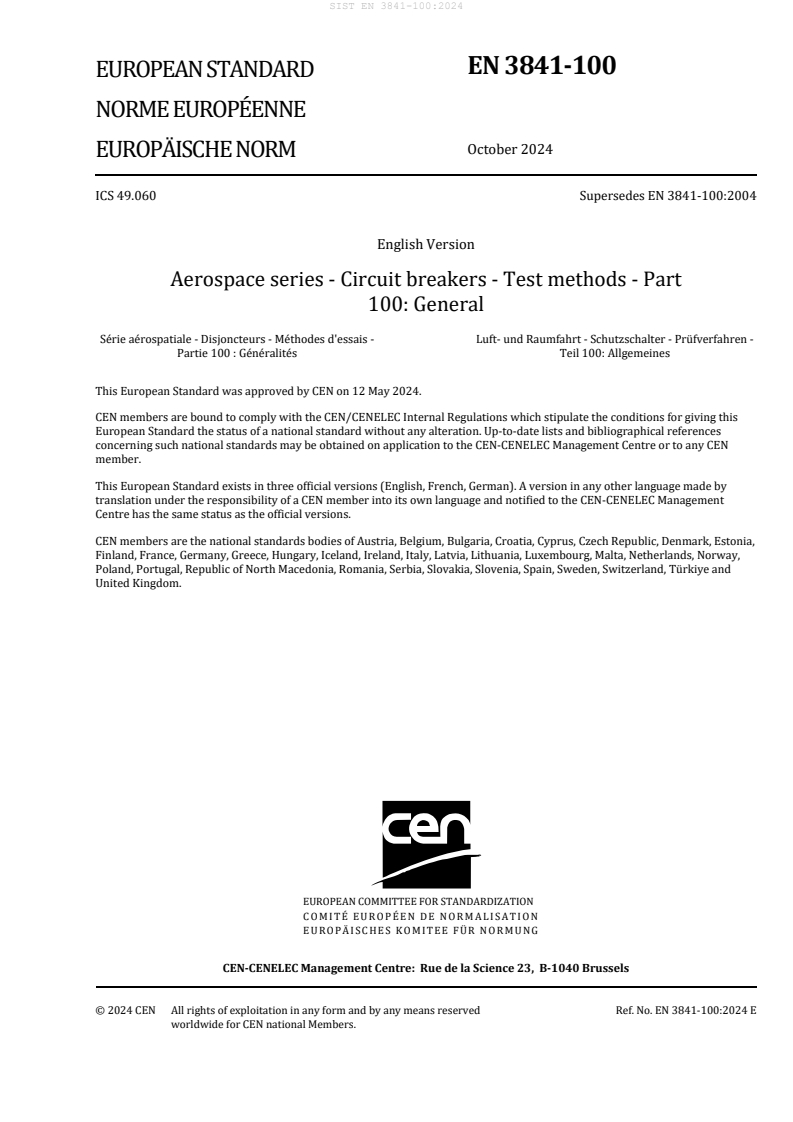
EN 3841-100
EUROPEAN STANDARD
NORME EUROPÉENNE
October 2024
EUROPÄISCHE NORM
ICS 49.060 Supersedes EN 3841-100:2004
English Version
Aerospace series - Circuit breakers - Test methods - Part
100: General
Série aérospatiale - Disjoncteurs - Méthodes d'essais - Luft- und Raumfahrt - Schutzschalter - Prüfverfahren -
Partie 100 : Généralités Teil 100: Allgemeines
This European Standard was approved by CEN on 12 May 2024.
CEN members are bound to comply with the CEN/CENELEC Internal Regulations which stipulate the conditions for giving this
European Standard the status of a national standard without any alteration. Up-to-date lists and bibliographical references
concerning such national standards may be obtained on application to the CEN-CENELEC Management Centre or to any CEN
member.
This European Standard exists in three official versions (English, French, German). A version in any other language made by
translation under the responsibility of a CEN member into its own language and notified to the CEN-CENELEC Management
Centre has the same status as the official versions.
CEN members are the national standards bodies of Austria, Belgium, Bulgaria, Croatia, Cyprus, Czech Republic, Denmark, Estonia,
Finland, France, Germany, Greece, Hungary, Iceland, Ireland, Italy, Latvia, Lithuania, Luxembourg, Malta, Netherlands, Norway,
Poland, Portugal, Republic of North Macedonia, Romania, Serbia, Slovakia, Slovenia, Spain, Sweden, Switzerland, Türkiye and
United Kingdom.
EUROPEAN COMMITTEE FOR STANDARDIZATION
COMITÉ EUROPÉEN DE NORMALISATION
EUROPÄISCHES KOMITEE FÜR NORMUNG
CEN-CENELEC Management Centre: Rue de la Science 23, B-1040 Brussels
© 2024 CEN All rights of exploitation in any form and by any means reserved Ref. No. EN 3841-100:2024 E
worldwide for CEN national Members.
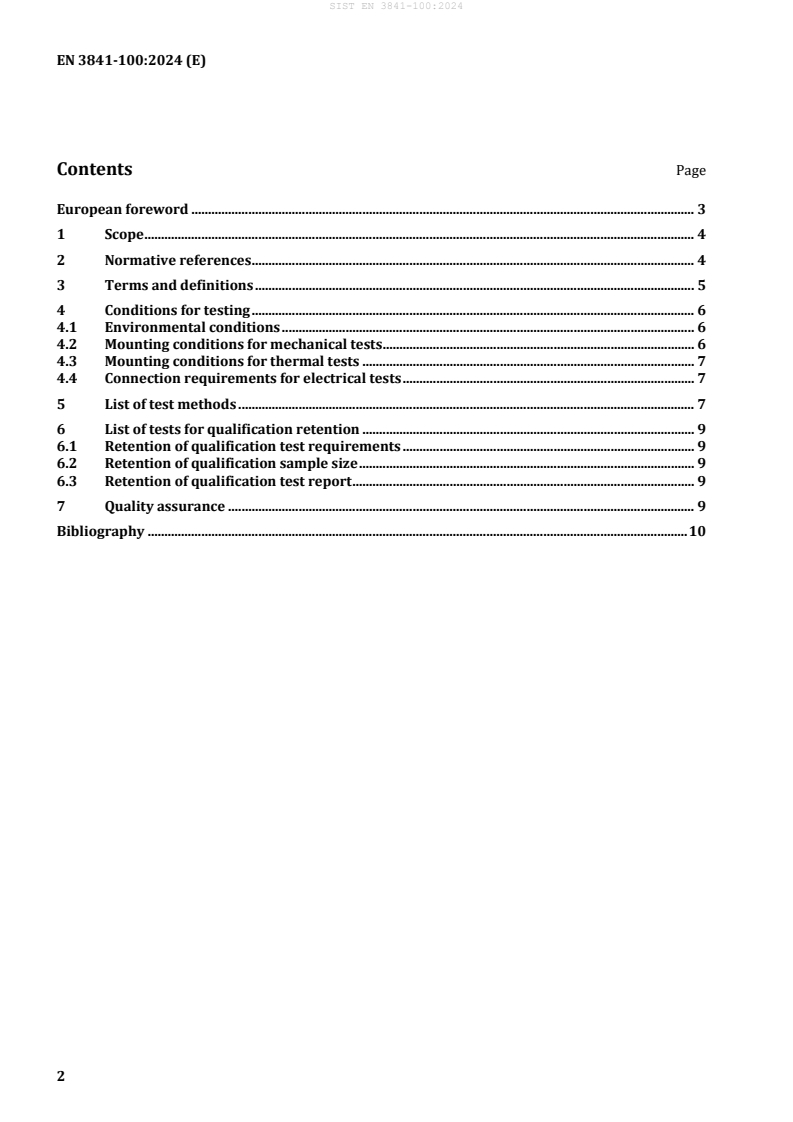
Contents Page
European foreword . 3
1 Scope . 4
2 Normative references . 4
3 Terms and definitions . 5
4 Conditions for testing . 6
4.1 Environmental conditions . 6
4.2 Mounting conditions for mechanical tests . 6
4.3 Mounting conditions for thermal tests . 7
4.4 Connection requirements for electrical tests . 7
5 List of test methods . 7
6 List of tests for qualification retention . 9
6.1 Retention of qualification test requirements . 9
6.2 Retention of qualification sample size . 9
6.3 Retention of qualification test report . 9
7 Quality assurance . 9
Bibliography . 10
European foreword
This document (EN 3841-100:2024) has been prepared by ASD-STAN.
After enquiries and votes carried out in accordance with the rules of this Association, this document has
received the approval of the National Associations and the Official Services of the member countries of
ASD-STAN, prior to its presentation to CEN.
This document shall be given the status of a national standard, either by publication of an identical text
or by endorsement, at the latest by April 2025, and conflicting national standards shall be withdrawn at
the latest by April 2025.
Attention is drawn to the possibility that some of the elements of this document may be the subject of
patent rights. CEN shall not be held responsible for identifying any or all such patent rights.
This document supersedes EN 3841-100:2004.
The main changes with respect to the previous edition are as follows:
— EN 3841-100 (P2), 12/2004 — General editorial improvements and update to include 6,3 mm
blade circuit breaker test method and to add retention of qualification.
According to the CEN-CENELEC Internal Regulations, the national standards organizations of the
following countries are bound to implement this document: Austria, Belgium, Bulgaria, Croatia, Cyprus,
Czech Republic, Denmark, Estonia, Finland, France, Germany, Greece, Hungary, Iceland, Ireland, Italy,
Latvia, Lithuania, Luxembourg, Malta, Netherlands, Norway, Poland, Portugal, Republic of North
Macedonia, Romania, Serbia, Slovakia, Slovenia, Spain, Sweden, Switzerland, Türkiye and the United
Kingdom.
1 Scope
This document specifies the general conditions for test methods applicable to circuit breakers for
aerospace applications.
2 Normative references
The following documents are referred to in the text in such a way that some or all of their content
constitutes requirements of this document. For dated references, only the edition cited applies. For
undated references, the latest edition of the referenced document (including any amendments) applies.
EN 2995-001:2023, Aerospace series — Circuit breakers, single-pole, temperature compensated, rated
currents 1 A to 25 A — Part 001: Technical specification
EN 2995-006, Aerospace series — Circuit breakers, single-pole, temperature compensated, rated currents
1 A to 25 A — Part 006: 6,3 mm & 2,8 mm blade terminal with polarized signal contact —
Product standard
EN 3773-006, Aerospace series — Circuit breakers, single-pole, temperature compensated, rated currents
1 A to 25 A — Part 006: 6,3 mm blade terminal — Product standard
EN 3774-006, Aerospace series — Circuit breakers, three-pole, temperature compensated, rated currents
1 A to 25 A — Part 006: 6,3 blade terminal — Product standard
EN 3841-201, Aerospace series — Circuit breakers — Test methods — Part 201: Visual inspection
EN 3841-202, Aerospace series — Circuit breakers — Test methods — Part 202: Dimensions and masses
EN 3841-301, Aerospace series — Circuit breakers — Test methods — Part 301: Voltage drop
EN 3841-302, Aerospace series — Circuit breakers — Test methods — Part 302: Insulation resistance
EN 3841-303, Aerospace series — Circuit breakers — Test methods — Part 303: Dielectric strength
EN 3841-304, Aerospace series — Circuit breakers — Test methods — Part 304: Tripping points
EN 3841-305, Aerospace series — Circuit breakers — Test methods — Part 305: Short-circuit
performance
EN 3841-306, Aerospace series — Circu
...