

EN 15027:2007
(Main)Transportable wall saw and wire saw equipment for job site - Safety
- Abstract
The global description “wall saw and wire saw equipment” contains two differing types of machines for use in the construction industry, and both used to make cuts on walls, ceilings and floors composed of mineral construction materials and/or composite materials. The many different cutting tasks and choice of operating method determine the type of machine to be used for each application.
The machines may therefore be split into the following two principal classifications:
- Wall saws – exclusively rail guided – transportable.
- Wire saws – transportable.
The machines are intended for the use of diamond tools. The types of cutting tools used in conjunction with the machines as described above fall within the design and use parameters supplied by the manufacturer.
Cutting debry generated by the cutting action is removed from the cutting joint by a medium such as water directed to the cutting tool.
Machines covered by this standard may be powered by: electric motor, IC engine, electro-hydraulic drive and IC engine-hydraulic drive.
This European Standard deals with all significant hazards, hazardous situations and events relevant to wall saws and wire saws machinery, when they are used as intended and under conditions of misuse which are reasonably foreseeable by the manufacturer (see Clause 4).
This standard specifies the appropriate technical measures to eliminate or reduce risks arising from the significant hazards generated by the cutting process work cycle.
For special applications, for example, when working in potentially explosive atmospheres, additional safety requirements is necessary which are not covered by this standard.
This European Standard does not apply for wire saws intended for quarrying and stationary machining of natural stone as covered by prEN 12866.
This European Standard applies primarily to machines which are manufactured after the date of approval by CEN of this standard.
- Status
- Withdrawn
- Publication Date
- 13-Nov-2007
- Withdrawal Date
- 24-Mar-2009
- Technical Committee
- CEN/TC 151 - Construction equipment and building material machines - Safety
- Current Stage
- 9960 - Withdrawal effective - Withdrawal
- Start Date
- 25-Mar-2009
- Completion Date
- 25-Mar-2009
- Directive
- 98/37/EC - Machinery

Relations
- Merged Into
EN 15027:2007+A1:2009 - Transportable wall saw and wire saw equipment for job site - Safety - Effective Date
- 28-Jan-2009
- Effective Date
- 22-Dec-2008
Get Certified
Connect with accredited certification bodies for this standard

DIBt (Deutsches Institut für Bautechnik)
German Institute for Building Technology.
DIN CERTCO
DIN Group product certification.
DVS-ZERT GmbH
German welding certification society.
Sponsored listings
Frequently Asked Questions
EN 15027:2007 is a standard published by the European Committee for Standardization (CEN). Its full title is "Transportable wall saw and wire saw equipment for job site - Safety". This standard covers: The global description “wall saw and wire saw equipment” contains two differing types of machines for use in the construction industry, and both used to make cuts on walls, ceilings and floors composed of mineral construction materials and/or composite materials. The many different cutting tasks and choice of operating method determine the type of machine to be used for each application. The machines may therefore be split into the following two principal classifications: - Wall saws – exclusively rail guided – transportable. - Wire saws – transportable. The machines are intended for the use of diamond tools. The types of cutting tools used in conjunction with the machines as described above fall within the design and use parameters supplied by the manufacturer. Cutting debry generated by the cutting action is removed from the cutting joint by a medium such as water directed to the cutting tool. Machines covered by this standard may be powered by: electric motor, IC engine, electro-hydraulic drive and IC engine-hydraulic drive. This European Standard deals with all significant hazards, hazardous situations and events relevant to wall saws and wire saws machinery, when they are used as intended and under conditions of misuse which are reasonably foreseeable by the manufacturer (see Clause 4). This standard specifies the appropriate technical measures to eliminate or reduce risks arising from the significant hazards generated by the cutting process work cycle. For special applications, for example, when working in potentially explosive atmospheres, additional safety requirements is necessary which are not covered by this standard. This European Standard does not apply for wire saws intended for quarrying and stationary machining of natural stone as covered by prEN 12866. This European Standard applies primarily to machines which are manufactured after the date of approval by CEN of this standard.
The global description “wall saw and wire saw equipment” contains two differing types of machines for use in the construction industry, and both used to make cuts on walls, ceilings and floors composed of mineral construction materials and/or composite materials. The many different cutting tasks and choice of operating method determine the type of machine to be used for each application. The machines may therefore be split into the following two principal classifications: - Wall saws – exclusively rail guided – transportable. - Wire saws – transportable. The machines are intended for the use of diamond tools. The types of cutting tools used in conjunction with the machines as described above fall within the design and use parameters supplied by the manufacturer. Cutting debry generated by the cutting action is removed from the cutting joint by a medium such as water directed to the cutting tool. Machines covered by this standard may be powered by: electric motor, IC engine, electro-hydraulic drive and IC engine-hydraulic drive. This European Standard deals with all significant hazards, hazardous situations and events relevant to wall saws and wire saws machinery, when they are used as intended and under conditions of misuse which are reasonably foreseeable by the manufacturer (see Clause 4). This standard specifies the appropriate technical measures to eliminate or reduce risks arising from the significant hazards generated by the cutting process work cycle. For special applications, for example, when working in potentially explosive atmospheres, additional safety requirements is necessary which are not covered by this standard. This European Standard does not apply for wire saws intended for quarrying and stationary machining of natural stone as covered by prEN 12866. This European Standard applies primarily to machines which are manufactured after the date of approval by CEN of this standard.
EN 15027:2007 is classified under the following ICS (International Classification for Standards) categories: 25.080.60 - Sawing machines; 91.220 - Construction equipment. The ICS classification helps identify the subject area and facilitates finding related standards.
EN 15027:2007 has the following relationships with other standards: It is inter standard links to EN 15027:2007+A1:2009, EN 15027:2007/prA1. Understanding these relationships helps ensure you are using the most current and applicable version of the standard.
EN 15027:2007 is associated with the following European legislation: EU Directives/Regulations: 98/37/EC; Standardization Mandates: M/BC/CEN/88/13. When a standard is cited in the Official Journal of the European Union, products manufactured in conformity with it benefit from a presumption of conformity with the essential requirements of the corresponding EU directive or regulation.
EN 15027:2007 is available in PDF format for immediate download after purchase. The document can be added to your cart and obtained through the secure checkout process. Digital delivery ensures instant access to the complete standard document.
Standards Content (Sample)
2003-01.Slovenski inštitut za standardizacijo. Razmnoževanje celote ali delov tega standarda ni dovoljeno.Transportable Wand- und Seilsägen für den Baustelleneinsatz - SicherheitScies murales et scies a fil transportables de chantier - SécuritéTransportable wall saw and wire saw equipment for job site - Safety91.220Gradbena opremaConstruction equipment25.080.60Strojne žageSawing machinesICS:Ta slovenski standard je istoveten z:EN 15027:2007SIST EN 15027:2008en,fr01-april-2008SIST EN 15027:2008SLOVENSKI
STANDARD
EUROPEAN STANDARDNORME EUROPÉENNEEUROPÄISCHE NORMEN 15027November 2007ICS 91.220; 25.080.60 English VersionTransportable wall saw and wire saw equipment for job site -SafetyScies murales et scies à fil transportables de chantier -SécuritéTransportable Wand- und Seilsägen für denBaustelleneinsatz - SicherheitThis European Standard was approved by CEN on 7 October 2007.CEN members are bound to comply with the CEN/CENELEC Internal Regulations which stipulate the conditions for giving this EuropeanStandard the status of a national standard without any alteration. Up-to-date lists and bibliographical references concerning such nationalstandards may be obtained on application to the CEN Management Centre or to any CEN member.This European Standard exists in three official versions (English, French, German). A version in any other language made by translationunder the responsibility of a CEN member into its own language and notified to the CEN Management Centre has the same status as theofficial versions.CEN members are the national standards bodies of Austria, Belgium, Bulgaria, Cyprus, Czech Republic, Denmark, Estonia, Finland,France, Germany, Greece, Hungary, Iceland, Ireland, Italy, Latvia, Lithuania, Luxembourg, Malta, Netherlands, Norway, Poland, Portugal,Romania, Slovakia, Slovenia, Spain, Sweden, Switzerland and United Kingdom.EUROPEAN COMMITTEE FOR STANDARDIZATIONCOMITÉ EUROPÉEN DE NORMALISATIONEUROPÄISCHES KOMITEE FÜR NORMUNGManagement Centre: rue de Stassart, 36
B-1050 Brussels© 2007 CENAll rights of exploitation in any form and by any means reservedworldwide for CEN national Members.Ref. No. EN 15027:2007: ESIST EN 15027:2008
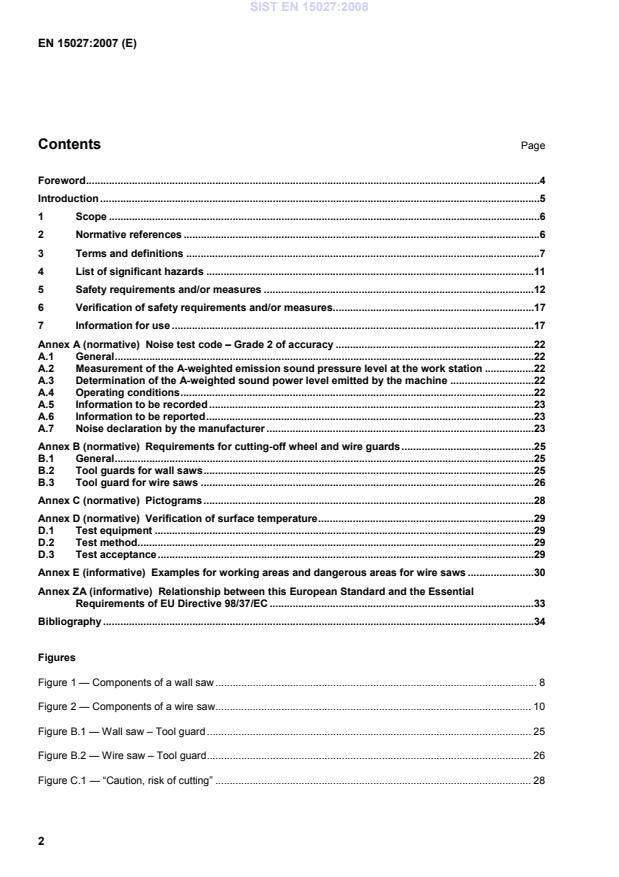
Noise test code – Grade 2 of accuracy.22 A.1 General.22 A.2 Measurement of the A-weighted emission sound pressure level at the work station.22 A.3 Determination of the A-weighted sound power level emitted by the machine.22 A.4 Operating conditions.22 A.5 Information to be recorded.23 A.6 Information to be reported.23 A.7 Noise declaration by the manufacturer.23 Annex B (normative)
Requirements for cutting-off wheel and wire guards.25 B.1 General.25 B.2 Tool guards for wall saws.25 B.3 Tool guard for wire saws.26 Annex C (normative)
Pictograms.28 Annex D (normative)
Verification of surface temperature.29 D.1 Test equipment.29 D.2 Test method.29 D.3 Test acceptance.29 Annex E (informative)
Examples for working areas and dangerous areas for wire saws.30 Annex ZA (informative)
Relationship between this European Standard and the Essential Requirements of EU Directive 98/37/EC.33 Bibliography.34
Figures Figure 1 — Components of a wall saw.8 Figure 2 — Components of a wire saw.10 Figure B.1 — Wall saw – Tool guard.25 Figure B.2 — Wire saw – Tool guard.26 Figure C.1 — “Caution, risk of cutting”.28 SIST EN 15027:2008
C.2 — "Read operator’s instructions" (see ISO 7000:2004).28 Figure C.3 — “Ear Hearing protection shall be worn”.28 Figure C.4 — “Eye protection shall be worn”.28 Figure C.5 — “Hand protection shall be worn“.28 Figure D.1 — Test cone to detect hot surface.29 Figure E.1 — Danger zones for wall cutting with additional wire guiding devices.30 Figure E.2 — Danger zones for wall cutting without additional wire guiding devices.31 Figure E.3 — Danger zones for floor cutting.32 Tables Table 1 — List of significant hazards.11 Table B.1 — Minimum thickness of tool guard parts for wall saws.26 Table B.2 — Minimum thickness of tool guard parts for wire saws.27
The machinery concerned and the extent to which hazards, hazardous situations and events are covered are indicated in the scope of this document.
When provisions of this type C standard are different from those which are stated in type A or B standards, the provisions of this type C standard take precedence over the provisions of the other standards, for machines that have been designed and built according to the provisions of this type C standard. It is intended to revise this standard to align with changes in legislation and the availability of other European Standards in preparation. SIST EN 15027:2008
1 Scope The global description “wall saw and wire saw equipment” contains two differing types of machines for use in the construction industry, and both used to make cuts on walls, ceilings and floors composed of mineral construction materials and/or composite materials. The many different cutting tasks and choice of operating method determine the type of machine to be used for each application. The machines may therefore be split into the following two principal classifications: Wall saws – exclusively rail guided – transportable. Wire saws – transportable. The machines are intended for the use of diamond tools. The types of cutting tools used in conjunction with the machines as described above fall within the design and use parameters supplied by the manufacturer. Cutting debry generated by the cutting action is removed from the cutting joint by a medium such as water directed to the cutting tool. Machines covered by this standard may be powered by: electric motor, IC engine, electro-hydraulic drive and IC engine-hydraulic drive. This European Standard deals with all significant hazards, hazardous situations and events relevant to wall saws and wire saws machinery, when they are used as intended and under conditions of misuse which are reasonably foreseeable by the manufacturer (see Clause 4). This standard specifies the appropriate technical measures to eliminate or reduce risks arising from the significant hazards generated by the cutting process work cycle. For special applications, for example, when working in potentially explosive atmospheres, additional safety requirements is necessary which are not covered by this standard.
This European Standard does not apply for wire saws intended for quarrying and stationary machining of natural stone as covered by prEN 15163. This European Standard applies primarily to machines which are manufactured after the date of approval by CEN of this standard. 2 Normative references The following referenced documents are indispensable for the application of this document. For dated references, only the edition cited applies. For undated references, the latest edition of the referenced document (including any amendments) applies.
EN 294:1992, Safety of machinery — Safety distance to prevent danger zones being reached by the upper limbs EN 573-3:2007, Aluminium and aluminium alloys — Chemical composition and form of wrought products — Part 3: Chemical composition EN 953:1997, Safety of machinery - Guards - General requirements for the design and construction of fixed and movable guards SIST EN 15027:2008
3.3 components of wall saws
Key
1 cutting head
2 drive motor hydraulic/drive motor electric
3 tool protection/blade guard
track guiding system
5 mounting devices
6 remote control system
7 feed system
8 depth control
9 power source
10 power transmission
11 tool mounting device
12 diamond tool
coolant supply
Figure 1 — Components of a wall saw SIST EN 15027:2008
device (e. g. flange) for wall saws to securely hold the cutting tool on the cutting head during the cutting operation 3.3.5 clamping flange system clamping flange system for wall saws consists of two plates with concentric tool seat. They are spanned by a locking device 3.3.6 flush cut flange system flush cut flange system for wall saws consists of a single flange with concentric tool seat and a fixing device in order to mount the tool 3.3.7 tool protection guard guard which encloses non-working parts of the cutting tool 3.3.8 power supply unit unit supplying electric or hydraulic power required in order to perform the specific cutting operation SIST EN 15027:2008
Key
1 wire drive unit
2 tool protection/guards
3 power source
4 remote control
5 power and coolant transmission
6 feed system
7 wire guiding device
8 wire drive wheel
9 wire storage
10 diamond tool (wire)
Figure 2 — Components of a wire saw 3.4.1 wire drive unit drive unit for wire saws powered by an internal or external power source incorporates the driving wheel(s) for the diamond wire, feeding and tensioning device and the protective/safety devices to afford protection to the operator or site personnel. It may incorporate a wire storage and guiding device 3.4.2 wire guiding devices device(s) which can be mounted in the vicinity of the surface to be cut in order to guide the wire during the cutting operation 3.4.3 cutting tool flexible circulating tool consisting of a core (wire rope) fitted with diamond impregnated beds (cutting rings) 3.4.4 power supply unit unit supplying electric or hydraulic power required in order to perform the specific cutting operation SIST EN 15027:2008
Hazards Concerned subclauses 4.1 Crushing hazard 5.2.1, 5.2.2, 5.2.4, 5.2.5, 5.2.7 4.2 Shearing hazard 5.2.1, 5.2.2, 5.2.4, 5.2.5, 5.2.7 4.3 Cutting and severing hazard 5.2.1, 5.2.2, 7.3.2 4.4 Entanglement hazard 5.2.1, 5.2.2, 7.3.2 4.5 Drawing in or trapping hazard 5.2.1, 5.2.2, 7.3.2 4.6 Impact hazard 5.2.1, 5.2.2, 5.2.6, 7.3.2 4.7 Fluid injection hazard 5.6 4.8 Hazards caused by ejection of parts, material, lash of bands etc. 5.2.1, 5.2.2, 5.2.5, 5.2.6, 5.9, 7.3.2, 7.3.2.3, Annex B 4.9 Hazards caused by loss of stability 5.2.3, 7.3.2 4.10 Slip, trip and fall hazard in relation with machine 5.7, 7.3.2 4.11 Hazards caused by electrical contact direct/indirect 5.3 4.12 Hazards resulting in burns or scalds, by possible contact of persons by flames, explosion and radiation of heat sources. 5.4, Annex D 4.13 Hearing loss, physiological disorders, interference with speech communication and auditory danger signals 5.10, 7.3.2, Annex A 4.14 Hazards resulting from contact with or inhalation of harmful fluids, gases, mists, fumes and dusts. 5.5, 5.8, 7.3.2 4.15 Hazards caused by fire or explosion. 5.11, 7.3.2 4.16 Hazard combinations 5 4.17 Hazard caused by failure of energy supply or control circuits 5.2.8, 5.2.9 4.18 Hazards caused by failure or malfunction of control system 5.2.8 4.19 Hazards caused by assembly errors 7.3.2, 7.3.3 4.20 Hazards caused by temporary missing or incorrectly positioned safety related measures such as: -
4.20.1 Guards of all kinds 5.2.2 4.20.2 Safety related protection devices of all kinds 5.2.2 4.20.3 Starting and stopping devices 5.2.8 4.20.4 Safety signs and tags 7.2.3, 7.3.2, Annex C 4.20.5 Information and warning devices of all kinds 7.2.2 4.20.6 Essential equipment and accessories for safe adjusting and maintenance 7.2.2 SIST EN 15027:2008
5.2 Mechanical hazards 5.2.1 General As components and parts have to be manually handled, all accessible parts, the cutting tool excepted, shall be free of sharp edges and burrs which could generate hazards when setting up, using, handling and maintaining the machine. Burrs from, for example, manufacturing, casting and welding shall be eliminated, sharp edges shall be smoothed. 5.2.2 Protection against moving parts 5.2.2.1 Moving parts not involved in the working process Rotating transmission parts, for example, couplings and drive shafts shall be provided with fixed guards to prevent contact. Guards shall comply with EN 953:1997 and in particular with Clauses 5, 6 and 7. Fixed guards shall be used and be held in position either by welding or mounting them in such a way that they can only be opened or removed only with the aid of tools or keys. Guards shall comply with the provisions of EN 294:1992 on safety distances. When daily access is required for service or maintenance purposes instead of fixed guards, movable guards (see EN ISO 12100-2:2003, 5.3.2.3 a), may be fitted. They shall fulfil the following requirements: they shall remain fixed to the machine when open; they shall be fitted with a system holding them in the open position. NOTE The system may be of – for example – a locking, latching, own-weight or spring loaded type. 5.2.2.2 Moving parts involved in the working process 5.2.2.2.1 General
The guards for the protection against contact with the tool and its driving and guiding devices shall be so designed and robust enough to resist strains resulting from an accidental projection of fragments of the cutting tool. Brittleness of the guard material shall be taken into account. Permanent plastic deformation of the guard resulting from stress shall be allowed. Requirements for the strength of cutting-off wheel and wire guards are specified in Annex B. The existence of a device stopping the cutting-off wheel is not necessary, when the absence or the opening of the guard creates a projection of water, which prevents an intended use of the machine. SIST EN 15027:2008
Only for flush cutting the guard may have a open side (lateral) or a special design in order to allow a cut close to adjacent surface (see operator's instructions in 7.3.2.3). In that case fixing screws and similar devices shall be designed countersunk in the flange or cutting tool. 5.2.2.2.3 Wire saws The drive, tensioning (feed) and storage system of the wire saw except of the external wire guiding devices shall be covered with fixed guards to avoid inadvertent contact. This/these guard(s) shall have sufficient strength to protect against ejection of fragments of the tool. When designing the guard system it shall take into account that the machine will be remotely controlled by the operator. The distance from the unprotected moving tool to the remote control shall allow that the operator can operate the machine outside the dangerous area described in the instruction manual (see 7.3.2.3).
The mounting and dismounting of the guard system shall need an intentional manual action. For removable guard systems, keyless fixation of the guard may be applied as an alternative to a key operated system. 5.2.3 Stability The machines shall be designed and constructed so that they are sufficiently stable under the intended operating conditions. Machines shall be equipped with fixing devices which shall allow a rigid and safe mounting in relation to the material to be cut. Nuts and screws intended to adjust the mountings in position shall need intentional action to loosen. 5.2.4 Transport and handling The movable parts of the machine shall be either lockable or removable to avoid risk of shearing, crushing, unlocking or falling down e. g. during handling or carrying. NOTE For technical requirements relating to transport and lifting of machines see 5.5.5 of EN ISO 12100-2:2003, Annex A.
5.2.8 Control devices 5.2.8.1 General For control functions in electric, hydraulic and pneumatic systems the requirements specified in Clauses 7, 9, 11 and 13 of EN 6
...