

EN 1433:2002
(Main)Drainage channels for vehicular and pedestrian areas - Classification, design and testing requirements, marking and evaluation of conformity
- Abstract
This European Standard specifies requirements for prefabricated linear drainage channels for the collection and conveyance of surface water when installed within areas subject to pedestrian and/or vehicular traffic. It applies to grid units, slot units and kerb units up to a clear opening of 1000 mm.
- Status
- Published
- Publication Date
- 12-Nov-2002
- Technical Committee
- CEN/TC 165 - Waste water engineering
- Drafting Committee
- CEN/TC 165/WG 4 - Gullies and tops a.s.o.
- Current Stage
- 9093 - Decision to confirm - Review Enquiry
- Start Date
- 09-Jun-2022
- Completion Date
- 07-Oct-2026
- Directive
- 305/2011 - Regulation (eu) No 305/2011 of the European Parliament and of the Council of 9 march 2011 laying down harmonised conditions for the marketing of construction products and repealing council directive 89/106/eecOJ Ref: C, C 259 OJ Date: 08-Aug-2014
89/106/EEC - Construction productsOJ Ref: C 13, C 139, C 319, C 75 OJ Date: 27-Mar-2003
Buy Documents






Overview
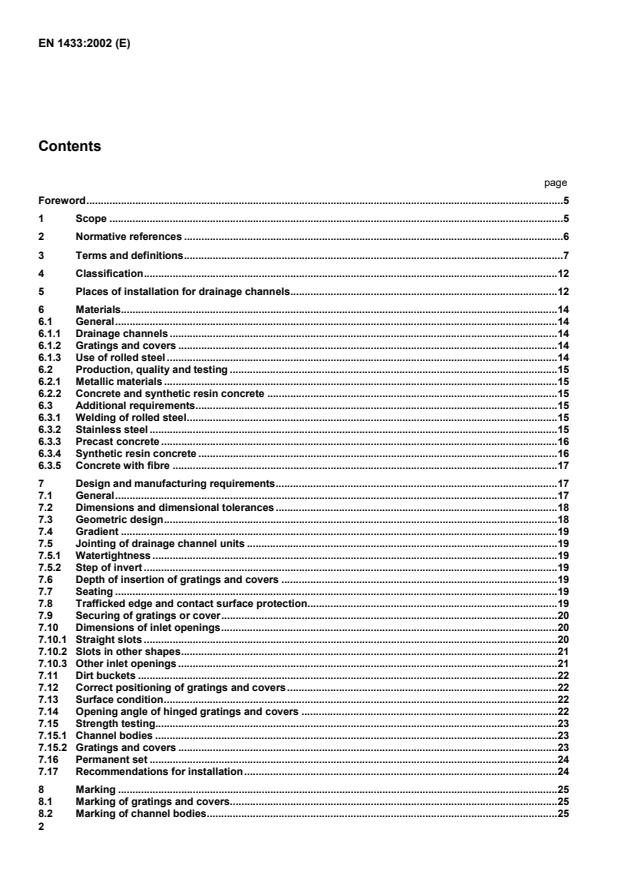
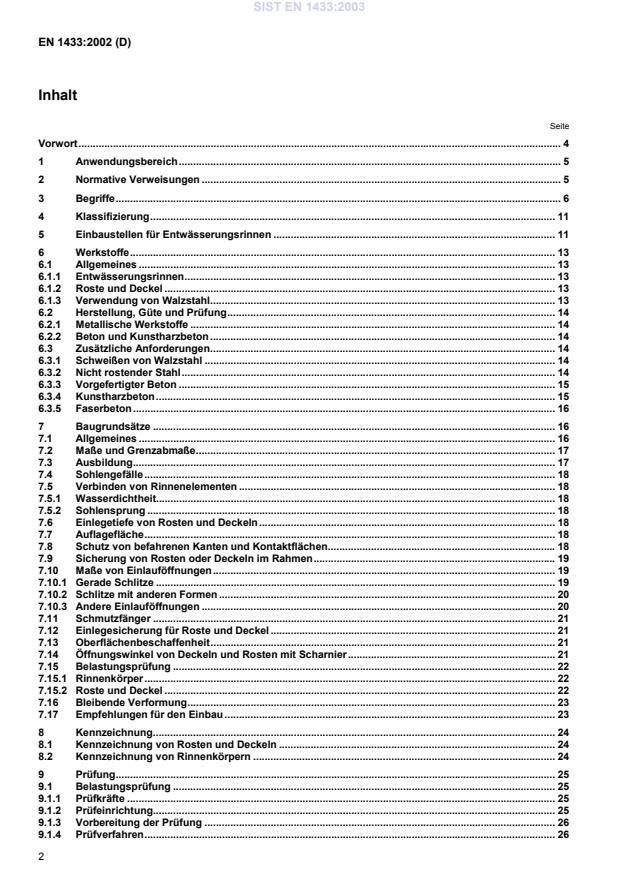
EN 1433:2002 is the European Standard published by CEN that specifies requirements for prefabricated linear drainage channels used to collect and convey surface water in areas subjected to vehicular and pedestrian traffic. It applies to grid units, slot units and kerb units with a clear opening up to 1000 mm, covering classification, design, testing, marking and evaluation of conformity. The standard supports harmonized product performance and compliance across CEN member states.
Key Topics
- Scope and definitions: applicability to prefabricated channels for surface-water conveyance in trafficked zones.
- Classification and places of installation: describes intended locations and product categories for different traffic conditions.
- Materials and production: requirements for metallic materials, stainless steel, precast concrete, synthetic resin concrete and concrete with fibre; plus production quality and testing.
- Design and manufacturing: dimensional tolerances, geometric design, gradients, jointing (including watertightness), seating, dirt buckets, inlet-opening dimensions and trafficked edge protection.
- Gratings and covers: design, seating, securing methods and opening angles for hinged units.
- Strength and durability testing: loading tests for channel bodies and gratings/covers, permanent set limits, and material-specific tests (including freeze–thaw resistance covered in normative annexes).
- Marking and conformity: marking requirements for gratings/covers and channel bodies and procedures for type testing, factory production control (FPC) and evaluation of conformity (including model FPC in Annex A).
- Annexes: Annex B/C specify freeze–thaw test methods for de-icing salt exposure; Annex D describes third‑party inspection; Annex ZA relates the standard to the EU Construction Products Directive.
Applications
EN 1433 is used to specify and verify linear drainage systems in:
- Roads, highways and parking areas
- Urban streets, pedestrian plazas and cycleways
- Airport aprons, industrial yards and logistics terminals
- Sports facilities and commercial developments
Typical users:
- Civil and drainage engineers specifying stormwater conveyance
- Manufacturers of drainage channels, gratings and covers
- Contractors and installers fitting drainage systems
- Test laboratories, certification bodies and authorities responsible for conformity assessment
- Local governments and infrastructure asset managers
Related Standards (if applicable)
- EN 1433 is part of the wastewater/drainage product family and interfaces with national standards and directives (see Annex ZA for links to the EU Construction Products Directive). Project designers should check complementary standards for load classes, surface drainage hydraulics and local installation codes.
Keywords: EN 1433, drainage channels, linear drainage, surface water, vehicular areas, pedestrian areas, drainage channel design, drainage channel testing, conformity assessment.
Relations
- Effective Date
- 25-Aug-2026
- Effective Date
- 25-Aug-2026
- Effective Date
- 25-Aug-2026
- Effective Date
- 25-Aug-2026
- Effective Date
- 25-Aug-2026
- Effective Date
- 25-Aug-2026
- Effective Date
- 28-Jan-2026
- Effective Date
- 28-Jan-2026
- Effective Date
- 28-Jan-2026
- Effective Date
- 28-Jan-2026
- Effective Date
- 28-Jan-2026
- Effective Date
- 28-Jan-2026
- Effective Date
- 28-Jan-2026
- Effective Date
- 28-Jan-2026
- Effective Date
- 28-Jan-2026
Buy Documents
Get Certified
Connect with accredited certification bodies for this standard

Zavod za gradbeništvo Slovenije (ZAG) - Inšpekcija
ZAG inspection body for construction products, structures, and materials.
Sponsored listings
Frequently Asked Questions
EN 1433:2002 is a standard published by the European Committee for Standardization (CEN). Its full title is "Drainage channels for vehicular and pedestrian areas - Classification, design and testing requirements, marking and evaluation of conformity". This standard covers: This European Standard specifies requirements for prefabricated linear drainage channels for the collection and conveyance of surface water when installed within areas subject to pedestrian and/or vehicular traffic. It applies to grid units, slot units and kerb units up to a clear opening of 1000 mm.
This European Standard specifies requirements for prefabricated linear drainage channels for the collection and conveyance of surface water when installed within areas subject to pedestrian and/or vehicular traffic. It applies to grid units, slot units and kerb units up to a clear opening of 1000 mm.
EN 1433:2002 is classified under the following ICS (International Classification for Standards) categories: 93.080.30 - Road equipment and installations. The ICS classification helps identify the subject area and facilitates finding related standards.
EN 1433:2002 has the following relationships with other standards: It is inter standard links to ISO 3755:1991, ISO 4012:1978, ISO 8062:1994, ISO 185:1988, ISO 1461:1999, ISO 630:1995, EN 1563:2018, EN 1169:2024, EN 10088-2:2024, EN 804:1994, EN 12441-6:2003, EN 539-1:2005, EN 10088-3:2023, EN 1248:2001, EN 10346:2015. Understanding these relationships helps ensure you are using the most current and applicable version of the standard.
EN 1433:2002 is associated with the following European legislation: EU Directives/Regulations: 305/2011, 89/106/EEC, 93/38/EEC; Standardization Mandates: M/118, M/BC/CEN/88/15. When a standard is cited in the Official Journal of the European Union, products manufactured in conformity with it benefit from a presumption of conformity with the essential requirements of the corresponding EU directive or regulation.
EN 1433:2002 is available in PDF format for immediate download after purchase. The document can be added to your cart and obtained through the secure checkout process. Digital delivery ensures instant access to the complete standard document.
Standards Content (Sample)
2003-01.Slovenski inštitut za standardizacijo. Razmnoževanje celote ali delov tega standarda ni dovoljeno.Drainage channels for vehicular and pedestrian areas - Classification, design and testing requirements, marking and evaluation of conformityNDNRYRVWLCaniveaux hydrauliques pour l'évacuation des eaux dans les zones de circulation utilisées par les piétons et les vehicules - Classification, prescriptions de conception et d'essai, marquage et évaluation de la conformitéEntwässerungsrinnen für Verkehrsflächen - Klassifizierung, Bau- und Prüfgrundsätze, Kennzeichnung und Beurteilung der KonformitätTa slovenski standard je istoveten z:EN 1433:2002SIST EN 1433:2003en,fr,de93.080.30ICS:SLOVENSKI
STANDARDSIST EN 1433:200301-junij-2003
EUROPEAN STANDARDNORME EUROPÉENNEEUROPÄISCHE NORMEN 1433November 2002ICS 93.080.30English versionDrainage channels for vehicular and pedestrian areas -Classification, design and testing requirements, marking andevaluation of conformityCaniveaux hydrauliques pour l'évacuation des eaux dansles zones de circulation utilisées par les piétons et lesvehicules - Classification, prescriptions de conception etd'essai, marquage et évaluation de la conformitéEntwässerungsrinnen für Verkehrsflächen - Klassifizierung,Bau- und Prüfgrundsätze, Kennzeichnung und Beurteilungder KonformitätThis European Standard was approved by CEN on 9 October 2002.CEN members are bound to comply with the CEN/CENELEC Internal Regulations which stipulate the conditions for giving this EuropeanStandard the status of a national standard without any alteration. Up-to-date lists and bibliographical references concerning such nationalstandards may be obtained on application to the Management Centre or to any CEN member.This European Standard exists in three official versions (English, French, German). A version in any other language made by translationunder the responsibility of a CEN member into its own language and notified to the Management Centre has the same status as the officialversions.CEN members are the national standards bodies of Austria, Belgium, Czech Republic, Denmark, Finland, France, Germany, Greece,Iceland, Ireland, Italy, Luxembourg, Malta, Netherlands, Norway, Portugal, Spain, Sweden, Switzerland and United Kingdom.EUROPEAN COMMITTEE FOR STANDARDIZATIONCOMITÉ EUROPÉEN DE NORMALISATIONEUROPÄISCHES KOMITEE FÜR NORMUNGManagement Centre: rue de Stassart, 36
B-1050 Brussels© 2002 CENAll rights of exploitation in any form and by any means reservedworldwide for CEN national Members.Ref. No. EN 1433:2002 E
Model procedure of internal quality control.37Annex B (normative)
Supplementary requirements for concrete products submitted to very severefreeze-thaw conditions with standing water containing de-icing salts.44B.1 Scope.44B.2 Conditions of application.44B.3 Resistance to freeze-thaw with de-icing salts.44B.4 Marking.44Annex C (normative)
Determination of freeze/thaw resistance with de-icing salt.45C.1 Principle.45C.2 Sampling.45C.3 Materials.45C.4 Apparatus.45C.5 Preparation of test specimens.46C.6 Procedure.47C.7 Expression of test results.49C.8 Test report.49Annex D (informative)
Inspection control,
carried out by a third party certification body (third partycontrol).50D.1 Purpose and procedure of third party Inspection.50D.2 Report by the third party.51Annex ZA (informative)
Clauses of this European Standard addressing the provisions of the EUConstruction Products Directive.52
testing machines (ISO 7500-1:1999).ISO 185, Grey cast iron — Classification.ISO 630, Structural steels — Plates, wide flats, bars, sections and profiles.ISO 1461, Hot dip galvanized coatings on fabricated iron and steel articles – Specifications and test methods.ISO 3755, Cast carbon steels for general engineering purposes.ISO 4012, Concrete — Determination of compressive strength of test specimens.ISO 8062, Castings — System of dimensional tolerances and machining allowances.
e - Thickness of trafficked edge2 Contact surface;
d - Thickness of contact surfaceFigure 6 — Examples of contact surfaces and trafficked edges3.12depth of insertion of gratings and coversdimension A, shown in Figure 7, which is instrumental in securing the gratings or covers in the channelKey1Floor level3Channel wall2Overlay grating/covera1, a2Clearances between channel body and grating or coverFigure 7 — Examples of depth of insertion3.13clear areaunobstructed area between the seating or slot edgesNOTEThe clear area is expressed in square millimetres (mm2) or multiples of the unit (e.g. cm2)
L = l1 + l2 +l3Figure 8 — Examples of clear areas3.14clear openingCOunobstructed width between the seating of grid units or slot edges of slot units.Examples of the dimension CO are shown in Figures 7 and 8NOTEThe clear opening is expressed in millimetres (mm).3.15mass per unit areatotal mass of the grating or the cover in kg divided by the clear area in m2 of the grid unitNOTEThe mass per unit area is expressed in kilograms per square metres (kg/m2).3.16cushioning insertmaterial in a channel body, grating or cover used to provide a non rock seating3.17test loadload applied to a grating/cover or to a drainage channel unit during a testNOTEThe test load is expressed in kilonewtons (kN).3.18ultimate (collapse) loadmaximum load reached by the testing machine during a loading test (i.e. when the load-recording facility does notshow any further increase)3.19pedestrian areaarea reserved for pedestrians but which may also be trafficked occasionally by, for example, delivery, cleaning oremergency vehicles3.20pedestrian streetarea subjected to regular vehicular traffic but during controlled periods only e.g. outside business hours3.21dirt bucketremovable component of a drainage channel system which collects debris
Direction of flow2
Invert of channel unitsFigure 9 — Example for step of invert3.24type testtest to prove the design and which is carried out once to demonstrate conformity with this standard and which isrepeated after significant manufacturing, design, or material changes4 ClassificationDrainage channels shall be classified as follows according to their intended use (see also clause 5):A 15, B 125, C 250, D 400, E 600, F 900.5 Places of installation for drainage channelsThe appropriate load class of drainage channel to chose depends upon where the channel is to be installed.Typical places of installation have been divided into groups numbered 1 to 6 as listed below. Figure 10 andFigure 11 show the location of some of these groups in a highway environment. An indication as to which minimumload class of drainage channel should be selected is shown in parenthesis for each group. The selection of theappropriate load class is the responsibility of the designer.Where there is any doubt, a higher load class should be selected.Groups of installation:Group 1
(min. class A 15)Areas which can only be used by pedestrians and pedal cyclists.Group 2
(min. class B 125)Footways, pedestrian areas and comparable areas, private car parks or car parking decks.
(min. class C 250)Kerb sides (Figure 10) and non-trafficked areas of hard shoulders and similar; Kerb units are always group 3.Group 4
(min. class D 400)Carriageways of roads (including pedestrian streets), hard shoulders (Figures 10 and 11) and parking areas, for alltypes of road vehicles.Group 5
(min. class E 600)Areas subjected to high wheel loads, e. g. ports and dock sides.Group 6
(class F 900)Areas subjected to especially high wheel loads e. g. aircraft pavements.Key1
Group 1 (e.g. on pedestrian bridges)2
Group 23
Group 34
Group 4Figure 10 — Typical highway cross section showing the location of some installation groupsKey1
Group 12
Trafficked area of hard shoulder3
Carriageway4
Group 4Figure 11 — Typical hard shoulder section showing the location of some installation groups
The national requirements remain valid until further harmonisation.6.3.3.3 Weathering resistanceWhen tested for water absorption in accordance with the test method described in 9.2.1 drainage channels shall begraded and marked in accordance with Table 1 and clause 8.Table 1 — Grades of weathering resistanceGradeMarkingaWater absorption in% of mass1Nno performance measured2Wmean value £ 6,5;no individual result ³ 7,0aWhen specific conditions of use corresponding to those defined in annex B (frequent contact of a surface ofdrainage channel, partially or entirely made with concrete, with standing water containing de-icing salts in frostconditions or where regulations require), then the additional requirements defined in annex B shall be applied and, ifappropriate, the product shall be marked with "+R".National editions of this standard may state in their national foreword that only one of the grades may need to bespecified as relevant to their climate conditions.6.3.4 Synthetic resin concreteFor polyester resin concrete the flexural bending strength and the compressive strength at 7 days for testspecimens in accordance with Table 3 shall conform to the values given in Table 2.Table 2 — Strength requirementsStrengthMean value of 3 test specimensN/mm2Lowest individual valueN/mm2Flexural bending strength³
22³ 18Compressive strength³
90³ 75
350 mm ´ 100 mm ´ 10 mmTest platesWhen manufactured separately the newly cast test platesshall be covered, for 24 h, by a wet cloth in a temperatureof (20 ± 4) °C and thereafter they shall be kept underwater at (20 ± 4) °C until the test. Alternatively test platesmay be cut from finished products.aTolerances shall not exceed ±1 mm.7 Design and manufacturing requirements7.1 GeneralDrainage channels shall be free of defects which might impair their fitness for purpose (e.g. holes, broken edges).Two or more materials may be combined to form a composite, sufficient to transfer the stresses between thosematerials. Drainage channel units shall possess adequate vertical and lateral strength in order to withstand normaltransportation and handling loads and stresses when installed in accordance with the manufacturer's instructions (seeclause 11).Drainage channels shall resist external forces resulting from the place of installation e.g. traffic loading, thermalexpansion, either by themselves or by a method of installation recommended by the manufacturer (see 7.17 andclause 11).
£ 4 000± 4Length (L)L > 4 000± 5b £ 500± 2Width (b)500 < b £ 1 000± 3h £ 200± 2Height (h)h > 200± 1 % with amaximum of ± 3 mma
For kerb and slot units the tolerance of the dimension L shall be ± 5 mm.a = al
+ arFigure 3 — Total clearanceIn order to limit the horizontal displacement of the grating or cover in the channel body, the relevant dimensions anddimensional tolerances of these units shall be such as to meet the total clearance a (see Figure 12) as follows:¾ CO £ 400 mm: a £ 7 mm,¾ CO > 400 mm: a £ 9 mm.7.3 Geometric designIn general, h shall be at least equal to b (see clause 3, Figures 2, 4 and 5). With respect to the hydraulic design of adrainage channel, the inlet capacity of the system, the flow capacity of the channel and the discharge capacity of theoutlet(s) from the system, the manufacturer shall provide sufficient hydraulic data to enable selection of suitableproducts. At the point of discharge, an appropriate element may be installed for onward connection to a drainagesystem. The nominal size of discharge outlets and onward connections shall in general be not less than DN 100.Their dimensions shall correspond to those of a standard pipe and it shall be possible to form the connection topipelines by means of joints which comply with the requirements specified for the respective pipe.
Orientation No 1;
Orientation No 2;
Direction of trafficFigure 13 — Orientation of slotsTable 9 — Dimensions for classes C 250 to F 900OrientationWidthmmLengthmm³ 10 to 18no limitationNo 1from
0° to 45°
andfrom > 135° to 180°> 18 to 32£ 170No 2from 45° to 135°³ 10 to 42no limitationNOTEIn pedestrian streets and pedestrian areas the slot width can be reduced to 5 mm at thespecifier's discretion
...
2003-01.Slovenski inštitut za standardizacijo. Razmnoževanje celote ali delov tega standarda ni dovoljeno.NDNRYRVWLEntwässerungsrinnen für Verkehrsflächen - Klassifizierung, Bau- und Prüfgrundsätze, Kennzeichnung und Beurteilung der KonformitätCaniveaux hydrauliques pour l'évacuation des eaux dans les zones de circulation utilisées par les piétons et les vehicules - Classification, prescriptions de conception et d'essai, marquage et évaluation de la conformitéDrainage channels for vehicular and pedestrian areas - Classification, design and testing requirements, marking and evaluation of conformity93.080.30Cestna oprema in pomožne napraveRoad equipment and installationsICS:Ta slovenski standard je istoveten z:EN 1433:2002SIST EN 1433:2003en,fr,de01-junij-2003SIST EN 1433:2003SLOVENSKI
STANDARD
EUROPÄISCHE NORMEUROPEAN STANDARDNORME EUROPÉENNEEN 1433November 2002ICS 93.080.30Deutsche FassungEntwässerungsrinnen für Verkehrsflächen - Klassifizierung, Bau-und Prüfgrundsätze, Kennzeichnung und Beurteilung derKonformitätDrainage channels for vehicular and pedestrian areas -Classification, design and testing requirements, markingand evaluation of conformityCaniveaux hydrauliques pour l'évacuation des eaux dansles zones de circulation utilisées par les piétons et lesvehicules - Classification, prescriptions de conception etd'essai, marquage et évaluation de la conformitéDiese Europäische Norm wurde vom CEN am 9.Oktober 2002 angenommen.Die CEN-Mitglieder sind gehalten, die CEN/CENELEC-Geschäftsordnung zu erfüllen, in der die Bedingungen festgelegt sind, unter denendieser Europäischen Norm ohne jede Änderung der Status einer nationalen Norm zu geben ist. Auf dem letzen Stand befindliche Listendieser nationalen Normen mit ihren bibliographischen Angaben sind beim Management-Zentrum oder bei jedem CEN-Mitglied auf Anfrageerhältlich.Diese Europäische Norm besteht in drei offiziellen Fassungen (Deutsch, Englisch, Französisch). Eine Fassung in einer anderen Sprache,die von einem CEN-Mitglied in eigener Verantwortung durch Übersetzung in seine Landessprache gemacht und dem Management-Zentrum mitgeteilt worden ist, hat den gleichen Status wie die offiziellen Fassungen.CEN-Mitglieder sind die nationalen Normungsinstitute von Belgien, Dänemark, Deutschland, Finnland, Frankreich, Griechenland, Irland,Island, Italien, Luxemburg, Malta, Niederlande, Norwegen, Österreich, Portugal, Schweden, Schweiz, Spanien, der TschechischenRepublik und dem Vereinigten Königreich.EUROPÄISCHES KOMITEE FÜR NORMUNGEUROPEAN COMMITTEE FOR STANDARDIZATIONCOMITÉ EUROPÉEN DE NORMALISATIONManagement-Zentrum: rue de Stassart, 36
B-1050 Brüssel© 2002 CENAlle Rechte der Verwertung, gleich in welcher Form und in welchemVerfahren, sind weltweit den nationalen Mitgliedern von CEN vorbehalten.Ref. Nr. EN 1433:2002 DSIST EN 1433:2003
Schema für die werkseigene Produktionskontrolle.35Anhang B (normativ)
Ergänzende Anforderungen an Betonteile, die strengen Frost-Tau-Zyklen undstehendem tausalzhaltigen Wasser ausgesetzt sind.42B.1Anwendungsbereich.42B.2Anwendungsbedingungen.42B.3Beständigkeit gegenüber Frost-Tau-Zyklen und Tausalzen.42B.4Kennzeichnung.42Anhang C (normativ)
Ermittlung der Beständigkeit gegen Frost-Tau-Zyklen mit Tausalz.43C.1Prinzip.43C.2Probeentnahme.43C.3Werkstoffe.43C.4Prüfeinrichtungen.43C.5Vorbereitung der Prüfstücke.44C.6Durchführung.45C.7Auswertung.47C.8Prüfbericht.47Anhang D (informativ)
Überwachung durch eine unabhängige Zertifizierungsstelle(Fremdüberwachung).48D.1Ziel und Durchführung der Fremdüberwachung.48D.2Bericht des Fremdüberwachers.49Anhang ZA (informativ)
Abschnitte in dieser Europäischen Norm, die grundlegende Anforderungenoder andere Vorgaben von EU-Richtlinien betreffen.50Literaturhinweise.55SIST EN 1433:2003
Verwendung.EN ISO 7500-1, Metallische Werkstoffe
— Prüfung von Prüfmaschinen für statische einachsige Beanspruchung —Teil 1: Zug- und Druckprüfmaschinen (ISO 7500-1:1999) .ISO 185, Gusseisen mit Lamellengraphit; Klassifikation.SIST EN 1433:2003
Profile.ISO 1461, Durch Feuerverzinken auf Stahl aufgebrachte
Zinküberzüge (Stückverzinken) — Anforderungen undPrüfung.ISO 3755, Cast carbon steels für general engineering purposes.ISO 4012, Beton; Bestimmung der Druckfestigkeit von Probekörpern.ISO 8062, Castings — System of dimensional tolerances and machining allowances.3 BegriffeFür die Anwendung dieser Europäischen Norm gelten die folgenden Begriffe und Definitionen.3.1Entwässerungsrinnegeradlinige Bauteilkombination, die Oberflächenwasser über ihre gesamte Länge aufnimmt und in einen Abflussweiterleitet3.2Typ IEntwässerungsrinne, die kein lastabtragendes Fundament und/oder eine Ummantelung benötigt, um im einge-bautem Zustand vertikal und horizontal auftretende Belastungen abtragen zu können (siehe Bild 1)3.3Typ MEntwässerungsrinne, die ein lastabtragendes Fundament und/oder eine Ummantelung benötigt um im eingebautenZustand vertikal und horizontal auftretende Belastungen abtragen zu können (siehe Bild 1)Beispiel für Typ IBeispiel für Typ MLegendex, y und z Maße für das lastabtragende Fundament und/oder die UmmantelungBild 1 — Beispiele für Typ I und Typ MSIST EN 1433:2003
Rost2
Rinnenkörperh, b
Innenmaße (benetzter Umfang)Bild 2 — Beispiele für Kastenrinnen3.5Rost/Deckelabnehmbares Teil einer Kastenrinne, das, im Falle von Rosten, den Einlauf von Oberflächenwasser zulässt (sieheBild 3)Bild A3 — Beispiele für Roste3.6Schlitzrinnevorgefertigte Entwässerungsrinne mit einem geschlossenen Profil und einem auf der Oberseite befindlichen,durchgehenden oder unterbrochenen Einlaufschlitz zur Aufnahme von Oberflächenwasser (siehe Bild 4)Legendeh, b
Innenmaße (benetzter Umfang)Bild 4 — Beispiel einer SchlitzrinneSIST EN 1433:2003
e
Dicke der befahrenen Kante2 Kontaktfläche
d
Dicke der KontaktflächeBild 6 — Beispiele für Kontaktflächen und befahrene Kanten3.12Einlegetiefe von Rosten und DeckelnMaß A wie in Bild 7 angegeben, das für einen sicheren Sitz der Deckel oder Roste im Rinnenkörper erforderlich istLegende1Geländeoberkante3Rinnenwandung2Überlappung des Rostes/Deckelsa1, a 2Spaltweite zwischen Rinnenkörper und Rost oder DeckelBild 7 — Beispiele für die EinlegetiefeSIST EN 1433:2003
= l1 + l2 + l3Bild 8 — Beispiele für lichte Flächen3.14lichte WeiteCOder von Hindernissen freie Abstand zwischen den Auflageflächen von Kastenrinnen oder zwischen den Kanten derSchlitze von Schlitzrinnen. Beispiele für das Maß CO enthalten die Bilder 7 und 8ANMERKUNGDie lichte Weite wird in Millimeter (mm) angegeben.3.15flächenbezogene MasseQuotient aus der Gesamtmasse des Rostes oder des Deckels einer Kastenrinne in Kilogramm (kg) und ihrer lichtenFläche in Quadratmeter (m2)ANMERKUNGDie flächenbezogene Masse wird in Kilogramm durch Quadratmeter (kg/m2) angegeben.3.16dämpfende EinlageWerkstoff, der in einem Rinnenkörper, Rost oder Deckel befestigt wird um eine ruhige Lage sicherzustellen3.17PrüfkraftKraft, die auf einen Rost/Deckel oder auf ein Rinnenelement während der Prüfung aufgebracht wirdANMERKUNGDie Prüfkraft wird in Kilonewton (kN) angegeben.3.18Bruchkraftmaximale Kraft, die in einer Prüfmaschine während einer Druckprüfung erreicht wird (zum Beispiel wenn die Kraft-anzeige keine weitere Erhöhung anzeigt)3.19FußgängerzoneBereich, der dem Fußgängerverkehr vorbehalten ist und zum Zweck der Versorgung oder Reinigung oder in Not-fällen gelegentlich befahren wirdSIST EN 1433:2003
angegeben.3.23SohlensprungsHöhendifferenz der Sohlen von angrenzenden Rinnenkörpern, wie in Bild 9 dargestelltLegende1
Fließrichtung2
Sohle der RinnenelementeBild 9 — Beispiel für den Sohlensprung3.24Erstprüfungeinmalig durchzuführender Nachweis der Übereinstimmung der konstruktiven Einzelheiten mit den Anforderungendieser Norm, der nur nach einem signifikanten Wechsel des Herstellungsverfahrens, der Konstruktion oder desWerkstoffes wiederholt wird4 KlassifizierungEntwässerungsrinnen sind entsprechend ihrer beabsichtigten Nutzung in folgende Klassen einzuteilen (siehe auchAbschnitt 5):A 15, B 125, C 250, D 400, E 600, F 900.5 Einbaustellen für EntwässerungsrinnenDie zur Verwendung geeignete Klasse von Entwässerungsrinnen richtet sich nach der Einbaustelle. Die verschie-denen Einbaustellen wurden, wie unten aufgeführt, in Gruppen mit den Nummern 1 bis 6 eingeteilt. Die Bilder 10und 11 zeigen die Lage einiger dieser Gruppen in der Umgebung einer Straße. Für jede Gruppe ist als Richtlinienachfolgend angegeben, welche Klasse von Entwässerungsrinnen verwendet werden sollte. Die Wahl der entspre-chenden Klasse ist dem Anwender/Planer überlassen. Im Zweifelsfall sollte die nächsthöhere Klasse gewählt wer-den.SIST EN 1433:2003
Gruppe 1 (z. B. auf Fußgängerbrücken)2 Gruppe 23 Gruppe 34 Gruppe 4Bild 10 — Typischer Querschnitt einer Straße mit einigen Gruppen von EinbaustellenLegende1
Gruppe 12
Befahrener Bereich der befestigten Seitenstreifen3
Fahrbahn4
Gruppe 4Bild 11 — Typische Details von Seitenstreifen mit Darstellung einiger Gruppen von EinbaustellenSIST EN 1433:2003
22≥ 18Druckfestigkeit≥
90≥ 75SIST EN 1433:2003
≤ 840 × 40 × 200> 8 ≤ 1680 × 80 × 400in senkrechter Lage hergestelltaGrenzabmaße von ± 1 mm sind einzuhalten.6.3.5 FaserbetonDie Gebrauchstauglichkeit von Produkten aus Faserbeton muss vor deren Anwendung nachgewiesen werden. BeiGlasfaserbeton ohne Stahlbewehrung muss nach 28 Tagen die Biegefestigkeit für Prüfstücke nach Tabelle 5 mitden in Tabelle 4 angegebenen Werten übereinstimmen.Tabelle 4 — FestigkeitsanforderungenMittelwert aus 3 PrüfstückenNiedrigster EinzelwertFestigkeitN/mm2N/mm2Biegefestigkeit≥ 20≥ 16Druckfestigkeit≥ 45 (Würfel)≥ 35 (Zylinder)36 (Würfel)28 (Zylinder)Tabelle 5 — PrüfstückeMaßea350 mm × 100 mm × 10 mmPrüfplattenWenn sie einzeln hergestellt werden, müssen neu gegossene Prüfplatten vor der Prüfungüber eine Zeitspanne von 24 h bei (20 ± 4) °C mit nassen Tüchern bedeckt und danachbis zur Prüfung unter Wasser von (20 ± 4) °C gehalten werden. Alternativ dürfen Prüf-platten auch aus Fertigprodukten herausgeschnitten werden.aGrenzabmaße von ± 1 mm sind einzuhalten.7 Baugrundsätze7.1 AllgemeinesEntwässerungsrinnen müssen frei von Fehlern sein, die ihre Verwendung beeinträchtigen könnten (z. B. Löcher,zerbrochene Kanten). Zwei oder mehr Werkstoffe dürfen zu einem Verbundwerkstoff kombiniert werden, wenn dieBelastungen zwischen diesen Werkstoffen ausreichend übertragen werden. Entwässerungsrinnen müssen übereine ausreichende Stabilität in senkrechter und seitlicher Richtung verfügen, um Belastungen durch Transport un-ter normalen Bedingungen, Handhabung und Einbau nach Anleitung des Herstellers (siehe Abschnitt 11) zu wider-stehen.Entwässerungsrinnen müssen entweder selbst oder durch ein vom Hersteller empfohlenes Einbauverfahren (siehe7.17, und Abschnitt 11) am Einbauort auftretenden äußeren Kräften wie, z. B. Verkehrslasten, Wärmeausdehnung,widerstehen.SIST EN 1433:2003
≤ 1 000± 21 000 < L a
≤ 4 000± 4Länge (L)L > 4000± 5b
≤ 500± 2Weite (b)500 < b ≤ 1000± 3h ≤ 200± 2Höhe (h)h > 200± 1 % mit einemMaximum von ± 3 mmaFür das Maß L von Bordschlitzrinnen und Schlitzrinnen sind Grenzabmaße von ± 5 mm ein-zuhalten.a
= al
+ arBild 12 — GesamtspaltweiteZur Begrenzung der horizontalen Verschiebung der Roste und Deckel im Rinnenkörper müssen die entsprechen-den Maße und Grenzabmaße dieser Teile so gewählt sein, dass die Gesamtspaltweite a (siehe Bild 12) denfolgenden Werten entspricht: CO ≤ 400 mm: a ≤ 7 mm, CO > 400 mm: a ≤ 9 mm.7.3 AusbildungIm Allgemeinen muss h mindestens gleich b sein (siehe Abschnitt 3, Bilder 2, 4 und 5). Für die hydraulische Ausbil-dung der Entwässerungsrinne, die Aufnahmekapazität des Systems, die Durchflusskapazität des Kanals und dasAbflussvermögen am Ausgang des Systems muss der Hersteller genügend hydraulische Daten zur Verfügungstellen, um die Auswahl geeigneter Produkte zu ermöglichen. Am Ausgang des Systems darf im Allgemeinen zumAnschluss an das Entwässerungssystem ein geeignetes Bauteil installiert werden. Die Nennweite von Abflussöff-nungen und Anschlussstücken darf im Allgemeinen nicht kleiner als DN 100 sein. Die Maße der Anschlussstückemüssen denen eines genormten Rohres entsprechen. Es muss möglich sein, die Verbindung zu weiterführendenRohrleitungen mittels Rohrverbindungen herzustellen, die den Anforderungen an das entsprechende Rohr genü-gen.SIST EN 1433:2003
...