

EN 14055:2010
(Main)WC and urinal flushing cisterns
- Abstract
This European Standard specifies design, performance requirements and the test methods for WC and urinal flushing cisterns with flushing mechanism, inlet valve and overflow.
This document covers flushing cisterns designed to be connected to drinking water installations inside buildings.
This standard does not cover automatic valveless siphon flushing cisterns for flushing urinals.
NOTE Flushing cisterns for one-piece WCs and close-coupled suites are covered by EN 997.
- Status
- Withdrawn
- Publication Date
- 23-Nov-2010
- Withdrawal Date
- 06-Oct-2026
- Technical Committee
- CEN/TC 163 - Sanitary appliances
- Current Stage
- 9960 - Withdrawal effective - Withdrawal
- Start Date
- 24-Jun-2015
- Completion Date
- 07-Oct-2026
- Directive
- 305/2011 - Regulation (eu) No 305/2011 of the European Parliament and of the Council of 9 march 2011 laying down harmonised conditions for the marketing of construction products and repealing council directive 89/106/eecOJ Ref: C, C 259 OJ Date: 08-Aug-2014
89/106/EEC - Construction productsOJ Ref: C, C 246 OJ Date: 24-Aug-2011

Relations
- Effective Date
- 19-Jan-2023
- Effective Date
- 01-Apr-2026
- Effective Date
- 28-Jan-2026
- Effective Date
- 28-Jan-2026
- Effective Date
- 28-Jan-2026
- Effective Date
- 28-Jan-2026
- Effective Date
- 14-Aug-2013
Get Certified
Connect with accredited certification bodies for this standard

DIBt (Deutsches Institut für Bautechnik)
German Institute for Building Technology.
DIN CERTCO
DIN Group product certification.

Aboma Certification B.V.
Specialized in construction, metal, and transport sectors.
Sponsored listings
Frequently Asked Questions
EN 14055:2010 is a standard published by the European Committee for Standardization (CEN). Its full title is "WC and urinal flushing cisterns". This standard covers: This European Standard specifies design, performance requirements and the test methods for WC and urinal flushing cisterns with flushing mechanism, inlet valve and overflow. This document covers flushing cisterns designed to be connected to drinking water installations inside buildings. This standard does not cover automatic valveless siphon flushing cisterns for flushing urinals. NOTE Flushing cisterns for one-piece WCs and close-coupled suites are covered by EN 997.
This European Standard specifies design, performance requirements and the test methods for WC and urinal flushing cisterns with flushing mechanism, inlet valve and overflow. This document covers flushing cisterns designed to be connected to drinking water installations inside buildings. This standard does not cover automatic valveless siphon flushing cisterns for flushing urinals. NOTE Flushing cisterns for one-piece WCs and close-coupled suites are covered by EN 997.
EN 14055:2010 is classified under the following ICS (International Classification for Standards) categories: 91.140.70 - Sanitary installations. The ICS classification helps identify the subject area and facilitates finding related standards.
EN 14055:2010 has the following relationships with other standards: It is inter standard links to EN 14055:2010+A1:2015, EN 1717:2025+A1:2026, EN 13407:2015+A1:2018, EN 1717:2025, EN 14124:2004, EN 997:2018, EN 14055:2010/FprA1. Understanding these relationships helps ensure you are using the most current and applicable version of the standard.
EN 14055:2010 is associated with the following European legislation: EU Directives/Regulations: 305/2011, 89/106/EEC; Standardization Mandates: M/110. When a standard is cited in the Official Journal of the European Union, products manufactured in conformity with it benefit from a presumption of conformity with the essential requirements of the corresponding EU directive or regulation.
EN 14055:2010 is available in PDF format for immediate download after purchase. The document can be added to your cart and obtained through the secure checkout process. Digital delivery ensures instant access to the complete standard document.
Standards Content (Sample)
2003-01.Slovenski inštitut za standardizacijo. Razmnoževanje celote ali delov tega standarda ni dovoljeno.Izplakovalniki WC in pisoarjevSpülkästen für WC-Becken und UrinaleRéservoirs de chasse d'eau pour WC et urinoirsWC and urinal flushing cisterns91.140.70Sanitarne napraveSanitary installationsICS:Ta slovenski standard je istoveten z:EN 14055:2010SIST EN 14055:2011en,fr,de01-oktober-2011SIST EN 14055:2011SLOVENSKI
STANDARD
EUROPEAN STANDARD NORME EUROPÉENNE EUROPÄISCHE NORM
EN 14055
November 2010 ICS 91.140.70 English Version
WC and urinal flushing cisterns
Réservoirs de chasse d'eau pour WC et urinoirs
Spülkästen für WC-Becken und Urinale This European Standard was approved by CEN on 16 October 2010.
CEN members are bound to comply with the CEN/CENELEC Internal Regulations which stipulate the conditions for giving this European Standard the status of a national standard without any alteration. Up-to-date lists and bibliographical references concerning such national standards may be obtained on application to the CEN Management Centre or to any CEN member.
This European Standard exists in three official versions (English, French, German). A version in any other language made by translation under the responsibility of a CEN member into its own language and notified to the CEN Management Centre has the same status as the official versions.
CEN members are the national standards bodies of Austria, Belgium, Bulgaria, Croatia, Cyprus, Czech Republic, Denmark, Estonia, Finland, France, Germany, Greece, Hungary, Iceland, Ireland, Italy, Latvia, Lithuania, Luxembourg, Malta, Netherlands, Norway, Poland, Portugal, Romania, Slovakia, Slovenia, Spain, Sweden, Switzerland and United Kingdom.
EUROPEAN COMMITTEE FOR STANDARDIZATION
COMITÉ EUROPÉEN DE NORMALISATION EUROPÄISCHES KOMITEE FÜR NORMUNG
Management Centre:
Avenue Marnix 17,
B-1000 Brussels © 2010 CEN All rights of exploitation in any form and by any means reserved worldwide for CEN national Members. Ref. No. EN 14055:2010: ESIST EN 14055:2011
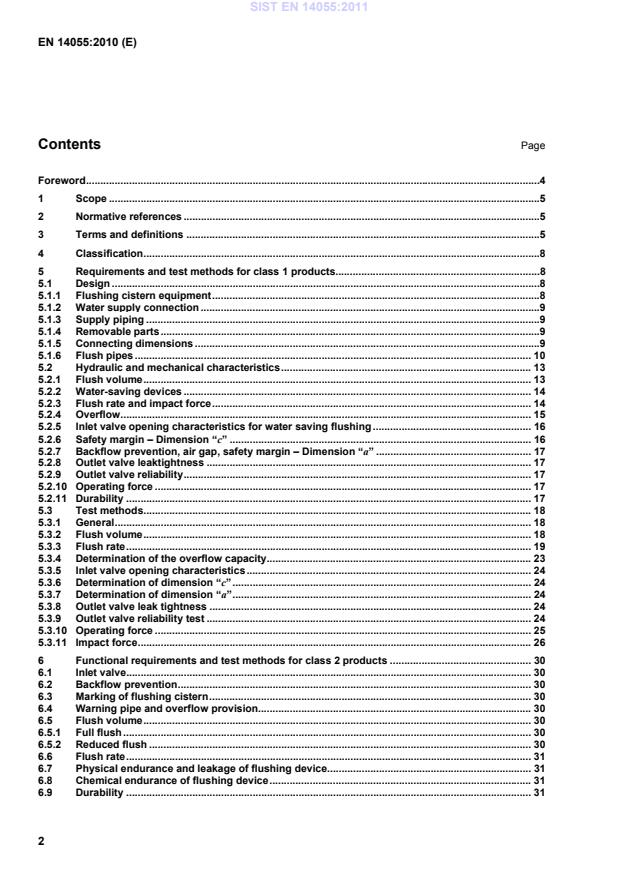
Clauses of this European Standard addressing the provisions of the EU Construction Products Directive . 40ZA.1 Scope and relevant characteristic . 40ZA.2 Procedure for attestation of conformity of WC and urinal flushing cisterns . 41ZA.2.1 System of attestation of conformity . 41ZA.2.2 Declaration of conformity . 42ZA.3 CE marking and labelling. 42Bibliography . 44 SIST EN 14055:2011
Built-in independent
Wall-hung independent mid-level
Wall-hung independent high-level
One-piece integral (with WC pan)
Close-coupled
3.3 close-coupled multiple use flushing cistern close-coupled flushing cistern for use with different WC pans 3.4 independent flushing cistern flushing cistern mounted separately from a WC pan or urinal 3.5 outlet valve mechanism for opening and closing the outlet orifice of the flushing cistern 3.6 operating mechanism mechanism to open, and if applicable, close the outlet valve 3.7 flush pipe connecting pipe between a flushing cistern’s outlet and a WC’s or urinal's inlet 3.8 overflow device enabling release of excess water from a flushing cistern when water reaches a pre-determined level SIST EN 14055:2011
water-saving device flushing device that permits a part of the total flush volume to be delivered, e.g. acting as double-action mechanisms (interruptible) or double-control mechanisms (dual control or dual flush) 3.25 warning level level of spill over of a vertically mounted warning pipe connection or the invert of a horizontally mounted warning pipe connection, or the level at which an equally effective (warning) device would operate 3.26 short-term leak test leak test consisting of a 15 min wait after flushing then positioning paper designed to change colour when wet, under the flushing device for 10 min
NOTE
A leak is defined as being visible discharge of water amounting to more than three separate drops. 3.27 long-term leak test leak test consisting of a 2 h wait after flushing then positioning paper designed to change colour when wet, under the outlet for 15 min
NOTE
A leak is defined as being visible discharge of water amounting to more than three separate drops. 4 Classification Flushing cisterns are classified as described below: Class 1: Flushing cisterns tested in accordance with the requirements of Clauses 5 and 8 using a nominal flush volume of either 4 l, 5 l, 6 l, 7 l or 9 l. Class 2: Flushing cisterns tested in accordance with the requirements of Clauses 6 and 8 using a maximum flushing volume of 6 l, or a dual-flush which combines a maximum flush of 6 l and a reduced flush no greater than two-thirds of the maximum flush. Class 3: Class 1 flushing cistern intended to be used in connection with urinals. 5 Requirements and test methods for class 1 products 5.1 Design 5.1.1 Flushing cistern equipment An equipped flushing cistern comprises: a shell, provided with a removable lid or an access flap allowing access to components; an inlet valve complying with EN 14124; a flushing device; SIST EN 14055:2011
mm Remarks Hole for inlet valve — 19 ± 2 c For inlet valves size 3/8" 23 ± 2 c For inlet valves size ½" Hole for outlet valve A 6323+− c For ceramic flushing cisterns 6120+ c For thin-walled flushing cisterns (e.g. plastic) 4523+− c For high level flushing cisterns Inside diameter of outlet connection B 32,510+ c For flush pipes of design A 515,00+ c For flush pipes of design B Outside diameter of outlet connection C a 49,54,00+ b For flush pipes of design C Hole in the cover for operating device — 4021+− c Recommended dimension a Not applicable to flushing cisterns built into wall frames. b Where the exterior diameter of the flush pipe is conical or has several stepped diameters, the maximum diameter is to be verified and recorded. c Other dimensions are permissible if the performance of the cistern is assured.
Key See Table 1 Figure 1 — Outlet connection for flush
pipes of designs A and B Key See Table 1 Figure 2 — Outlet connection for flush
pipes of design C 5.1.6 Flush pipes The dimensions of flush pipes designed to equip WC pans for independent supply shall comply with Table 2. The flush pipe shall be provided by the manufacturer of the flushing cistern. SIST EN 14055:2011
mm Remarks Outside diameter at inlet b 325,00+ For flush pipes of design A 505,00+ For flush pipes of design B Inside diameter c 5010+ For flush pipes of design C Outside diameter at outlet to WC e 325,00+ For flush pipes of design A 445,00+ For flush pipes of design B 455,00+ For flush pipes of design C Inside diameter at outlet to WC f ≥ 39 For flush pipes of designs B and C Height of flush pipe h ≥ 1 500 For flush pipes of design A ≥ 165 For flush pipes of design B ≥ 600 ≥ 165 For flush pipes of design C Length k ≥ 210 For flush pipes of designs A and B ≥ 180 For flush pipes of design C Length of vertical inlet portion m ≥ 100 For flush pipes of design A Radius of bend r 50 to 80 For flush pipes of design A ≥ 15 For flush pipes of design B ≥ 5 For flush pipes of design C Apart from dimension e other dimensions are permissible, provided the performance requirements in 5.2 are satisfied. SIST EN 14055:2011
Key See Table 2 Figure 3 — Design A flush pipe for wall-hung high-level cisterns, fabricated in one or two parts
Key See Table 2 Figure 4 — Design B flush pipe for wall-hung low-level or mid-level cisterns SIST EN 14055:2011
Key See Table 2 Figure 5 — Design C flush pipe for built-in cisterns
Key
r Radius of bend Figure 6 — Detail X 5.2 Hydraulic and mechanical characteristics 5.2.1 Flush volume Flush volume(s) shall correspond with those specified in Table 3, when measured as described in 5.3.2. SIST EN 14055:2011
l Flush volumes
l For complete flushing For water-saving (dual) flushing Minimum Maximum Minimum Maximum 9,0 8,5 9,0 3,0 4,5 a 7,0 7,0 7,5 3,0 4,0 a 6,0 6,0 6,5 3,0 4,0 a 5,0 4,5 5,5 3,0 4,0 a 4,0 4,0 4,5 2,0 3,0 a a Only for double-control water-saving (dual) flushing devices. Flushing cisterns or their components shall be marked to allow the correct volume(s) of flush to be achieved. Flushing cisterns with a nominal volume of 9 l, 7 l, 6 l, 5 l or 4 l can be used to deliver the different volumes shown in Table 3. Adjustment can be effected at the inlet valve and/or the outlet mechanism. The manufacturer’s instructions shall describe the procedure and the consequences (e.g. increase in the residual water level or decrease in the filling level). 5.2.2 Water-saving devices Water-saving mechanisms shall be designed so that, when selected, only part of the total flush volume is delivered. Water-saving mechanisms shall comply with the requirements specified below: a) Double-action mechanisms (interruptible): 1) one action initiates flushing; and 2) a second action stops the flush. Devices with immediate and automatic closing are not permitted. b) Double-control mechanisms (dual control): 1) one control releases the full flush volume; and 2) another control releases a reduced flush volume. Both devices shall deliver flush volumes and flush rates in accordance with Tables 3 and 4. 5.2.3 Flush rate and impact force When tested as described in 5.3.3 and 5.3.11, the flush rate and the impact force shall comply with the values specified in Table 4. SIST EN 14055:2011
N Flush rate for complete flushl/s Independent wall-hung low-level 200 ± 5 — 2,4 ± 0,2 Independent built-in ≥ 195 a — 2,2 ± 0,2 Independent built-in < 195 a > 3,9 (defined by the maximum method) or > 3,7 (defined by the fixed time frame method)2,2 ± 0,2 Independent wall-hung mid-level 565 ± 5 — 1,8 4,01,0+− Independent wall-hung high-level 1 365 ± 5 — 1,8 4,01,0+− One-piece and close-coupled — — n.a. b Multiple use close-coupled — — min. 2,0 c a Flushing cisterns with integral flush pipes and flushing cisterns built into wall frames shall be tested as supplied by the manufacturer, regardless of the test height. b One-piece and close-coupled type will be tested in accordance with EN 997. c Independent from this value, the flushing cistern shall be tested in accordance with EN 997 with dedicated WC pans specified by the manufacturer of multiple use close-coupled flushing cistern. 5.2.4 Overflow When tested as described in 5.3.4, the overflow shall be designed in accordance with the requirements specified below (see Figure 7): a) the distance between the maximum water level and the level of overflow shall be ≤ 20 mm; b) the distance between the critical water level and the level of overflow shall be ≤ 10 mm; c) the distance between the meniscus level and the level of overflow shall be ≤ 5 mm. SIST EN 14055:2011
Key 1 Overflow pipe 2 Overflow level 3 Maximum water level 4 Critical water level 5 Meniscus level Figure 7 — Maximum, critical and overflow level 5.2.5 Inlet valve opening characteristics for water saving flushing When tested as described in 5.3.5, inlet valves used with flushing cisterns equipped with a water-saving device shall re-open during or after the short flush has been completed. 5.2.6 Safety margin – Dimension “c” When tested as described in 5.3.6, dimension “c” (see Figure 8) corresponding to the distance between the overflow level and the maximum nominal water level indicated by the manufacturer shall be at least 20 mm. SIST EN 14055:2011
Key 1 Maximum water level 2 Overflow level 3 Maximum nominal water level a Distance between overflow level and the point of the air inlet orifice of the inlet valve c Safety margin Figure 8 — Safety margin dimensions 5.2.7 Backflow prevention, air gap, safety margin – Dimension “a” When tested as described in 5.3.7, the dimension “a” (see Figure 8) between the overflow level and the lowest point of the air inlet orifice of the inlet valve shall be 20 mm minimum as required by EN 1717 to prevent backflow. In the case of adjustable overflow, the adjustment shall provide a dimension “a” of 20 mm minimum. 5.2.8 Outlet valve leaktightness When tested in accordance with 5.3.8, there shall be no leakage greater than three drops within 15 min. 5.2.9 Outlet valve reliability When tested in accordance with 5.3.9, the outlet mechanism functions shall be ensured.
The flushing device shall not show any failure or permanent distortion of any components including linkages that prevents normal operation of the mechanism. The outlet of the flushing device shall not show leakage greater than three drops within 15 min. 5.2.10 Operating force When tested as described in 5.3.10, it shall be possible for the outlet mechanism to be actuated with a maximum force of 25 N. 5.2.11 Durability Class 1 products conforming with 5.2.1, 5.2.3 to 5.2.9 and Clause 8 are deemed to be durable. SIST EN 14055:2011
Key 1 Flushing cistern 5 Residual water level 2 Measured volume 6 Seat level 3 Pressure sensor 7 Flush pipe 4 Nominal water level 8 Test height (see Table 4) Figure 9 — Test arrangement for testing low-level, mid-level and built-in flushing cisterns 5.3.3.2 Determination of the residual water level Fill the flushing cistern via an inlet valve to the water level indicated by the manufacturer. Shut off the supply. Operate the flushing mechanism. Record the residual water level, when flushing is completed. Perform the test three times. If there are differences in the levels obtained, record the highest residual water level. In the case of flushing cisterns with alternative flush volumes indicated, the residual water level shall be established for each volume. In the case of flushing cisterns having an adjustment of flushing volumes via the outlet valve, the increased residual water level shall be established and marked for each of the adjustable flushing water volumes. 5.3.3.3 Establishing the measuring points to measure the flush rate 5.3.3.3.1 General In order to measure the flush rate, it is necessary to establish the measuring points indicated in Figures 10, 11 and 12. SIST EN 14055:2011
Key V1 Starting volume (full flush 1,0 l) V2 Measuring volume (full flush 3,0 l) V3 Finishing volume (full flush 2,0 l, 3,0 l, 5,0 l) Figure 10 — Flushing cisterns with an outlet valve adjustment for flushing volumes of 6 l, 7 l or 9 l respectively 5.3.3.3.3 Flushing cisterns with an inlet valve adjustment for flushing volumes of 6 l, 7 l or 9 l respectively The determination of the measuring points and the adjustment of the water level are illustrated in Figure 11. The choice of measuring points is significant for measuring the flush rate. SIST EN 14055:2011
Key V1 Starting volume (full flush 1,0 l, 2,0 l, 4,0 l) V2 Measuring volume (full flush 3,0 l) V3 Finishing volume (full flush 2,0 l) Figure 11 — Flushing cisterns with an inlet valve adjustment for flushing volumes of 6 l, 7 l or 9 l respectively 5.3.3.3.4 Flushing cisterns with a combined outlet/inlet valve adjustment flushing volume of 4,0 l or 5,0 l respectively Flushing cisterns with a combined outlet/inlet valve adjustment flushing volume of 4,0 l or 5,0 l and the determination of the measuring points and the adjustment of the water level are illustrated in Figure 12. The choice of measuring points is significant for measuring the flush rate.
Key V1 Starting volume (full flush 1,0 l) V2 Measuring volume (full flush ≥ 2,0 l) V3 Finishing volume (full flush 1,0 l) V4 Residual volume (full flush individual) Figure 12 — Flushing cisterns with a combined outlet/inlet valve adjustment flushing volume of 4,0 l or 5,0 l respectively EXAMPLE
For a flush with 4 l in a 7 l flushing cistern: Maximum adjustable flushing volume 7,0 l SIST EN 14055:2011
Dimensions in millimetres Dimensions in millimetres
Key 1 Push button or cistern operating mechanism 2 Guide 3 Test force Key1 Push button or cistern operating mechanism 2 Guide 3 Test force 4 Release Figure 13 — Test apparatus for
vertical operation Figure 14 — Test apparatus for
horizontal operation 5.3.10.2 Procedure Fill the flushing cistern to the maximum water level indicated by the manufacturer. Place the testing device 2 mm from the push button or cistern operating mechanism. Apply a maximum force of 25 N to the push button or cistern operating mechanism. Verify that the push button or cistern operating mechanism is activated within 0,5 s to 1 s. 5.3.11 Impact force
5.3.11.1 General The impact force of the flushing cistern complete with the flush pipe according to Table 4 shall be measured with the test device shown in Figure 15. The flushing water from the flush pipe shall be directed against the sensor plate (90 mm diameter) to create an impact force. This impact force shall be measured with a load cell and expressed in newtons. The test procedure consists of the measurement procedure and the calculation procedure using calibrated test equipment. 5.3.11.2 Test device The test device shall meet the following requirements: The test device shall be in accordance with Figures 15 and 16. SIST EN 14055:2011
...