

EN 16147:2017+A1:2022
(Main + Amendment)Heat pumps with electrically driven compressors - Testing, performance rating and requirements for marking of domestic hot water units
- Abstract
This European Standard specifies methods for testing, rating of performance and calculation of water heating energy efficiency of air/water, brine/water, water/water and direct exchange/water heat pump water heaters and heat pump combination heaters with electrically driven compressors and connected to or including a domestic hot water storage tank for domestic hot water production.
This European Standard comprises only the testing procedure for the domestic hot water production of the heat pump system.
NOTE 1 Testing procedures for simultaneous operation for domestic hot water production and space heating are not treated in this standard. Simultaneous means that domestic hot water production and space heating generation occur at the same time and may interact.
NOTE 2 For heat pump combination heaters the seasonal efficiency of space heating is determined according to EN 14825.
This European Standard only applies to water heaters which are supplied in a package of heat pump and storage tank. In the case of water heaters consisting of several parts with refrigerant connections, this European Standard applies only to those designed and supplied as a complete package.
This European Standard does not specify requirements of the quality of the used water.
- Status
- Published
- Publication Date
- 20-Dec-2022
- Technical Committee
- CEN/TC 113 - Heat pumps and air conditioning units
- Drafting Committee
- CEN/TC 113/WG 10 - Revision of EN 255-3
- Current Stage
- 6060 - Definitive text made available (DAV) - Publishing
- Start Date
- 21-Dec-2022
- Due Date
- 21-Jul-2022
- Completion Date
- 21-Dec-2022

Overview
EN 16147:2017+A1:2022 is a European Standard developed by CEN, titled "Heat pumps with electrically driven compressors - Testing, performance rating and requirements for marking of domestic hot water units." This standard focuses on the testing procedures, performance rating, and marking requirements for domestic hot water heat pumps and combination heaters that use electrically driven compressors. It specifically addresses units that include or are connected to a domestic hot water storage tank and are designed for residential water heating applications.
The standard establishes the methodology for evaluating the energy efficiency and performance of air/water, brine/water, water/water, and direct exchange/water heat pump systems. Notably, EN 16147 is limited to domestic hot water production testing and does not cover simultaneous space heating and hot water operation.
Key Topics
- Scope and Applicability
- Applies to domestic hot water heat pump water heaters and heat pump combination heaters with electrically driven compressors.
- Relevant for heat pumps supplied as a complete package with a storage tank.
- Excludes units assembled from multiple parts not delivered as a complete package and does not address water quality.
- Testing Methods
- Defines laboratory procedures for testing domestic hot water production.
- Prescribes installation requirements, test conditions, and settings to ensure reliable and repeatable results.
- Specifies how to install the heat pump, arrange measurement points, and handle ducted/non-ducted units.
- Performance Evaluation
- Outlines how to calculate water heating energy efficiency, accounting for electrical input and useful heat output.
- Details assessment of the coefficient of performance (COP), annual electric energy consumption, and the smart control factor (SCF).
- Requires reporting on seasonal coefficient of performance (SCOP) for domestic hot water when applicable.
- Marking and Documentation
- Lists content requirements for product marking, technical data sheets, and instructions for installation and maintenance.
- Ensures every unit provides consistent and clear consumer information as per EU regulatory needs.
Applications
EN 16147:2017+A1:2022 plays a critical role for:
- Manufacturers
- Ensuring heat pump water heaters and combination heaters meet consistent EU performance and energy efficiency expectations.
- Supporting product development and declaration of energy ratings.
- Testing Laboratories
- Providing uniform procedures to test, measure, and report water heating performance.
- Market Surveillance & Regulators
- Verifying compliance with ecodesign and energy labeling regulations in the European market.
- Installers and Distributors
- Offering guidance on correct installation and setup to achieve rated performance.
- Facilitating clear labeling and customer information for end users.
Adherence to EN 16147 is key for products to access the European market and carry energy labels required under EU directives.
Related Standards
EN 16147:2017+A1:2022 references and interrelates with several important European and international standards:
- EN 14511 (all parts): Air conditioners, chillers, and heat pumps for space heating and cooling - terms, test conditions, and methods.
- EN 14825: Specifies testing and calculation of seasonal space heating efficiency.
- EN 60204-1: Safety of electrical machinery.
- EN 61000-3-11: Electromagnetic compatibility for low-voltage supply systems.
- EN 50440: Smart control testing references.
- EN IEC 60335-2-40: Safety requirements for heat pumps and related equipment.
It also supports compliance with relevant EU directives for ecodesign (Commission Regulation (EU) No 814/2013, 813/2013) and energy labeling (Commission Delegated Regulation (EU) No 812/2013, 811/2013).
Keywords: EN 16147, heat pump standard, domestic hot water, performance testing, energy efficiency, CEN, water heater marking, heat pump water heater, ecodesign, EU energy labelling
Relations
- Effective Date
- 18-Jan-2023
- Effective Date
- 05-May-2021
- Effective Date
- 09-Feb-2026
- Effective Date
- 09-Feb-2026
- Effective Date
- 09-Feb-2026
- Effective Date
- 28-Jan-2026
- Effective Date
- 28-Jan-2026
- Effective Date
- 28-Jan-2026
- Effective Date
- 28-Jan-2026
- Effective Date
- 28-Jan-2026
- Effective Date
- 28-Jan-2026
Get Certified
Connect with accredited certification bodies for this standard

DNV
DNV is an independent assurance and risk management provider.

Lloyd's Register
Lloyd's Register is a global professional services organisation specialising in engineering and technology.
DNV Energy Systems
Energy and renewable energy certification.
Sponsored listings
Frequently Asked Questions
EN 16147:2017+A1:2022 is a standard published by the European Committee for Standardization (CEN). Its full title is "Heat pumps with electrically driven compressors - Testing, performance rating and requirements for marking of domestic hot water units". This standard covers: This European Standard specifies methods for testing, rating of performance and calculation of water heating energy efficiency of air/water, brine/water, water/water and direct exchange/water heat pump water heaters and heat pump combination heaters with electrically driven compressors and connected to or including a domestic hot water storage tank for domestic hot water production. This European Standard comprises only the testing procedure for the domestic hot water production of the heat pump system. NOTE 1 Testing procedures for simultaneous operation for domestic hot water production and space heating are not treated in this standard. Simultaneous means that domestic hot water production and space heating generation occur at the same time and may interact. NOTE 2 For heat pump combination heaters the seasonal efficiency of space heating is determined according to EN 14825. This European Standard only applies to water heaters which are supplied in a package of heat pump and storage tank. In the case of water heaters consisting of several parts with refrigerant connections, this European Standard applies only to those designed and supplied as a complete package. This European Standard does not specify requirements of the quality of the used water.
This European Standard specifies methods for testing, rating of performance and calculation of water heating energy efficiency of air/water, brine/water, water/water and direct exchange/water heat pump water heaters and heat pump combination heaters with electrically driven compressors and connected to or including a domestic hot water storage tank for domestic hot water production. This European Standard comprises only the testing procedure for the domestic hot water production of the heat pump system. NOTE 1 Testing procedures for simultaneous operation for domestic hot water production and space heating are not treated in this standard. Simultaneous means that domestic hot water production and space heating generation occur at the same time and may interact. NOTE 2 For heat pump combination heaters the seasonal efficiency of space heating is determined according to EN 14825. This European Standard only applies to water heaters which are supplied in a package of heat pump and storage tank. In the case of water heaters consisting of several parts with refrigerant connections, this European Standard applies only to those designed and supplied as a complete package. This European Standard does not specify requirements of the quality of the used water.
EN 16147:2017+A1:2022 is classified under the following ICS (International Classification for Standards) categories: 27.080 - Heat pumps. The ICS classification helps identify the subject area and facilitates finding related standards.
EN 16147:2017+A1:2022 has the following relationships with other standards: It is inter standard links to EN 16147:2017/FprA1, EN 16147:2017, EN 60204-1:2018, EN IEC 61000-3-11:2019, EN IEC 60335-2-40:2023, EN 14511-2:2018, EN 14511-1:2018, EN 14511-3:2018, EN 15316-4-2:2017, EN 16573:2017, EN 16798-5-2:2017. Understanding these relationships helps ensure you are using the most current and applicable version of the standard.
EN 16147:2017+A1:2022 is associated with the following European legislation: EU Directives/Regulations: 811/2013, 812/2013, 813/2013, 814/2013; Standardization Mandates: M/534, M/535. When a standard is cited in the Official Journal of the European Union, products manufactured in conformity with it benefit from a presumption of conformity with the essential requirements of the corresponding EU directive or regulation.
EN 16147:2017+A1:2022 is available in PDF format for immediate download after purchase. The document can be added to your cart and obtained through the secure checkout process. Digital delivery ensures instant access to the complete standard document.
Standards Content (Sample)
SLOVENSKI STANDARD
01-marec-2023
Toplotne črpalke z električnimi kompresorji - Preskušanje, vrednotenje lastnosti in
zahteve za označevanje naprav za pripravo tople sanitarne vode (vključuje
dopolnilo A1)
Heat pumps with electrically driven compressors - Testing, performance rating and
requirements for marking of domestic hot water units
Wärmepumpen mit elektrisch angetriebenen Verdichtern - Prüfungen,
Leistungsbemessung und Anforderungen an die Kennzeichnung von Geräten zum
Erwärmen von Brauchwarmwasser
Pompes à chaleur avec compresseur entraîné par moteur électrique - Essais,
détermination des performances et exigences pour le marquage des appareils pour eau
chaude sanitaire
Ta slovenski standard je istoveten z: EN 16147:2017+A1:2022
ICS:
23.140 Kompresorji in pnevmatični Compressors and pneumatic
stroji machines
27.080 Toplotne črpalke Heat pumps
91.140.65 Oprema za ogrevanje vode Water heating equipment
2003-01.Slovenski inštitut za standardizacijo. Razmnoževanje celote ali delov tega standarda ni dovoljeno.
EN 16147:2017+A1
EUROPEAN STANDARD
NORME EUROPÉENNE
December 2022
EUROPÄISCHE NORM
ICS 27.080 Supersedes EN 16147:2017
English Version
Heat pumps with electrically driven compressors - Testing,
performance rating and requirements for marking of
domestic hot water units
Pompes à chaleur avec compresseur entraîné par Wärmepumpen mit elektrisch angetriebenen
moteur électrique - Essais, détermination des Verdichtern - Prüfungen, Leistungsbemessung und
performances et exigences pour le marquage des Anforderungen an die Kennzeichnung von Geräten
appareils pour eau chaude sanitaire zum Erwärmen von Brauchwarmwasser
This European Standard was approved by CEN on 8 October 2016 and includes Amendment 1 approved by CEN on 23 May 2021.
CEN members are bound to comply with the CEN/CENELEC Internal Regulations which stipulate the conditions for giving this
European Standard the status of a national standard without any alteration. Up-to-date lists and bibliographical references
concerning such national standards may be obtained on application to the CEN-CENELEC Management Centre or to any CEN
member.
This European Standard exists in three official versions (English, French, German). A version in any other language made by
translation under the responsibility of a CEN member into its own language and notified to the CEN-CENELEC Management
Centre has the same status as the official versions.
CEN members are the national standards bodies of Austria, Belgium, Bulgaria, Croatia, Cyprus, Czech Republic, Denmark, Estonia,
Finland, France, Germany, Greece, Hungary, Iceland, Ireland, Italy, Latvia, Lithuania, Luxembourg, Malta, Netherlands, Norway,
Poland, Portugal, Republic of North Macedonia, Romania, Serbia, Slovakia, Slovenia, Spain, Sweden, Switzerland, Türkiye and
United Kingdom.
EUROPEAN COMMITTEE FOR STANDARDIZATION
COMITÉ EUROPÉEN DE NORMALISATION
EUROPÄISCHES KOMITEE FÜR NORMUNG
CEN-CENELEC Management Centre: Rue de la Science 23, B-1040 Brussels
© 2022 CEN All rights of exploitation in any form and by any means reserved Ref. No. EN 16147:2017+A1:2022 E
worldwide for CEN national Members.
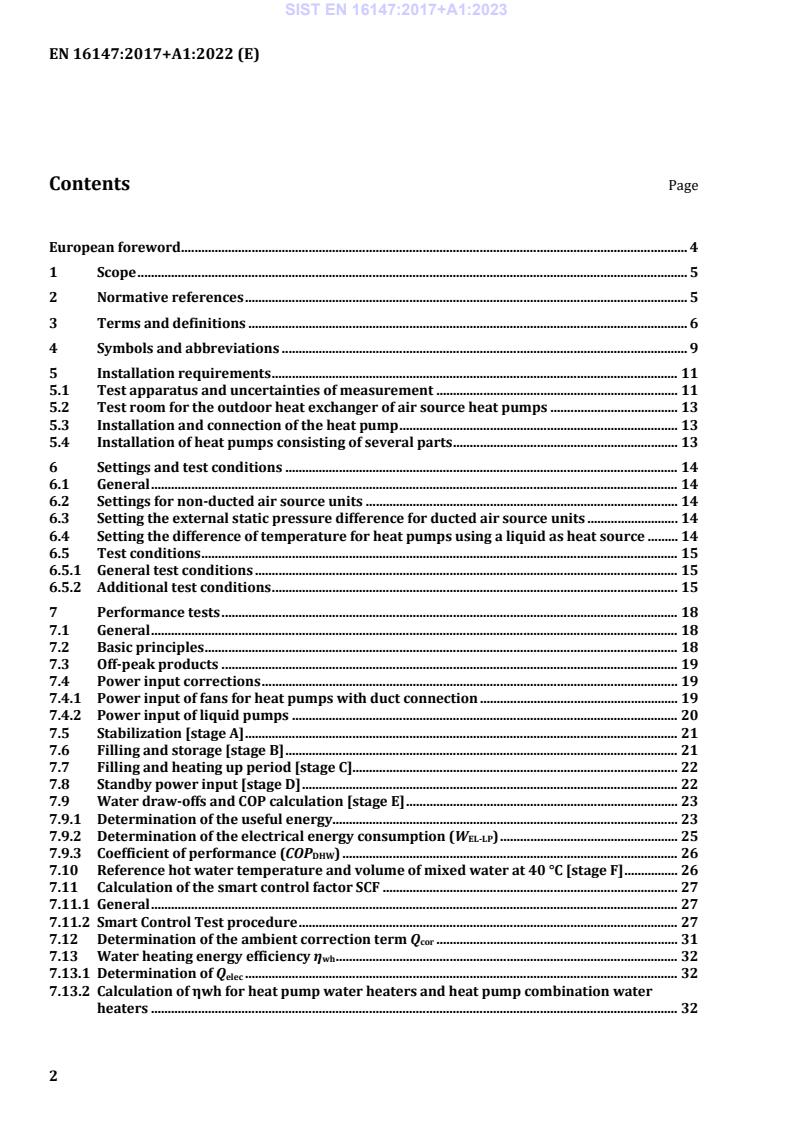
Contents Page
European foreword . 4
1 Scope . 5
2 Normative references . 5
3 Terms and definitions . 6
4 Symbols and abbreviations . 9
5 Installation requirements . 11
5.1 Test apparatus and uncertainties of measurement . 11
5.2 Test room for the outdoor heat exchanger of air source heat pumps . 13
5.3 Installation and connection of the heat pump . 13
5.4 Installation of heat pumps consisting of several parts . 13
6 Settings and test conditions . 14
6.1 General . 14
6.2 Settings for non-ducted air source units . 14
6.3 Setting the external static pressure difference for ducted air source units . 14
6.4 Setting the difference of temperature for heat pumps using a liquid as heat source . 14
6.5 Test conditions . 15
6.5.1 General test conditions . 15
6.5.2 Additional test conditions . 15
7 Performance tests . 18
7.1 General . 18
7.2 Basic principles . 18
7.3 Off-peak products . 19
7.4 Power input corrections . 19
7.4.1 Power input of fans for heat pumps with duct connection . 19
7.4.2 Power input of liquid pumps . 20
7.5 Stabilization [stage A] . 21
7.6 Filling and storage [stage B] . 21
7.7 Filling and heating up period [stage C]. 22
7.8 Standby power input [stage D] . 22
7.9 Water draw-offs and COP calculation [stage E] . 23
7.9.1 Determination of the useful energy. 23
7.9.2 Determination of the electrical energy consumption (WEL-LP) . 25
7.9.3 Coefficient of performance (COP ) . 26
DHW
7.10 Reference hot water temperature and volume of mixed water at 40 °C [stage F] . 26
7.11 Calculation of the smart control factor SCF . 27
7.11.1 General . 27
7.11.2 Smart Control Test procedure . 27
7.12 Determination of the ambient correction term Q . 31
cor
7.13 Water heating energy efficiency η . 32
wh
7.13.1 Determination of Q . 32
elec
7.13.2 Calculation of ηwh for heat pump water heaters and heat pump combination water
heaters . 32
7.13.3 Calculation of the Annual Consumption of electric energy . 33
7.14 Other performance. 34
7.14.1 Rated heat output . 34
7.14.2 Seasonal coefficient of performance (SCOP ) . 34
DHW
8 Other tests . 35
8.1 Temperature operating range . 35
8.2 Outside the operating range . 36
8.3 Safety devices checking test . 36
8.3.1 General . 36
8.3.2 Shutting off the heat transfer medium flows . 36
8.3.3 Complete power supply failure . 37
8.4 Condensate draining. 37
9 Test results and test report . 37
9.1 Data to be recorded. 37
9.2 Test report . 40
9.2.1 General information . 40
9.2.2 Main results . 41
10 Marking . 41
11 Documentation . 42
11.1 Technical data sheet . 42
11.1.1 General description . 42
11.1.2 Performance characteristics . 42
11.2 Instructions . 43
11.2.1 General . 43
11.2.2 Physical description . 43
11.2.3 Additional heating devices, if integrated in unit . 43
11.2.4 Control and safety . 43
11.2.5 Instructions for installation . 44
11.2.6 Instructions for maintenance . 44
Annex A (normative) Load profiles . 45
Annex ZA (informative) Relationship between this European Standard and the ecodesign
requirements of Commission Regulation (EU) No 814/2013 aimed to be covered . 50
Annex ZB (informative) Relationship between this European Standard and and the energy
labelling requirements of Commission Delegated Regulation (EU) No 812/2013
aimed to be covered . 52
Annex ZC (informative) Relationship between this European Standard and the ecodesign
requirements of Commission Regulation (EU) No 813/2013 aimed to be covered . 54
Annex ZD (informative) Relationship between this European Standard and the energy
labelling requirements of Commission Delegated Regulation (EU) No 811/2013
aimed to be covered . 55
Bibliography . 57
European foreword
This document (EN 16147:2017+A1:2022) has been prepared by Technical Committee CEN/TC 113
“Heat pumps and air conditioning units”, the secretariat of which is held by AENOR.
This European Standard shall be given the status of a national standard, either by publication of an
identical text or by endorsement, at the latest by June 2023, and conflicting national standards shall be
withdrawn at the latest by June 2023.
Attention is drawn to the possibility that some of the elements of this document may be the subject of
patent rights. CEN shall not be held responsible for identifying any or all such patent rights.
This document supersedes !EN 16147:2017".
!The main changes with respect to the previous edition are listed below:
a) correction of the calculation of η for heat pump water heaters and heat pump combination water
wh
heaters;
b) correction of the calculation of the annual consumption of electric energy;
c) completion of Annexes ZA, ZB, ZC and ZD in line with the standardization requests M/534 (water
heaters) and M/535 (space heaters)."
This document includes Amendment 1 approved by CEN on 23 May 2021.
The start and finish of text introduced or altered by amendment is indicated in the text by tags !".
This document has been prepared under a mandate given to CEN by the European Commission and the
European Free Trade Association, and supports essential requirements of EU Directive(s).
For relationship with EU Directive(s), see informative Annexes ZA, ZB, ZC and ZD, which are an integral
part of this document.
Note that the following provides details of significant technical changes between this document and the
previous edition:
d) re-structuring of the standard into the Clause 5 “Installation requirements”, Clause 6 “Settings and
test conditions”, Clause 7 “Performance tests”, Clause 8 „Other tests“ and Clause 9 „Test results and
test report“;
e) update of Table 1 “Uncertainties of measurement for indicated values” in terms of units;
f) update of the performance test regarding the stages (i.e. A. to F.) and the order of the tests (see 7.2);
g) introduction of 7.11 “Calculation of the smart control factor SCF” and 7.12 „Determination of the
ambient correction term Q “ on the basis of the European Standard EN 50440:2015;
cor
h) introduction of 7.13.3 “Calculation of the Annual Consumption of electric energy”;
i) re-allocation and revision of the former “tapping cycles“ into the new annex “Load profiles” (see
Tables A.1 to A.3);
j) introduction of 7.14 “Other performances” regarding rated heat output and seasonal coefficient of
performance;
k) addition of the Annex ZA and Annex ZB for the relationship between this European Standard and
the requirements of Commission Regulation (EU) No 814/2013 and (EU) No 812/2013;
l) addition of the Annex ZC and Annex ZD for the relationship between this European Standard and
the requirements of Commission Regulation (EU) No 813/2013 and (EU) No 811/2013.
Any feedback and questions on this document should be directed to the users’ national standards body.
A complete listing of these bodies can be found on the CEN website.
According to the CEN-CENELEC Internal Regulations, the national standards organisations of the
following countries are bound to implement this European Standard: Austria, Belgium, Bulgaria,
Croatia, Cyprus, Czech Republic, Denmark, Estonia, Finland, France, Germany, Greece, Hungary, Iceland,
Ireland, Italy, Latvia, Lithuania, Luxembourg, Malta, Netherlands, Norway, Poland, Portugal, Republic of
North Macedonia, Romania, Serbia, Slovakia, Slovenia, Spain, Sweden, Switzerland, Türkiye and the
United Kingdom.
1 Scope
This document specifies methods for testing, rating of performance and calculation of water heating
energy efficiency of air/water, brine/water, water/water and direct exchange/water heat pump water
heaters and heat pump combination heaters with electrically driven compressors and connected to or
including a domestic hot water storage tank for domestic hot water production.
This document comprises only the testing procedure for the domestic hot water production of the heat
pump system.
NOTE 1 Testing procedures for simultaneous operation for domestic hot water production and space heating
are not treated in this standard. Simultaneous means that domestic hot water production and space heating
generation occur at the same time and may interact.
NOTE 2 For heat pump combination heaters the seasonal efficiency of space heating is determined according to
EN 14825.
This document only applies to water heaters which are supplied in a package of heat pump and storage
tank. In the case of water heaters consisting of several parts with refrigerant connections, this European
Standard applies only to those designed and supplied as a complete package.
This document does not specify requirements of the quality of the used water.
2 Normative references
The following documents, in whole or in part, are normatively referenced in this document and are
indispensable for its application. For dated references, only the edition cited applies. For undated
references, the latest edition of the referenced document (including any amendments) applies.
!EN 14511-1:2018, Air conditioners, liquid chilling packages and heat pumps for space heating and
cooling and process chillers, with electrically driven compressors - Part 1: Terms and definitions
EN 14511-2:2018, Air conditioners, liquid chilling packages and heat pumps for space heating and cooling
and process chillers, with electrically driven compressors - Part 2: Test conditions
EN 14511-3:2018, Air conditioners, liquid chilling packages and heat pumps for space heating and cooling
and process chillers, with electrically driven compressors - Part 3: Test methods
EN 60204-1:2018, Safety of machinery - Electrical equipment of machines - Part 1: General requirements
prEN IEC 60335-2-40:2020, Household and similar electrical appliances - Safety - Part 2-40: Particular
requirements for electrical heat pumps, air-conditioners and dehumidifiers (IEC 60335-2-40:2018)
EN 61000-3-11:2019, Electromagnetic compatibility (EMC) - Part 3-11: Limits - Limitation of voltage
changes, voltage fluctuations and flicker in public low-voltage supply systems - Equipment with rated
current ≤ 75 A and subject to conditional connection (IEC 61000-3-11:2017)"
3 Terms and definitions
For the purposes of this document, the terms and definitions given in !EN 14511-1:2018" and the
following apply.
3.1
heat pump water heater
water heater that uses ambient heat from air source, water source or ground source, and/or waste heat
for heat generation
3.2
heat pump combination heater
heat pump space heater that is designed to also provide heat to deliver hot drinking or sanitary water at
given temperature levels, quantities and flow rates during given intervals, and is connected to an
external supply of drinking or sanitary water
3.3
domestic hot water
water heated for household or similar purposes
3.4
storage volume
V
m
measured volume of the tank
3.5
non heated space air
heat source for a heat pump which absorbs heat by an air heat exchanger in direct contact with the air
inside a non-heated space within a building
3.6
indoor air
heat source for a heat pump which absorbs heat by an air heat exchanger in direct contact with the air
inside a heated space within a building
3.7
coefficient of performance for domestic hot water
COP
DHW
coefficient of performance which is determined by the use of a reference load profile and which
includes the heat losses of the storage tank
3.8
reference hot water temperature
θ'
WH
temperature determined as the mean temperature value of the average temperatures during one single
draw-off which ends when the hot water temperature is below 40 °C
3.9
mixed water at 40 °C
V
quantity of water at 40 °C, which has the same heat content (enthalpy) as the hot water which is
delivered above 40 °C at the output of the water heater
3.10
off-peak product
water heater that is energised for a maximum period of 8 consecutive hours between 22:00 and 07:00
of the 24 hour tapping pattern
3.11
water heating energy efficiency
η
wh
ratio between the useful energy (in domestic hot water) provided by a water heater and the energy
required for its generation
3.12
load profile
given sequence of water draw-offs
3.13
water draw-off
given combination of useful water flow rate, useful water temperature, useful energy content and peak
temperature
3.14
useful water flow rate
f
minimum flow rate for which hot water is contributing to the reference energy
3.15
useful water temperature
T
m
water temperature at which hot water starts contributing to the reference energy
3.16
useful energy content
Q
tap
energy content of hot water provided at a temperature equal to, or above, the useful water temperature,
and at water flow rates equal to, or above, the useful water flow rate
3.17
peak temperature
T
p
minimum water temperature to be achieved during water draw-off calculated as the mean value over
the water draw-off
3.18
reference energy of the load profile
Q
ref
sum of the useful energy content of water draw-offs in a particular load profile
3.19
daily electrical energy consumption
Q
elec
consumption of electrical energy for water heating over 24 consecutive hours under a specific load
profile
3.20
smart control
device that automatically adapts the water heating process to individual usage conditions with the aim
of reducing energy consumption
3.21
smart control factor
SCF
water heating energy efficiency gain due to smart control
3.22
primary standby heat loss
P
stby
primary power input of a heat pump water heater in operating modes without heat demand
3.23
standby power input
P
es
total power input of the unit during the standby test, including the power input of the unit to overcome
heat losses of the tank and the power input of any auxiliary device
3.24
ambient correction term
Q
cor
energy correction term which takes into account the fact that the place where the water heater is
installed is not an isothermal place
3.25
conversion coefficient
CC
coefficient reflecting the power generation efficiency
Note 1 to entry: According to Directive 2012/27/EU the CC value is equal to 2,5.
4 Symbols and abbreviations
Symbol Description Units
AEC Annual electrical energy consumption kWh/a
CC conversion coefficient, equal to 2,5 —
SCF smart control factor —
COP coefficient of performance for domestic hot water —
DHW
specific heat capacity of water
c
kJ/(kgK)
p
ESP external static pressure Pa
f useful water flow rate l/min
f maximum flow rate of considered load profile
l/min
max
f (t) maximum flow rate of hot water during draw-off
l/min
max
f(t) useful water flow rate l/min
i index for the draw-off —
coefficient for the determination of ambient correction
k —
term, which value is given in Table 7
difference of the two weights (filled/empty) of the storage
m
kg
act
water heater
P standby power input
kW
es
rated heat output
P
kW
rated
measured average power input for off-peak products
P
kW
S
P primary standby heat loss
kW
stby
Q ambient correction term
kWh
cor
daily electrical energy consumption
Q
kWh
elec
calculated heat energy produced by electrical resistance
Q
kWh
EL-LP
heater during the whole load profile
Calculated heat energy produced by electrical resistance
Q
kWh
EL-tap
heater to reach the required tapping temperature
Q useful energy during one single draw-off
kWh
HP-tap
Q total useful energy content during the whole load profile
kWh
LP
total electrical energy consumption during the smart period
smart
Q
kWh
elec
of the smart cycle
Symbol Description Units
total useful energy content during the smart period of the
smart
Q
kWh
LP
smart cycle
Total electrical energy consumption during the reference
ref
Q
kWh
elec
period of the smart cycle
total useful energy content during the reference period of
ref
Q
kWh
LP
the smart cycle
Q reference energy of the load profile
kWh
ref
energy content of hot water provided at a temperature
equal to, or above, the useful water temperature, and at
Q
kWh
tap
water flow rates equal to, or above, the useful water flow
rate
smart indicator of the smart control compliance of the product
SCOP Seasonal Coefficient of Performance for domestic hot water
DHW
test phase duration
t
s
d
duration of the last on-off-cycle of the heat pump
t
s
es
th heating up time s
t40 time from starting the draw-off until θWH is less than 40 °C s
ttap duration of a draw-off of useful water s
t load profile time h
TTC
T dry bulb temperature °C
DB
T useful water temperature °C
m
Tp peak temperature °C
TWB wet bulb temperature °C
.
nominal air volume flow rate 3
m /s
V
air
.
measured liquid volume flow rate
m /s
V
fluid
Vm storage volume l
V mixed water at 40 °C l
total electrical energy consumption during the test duration
W kWh
eh-HP
t
h
measured electrical energy consumption during the test
W kWh
eh-M
duration t
h
correction due to electrical energy consumption of
WEL-Corr kWh
fan/liquid pump
Symbol Description Units
total electrical energy consumption during the whole load
W kWh
EL-LP
profile
W total measured electrical energy consumption kWh
EL-M-LP
calculated electrical energy consumption for off-peak
WEL-OFF kWh
products
total electrical energy consumption during the last on-off-
Wes-HP kWh
cycle
measured electrical energy consumption during the last on-
Wes-M kWh
off cycle
Δpe measured external static pressure difference Pa
Δp measured internal static pressure difference Pa
i
η efficiency of the fan or the pump according to EN 14511–3 —
η water heating energy efficiency %
wh
ntap number of draw-offs during the load profile —
θWC incoming cold water temperature °C
θWC(t) incoming cold water temperature during draw-off °C
θ outgoing hot water temperature °C
WH
θ (t) hot water temperature during draw-off °C
WH
θ'WH reference hot water temperature °C
ρ(T) density of water at temperature T kg/m
5 Installation requirements
5.1 Test apparatus and uncertainties of measurement
The test apparatus shall be designed in such a way that all requirements for adjustment of set values,
stability criteria and uncertainties of measurement according to this European Standard can be fulfilled.
Water systems or other heat transfer liquid systems shall be sufficiently free of entrained gas as to
ensure that the measured results are not significantly influenced.
The inlet and outlet temperatures of the domestic water are measured in the centre of the flow and as
close as possible to the appliance. The response time of the temperature sensor and the sampling
interval have to be chosen to maintain the uncertainties in Table 1.
Ducted air systems shall be sufficiently airtight to ensure that the measured results are not significantly
influenced by exchange of air with the surroundings.
The uncertainties of measurement shall not exceed the values specified in Table 1.
Table 1 — Uncertainties of measurement for indicated values
Measured quantity Unit Uncertainty
Domestic Hot Water
Temperature °C ±0,2 K
Temperature difference K ±0,2 K
Volume L ±2 %
Volume flow l/min ±2 %
Thermal energy kWh ±5 %
Liquid (heat source)
Temperature
°C ±0,15 K
inlet/outlet
Volume flow m /s ±1 %
±1 kPa
Static pressure
Pa (∆P ≤ 20 kPa) ± 5 %
difference
(∆P ≥ 20 kPa)
Brine concentration % vol. ±2 % vol.
Air (heat source)
Dry bulb temperature °C ±0,2 K
Wet bulb temperature °C ±0,4 K
Volume flow m /h ±5 %
±5 Pa (∆P ≤ 100 Pa)
Static pressure
Pa
difference
±5 % (∆P ≥ 100 Pa)
Electrical quantities
±0,1 W (≤10 W)
Electric power W
±1 % (≥10 W)
Electrical energy kWh ±1 %
Voltage V ±0,5 %
current A ±0,5 %
Ambient
Ambient temperature
°C ±0,5 K
indoors
5.2 Test room for the outdoor heat exchanger of air source heat pumps
The size of the test room shall be selected to avoid any resistance to air flow at the air inlet and air
outlet orifices of the test object. The air flow through the room shall not be capable of initiating any
short circuit between the two orifices, and therefore the velocity of air flow at these two locations shall
not exceed 1,5 m/s when the test object is switched off.
Unless otherwise stated by the manufacturer, the air inlet and air outlet orifices shall not be less than
1 m from the surfaces of the test room; this also applies to any measuring ducts.
Any direct heat radiation (e.g. solar radiation) onto heating units in the test room onto the heat pump or
onto the temperature measuring points shall be avoided.
5.3 Installation and connection of the heat pump
The heat pump shall be installed and connected for the test as recommended by the manufacturer in his
installation and operation manual. The accessories provided by option (for example heating element)
are not included in the test.
Temperature and pressure measuring points shall be arranged in order to obtain significant mean
values.
5.4 Installation of heat pumps consisting of several parts
In the case of heat pumps consisting of several refrigeration parts (split heat pumps) the following
installation conditions shall be complied with for the tests:
a) each refrigerant line shall be installed in accordance with the manufacturer's instructions; the
length of each line shall be between 5 m and 7,5 m;
b) the lines shall be installed so that the difference in elevation does not exceed 2,5 m;
c) thermal insulation shall be applied to the lines in accordance with the manufacturer's instructions;
d) unless constrained by the design at least half of the interconnecting lines shall be exposed to the
outdoor conditions with the rest of the lines exposed to the indoor conditions.
For the test of direct exchange ground coupled heat pumps requirement d) is not valid.
For indirect systems where the heat pump is separated from the tank, water or brine connections to the
tank shall be installed in accordance with the manufacturer’s instructions to the maximum stated length
or 5 m, whichever is shorter. Piping shall be installed according to d) and with as few bends as possible
and insulated according to c).
6 Settings and test conditions
6.1 General
Set points for internal control equipment of the unit such as thermostats, pressure switches or mixing
valves shall be set to the values as stated in the installation and operating instructions.
If several set points or a range are stated, the manufacturer shall indicate the one to be used for the
tests.
Thermostat settings and settings for auxiliary electrical heaters shall be done according to the
installations and operating instructions and shall remain in the same position for the duration of the
test.
If the water heater is equipped with a mixing valve for the hot water, this valve shall be set at the
manufacturer's recommended setting throughout the test.
6.2 Settings for non-ducted air source units
For non-ducted units, the adjustable settings such as louvers and fan speed shall be set according to the
installations and operating instructions.
Without information from the manufacturer, louvers and fan speed shall be set for maximum air flow
rate.
6.3 Setting the external static pressure difference for ducted air source units
The volume flow and the pressure difference shall be related to standard air and with dry heat
exchanger. If the air flow rate is given by the manufacturer with no atmospheric pressure, temperature
and humidity conditions, it shall be considered as given for standard air conditions.
The air flow rate as stated in the installation and operating instructions shall be converted into standard
air conditions. The air flow rate setting shall be made when the fan only is operating.
The resulting standard air flow rate shall be set and the resulting external static pressure (ESP)
measured.
If the ESP is lower than 30 Pa, the air flow rate is decreased to reach this minimum value.
The apparatus used for setting the ESP shall be maintained in the same position during all the tests.
If the installation and operating instructions state that the maximum allowable duct length is for inlet
and outlet together less than 2 m, then the unit shall be tested with its duct length but as a non-ducted
unit; therefore the ESP is considered equal to 0 Pa
6.4 Setting the difference of temperature for heat pumps using a liquid as heat source
For heat pump water heater using liquid (water or brine) as heat source, the nominal liquid flow rate as
specified in the operation and installation instructions shall be set with the inlet liquid temperature as
given in Table 4.
For heat pump combination heater, the liquid flow rate as specified for space heating operation at
standard rating conditions at medium temperature application (47 °C/55 °C) according to
!EN 14511-2:2018 and EN 14511-3:2018" shall be set with the inlet liquid temperature as given in
Table 4.
6.5 Test conditions
6.5.1 General test conditions
The tests shall be carried out at the relevant test conditions specified in Table 3 and Table 4.
For heat pumps using ventilation exhaust air as heat source, the air flow rate shall be set as specified by
the manufacturer but shall not exceed the maximum values given in Table 5.
Permissible deviations shall not exceed the values specified in Table 2. In addition the maximal
permissible deviation of thermal energy for the complete load profile shall be 5 %.
6.5.2 Additional test conditions
For heat pumps using ventilation exhaust air as heat source, additional air flow rates can be tested.
Table 2 — Variations allowed for the test conditions when the heat pump is running
Variations of arithmetical Variation of individual readings
mean values from from specified test conditions
specified test conditions
Readings
Interval Interval Interval Interval Interval Interval
a
a b c H b c
H D S D S
Air temperature
d
dry-bulb ±0,6 K ±1,5 K ±1,0 K ±5,0 K ±2,5 K
- wet-bulb ±0,4 K ±1,0 K ±0,6 K —
- volume flow ±5 % ±10 %
- static pressure
— ±10 %
difference
- ambient temperature of
the tank
±1 K ±2 K
(if not used as heat
source)
Domestic hot water
- inlet temperature ±1 K ±1 K
- volume flow ≥ 10 l/min (±5 %) ≥ 10 l/min (±10 %)
±0,5 l/min (≤10 l/min) ±1,0 l/min (≤10 l/min)
Liquid
- Liquid source Inlet
±0,2 K — ±0,5 K ±0,5 K — —
temperature
- Volume flow ±1 % ±2,5 %
- Static pressure
– ±10 %
difference
Variations of arithmetical Variation of individual readings
mean values from from specified test conditions
specified test conditions
Readings
Interval Interval Interval Interval Interval Interval
a
a b c H b c
H D S D S
Others
Voltage ±4 % ±4 %
a
Interval H applies when the heat pump is operating, except for the first 10 min after termination of a defrost
cycle, and the first 10 min after a restart of the heat pump.
b
Interval D applies during a defrost cycle and during the first 10 min after the termination of a defrost cycle
when the heat pump is operating in the heating mode.
c
Interval S applies when the compressor is stopped and during the first 10 min after the hot water thermostat
has started again the heat pump.
d 2
For units with outdoor heat exchanger surfaces greater than 5 m , the deviation on the air inlet dry bulb
temperature is doubled.
Table 3 — Test conditions applicable to all systems
Measured variable Set value
Power supply voltage Rated voltage
Power supply frequency Rated frequency
Air flow rate on the heat source side Nominal, as indicated by the
manufacturer.
When only a range is given, tests are
to
be carried out at the maximum value.
Temperature of the incoming cold 10 °C
water
Pressure of incoming cold water max. 0,6 MPa (6 bar)
Hot water flow rate (see load profiles in Annex A)
Table 4 — Test conditions for particular types of systems
Type of heat Heat source Heat source Range of Ambient
source inlet/outlet or ambient temperature
Air Dry (wet)
a
bath of
bulb temperature
temperature
temperature of heat pump storage tank
in °C
in °C in °C in °C
Outdoor air heat from 15 to 30 20
pump (placed
indoor side)
average 7 (6)
colder 2 (1)
warmer 14 (13)
Outdoor air heat – heat source 20
pump (outdoor temperature
side)
average 7 (6)
colder 2 (1)
warmer 14 (13)
Non heated 15 (12) – heat source 15
space air temperature
Indoor air 20 (15) – heat source 20
temperature
Exhaust air 20 (12) – from 15 to 30 20
b
Water – 10 / 7 from 15 to 30 20
b
Brine – 0 / −3 from 15 to 30 20
a
Direct – 4 from 15 to 30 20
evaporation
a
Brine bath mean temperature for direct evaporation testing.
b
The outlet temperature shall be used by the manufacturer for setting the flow rate that is to be maintained
during the test in accordance with 6.4.
Table 5 — Maximum ventilation exhaust air available dependent on declared load profile
Declared load profile XXS XS S M L XL XXL 3XL 4XL
Maximum ventilation 109 128 128 159 190 870 1 021 2 943 8
exhaust air available, m /h 830
3 3
The flow rates in Table 5 are expressed in m /h at a humidity of 5,5 g/m .
NOTE Measurement of the air flow rate according to EN ISO 5801.
7 Performance tests
7.1 General
The test methods specified in this clause are designed to determine the water heating energy efficiency
and the performance of heat pump when providing heat for domestic hot water.
The appliance shall be installed and adjusted in the initial state conditions and in the initial adjustment
conditions as given in Clauses 5 and 6.
7.2 Basic principles
The test consists of the following six principal stages:
[Stage A] Stabilization (see 7.5);
[Stage B] Filling and storage volume (see 7.6);
[Stage C] Filling and heating up period (see 7.7);
[Stage D] Standby power input (see 7.8);
[Stage E] Water draw-offs (see 7.9);
[Stage F] Mixed water at 40 °C and reference hot water temperature (see 7.10).
After the preparation of the test (stages A and B) the tests C to F are performed as shown in Figure 1.
Provided that the starting conditions are the ending conditions of the previous stage, each individual
stage can be carried out independently.
Key
1 [Stage C] Filling and heating up period (see 7.7) T temperature
2 [Stage D] Standby power input (see 7.8) t time
3 [Stage E] Water draw-offs (see 7.9) a set point temperature
4 [Stage F] Mixed water at 40 °C and reference hot
water temperature (see 7.10)
Figure 1 — Stages and order of the tests
All tests are performed with power supplied at the rated voltage and rated frequency as stated in the
installation and operation instructions. After the initial start of the heat pump the power supply is left
for the duration of the test.
Any supplementary heat supply which can be switched off by the user shall be switched off during the
entire test, unless otherwise stated by the manufacturer.
7.3 Off-peak products
For off-peak products, th
...