

EN 508-2:2026
(Main)Roofing and cladding products from metal sheet - Specification for self-supporting products of steel, aluminium or stainless steel sheet - Part 2: Aluminium
- Abstract
This part of EN 508 specifies requirements for self-supporting external profiled sheets for roof covering, wall cladding, lining and liner tray products for discontinuous laying made from aluminium sheet with or without surface treatment (additional organic coatings or anodising).
This document establishes the general characteristics, the definitions, the classifications and the labelling for the products, together with requirements for the materials from which the products can be manufactured. This document is intended to be used either by manufacturers to ensure that their products comply with the requirements or by purchasers to verify that the products comply before they are made available on the market before being dispatched from the factory. It specifies the requirements for products which enable them to meet all normal service conditions.
This document is applicable to all discontinuously laid self-supporting external profiled sheets for roof covering, wall cladding, lining and liner trays with the exception of tiles with a surface area less than 1 m2 and produced by stamping. These profiled roof sheets are designed to keep wind, rain and snow out of the building, and to transfer any resultant loads and infrequent maintenance loads to the structure.
This document does not cover products for structural purposes, i.e. it does cover products used in structural class III (according to EN 1999-1-4), it does not cover products used in constructions of structural classes I and II (according to EN 1999-1-4) intended to contribute to the global or partial stability of the building structure by providing racking resistance or resistance of permanent static loads (excluding self-weight of the metal sheet).
This document does not specify requirements for supporting construction, design of roof or cladding system and execution of connections and flashings.
- Status
- Not Published
- Publication Date
- 08-Dec-2026
- Technical Committee
- CEN/TC 128 - Roof covering products for discontinuous laying and products for wall cladding
- Drafting Committee
- CEN/TC 128/SC 7 - Roofing products from metal sheet
- Current Stage
- 6055 - CEN Ratification completed (DOR) - Publishing
- Start Date
- 25-Oct-2026
- Due Date
- 28-Sep-2026
- Completion Date
- 28-Sep-2026
EN 508-2 is a CEN standard for self-supporting aluminium profiled sheets used for roof covering, wall cladding, lining and liner tray products in discontinuous laying. It sets requirements for the product characteristics, materials, classifications, labelling and test methods that manufacturers use to design and declare the product, and that purchasers use to check conformity before the product is released.
What does EN 508-2 specify?
EN 508-2 specifies requirements for self-supporting external profiled sheets made from aluminium sheet, with or without surface treatment such as organic coatings or anodising. It is written for products that are intended to perform in normal service conditions and to keep wind, rain and snow out of the building while transferring loads to the structure.
The scope covers general characteristics, definitions, classifications and labelling, together with the material requirements for the aluminium and surface finishes used to make the products. It excludes products used for structural purposes in the sense described in the document, and it does not cover the supporting construction, roof or cladding design, or the execution of connections and flashings.
The document is organised into scope, normative references, terms and definitions, requirements, test methods, and marking, labelling and packaging. It also includes two annexes that support measurement and testing.
| Annex | What it covers |
|---|---|
| Annex A | Normative dimensional tolerances and measurement methods for trapezoidal sheets, sinusoidal profiles and tiles |
| Annex B | Informative test methods and references for concentrated load |
What are the key requirements of EN 508-2?
EN 508-2 focuses on material selection, declared mechanical performance, dimensional control and fire-related classification. In practice, the standard tells the manufacturer what to choose, what to declare and what to measure so the sheet can be specified and checked consistently.
Materials and supplied product quality
Clause 4.2 requires the product to be made from materials that comply with the relevant material requirements. For aluminium, the standard limits the suitable alloys to those listed in Table 2, and their properties must meet the relevant material standards. The temper must be chosen so that the ultimate tensile strength is not lower than 150 MPa.
This matters because the alloy, temper and coating finish control strength, formability and corrosion resistance. The supplier is also responsible for the tests needed to confirm conformity and should provide inspection documents on request.
Surface finish and coating systems
Clause 4.2.2 covers factory-applied organic coatings such as acrylic, polyester, silicone-modified polyester, PVDF, PUR, PUR-PA, SP-PA, AK and EP, as well as factory-applied laminated film. Clause 4.2.3 allows anodised surfaces and points to EN ISO 7599 for anodised product specifications.
The practical point is that coating choice is not only aesthetic - it must fit the substrate, pre-treatment, top coat and climate conditions. The document also notes that reverse-side coating may be used for handling, storage or corrosion protection, so buyers should agree the coating build-up at ordering stage.
Mechanical resistance and design data
Clause 4.3.1 requires the manufacturer to state the cross-sectional, material and member characteristics needed for design and use-related verification at the place of use. The product has to resist the relevant design loads from self-weight, insulation if applicable, membranes, snow, wind and maintenance for roofs, and from self-weight, insulation and wind for cladding.
Clause 4.3.2 requires the mechanical performance to be declared together with the values used to determine it. For calculation and testing, either national regulations or EN 1999-1-4 may be used.
For users, this means the sheet is not just a shape and thickness choice - the declared performance has to match the actual roof or wall design conditions. The document also makes clear that trapezoidal sheets are the main focus of the calculation and test methods, while tiles, standing seam sheets and concealed fix sheets are normally designed by testing within proprietary systems.
Dimensions and thickness classes
Clause 4.3.3 requires dimensions to be fixed so the assembled roof or cladding can do its job. Thickness measurements are taken not less than 40 mm from the edges, in line with EN ISO 9445-1 and EN ISO 9445-2, and the product is classified into thickness classes 1, 2 or 3.
This is important because thickness affects strength, stiffness and the way the product is treated in design calculations. For class 3, the mechanical resistance is calculated using the minimum thickness of the aluminium core stated by the manufacturer.
Dimensional tolerances
Clause 4.3.4 sends profile-shape tolerances and the related measurement methods to Annex A. Annex A gives tolerances for key geometry such as depth, pitch, crown and valley widths, cover width, bend radius, straightness, squareness, length and side lap.
For a buyer or inspector, this is the section that supports acceptance checks on delivered sheets. The measurements are factory checks before delivery and are corrected to 20 °C where appropriate.
Safety in case of fire
Clause 4.3.5 states that aluminium is non-combustible and will melt in a severe fire, so the whole structure still has to be assessed. For reaction to fire, the document uses the euroclass system. Non-organically coated products are considered to satisfy Class A1 without testing, and certain polyester-coated products are also treated as Class A1 under the stated limits.
This matters because fire performance is often set by building regulations rather than by the sheet alone. The document also notes that external fire roof performance, when required, is defined using the euroclass system.
Marking, labelling and packaging
Clause 6 requires each pack, bundle or delivery unit to identify the manufacturer, the product designation, the order or batch number, dimensions and quantity, and gross mass. It also asks the parties to agree packaging and special conditions at ordering stage, and it gives handling guidance for transport and storage.
That information supports traceability, site control and damage prevention. In practice, it helps keep products identifiable and helps avoid deformation, moisture staining and handling damage.
What terms does EN 508-2 define?
- self-supporting product - a product that carries applied loads by virtue of its own material and shape and transfers them to spaced structural supports.
- temper - the material condition after production steps such as mechanical treatment and/or heat treatment that give the aluminium its required properties.
- organic coated aluminium sheet - aluminium painted, post-coated, laminated or coil coated on one or both sides.
- anodized aluminium sheet - aluminium with an anodic coating produced by electrolytic oxidation to form a mainly oxide surface.
- trapezoidal profiled sheet - a self-supporting sheet designed for side and end lapping, with crowns that may be rounded and may be stiffened.
- standing seam and concealed fix sheet - a self-supporting sheet with hidden fixings that are not exposed to the weather.
- tile profile - a part of a typical tile profiled sheet that can allow side and/or end lapping.
- PVDF - polyvinylidenefluoride paint coating, one of the named organic coating designations used in the document.
Who uses EN 508-2?
EN 508-2 is used by aluminium product manufacturers, roof and cladding system suppliers, purchasers, specifiers, and testing or inspection personnel. Manufacturers use it to choose suitable alloys, coatings and tolerances and to declare mechanical performance.
Purchasers and buyers use it to check that the delivered product matches the agreed designation, thickness class and labelling before it is put on the market or dispatched from the factory. Designers and technical teams use it when they need product data for roof or wall application, while labs and inspectors use it for dimensional checks, load-related testing and conformity review.
What changed in EN 508-2 from the previous edition?
EN 508-2 supersedes EN 508-2:2019. The significant technical change stated in the document is that the list of aluminium alloys suitable for roofing and cladding products has been extended, and the change is located in 4.2.1.
Which standards are used with EN 508-2?
- EN 485-1 - provides the aluminium sheet, strip and plate inspection and delivery terms used for the material definitions.
- EN 485-4 - provides shape and dimension tolerances for cold-rolled aluminium products.
- EN 1396 - provides the performance and test methods for coil coated aluminium, including surface properties.
- EN 14782 - supports product specification and requirements for self-supporting metal sheet, and is used here for reaction-to-fire specimen information and concentrated-load reference.
- EN ISO 7599 - gives the specification method for anodised aluminium coatings.
- EN 1999-1-4 - is the design reference named for aluminium structural sheeting when mechanical resistance is calculated or verified.
- EN 508-1 and EN 508-3 - are the companion parts of the EN 508 series for steel and stainless steel products.
What does the EN 508-2 document contain?
EN 508-2 includes a framework introduction, a full set of terms and definitions, and a requirements section covering materials, mechanical resistance, dimensions and fire-related performance. It also contains tables of suitable aluminium alloys and factory-applied coatings, plus figures that define common profile shapes such as trapezoidal, sinusoidal, standing seam, concealed fix and tile profiles.
Annex A is a detailed measurement annex. It gives the tolerances and methods for checking profile geometry, straightness, squareness, length, side laps and curved sheets, which is what fabricators and inspectors use for acceptance testing and factory control.
Annex B gives references for concentrated-load testing where European test methods are not available. The document also includes a designation example and a marking, labelling, packaging and storage section, so users can identify the product and handle it correctly from delivery through installation.
Relations
- Effective Date
- 09-Jul-2024
Get Certified
Connect with accredited certification bodies for this standard

DIBt (Deutsches Institut für Bautechnik)
German Institute for Building Technology.

DIN CERTCO
DIN Group product certification.

Aboma Certification B.V.
Specialized in construction, metal, and transport sectors.
Sponsored listings
Frequently Asked Questions
EN 508-2:2026 is a draft published by the European Committee for Standardization (CEN). Its full title is "Roofing and cladding products from metal sheet - Specification for self-supporting products of steel, aluminium or stainless steel sheet - Part 2: Aluminium". This standard covers: This part of EN 508 specifies requirements for self-supporting external profiled sheets for roof covering, wall cladding, lining and liner tray products for discontinuous laying made from aluminium sheet with or without surface treatment (additional organic coatings or anodising). This document establishes the general characteristics, the definitions, the classifications and the labelling for the products, together with requirements for the materials from which the products can be manufactured. This document is intended to be used either by manufacturers to ensure that their products comply with the requirements or by purchasers to verify that the products comply before they are made available on the market before being dispatched from the factory. It specifies the requirements for products which enable them to meet all normal service conditions. This document is applicable to all discontinuously laid self-supporting external profiled sheets for roof covering, wall cladding, lining and liner trays with the exception of tiles with a surface area less than 1 m2 and produced by stamping. These profiled roof sheets are designed to keep wind, rain and snow out of the building, and to transfer any resultant loads and infrequent maintenance loads to the structure. This document does not cover products for structural purposes, i.e. it does cover products used in structural class III (according to EN 1999-1-4), it does not cover products used in constructions of structural classes I and II (according to EN 1999-1-4) intended to contribute to the global or partial stability of the building structure by providing racking resistance or resistance of permanent static loads (excluding self-weight of the metal sheet). This document does not specify requirements for supporting construction, design of roof or cladding system and execution of connections and flashings.
This part of EN 508 specifies requirements for self-supporting external profiled sheets for roof covering, wall cladding, lining and liner tray products for discontinuous laying made from aluminium sheet with or without surface treatment (additional organic coatings or anodising). This document establishes the general characteristics, the definitions, the classifications and the labelling for the products, together with requirements for the materials from which the products can be manufactured. This document is intended to be used either by manufacturers to ensure that their products comply with the requirements or by purchasers to verify that the products comply before they are made available on the market before being dispatched from the factory. It specifies the requirements for products which enable them to meet all normal service conditions. This document is applicable to all discontinuously laid self-supporting external profiled sheets for roof covering, wall cladding, lining and liner trays with the exception of tiles with a surface area less than 1 m2 and produced by stamping. These profiled roof sheets are designed to keep wind, rain and snow out of the building, and to transfer any resultant loads and infrequent maintenance loads to the structure. This document does not cover products for structural purposes, i.e. it does cover products used in structural class III (according to EN 1999-1-4), it does not cover products used in constructions of structural classes I and II (according to EN 1999-1-4) intended to contribute to the global or partial stability of the building structure by providing racking resistance or resistance of permanent static loads (excluding self-weight of the metal sheet). This document does not specify requirements for supporting construction, design of roof or cladding system and execution of connections and flashings.
EN 508-2:2026 is classified under the following ICS (International Classification for Standards) categories: 91.060.20 - Roofs. The ICS classification helps identify the subject area and facilitates finding related standards.
EN 508-2:2026 has the following relationships with other standards: It is inter standard links to EN 508-2:2019. Understanding these relationships helps ensure you are using the most current and applicable version of the standard.
EN 508-2:2026 is available in PDF format for immediate download after purchase. The document can be added to your cart and obtained through the secure checkout process. Digital delivery ensures instant access to the complete standard document.
Standards Content (Sample)
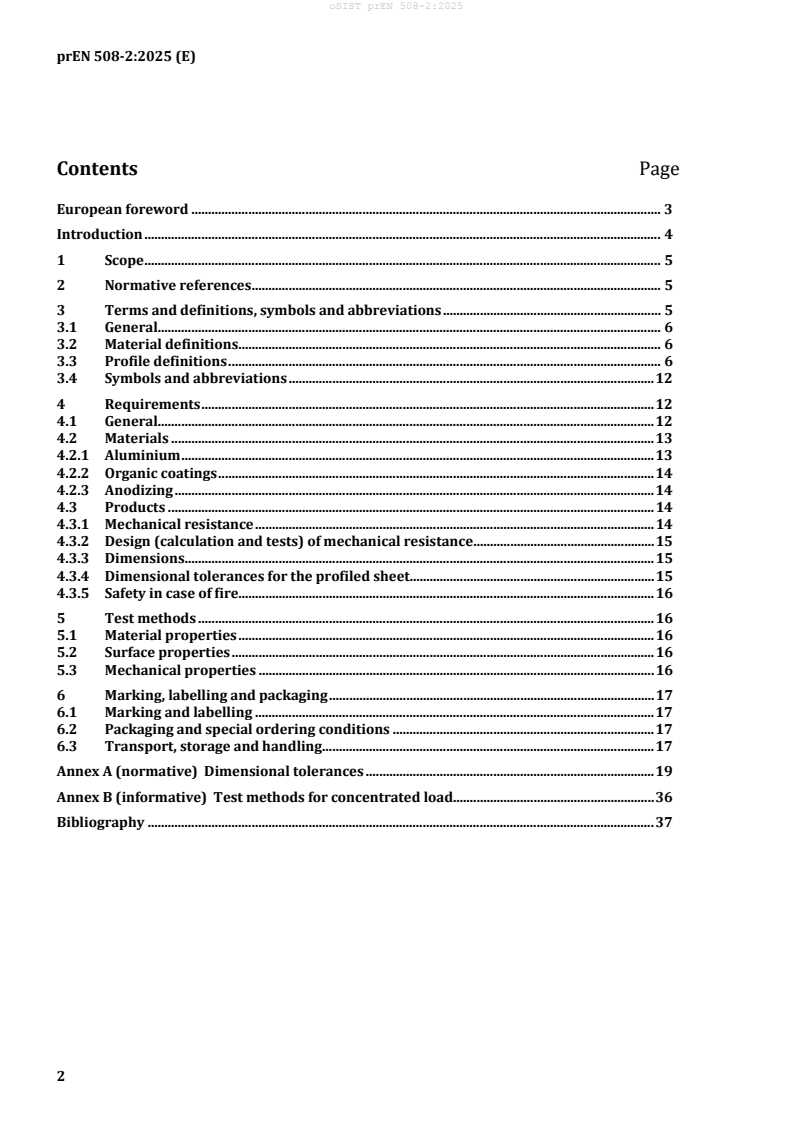
Contents
- Introduction
- 1 Scope
- 2 Normative references
- 3 Terms and definitions, symbols and abbreviations
- 3.1 General
- 3.1.1 self-supporting product
- 3.2 Material definitions
- 3.2.1 temper
- 3.2.2 organic coated aluminium sheet
- 3.2.3 anodized aluminium sheet
- 3.3 Profile definitions
- 3.3.1 trapezoidal profiled sheet
- 3.3.2 sinusoidal profiled sheet
- 3.3.3 standing seam and concealed fix sheet
- 3.3.4 tile profile
- 3.4 Symbols and abbreviations
- 4 Requirements
- 4.1 General
- 4.2 Materials
- 4.3 Products
- 5 Test methods
- 5.1 Material properties
- 5.2 Surface properties
- 5.3 Mechanical properties
- 6 Marking, labelling and packaging
- 6.1 Marking and labelling
- 6.2 Packaging and special ordering conditions
- 6.3 Transport, storage and handling
- Annex A
- Annex B
- Bibliography
Introduction
Table 1 indicates the position of this document in the CEN framework of standards concerning roofing and cladding products of metal sheet.
Table 1 — Framework of standards Roofing and cladding products of metal sheet
Self-supporting Fully supported products products EN 14782 EN 14783
Copper / Steel Aluminium Stainless steel Zinc EN 508-1 EN 508-2 EN 508-3 EN 506 In this document the performance of the product has been defined in terms of calculation and a number of type tests.
The performance of a roof or cladding constructed with these products depends not only on the properties of the product as required by this document, but also on the design, construction and performance of the roof as a whole in relation to the environment and conditions of use.
oSIST prEN 508-2:2025 prEN 508-2:2025 (E)
1 Scope
This part of EN 508 specifies requirements for self-supporting external profiled sheets for roof covering, wall cladding, lining and liner tray products for discontinuous laying made from aluminium sheet with or without surface treatment (additional organic coatings or anodising). This document establishes general characteristics, definitions, classifications and labelling for the products, together with requirements for the materials from which the products can be manufactured. It is intended to be used either by manufacturers to ensure that their products comply with the requirements or by purchasers to verify that the products comply before they are made available on the market before being dispatched from the factory. It specifies the requirements for products which enable them to meet all normal service conditions.
This document applies to all discontinuously laid self-supporting external profiled sheets for roof
covering, wall cladding, lining and liner trays with the exception of tiles with a surface area less than 1 m and produced by stamping. These profiled roof sheets are designed to keep wind, rain and snow out of the building, and to transfer any resultant loads and infrequent maintenance loads to the structure. This document does not cover products for structural purposes, i.e. it does cover products used in structural class III (according to EN 1999-1-4), it does not cover products used in constructions of structural classes I and II (according to EN 1999-1-4) intended to contribute to the global or partial stability of the building structure by providing racking resistance or resistance of permanent static loads (excluding self-weight of the metal sheet).
No requirements for supporting construction, design of roof or cladding system and execution of connections and flashings are included.
2 Normative references
The following documents are referred to in the text in such a way that some or all of their content constitutes requirements of this document. For dated references, only the edition cited applies. For undated references, the latest edition of the referenced document (including any amendments) applies. EN 485-1, Aluminium and aluminium alloys — Sheet, strip and plate — Part 1: Technical conditions for inspection and delivery EN 485-4, Aluminium and aluminium alloys — Sheet, strip and plate — Part 4: Tolerances on shape and dimensions for cold-rolled products EN 1396, Aluminium and aluminium alloys — Coil coated sheet and strip for general applications — Specifications EN 14782, Self-supporting metal sheet for roofing, external cladding and internal lining — Product specification and requirements EN ISO 7599, Anodizing of aluminium and its alloys — Method for specifying decorative and protective anodic oxidation coatings on aluminium (ISO 7599)
3 Terms and definitions, symbols and abbreviations
For the purposes of this document, the terms and definitions given in EN 485-1 and the following apply. ISO and IEC maintain terminology databases for use in standardization at the following addresses:
- ISO Online browsing platform: available at https://www.iso.org/obp/
- IEC Electropedia: available at https://www.electropedia.org/
oSIST prEN 508-2:2025 prEN 508-2:2025 (E) NOTE Wherever the term aluminium is used it is meant unalloyed or alloyed aluminium.
3.1 General
3.1.1 self-supporting product
product which will, by virtue of its material and shape, support all applied loadings (e.g. snow, wind, foot traffic, insulation, membrane), and transmit these loadings to spaced structural supports
3.2 Material definitions
3.2.1 temper
material conditions after a production stage, for example mechanical treatment and/or heat treatment, intended to give the material physical and/or metallurgical properties
3.2.2 organic coated aluminium sheet
painted, post coated, laminated or coil coated (continuously organic coated) aluminium on one or on both sides
3.2.3 anodized aluminium sheet
aluminium with an anodic coating, produced by an electrolytic oxidation process in which the surface of the aluminium is converted to a mainly oxide coating having protective, decorative or functional properties
3.3 Profile definitions
3.3.1 trapezoidal profiled sheet
self-supporting sheet which is designed to allow it to be side and end lapped, the crowns of which may be rounded and, in addition, the crowns, web and valley may be stiffened Note 1 to entry: See Figures 2, 3, 4 and 5.
Note 2 to entry: The names for various parts of typical trapezoidal profiled sheets are given in Figure 6 and Figure 7.
Figure 2 — Part of typical trapezoidal profile
Figure 3 — Part of typical trapezoidal profile with rounded crowns
oSIST prEN 508-2:2025 prEN 508-2:2025 (E)
Figure 4 — Part of typical trapezoidal profile with stiffened crown and web
Figure 5 — Part of typical trapezoidal profile with stiffened valley
oSIST prEN 508-2:2025 prEN 508-2:2025 (E)
Key 1 cover width 7 depth 2 valley stiffener 8 valley 3 rib 9 pitch 4 web stiffener 10 crown 5 trough 11 drainage groove 6 web 12 crown stiffener Figure 6 — Definitions of the parts of typical trapezoidal profiled sheets
oSIST prEN 508-2:2025 prEN 508-2:2025 (E)
Key 1 depth 5 web angle 2 pitch 6 bend radius 3 overlap 7 side lap in principle the same on tiles 4 angle 8 end lap Figure 7 — Definitions of the parts of typical trapezoidal profiled sheets
3.3.2 sinusoidal profiled sheet
self-supporting sheet which is designed to allow it to be side and end lapped, comprising a series of arc shaped crowns and valleys interconnected with tangential webs Note 1 to entry: See Figure 8.
Note 2 to entry: Additional definitions for sinusoidal profiles in are given in Figure 9.
oSIST prEN 508-2:2025 prEN 508-2:2025 (E)
Key 1 depth 2 pitch 3 overlap 4 inclination Figure 8 — Part of typical sinusoidal profiled sheet
Key 1 depth 2 pitch Figure 9 — Definitions of the parts of typical sinusoidal profiled sheets
3.3.3 standing seam and concealed fix sheet
self-supporting sheet profiled in such a way that the fixings are hidden within the construction and are not exposed to the weather Note 1 to entry: The profile shape is designed to allow the formation of side laps on site. Note 2 to entry: As these types of roof covering and cladding products are used in proprietary roofing and cladding systems, no structural requirements are given within this part of EN 508. Note 3 to entry: These products are normally designed by testing. Note 4 to entry: See Figures 10 and 11.
Figure 10 — Typical standing seam profile
oSIST prEN 508-2:2025 prEN 508-2:2025 (E)
Figure 11 — Typical concealed fix profile
3.3.4 tile profile
part of typical tile profiled sheets that can allow the sheet to be side and/or end lapped Note 1 to entry: The tile profiles can include transverse steps. Note 2 to entry: As these types of roof covering products are used in proprietary systems no structural requirements are given within this part of EN 508.
Note 3 to entry: These products are normally designed by testing. Note 4 to entry: See Figures 12a, 12b and 12c.
Note 5 to entry: Additional definitions for tile profiles are given in Figure 13.
Figure 12 — Typical tile profiles
oSIST prEN 508-2:2025 prEN 508-2:2025 (E)
Key 1 height of the step 2 length of the step 3 number of steps 4 end lap Figure 13 — Definitions of the parts of typical tile
3.4 Symbols and abbreviations
For the purposes of this document, the following symbols and abbreviations apply. AA The symbols for aluminium sheets are the alloy symbols as in 4.2.1 AK Alkyd paint coating AY Acrylic paint coating EP Epoxy paint coating for use within a building H Aluminium temper symbol PUR Polyurethane paint coating PUR-PA Polyamide-modified polyurethane paint coating PVDF Polyvinylidenefluoride paint coating PVF(F) Polyvinylfluoride film coating SP Polyester paint coating SP-PA Polyamid-modified polyester paint coating SP-SI Silicone-modified polyester paint coating
4 Requirements
4.1 General
The product should be manufactured from materials complying with 4.2. The supplier of the materials is responsible for carrying out the tests necessary to verify that the materials supplied to the manufacturer comply with the requirements and should provide appropriate inspection documents (according to EN 10204) on request.
NOTE The symbols and abbreviations used to designate the aluminium alloy, the type and thickness of the organic coating are those of the standards referred to in Clause 2.
oSIST prEN 508-2:2025 prEN 508-2:2025 (E) Product testing should be provided to a defined schedule. A permanent quality system should be adopted
by the manufacturer .
4.2 Materials
4.2.1 Aluminium
Aluminium alloys given in Table 2 are suitable provided that their properties conform to the values given in the relevant material standards (EN 485-2, EN 573-3).
Table 2 — Alloys of aluminium Designation based Numerical designation on chemical symbol EN AW-1050A EN AW-Al 99,5 a EN AW-1200 EN AW-Al 99,0 EN AW-3003 EN AW-Al Mn1Cu EN AW-3004 EN AW-Al Mn1Mg1 EN AW-3005 EN AW-Al Mn1Mg0,5 EN AW-3005A EN AW-Al Mn1Mg0.5(A) EN AW-3103 EN AW-Al Mn1 EN AW-3105 EN AW-Al Mn0,5Mg0,5 EN AW-3105B EN AW-Al Mn0,6Mg0,5 EN AW-4015 EN AW-Al Si2Mn EN AW-4016 EN AW-Al Si2MnZn EN AW-4017 EN AW-Al Si1MnCu EN AW-5005 EN AW-Al Mg1(B) EN AW-5005A EN AW-AlMg1(C) EN AW-5006 EN AW-Al Mg1Mn0,5 EN AW-5050A EN AW-Al Mg1 (C) EN AW-5052 EN AW-Al Mg2,5 EN AW-5083 EN AW-Al Mg4,5Mn0,7 EN AW-5251 EN AW-Al Mg2 EN AW-5754 EN AW-Al Mg3 EN AW-6025–7072 alclad EN AW-A1Mg2,5SiMnCu-A1Zn1 alclad EN AW-6061 EN AW-Al Mg1SiCu EN AW-8006 EN AW-AlFe1.5Mn a EN AW-8011 A EN AW-Al Fe Si (A) a Only with organic coatings.
1 E.g. a quality management system based on EN ISO 9001.
oSIST prEN 508-2:2025 prEN 508-2:2025 (E) Temper shall be chosen so that the ultimate tensile strength is not lower than 150 MPa. Alloy and temper are chosen to give corrosion resistance, strength and formability. Specification of alloy, temper and coating finish should be agreed between purchaser and supplier at the time of ordering. Tolerances on shape and dimensions shall be in accordance with EN 485-4.
4.2.2 Organic coatings
The main external weather resistant organic coatings suitable for application to aluminium substrates are given in Table 3.
Table 3 — Factory applied organic coatings Type of coating Designation Remarks Factory applied coatings Acrylic AY Polyester SP Silicone-modified polyester SP-SI Polyvinylidene fluoride PVDF With proper primers Polyamide-modified polyurethane PUR-PA Polyurethane PUR Polyamide-modified polyester SP-PA Alkyd AK Epoxy EP Only within buildings Factory applied Polyvinyl fluoride PVF(F) laminated film NOTE Aluminium sheet is used either without coating or with organic coatings mainly for aesthetic reasons. It should be noted that different coating systems behave in different ways under various climatic conditions. The primer and/or adhesive should be chosen taking into account which type of substrate, pre-treatment and top coat are used.
Reverse side painting or coating is used if being required for handling and storage reasons as well as for corrosion protection in some installation conditions.
Performance and test methods for coil coated aluminium shall be in accordance with EN 1396. Special coatings or films may be applied to the reverse side to reduce the dripping of moisture caused by condensation.
...