

EN 415-7:2006
(Main)Safety of packaging machines - Part 7: Group and secondary packaging machines
- Abstract
This European Standard applies to the following groups of machines:
Group and secondary packaging machines and the collating systems associated with them.
The individual machines are described in 3.2 of this European Standard.
This European Standard deals with safety requirements for machine design, construction, installation, commissioning, operation, adjustment, maintenance and cleaning of group and secondary packaging machines.
The extent to which hazards, hazardous situations and events are covered, are indicated in Clause 4.
Exclusions
This European Standard is not applicable to the following machines:
¾ machines that were manufactured before the date of publication of this document by CEN;
¾ strapping machines. These machines are covered by EN 415-8;
¾ crate loaders and un-loaders for pre-formed rigid containers. These machines are covered by
EN 415-2;
¾ cartoning machines. Cartoning machines are covered by EN 415-3.
This European Standard does not consider the following hazards:
¾ use of group and secondary packaging machines in potentially explosive atmospheres;
¾ health, safety or hygiene hazards associated with the products that may be handled by the machines, but does include general advice on this subject;
¾ hazards that may be associated with electromagnetic emissions from group and secondary packaging machines;
¾ hazards that may be associated with decommissioning group and secondary packaging machines.
- Status
- Withdrawn
- Publication Date
- 11-Jul-2006
- Withdrawal Date
- 01-Jul-2008
- Technical Committee
- CEN/TC 146 - Packaging machines - Safety
- Drafting Committee
- CEN/TC 146/WG 7 - Group packaging machines
- Current Stage
- 9960 - Withdrawal effective - Withdrawal
- Start Date
- 02-Jul-2008
- Completion Date
- 02-Jul-2008
- Directive
- 98/37/EC - MachineryOJ Ref: C, C 104 OJ Date: 08-May-2007

Relations
- Effective Date
- 22-Dec-2008
- Effective Date
- 28-Jan-2026
- Effective Date
- 28-Jan-2026
Get Certified
Connect with accredited certification bodies for this standard

BRCGS (Brand Reputation Compliance Global Standards)
Global food safety and quality standards owner.
Sponsored listings
Frequently Asked Questions
EN 415-7:2006 is a standard published by the European Committee for Standardization (CEN). Its full title is "Safety of packaging machines - Part 7: Group and secondary packaging machines". This standard covers: This European Standard applies to the following groups of machines: Group and secondary packaging machines and the collating systems associated with them. The individual machines are described in 3.2 of this European Standard. This European Standard deals with safety requirements for machine design, construction, installation, commissioning, operation, adjustment, maintenance and cleaning of group and secondary packaging machines. The extent to which hazards, hazardous situations and events are covered, are indicated in Clause 4. Exclusions This European Standard is not applicable to the following machines: ¾ machines that were manufactured before the date of publication of this document by CEN; ¾ strapping machines. These machines are covered by EN 415-8; ¾ crate loaders and un-loaders for pre-formed rigid containers. These machines are covered by EN 415-2; ¾ cartoning machines. Cartoning machines are covered by EN 415-3. This European Standard does not consider the following hazards: ¾ use of group and secondary packaging machines in potentially explosive atmospheres; ¾ health, safety or hygiene hazards associated with the products that may be handled by the machines, but does include general advice on this subject; ¾ hazards that may be associated with electromagnetic emissions from group and secondary packaging machines; ¾ hazards that may be associated with decommissioning group and secondary packaging machines.
This European Standard applies to the following groups of machines: Group and secondary packaging machines and the collating systems associated with them. The individual machines are described in 3.2 of this European Standard. This European Standard deals with safety requirements for machine design, construction, installation, commissioning, operation, adjustment, maintenance and cleaning of group and secondary packaging machines. The extent to which hazards, hazardous situations and events are covered, are indicated in Clause 4. Exclusions This European Standard is not applicable to the following machines: ¾ machines that were manufactured before the date of publication of this document by CEN; ¾ strapping machines. These machines are covered by EN 415-8; ¾ crate loaders and un-loaders for pre-formed rigid containers. These machines are covered by EN 415-2; ¾ cartoning machines. Cartoning machines are covered by EN 415-3. This European Standard does not consider the following hazards: ¾ use of group and secondary packaging machines in potentially explosive atmospheres; ¾ health, safety or hygiene hazards associated with the products that may be handled by the machines, but does include general advice on this subject; ¾ hazards that may be associated with electromagnetic emissions from group and secondary packaging machines; ¾ hazards that may be associated with decommissioning group and secondary packaging machines.
EN 415-7:2006 is classified under the following ICS (International Classification for Standards) categories: 55.020 - Packaging and distribution of goods in general. The ICS classification helps identify the subject area and facilitates finding related standards.
EN 415-7:2006 has the following relationships with other standards: It is inter standard links to EN 415-7:2006+A1:2008, EN ISO 10440-1:2007, EN 415-1:2000+A1:2009. Understanding these relationships helps ensure you are using the most current and applicable version of the standard.
EN 415-7:2006 is associated with the following European legislation: EU Directives/Regulations: 98/37/EC; Standardization Mandates: M/079. When a standard is cited in the Official Journal of the European Union, products manufactured in conformity with it benefit from a presumption of conformity with the essential requirements of the corresponding EU directive or regulation.
EN 415-7:2006 is available in PDF format for immediate download after purchase. The document can be added to your cart and obtained through the secure checkout process. Digital delivery ensures instant access to the complete standard document.
Standards Content (Sample)
2003-01.Slovenski inštitut za standardizacijo. Razmnoževanje celote ali delov tega standarda ni dovoljeno.Safety of packaging machines - Part 7: Group and secondary packaging machinesPakirne naprave – Varnost pakirnih naprav – 7. del: Zbirni in dodatni pakirni strojiSécurité des machines d'emballage - Partie 7: Machines de groupe et d'emballage secondaireSicherheit von Verpackungsmaschinen - Teil 7: SammelpackmaschinenTa slovenski standard je istoveten z:EN 415-7:2006SIST EN 415-7:2007en55.200Pakirni strojiPackaging machineryICS:SLOVENSKI
STANDARDSIST EN 415-7:200701-januar-2007
EUROPEAN STANDARDNORME EUROPÉENNEEUROPÄISCHE NORMEN 415-7July 2006ICS 55.020 English VersionSafety of packaging machines - Part 7: Group and secondarypackaging machinesSécurité des machines d'emballage - Partie 7: Machines degroupe et d'emballage secondaireSicherheit von Verpackungsmaschinen - Teil 7:SammelpackmaschinenThis European Standard was approved by CEN on 20 April 2006.CEN members are bound to comply with the CEN/CENELEC Internal Regulations which stipulate the conditions for giving this EuropeanStandard the status of a national standard without any alteration. Up-to-date lists and bibliographical references concerning such nationalstandards may be obtained on application to the Central Secretariat or to any CEN member.This European Standard exists in three official versions (English, French, German). A version in any other language made by translationunder the responsibility of a CEN member into its own language and notified to the Central Secretariat has the same status as the officialversions.CEN members are the national standards bodies of Austria, Belgium, Cyprus, Czech Republic, Denmark, Estonia, Finland, France,Germany, Greece, Hungary, Iceland, Ireland, Italy, Latvia, Lithuania, Luxembourg, Malta, Netherlands, Norway, Poland, Portugal, Romania,Slovakia, Slovenia, Spain, Sweden, Switzerland and United Kingdom.EUROPEAN COMMITTEE FOR STANDARDIZATIONCOMITÉ EUROPÉEN DE NORMALISATIONEUROPÄISCHES KOMITEE FÜR NORMUNGManagement Centre: rue de Stassart, 36
B-1050 Brussels© 2006 CENAll rights of exploitation in any form and by any means reservedworldwide for CEN national Members.Ref. No. EN 415-7:2006: E
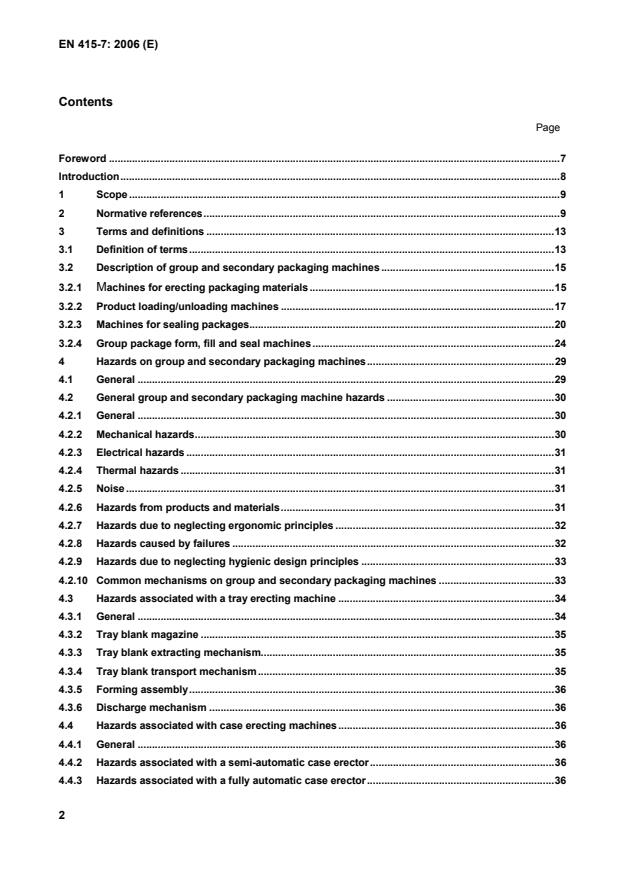
EN 415-7: 2006 (E) 2 Contents Page Foreword.7 Introduction.8 1 Scope.9 2 Normative references.9 3 Terms and definitions.13 3.1 Definition of terms.13 3.2 Description of group and secondary packaging machines.15 3.2.1 Machines for erecting packaging materials.15 3.2.2 Product loading/unloading machines.17 3.2.3 Machines for sealing packages.20 3.2.4 Group package form, fill and seal machines.24 4 Hazards on group and secondary packaging machines.29 4.1 General.29 4.2 General group and secondary packaging machine hazards.30 4.2.1 General.30 4.2.2 Mechanical hazards.30 4.2.3 Electrical hazards.31 4.2.4 Thermal hazards.31 4.2.5 Noise.31 4.2.6 Hazards from products and materials.31 4.2.7 Hazards due to neglecting ergonomic principles.32 4.2.8 Hazards caused by failures.32 4.2.9 Hazards due to neglecting hygienic design principles.33 4.2.10 Common mechanisms on group and secondary packaging machines.33 4.3 Hazards associated with a tray erecting machine.34 4.3.1 General.34 4.3.2 Tray blank magazine.35 4.3.3 Tray blank extracting mechanism.35 4.3.4 Tray blank transport mechanism.35 4.3.5 Forming assembly.36 4.3.6 Discharge mechanism.36 4.4 Hazards associated with case erecting machines.36 4.4.1 General.36 4.4.2 Hazards associated with a semi-automatic case erector.36 4.4.3 Hazards associated with a fully automatic case erector.36
EN 415-7: 2006 (E) 4 5.2.5 Noise reduction.60 5.2.6 Measures to control hazards generated by products and materials.61 5.2.7 Ergonomic design principles.62 5.2.8 Requirements to prevent hazards caused by failures.63 5.2.9 Hygienic design requirements.65 5.2.10 Requirements for mechanisms used on most group and secondary packaging machines.66 5.3 Safety requirements for a tray erecting machine.68 5.3.1 General.68 5.3.2 Tray blank magazine.68 5.3.3 Tray blank extracting mechanism.69 5.3.4 Tray blank transport mechanism.69 5.3.5 Forming assembly.69 5.3.6 Discharge mechanism.69 5.4 Safety requirements for a case erecting machine.69 5.4.1 Safety requirements for a semi-automatic case erector.69 5.4.2 Safety requirements for a fully automatic case erector.70 5.5 Safety requirements for a place packing machine.71 5.5.1 General.71 5.5.2 In-feed conveyor.71 5.5.3 Product collating mechanisms.71 5.5.4 Transport mechanism.71 5.5.5 Product loading mechanism.71 5.6 Safety requirements for a horizontal case loading machine.72 5.6.1 General.72 5.6.2 In-feed conveyor – See 5.3.6.2.72 5.6.3 Product turning devices.72 5.6.4 Product stacking mechanism.72 5.6.5 Case loading mechanism.73 5.6.6 Case funnel.73 5.6.7 Case support arms.73 5.6.8 Discharge conveyor – See 5.3.6.73 5.7 Safety requirements for case taping machines.73 5.7.1 Safety requirements for a manually adjusted case taping machine without flap tucking.73 5.7.2 Safety requirements for a self adjusting case taping machine without flap tucking.74 5.7.3 Safety requirements for a manually adjusted case taping machine with flap tucking.74 5.7.4 Safety requirements for a fully automatic case taping machine.75 5.7.5 Noise reduction.75 5.8 Safety requirements for a wraparound case packing machine.75 5.8.1 General.75
Noise test code for group and secondary packaging machines - grade of accuracy 2 and 3.83 Annex B (normative)
Methods of safeguarding small and medium sized apertures.89 Annex C (normative)
Methods of safeguarding large apertures.97
EN 415-7: 2006 (E) 6 Annex D (normative)
ESPE Muting.102 Bibliography.105
EN 415-7: 2006 (E) 8 Introduction Group and secondary packaging machines are used extensively in Europe, in an increasingly wide range of industries. They contain several significant hazards and have the potential to cause serious injury. This document is a type C standard as defined in the Introduction of EN ISO 12100-1:2003. The machinery concerned and the extent to which hazards, hazardous situations and events are covered are indicated in the scope of this European Standard. When provisions of this type C standard are different from those which are stated in type A or B standards, the provisions of this type C standard take precedence over the provisions of the other standards, for machines that have been designed and built according to the provisions of this type C standard.
1 Scope This European Standard applies to the following groups of machines: Group and secondary packaging machines and the collating systems associated with them. The individual machines are described in 3.2 of this European Standard. This European Standard deals with safety requirements for machine design, construction, installation, commissioning, operation, adjustment, maintenance and cleaning of group and secondary packaging machines. The extent to which hazards, hazardous situations and events are covered, are indicated in Clause 4. Exclusions This European Standard is not applicable to the following machines: machines that were manufactured before the date of publication of this document by CEN; strapping machines. These machines are covered by EN 415-8; crate loaders and un-loaders for pre-formed rigid containers. These machines are covered by
EN 415-2; cartoning machines. Cartoning machines are covered by EN 415-3. This European Standard does not consider the following hazards: use of group and secondary packaging machines in potentially explosive atmospheres; health, safety or hygiene hazards associated with the products that may be handled by the machines, but does include general advice on this subject; hazards that may be associated with electromagnetic emissions from group and secondary packaging machines; hazards that may be associated with decommissioning group and secondary packaging machines. 2 Normative references The following referenced documents are indispensable for the application of this document. For dated references, only the edition cited applies. For undated references, the latest edition of the referenced document (including any amendments) applies. EN 294:1992, Safety of machinery — Safety distances to prevent danger zones being reached by the upper limbs EN 349:1993, Safety of machinery — Minimum gaps to avoid crushing of parts of the human body EN 415-1:2000, Packaging machines safety — Part 1: Terminology and classification for packaging machines and associated equipment
EN 415-7: 2006 (E) 10 EN 418, Safety of machinery — Emergency stop equipment, functional aspects, principles for design EN 563, Safety of machinery — Temperatures of touchable surfaces — Ergonomics data to establish temperature limit values for hot surfaces EN 574:1996, Safety of machinery — Two-hand control devices — Functional aspects — Principles for design EN 614-1:1995, Safety of machinery — Ergonomic design principles — Part 1: Terminology and general principles EN 619, Continuous handling equipment and systems — Safety and EMC requirements for equipment for mechanical handling of unit loads EN 626-1, Safety of machinery — Reduction of risks to health from hazardous substances emitted by machinery — Part 1: Principles and specifications for machinery manufacturers EN 626-2, Safety of machinery — Reduction of risk to health from hazardous substances emitted by machinery — Part 2: Methodology leading to verification procedures EN 775; Manipulating industrial robots — Safety (ISO 10218:1992, modified) EN 811, Safety of machinery — Safety distances to prevent danger zones being reached by the lower limbs EN 894-1, Safety of machinery — Ergonomics requirements for the design of displays and control actuators — Part 1: General principals for human interactions with displays and control actuators EN 894-2, Safety of machinery — Ergonomics requirements for the design of displays and control actuators — Part 2: Displays EN 894-3, Safety of machinery — Ergonomics requirements for the design of displays and control actuators — Part 3: Control actuators EN 953:1997, Safety of machinery — Guards - General requirements for the design and construction of fixed and moveable guards EN 954-1:1996, Safety of machinery — Safety related parts of control systems — Part 1: General principles for design EN 982:1996, Safety of machinery — Safety requirements for fluid power systems and their components — Hydraulics EN 983:1996, Safety of machinery — Safety requirements for fluid power systems and their components — Pneumatics EN 999, Safety of machinery — The positioning of protective equipment in respect of approach speeds of parts of the human body EN 1005-2:2003, Safety of machinery — Human physical performance — Part 2: Manual handling of machinery and component parts of machinery EN 1005-3, Safety of machinery — Human physical performance — Part 3: Recommended force limits for machinery operation EN 1005-4:2005, Safety of machinery — Human physical performance — Part 4: Evaluation of working postures and movements in relation to machinery EN 1037, Safety of machinery — Prevention of unexpected start-up
EN 415-7: 2006 (E) 12 EN ISO 9614-2:1996, Acoustics — Determination of sound power levels of noise sources using sound intensity — Part 2: Measurement by scanning (ISO 9614-2:1996) EN ISO 11201:1995, Acoustics — Noise emitted by machinery and equipment — Measurement of emission sound pressure levels at a work station and at other specified positions — Engineering method in an essentially free field over a reflective plane (ISO 11201:1995) EN ISO 11202:1995, Acoustics — Noise emitted by machinery and equipment — Measurement of emission sound pressure levels at a work station and at other specified positions — Survey method in situ (ISO 11202:1995) EN ISO 11204:1995, Acoustics — Noise emitted by machinery and equipment — Measurement of emission sound pressure levels at a work station and at other specified positions — Method requiring environmental corrections (ISO 11204:1995) EN ISO 12001:1996, Acoustics — Noise emitted by machinery and equipment - rules for the drafting and presentation of a noise test code (ISO 12001:1996) EN ISO 12100-1:2003, Safety of machinery — Basic concepts, general principles for design — Part 1: Basic terminology, methodology (ISO 12100-1:2003) EN ISO 12100-2:2003, Safety of machinery; basic concepts, general principles for design — Part 2: Technical principles (ISO 12100-2:2003) EN ISO 14122-1:2001, Safety of machinery — Permanent means of access to machinery — Part 1: Choice of fixed means of access between two levels (ISO 14122-1:2001) EN ISO 14122-2, Safety of machinery — Permanent means of access to machinery — Part 2: Working platforms and walkways (ISO 14122-2:2001) EN ISO 14122-3, Safety of machinery — Permanent means of access to machinery — Part 3: Stairs, stepladders and guard-rails (ISO 14122-3:2001) EN ISO 14122-4, Safety of machinery — Permanent means of access to machinery — Part 4: Fixed ladders (ISO 14122-4:2004) IEC 60417-1:2002, Graphical symbols for use on equipment — Part 1: Overview and application ISO 7000, Graphical symbols for use on equipment — Index and synopsis
EXAMPLE corrugated board, carton board 3.1.6 carton container that is made from carton board, generally between 250 µm and 1 000 µm in thickness, and is usually delivered to the user in the form of a carton blank or folded and side seam glued 3.1.7 carton blank individual carton in the flat after cutting and creasing and with the strippings removed 3.1.8 carton tray rectangular open carton with sides and ends made from carton board generally between 250 µm and
1 000 µm in thickness and usually delivered to the user in the form of a carton blank 3.1.9 carton board paper board used for folding cartons generally between 250 µm and 1 000 µm thick and pliable enough so that it can be folded along score lines without cracking the material 3.1.10 case container, which is generally made from corrugated board that is used to contain groups of packages and is delivered to the user in the form of a glued or stitched case or a flat blank
EN 415-7: 2006 (E) 14 3.1.11 corrugated board material comprising one or more sheets of fluted paper stuck between flat sheets of paper 3.1.12 tray open topped container, typically made from carton board or corrugated board and supplied to the user as a flat blank or pre-glued and folded 3.1.13 tuck erection process in which carton board or corrugated board packages are formed or closed by pushing pre-cut tabs into slots 3.1.14 side seam longitudinal seal which is made, usually by the carton or case manufacturer by stapling, heat-sealing or applying adhesive, when a carton or case blank is formed into a flat carton or case 3.1.15 wraparound case case, usually made from corrugated board, which is supplied to the user as a flat blank and is folded and glued around the product in a wraparound case packing machine to produce the finished pack 3.1.16 wraparound lid lid, usually made from corrugated board, which is supplied to the user as a flat blank and is folded and glued around a group package in a wraparound lidding machine to produce the finished transit pack 3.1.17 wraparound sleeve package, usually made from either carton board or corrugated board, which is supplied to the user as a flat blank and is folded and secured around the product in a wraparound sleeving machine to produce the finished pack 3.1.18 wraparound tray tray, usually made from corrugated board, which is supplied to the user as a flat blank and is folded and glued around the product in a wraparound tray packing machine to produce the finished pack 3.1.19 cold adhesive adhesive that is liquid at room temperature, e.g. PVA adhesive 3.1.20 PVA adhesive water dispersible emulsion adhesive made from polyvinyl acetate 3.1.21 hot melt adhesive adhesive that is solid at room temperature and which is melted and applied at elevated temperature 3.1.22 pressure sensitive tape tape usually made from a thin plastic film, which is coated in an adhesive that requires only pressure to form a bond
Group packages include cases, trays, crates, and sleeves. 3.2.1 Machines for erecting packaging materials 3.2.1.1 tray erecting machine: packaging machine that erects trays, usually from pre-cut corrugated board or carton board blanks. The characteristic features are: - blank magazine; - blank extracting mechanism; - blank transport mechanism; - forming assembly (including sealing)
EN 415-7: 2006 (E) 16
Figure 1 — Tray erecting machine
3.2.1.2 case erecting machine: packaging machine that erects side seamed cases, usually made from corrugated board. The characteristic features are: - case blank magazine; - blank extracting mechanism; - blank transport mechanism; - case erecting mechanism; - flap folding mechanism; - flap closing and sealing device. In a semi-automatic case erecting machine, flap folding, closing and sealing are machine operations. The other functions are hand operated.
Figure 2 — Case erecting machine
3.2.2 Product loading/unloading machines 3.2.2.1 drop packing machine: packaging machine that assembles groups of products and loads them into group packages by gravity. The characteristic features are: - in-feed conveyor; - product collating mechanism; - collation assembly mechanism; - case/crate/tray transport mechanism
EN 415-7: 2006 (E) 18
Figure 3 — Drop packing machine
3.2.2.2 place packing/unpacking machine: packaging machine that grips groups of products and either places them vertically into or removes them from group packages. The characteristic features are: - in-feed conveyor; - product collating mechanism; - product loading mechanism; - case/crate/tray transport mechanism
Figure 4 — Place packing/unpacking machine
3.2.2.3 horizontal case loading machine: packaging machine that assembles groups of products and loads them horizontally into group packages, usually pre-erected cases. The characteristic features are: - in-feed conveyor; - product collating mechanism; - product loading mechanism; - case funnel; - discharge conveyor
EN 415-7: 2006 (E) 20
Figure 5 — Horizontal case loading machine
3.2.3 Machines for sealing packages 3.2.3.1 case gluing machine: packaging machine that closes cases, usually made from corrugated board, and seals them with adhesive. The characteristic features are: - case transport mechanism; - flap folding mechanism; - adhesive application mechanism; - case flap closing and sealing mechanism
Figure 6 — Case gluing machine
...