

prEN 1366-3
(Main)Fire resistance tests for service installations - Part 3: Penetration seals
- Abstract
This part of the EN 1366 series specifies a method of test and criteria for the evaluation (including field of direct application rules) of the ability of a penetration seal to maintain the fire resistance of a separating element at the position at which it has been penetrated by a service or services. Penetration seals used to seal gaps around chimneys, air ventilation systems, fire rated ventilation ducts, fire rated service ducts, shafts and smoke extraction ducts as well as combined penetration seals are excluded from this part of the EN 1366 series. Supporting constructions are used in this part of the EN 1366 series to represent separating elements such as walls or floors. These simulate the interaction between the test specimen and the separating element into which the sealing system is to be installed in practice.
This part of the EN 1366 series is used in conjunction with EN 1363-1.
The purpose of a test described in this part of the EN 1366 series is to assess the integrity and insulation performance of the penetration seal, of the penetrating service or services and of the separating element in the surrounding area of the penetration seal.
No information can be implied by the test concerning the influence of the inclusion of such penetrations and penetration seals on the loadbearing capacity of the separating element.
It is assumed that in each case the lintel above a penetration seal in the wall is designed in hot and cold state in a way that it does not apply any additional vertical load on the penetration seal.
It is not the intention of this test to provide quantitative information on the rate of leakage of smoke and/or hot gases or on the transmission or generation of fumes. Such phenomena are only to be noted in the test report in describing the general behaviour of test specimens during the test.
Tests in accordance with this part of the EN 1366 series are not intended to supply any information on the ability of the penetration seal to withstand stress caused by movements or displacements of the penetrating services.
The risk of spread of fire downwards caused by burning material, which drips through a pipe downwards to floors below, cannot be assessed with this test.
Tests in accordance with this part of the EN 1366 series do not address any risks associated with leakage of dangerous liquids or gases caused by failure of the pipe(s) in case of fire.
Tests in accordance with this part of the EN 1366 series of pipe penetration seals for pipes of pneumatic dispatch systems, pressurised air systems etc. simulate a situation where the systems are shut off in case of fire.
Explanatory notes to this test method are given in Annex H.
All values given without tolerances in this Standard are nominal ones unless otherwise specified.
- Status
- Not Published
- Publication Date
- 23-Sep-2019
- Withdrawal Date
- 23-Mar-2020
- Technical Committee
- CEN/TC 127 - Fire safety in buildings
- Drafting Committee
- CEN/TC 127/WG 2 - Services
- Current Stage
- 4098 - Decision to abandon - Enquiry
- Start Date
- 22-Jul-2019
- Completion Date
- 07-Oct-2026


Overview
prEN 1366-3 specifies a test method and evaluation criteria for penetration seals used to maintain the fire resistance of separating elements (walls and floors) where services pass through. The standard is intended to be used in conjunction with EN 1363-1 and defines the scope, test specimen configuration, instrumentation and performance criteria for assessing integrity and insulation of penetration seals and the surrounding area.
This part of the EN 1366 series focuses on the behaviour of seals under fire test conditions. It does not address effects on loadbearing capacity, quantitative smoke or gas leakage rates, stresses from movement of services, or risks from leaking liquids/gases.
Key Topics
- Purpose of the test: Assess integrity and insulation performance of the penetration seal, the penetrating service(s) and the separating element in the surrounding area.
- Scope and exclusions: Penetration seals around chimneys, fire-rated ventilation ducts, shafts and combined seals are excluded. Pneumatic dispatch and pressurised air systems are tested assuming systems are shut off in fire.
- Test setup: Uses supporting constructions to represent walls and floors so that interaction between specimen and separating element is simulated.
- Performance criteria: Integrity (no flame passage) and insulation (temperature limitations) are recorded; other phenomena such as smoke or fumes are described but not quantified.
- Limitations: No inference on structural loadbearing capacity, leakage of dangerous fluids, downward burning drips or seal resistance to service movement.
- Guidance: Explanatory notes are provided in Annex H; field of direct application rules define how test results may be applied to real installations.
Applications
prEN 1366-3 is a practical reference for:
- Manufacturers of penetration seal systems preparing test specimens and technical files.
- Test laboratories conducting fire resistance testing for product certification.
- Specifiers, designers and fire safety engineers selecting seals for compliance with building regulations and for integration into fire compartmentation strategies.
- Building assessors and approval bodies using test reports to determine the field of direct application of particular seal designs.
Practical uses include informing installation instructions, specifying supporting construction requirements, defining acceptable service support and arrangement, and documenting limits of application in test reports.
Related Standards
- EN 1363-1: General requirements for fire resistance tests (mandatory to use in conjunction with prEN 1366-3).
- Other parts of EN 1366 series covering different service installations and configurations.
For compliance and correct application, consult the full text of prEN 1366-3 and its annexes. Test reports should clearly state the test configuration, supporting construction, services, instrumentation and the field of direct application to avoid misinterpretation of performance limits.
Relations
- Effective Date
- 18-Jan-2023
Get Certified
Connect with accredited certification bodies for this standard

CIS Institut d.o.o.
Personal Protective Equipment (PPE) certification body. Notified Body NB-2890 for EU Regulation 2016/425 PPE.

Kiwa BDA Testing
Building and construction product certification.
Kmetijski inštitut Slovenije
Agricultural Institute of Slovenia. Soil testing, plant health, agricultural product analysis.
Sponsored listings
Frequently Asked Questions
prEN 1366-3 is a draft published by the European Committee for Standardization (CEN). Its full title is "Fire resistance tests for service installations - Part 3: Penetration seals". This standard covers: This part of the EN 1366 series specifies a method of test and criteria for the evaluation (including field of direct application rules) of the ability of a penetration seal to maintain the fire resistance of a separating element at the position at which it has been penetrated by a service or services. Penetration seals used to seal gaps around chimneys, air ventilation systems, fire rated ventilation ducts, fire rated service ducts, shafts and smoke extraction ducts as well as combined penetration seals are excluded from this part of the EN 1366 series. Supporting constructions are used in this part of the EN 1366 series to represent separating elements such as walls or floors. These simulate the interaction between the test specimen and the separating element into which the sealing system is to be installed in practice. This part of the EN 1366 series is used in conjunction with EN 1363-1. The purpose of a test described in this part of the EN 1366 series is to assess the integrity and insulation performance of the penetration seal, of the penetrating service or services and of the separating element in the surrounding area of the penetration seal. No information can be implied by the test concerning the influence of the inclusion of such penetrations and penetration seals on the loadbearing capacity of the separating element. It is assumed that in each case the lintel above a penetration seal in the wall is designed in hot and cold state in a way that it does not apply any additional vertical load on the penetration seal. It is not the intention of this test to provide quantitative information on the rate of leakage of smoke and/or hot gases or on the transmission or generation of fumes. Such phenomena are only to be noted in the test report in describing the general behaviour of test specimens during the test. Tests in accordance with this part of the EN 1366 series are not intended to supply any information on the ability of the penetration seal to withstand stress caused by movements or displacements of the penetrating services. The risk of spread of fire downwards caused by burning material, which drips through a pipe downwards to floors below, cannot be assessed with this test. Tests in accordance with this part of the EN 1366 series do not address any risks associated with leakage of dangerous liquids or gases caused by failure of the pipe(s) in case of fire. Tests in accordance with this part of the EN 1366 series of pipe penetration seals for pipes of pneumatic dispatch systems, pressurised air systems etc. simulate a situation where the systems are shut off in case of fire. Explanatory notes to this test method are given in Annex H. All values given without tolerances in this Standard are nominal ones unless otherwise specified.
This part of the EN 1366 series specifies a method of test and criteria for the evaluation (including field of direct application rules) of the ability of a penetration seal to maintain the fire resistance of a separating element at the position at which it has been penetrated by a service or services. Penetration seals used to seal gaps around chimneys, air ventilation systems, fire rated ventilation ducts, fire rated service ducts, shafts and smoke extraction ducts as well as combined penetration seals are excluded from this part of the EN 1366 series. Supporting constructions are used in this part of the EN 1366 series to represent separating elements such as walls or floors. These simulate the interaction between the test specimen and the separating element into which the sealing system is to be installed in practice. This part of the EN 1366 series is used in conjunction with EN 1363-1. The purpose of a test described in this part of the EN 1366 series is to assess the integrity and insulation performance of the penetration seal, of the penetrating service or services and of the separating element in the surrounding area of the penetration seal. No information can be implied by the test concerning the influence of the inclusion of such penetrations and penetration seals on the loadbearing capacity of the separating element. It is assumed that in each case the lintel above a penetration seal in the wall is designed in hot and cold state in a way that it does not apply any additional vertical load on the penetration seal. It is not the intention of this test to provide quantitative information on the rate of leakage of smoke and/or hot gases or on the transmission or generation of fumes. Such phenomena are only to be noted in the test report in describing the general behaviour of test specimens during the test. Tests in accordance with this part of the EN 1366 series are not intended to supply any information on the ability of the penetration seal to withstand stress caused by movements or displacements of the penetrating services. The risk of spread of fire downwards caused by burning material, which drips through a pipe downwards to floors below, cannot be assessed with this test. Tests in accordance with this part of the EN 1366 series do not address any risks associated with leakage of dangerous liquids or gases caused by failure of the pipe(s) in case of fire. Tests in accordance with this part of the EN 1366 series of pipe penetration seals for pipes of pneumatic dispatch systems, pressurised air systems etc. simulate a situation where the systems are shut off in case of fire. Explanatory notes to this test method are given in Annex H. All values given without tolerances in this Standard are nominal ones unless otherwise specified.
prEN 1366-3 is classified under the following ICS (International Classification for Standards) categories: 13.220.50 - Fire-resistance of building materials and elements. The ICS classification helps identify the subject area and facilitates finding related standards.
prEN 1366-3 has the following relationships with other standards: It is inter standard links to EN 1366-3:2009. Understanding these relationships helps ensure you are using the most current and applicable version of the standard.
prEN 1366-3 is associated with the following European legislation: EU Directives/Regulations: 305/2011; Standardization Mandates: M/117. When a standard is cited in the Official Journal of the European Union, products manufactured in conformity with it benefit from a presumption of conformity with the essential requirements of the corresponding EU directive or regulation.
prEN 1366-3 is available in PDF format for immediate download after purchase. The document can be added to your cart and obtained through the secure checkout process. Digital delivery ensures instant access to the complete standard document.
Standards Content (Sample)
SLOVENSKI STANDARD
01-april-2018
Preskusi požarne odpornosti servisnih inštalacij - 3. del: Tesnitve prebojev
Fire resistance tests for service installations - Part 3: Penetration seals
Feuerwiderstandsprüfungen für Installationen - Teil 3: Abschottungen
Essais de résistance au feu des installations techniques - Partie 3 : Calfeutrements de
trémie
Ta slovenski standard je istoveten z: prEN 1366-3
ICS:
13.220.50 Požarna odpornost Fire-resistance of building
gradbenih materialov in materials and elements
elementov
2003-01.Slovenski inštitut za standardizacijo. Razmnoževanje celote ali delov tega standarda ni dovoljeno.
DRAFT
EUROPEAN STANDARD
NORME EUROPÉENNE
EUROPÄISCHE NORM
February 2018
ICS 13.220.50 Will supersede EN 1366-3:2009
English Version
Fire resistance tests for service installations - Part 3:
Penetration seals
Essais de résistance au feu des installations techniques Feuerwiderstandsprüfungen für Installationen - Teil 3:
- Partie 3 : Calfeutrements de trémie Abschottungen
This draft European Standard is submitted to CEN members for enquiry. It has been drawn up by the Technical Committee
CEN/TC 127.
If this draft becomes a European Standard, CEN members are bound to comply with the CEN/CENELEC Internal Regulations
which stipulate the conditions for giving this European Standard the status of a national standard without any alteration.
This draft European Standard was established by CEN in three official versions (English, French, German). A version in any other
language made by translation under the responsibility of a CEN member into its own language and notified to the CEN-CENELEC
Management Centre has the same status as the official versions.
CEN members are the national standards bodies of Austria, Belgium, Bulgaria, Croatia, Cyprus, Czech Republic, Denmark, Estonia,
Finland, Former Yugoslav Republic of Macedonia, France, Germany, Greece, Hungary, Iceland, Ireland, Italy, Latvia, Lithuania,
Luxembourg, Malta, Netherlands, Norway, Poland, Portugal, Romania, Serbia, Slovakia, Slovenia, Spain, Sweden, Switzerland,
Turkey and United Kingdom.
Recipients of this draft are invited to submit, with their comments, notification of any relevant patent rights of which they are
aware and to provide supporting documentation.
Warning : This document is not a European Standard. It is distributed for review and comments. It is subject to change without
notice and shall not be referred to as a European Standard.
EUROPEAN COMMITTEE FOR STANDARDIZATION
COMITÉ EUROPÉEN DE NORMALISATION
EUROPÄISCHES KOMITEE FÜR NORMUNG
CEN-CENELEC Management Centre: Rue de la Science 23, B-1040 Brussels
© 2018 CEN All rights of exploitation in any form and by any means reserved Ref. No. prEN 1366-3:2018 E
worldwide for CEN national Members.
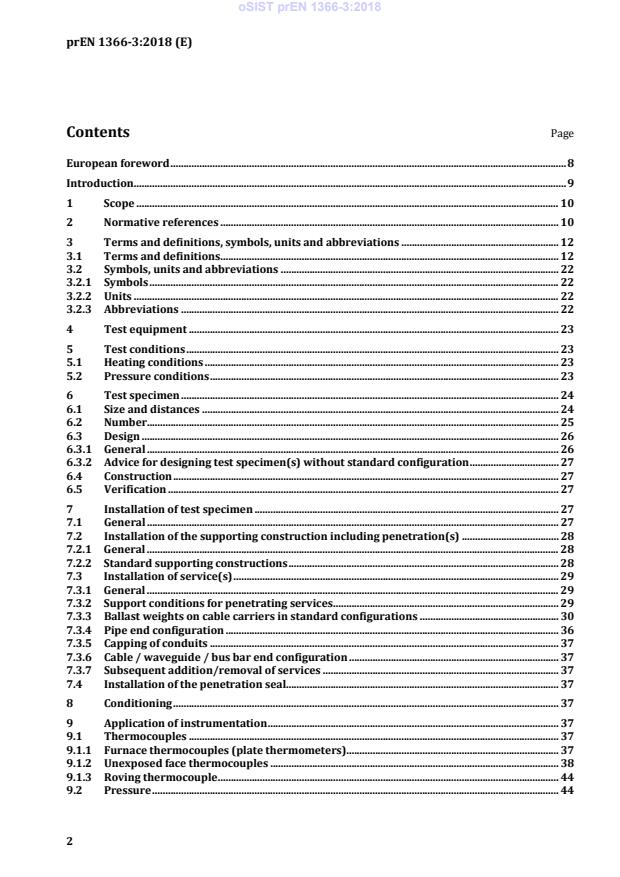
Contents Page
European foreword . 8
Introduction . 9
1 Scope . 10
2 Normative references . 10
3 Terms and definitions, symbols, units and abbreviations . 12
3.1 Terms and definitions . 12
3.2 Symbols, units and abbreviations . 22
3.2.1 Symbols . 22
3.2.2 Units . 22
3.2.3 Abbreviations . 22
4 Test equipment . 23
5 Test conditions . 23
5.1 Heating conditions . 23
5.2 Pressure conditions . 23
6 Test specimen . 24
6.1 Size and distances . 24
6.2 Number. 25
6.3 Design . 26
6.3.1 General . 26
6.3.2 Advice for designing test specimen(s) without standard configuration . 27
6.4 Construction . 27
6.5 Verification . 27
7 Installation of test specimen . 27
7.1 General . 27
7.2 Installation of the supporting construction including penetration(s) . 28
7.2.1 General . 28
7.2.2 Standard supporting constructions . 28
7.3 Installation of service(s) . 29
7.3.1 General . 29
7.3.2 Support conditions for penetrating services . 29
7.3.3 Ballast weights on cable carriers in standard configurations . 30
7.3.4 Pipe end configuration . 36
7.3.5 Capping of conduits . 37
7.3.6 Cable / waveguide / bus bar end configuration . 37
7.3.7 Subsequent addition/removal of services . 37
7.4 Installation of the penetration seal. 37
8 Conditioning . 37
9 Application of instrumentation . 37
9.1 Thermocouples . 37
9.1.1 Furnace thermocouples (plate thermometers). 37
9.1.2 Unexposed face thermocouples . 38
9.1.3 Roving thermocouple . 44
9.2 Pressure . 44
10 Test procedure . 44
10.1 General . 44
10.2 Integrity . 44
10.3 Other observations . 45
11 Performance criteria . 45
11.1 Integrity . 45
11.2 Insulation . 45
11.3 Multiple and mixed penetration seals . 45
11.4 Multiple penetrations . 46
12 Test report . 46
13 Field of direct application of test results . 46
13.1 General . 46
13.2 Orientation . 46
13.3 Supporting construction . 46
13.3.1 Rigid floor and wall constructions . 46
13.3.2 Flexible wall constructions . 47
13.4 Services . 48
13.5 Service support construction . 49
13.6 Penetration seal size . 49
13.7 Distances . 49
Annex A (normative) Configuration and field of direct application for “cable
penetration seals — large” . 50
A.1 Purpose of Annex A . 50
A.2 Overview of options for test set up and the resulting field of direct application . 50
A.2.1 Standard configuration . 50
A.2.2 Non-standard configuration . 50
A.3 Designing the standard configuration test specimens . 50
A.3.1 Specimen size. 50
A.3.2 Services . 50
A.3.3 Service options . 50
A.3.4 Location of the services . 51
A.3.5 Installation of the services / test equipment . 53
A.4 Field of direct application . 57
A.4.1 General . 57
A.4.2 Cable type (construction characteristics) . 57
A.4.3 Cable size . 57
A.4.4 Cable carriers. 57
A.4.5 Distances . 58
A.4.6 Cable support . 58
Annex B (normative) Configuration and field of direct application for “cable
penetration seals — small”, modular systems and steel framed cable boxes . 59
B.1 Configuration and field of direct application for “cable penetration seals —
small” . 59
B.1.1 Purpose of B.1 . 59
B.1.2 Overview of options for test set up and the resulting field of direct application . 59
B.1.3 Designing the standard configuration test specimens. 59
B.1.4 Field of direct application . 64
B.2 Configuration and field of direct application for modular systems . 66
B.2.1 Purpose of B.2 . 66
B.2.2 Overview of options for test set up and the resulting field of direct application . 67
B.2.3 Designing the standard configuration test specimens. 68
B.2.4 Field of direct application . 69
B.3 Configuration and field of direct application for steel framed cable boxes . 72
B.3.1 Purpose of B.3 . 72
B.3.2 Overview of options for test set up and the resulting field of direct application . 72
B.3.3 Designing the standard configuration test specimens. 72
B.3.4 Field of direct application for steel framed cable boxes . 74
Annex C (normative) Test configuration and field of direct application for conduits and
trunkings for cables . 76
C.1 Conduits . 76
C.1.1 General . 76
C.1.2 Standard conduit configuration . 77
C.1.3 Field of direct application . 83
C.2 Trunkings . 86
C.2.1 General . 86
C.2.2 Standard trunking configuration . 86
C.2.3 Field of direct application . 87
Annex D (normative) Specimen design and field of direct application for bus bars / bus
bar trunking units . 88
D.1 Purpose of Annex D . 88
D.2 Test specimen . 88
D.3 Field of direct application . 88
Annex E (normative) Test specimen design, test procedure and field of direct
application for pipe penetration seals . 92
E.1 Purpose of Annex E . 92
E.2 Selection of pipes to be included in the test . 92
E.2.1 Metal pipes (hmp) in accordance with 3.1.37 . 92
E.2.2 Metal pipes (lmp) in accordance with 3.1.38 . 93
E.2.3 Coated metal pipes (hmp) in accordance with 3.1.39 . 93
E.2.4 Coated metal pipes (lmp) in accordance with 3.1.40 . 93
E.2.5 Single layer plastic pipes . 93
E.2.6 Multilayer plastic pipes in accordance with 3.1.42 . 97
E.2.7 Composite pipes in accordance with 3.1.43 . 97
E.2.8 MLC pipes in accordance with 3.1.44 . 97
E.2.9 Pipes with the risk of fracture in accordance with 3.1.45 . 97
E.2.10 Small tubes . 97
E.2.11 Pipe-in-pipe systems . 98
E.2.12 Special installations . 98
E.3 Designing the test specimen . 98
E.3.1 Single arrangement (distance between pipes ≥ 100 mm) . 98
E.3.2 Linear arrangement or cluster arrangement (distance between pipes < 100 mm) . 99
E.4 Field of direct application . 102
E.4.1 General rules . 102
E.4.2 Metal pipes (hmp) in accordance with 3.1.37 . 104
E.4.3 Metal pipes (lmp) in accordance with 3.1.38 . 113
E.4.4 Coated metal pipes (hmp) in accordance with 3.1.39 . 113
E.4.5 Coated metal pipes (lmp) in accordance with 3.1.40 . 113
E.4.6 Single layer plastic pipes . 113
E.4.7 Multilayer plastic pipes in accordance with 3.1.42 . 122
E.4.8 Composite pipes in accordance with 3.1.43 . 123
E.4.9 MLC pipes in accordance with 3.1.44 . 123
E.4.10 Pipes with the risk of fracture in accordance 3.1.45 . 124
E.4.11 Small tubes . 124
E.4.12 Pipe-in-pipe-systems . 124
E.5 Floor penetrations ending at floor level (e.g. floor drain) . 124
Annex F (normative) Test specimen design, test procedure and field of direct
application for mixed penetration seals . 126
F.1 Purpose of Annex F . 126
F.2 Mixed penetration seals containing pipes of different pipe material groups . 126
F.2.1 Single arrangement (distance between pipes ≥ 100 mm) . 126
F.2.2 Linear arrangement or cluster arrangement (distance between pipes < 100 mm) . 128
F.3 Mixed penetration seals containing cables and other services . 133
F.3.1 General . 133
F.3.2 Intended mixed penetration seal size ≥ 600 mm x 600 mm . 133
F.3.3 Intended mixed penetration seal size ≥ 300 mm x 300 mm but < 600 mm x
600 mm . 138
F.3.4 Intended mixed penetration seal size < 300 mm x 300 mm . 141
F.4 Mixed penetration seals containing pipes and other services . 144
F.5 Mixed penetration seals containing different services other than cables and
pipes . 144
F.6 Selection of previous test results (if available) for designing the test specimen . 144
F.7 Field of direct application . 144
F.7.1 General . 144
F.7.2 Services . 144
F.7.3 Distances. 145
Annex G (normative) Critical service approach . 146
G.1 General . 146
G.2 Criteria to identify the critical services . 146
G.3 Identification and selection of the most critical services . 147
G.3.1 Metal pipes (hmp) in accordance with 3.1.37 . 147
G.3.2 Metal pipes (lmp) in accordance with 3.1.38 . 147
G.3.3 Single layer Plastic pipes in accordance with 3.1.41 . 148
G.3.4 Multilayer plastic pipes in accordance with 3.1.42 . 148
G.3.5 Metal conduits (hmp) in accordance with 3.1.33. 148
G.3.6 Metal conduits (lmp) in accordance with 3.1.34 . 148
G.3.7 Plastic conduits in accordance with 3.1.35 . 148
G.3.8 Metal trunkings (hmp) in accordance with 3.1.50 . 149
G.3.9 Metal trunkings (lmp) in accordance with 3.1.51 . 149
G.3.10 Plastic trunkings in accordance with 3.1.52 . 149
G.3.11 Composite pipes in accordance with 3.1.43 . 149
G.3.12 MLC pipes in accordance with 3.1.44 . 149
G.3.13 Bus bars and bus bar trunking units . 149
G.3.14 Waveguides . 150
G.3.15 Coaxial cables . 150
Annex H (informative) Explanatory notes . 151
H.1 General . 151
H.2 Notes on the scope and application of test results . 151
H.2.1 General . 151
H.3 Notes on test conditions . 152
H.3.1 Size of furnace . 152
H.3.2 Furnace pressure . 152
H.4 Notes on test construction . 152
H.4.1 Services . 152
H.4.2 Pipe end configuration . 158
H.4.3 Service support . 160
H.4.4 Supporting construction . 161
H.4.5 Distance between penetration seals . 161
H.4.6 Non-standard cable configuration . 161
H.4.7 Pipe penetration seals . 162
H.4.8 Small penetration seals . 164
H.4.9 Modular systems . 164
H.4.10 Cable boxes . 165
H.4.11 Mixed penetration seals. 165
H.4.12 Fire exposure from the upper side . 165
H.5 Notes on instrumentation . 166
H.5.1 Thermocouple pad . 166
H.5.2 Thermocouples A . 166
H.6 Notes on test procedure . 166
H.6.1 General . 166
H.6.2 Blank penetration seal . 166
H.6.3 Pipe penetration seals . 166
H.6.4 Mixed penetration seals. 168
H.6.5 Critical service approach . 169
H.7 Notes on test criteria . 169
H.8 Notes on validity of test results (field of application) . 169
H.8.1 Rigid wall or floor constructions . 169
H.8.2 Flexible wall constructions . 169
H.8.3 Cables . 170
H.8.4 Conduits . 170
H.8.5 Trunkings . 171
H.8.6 Restriction of field of direct application in case of different test results for single
services in multiple or mixed penetration seals. 171
H.8.7 Penetration seal size . 172
H.9 Notes on test report . 173
Bibliography . 174
European foreword
This document (prEN 1366-3:2018) has been prepared by Technical Committee CEN/TC 127 “Fire
Safety in Buildings”, the secretariat of which is held by BSI.
This document is currently submitted to the CEN Enquiry.
This document will supersedes EN 1366-3:2009.
This document has been prepared under a mandate given to CEN by the European Commission and
the European Free Trade Association.
Annexes A to G are normative. Annex H is informative.
EN 1366 ‘Fire resistance tests for service installations’ consists of the following:
— Part 1: Ducts
— Part 2: Fire dampers
— Part 3: Penetration seals
— Part 4: Linear joint seals
— Part 5: Service ducts and shafts
— Part 6: Raised access floors and hollow floors
— Part 7: Closures for conveyors and trackbound transportation systems
— Part 8: Smoke extraction ducts
— Part 9: Single compartment smoke extraction ducts
— Part 10: Smoke control dampers
— Part 11: Fire Protection system for essential services (in course of preparation)
— Part 12: Non-mechanical fire barrier for ventilation ductwork
— Part 13: 1-, 2-, 3-sided ventilation ducts (in course of preparation)
— Part 14: Kitchen extraction ducts
— Part 15: Combined penetration seals (in course of preparation)
Introduction
This part of the EN 1366 series has been prepared to provide a method of test for assessing the
contribution of a penetration seal to the fire resistance of separating elements when they have
been penetrated by a service or services.
Caution
The attention of all persons concerned with managing and carrying out fire resistance testing is
drawn to the fact that fire testing can be hazardous and that there is a possibility that toxic and/or
harmful smoke and gases will be emitted during the test. Mechanical and operational hazards
might also arise during the construction of the test elements or structures, their testing and
disposal of test residues.
An assessment of all potential hazards and risks to health should be made and safety precautions
should be identified and provided. Written safety instructions should be issued. Appropriate
training should be given to relevant personnel. Laboratory personnel should ensure that they
follow written safety instructions at all times.
1 Scope
This part of the EN 1366 series specifies a method of test and criteria for the evaluation (including
field of direct application rules) of the ability of a penetration seal to maintain the fire resistance of
a separating element at the position at which it has been penetrated by a service or services.
Penetration seals used to seal gaps around chimneys, air ventilation systems, fire rated ventilation
ducts, fire rated service ducts, shafts and smoke extraction ducts as well as combined penetration
seals are excluded from this part of the EN 1366 series. Supporting constructions are used in this
part of the EN 1366 series to represent separating elements such as walls or floors. These simulate
the interaction between the test specimen and the separating element into which the sealing
system is to be installed in practice.
This part of the EN 1366 series is intended to be used in conjunction with EN 1363-1.
The purpose of a test described in this part of the EN 1366 series is to assess the integrity and
insulation performance of the penetration seal, of the penetrating service or services and of the
separating element in the surrounding area of the penetration seal.
No information can be implied by the test concerning the influence of the inclusion of such
penetrations and penetration seals on the loadbearing capacity of the separating element.
It is assumed that in each case the lintel above a penetration seal in the wall is designed in hot and
cold state in a way that it does not apply any additional vertical load on the penetration seal.
It is not the intention of this test to provide quantitative information on the rate of leakage of
smoke and/or hot gases or on the transmission or generation of fumes. Such phenomena are only
to be noted in the test report in describing the general behaviour of test specimens during the test.
Tests in accordance with this part of the EN 1366 series are not intended to supply any information
on the ability of the penetration seal to withstand stress caused by movements or displacements of
the penetrating services.
The risk of spread of fire downwards caused by burning material, which drips through a pipe
downwards to floors below, cannot be assessed with this test.
Tests in accordance with this part of the EN 1366 series do not address any risks associated with
leakage of dangerous liquids or gases caused by failure of the pipe(s) in case of fire.
Tests in accordance with this part of the EN 1366 series of pipe penetration seals for pipes of
pneumatic dispatch systems, pressurized air systems etc. simulate a situation where the systems
are shut off in case of fire.
Explanatory notes to this test method are given in Annex H.
All values given without tolerances in this Standard are nominal ones unless otherwise specified.
2 Normative references
The following documents are referred to in the text in such a way that some or all of their content
constitutes requirements of this document. For dated references, only the edition cited applies. For
undated references, the latest edition of the referenced document (including any amendments)
applies.
EN 520, Gypsum plasterboards – Definitions, requirements and test methods
EN 1329-1, Plastics piping systems for soil and waste discharge (low and high temperature) within
the building structure - Unplasticized poly(vinyl chloride) (PVC-U) - Part 1: Specifications for pipes,
fittings and the system
EN 1363-1, Fire resistance tests - Part 1: General Requirements
EN 1363-2, Fire resistance tests - Part 2: Alternative and additional procedures
EN 1451-1, Plastics piping systems for soil and waste discharge (low and high temperature) within
the building structure - Polypropylene (PP) - Part 1: Specifications for pipes, fittings and the system
EN 1453-1, Plastics piping systems with structured-wall pipes for soil and waste discharge (low and
high temperature) inside buildings - Unplasticized poly(vinyl chloride) (PVC-U) - Part 1: Specifications
for pipes and the system
EN 1455-1, Plastics piping systems for soil and waste discharge (low and high temperature) within
the building structure - Acrylonitrile-butadiene-styrene (ABS) - Part 1: Requirements for pipes, fittings
and the system
EN 1519 (all parts), Plast
...