

EN 14375:2003
(Main)Child-resistant non-reclosable packaging for pharmaceutical products - Requirements and testing
- Abstract
This European Standard specifies performance requirements and methods of test for non-reclosable packaging that have been designated child-resistant. This standard is intended for type approval only (see 3.5) and is not intended for quality assurance purposes.
- Status
- Withdrawn
- Publication Date
- 18-Nov-2003
- Withdrawal Date
- 06-Oct-2026
- Technical Committee
- CEN/TC 261 - Packaging
- Drafting Committee
- CEN/TC 261/SC 5/WG 27 - Child resistant packaging
- Current Stage
- 9960 - Withdrawal effective - Withdrawal
- Start Date
- 13-Jul-2016
- Completion Date
- 07-Oct-2026


Relations
- Effective Date
- 20-Jul-2016
- Effective Date
- 28-Jan-2026
- Effective Date
- 08-Jun-2022
Get Certified
Connect with accredited certification bodies for this standard

BSI Group
BSI (British Standards Institution) is the business standards company that helps organizations make excellence a habit.

TÜV Rheinland
TÜV Rheinland is a leading international provider of technical services.

TÜV SÜD
TÜV SÜD is a trusted partner of choice for safety, security and sustainability solutions.
Sponsored listings
Frequently Asked Questions
EN 14375:2003 is a standard published by the European Committee for Standardization (CEN). Its full title is "Child-resistant non-reclosable packaging for pharmaceutical products - Requirements and testing". This standard covers: This European Standard specifies performance requirements and methods of test for non-reclosable packaging that have been designated child-resistant. This standard is intended for type approval only (see 3.5) and is not intended for quality assurance purposes.
This European Standard specifies performance requirements and methods of test for non-reclosable packaging that have been designated child-resistant. This standard is intended for type approval only (see 3.5) and is not intended for quality assurance purposes.
EN 14375:2003 is classified under the following ICS (International Classification for Standards) categories: 11.120.01 - Pharmaceutics in general; 55.020 - Packaging and distribution of goods in general; 97.190 - Equipment for children. The ICS classification helps identify the subject area and facilitates finding related standards.
EN 14375:2003 has the following relationships with other standards: It is inter standard links to EN 14375:2016, EN 862:2001, EN 14375:2003/AC:2006. Understanding these relationships helps ensure you are using the most current and applicable version of the standard.
EN 14375:2003 is associated with the following European legislation: EU Directives/Regulations: 80/232/EEC, 87/356/EEC. When a standard is cited in the Official Journal of the European Union, products manufactured in conformity with it benefit from a presumption of conformity with the essential requirements of the corresponding EU directive or regulation.
EN 14375:2003 is available in PDF format for immediate download after purchase. The document can be added to your cart and obtained through the secure checkout process. Digital delivery ensures instant access to the complete standard document.
Standards Content (Sample)
2003-01.Slovenski inštitut za standardizacijo. Razmnoževanje celote ali delov tega standarda ni dovoljeno.Embalaža za farmacevtske proizvode, ki se ne zapira ponovno in je
varna za otroke - Zahteve in preskusni postopkiKindergesicherte, nichtwiederverschließbare Verpackungen für pharmazeutische Produkte - Anforderungen und PrüfungenEmballage a l'epreuve des enfants, non refermables pour produits pharmaceutiques - Exigences et essaisChild-resistant non-reclosable packaging for pharmaceutical products - Requirements and testing97.190Otroška opremaEquipment for children55.020Pakiranje in distribucija blaga na splošnoPackaging and distribution of goods in general11.120.01Farmacija na splošnoPharmaceutics in generalICS:Ta slovenski standard je istoveten z:EN 14375:2003SIST EN 14375:2004en01-januar-2004SIST EN 14375:2004SLOVENSKI
STANDARD
EUROPEAN STANDARDNORME EUROPÉENNEEUROPÄISCHE NORMEN 14375November 2003ICS 11.120.01; 55.020; 97.190English versionChild-resistant non-reclosable packaging for pharmaceuticalproducts - Requirements and testingEmballage à l'epreuve des enfants, non refermables pourproduits pharmaceutiques - Exigences et essaisKindergesicherte, nichtwiederverschließbare Verpackungenfür pharmazeutische Produkte - Anforderungen undPrüfungenThis European Standard was approved by CEN on 1 September 2003.CEN members are bound to comply with the CEN/CENELEC Internal Regulations which stipulate the conditions for giving this EuropeanStandard the status of a national standard without any alteration. Up-to-date lists and bibliographical references concerning such nationalstandards may be obtained on application to the Management Centre or to any CEN member.This European Standard exists in three official versions (English, French, German). A version in any other language made by translationunder the responsibility of a CEN member into its own language and notified to the Management Centre has the same status as the officialversions.CEN members are the national standards bodies of Austria, Belgium, Czech Republic, Denmark, Finland, France, Germany, Greece,Hungary, Iceland, Ireland, Italy, Luxembourg, Malta, Netherlands, Norway, Portugal, Slovakia, Spain, Sweden, Switzerland and UnitedKingdom.EUROPEAN COMMITTEE FOR STANDARDIZATIONCOMITÉ EUROPÉEN DE NORMALISATIONEUROPÄISCHES KOMITEE FÜR NORMUNGManagement Centre: rue de Stassart, 36
B-1050 Brussels© 2003 CENAll rights of exploitation in any form and by any means reservedworldwide for CEN national Members.Ref. No. EN 14375:2003 ESIST EN 14375:2004
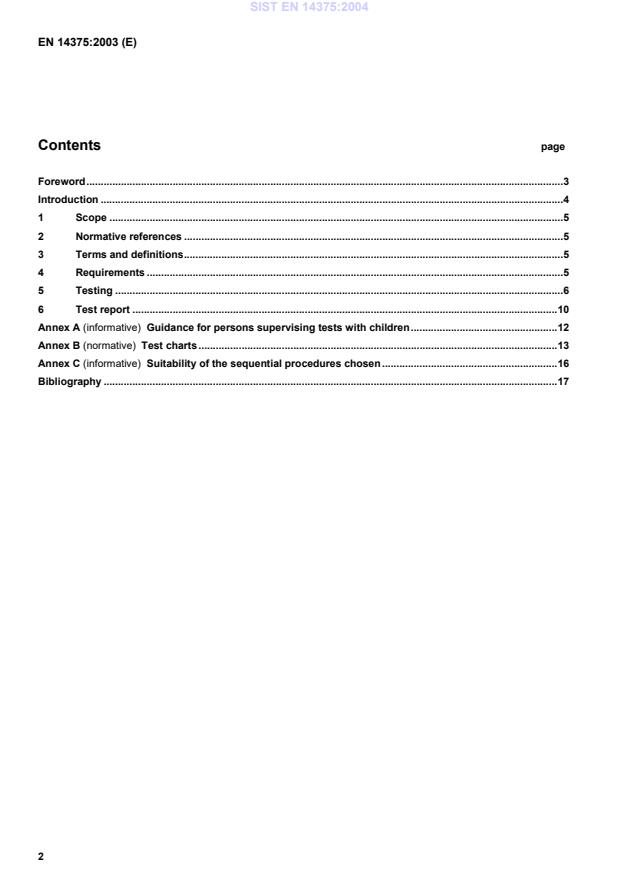
pageForeword.3Introduction.41Scope.52Normative references.53Terms and definitions.54Requirements.55Testing.66Test report.10Annex A (informative)
Guidance for persons supervising tests with children.12Annex B (normative)
Test charts.13Annex C (informative)
Suitability of the sequential procedures chosen.16Bibliography.17SIST EN 14375:2004
Some pharmaceutical products on the market can cause harm to children by the ingestion of fewerthan eight units.
However, reliable data on child toxicity exists for few pharmaceutical products.
A harmful dose can beestablished for some existing pharmaceutical products and a maximum safe dose can be established for all pharmaceuticalproducts by one means or another.
Such information is not currently available for all products and there is no central registerwhere this information could be held. In the absence of European legislation on this topic the drafters of this European Standardacknowledge these concerns and believe that research and collection of data should continue with a view to considering thesubstitution of a toxicity based pass/fail criterion for the child panel test in a later revision.4.2.2 Adult testWhen tested in accordance with 5.3.3.2, at least 90 % of the adults shall be able to access at least 1 unit dosewithin the 1 min test period, without a demonstration.NOTETo minimise the exposure of children to unnecessary testing the adult test should be carried out before the childtest.5 Testing5.1 PrincipleType approval for non-reclosable child-resistant packaging is obtained by a sequential test method or full panel testfor children and a full panel test for adults. A test group of up to 200 children aged 42 to 51 months is divided intopairs. Each child is given a number of non-reclosable packages to be opened by whatever means they wish to use.If a child fails to gain access within 5 min, the method of opening is demonstrated by the supervisor and the child isgiven a further 5 min to open the package. The results are recorded sequentially, as obtained. The package isdeemed child-resistant if the trail of results on the test charts passes into the acceptance zone or if at least 80 % ofthe children are unable to access more than eight unit doses within 10 min and at least 85 % of the children areunable to access more than eight unit doses within the first 5 min. The package’s accessibility by a test group of100 adults is also assessed. Each adult is given a non-reclosable package, any associated opening tools andwritten instructions, and is allowed 5 min to familiarize themselves with the packaging. The number of adultsopening the package within a 1 min test period is recorded. The package is deemed to comply with therequirements of this standard if at least 90 % of the adults are able to access at least 1 unit dose in 1 min.SIST EN 14375:2004
The material anddesign of the test samples shall conform to the technical specification and they shall be representative of anaverage batch of original packages.Packages for the child panel test shall be unprinted.In every test, a new package shall be provided for each member of the test group. For both the child and adulttests, there shall be at least 10 unit doses available for each participant.Each sample package shall be checked for integrity before the test is conducted. The packages shall be presentedto the children without the outer retail packaging, giving them access to the individual unit doses.5.3 Procedure5.3.1 GeneralThe test procedure is carried out in two stages:a) child test (see 5.3.2);b) adult test (see 5.3.3).5.3.2 Child test5.3.2.1 Composition of child test groupThe test group shall comprise no more than 200 children aged 42 to 51 months, inclusive, with approximately equalnumbers of girls and boys. As far as possible, there shall be an even distribution of ages and sexes within thepanel. The children shall be selected at random and shall have no apparent physical or mental disability whichmight affect manual dexterity.
...