

EN 13697:2015
(Main)Chemical disinfectants and antiseptics - Quantitative non-porous surface test for the evaluation of bactericidal and/or fungicidal activity of chemical disinfectants used in food, industrial, domestic and institutional areas - Test method and requirements without mechanical action (phase 2, step 2)
- Abstract
This European Standard specifies a test method (phase 2/step 2) and the minimum requirements for bactericidal and/or fungicidal or yeasticidal activity of chemical disinfectants that form a homogeneous physically stable preparation in hard water or – in the case of ready-to-use products – with water in food, industrial, domestic and institutional areas, excluding areas and situations where disinfection is medically indicated and excluding products used on living tissues.
The scope of this European Standard applies at least to the following:
a) Processing, distribution and retailing of:
1) Food of animal origin:
i) milk and milk products;
ii) meat and meat products;
iii) fish, seafood and products;
iv) eggs and egg products;
v) animal feeds;
vi) etc.
2) Food of vegetable origin:
i) beverages;
ii) fruits, vegetables and derivatives (including sugar distillery);
iii) flour, milling and backing;
iv) animal feeds;
v) etc.
b) Institutional and domestic areas:
1) catering establishments;
2) public areas;
3) public transports;
4) schools;
5) nurseries;
6) shops;
7) sports rooms;
8) waste container (bins);
9) hotels;
10) dwellings;
11) clinically non sensitive areas of hospitals;
12) offices;
13) etc.
c) Other industrial areas:
1) packaging material;
2) biotechnology (yeast, proteins, enzymes...);
3) pharmaceutical;
4) cosmetics and toiletries;
5) textiles;
6) space industry, computer industry;
7) etc.
Using this European Standard, it is possible to determine the bactericidal or fungicidal or yeasticidal activity of the undiluted product. As three concentrations are tested, in the active to non active range, dilution of the product is required and, therefore, the product forms a homogeneous stable preparation in hard water.
EN 14885 specifies in detail the relationship of the various tests to one another and to use recommendations.
NOTE 1 The method described is intended to determine the activity of commercial formulations or active substances on bacteria and/or fungi in the conditions in which they are used.
NOTE 2 This method cannot be used to evaluate the activity of products against mycobacteria.
- Status
- Withdrawn
- Publication Date
- 31-Mar-2015
- Withdrawal Date
- 06-Oct-2026
- Technical Committee
- CEN/TC 216 - Chemical disinfectants and antiseptics
- Drafting Committee
- CEN/TC 216/WG 3 - Food hygiene and domestic and institutional use
- Current Stage
- 9960 - Withdrawal effective - Withdrawal
- Start Date
- 31-Jul-2019
- Completion Date
- 07-Oct-2026


Relations
- Effective Date
- 08-Apr-2015
- Effective Date
- 18-Jan-2023
- Effective Date
- 25-Aug-2026
- Effective Date
- 28-Jan-2026
- Effective Date
- 28-Jan-2026
- Effective Date
- 28-Jan-2026
- Effective Date
- 28-Jan-2026
- Effective Date
- 17-May-2017
- Effective Date
- 17-Dec-2014
Get Certified
Connect with accredited certification bodies for this standard

BSI Group
BSI (British Standards Institution) is the business standards company that helps organizations make excellence a habit.

TÜV Rheinland
TÜV Rheinland is a leading international provider of technical services.

TÜV SÜD
TÜV SÜD is a trusted partner of choice for safety, security and sustainability solutions.
Sponsored listings
Frequently Asked Questions
EN 13697:2015 is a standard published by the European Committee for Standardization (CEN). Its full title is "Chemical disinfectants and antiseptics - Quantitative non-porous surface test for the evaluation of bactericidal and/or fungicidal activity of chemical disinfectants used in food, industrial, domestic and institutional areas - Test method and requirements without mechanical action (phase 2, step 2)". This standard covers: This European Standard specifies a test method (phase 2/step 2) and the minimum requirements for bactericidal and/or fungicidal or yeasticidal activity of chemical disinfectants that form a homogeneous physically stable preparation in hard water or – in the case of ready-to-use products – with water in food, industrial, domestic and institutional areas, excluding areas and situations where disinfection is medically indicated and excluding products used on living tissues. The scope of this European Standard applies at least to the following: a) Processing, distribution and retailing of: 1) Food of animal origin: i) milk and milk products; ii) meat and meat products; iii) fish, seafood and products; iv) eggs and egg products; v) animal feeds; vi) etc. 2) Food of vegetable origin: i) beverages; ii) fruits, vegetables and derivatives (including sugar distillery); iii) flour, milling and backing; iv) animal feeds; v) etc. b) Institutional and domestic areas: 1) catering establishments; 2) public areas; 3) public transports; 4) schools; 5) nurseries; 6) shops; 7) sports rooms; 8) waste container (bins); 9) hotels; 10) dwellings; 11) clinically non sensitive areas of hospitals; 12) offices; 13) etc. c) Other industrial areas: 1) packaging material; 2) biotechnology (yeast, proteins, enzymes...); 3) pharmaceutical; 4) cosmetics and toiletries; 5) textiles; 6) space industry, computer industry; 7) etc. Using this European Standard, it is possible to determine the bactericidal or fungicidal or yeasticidal activity of the undiluted product. As three concentrations are tested, in the active to non active range, dilution of the product is required and, therefore, the product forms a homogeneous stable preparation in hard water. EN 14885 specifies in detail the relationship of the various tests to one another and to use recommendations. NOTE 1 The method described is intended to determine the activity of commercial formulations or active substances on bacteria and/or fungi in the conditions in which they are used. NOTE 2 This method cannot be used to evaluate the activity of products against mycobacteria.
This European Standard specifies a test method (phase 2/step 2) and the minimum requirements for bactericidal and/or fungicidal or yeasticidal activity of chemical disinfectants that form a homogeneous physically stable preparation in hard water or – in the case of ready-to-use products – with water in food, industrial, domestic and institutional areas, excluding areas and situations where disinfection is medically indicated and excluding products used on living tissues. The scope of this European Standard applies at least to the following: a) Processing, distribution and retailing of: 1) Food of animal origin: i) milk and milk products; ii) meat and meat products; iii) fish, seafood and products; iv) eggs and egg products; v) animal feeds; vi) etc. 2) Food of vegetable origin: i) beverages; ii) fruits, vegetables and derivatives (including sugar distillery); iii) flour, milling and backing; iv) animal feeds; v) etc. b) Institutional and domestic areas: 1) catering establishments; 2) public areas; 3) public transports; 4) schools; 5) nurseries; 6) shops; 7) sports rooms; 8) waste container (bins); 9) hotels; 10) dwellings; 11) clinically non sensitive areas of hospitals; 12) offices; 13) etc. c) Other industrial areas: 1) packaging material; 2) biotechnology (yeast, proteins, enzymes...); 3) pharmaceutical; 4) cosmetics and toiletries; 5) textiles; 6) space industry, computer industry; 7) etc. Using this European Standard, it is possible to determine the bactericidal or fungicidal or yeasticidal activity of the undiluted product. As three concentrations are tested, in the active to non active range, dilution of the product is required and, therefore, the product forms a homogeneous stable preparation in hard water. EN 14885 specifies in detail the relationship of the various tests to one another and to use recommendations. NOTE 1 The method described is intended to determine the activity of commercial formulations or active substances on bacteria and/or fungi in the conditions in which they are used. NOTE 2 This method cannot be used to evaluate the activity of products against mycobacteria.
EN 13697:2015 is classified under the following ICS (International Classification for Standards) categories: 11.080.20 - Disinfectants and antiseptics; 71.100.35 - Chemicals for industrial and domestic disinfection purposes. The ICS classification helps identify the subject area and facilitates finding related standards.
EN 13697:2015 has the following relationships with other standards: It is inter standard links to EN 13697:2001, EN 13697:2015+A1:2019, ISO 4793:1980, EN 12353:2021, EN 14885:2022, EN ISO 846:2019, CEN ISO/TR 20880:2007, EN 13697:2015/FprA1:2019, EN 13704:2018. Understanding these relationships helps ensure you are using the most current and applicable version of the standard.
EN 13697:2015 is available in PDF format for immediate download after purchase. The document can be added to your cart and obtained through the secure checkout process. Digital delivery ensures instant access to the complete standard document.
Standards Content (Sample)
2003-01.Slovenski inštitut za standardizacijo. Razmnoževanje celote ali delov tega standarda ni dovoljeno.Chemische Desinfektionsmittel und Antiseptika - Quantitativer Oberflächen-Versuch nicht poröser Oberflächen zur Bestimmung der bakteriziden und/oder fungiziden Wirkung chemischer Desinfektionsmittel in den Bereichen Lebensmittel, Industrie, Haushalt und öffentliche Einrichtungen - Prüfverfahren und Anforderungen ohne mechanische Behandlung (Phase 2, Stufe 2)Antiseptiques et désinfectants chimiques - Essai quantitatif de surface non-poreuse pour l'évaluation de l'activité bactéricide et/ou fongicide des désinfectants chimiques utilisés dans le domaine de l'agro-alimentaire, dans l'industrie, dans les domaines domestiques et en collectivité - Méthode d'essai sans action mécanique et prescriptions (phase 2/étape 2)Chemical disinfectants and antiseptics - Quantitative non-porous surface test for the evaluation of bactericidal and/or fungicidal activity of chemical disinfectants used in food, industrial, domestic and institutional areas - Test method and requirements without mechanical action (phase 2, step 2)71.100.35Kemikalije za dezinfekcijo v industriji in domaChemicals for industrial and domestic disinfection purposesICS:Ta slovenski standard je istoveten z:EN 13697:2015SIST EN 13697:2015en,fr,de01-junij-2015SIST EN 13697:2015SLOVENSKI
STANDARDSIST EN 13697:20021DGRPHãþD
EUROPEAN STANDARD NORME EUROPÉENNE EUROPÄISCHE NORM
EN 13697
April 2015 ICS 11.080.20; 71.100.35 Supersedes EN 13697:2001English Version
Chemical disinfectants and antiseptics - Quantitative non-porous surface test for the evaluation of bactericidal and/or fungicidal activity of chemical disinfectants used in food, industrial, domestic and institutional areas - Test method and requirements without mechanical action (phase 2, step 2)
Antiseptiques et désinfectants chimiques - Essai quantitatif de surface non-poreuse pour l'évaluation de l'activité bactéricide et/ou fongicide des désinfectants chimiques utilisés dans le domaine de l'agro-alimentaire, dans l'industrie, dans les domaines domestiques et en collectivité - Méthode d'essai sans action mécanique et prescriptions (phase 2/étape 2)
Chemische Desinfektionsmittel und Antiseptika - Quantitativer Oberflächen-Versuch nicht poröser Oberflächen zur Bestimmung der bakteriziden und/oder fungiziden Wirkung chemischer Desinfektionsmittel in den Bereichen Lebensmittel, Industrie, Haushalt und öffentliche Einrichtungen - Prüfverfahren und Anforderungen ohne mechanische Behandlung (Phase 2, Stufe 2) This European Standard was approved by CEN on 20 January 2015.
CEN members are bound to comply with the CEN/CENELEC Internal Regulations which stipulate the conditions for giving this European Standard the status of a national standard without any alteration. Up-to-date lists and bibliographical references concerning such national standards may be obtained on application to the CEN-CENELEC Management Centre or to any CEN member.
This European Standard exists in three official versions (English, French, German). A version in any other language made by translation under the responsibility of a CEN member into its own language and notified to the CEN-CENELEC Management Centre has the same status as the official versions.
CEN members are the national standards bodies of Austria, Belgium, Bulgaria, Croatia, Cyprus, Czech Republic, Denmark, Estonia, Finland, Former Yugoslav Republic of Macedonia, France, Germany, Greece, Hungary, Iceland, Ireland, Italy, Latvia, Lithuania, Luxembourg, Malta, Netherlands, Norway, Poland, Portugal, Romania, Slovakia, Slovenia, Spain, Sweden, Switzerland, Turkey and United Kingdom.
EUROPEAN COMMITTEE FOR STANDARDIZATION
COMITÉ EUROPÉEN DE NORMALISATION EUROPÄISCHES KOMITEE FÜR NORMUNG
CEN-CENELEC Management Centre:
Avenue Marnix 17,
B-1000 Brussels © 2015 CEN All rights of exploitation in any form and by any means reserved worldwide for CEN national Members. Ref. No. EN 13697:2015 ESIST EN 13697:2015
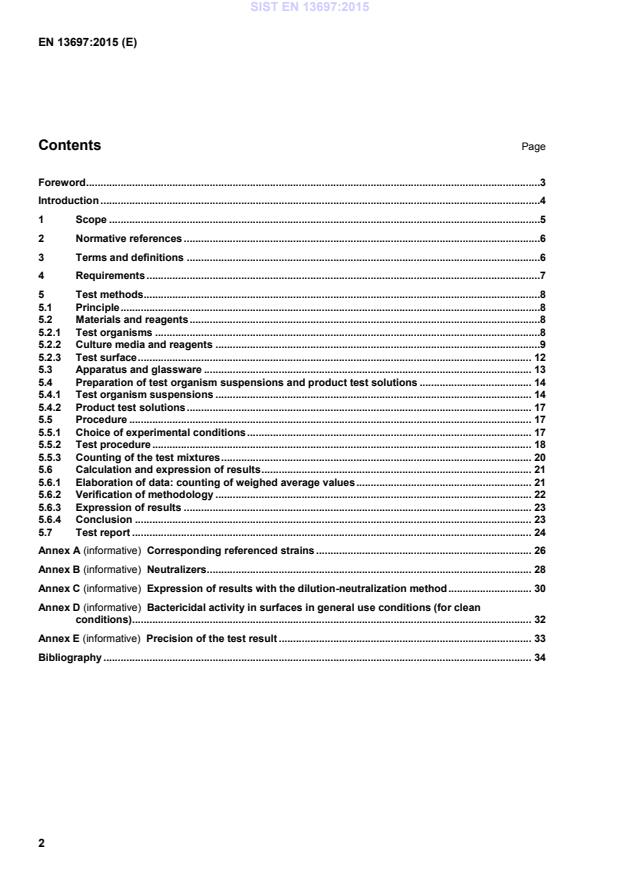
Corresponding referenced strains . 26 Annex B (informative)
Neutralizers . 28 Annex C (informative)
Expression of results with the dilution-neutralization method . 30 Annex D (informative)
Bactericidal activity in surfaces in general use conditions (for clean conditions) . 32 Annex E (informative)
Precision of the test result . 33 Bibliography . 34
(see 5.2.1) obligatory Enterococcus hirae Escherichia coli Pseudomonas aeruginosa Staphylococcus aureus Candida albicans Candida albicans Aspergillus brasiliensis (ex A. niger) example Salmonella typhimurium Lactobacillus brevis Enterobacter cloacae Saccharomyces cerevisiae (for breweries) Saccharomyces cerevisiae var. diastaticus (for breweries) any relevant test organism Test temperature obligatory Between 18 °C ± 1 °C and 25 °C ± 1 °C Between 18 °C ± 1 °C and 25 °C ± 1 °C Between 18 °C ± 1 °C and 25 °C ± 1 °C additional 4 °C ± 1 °C; 10 °C ± 1 °C; 40 °C ± 1 °C 4 °C ± 1 °C; 10 °C ± 1 °C; 40 °C ± 1 °C 4 °C ± 1 °C; 10 °C ± 1 °C; 40 °C ± 1 °C Contact time obligatory 5 min ± 10 s 15 min ± 10 s 15 min ± 10 s additional 1 min ± 5 s; 15 min ± 10 s; 30 min ± 10 s; 60 min ± 10 s 1 min ± 5 s; 5 min ± 10 s; 30 min ± 10 s; 60 min ± 10 s 1 min ± 5 s; 5 min ± 10 s; 30 min ± 10 s; 60 min ± 10 s Interfering substance obligatory clean conditions 0,3 g/l Bovine Albumin for Staphylococcus aureus, Enterococcus hirae and Escherichia coli ; 8,5 g/l skim milk for Pseudomonas aeruginosa 0,3 g/l Bovine Albumin for C. albicans 0,3 g/l Bovine Albumin for C. albicans and A. brasiliensis dirty conditions 3,0 g/l Bovine Albumin for Staphylococcus aureus, Enterococcus hirae, Pseudomonas aeruginosa and Escherichia coli 3,0 g/l Bovine Albumin for C. albicans 3,0 g/l Bovine Albumin for C. albicans and A. brasiliensis additional any relevant substance any relevant substance any relevant substance Log reduction from a water control (decimal log) ≥ 4Log ≥ 3Log ≥ 3Log The obligatory contact times for surface disinfectants stated in Table 1 were chosen to enable comparison of standard conditions. The referenced test conditions are by no means intended as requirements for the use of a product, nor as requirements for the evaluation and acceptance of products by regulatory authorities. The recommended contact time for the use of the product is within the responsibility of the manufacturer. Where appropriate (specific purposes), additional specific bactericidal/yeasticidal/fungicidal activity shall be determined under other conditions of time, temperature, additional strains and interfering substances in order to take into account intended specific use conditions. NOTE For the additional conditions, the concentration defined as a result can be lower than the one obtained under the obligatory test conditions. SIST EN 13697:2015
1) ATCC 15 442, ATCC 6 538, ATCC 10 541, ATCC 10 536, ATCC 10 231, ATCC 16 404 and ATCC 13311 are the collection numbers of strains supplied by the American Type Culture Collections. This information is given for the convenience of users of this standard and does not constitute an endorsement by CEN of the product named. Equivalent products can be used if they can be shown to lead to the same results. SIST EN 13697:2015
2) This information is given for the convenience of users of this European Standard and does not constitute an endorsement by CEN of the product named. Equivalent products may be used if they can be shown to lead to the same results. SIST EN 13697:2015
3) Decon is an example of a suitable product available commercially. This information is given for the convenience of users of this standard and does not constitute an endorsement by CEN of this product. SIST EN 13697:2015
5.3.2.3 Water baths capable of being controlled at 20 °C ± 1 °C, at 45 °C ± 1 °C and at additional test
± 1 °C (see 5.5.1). 5.3.2.4 Incubator (for bactericidal activity), capable of being controlled at either 36 °C ± 1 °C or 37 °C ± 1 °C. An incubator at 37 °C ± 1 °C may be used if an incubator at 36 °C ± 1 °C is not available. 5.3.2.5 Incubator (for fungicidal or yeasticidal activity), capable of being controlled at 30 °C ± 1 °C. 5.3.2.6 pH meter, having an accuracy of calibration of 0,1 pH units at 20 °C ± 1 °C. 5.3.2.7 Stopwatch. 5.3.2.8 Vortex mixer (mechanical shaker or electromechanical agitator, i.e. Vortex® mixer 5)). 5.3.2.9 Containers: Test tubes, culture bottles or flasks of suitable capacity. 5.3.2.10 Graduated pipettes of nominal capacities 10 ml, 1 ml, 0,1 ml and 0,05 ml, or calibrated automatic pipettes. 5.3.2.11 Petri dishes of size 90 mm to 100 mm. 5.3.2.12 Glass beads (Diameter: ≤ 5 mm). 5.3.2.13 Volumetric flasks.
4) Disposable equipment is an acceptable alternative to reusable glassware. 5) Vortex® in an example of a suitable product available commercially. This information is given for the convenience of users of this standard and does not constitute an endorsement by CEN of this product. SIST EN 13697:2015
Membrane filtration apparatus, constructed of a material compatible with the substances to be filtered. The apparatus shall have a filter holder of at least 50 ml volume. It shall be suitable for use with filters of diameter 47 mm to 50 mm and 0,45 5.2.2.7). 5.4 Preparation of test organism suspensions and product test solutions 5.4.1 Test organism suspensions 5.4.1.1 Stock cultures of test organisms Stocks cultures shall be kept in accordance with the requirements of EN 12353. 5.4.1.2 Working culture of test organisms a) Bacteria: In order to prepare the working culture of the test organism, subculture from the stock culture (see 5.4.1.1) by streaking on TSA slopes (see 5.2.2.3) and incubate (see 5.3.2.4). After 18 h to 24 h, prepare a second subculture from the first subculture in the same way and incubate for 18 h to 24 h. From this second subculture, a third subculture may be produced in the same way. NOTE 1 The second and/or third subculture are the working culture(s). If it is not possible to prepare the second subculture on a particular day, a 48 h subculture may be used for subsequent subculturing, provided that the subculture has been kept in the incubator during the 48 h period. In these circumstances, prepare a further 24 h subculture after proceeding. Do not take a fourth subculture. For additional strains (see 5.2.1), any departure from this method of culturing the bacteria or preparing the suspensions shall be noted, giving the reasons in the test report. b) fungi: In order to prepare the working culture of Candida albicans, subculture from the stock culture (see 5.4.1.1) by streaking onto MEA slopes (see 5.2.2.4) and incubate (see 5.3.2.5). After 42 h to 48 h, prepare a second subculture from the first subculture in the same way and incubate for 42 h to 48 h. From this second subculture, a third subculture may be produced in the same way. NOTE 2 The second and/or third subculture are the working culture(s). For Aspergillus brasiliensis (previously A. niger) (5.2.1), use only the first subculture grown on MEA (5.2.2.4) in Petri dishes or flasks with ventilated caps (5.3.2.17) and incubate at 30 °C ± 1 °C for 7 d to 9 d. No further subculturing is needed. Do not stack the Petri dishes during the incubation to improve the temperature homogenization. SIST EN 13697:2015
the presence of a high concentration (at least 75 % of spiny spores) of characteristic mature spores, i.e. spiny spores (versus smooth spores); —
the absence of spore germination (check at least 10 fields of view); —
the absence of mycelia fragments (check at least 10 fields of view). If germinated spores are present, discard the suspension. If mycelia are present, proceed to a 2nd fritted filtration. If mycelia are still present, discard the suspension.
6) Analytical quality, non hydrolysed in accordance with European Pharmacopoeia, Volume 1. TWEEN 80 is an example of a suitable product available commercially. This information is given for the convenience of users of this standard and does not constitute an endorsement by CEN of this product. SIST EN 13697:2015
to 48 h (Aspergillus brasiliensis (ex A. niger)). Discard any plates which are not countable for any reason. Count the plates and determine the number of colony forming units. Incubate the plates for a further 24 h. Do not recount plates which no longer show well-separated colonies. Recount the remaining plates. For Aspergillus brasiliensis (ex A. niger), continue incubation for a further 20 h to 24 h and if necessary a further 20 h to 24 h, provided the number of countable colonies (discrete colonies) is increasing. Determine the highest number of colonies for each 1 ml sample. For incubation and counting, see 5.4.1.5. SIST EN 13697:2015
is the dilution factor corresponding to the lower dilution (10−6). 5.4.2 Product test solutions Details of samples of the product as received shall be recorded. Product test solutions shall be prepared in hard water (see 5.2.2.7) at minimum three different concentrations to include one concentration in the active range and one concentration in the non active range. For solid products, dissolve the product as received by weighing at least 1 g ± 10 mg of the product in a volumetric flask and dilute with hard water (see 5.2.2.7) Subsequent dilutions shall be prepared in volumetric flasks (see 5.3.2.13) on a volume/volume basis in hard water (see 5.2.2.7). For liquid products, dilutions of the product shall be prepared in hard water (see 5.2.2.7) on a volume/volume basis using volumetric flasks (see 5.3.2.13). The product as received may be used as one of the product test solutions. For products supplied in a ready to use state, water (see 5.2.2.2) shall be used to prepare dilutions. When the product is diluted in hard water, it shall give a physically homogeneous stable preparation. The product test solution and dilutions of it shall be prepared freshly and used within 2 h. The concentration of the product stated in the test report shall be the test concentration. Record the test concentration in terms of volume per volume or weight per volume. 5.5 Procedure 5.5.1 Choice of experimental conditions The selection of contact temperature, contact time and interfering substances shall be carried out according to the practical use considered for the product (see Clause 4 Table 1) as follows: SIST EN 13697:2015
1) the test temperature shall be at room temperature between the range (18 ± 1) °C and (25 ± 1) °C; 2) additional temperatures may be chosen from 4 °C ± 1 °C or 10 °C ± 1 °C or 40 °C ± 1 °C. A temperature controlled chamber should be used for temperatures other than ambient. b) contact time; t (min): 1) the contact time to be tested is 5 min ± 10 s for bacteria and 15 min ± 10 s for fungi; 2) additional times may be chosen from 1 min ± 10 s, 5 min ± 10 s, 15 min ± 10 s, 30 min ± 10 s a
...