

EN ISO 14122-4:2004
(Main)Safety of machinery - Permanent means of access to machinery - Part 4: Fixed ladders (ISO 14122-4:2004)
- Abstract
ISO 14122-4:2004 applies to all machinery (stationary and mobile) where fixed means of access are necessary.
The purpose of the standard is to define the general requirements for safe access to machines mentioned in ISO 12100-2. ISO 14122-1 gives advice about the correct choice of access means when the necessary access to the machine is not possible directly from the ground level or from a floor.
The standard applies to fixed ladders which are a part of a machine.
It may also be applied to ladders fixed to that part of the building where the machine is installed, providing the main function of that part of the building is to provide a means of access to the machine.
It also applies to ladders which are not permanently fixed to the machine and which may be removed, moved to the side or pivoted (swivel-mounted) for some operations of the machine (e.g. changing tools in a large press).
- Status
- Withdrawn
- Publication Date
- 14-Dec-2004
- Withdrawal Date
- 06-Oct-2026
- Technical Committee
- CEN/TC 114 - Safety of machinery
- Drafting Committee
- CEN/TC 114/WG 17 - Permanent access to machines and industrial plant
- Current Stage
- 9960 - Withdrawal effective - Withdrawal
- Start Date
- 22-Jun-2016
- Completion Date
- 07-Oct-2026
- Directive
- 2006/42/EC - Directive 2006/42/EC of the European Parliament and of the Council of 17 May 2006 on machinery, and amending Directive 95/16/EC (recast)OJ Ref: C, C 110 OJ Date: 08-Apr-2011

Relations
- Effective Date
- 08-Jun-2022
- Effective Date
- 28-Jan-2026
- Effective Date
- 28-Jan-2026
- Effective Date
- 28-Jan-2026
- Effective Date
- 28-Jan-2026
- Effective Date
- 28-Jan-2026
- Effective Date
- 28-Jan-2026
- Effective Date
- 28-Jan-2026
- Effective Date
- 28-Jan-2026
- Effective Date
- 28-Jan-2026
- Referred By
EN 422:2009 - Plastics and rubber machines - Blow moulding machines - Safety requirements - Effective Date
- 28-Jan-2026
- Effective Date
- 28-Jan-2026
- Effective Date
- 28-Jan-2026
- Referred By
EN 12409:2008+A1:2011 - Plastics and rubber machines - Thermoforming machines - Safety requirements - Effective Date
- 28-Jan-2026
- Effective Date
- 28-Jan-2026
Get Certified
Connect with accredited certification bodies for this standard

CIS Institut d.o.o.
Personal Protective Equipment (PPE) certification body. Notified Body NB-2890 for EU Regulation 2016/425 PPE.

Kiwa BDA Testing
Building and construction product certification.
Kmetijski inštitut Slovenije
Agricultural Institute of Slovenia. Soil testing, plant health, agricultural product analysis.
Sponsored listings
Frequently Asked Questions
EN ISO 14122-4:2004 is a standard published by the European Committee for Standardization (CEN). Its full title is "Safety of machinery - Permanent means of access to machinery - Part 4: Fixed ladders (ISO 14122-4:2004)". This standard covers: ISO 14122-4:2004 applies to all machinery (stationary and mobile) where fixed means of access are necessary. The purpose of the standard is to define the general requirements for safe access to machines mentioned in ISO 12100-2. ISO 14122-1 gives advice about the correct choice of access means when the necessary access to the machine is not possible directly from the ground level or from a floor. The standard applies to fixed ladders which are a part of a machine. It may also be applied to ladders fixed to that part of the building where the machine is installed, providing the main function of that part of the building is to provide a means of access to the machine. It also applies to ladders which are not permanently fixed to the machine and which may be removed, moved to the side or pivoted (swivel-mounted) for some operations of the machine (e.g. changing tools in a large press).
ISO 14122-4:2004 applies to all machinery (stationary and mobile) where fixed means of access are necessary. The purpose of the standard is to define the general requirements for safe access to machines mentioned in ISO 12100-2. ISO 14122-1 gives advice about the correct choice of access means when the necessary access to the machine is not possible directly from the ground level or from a floor. The standard applies to fixed ladders which are a part of a machine. It may also be applied to ladders fixed to that part of the building where the machine is installed, providing the main function of that part of the building is to provide a means of access to the machine. It also applies to ladders which are not permanently fixed to the machine and which may be removed, moved to the side or pivoted (swivel-mounted) for some operations of the machine (e.g. changing tools in a large press).
EN ISO 14122-4:2004 is classified under the following ICS (International Classification for Standards) categories: 13.110 - Safety of machinery. The ICS classification helps identify the subject area and facilitates finding related standards.
EN ISO 14122-4:2004 has the following relationships with other standards: It is inter standard links to EN ISO 14122-4:2016, EN ISO 14122-2:2016, EN ISO 14122-3:2016, EN ISO 12100-2:2003, EN 131-2:1993, EN ISO 12100-1:2003, EN 363:2018, EN 353-1:2014+A1:2017, EN ISO 12100:2010, EN ISO 14122-1:2016, EN 422:2009, EN 12012-4:2006+A1:2008, EN 15162:2008, EN 12409:2008+A1:2011, EN 13289:2001+A1:2013. Understanding these relationships helps ensure you are using the most current and applicable version of the standard.
EN ISO 14122-4:2004 is associated with the following European legislation: EU Directives/Regulations: 2006/42/EC, 98/37/EC; Standardization Mandates: M/BC/CEN/88/13. When a standard is cited in the Official Journal of the European Union, products manufactured in conformity with it benefit from a presumption of conformity with the essential requirements of the corresponding EU directive or regulation.
EN ISO 14122-4:2004 is available in PDF format for immediate download after purchase. The document can be added to your cart and obtained through the secure checkout process. Digital delivery ensures instant access to the complete standard document.
Standards Content (Sample)
SLOVENSKI STANDARD
01-marec-2005
Varnost strojev - Trajna sredstva za dostop do strojev - 4. del: Fiksne lestve (ISO
14122-4:2004)
Safety of machinery - Permanent means of access to machinery - Part 4: Fixed ladders
(ISO 14122-4:2004)
Sicherheit von Maschinen - Ortsfeste Zugänge zu maschinellen Anlagen - Teil 4:
Ortsfeste Steigleitern (ISO 14122-4:2004)
Sécurité des machines - Moyens d'acces permanents aux machines - Partie 4: Echelles
fixes (ISO 14122-4:2004)
Ta slovenski standard je istoveten z: EN ISO 14122-4:2004
ICS:
13.110 Varnost strojev Safety of machinery
97.145 Lestve Ladders
2003-01.Slovenski inštitut za standardizacijo. Razmnoževanje celote ali delov tega standarda ni dovoljeno.
EUROPEAN STANDARD
EN ISO 14122-4
NORME EUROPÉENNE
EUROPÄISCHE NORM
December 2005
ICS 13.110
English version
Safety of machinery - Permanent means of access to machinery
- Part 4: Fixed ladders (ISO 14122-4:2004)
Sécurité des machines - Moyens d'accès permanents aux Sicherheit von Maschinen - Ortsfeste Zugänge zu
machines - Partie 4: Echelles fixes (ISO 14122-4:2004) maschinellen Anlagen - Teil 4: Ortsfeste Steigleitern (ISO
14122-4:2004)
This European Standard was approved by CEN on 18 March 2003.
CEN members are bound to comply with the CEN/CENELEC Internal Regulations which stipulate the conditions for giving this European
Standard the status of a national standard without any alteration. Up-to-date lists and bibliographical references concerning such national
standards may be obtained on application to the Central Secretariat or to any CEN member.
This European Standard exists in three official versions (English, French, German). A version in any other language made by translation
under the responsibility of a CEN member into its own language and notified to the Central Secretariat has the same status as the official
versions.
CEN members are the national standards bodies of Austria, Belgium, Cyprus, Czech Republic, Denmark, Estonia, Finland, France,
Germany, Greece, Hungary, Iceland, Ireland, Italy, Latvia, Lithuania, Luxembourg, Malta, Netherlands, Norway, Poland, Portugal, Slovakia,
Slovenia, Spain, Sweden, Switzerland and United Kingdom.
EUROPEAN COMMITTEE FOR STANDARDIZATION
COMITÉ EUROPÉEN DE NORMALISATION
EUROPÄISCHES KOMITEE FÜR NORMUNG
Management Centre: rue de Stassart, 36 B-1050 Brussels
© 2005 CEN All rights of exploitation in any form and by any means reserved Ref. No. EN ISO 14122-4:2004: E
worldwide for CEN national Members.
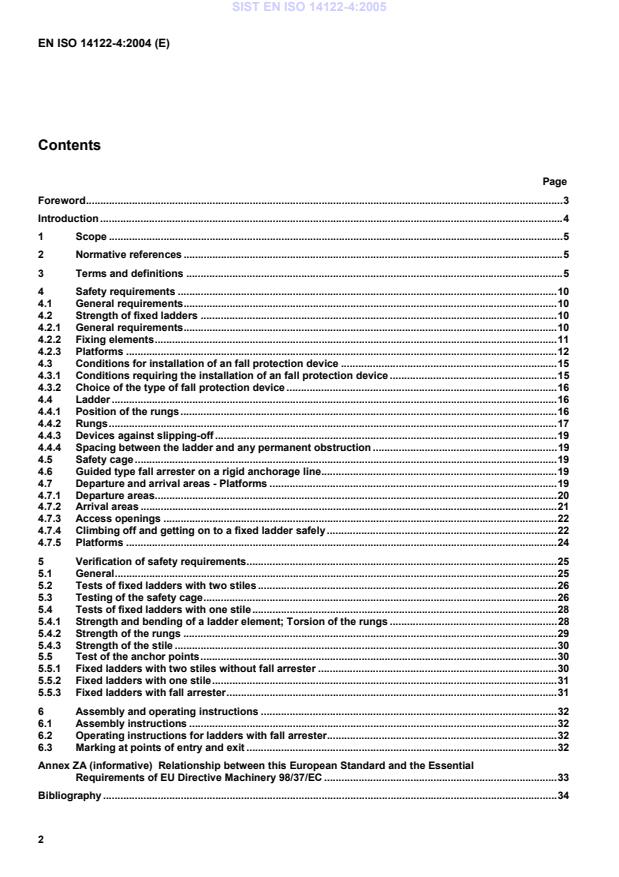
Contents
Page
Foreword.3
Introduction .4
1 Scope .5
2 Normative references .5
3 Terms and definitions .5
4 Safety requirements .10
4.1 General requirements.10
4.2 Strength of fixed ladders .10
4.2.1 General requirements.10
4.2.2 Fixing elements.11
4.2.3 Platforms .12
4.3 Conditions for installation of an fall protection device .15
4.3.1 Conditions requiring the installation of an fall protection device .15
4.3.2 Choice of the type of fall protection device .16
4.4 Ladder .16
4.4.1 Position of the rungs.16
4.4.2 Rungs.17
4.4.3 Devices against slipping-off.19
4.4.4 Spacing between the ladder and any permanent obstruction .19
4.5 Safety cage.19
4.6 Guided type fall arrester on a rigid anchorage line.19
4.7 Departure and arrival areas - Platforms .19
4.7.1 Departure areas.20
4.7.2 Arrival areas .21
4.7.3 Access openings .22
4.7.4 Climbing off and getting on to a fixed ladder safely.22
4.7.5 Platforms .24
5 Verification of safety requirements.25
5.1 General.25
5.2 Tests of fixed ladders with two stiles .26
5.3 Testing of the safety cage.26
5.4 Tests of fixed ladders with one stile.28
5.4.1 Strength and bending of a ladder element; Torsion of the rungs .28
5.4.2 Strength of the rungs .29
5.4.3 Strength of the stile .30
5.5 Test of the anchor points.30
5.5.1 Fixed ladders with two stiles without fall arrester .30
5.5.2 Fixed ladders with one stile.31
5.5.3 Fixed ladders with fall arrester.31
6 Assembly and operating instructions .32
6.1 Assembly instructions .32
6.2 Operating instructions for ladders with fall arrester.32
6.3 Marking at points of entry and exit .32
Annex ZA (informative) Relationship between this European Standard and the Essential
Requirements of EU Directive Machinery 98/37/EC .33
Bibliography .34
Foreword
This document (EN ISO 14122-4:2004) has been prepared by Technical Committee CEN/TC 114 “Safety of
machinery”, the secretariat of which is held by DIN, in collaboration with Technical Committee ISO/TC 199 “Safety
of machinery”.
This European Standard shall be given the status of a national standard, either by publication of an identical text or
by endorsement, at the latest by June 2005, and conflicting national standards shall be withdrawn at the latest by
June 2005.
This document has been prepared under a mandate given to CEN by the European Commission and the European
Free Trade Association, and supports essential requirements of EU Directive(s).
For relationship with EU Directive(s), see informative Annex ZA, which is an integral part of this document.
According to the CEN/CENELEC Internal Regulations, the national standards organizations of the following
countries are bound to implement this European Standard: Austria, Belgium, Cyprus, Czech Republic, Denmark,
Estonia, Finland, France, Germany, Greece, Hungary, Iceland, Ireland, Italy, Latvia, Lithuania, Luxembourg, Malta,
Netherlands, Norway, Portugal, Slovakia, Slovenia, Spain, Poland, Sweden, Switzerland and the United Kingdom.
Introduction
This is the fourth part of the standard "Safety of machinery — Permanent means of access to machinery". The
parts of the standard are:
Part 1: Choice of a fixed means of access between two levels
Part 2: Working platforms and walkways
Part 3: Stairs, stepladders and guard-rails
Part 4: Fixed ladders.
This European standard is a type B standard as stated in EN ISO 12100.
This standard is to be read in conjunction with Clause 1.6.2 "Access to operating position and servicing points"
and 1.5.15 "Risk of slipping, tripping or falling" of the essential safety requirements expressed in Annex A of
EN 292-2:1991/A1:1995. See also 5.5.6 "Measures for safe access to machinery" of EN ISO 12100-2:2003 which
supersedes EN 292-2.
The provisions of this document can be supplemented or modified by a type C standard.
NOTE 1 For machines which are covered by the scope of a type C standard and which have been designed and built
according to the provisions of that standard, the provisions of that type C standard will take precedence over the provisions of
this type B standard.
NOTE 2 The use of materials other than metals (composite materials, so-called "advanced" materials, etc.) does not alter the
application of the present standard.
1 Scope
This standard applies to all machinery (stationary and mobile) where fixed means of access are necessary.
The purpose of this standard is to define the general requirements for safe access to machines mentioned in
EN ISO 12100-2. EN ISO 14122-1 gives advice about the correct choice of access means when the necessary
access to the machine is not possible directly from the ground level or from a floor.
This standard applies to fixed ladders, which are a part of a machine.
This standard may also be applied to fixed ladders to that part of the building where the machine is installed,
providing the main function of that part of the building is to provide a means of access to the machine.
NOTE This standard may be used also for means of access which are outside the scope of this standard. In those cases
the possible relevant national or other regulations should be taken into account.
This standard applies also to ladders which are not permanently fixed to the machine and which may be removed,
moved to the side or pivoted (swivel-mounted) for some operations of the machine (e. g. changing tools in a large
press).
For the significant hazards covered by this standard, see Clause 4 of EN ISO 14122-1.
This standard is not applicable to machinery which are manufactured before the date of publication of this standard
by CEN.
2 Normative references
The following referenced documents are indispensable for the application of this document. For dated references,
only the edition cited applies. For undated references, the latest edition of the referenced document (including any
amendments) applies.
EN 131-2:1993, Ladders — Requirements, tests, markings.
EN 353-1, Personal protective equipment against falls from a height — Part 1: Guided type fall arresters including a
rigid anchorage line.
EN 363, Personal protective equipment against falls from a height — Fall arrest systems.
EN ISO 12100-1:2003, Safety of machinery — Basic concepts, general principles for design — Part 1: Basic
terminology, methodology (ISO 12100-1:2003)
EN ISO 12100-2:2003, Safety of machinery — Basic concepts, general principles for design — Part 2: Technical
principles (ISO 12100-2:2003).
EN ISO 14122-1, Safety of machinery — Permanents means of access to machinery — Part 1: Choice of a fixed
means of access between two levels (ISO 14122-1:2001).
EN ISO 14122-2, Safety of machinery — Permanents means of access to machinery — Part 2: Working platforms
and walkways (ISO 14122-2:2001).
EN ISO 14122-3, Safety of machinery — Permanents means of access to machinery — Part 3: Stairs, stepladders
and guard-rails (ISO 14122-3:2001).
3 Terms and definitions
For the purposes of this European Standard, the terms and definitions given in EN ISO 12100-1:2003,
EN ISO 14122-1:2001 and the following apply.
The main terms used in the present standard are given as an example in Figures 1, 2, 3 and 4.
3.1
fixed ladder with two stiles
ladder, according to 3.1 of EN ISO 14122-1, which is stationary and where the rungs are arranged between and
attached to the stiles. The stiles carry the load (see Figure 2)
3.2
fixed ladder with one stile
ladder, according to 3.1 of EN ISO 14122-1, which is stationary and where the rungs are attached to both sides of
the stile. The stile carries the load alone (see Figure 3)
3.3
ladder flight
continuous part of the fixed ladder (see Figure 1):
between arrival and departure area, in the case of ladders without platforms; or
between the arrival area respectively departure area and the nearest platform; or
between rest platforms following each other
3.4
climbing height H of a fixed ladder
total vertical distance between the walking surface of the arrival area at the top of the ladder(s) and the walking
surface of the departure area at the base of the ladder(s) (see Figure 1)
3.5
height h of the ladder flight
vertical distance between the level at the beginning and the level at the end of each flight (see Figure 1)
3.6
fall protection
technical measure to prevent or reduce the risk of people falling from fixed ladders
NOTE Commonly used fall protection devices are defined in 3.6.1 and 3.6.2.
3.6.1
safety cage
assembly which serves to limit the risk of people falling from the ladder (see Figure 2)
3.6.2
guided type fall arrester on a rigid anchorage line
fall arrester
protective equipment fixed to ladder used in combination with personal protective equipment that everyone has
available before being allowed to use the ladder. (See also definition in EN 353-1 and EN 363)
In the following text the abbreviation "fall arrester" will also be used for this type of fall protection device.
3.7
arrival level
upper level of the surroundings or of the intermediate platform to which, the person steps after the ascent (see
Figure 1)
3.8
departure level
lower level of the surroundings or of the intermediate platform from which the person starts to climb the fixed ladder
(see Figure 1)
3.9
intermediate platform
horizontal structure (platform) between two consecutive flights of a ladder (used with ladders having staggered
flights) (see Figure 1 and 4b)
3.10
rest platform
area equipped with the required protective means designed so that the user of the ladder can have a physical rest
(See Figures 1b, 10, 11 and 12)
3.11
access platform
horizontal structure at the arrival or departure area used by a person for means of access
3.12
trap door
normally closed device which can be opened to give access through a platform or through other similar horizontal
structures
Position of the rest platforms
Dimensions in millimetres
H = 10000 mm h = 6000 mm
max max
Figure 1.a : Ladder without rest platform Figure 1.b : Ladder with staggered flights
(single flight)
Key
1 Arrival area
2 Departure area
3 Intermediate platform or rest platform
4 Ladder flight
Figure 1 — Height of flights and location of platforms
Key
1 Anchor bracket
2 Rung
3 Ladder stile
4 Safety cage vertical members
5 Lowest hoop
6 Intermediate hoop
7 Toe plate
8 Platform step
9 Gate
10 Upper hoop
[A] Exit section
[B] Safety cage
Figure 2 — Terminology
Key
1 Stile
2 Rung
3 Protective device against slipping-off
4 Anchor point
Figure 3 — Example of a ladder less than 3000 mm with one stile
4 Safety requirements
4.1 General requirements
The materials, dimensions of constituent elements and construction mode used shall meet the safety objectives of
this standard.
Ladders shall be designed to meet the same installation requirements as the machine, taking into consideration
where necessary, conditions such as harsh environment, vibrations, etc.
As far as possible, fixed ladders should be designed with two stiles. In exceptional circumstances (e. g. a
continuous ladder with a varying angle of pitch or insufficient space to provide two stiles), fixed ladders may be
provided with only one stile.
All parts likely to be in contact with users shall be designed so as not to catch, hurt or hinder i. e. sharp corners,
welds with burrs, or rough edges, etc. should be avoided. Opening or closing the mobile parts (gate) shall not
cause further hazards (e. g. shearing or accidental falling) for persons using the ladder and those in the vicinity.
Fittings, hinges, anchor points, supports and mounting points shall hold the assembly sufficiently rigid and stable to
ensure the safety of users under normal conditions of use.
4.2 Strength of fixed ladders
4.2.1 General requirements
A ladder, platform and safety cage (when installed) shall meet the following design requirements:
4.2.1.1 Ladder element
The ladder elements are considered to fulfil the requirements mentioned in 4.2.1 when they meet the requirements
of EN 131-2. The maximum deflection as indicated in 5.1 shall not exceed 50 mm.
In case of fixed ladders with one stile instead of the lateral bending test (see 4.4 of EN 131-2:1993) a torsion test
shall be made by application of two test loads each 400 N. The deflection of the ladder shall not exceed 20 mm
(see 5.4.3 and Figure 16). For the rungs, the load is applied on a length of 100 mm close to the lateral devices
against slipping off. The residual deflection of the rungs shall be not more than 0,3 % related to the length of the
rung (see 5.4.2, and Figure 15).
4.2.1.2 Safety cage
The safety cage is considered to meet these requirements if the permanent deformation as the result of a vertical
load of 1000 N is not more than 10 mm and as the result of a horizontal load of 500 N is not more than 10 mm.
(see 5.3 and Figure 13).
4.2.1.3 Fixed ladders equipped with a fall arrester
In addition to the requirements of 4.2.1.1, the combination of fall arrester and ladder shall be capable of stopping
the user from falling (see Clause 5).
4.2.2 Fixing elements
4.2.2.1 General
Fixing elements such as fittings, anchorage points, hinges, supports and mountings shall hold the assembly
sufficiently rigid and stable to ensure the safety of user under normal conditions of use (see verification in 5.5).
In case of fixed ladders equipped with a fall arrester the connecting elements shall withstand the stresses caused
by the fall arrester catching the person who falls down.
4.2.2.2 Anchoring points of fixed ladders
The anchoring points and connections to them shall be capable of supporting 3000 N per stile. Up to four
anchorages may be considered to contribute to this support. See 5.5 for the test method.
4.2.3 Platforms
All platforms shall comply with the requirements of EN ISO 14122-2.
Dimensions in millimetres
Figure 4a — Side elevation on ladder with a safety cage
Dimension in millimetres
Figure 4b — Front elevation on ladder with safety cage
Dimensions in millimetres
Figure 4.c – Plan view of a ladder with a safety cage
Dimensions in millimetres
Figure 4.d – Plan view of a ladder without safety cage
Key
1 Connection element
2 Gate
3 Discontinuous obstacle
4 To suit maximum open area ≤ 0,4 m²
5 Intermediate platform
Figure 4 — Principal dimensions of ladders and safety cages
Dimensions in millimetres
Key
1 See 4.4.1.1
2 See 4.4.1.2 and Figure 6.a
3 Discontinuous obstacle
Figure 5 — Principal dimensions of a fixed ladder with one stile
4.3 Conditions for installation of an fall protection device
4.3.1 Conditions requiring the installation of an fall protection device
The ladder shall be fitted with a fall protection device when:
a) height of the ladder flight is more than 3000 mm;
b) height of the ladder is 3000 mm or less, but at the departure area there is the risk of falling an additional
distance. In this case, the total distance of fall from the upper level of the ladder could be more than 3000 mm.
NOTE Risk of falling is considered to exist when the distance from the centre of the ladder to the unprotected side of a
platform (or similar structure) is less than 3000 mm.
4.3.2 Choice of the type of fall protection device
Two main alternatives for protection of the users of fixed ladders against falls from a height are safety cages or fall
arresters:
The cage shall be the required choice, as it is a means which is always present and the actual safety function
is independent of the operator's actions,
Where it is not possible to use a cage, individual protective equipment shall be provided. The fall arrester is
only effective if the user chooses to use it. If a harness with an incompatible sliding system is used with a
guided type fall arrester, there will be a risk (requirements for information for use see Clause 6).
A fall arrester shall be designed only for low frequency and specialised access (e. g. maintenance).
NOTE An appropriate individual fall protection device is able to arrest a fall better than a cage.
4.4 Ladder
The principal dimensions of the ladder shall be determined in accordance with 4.4.1 to 4.4.4 (See also Figures 4
and 5).
4.4.1 Position of the rungs
4.4.1.1 Spacing between the rungs
The spacing between successive rungs shall be constant and shall be between 225 mm and 300 mm.
4.4.1.2 Spacing between rungs and the departure and arrival area
The distance between the walk
...