

EN 16274:2012
(Main)Methods for analysis of allergens - Quantification of suspected fragrance allergens in consumer products - Step 1: GC analysis of ready-to-inject sample
- Abstract
This European Standard describes a method for the identification and determination of 24 volatile suspected allergens from ready-to-inject cosmetics and raw materials used in cosmetic products and are compatible with GC analysis. This analysis uses GC-MS after sample preparation. The 24 suspected allergens are restricted under Council Directives (7th amendment to the Cosmetic Directive 2003/15/EC).
This European Standard does not include requirements for the preparation of samples in matrices for which direct injection in GC is not feasible.
- Status
- Withdrawn
- Publication Date
- 11-Sep-2012
- Withdrawal Date
- 06-Oct-2026
- Technical Committee
- CEN/TC 347 - Methods for analysis of allergens
- Drafting Committee
- CEN/TC 347/WG 4 - Fragrances and colophony
- Current Stage
- 9960 - Withdrawal effective - Withdrawal
- Start Date
- 05-May-2021
- Completion Date
- 07-Oct-2026

Relations
- Effective Date
- 12-May-2021
Get Certified
Connect with accredited certification bodies for this standard

ECOCERT
Organic and sustainability certification.

Eurofins Food Testing Global
Global leader in food, environment, and pharmaceutical product testing.

Intertek Bangladesh
Intertek certification and testing services in Bangladesh.
Sponsored listings
Frequently Asked Questions
EN 16274:2012 is a standard published by the European Committee for Standardization (CEN). Its full title is "Methods for analysis of allergens - Quantification of suspected fragrance allergens in consumer products - Step 1: GC analysis of ready-to-inject sample". This standard covers: This European Standard describes a method for the identification and determination of 24 volatile suspected allergens from ready-to-inject cosmetics and raw materials used in cosmetic products and are compatible with GC analysis. This analysis uses GC-MS after sample preparation. The 24 suspected allergens are restricted under Council Directives (7th amendment to the Cosmetic Directive 2003/15/EC). This European Standard does not include requirements for the preparation of samples in matrices for which direct injection in GC is not feasible.
This European Standard describes a method for the identification and determination of 24 volatile suspected allergens from ready-to-inject cosmetics and raw materials used in cosmetic products and are compatible with GC analysis. This analysis uses GC-MS after sample preparation. The 24 suspected allergens are restricted under Council Directives (7th amendment to the Cosmetic Directive 2003/15/EC). This European Standard does not include requirements for the preparation of samples in matrices for which direct injection in GC is not feasible.
EN 16274:2012 is classified under the following ICS (International Classification for Standards) categories: 71.100.60 - Essential oils. The ICS classification helps identify the subject area and facilitates finding related standards.
EN 16274:2012 has the following relationships with other standards: It is inter standard links to EN 16274:2021. Understanding these relationships helps ensure you are using the most current and applicable version of the standard.
EN 16274:2012 is available in PDF format for immediate download after purchase. The document can be added to your cart and obtained through the secure checkout process. Digital delivery ensures instant access to the complete standard document.
Standards Content (Sample)
2003-01.Slovenski inštitut za standardizacijo. Razmnoževanje celote ali delov tega standarda ni dovoljeno.Analyseverfahren für Allergene - Quantifizierung von mutmaßlichen Allergie auslösenden Duftstoffen in Verbrauchsgütern - Stufe 1: GC-Analyse von einspritzfertigen ProbenMéthodes d'analyse des allergènes - Quantification des fragrances allergènes suspectées dans les produits de consommation - Analyse par CG d'échantillons prêts à être injectésMethods for analysis of allergens - Quantification of suspected fragrance allergens in consumer products - Step 1: GC analysis of ready-to-inject sample71.100.70SULSRPRþNLCosmetics. ToiletriesICS:Ta slovenski standard je istoveten z:EN 16274:2012SIST EN 16274:2012en,fr,de01-december-2012SIST EN 16274:2012SLOVENSKI
STANDARD
EUROPEAN STANDARD NORME EUROPÉENNE EUROPÄISCHE NORM
EN 16274
September 2012 ICS 71.100.60 English Version
Methods for analysis of allergens - Quantification of suspected fragrance allergens in consumer products - Step 1: GC analysis of ready-to-inject sample
Méthodes d'analyse des allergènes - Quantification des fragrances allergènes suspectées dans les produits de consommation - Étape 1 : Analyse par GC d'échantillons prêts à être injectés
Analyseverfahren für Allergene - Quantifizierung von mutmaßlichen Allergie auslösenden Duftstoffen in Verbrauchsgütern - Stufe 1: GC-Analyse von einspritzfertigen Proben This European Standard was approved by CEN on 4 August 2012.
CEN members are bound to comply with the CEN/CENELEC Internal Regulations which stipulate the conditions for giving this European Standard the status of a national standard without any alteration. Up-to-date lists and bibliographical references concerning such national standards may be obtained on application to the CEN-CENELEC Management Centre or to any CEN member.
This European Standard exists in three official versions (English, French, German). A version in any other language made by translation under the responsibility of a CEN member into its own language and notified to the CEN-CENELEC Management Centre has the same status as the official versions.
CEN members are the national standards bodies of Austria, Belgium, Bulgaria, Croatia, Cyprus, Czech Republic, Denmark, Estonia, Finland, Former Yugoslav Republic of Macedonia, France, Germany, Greece, Hungary, Iceland, Ireland, Italy, Latvia, Lithuania, Luxembourg, Malta, Netherlands, Norway, Poland, Portugal, Romania, Slovakia, Slovenia, Spain, Sweden, Switzerland, Turkey and United Kingdom.
EUROPEAN COMMITTEE FOR STANDARDIZATION
COMITÉ EUROPÉEN DE NORMALISATION EUROPÄISCHES KOMITEE FÜR NORMUNG
Management Centre:
Avenue Marnix 17,
B-1000 Brussels © 2012 CEN All rights of exploitation in any form and by any means reserved worldwide for CEN national Members. Ref. No. EN 16274:2012: ESIST EN 16274:2012
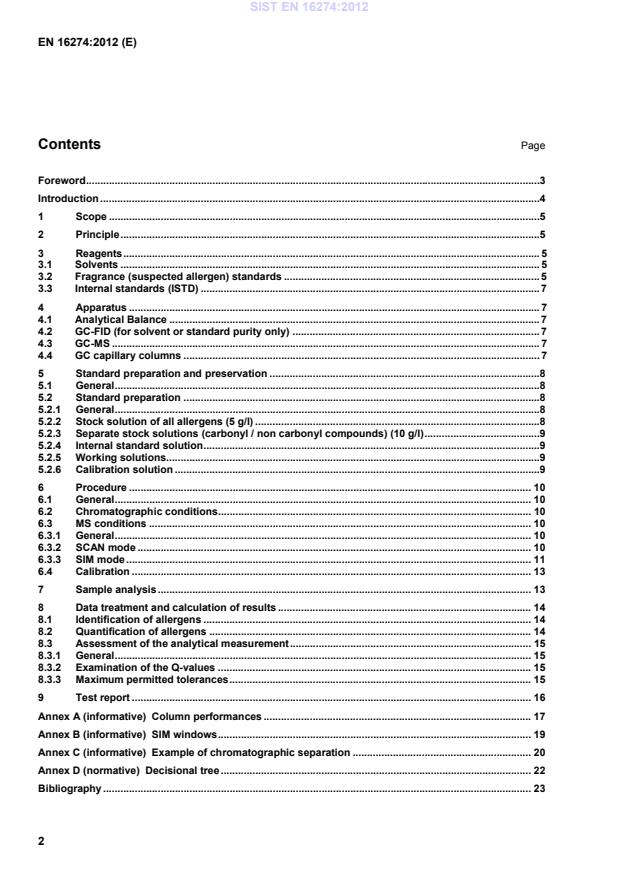
Column performances . 17Annex B (informative)
SIM windows . 19Annex C (informative)
Example of chromatographic separation . 20Annex D (normative)
Decisional tree . 22Bibliography . 23SIST EN 16274:2012
The final result depends on the agreement of the different ion ratios obtained for both injections according to specific requirements. 3 Reagents Unless otherwise stated, use only reagents of recognised analytical grade. The solvent shall be of quality for GC-MS analysis. 3.1 Solvents 3.1.1 Methyl pivalate, CAS no: [598-98-1], analytical grade or higher. 3.1.2 Ortho-fluorotoluene, CAS no: [95-52-3], analytical grade or higher. 3.1.3 Acetone, CAS no: [67-64-1], analytical grade or higher. IMPORTANT — if other solvents are used, their inertness with the analytes shall be demonstrated. In any case, the same solvent shall be used both for calibration and determination. 3.2 Fragrance (suspected allergen) standards 3.2.1 Amylcinnamic alcohol, CAS no: [101-85-9], with known purity. NOTE Possibly two isomers. 3.2.2 Amylcinnamic aldehyde (flosal®), CAS no: [122-40-7], with known purity. NOTE Possibly two isomers. 3.2.3 Anisyl alcohol, CAS no: [105-13-5], with known purity. 3.2.4 Benzyl alcohol, CAS no: [100-51-6], with known purity. 3.2.5 Benzyl benzoate, CAS no: [120-51-4], with known purity. SIST EN 16274:2012
αααα-Isomethyl ionone, CAS no: [127-51-5], with known purity. 3.2.22 Limonene, CAS no: [5989-27-5], with known purity. 3.2.23 Linalool, CAS no: [78-70-6], with known purity. 3.2.24 Methyl-2-octynoate (folione®), CAS no [111-12-6], with known purity. SIST EN 16274:2012
tR,i total retention time of the ith peak; wh,i width at half height of the ith peak; n number of peaks in the chromatogram. If0=R,the column can only be used if there is no ion listed in Table 2 in common between 2 co-eluted allergens. SIST EN 16274:2012
chemical inertia towards the allergen analytes, low volatility to ensure solution stability and concentration, and expansion volume compatible with the inner volume of injector insert. The volume of injection shall be compatible with the volume of the insert and with the capacity of the column. Overflowing of the expanded volume of vaporised solvent shall be avoided.
Methyl pivalate (3.1.1) and ortho-fluorotoluene (3.1.2) are suitable for the preparation of all standard and sample solutions. Acetone (3.1.3) may be used for the preparation of calibration solutions or final sample dilutions. In any case, the stock solution shall not be diluted in a volatile solvent such as acetone. NOTE Ethanol is normally not suitable. If present in high concentration in the sample, ethanol can be used provided that immediate injection is performed. Iso-octane is not suitable for polar fragrances. The solvent purity shall be checked to ensure that no impurities interfere with any of the 24 fragrance suspected allergens analysed under the GC conditions used in this European Standard. For ready-to-inject samples, the same solvent shall be used to prepare calibration solutions and sample dilution, except where a volatile solvent is used. During analysis by GC-MS, a vial containing either the calibration solution or sample dilution shall be injected only once for analysis. At least, half of the sample dilution solvent should be the same as the solvent used for calibration. 5.2 Standard preparation 5.2.1 General The purity of each standard and each internal standard and the respective percentages for geometrical isomers (amylcinnamic alcohol (3.2.1), flosal® (3.2.2), benzyl cinnamate (3.2.6), cinnamic alcohol (3.2.9), cinnamic aldehyde (3.2.10), citral (3.2.11), farnesol (3.2.15), jasmonal® (3.2.17), lyral® (3.2.19), isoeugenol (3.2.20)) shall be determined by GC-FID, for further calculations of purity under the conditions used in this European Standard.
Preparation shall be undertaken according to either 5.2.2 or 5.2.3. For citral and farnesol, the concentrations described hereafter (5.2.2 and 5.2.3) should be doubled in order to be in compliance with the final calibration range. Standard solutions shall be prepared following 5.2.2 or 5.2.3 depending on storage facilities. 5.2.2 Stock solution of all allergens (5 g/l) Prepare stock solution (A) of standard compounds (3.2) containing 5 g of each in 1 l of appropriate inert and non-volatile solvent (concentration 5 g/l). NOTE 5 g/l level can be obtained by weighing 50 mg of each compound in 10 ml of solvent in order to use little quantity of fragrances and solvents. SIST EN 16274:2012
...