

EN 13112:2002+A1:2009
(Main + Amendment)Tannery machines - Splitting and bandknife shearing machines - Safety requirements
- Abstract
This European Standard specifies safety requirements for design, construction, operation, adjustment, setting, cleaning and maintenance of
- splitting machines (see figures 1, 2) for limed hides and skins, wet blue and dry materials,
- bandknife shearing machines (see figures 3, 4, 5, 6)
used in the splitting and shearing of leather and synthetic materials.
This standard takes account of intended use, foreseeable misuse, component and systems failure.
The machines are for fixed installation.
This document is not applicable to the splitting and bandknife shearing machines which are manufactured before the date of its publication as EN.
All the significant hazards listed in clause 4 are safeguarded by the requirements included in clause 5 except dust and fire.
For these hazards general guidelines are proposed in normative annex A.
Designers and manufacturers shall verify directly that the methods adopted to reduce these hazards have been successful.
This standard does not establish any requirements for electromagnetic disturbances.
NOTE Directive 94/9/EC concerning equipment and protective systems intended for use in potentially explosive atmospheres can be applicable to the type of machine or equipment covered by this European Standard. The present standard does not necessarily comply with Directive 94/9/EC. Additional safety requirements in a future revision of this standard can be necessary to satisfy Directive 94/9/EC.
- Status
- Published
- Publication Date
- 17-Nov-2009
- Technical Committee
- CEN/TC 200 - Tannery machinery - Safety
- Drafting Committee
- CEN/TC 200/WG 2 - Cutting and triming machines
- Current Stage
- 9093 - Decision to confirm - Review Enquiry
- Start Date
- 22-Jun-2022
- Completion Date
- 07-Oct-2026
- Directive
- 2006/42/EC - Directive 2006/42/EC of the European Parliament and of the Council of 17 May 2006 on machinery, and amending Directive 95/16/EC (recast)OJ Ref: C, C 136 OJ Date: 26-May-2010

Overview
EN 13112:2002+A1:2009 is a CEN European Standard that defines safety requirements for tannery machines, specifically splitting machines and bandknife shearing machines used for the splitting and shearing of leather and synthetic materials. The standard covers design, construction, operation, adjustment, setting, cleaning and maintenance for machines intended for fixed installation. It incorporates Amendment 1 (2009) and supports conformity with relevant EU machinery directives (see Annex ZA/ZB).
Key topics and technical requirements
This standard concentrates on machine safety and risk reduction by addressing the following technical topics:
- Hazard identification and safeguarding - Significant hazards are listed (clause 4) and safeguarded by requirements in clause 5 (mechanical, electrical, noise, etc.).
- Mechanical hazards - Risks from moving parts of splitting and bandknife shearing machines (feeding, cutting, rotating elements).
- Electrical safety - Requirements for electrical equipment and protections in line with referenced standards.
- Control systems & emergency stop - Safety-related control design, emergency stop arrangements and interlocks.
- Guarding and access zones - Requirements for fixed and movable guards, safe access for adjustment, cleaning and maintenance.
- Bandknife changing - Specific risks and safety measures for replacing bandknives.
- Slip, trip and fall prevention and high‑pressure fluid ejection safeguards.
- Noise - Measures to limit exposure and information for use.
- Dust and fire - Not fully covered as protected hazards; normative Annex A provides guidelines for dust and fire prevention. Designers and manufacturers must verify effectiveness of these measures.
- Verification and documentation - Verification procedures, instruction handbook, marking and user information.
Referenced normative documents include machine-safety standards such as EN ISO 12100, EN 60204-1, guarding/ interlock standards (EN 953 / EN 1088) and acoustic standards noted in the normative references.
Applications and who uses it
EN 13112:2002+A1:2009 is intended for:
- Machine designers and manufacturers of splitting and bandknife shearing equipment for tanneries.
- Safety engineers and compliance officers assessing machine conformity with EU machinery directives.
- Tannery operators, maintenance and installation teams who need safe procedures for operation, adjustment, cleaning and maintenance.
- Purchasers and notified bodies evaluating machine safety prior to procurement or certification.
Practical benefits include reduced accident risk, clearer requirements for guarding and controls, and guidance for safe maintenance and knife-changing procedures.
Related standards
Relevant standards referenced in EN 13112 include (but are not limited to) EN ISO 12100, EN 60204-1, EN 953, EN 1088 and various acoustic and safety control documents. Note: the standard does not address electromagnetic disturbances and may need supplementation (e.g., ATEX Directive 94/9/EC) for explosive atmospheres.
Relations
- Effective Date
- 18-Jan-2023
- Merged From
EN 13112:2002 - Tannery machines - Splitting and bandknife shearing machines - Safety requirements - Effective Date
- 19-Sep-2009
- Effective Date
- 03-Jun-2026
- Effective Date
- 09-Feb-2026
- Effective Date
- 09-Feb-2026
- Effective Date
- 09-Feb-2026
- Effective Date
- 28-Jan-2026
- Effective Date
- 28-Jan-2026
- Effective Date
- 28-Jan-2026
- Effective Date
- 28-Jan-2026
- Effective Date
- 28-Jan-2026
- Effective Date
- 28-Jan-2026
- Effective Date
- 28-Jan-2026
- Effective Date
- 28-Jan-2026
- Effective Date
- 28-Jan-2026
Get Certified
Connect with accredited certification bodies for this standard

Control Union Certifications
Global certification for agriculture and sustainability.

Hohenstein Institut
Textile testing and certification.

Bureau Veritas Bangladesh
Bureau Veritas certification services in Bangladesh.
Sponsored listings
Frequently Asked Questions
EN 13112:2002+A1:2009 is a standard published by the European Committee for Standardization (CEN). Its full title is "Tannery machines - Splitting and bandknife shearing machines - Safety requirements". This standard covers: This European Standard specifies safety requirements for design, construction, operation, adjustment, setting, cleaning and maintenance of - splitting machines (see figures 1, 2) for limed hides and skins, wet blue and dry materials, - bandknife shearing machines (see figures 3, 4, 5, 6) used in the splitting and shearing of leather and synthetic materials. This standard takes account of intended use, foreseeable misuse, component and systems failure. The machines are for fixed installation. This document is not applicable to the splitting and bandknife shearing machines which are manufactured before the date of its publication as EN. All the significant hazards listed in clause 4 are safeguarded by the requirements included in clause 5 except dust and fire. For these hazards general guidelines are proposed in normative annex A. Designers and manufacturers shall verify directly that the methods adopted to reduce these hazards have been successful. This standard does not establish any requirements for electromagnetic disturbances. NOTE Directive 94/9/EC concerning equipment and protective systems intended for use in potentially explosive atmospheres can be applicable to the type of machine or equipment covered by this European Standard. The present standard does not necessarily comply with Directive 94/9/EC. Additional safety requirements in a future revision of this standard can be necessary to satisfy Directive 94/9/EC.
This European Standard specifies safety requirements for design, construction, operation, adjustment, setting, cleaning and maintenance of - splitting machines (see figures 1, 2) for limed hides and skins, wet blue and dry materials, - bandknife shearing machines (see figures 3, 4, 5, 6) used in the splitting and shearing of leather and synthetic materials. This standard takes account of intended use, foreseeable misuse, component and systems failure. The machines are for fixed installation. This document is not applicable to the splitting and bandknife shearing machines which are manufactured before the date of its publication as EN. All the significant hazards listed in clause 4 are safeguarded by the requirements included in clause 5 except dust and fire. For these hazards general guidelines are proposed in normative annex A. Designers and manufacturers shall verify directly that the methods adopted to reduce these hazards have been successful. This standard does not establish any requirements for electromagnetic disturbances. NOTE Directive 94/9/EC concerning equipment and protective systems intended for use in potentially explosive atmospheres can be applicable to the type of machine or equipment covered by this European Standard. The present standard does not necessarily comply with Directive 94/9/EC. Additional safety requirements in a future revision of this standard can be necessary to satisfy Directive 94/9/EC.
EN 13112:2002+A1:2009 is classified under the following ICS (International Classification for Standards) categories: 59.140.40 - Machines and equipment for leather and fur production. The ICS classification helps identify the subject area and facilitates finding related standards.
EN 13112:2002+A1:2009 has the following relationships with other standards: It is inter standard links to EN 13112:2002/FprA1, EN 13112:2002, ISO 8598:1996, EN 60529:1991, EN 61496-1:2004, CLC/TS 61496-2:2006, EN ISO 4871:1996, EN 2286:1989, EN 294:1992, EN ISO 11203:1995, EN ISO 11204:1995, EN ISO 13849-1:2008, EN 999:1998, EN ISO 3747:2000, EN ISO 11688-1:1998. Understanding these relationships helps ensure you are using the most current and applicable version of the standard.
EN 13112:2002+A1:2009 is associated with the following European legislation: EU Directives/Regulations: 2006/42/EC, 98/37/EC; Standardization Mandates: M/079, M/396. When a standard is cited in the Official Journal of the European Union, products manufactured in conformity with it benefit from a presumption of conformity with the essential requirements of the corresponding EU directive or regulation.
EN 13112:2002+A1:2009 is available in PDF format for immediate download after purchase. The document can be added to your cart and obtained through the secure checkout process. Digital delivery ensures instant access to the complete standard document.
Standards Content (Sample)
2003-01.Slovenski inštitut za standardizacijo. Razmnoževanje celote ali delov tega standarda ni dovoljeno.Gerberei-Maschinen - Spalt- und Bandmesserschermaschinen - SicherheitsanforderungenMachines de tannerie - Machines à refendre et tondeuses à ruban - Prescriptions de sécuritéTannery machines - Splitting and bandknife shearing machines - Safety requirements59.140.40Stroji in oprema za proizvodnjo usnja in krznaMachines and equipment for leather and fur productionICS:Ta slovenski standard je istoveten z:EN 13112:2002+A1:2009SIST EN 13112:2003+A1:2010en,fr01-januar-2010SIST EN 13112:2003+A1:2010SLOVENSKI
STANDARD
EUROPEAN STANDARD NORME EUROPÉENNE EUROPÄISCHE NORM
EN 13112:2002+A1
November 2009 ICS 59.140.40 Supersedes EN 13112:2002English Version
Tannery machines - Splitting and bandknife shearing machines -Safety requirements
Machines de tannerie - Machines à refendre et tondeuses à ruban - Prescriptions de sécurité
Gerberei-Maschinen - Spalt- und Bandmesserschermaschinen - Sicherheitsanforderungen This European Standard was approved by CEN on 27 December 2001 and includes Amendment 1 approved by CEN on 10 October 2009.
CEN members are bound to comply with the CEN/CENELEC Internal Regulations which stipulate the conditions for giving this European Standard the status of a national standard without any alteration. Up-to-date lists and bibliographical references concerning such national standards may be obtained on application to the CEN Management Centre or to any CEN member.
This European Standard exists in three official versions (English, French, German). A version in any other language made by translation under the responsibility of a CEN member into its own language and notified to the CEN Management Centre has the same status as the official versions.
CEN members are the national standards bodies of Austria, Belgium, Bulgaria, Cyprus, Czech Republic, Denmark, Estonia, Finland, France, Germany, Greece, Hungary, Iceland, Ireland, Italy, Latvia, Lithuania, Luxembourg, Malta, Netherlands, Norway, Poland, Portugal, Romania, Slovakia, Slovenia, Spain, Sweden, Switzerland and United Kingdom.
EUROPEAN COMMITTEE FOR STANDARDIZATION
COMITÉ EUROPÉEN DE NORMALISATION EUROPÄISCHES KOMITEE FÜR NORMUNG
Management Centre:
Avenue Marnix 17,
B-1000 Brussels © 2009 CEN All rights of exploitation in any form and by any means reserved worldwide for CEN national Members. Ref. No. EN 13112:2002+A1:2009: ESIST EN 13112:2003+A1:2010
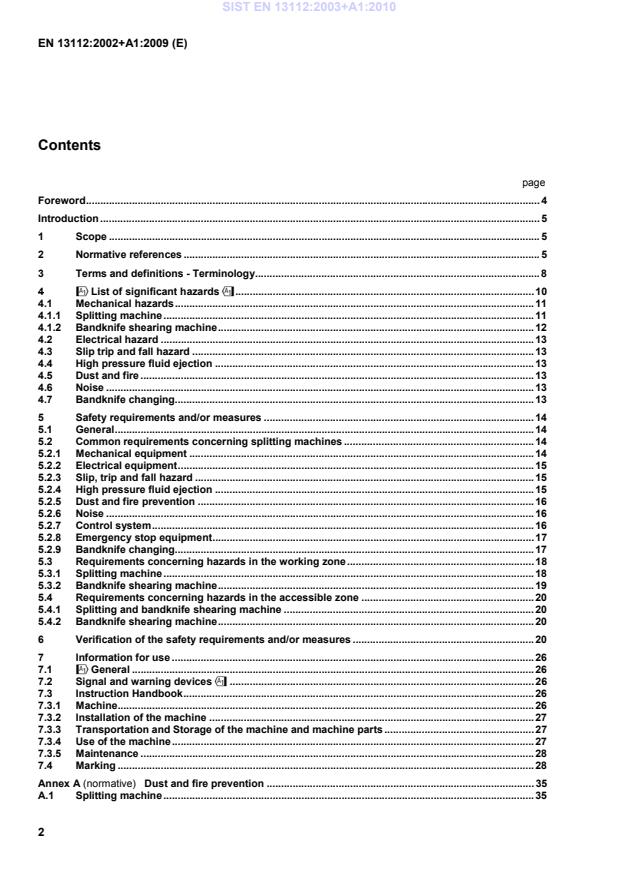
Dust and fire prevention . 35A.1 Splitting machine . 35SIST EN 13112:2003+A1:2010
!Relationship between this European Standard and the Essential Requirements of EU Directive 98/37/EC" . 36Annex ZB (informative)
!Relationship between this European Standard and the Essential Requirements of EU Directive 2006/42/EC" . 37Bibliography . 38 SIST EN 13112:2003+A1:2010
(ISO 3746:1995) !EN ISO 3747:2000", Acoustics — Determination of sound power levels of noise sources using sound pressure — Comparison method for use in situ (ISO 3747:2000) !EN ISO 4871:1996", Acoustics — Declaration and verification of noise emission values of machinery and equipment (ISO 4871:1996) !EN ISO 7731:2008, Ergonomics — Danger signals for public and work areas — Auditory danger signals (ISO 7731:2003)" SIST EN 13112:2003+A1:2010
(ISO 13850:2006)" !EN 60204-1:2006, Safety of machinery — Electrical equipment of machines — Part 1: General requirements (IEC 60204-1:2005, modified)" EN 60529:1991, Degrees of protection provided by enclosures (IP Code) (IEC 60529:1989) !EN 61496-1:2004, Safety of machinery — Electro-sensitive protective equipment — Part 1: General requirements and tests (IEC 61496-1:2004, modified)" !CLC/TS 61496-2:2006, Safety of machinery — Electro-sensitive protective equipment — Particular requirements for equipment using active optoelectronic protective devices (AOPDs) (IEC 61496-2:2006)" SIST EN 13112:2003+A1:2010
Figure Safety requirements 4.1 Mechanical hazards 4.1.1 Splitting machine Machine open (see 3.15) The feeding zone
The moving bandknife Cutting A, B 1, 2 5.3.1.1 Machine working (see 3.17) The feeding zone Synchronised rollers rotation
the moving bandknife Crushing Entanglement Trapping
Cutting A
A 1, 2
1, 2 5.3.1.2
5.3.1.2 Machine at rest (see 3.13) The feeding zone
the zone around knife wheel the stopped bandknife
the stopped bandknife Cutting
Cutting A
C 1, 2
1 5.3.1.3
5.3.1.3 Machine closing (see 3.14) The feeding zone
The zone between the transport rollers
The zone between the lower transport roller and insertion table the moving bandknife
the closing transport roller movement
closing insertion table movement Cutting
Crushing
Crushing Shearing
A,B
A,B
D 1, 2
1, 2
2 5.3.1.4
5.3.1.4
5.3.1.4
General working conditions The zone around knife wheel
The zone around grinding unit Moving bandknife and knife wheel
grinding unit explosion Crushing Cutting Entanglement Trapping
Ejection of part from machinery C
E 1
1 5.4.1
5.4.1
4.1.2 Bandknife shearing machine Danger Zone Source of hazard Hazard Zone Figure Safety requirements Machine working (see 3.16) The feeding zone Moving bandknife
moving feed-in belt Cutting
Crushing
Entanglement Trapping A
B 3, 4
3, 4 5.3.2.1.1
5.3.2.1.2 and 5.4.2 The unloading zone moving unloading belt
fur choice belt Crushing
Entanglement Trapping
Crushing Entanglement Trapping F
G 3, 4
4 5.3.2.1.2 and 5.4.2
5.3.2.1.2 and 5.4.2 Machine at rest (see 3.12) The feeding zone
Side access to feeding zone the stopped bandknife
the stopped bandknife Cutting
Cutting A
A 3, 4
3, 4 5.3.2.2
5.4.2 General conditions The zone around knife wheel
The zone around grinding unit moving bandknife and knife wheel
grinding unit explosion Crushing Cutting Entanglement Trapping
Ejection of part from machinery C
E 5 5.4.1
5.4.1
4.2 Electrical hazard Danger Zone and source of hazard Hazard Zone
Figure Safety requirements Electrical contact, direct or indirect, caused by: - component failure, - insulation failure, incorrect design, installation or component specification of the electrical equipment
Electric shock, burns
5.2.2 4.3 Slip trip and fall hazard Danger Zone Source of hazard Hazard Zone
Figure Safety requirements Spilling and overflowing of substances during processing
Slip, trip and fall
5.2.3 4.4 High pressure fluid ejection Danger Zone Source of hazard Hazard Zone
Figure Safety requirements
High pressure fluid ejection or ejection of a burst component part by failure of hydraulic unit (broken hoses, fittings and tubes) Burn and impact from hot oil or machinery parts
under pressure
5.2.4 4.5 Dust and fire Danger Zone Source of hazard Hazard Zone
Figure Safety requirements
Processed materials Bandknife grinding
-Dust emission - Fire
5.2.5 4.6 Noise Danger Zone Source of hazard Hazard Zone
Figure Safety requirements Noise generated by: - grinding unit and mechanical equipment - action of the bandknife on the material - hydraulic unit Hearing loss, Interference with communication and acoustic signals
5.2.6 4.7 Bandknife changing Danger Zone Source of hazard Hazard Zone
Figure Safety requirements The contact with bandknife blade in the grip points Cutting C 1, 5 5.2.9 SIST EN 13112:2003+A1:2010
Zone references A
feeding zone B
feed-out zone C
zone around knife wheel D
zone between the lower transport roller and insertion table E
zone around grinding unit F
unloading zone (skins) G
unloading zone (fur)
5 Safety requirements and/or measures !deleted text" 5.1 General !Machinery shall comply with the safety requirements and/or protective measures of this clause. In addition, the machine shall be designed according to the principles of EN ISO 12100-2 for relevant but not significant hazards which are not dealt with by this document. For hazards which are to be reduced by the application of a type B-standard such as EN 294, EN 953,
EN ISO 13850, EN 60204-1 etc., the manufacturer shall carry out a risk assessment to establish the requirements of the B-standards which are to be applied." 5.2 Common requirements concerning splitting machines 5.2.1 Mechanical equipment 5.2.1.1 Safeguarding against the hazards generated by moving transmission parts (such as pulleys, belts, gears, rack, etc.) shall be ensured by: fixed enclosing guards in accordance with !EN 953 and 5.3.2.2 of EN ISO 12100-2:2003"; or movable interlocking guards in accordance with !EN 953, EN 1088 and 5.3.2.3 of
EN ISO 12100-2:2003". 5.2.1.2 Hazardous motions of moving machinery parts, feed systems, grinding units, tools and workpieces shall be safeguarded by
fixed enclosing guards, covers which satisfy !EN 953 and 5.3.2.2 of EN ISO 12100-2:2003"; or fixed distance guards which satisfy !EN 953 and 5.3.2.3 of EN ISO 12100-2:2003" and the distances given in the appropriate table (1, 3 or 4) of EN 294:1992. SIST EN 13112:2003+A1:2010
EN 953:1997 (design and construction) and shall be designed and manufactured in such a way as to keep all their functions during the force application of 800 N to the central zone of the guard between two supports, distributed over an area of approximately 0,01m2. On release of the force no detectable distortion of the guard shall remain. 5.2.1.4 Where the above measures cannot be applied, devices shall be provided which !will shutdown the" hazardous motion !before" the danger point. !Suitable protective devices are: movable interlocking guards which satisfy EN 953 and EN 1088, 5.3.2.3 of EN ISO 12100-2:2003 and the distances given in the appropriate table (1 or 3) of EN 294; trip devices, such as electrosensitive protective devices satisfying EN 61496-1, CLC/TS 61496-2 and EN 999; pressure sensitive protective device satisfying EN 1760-2 type 3.1 or 3.2." 5.2.2 Electrical equipment 5.2.2.1 Electrical systems and equipment shall be in accordance with EN 60204-1. Control and safety devices shall be protected to IP55 level. Specific levels of protection are defined in
!EN 60529". 5.2.2.2 All operating controls requiring adjustment for changing the working process shall be located on the outside of the electrical cabinet. NOTE Controls for routine electrical adjustment are for example time, speed or pressure variation. 5.2.3 Slip, trip and fall hazard Hazards, slipping especially, may arise from substances spilling and overflowing during processing. The manufacturer shall include in the “instructions for use” information on water and grease, if discharged from the machine. Advice on the need to provide, at machine installation, safeguards such as footboards, non-slip floors etc., shall be noted in the instruction handbook (!see 7.3.2 j)"). 5.2.4 High pressure fluid ejection If a machine is fitted with hydraulic/pneumatic equipment, a loss of fluid under high pressure may arise and result in a hazard of impact either directly or by impelled obje
...