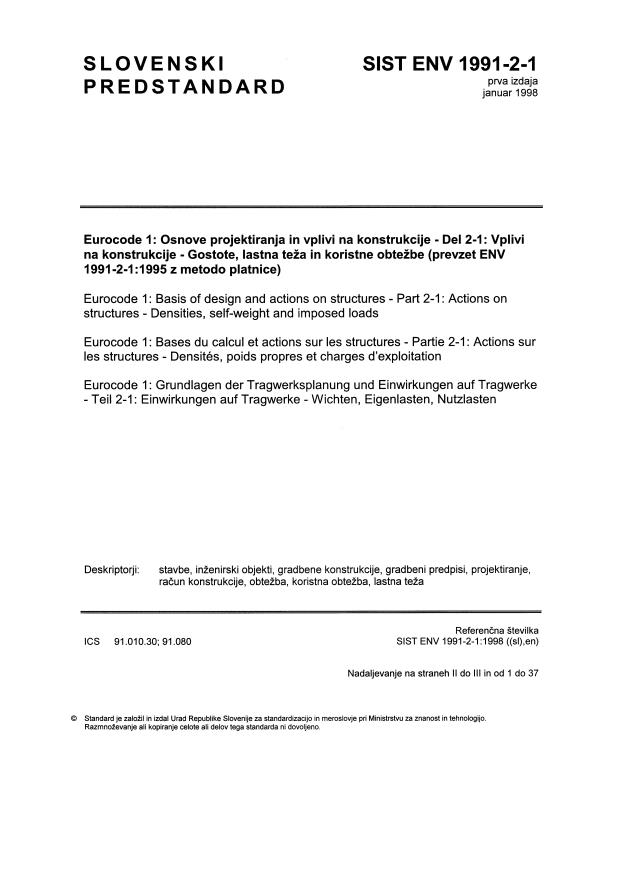
Eurocode 1 - Basis of design and actions on structures - Part 2-1: Actions on structures - Densities, self-weight and imposed loads

Migrated from Progress Sheet (TC Comment) (2000-07-10): All dates refer to ENV. No Enquiry nor standstill ++ Two Years Review (therefore re-use of old WI number and use of stage 41).

Eurocode 1 - Grundlagen der Tragwerksplanung und Einwirkungen auf Tragwerke - Teil 2-1: Einwirkungen auf Tragwerke - Wichten, Eigenlasten, Nutzlasten

Eurocode 1 - Bases du calcul et actions sur les structures - Partie 2-1: Actions sur les structures - Densités, poids propres et charges d'exploitation

Eurocode 1: Osnove projektiranja in vplivi na konstrukcije - Del 2-1: Vplivi na konstrukcije - Gostote, lastna teža in koristne obtežbe

General Information

Status
Withdrawn
Publication Date
08-Feb-1995
Withdrawal Date
23-Apr-2002
Current Stage
9960 - Withdrawal effective - Withdrawal
Start Date
24-Apr-2002
Completion Date
24-Apr-2002

Relations

Effective Date
22-Dec-2008
Effective Date
22-Dec-2008
Effective Date
22-Dec-2008
Standard + National Annex and/or Foreword

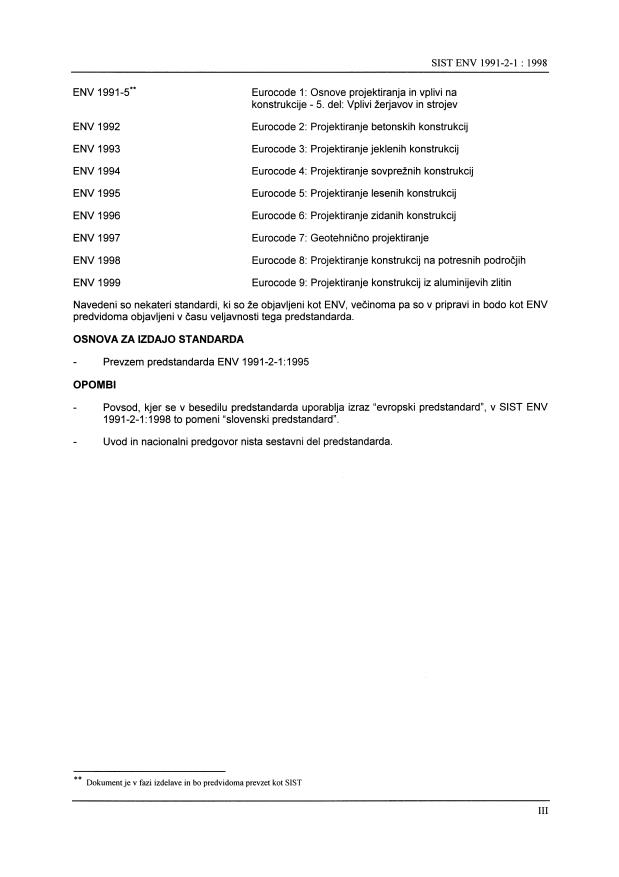
ENV 1991-2-1:1998

Foreword and/or annex in Slovenian language, body of the standard in English language
40 pages
Preview
Preview
e-Library read for
1 day

Frequently Asked Questions

ENV 1991-2-1:1995 is a standard + national annex and/or foreword published by the European Committee for Standardization (CEN). Its full title is "Eurocode 1 - Basis of design and actions on structures - Part 2-1: Actions on structures - Densities, self-weight and imposed loads". This standard covers: Migrated from Progress Sheet (TC Comment) (2000-07-10): All dates refer to ENV. No Enquiry nor standstill ++ Two Years Review (therefore re-use of old WI number and use of stage 41).

Migrated from Progress Sheet (TC Comment) (2000-07-10): All dates refer to ENV. No Enquiry nor standstill ++ Two Years Review (therefore re-use of old WI number and use of stage 41).

ENV 1991-2-1:1995 is classified under the following ICS (International Classification for Standards) categories: 91.010.30 - Technical aspects. The ICS classification helps identify the subject area and facilitates finding related standards.

ENV 1991-2-1:1995 has the following relationships with other standards: It is inter standard links to EN 1991-1-1:2002; is excused to ENV 1991-2-4:1995, ENV 1991-2-3:1995. Understanding these relationships helps ensure you are using the most current and applicable version of the standard.

ENV 1991-2-1:1995 is associated with the following European legislation: EU Directives/Regulations: 305/2011, 89/106/EEC; Standardization Mandates: M/111, M/BC/CEN/89/11. When a standard is cited in the Official Journal of the European Union, products manufactured in conformity with it benefit from a presumption of conformity with the essential requirements of the corresponding EU directive or regulation.

You can purchase ENV 1991-2-1:1995 directly from iTeh Standards. The document is available in PDF format and is delivered instantly after payment. Add the standard to your cart and complete the secure checkout process. iTeh Standards is an authorized distributor of CEN standards.

Questions, Comments and Discussion

Ask us and Technical Secretary will try to provide an answer. You can facilitate discussion about the standard in here.

Loading comments...

The ENV 1991-2-1:1995 standard titled "Eurocode 1 - Basis of design and actions on structures - Part 2-1: Actions on structures - Densities, self-weight and imposed loads" serves as a fundamental resource within the domain of structural engineering. Its scope encompasses the essential methodologies for calculating the various loads that structures must withstand, particularly focusing on densities, self-weight, and imposed loads. This standard is pivotal for the design of structures, ensuring that engineers have a reliable basis for assessing structural integrity in relation to various physical forces. One of the significant strengths of ENV 1991-2-1:1995 is its comprehensive approach to the classification and quantification of loads. By providing detailed information on density values for different materials, the standard allows for accurate self-weight calculations, which are crucial in the initial stages of structural analysis. Moreover, the inclusion of imposed loads takes into account various usage scenarios that structures may encounter, thus promoting safety and resilience in architectural design. The relevance of this standard extends beyond mere load calculations. It aligns with the overarching principles of modern engineering practices by emphasizing the importance of consistent and standardized procedures in structural design. This standard not only facilitates compliance with regulatory requirements but also enhances communication among stakeholders in the construction industry, ensuring that all parties work from a shared understanding of load assumptions. In summary, ENV 1991-2-1:1995 stands out for its detailed guidance on densities, self-weight, and imposed loads, which are critical for the reliable design and construction of structures. Its standardization plays a vital role in enhancing structural safety and integrity, making it an indispensable reference within the field.

Die Norm ENV 1991-2-1:1995, bekannt als Eurocode 1, bietet eine umfassende Grundlage für das Design und die Berechnung von Tragwerken. Ihr spezifischer Fokus liegt auf den Lasten, die auf Strukturen wirken – insbesondere bezüglich Dichten, Eigengewicht und aufgebrachten Lasten. Der Anwendungsbereich der Norm ist klar definiert und zielt darauf ab, Ingenieuren und Architekten eine zuverlässige Referenz zu bieten, um die sicherheitsrelevanten Aspekte in der Planung und Ausführung von Bauprojekten effektiv zu berücksichtigen. Die detaillierten Vorgaben und Berechnungsverfahren ermöglichen eine einheitliche Handhabung und Vergleichbarkeit in der Bauindustrie. Ein wesentlicher Stärke der Norm ist ihre klare Strukturierung und die verständliche Darstellung komplexer Zusammenhänge. Diese macht sie zu einem wertvollen Werkzeug für Fachleute, da sie die Unterschiede in Materialverhalten und Lastverteilungen präzise beleuchtet. Zudem fördert die Norm die Verwendung einheitlicher Kriterien in dem europäischen Raum, was die grenzüberschreitende Zusammenarbeit erleichtert. Die Relevanz von ENV 1991-2-1:1995 erstreckt sich über die reine technische Anwendung hinaus. Sie unterstützt nicht nur die Sicherheit und Stabilität von Bauwerken, sondern spielt auch eine zentrale Rolle in der Entwicklung nachhaltiger Baupraktiken. Durch die Festlegung verbindlicher Standards trägt sie dazu bei, die Umweltauswirkungen von Bauprojekten zu minimieren. Insgesamt stellt die Norm ENV 1991-2-1:1995 eine entscheidende Ressource für die normative Grundlage von Bauprojekten dar und gewährleistet die Berücksichtigung essenzieller Designaspekte und Handlungsanweisungen im Ingenieurbereich.

환경 표준 ENV 1991-2-1:1995는 유럽 건축 설계의 중요한 기초를 제공하며, 구조물의 설계 및 하중에 대한 포괄적인 지침을 제시합니다. 이 표준은 주로 구조물에 작용하는 하중, 자중, 밀도, 그리고 부가하중에 대한 정보를 다루고 있습니다. 이 표준의 강점은 첫째, 다양한 종류의 구조물에 적용될 수 있는 유연성과 포괄성입니다. 즉, 여러 건축 유형과 조건에 맞게 조정할 수 있는 세부적인 기준을 포함하고 있어, 엔지니어와 설계자들이 실제 작업에 용이하게 적용할 수 있습니다. 둘째, ENV 1991-2-1:1995는 구조물의 안전성과 내구성을 보장하기 위한 실질적인 방법론을 제시함으로써, 건설업계에서 널리 인정받는 신뢰할 수 있는 기준입니다. 또한, 이 표준은 유럽 내에서의 일관성 있는 설계 기준을 통해 국제적인 협력 및 통합을 촉진하는 데에도 중요한 역할을 하고 있습니다. 건축 설계에서 이 표준을 사용하는 것은 법적 요구 사항을 준수하는 데에도 도움이 되며, 건축적 안전을 도모하는 데 필수적인 요소입니다. 따라서 ENV 1991-2-1:1995는 구조물 설계에서 필수적으로 참고되어야 할 문서로, 건축 및 공학 분야에서의 권위 있는 표준으로 자리 잡고 있습니다.

ENV 1991-2-1:1995は、基礎設計と構造物に対する作用に関連したEurocode 1の一部であり、構造物に対する密度、自己重量及び課された荷重に関する詳細なガイドラインを提供します。この標準は、建築物および土木構造物の設計における重要な基盤を成し、設計者がさまざまな荷重に対して適切に対応するための指針を提供します。 この標準の主な強みは、明確な定義と具体的な数値が提示されている点にあります。それにより、設計者は一貫した方法で構造物の荷重に関する計算を行うことが可能になります。また、標準は、自己重量と外部からの課された荷重の両方を考慮することで、より安全で効率的な構造設計を実現するための実用的な方法論を述べています。 さらに、ENV 1991-2-1:1995は、国際的な基準に準拠しているため、ヨーロッパ域内での構造設計の標準化を促進し、異なる国々との整合性を高める役割を果たしています。これは特に、国際案件や多国籍企業によるプロジェクトにおいて、設計基準の一貫性を保持するために不可欠です。 この文書は、従来の設計手法と比較して、進化したアプローチを反映しており、構造物の性能を向上させるためのものであるため、建設業界において非常に重要なリソースとして位置付けられています。標準には、温度変化、風荷重、雪荷重など、さまざまな環境条件による影響も考慮されており、構造物の設計における総合的な視点を提供しています。 結論として、ENV 1991-2-1:1995は、構造物設計における基本的な要素や荷重の扱いについて、非常に有益で実用的なガイドラインを提供しており、設計者にとって必携の文書と言えるでしょう。適切な荷重の評価と定義を行うための指針は、建築物やインフラの耐久性及び安全性を確保する上で欠かせない要素です。

La norme ENV 1991-2-1:1995, connue sous le titre "Eurocode 1 - Basis of design and actions on structures - Part 2-1: Actions on structures - Densities, self-weight and imposed loads", se révèle être un texte fondamental dans le domaine de la conception des structures. Cette norme définit clairement l’étendue des actions que peuvent exercer les structures, en se concentrant sur les densités, le poids propre et les charges imposées. Parmi les forces de cette norme, on peut mentionner son approche systématique dans la classification des charges qui peuvent affecter la stabilité et la sécurité des constructions. La précision des valeurs fournies pour les densités et les charges est cruciale pour les ingénieurs et architectes, leur permettant ainsi de concevoir des structures plus robustes et adaptées aux diverses conditions environnementales. L'application de l'ENV 1991-2-1:1995 est particulièrement pertinente dans le contexte actuel, où le respect des normes de sécurité et la durabilité des constructions sont primordiaux. Elle s'inscrit dans une démarche de standardisation européenne, ce qui renforce sa validité à travers les pays membres et favorise une harmonisation des pratiques de conception. En outre, le document SIST ENV 1991-2-1:1998 souligne l'importance de prendre en compte les charges temporaires et permanentes dans le processus de conception, ce qui contribue à une meilleure évaluation des risques liés à la résistance des structures. Cela favorise également une intégration cohérente des différentes étapes de la construction, en garantissant que toutes les parties prenantes respectent des références claires lors du développement de nouveaux projets. La norme ENV 1991-2-1:1995, par sa rigueur et sa pertinence, demeure un outil incontournable pour les professionnels du secteur, permettant ainsi de garantir que les constructions répondent aux exigences modernes de fiabilité et de sécurité.