

EN 13242:2002
(Main)Aggregates for unbound and hydraulically bound materials for use in civil engineering work and road construction
- Abstract
This European Standard specifies the properties of aggregates obtained by processing natural or manufactured or recycled materials for hydraulically bound and unbound materials for civil engineering work and road construction.
It provides for the evaluation of conformity of the products to this European Standard.
NOTE 1 The requirements in this European Standard are based upon experience with aggregate types with an established pattern of use. Care should be taken when considering the use of aggregates from sources with no such pattern of use, e.g., recycled aggregates and aggregates arising from certain industrial by-products. Such aggregates, which should comply with all the requirements of this European Standard, canould have other characteristics not included in Mandate M 125 that do not apply to the generality of aggregates types with an established pattern of use and when required, provisions valid at the place of use can be used to assess their suitability.
NOTE 2 Properties for lightweight aggregates are specified in prEN 13055-1:1997.
- Status
- Withdrawn
- Publication Date
- 03-Dec-2002
- Withdrawal Date
- 11-Dec-2007
- Technical Committee
- CEN/TC 154 - Aggregates
- Drafting Committee
- CEN/TC 154/SC 4 - Hydraulic bound and unbound aggregates
- Current Stage
- 9960 - Withdrawal effective - Withdrawal
- Start Date
- 12-Dec-2007
- Completion Date
- 12-Dec-2007
89/106/EEC - Construction productsOJ Ref: C 13, C 139, C 319, C 75 OJ Date: 27-Mar-2003

Relations
- Effective Date
- 22-Dec-2008
- Effective Date
- 28-Jan-2026
- Effective Date
- 28-Jan-2026
- Effective Date
- 28-Jan-2026
- Effective Date
- 28-Jan-2026
- Effective Date
- 28-Jan-2026
- Effective Date
- 28-Jan-2026
- Effective Date
- 28-Jan-2026
- Effective Date
- 28-Jan-2026
- Effective Date
- 28-Jan-2026
- Effective Date
- 28-Jan-2026
- Effective Date
- 28-Jan-2026
- Effective Date
- 28-Jan-2026
- Effective Date
- 22-Dec-2008
- Effective Date
- 22-Dec-2008
Get Certified
Connect with accredited certification bodies for this standard

DIBt (Deutsches Institut für Bautechnik)
German Institute for Building Technology.
DIN CERTCO
DIN Group product certification.

Aboma Certification B.V.
Specialized in construction, metal, and transport sectors.
Sponsored listings
Frequently Asked Questions
EN 13242:2002 is a standard published by the European Committee for Standardization (CEN). Its full title is "Aggregates for unbound and hydraulically bound materials for use in civil engineering work and road construction". This standard covers: This European Standard specifies the properties of aggregates obtained by processing natural or manufactured or recycled materials for hydraulically bound and unbound materials for civil engineering work and road construction. It provides for the evaluation of conformity of the products to this European Standard. NOTE 1 The requirements in this European Standard are based upon experience with aggregate types with an established pattern of use. Care should be taken when considering the use of aggregates from sources with no such pattern of use, e.g., recycled aggregates and aggregates arising from certain industrial by-products. Such aggregates, which should comply with all the requirements of this European Standard, canould have other characteristics not included in Mandate M 125 that do not apply to the generality of aggregates types with an established pattern of use and when required, provisions valid at the place of use can be used to assess their suitability. NOTE 2 Properties for lightweight aggregates are specified in prEN 13055-1:1997.
This European Standard specifies the properties of aggregates obtained by processing natural or manufactured or recycled materials for hydraulically bound and unbound materials for civil engineering work and road construction. It provides for the evaluation of conformity of the products to this European Standard. NOTE 1 The requirements in this European Standard are based upon experience with aggregate types with an established pattern of use. Care should be taken when considering the use of aggregates from sources with no such pattern of use, e.g., recycled aggregates and aggregates arising from certain industrial by-products. Such aggregates, which should comply with all the requirements of this European Standard, canould have other characteristics not included in Mandate M 125 that do not apply to the generality of aggregates types with an established pattern of use and when required, provisions valid at the place of use can be used to assess their suitability. NOTE 2 Properties for lightweight aggregates are specified in prEN 13055-1:1997.
EN 13242:2002 is classified under the following ICS (International Classification for Standards) categories: 91.100.15 - Mineral materials and products. The ICS classification helps identify the subject area and facilitates finding related standards.
EN 13242:2002 has the following relationships with other standards: It is inter standard links to EN 13242:2002+A1:2007, EN 14227-1:2013, EN 1778:1999, EN ISO 15493:2003, EN ISO 10931:2005, EN 14227-5:2013, EN 16236:2018, EN 13285:2018, EN 14227-2:2013, EN ISO 6259-1:2001, EN ISO 9311-3:2005, EN 14227-3:2013, EN ISO 15494:2003, EN 13242:2002/prA1, EN 13242:2002/AC:2004. Understanding these relationships helps ensure you are using the most current and applicable version of the standard.
EN 13242:2002 is associated with the following European legislation: EU Directives/Regulations: 305/2011, 89/106/EEC; Standardization Mandates: M/125. When a standard is cited in the Official Journal of the European Union, products manufactured in conformity with it benefit from a presumption of conformity with the essential requirements of the corresponding EU directive or regulation.
EN 13242:2002 is available in PDF format for immediate download after purchase. The document can be added to your cart and obtained through the secure checkout process. Digital delivery ensures instant access to the complete standard document.
Standards Content (Sample)
2003-01.Slovenski inštitut za standardizacijo. Razmnoževanje celote ali delov tega standarda ni dovoljeno.Aggregates for unbound and hydraulically bound materials for use in civil engineering work and road constructionGranulats pour matériaux traités aux liants hydrauliques et matériaux non traités utilisés pour les travaux de génie civil et pour la construction des chausséesGesteinskörnungen für ungebundene und hydraulisch gebundene Gemische für Ingenieur- und StraßenbauTa slovenski standard je istoveten z:EN 13242:2002SIST EN 13242:2003en91.100.15ICS:SLOVENSKI
STANDARDSIST EN 13242:200301-marec-2003
EUROPEAN STANDARDNORME EUROPÉENNEEUROPÄISCHE NORMEN 13242December 2002ICS 91.100.15English versionAggregates for unbound and hydraulically bound materials foruse in civil engineering work and road constructionGranulats pour matériaux traités aux liants hydrauliques etmatériaux non traités utilisés pour les travaux de génie civilet pour la construction des chausséesGesteinskörnungen für ungebundene und hydraulischgebundene Gemische für Ingenieur- und StraßenbauThis European Standard was approved by CEN on 23 September 2002.CEN members are bound to comply with the CEN/CENELEC Internal Regulations which stipulate the conditions for giving this EuropeanStandard the status of a national standard without any alteration. Up-to-date lists and bibliographical references concerning such nationalstandards may be obtained on application to the Management Centre or to any CEN member.This European Standard exists in three official versions (English, French, German). A version in any other language made by translationunder the responsibility of a CEN member into its own language and notified to the Management Centre has the same status as the officialversions.CEN members are the national standards bodies of Austria, Belgium, Czech Republic, Denmark, Finland, France, Germany, Greece,Iceland, Ireland, Italy, Luxembourg, Malta, Netherlands, Norway, Portugal, Spain, Sweden, Switzerland and United Kingdom.EUROPEAN COMMITTEE FOR STANDARDIZATIONCOMITÉ EUROPÉEN DE NORMALISATIONEUROPÄISCHES KOMITEE FÜR NORMUNGManagement Centre: rue de Stassart, 36
B-1050 Brussels© 2002 CENAll rights of exploitation in any form and by any means reservedworldwide for CEN national Members.Ref. No. EN 13242:2002 E
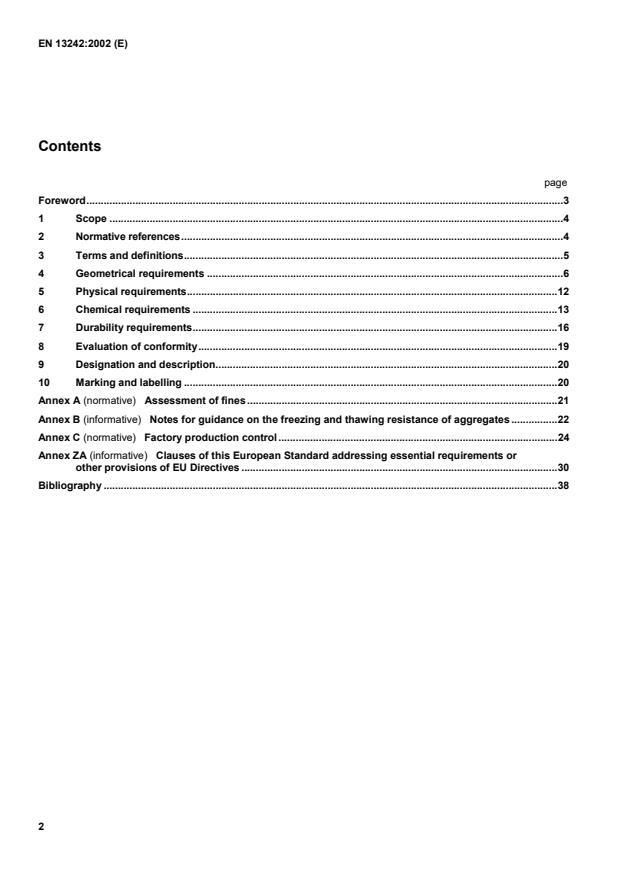
Assessment of fines.21Annex B (informative)
Notes for guidance on the freezing and thawing resistance of aggregates.22Annex C (normative)
Factory production control.24Annex ZA (informative)
Clauses of this European Standard addressing essential requirements orother provisions of EU Directives.30Bibliography.38
Care should be taken when considering the use of aggregates from sources with no such pattern of use, e.g.,recycled aggregates and aggregates arising from certain industrial by-products.
Such aggregates, which should comply with allthe requirements of this European Standard, can have other characteristics not included in Mandate M 125 that do not apply tothe generality of aggregates types with an established pattern of use and when required, provisions valid at the place of use canbe used to assess their suitability.NOTE 2Properties for lightweight aggregates are specified in EN 13055-2.2 Normative referencesThis European Standard incorporates by dated or undated reference, provisions from other publications. Thesenormative references are cited at the appropriate places in the text and the publications are listed hereafter. For datedreferences, subsequent amendments to or revisions of any of these publications apply to this European Standard onlywhen incorporated in it by amendment or revision.
For undated references the latest edition of the publicationreferred to applies (including amendments).EN 196-2, Methods of testing cement — Part 2: Chemical analysis of cement.EN 932-3, Tests for general properties of aggregates — Part 3: Procedure and terminology for simplifiedpetrographic description.EN 932-5, Tests for general properties of aggregates — Part 5: Common equipment and calibration.EN 933-1, Tests for geometrical properties of aggregates — Part 1: Determination of particle sizedistribution - Sieving method.EN 933-3, Tests for geometrical properties of aggregates — Part 3: Determination of particle shape— Flakiness index.EN 933-4, Tests for geometrical properties of aggregates — Part 4: Determination of particle shape— Shape index.EN 933-5, Tests for geometrical properties of aggregates — Part 5: Determination of percentage of crushed andbroken surfaces in coarse aggregates particlesEN 933-8, Tests for geometrical properties of aggregates — Part 8: Assessment of fines — Sand equivalent test.EN 933-9, Tests for geometrical properties of aggregates — Part 9: Assessment of fines — Methylene blue test.EN 1097-1, Tests for mechanical and physical properties of aggregates — Part 1: Determination of theresistance to wear (micro-Deval).EN 1097-2:1998, Tests for mechanical and physical properties of aggregates — Part 2: Methods for thedetermination of the resistance to fragmentation.EN 1097-6:2000, Tests for mechanical and physical properties of aggregates — Part 6: Determination ofparticle density and water absorption.EN 1367-1, Tests for thermal and weathering properties of aggregates — Part 1: Determination ofresistance to freezing and thawing.
When required, the tests specified in clause 4 shall be carried outto determine appropriate geometrical properties.NOTE 1When the value of a property is required but not defined by specified limits the value should be declared by themanufacturer as an XXDeclared category, e.g., in Table 5 a flakiness index of say 60 corresponds to FI60 (Declared value).NOTE 2When a property is not required, a “No requirement” category can be used.NOTE 3Guidance on selection of appropriate categories for specific applications can be found in national provisions in theplace of use of the aggregate.NOTE 4When specified, the requirements for the end-use product should supersede the requirements in this EuropeanStandard (e.g., grading and/or fines content for all-in aggregates).4.2 Aggregates sizesAll aggregates shall be described in terms of aggregate sizes using the designations d/D and shall comply with thegrading requirements specified in 4.3.Aggregate sizes shall be specified using the nominal sizes given in the Table 1 comprising the basic set or thebasic set plus set 1 or the basic set plus set 2. A combination of sieve sizes from set 1 and set 2 is not allowed.Aggregate sizes shall be separated by a ratio between their upper sieve size D and the lower sieve size d of notless than 1,4.
Greater than 90 mm sieve sizes can be used for particular applicationsNOTE 2
Rounded sizes shown in parentheses can be used as simplifieddescriptions of aggregate sizes.4.3 Grading4.3.1 GeneralThe grading of aggregate sizes when determined in accordance with EN 933-1 shall comply with the requirementsof 4.3.2 and 4.3.3 as appropriate to its aggregate size d/D.Combinations of two or more than two adjacent aggregate sizes or all-in aggregates are permitted.NOTEAggregate supplied as a mixture of different sizes or types should be uniformly blended. When aggregates ofsignificantly different density are blended caution is necessary to avoid segregation.When assessing production within a system of factory production control at least 90 % of gradings, taken ondifferent batches within a maximum period of 6 months, shall fall within the limits specified in 4.3.2 and 4.3.3 fortolerances on manufacturers' declared typical gradings.
110098 to 10085 to 990 to 150 to 5GC 85-15and D > 210098 to 10080 to 990 to 200 to 5GC 80-20Fine d = 010098 to 10085 to 99––GF 85and D
6,310098 to 10080 to 99––GF 80 d = 0-10085 to 99––GA 85All-in10098 to 10080 to 99––GA 80and D > 6,3100–75 to 99––GA 75a
For aggregate sizes where D is greater than 63 mm (e.g. 80 mm and 90 mm) only the oversize
requirements related to the 1,4 D sieve apply since there is no ISO 565/R20 series sieve above 125 mm.b
Where the sieves calculated as 1,4 D and d/2 are not exact sieve sizes in the ISO 565/R20 series then
the next higher or lower sieve size respectively shall be adopted.c
For special uses additional requirements may be specified.d
The percentage passing D may be greater than 99 % but in such cases the manufacturer shall document and
declare the typical grading including the sieves D, d, d/2 and sieves in the basic set plus set 1 or basic
set plus set 2 intermediate between d and D. Sieves with a ratio less than 1,4 times the next lower sieve
may be excluded.e
Limits for the percentage passing d can be modified to 1 to 15 for GC 85-15 and 1 to 20 for GC 80-20
where necessary to ensure a well graded aggregate.4.3.2Coarse aggregateAll coarse aggregates shall comply with the general grading requirements specified in Table 2 appropriate to theirsize d/D.When required, for graded coarse aggregate where D/d ³ 2, the following additional requirements shall apply forthe percentage passing the mid-size sieve:¾
all gradings shall comply with the overall limits given in Table 3;¾
the manufacturer shall document and, on request, declare the typical grading passing the mid-size sieve.
The
limit deviations shall comply with the requirements of the categories selected in Table 3 according to theparticular
application or end use.For single coarse aggregate where D/d <2, there shall be no requirement additional to those specified in Table 2.
³ 2D/dMid-sizesievemmOverall limitsLimit deviations onmanufacturer's declaredtypical gradingCategoryGT<4D/1,425 to
80± 15GTC25/1520 to 70± 15GTC20/15³4D/220 to 70± 17,5GTC20/17,5No requirementGTNRWhen the mid-size sieves calculated in the above is not an exact sieve size in the ISO 565/R20 seriesthen the nearest sieve in the series shall be used.4.3.3Fine aggregate and all-in aggregateFine aggregates and all-in aggregates shall comply with the general grading requirements specified in Table 2.When required, the manufacturer shall document, and on request declare, the typical grading for each fineaggregate and all-in aggregate size produced.
The limit deviations shall comply with the requirements of thecategories selected in Table 4 according to the particular application or end use.Table 4 — Categories of tolerances on manufacturer’s declaredtypical grading of fine aggregate and all-in aggregateLimit deviationsPercentage passing by massCategoryD sieveD/2 sieve0,063 mm sieveFine aggregateGTFAll-in aggregateGTA± 5± 5± 7,5± 10± 20± 25± 3 a± 4 b± 5 cGTF10GTF20GTF25GTA10GTA20GTA25No requirementGTFNRGTANRWhen the mid-size sieve calculated as above is not an exact sieve size in the ISO 565/R20 series, thenthe nearest sieve in the series shall be used.NOTE
Limit deviations of D sieves are further limited by the requirements of Table 2.a
Except for category f 3
(see Table 8).b
Except for categories f 3 and f 7 for fine aggregates and f 3 , f 5 and f 7 for all-in aggregates (see Table 8).c
Except for categories f 3 and f 7 for fine aggregates and f 3 , f 5 , f 7 and f 9 for all-in aggregates (see Table 8).
The flakiness index shall be the reference test for the determination of the shape of coarse aggregates.The flakiness index shall be declared in accordance with the relevant category specified in Table 5 according to theparticular application or end use.Table 5 — Categories for maximum values of flakiness indexFlakiness indexCategoryFI£ 20£ 35£ 50> 50FI20FI35FI50
FIDeclaredNo requirementFINRWhere required, the shape index, determined in accordance with EN 933-4, shall be declared in accordancewith the relevant category specified in Table 6 according to the particular application or end use.Table 6 — Categories for maximum values of shape indexShape indexCategorySI£ 20£ 40£ 55> 55SI20SI40SI55
SIDeclaredNo requirementSINR4.5 Percentage of crushed or broken particles and of totally rounded particles in coarse aggregatesWhen required, the percentage of crushed or broken and of totally rounded particles in coarse aggregates,determined in accordance with EN 933-5, shall be declared in accordance with the relevant category specified inTable 7.Aggregates obtained from crushing rock shall be assumed to be category C90/3 and do not require furthertesting.
C90/350 to 1000 to 10
C50/1050 to 1000 to 30
C50/30-0 to 50
CNR/50-0 to 70
CNR/70Declared valueDeclared value
CDeclaredNo requirementNo requirementCNR4.6 Fines contentWhen required, the fines content for coarse aggregate, fine aggregate and all-in aggregate, shall be declared inaccordance with the relevant category specified in Table 8.Table 8 — Categories for maximum values of fines contentAggregateMass fraction of passing0,063 mm sieve,%Categoryf£ 2f 2£ 4f 4> 4
f DeclaredCoarseNo requirementf NR£ 3f 3£ 7f 7£ 10f 10£ 16f 16£ 22f 22> 22
f DeclaredFineNo requirementf NR£ 3f 3£ 5f 5£ 7f 7£ 9f 9£ 12f 12£ 15f 15> 15
f DeclaredAll-inNo requirementf NR
When required, aggregates shall be assessed for harmfulfines in accordance with annex A.5 Physical requirements5.1 GeneralThe necessity for testing and declaring all properties in this clause shall be limited according to the particularapplication or end use or origin of the aggregate.
When required, the tests specified in clause 5 shall be carried outto determine appropriate physical properties.NOTE 1When the value of a property is required but not defined by specified limits the value should be declared by themanufacturer as an XXDeclared category, e.g., in Table 9 a Los Angeles coefficient of say 65 corresponds to LA65 (Declaredvalue).NOTE 2When a property is not required, a “No requirement” category can be used.NOTE 3Guidance on selection of appropriate categories for specific applications can be found in national provisions in theplace of use of the aggregate.5.2 Resistance to fragmentation of coarse aggregateWhen required, the resistance to fragmentation shall be determined in terms of the Los Angeles coefficient, asspecified in EN 1097-2:1998, clause 5.
The Los Angeles test method shall be the reference test for thedetermination of resistance of fragmentation.
The Los Angeles coefficient shall be declared in accordance with therelevant category specified in Table 9 according to the particular application or end use.Table 9 —Categories for maximum values of Los Angeles coefficientsLos Angeles coefficientCategoryLA£ 20LA20£ 25LA25£ 30LA30£ 35LA35£ 40LA40£ 50LA50£ 60LA60> 60
LADeclaredNo requirementLANRWhere required, the impact value, determined in accordance with EN 1097-2:1998, clause 6 shall be declared inaccordance with the relevant category specified in Table 10 according to the particular application or end use.
SZDeclaredNo requirementSZNR5.3 Resistance to wear of coarse aggregateWhen required, the resistance to wear of coarse aggregate (micro-Deval coefficient, MDE) determined inaccordance with EN 1097-1, shall be declared in accordance with the relevant category specified in Table 11according to the particular application or end use.Table 11 — Categories for maximum values of resistance to wearmicro-Deval coefficientCategoryMDE£ 20£ 25£ 35£ 50> 50MDE20MDE25MDE35MDE50
MDEDeclaredNo requirementMDENR5.4 Particle densityWhen required, the particle density shall be determined in accordance with EN 1097-6:2000, clauses 7, 8 or 9,depending upon the particle size of the aggregate, and the results declared.5.5 Water absorptionWhen required, the water absorption shall be determined in accordance with EN 1097-6:2000, clauses 7, 8 or 9,depending upon the particle size of the aggregate, and the results declared.6 Chemical requirements6.1 GeneralThe necessity for testing and declaring all properties in this clause shall be limited according to the particularapplication or end use or origin of the aggregate. When required, the tests specified in clause 6 shall be carried outto determine appropriate chemical properties.
ASDeclaredAggregates other than air-cooledblastfurnace slagNo requirementASNR£ 1,0AS1,0> 1,0
ASDeclaredAir-cooled blastfurnace slagNo requirementASNR6.3 Total sulfurWhen required, the total sulfur content of the aggregate, determined in accordance with EN 1744-1:1998,clause 11, shall be declared in accordance with the relevant category specified in Table 13.Table 13 — Categories for maximum values of total sulfur contentAggregateTotal sulfur content%CategoryS£ 1S1> 1
SDeclaredAggregates other than air-cooledblastfurnace slagNo requirement
SNR£ 2S2> 2
SDeclaredAir-cooled blastfurnace slagNo requirement
SNR
Special precautions are necessary if pyrrhotite, an unstable form of iron sulphide (FeS), is present in the aggregate. Ifthis mineral is known to be present, a maximum total sulphur content of 0,4 % as S should apply.6.4 Other constituents6.4.1 Constituents which alter the rate of setting and hardening of hydraulically bound mixturesAggregates and filler aggregates that contain organic or other substances in proportions that alter the rate ofsetting and hardening of hydraulically bound mixtures shall be assessed for the effect on stiffening time andcompressive strength in accordance with EN 1744-1:1998, 15.3.The proportions of such materials shall be such that they do not:a)increase the stiffening time of mortar test specimens by more than 120 min;b)decrease the compressive strength of mortar test specimens by more than 20 % at 28 days.The presence of organic matter shall be determined in accordance with EN 1744-1:1998, 15.1 (sodium hydroxidetest).
If the results indicate the presence of humic acid, the presence of fulvo acids shall be determined inaccordance with EN 1744-1:1998, 15.2.
If the supernatant liquid in these tests is lighter than the standard coloursthe aggregates shall be considered to be free from organic matter.NOTE 1Some inorganic compounds which discolour the supernatant liquid in the sodium hydroxide test do not adverselyaffect the setting and hardening of hydraulically bound mixtures.NOTE 2Sugars do not affect the colour of the supernatant liquid in the sodium hydroxide test or the fulvo acid test.
If it issuspected that sugars or sugar type materials are present, the aggregate should be tested using the mortar specimen test (seeEN 1744-1:1998, 15.3). The stiffening time and compressive strength requirements shown above should apply.6.4.2 Constituents which affect volume stability of blastfurnace and steel slag for unbound aggregates6.4.2.1 Volume stability of steel slagsWhen required the volume stability of steel slag aggregate shall be determined in accordance withEN 1744-1:1998, 19.3.
Steel slag aggregate shall be considered to be volumetrically stable if the expansion is notgreater than the specified maximum value declared in accordance with the category specified in Table 14according to the particular application or end use. For determination of the magnesium oxide (MgO) content thetest specified in EN 196-2 shall be used.
V7,5
V10 > 10
VDeclaredBOF-slag a /EAF-slag bNo requirement VNRNOTE 1
When the MgO content determined in accordance with EN 196-2 is not greater than orequal to 5 %, the testing time should be 24 h.
When the MgO content is more than 5 %, thetesting time should be 168 h.NOTE 2
The total MgO content is used as a measure of free MgO, in the absence, at presentof a reliable method of determining the content of free MgO. In the event of a reliable methodbeing developed, the types should be redefined in terms of free MgO content. MgO valuesdeclared by steel manufacturers are acceptable for use in determining testing time for steel slag.a BOF-slag: Basic oxygen furnace slag.b EAF-slag: Electric arc furnace slag.6.4.2.2 Dicalcium silicate disintegration of air-cooled blastfurnace slagsWhen required, air-cooled blastfurnace slag aggregate shall be tested in accordance with EN 1744-1:1998, 19.1,and shall be free from dicalcium silicate disintegration.6.4.2.3 Iron disintegration of air-cooled blast furnace slagsWhen required, air-cooled blastfurnace slag aggregate shall be tested in accordance with EN 1744-1:1998, 19.2,and shall be free from iron disintegration.6.4.3 Water soluble constituentsWhen a determination of water soluble constituent is required, the preparation of an eluate shall be made inaccordance with EN 1744-3.6.4.4 ImpuritiesWhen required, aggregates shall not contain any foreign matters such as wood, glass and plastic that will causedamage to the end use product.7 Durability requirements7.1 GeneralThe necessity for testing and declaring all properties in this clause shall be limited according to the particularapplication or end use or origin of the aggregate.
When required, the tests specified in clause 7 shall be carried outto determine appropriate durability properties.NOTE 1When the value of a property is required but not defined by specified limits the value should be declared by themanufacturer as an XXDeclared category, e.g. in Table 19 a freeze-thaw value of say 45 percentage loss of mass corresponds toF45 (Declared value).NOTE 2When a property is not required, a “No requirement” category can be used.
Usually hairline cracks are generatedradiating out from the spots and interconnecting them.
This reduces the strength of the mineral fabric, and as a result the rockdecays to small particles.
Depending on the source this process can take place within months of extraction or extend overseveral decades. In exceptional cases a rapid decay results in the formation of large cracks and the breaking of aggregateparticles.On completion of the boiling test, the loss of mass and the resistance to fragmentation (SBSZ or SBLA) shall bedeclared in accordance with the relevant category specified in Table 15 according to the particular application orend use.Table 15 — Categories for maximum values of resistance to ‘’Sonnenbrand’’Test methodResult%CategorySBBoiling testanda) Impact testorb) Los Angeles testIncrease of impact valueafter boilingIncrease of impact valueafter boilingIncrease of Los Angelescoefficient after boilingSBSZSBLABoiling testanda) Impact testorb) Los Angeles testLoss of mass afterboilingLoss of mass afterboilingIncrease of Los Angelescoefficient after boiling> 1> 5> 8SBSZ DeclaredSBLA DeclaredNo requirementSBNR7.3 Resistance to freezing and thawing7.3.1 GeneralGeneral guidance on the use of aggregates in an environment that is subject to freezing and thawing is given inannex B.7.3.2 Water absorption as a screening test for freeze-thaw resistanceWhen required the water absorption value as a screening test shall be determined in accordance with theprocedures specified in either EN 1097-6:2000, clause 7, or EN 1097-6:2000, annex B, declaring the result and thetest procedure used.NOTE
Selection of the water absorption test specified in EN 1097-6:2000, clause 7 or annex B is dependent upon the size ofthe aggregate.
The water absorption test as a screening test is not applicable for blastfurnace slag.If the water absorption, determined in accordance with EN 1097-6:2000, annex B, is not greater than the maximuma value of 0,5 %, the aggregate shall be assumed to be freeze-thaw resistant (see Table 17).Table 17 — Categories for maximum values of water absorption(EN 1097-6:2000, annex B)Water absorptionPercentage by mass%CategoryWA24£ 0,5> 0,5WA24 0,5
WA24
DeclaredNo requirementWA24 NRNOTE
The water absorption test as a screening test is not applicable for blastfurnace slag.7.3.3 Resistance to freezing and thawingWhen required, the resistance to freezing and thawing, determined in accordance with either EN 1367-1 orEN 1367-2 shall be declared in accordance with the relevant category specified in Table 18 or Table 19.
FDeclaredNo requirement FNRa In extreme situations of cold weather and/or salt or de-icing salt saturation, then tests using a saltsolution or urea described in EN1367-1:1999, annex B, may be more appropriate. The limits in thistable would not apply.Table 19 — Categories for maximum magnesium sulphate soundnessMagnesium sulphate valuePercentage loss of mass%CategoryMS< 18< 25< 35> 35MS18MS25MS35
MSDeclaredNo requirementMSNR8 Evaluation of conformity8.1 GeneralThe manufacturer shall undertake initial type tests (see 8.2) and Factory Production Control (see annex C) toensure that the product conforms to this European Standard and to declared values as appropriate.8.2 Initial type testsInitial type tests relevant to the intended end use shall be carried out to check compliance with specifiedrequirements in the following circumstances:a) A new source of aggregates is to be used;b) There is a major change in the nature of the raw materials or in the processing conditions which may affect
the properties of the aggregates.The results of the initial tests shall be documented as the starting point of the factory production control for thatmaterial.
This shall particularly include the identification of any components likely to emit radiation above normalbackground levels, any components likely to release polyaromatic carbons or other dangerous substances.
If the
The risk of damage is significantly increased where theaggregate is exposed to seawater or the action of de-icing salts.B.1.3 Petrographic typeFreezing and thawing resistance is related to the strength of the aggregate particles and to the size and distributionof the pores within the particles.B.2 TestingB.2.1 Indicative testsTests that can give an indication of freeze thaw susceptibility include either petrographical examination or one ofthe physical tests indicated below. Aggregates complying with the requirements of any one of these tests can beconsidered freeze-thaw resistant.B.2.2 Petrographic examinationA petrographic examination of the aggregate according to the procedure specified in EN 932–3 will give an indicationof the presence of weak and/or highly absorptive particles which can be susceptible to damage from freeze-thawaction. Where the presence of such particles is observed or suspected one of the physical tests given in 7.3.2 can beused to assess freeze-thaw resistance of the aggregate.Susceptible aggregates derived from highly weathered rocks and some conglomerates and breccias can include forexample some or all of the following:¾ Schist, mica schist, phyllite, chalk, marl, shale, porous flint, altered porous basalt or particles looselycemented by clay minerals.B.2.3 Water absorptionWhen the water absorption of the aggregate determined in accordance with EN1097-6 is not greater than the valueselected in accordance with 7.3.1, the aggregate can be considered resistant to freeze-thaw attack.
However,many satisfactory aggregates have higher absorption values.
Furthermore, it should be recognised that there is no correlation between water absorption andfreeze/thaw resistance for blast furnace slag and in consequence use of water absorption as a screening test forfreeze/thaw resistance would not be appropriate.B.2.4 Other indicative testsEither a freeze-thaw determined in accordance with EN1367-1 or a magnesium sulphate test determined inaccordance with EN1367-2 can be applied to assess the freeze-thaw resistance of an aggregate.B.3 Selection of categoryWhere a satisfactory service record for the performance of an aggregate, under similar conditions of use to thatintended is available, the aggregate can be deemed acceptable. In cases where a satisfactory record is notavailable and testing is deemed necessary, the environmental conditions, end use and climate can be used toselect an appropriate category from Table B.1. The selected category can then be used in conjunction with 7.3.2 toset the required level of freeze-thaw resistance or magnesium sulphate soundness.Table B.1 — Freeze-thaw severity categories related to climate and end useClimateEnvironmental conditionsMediterraneanAtlanticContinental aFrost free or dry situationPartial saturationSaturatedNRNRNRNRF4 or MS35F2 or MS25NRF2 or MS25F1 or MS18a The Continental category could also apply to Iceland, parts of Scandinavia and to
mountainous regions where severe winter weather conditions are experienced.
Records ofsuch reviews shall be maintained.C.3 Control proceduresC.3.1 Control manualThe manufacturer shall establish and maintain a factory production control manual setting out the procedures bywhich the requirements for factory production control are satisfied.C.3.2 Document and data controlDocument and data control shall include those documents and data that are relevant to the requirements of thisstandard covering purchasing, processing, inspec
...