

EN 1470:2008
(Main)Textile floor coverings - Classification of needled floor coverings except for needled pile floor coverings
- Abstract
This European Standard describes and specifies the requirements for classification of needled floor coverings in sheet form into use classes in respect of wear and appearance retention and a class for luxury rating.
This European Standard is also applicable to tiles, the additional requirements for which are given in Annex A.
This European Standard is not applicable to needled pile floor coverings.
This European Standard refers to the classification as defined in EN 685.
- Status
- Withdrawn
- Publication Date
- 03-Jun-2008
- Withdrawal Date
- 06-May-2014
- Technical Committee
- CEN/TC 134 - Resilient and textile floor coverings
- Drafting Committee
- CEN/TC 134/SC 1 - Textile floor coverings
- Current Stage
- 9960 - Withdrawal effective - Withdrawal
- Start Date
- 07-May-2014
- Completion Date
- 07-May-2014

Relations
- Effective Date
- 22-Dec-2008
- Effective Date
- 11-Jul-2012
- Effective Date
- 25-Aug-2026
- Effective Date
- 25-Aug-2026
- Refers
ISO 6356:2000 - Textile floor coverings — Assessment of static electrical propensity — Walking test - Effective Date
- 25-Aug-2026
- Effective Date
- 25-Aug-2026
- Effective Date
- 25-Aug-2026
- Effective Date
- 25-Aug-2026
- Effective Date
- 25-Aug-2026
- Effective Date
- 09-Feb-2026
- Effective Date
- 28-Jan-2026
- Effective Date
- 28-Jan-2026
- Effective Date
- 28-Jan-2026
- Effective Date
- 28-Jan-2026
- Effective Date
- 28-Jan-2026
Get Certified
Connect with accredited certification bodies for this standard

Control Union Certifications
Global certification for agriculture and sustainability.

Hohenstein Institut
Textile testing and certification.

Bureau Veritas Bangladesh
Bureau Veritas certification services in Bangladesh.
Sponsored listings
Frequently Asked Questions
EN 1470:2008 is a standard published by the European Committee for Standardization (CEN). Its full title is "Textile floor coverings - Classification of needled floor coverings except for needled pile floor coverings". This standard covers: This European Standard describes and specifies the requirements for classification of needled floor coverings in sheet form into use classes in respect of wear and appearance retention and a class for luxury rating. This European Standard is also applicable to tiles, the additional requirements for which are given in Annex A. This European Standard is not applicable to needled pile floor coverings. This European Standard refers to the classification as defined in EN 685.
This European Standard describes and specifies the requirements for classification of needled floor coverings in sheet form into use classes in respect of wear and appearance retention and a class for luxury rating. This European Standard is also applicable to tiles, the additional requirements for which are given in Annex A. This European Standard is not applicable to needled pile floor coverings. This European Standard refers to the classification as defined in EN 685.
EN 1470:2008 is classified under the following ICS (International Classification for Standards) categories: 59.080.60 - Textile floor coverings; 97.150 - Floor coverings. The ICS classification helps identify the subject area and facilitates finding related standards.
EN 1470:2008 has the following relationships with other standards: It is inter standard links to EN 1470:1997, EN 1307:2014, ISO 1765:1986, ISO 8543:1998, ISO 6356:2000, ISO 2424:2007, ISO 10965:1998, ISO 2551:1981, ISO 8302:1991, ISO 3415:1986, EN 12237:2003, EN 984:2001, EN ISO 10140-2:2021, EN ISO 12951:2020, EN 1269:2024. Understanding these relationships helps ensure you are using the most current and applicable version of the standard.
EN 1470:2008 is associated with the following European legislation: EU Directives/Regulations: 305/2011, 89/106/EEC. When a standard is cited in the Official Journal of the European Union, products manufactured in conformity with it benefit from a presumption of conformity with the essential requirements of the corresponding EU directive or regulation.
EN 1470:2008 is available in PDF format for immediate download after purchase. The document can be added to your cart and obtained through the secure checkout process. Digital delivery ensures instant access to the complete standard document.
Standards Content (Sample)
2003-01.Slovenski inštitut za standardizacijo. Razmnoževanje celote ali delov tega standarda ni dovoljeno.Textile Bodenbeläge - Einstufung von Nadelvlies-Bodenbelägen, ausgenommen Polvlies-BodenbelägeRevêtements de sol textiles - Classement des revêtements de sol aiguilletés à l'exception des moquettes aiguilletéesTextile floor coverings - Classification of needled floor coverings except for needled pile floor coverings59.080.60Tekstilne talne oblogeTextile floor coveringsICS:Ta slovenski standard je istoveten z:EN 1470:2008SIST EN 1470:2009en,fr,de01-januar-2009SIST EN 1470:2009SLOVENSKI
STANDARDSIST EN 1470:19991DGRPHãþD
EUROPEAN STANDARDNORME EUROPÉENNEEUROPÄISCHE NORMEN 1470June 2008ICS 59.080.60Supersedes EN 1470:1997
English VersionTextile floor coverings - Classification of needled floor coveringsexcept for needled pile floor coveringsRevêtements de sol textiles - Classement des revêtementsde sol aiguilletés à l'exception des moquettes aiguilletéesTextile Bodenbeläge - Einstufung von Nadelvlies-Bodenbelägen, ausgenommen Polvlies-BodenbelägeThis European Standard was approved by CEN on 30 April 2008.CEN members are bound to comply with the CEN/CENELEC Internal Regulations which stipulate the conditions for giving this EuropeanStandard the status of a national standard without any alteration. Up-to-date lists and bibliographical references concerning such nationalstandards may be obtained on application to the CEN Management Centre or to any CEN member.This European Standard exists in three official versions (English, French, German). A version in any other language made by translationunder the responsibility of a CEN member into its own language and notified to the CEN Management Centre has the same status as theofficial versions.CEN members are the national standards bodies of Austria, Belgium, Bulgaria, Cyprus, Czech Republic, Denmark, Estonia, Finland,France, Germany, Greece, Hungary, Iceland, Ireland, Italy, Latvia, Lithuania, Luxembourg, Malta, Netherlands, Norway, Poland, Portugal,Romania, Slovakia, Slovenia, Spain, Sweden, Switzerland and United Kingdom.EUROPEAN COMMITTEE FOR STANDARDIZATIONCOMITÉ EUROPÉEN DE NORMALISATIONEUROPÄISCHES KOMITEE FÜR NORMUNGManagement Centre: rue de Stassart, 36
B-1050 Brussels© 2008 CENAll rights of exploitation in any form and by any means reservedworldwide for CEN national Members.Ref. No. EN 1470:2008: ESIST EN 1470:2009
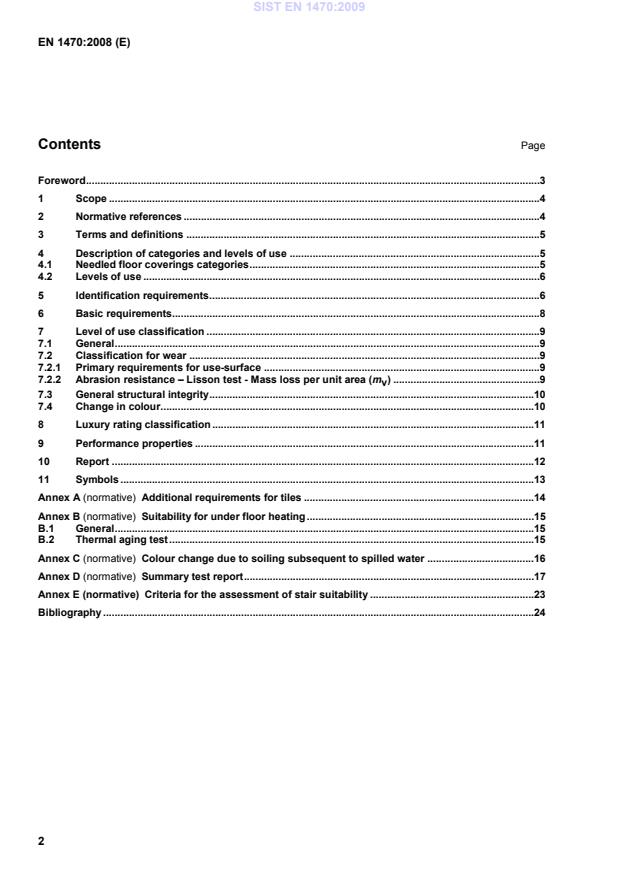
Additional requirements for tiles.14 Annex B (normative)
Suitability for under floor heating.15 B.1 General.15 B.2 Thermal aging test.15 Annex C (normative)
Colour change due to soiling subsequent to spilled water.16 Annex D (normative)
Summary test report.17 Annex E (normative)
Criteria for the assessment of stair suitability.23 Bibliography.24
1 Scope This European Standard describes and specifies the requirements for classification of needled floor coverings in sheet form into use classes in respect of wear and appearance retention and a class for luxury rating.
This European Standard is also applicable to tiles, the additional requirements for which are given in Annex A. This European Standard is not applicable to needled pile floor coverings. This European Standard refers to the classification as defined in EN 685. 2 Normative references The following referenced documents are indispensable for the application of this document. For dated references, only the edition cited applies. For undated references, the latest edition of the referenced document (including any amendments) applies. EN 984, Textile floor coverings — Determination of the mass per unit area of the use surface of needled floor coverings EN 985:2001, Textile floor coverings — Castor chair test EN 986, Textile floor coverings — Tiles — Determination of dimensional changes due to the effects of varied water and heat conditions and distortion out of plane EN 994, Textiles floor coverings — Determination of the side length, squareness and straightness of tiles EN 1269, Textile floorcoverings — Assessment of impregnations in needled floorcoverings by means of a soiling test EN 1471, Textile floor coverings — Assessment of changes in appearance EN 1963, Textile floor coverings — Tests using the Lisson Tretrad Machine CEN/TS 14159, Textile floor coverings — Requirements for tolerances on (linear) dimensions of rugs, runners, carpet tiles and wall-to-wall carpet and for tolerances on pattern repeat EN 15115, Textile floor coverings — Determination of sensitivity to spilled water CEN/TS 15398, Resilient, textile and laminate floor coverings — Floor covering standard symbols EN ISO 105-A01, Textiles — Tests for colour fastness — Part A01: General principles of testing (ISO 105-A01:1994) EN ISO 105-B02, Textiles — Tests for colour fastness — Part B02: Colour fastness to artificial light: Xenon arc fading lamp test (ISO 105-B02:1994, including amendment 1:1998) EN ISO 105-E01, Textiles — Tests for colour fastness — Part E01: Colour fastness to water
(ISO 105-E01:1994) EN ISO 105-X12, Textiles — Tests for colour fastness — Part X12: Colour fastness to rubbing
(ISO 105-X12:2001) EN ISO 140-8, Acoustics — Measurement of sound insulation in buildings and of building elements — Part 8: Laboratory measurements of the reduction of transmitted impact noise by floor coverings on a heavyweight standard floor (ISO 140-8:1997) EN ISO 354, Acoustics — Measurement of sound absorption in a reverberation room (ISO 354:2003) EN ISO 717-2, Acoustics — Rating of sound insulation in buildings and of building elements — Part 2: Impact sound insulation (ISO 717-2:1996) EN ISO 11378-2, Textile floor coverings — Laboratory soiling tests — Part 2: Drum test (ISO 11378-2:2001) SIST EN 1470:2009
3 Terms and definitions For the purposes of this document, the terms and definitions given in ISO 2424:2007 and the following apply. 3.1 non adhered tile (loose laid) tile installed without any use of a bonding system (see Annex A) [EN 1307:2008] 3.2 adhered removable tile tile installed with a bonding system allowing easy removal and reinstallation (see Annex A) [EN 1307:2008] 3.3 permanent adhered tile tile installed with a permanent bonding system (see Annex A) [EN 1307:2008] 3.4 nominal value value stated by the manufacturer 4 Description of categories and levels of use 4.1 Needled floor coverings categories Flat needled floor coverings shall be distributed in three categories: a) Type 1: one visible layer (homogeneous product); b) Type 2: more than one visible layer, the bonding compound of which does not reach the top of the use surface; c) Type 3: more than one visible layer, the bonding compound of which is present throughout its thickness. NOTE layers such as e.g. secondary backing should also be taken into consideration for the determination of the number of layers SIST EN 1470:2009
If symbols are to be used for the use classes, luxury rating classes and additional characteristics, the symbols listed in CEN/TS 15398 shall be used which can also be found on www.floorsymbols.com
For very specific use such as airports, theatres or industrial use, the technical requirements should be discussed and agreed between all parties involved. 5 Identification requirements This clause specifies the characteristics for identification of the product and requirements for tolerances for the identifying properties. The producer shall provide the following information in accordance with the definitions given in ISO 2424: commercial references; type of bonding (full impregnation or back coated); type of backing. The producer shall also declare the values of the characteristics listed in Table 2. SIST EN 1470:2009
Identification requirements Characteristics Test methods Tolerances Fibre composition of use surface a
Dimensions CEN/TS 14159 CEN/TS 14159 Total thickness mm ISO 1765 Nominal ± 15 % b Total mass per unit area g/m2 ISO 8543 Nominal ± 15 % Mass per unit area of the use-surface (for Type 2 and Type 3 product) g/m2
EN 984
Nominal ± 15 % a
Attention is drawn to the European Directives 96/73 and 96/74 which cover the fibre composition and are reflected in the national regulations
b For products with total thickness ≤ 3,5 mm: tolerance maximum ± 0,5 mm
Characteristics Requirements Test methods Shrinkage
≤ 1,2 % in either direction Dimensional stability Extension
≤ 0,5 % in either direction
ISO 2551 Assessment of impregnations ≥ 2-3 a EN 1269 Colour fastness to b
Light
EN ISO 105-B02 – general ≥ 5
– pastel shade c ≥ 4
Rubbing
EN ISO 105-X12 – wet ≥ 3
– dry ≥ 3–4
Water (change in colour)
EN ISO 105-E01 – plain floor coverings ≥ 3–4
– other floor coverings ≥ 4
Water (staining)
– all floor coverings ≥ 2–3 d
Hairiness (pilling) ≥ 2,5 e EN 1963 – Test D Static loading (for classes 23, 32 and 33) ≤ 0,8 mm ISO 3415 Colour change f – due to spilled water ≥ 4 EN 15115 – due to soiling subsequent to spilled water ≥ 3 Annex C a For class 21 products, the specification ≥ 2 is acceptable. b Conformity to be declared by the manufacturer for each colour. c Pastel shade: colour corresponding to a standard depth ≤ 1/12 in accordance with EN ISO 105-A01. d On multi-fibre: worst result. e Tested production-wise and cross-wise, worst result decisive. f Conformity to be declared by the manufacturer.
Type 2 Type 3
Class Measured total mass per unit area g/m² Measured use surface mass per unit area
g/m² Measured use surface mass per unit area
g/m² Domestic
21 _ _ _ 22 ≥ 500 ≥ 130 ≥ 150 22+
23 ≥ 700 ≥ 180 ≥ 200 Commercial
31 ≥ 500 ≥ 130 ≥ 150 32 ≥ 700 ≥ 180 ≥ 200 33 ≥ 850 ≥ 225 ≥ 250 Test methods ISO 8543 EN 984 EN 984
7.2.2 Abrasion resistance – Lisson test - Mass loss per unit area (mv) The requirements for each class are specified in Table 5; mv is calculated as indicated in EN 1963 test A. SIST EN 1470:2009
21 — 22 ≤ 80 22+ ≤ 50 23 ≤ 40 Commercial
31 ≤ 50 32 ≤ 40 33 ≤ 30
7.3 General structural integrity The requirements for each class are specified in Table 6. Table 6 — General structural integrity Class Requirement Test Method
EN 985 test C Domestic
10 000 cycles 22
10 000 cycles 22+ No destruction 10 000 cycles 23 (such as described in
EN 985:2001, 9.3) 25 000 cycles Commercial
10 000 cycles 32
25 000 cycles 33
25 000 cycles NOTE In the case of tiles, 4 tiles should be tested.
7.4 Change in colour Needled floor coverings shall be tested using the castor chair test in accordance with EN 985 using the number of cycles specified in Table 7. SIST EN 1470:2009
...