

EN 932-5:1999
(Main)Tests for general properties of aggregates - Part 5: Common equipment and calibration
- Abstract
This European Standard specifies general reuqirements for common equipment, calibration procedures and reagents for the testing of the properties of aggregates.
- Status
- Withdrawn
- Publication Date
- 16-Nov-1999
- Withdrawal Date
- 28-Feb-2012
- Technical Committee
- CEN/TC 154 - Aggregates
- Drafting Committee
- CEN/TC 154/SC 6 - Test methods
- Current Stage
- 9960 - Withdrawal effective - Withdrawal
- Start Date
- 29-Feb-2012
- Completion Date
- 29-Feb-2012

Relations
- Effective Date
- 07-Mar-2012
- Effective Date
- 09-Feb-2026
- Effective Date
- 28-Jan-2026
- Effective Date
- 22-Dec-2008
Get Certified
Connect with accredited certification bodies for this standard

DIBt (Deutsches Institut für Bautechnik)
German Institute for Building Technology.
DIN CERTCO
DIN Group product certification.

Aboma Certification B.V.
Specialized in construction, metal, and transport sectors.
Sponsored listings
Frequently Asked Questions
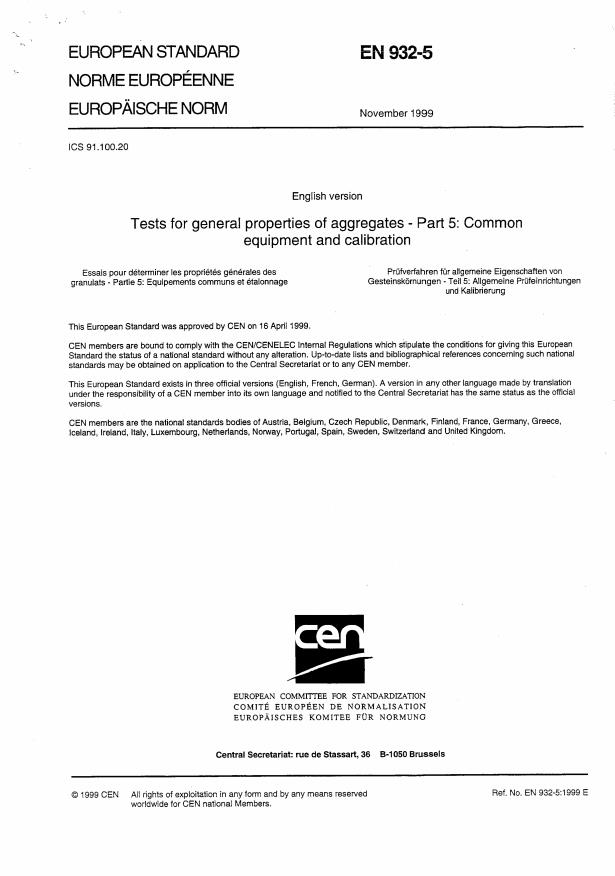
EN 932-5:1999 is a standard published by the European Committee for Standardization (CEN). Its full title is "Tests for general properties of aggregates - Part 5: Common equipment and calibration". This standard covers: This European Standard specifies general reuqirements for common equipment, calibration procedures and reagents for the testing of the properties of aggregates.
This European Standard specifies general reuqirements for common equipment, calibration procedures and reagents for the testing of the properties of aggregates.
EN 932-5:1999 is classified under the following ICS (International Classification for Standards) categories: 91.100.15 - Mineral materials and products. The ICS classification helps identify the subject area and facilitates finding related standards.
EN 932-5:1999 has the following relationships with other standards: It is inter standard links to EN 932-5:2012, HD 21.3 S3:1995, EN 13286-1:2003; is excused to EN 932-6:1999. Understanding these relationships helps ensure you are using the most current and applicable version of the standard.
EN 932-5:1999 is associated with the following European legislation: EU Directives/Regulations: 305/2011, 89/106/EEC. When a standard is cited in the Official Journal of the European Union, products manufactured in conformity with it benefit from a presumption of conformity with the essential requirements of the corresponding EU directive or regulation.
EN 932-5:1999 is available in PDF format for immediate download after purchase. The document can be added to your cart and obtained through the secure checkout process. Digital delivery ensures instant access to the complete standard document.
Standards Content (Sample)
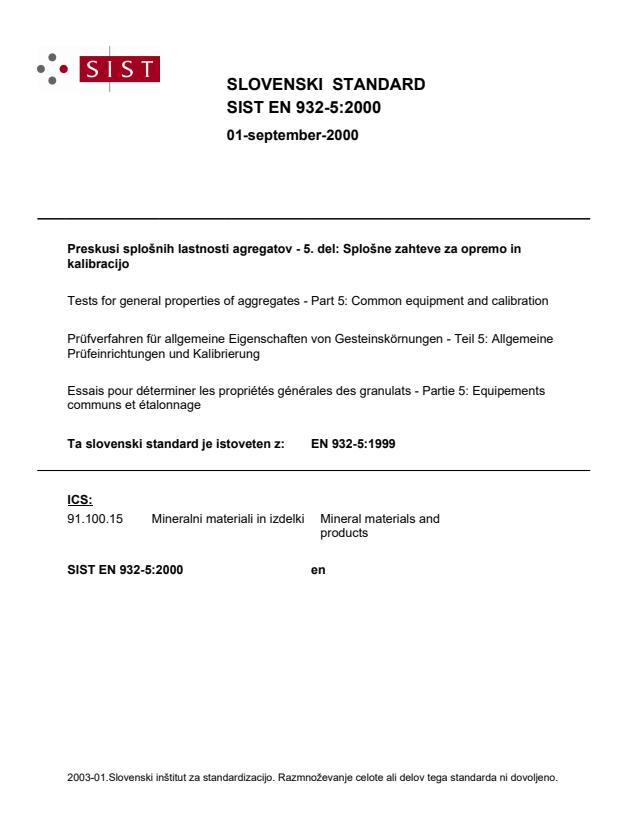
SLOVENSKI STANDARD
01-september-2000
Preskusi splošnih lastnosti agregatov - 5. del: Splošne zahteve za opremo in
kalibracijo
Tests for general properties of aggregates - Part 5: Common equipment and calibration
Prüfverfahren für allgemeine Eigenschaften von Gesteinskörnungen - Teil 5: Allgemeine
Prüfeinrichtungen und Kalibrierung
Essais pour déterminer les propriét
...