

EN 54-21:2006
(Main)Fire detection and fire alarm systems - Part 21: Alarm transmission and fault warning routing equipment
- Abstract
This European Standard specifies requirements, test methods and performance criteria against which the effectiveness and reliability of routing equipment capable of transmitting fire alarm and/or fault warning signals for use with fire detection and fire alarm systems installed in buildings can be assessed (see EN 54-1). The routing equipment is designed to allow the system to function in accordance with the requirements of this European Standard. It also provides for the evaluation of conformity of the equipment to the requirements of this standard.
- Status
- Published
- Publication Date
- 30-May-2006
- Withdrawal Date
- 30-May-2009
- Technical Committee
- CEN/TC 72 - Fire detection and fire alarm systems
- Drafting Committee
- CEN/TC 72/WG 15 - Routing devices
- Current Stage
- 6060 - Definitive text made available (DAV) - Publishing
- Start Date
- 31-May-2006
- Due Date
- 15-Oct-2007
- Completion Date
- 31-May-2006
- Directive
- 305/2011 - Regulation (eu) No 305/2011 of the European Parliament and of the Council of 9 march 2011 laying down harmonised conditions for the marketing of construction products and repealing council directive 89/106/eecOJ Ref: C, C 259 OJ Date: 08-Aug-2014
89/106/EEC - Construction productsOJ Ref: C, C 304 OJ Date: 13-Dec-2006



Overview
EN 54-21:2006 is a CEN European standard for alarm transmission and fault warning routing equipment used with fire detection and fire alarm systems. It specifies the requirements, test methods and performance criteria to assess the effectiveness and reliability of routing equipment that transmits fire alarm and/or fault warning signals in buildings. EN 54-21 supports conformity assessment and the correct functioning of fire alarm systems in accordance with EN 54 series requirements.
Key Topics
- Scope and purpose
- Assessment of routing equipment that forwards alarm and fault signals from fire detection systems.
- Evaluation of conformity to EN 54-21 requirements.
- Functional requirements
- Behavioural criteria for alarm transmission routing and fault warning routing equipment, including signal indication and reporting functions.
- Design requirements
- Manufacturer declarations, documentation, mechanical and electrical design, accessibility of controls and indicators, colour/light signalling requirements.
- Software-controlled equipment
- Additional documentation, software design, program monitoring, storage and memory integrity for devices that rely on embedded software.
- Power supply and marking
- Requirements for power sources and labelling for safe and reliable operation.
- Testing and performance verification
- Comprehensive test program covering functional tests, environmental tests (cold, damp heat, impact, vibration), EMC immunity, supply voltage variation and endurance tests.
- Performance metrics
- Transmission time, reporting time and availability criteria (see normative Annexes A and B).
- Conformity and regulatory linkage
- Clauses addressing conformity assessment and relationship to EU Construction Products Directive (informative Annex ZA).
Applications
EN 54-21 is used to:
- Evaluate and select alarm transmission equipment and fault routing devices for commercial, institutional and industrial buildings.
- Guide manufacturers in product design, documentation and software management to meet European conformity.
- Support installers, fire system designers and specifiers when integrating routing equipment with EN 54 fire alarm systems.
- Provide test houses and certification bodies with test methods for performance verification and CE marking.
Who benefits:
- Manufacturers, testing laboratories, certification bodies, fire safety consultants, system integrators and building owners concerned with reliable alarm transmission.
Related Standards
EN 54-21 complements other standards including:
- EN 54-1, EN 54-2, EN 54-4 (fire alarm system parts)
- EN 50136-1-1, EN 50136-2-1 (alarm transmission systems)
- EN 50130-4, EN 60068 series (EMC and environmental testing)
- EN 60529 (IP code)
Keywords: EN 54-21, alarm transmission, fault warning routing equipment, fire detection, fire alarm systems, CEN, testing, conformity.
Relations
- Effective Date
- 25-Aug-2026
- Effective Date
- 09-Feb-2026
- Effective Date
- 09-Feb-2026
- Effective Date
- 09-Feb-2026
- Effective Date
- 09-Feb-2026
- Effective Date
- 09-Feb-2026
- Effective Date
- 09-Feb-2026
- Effective Date
- 09-Feb-2026
- Effective Date
- 09-Feb-2026
- Effective Date
- 09-Feb-2026
- Effective Date
- 28-Jan-2026
- Refers
EN 54-2:1997 - Fire detection and fire alarm systems - Part 2: Control and indicating equipment - Effective Date
- 28-Jan-2026
- Effective Date
- 28-Jan-2026
- Effective Date
- 28-Jan-2026
- Effective Date
- 22-Jul-2026
Get Certified
Connect with accredited certification bodies for this standard

CIS Institut d.o.o.
Personal Protective Equipment (PPE) certification body. Notified Body NB-2890 for EU Regulation 2016/425 PPE.

Kiwa BDA Testing
Building and construction product certification.
Kmetijski inštitut Slovenije
Agricultural Institute of Slovenia. Soil testing, plant health, agricultural product analysis.
Sponsored listings
Frequently Asked Questions
EN 54-21:2006 is a standard published by the European Committee for Standardization (CEN). Its full title is "Fire detection and fire alarm systems - Part 21: Alarm transmission and fault warning routing equipment". This standard covers: This European Standard specifies requirements, test methods and performance criteria against which the effectiveness and reliability of routing equipment capable of transmitting fire alarm and/or fault warning signals for use with fire detection and fire alarm systems installed in buildings can be assessed (see EN 54-1). The routing equipment is designed to allow the system to function in accordance with the requirements of this European Standard. It also provides for the evaluation of conformity of the equipment to the requirements of this standard.
This European Standard specifies requirements, test methods and performance criteria against which the effectiveness and reliability of routing equipment capable of transmitting fire alarm and/or fault warning signals for use with fire detection and fire alarm systems installed in buildings can be assessed (see EN 54-1). The routing equipment is designed to allow the system to function in accordance with the requirements of this European Standard. It also provides for the evaluation of conformity of the equipment to the requirements of this standard.
EN 54-21:2006 is classified under the following ICS (International Classification for Standards) categories: 13.220.20 - Fire protection. The ICS classification helps identify the subject area and facilitates finding related standards.
EN 54-21:2006 has the following relationships with other standards: It is inter standard links to ISO 1402:1994, EN 50136-2-1:1998, EN 60068-1:2014, EN 60068-2-47:2005, EN 60068-2-75:2014, EN 50136-1-1:1998, EN IEC 60068-2-78:2025, EN IEC 60068-2-1:2025, EN 60529:1991, EN 60721-3-3:1995, EN 54-1:1996, EN 54-2:1997, EN 54-4:1997, EN ISO 9001:2000, EN 12845:2015+A2:2026. Understanding these relationships helps ensure you are using the most current and applicable version of the standard.
EN 54-21:2006 is associated with the following European legislation: EU Directives/Regulations: 305/2011, 89/106/EEC; Standardization Mandates: M/109. When a standard is cited in the Official Journal of the European Union, products manufactured in conformity with it benefit from a presumption of conformity with the essential requirements of the corresponding EU directive or regulation.
EN 54-21:2006 is available in PDF format for immediate download after purchase. The document can be added to your cart and obtained through the secure checkout process. Digital delivery ensures instant access to the complete standard document.
Standards Content (Sample)
2003-01.Slovenski inštitut za standardizacijo. Razmnoževanje celote ali delov tega standarda ni dovoljeno.Fire detection and fire alarm systems - Part 21: Alarm transmission and fault warning routing equipmentSistemi za odkrivanje in javljanje požara ter alarmiranje - 21. del: Oprema za usmerjanje alarma in opozoril o napakahSystemes de détection et d'alarme incendie - Partie 21 : Dispositif de transmission de l'alarme feu et du signal de dérangementBrandmeldeanlagen - Teil 21: Übertragungseinrichtungen für Brand- und StörungsmeldungenTa slovenski standard je istoveten z:EN 54-21:2006SIST EN 54-21:2006en13.32013.220.20ICS:OSIST prEN 54-21:20041DGRPHãþDSLOVENSKI
STANDARDSIST EN 54-21:200601-julij-2006
EUROPEAN STANDARDNORME EUROPÉENNEEUROPÄISCHE NORMEN 54-21May 2006ICS 13.220.20 English VersionFire detection and fire alarm systems - Part 21: Alarmtransmission and fault warning routing equipmentSystèmes de détection et d'alarme incendie - Partie 21 :Dispositif de transmission de l'alarme feu et du signal dedérangementBrandmeldeanlagen - Teil 21: Übertragungseinrichtungenfür Brand- und StörungsmeldungenThis European Standard was approved by CEN on 27 April 2006.CEN members are bound to comply with the CEN/CENELEC Internal Regulations which stipulate the conditions for giving this EuropeanStandard the status of a national standard without any alteration. Up-to-date lists and bibliographical references concerning such nationalstandards may be obtained on application to the Central Secretariat or to any CEN member.This European Standard exists in three official versions (English, French, German). A version in any other language made by translationunder the responsibility of a CEN member into its own language and notified to the Central Secretariat has the same status as the officialversions.CEN members are the national standards bodies of Austria, Belgium, Cyprus, Czech Republic, Denmark, Estonia, Finland, France,Germany, Greece, Hungary, Iceland, Ireland, Italy, Latvia, Lithuania, Luxembourg, Malta, Netherlands, Norway, Poland, Portugal, Romania,Slovakia, Slovenia, Spain, Sweden, Switzerland and United Kingdom.EUROPEAN COMMITTEE FOR STANDARDIZATIONCOMITÉ EUROPÉEN DE NORMALISATIONEUROPÄISCHES KOMITEE FÜR NORMUNGManagement Centre: rue de Stassart, 36
B-1050 Brussels© 2006 CENAll rights of exploitation in any form and by any means reservedworldwide for CEN national Members.Ref. No. EN 54-21:2006: E
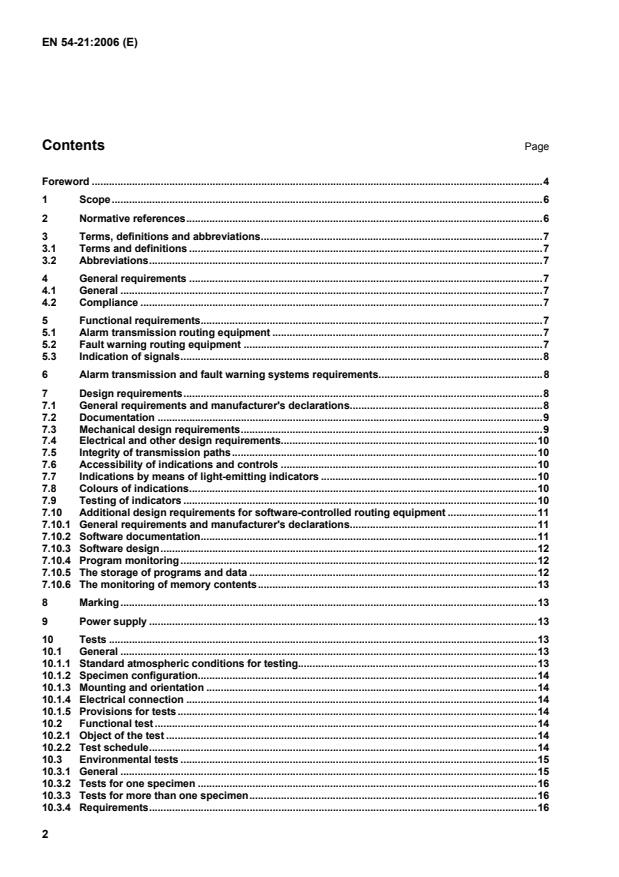
Performance requirements for alarm and fault warning transmission systems.24 Annex B (normative)
Verification of performance requirements for alarm and fault warning transmission systems.25 B.1 General.25 B.2 Transmission time.25 B.3 Reporting time.25 B.4 Availability.25 Annex C (informative)
Design requirements for software controlled routing equipments.26 Annex ZA (informative)
Clauses of this European Standard addressing the provisions of the EU Construction Products Directive (89/106/EEC).27 ZA.1 Scope and relevant clauses.27 ZA.2 Procedures for the attestation of conformity of alarm transmission and fault warning routing equipment covered by this standard.28 ZA.2.1 System of attestation of conformity.28 ZA.2.2 Evaluation of conformity.28 ZA.3 CE marking and labelling and accompanying documentation.32 ZA.4 EC certificate and declaration of conformity.34
1 Scope This European Standard specifies requirements, test methods and performance criteria against which the effectiveness and reliability of routing equipment capable of transmitting fire alarm and/or fault warning signals for use with fire detection and fire alarm systems installed in buildings can be assessed (see EN 54-1). The routing equipment is designed to allow the system to function in accordance with the requirements of this European Standard. It also provides for the evaluation of conformity of the equipment to the requirements of this standard. 2 Normative references The following referenced documents are indispensable for the application of this document. For dated references, only the edition cited applies. For undated references, the latest edition of the referenced document (including any amendments) applies. EN 54-1:1996, Fire detection and fire alarm systems — Part 1: Introduction EN 54-2:1997, Fire detection and fire alarm systems — Part 2: Control and indicating equipment EN 54-4:1997, Fire detection and fire alarm systems — Part 4: Power supply equipment EN 50130-4, Alarm systems — Part 4: Electromagnetic compatibility — Product family standard: Immunity requirements for components of fire, intruder and social alarm systems EN 50136-1-1:1998, Alarm systems — Alarm transmission systems and equipment — Part 1-1: General requirements for alarm transmission systems EN 50136-2-1:1998, Alarm systems — Alarm transmission systems and equipment — Part 2-1: General requirements for alarm transmission equipment EN 60068-1, Environmental testing - Part 1: General and guidance (IEC 60068-1:1988 + Corrigendum 1988 + A1:1992) EN 60068-2-1, Environmental testing; part 2: tests; tests A: cold (IEC 60068-2-1:1990) EN 60068-2-6, Environmental testing - Part 2: Tests - Tests Fc: Vibration (sinusoidal) (IEC 60068-2-6:1995 + Corrigendum 1995) EN 60068-2-47, Environmental testing - Part 2-47: Test Mounting of specimens for vibration, impact and similar dynamic tests (IEC 60068-2-47:2005) EN 60068-2-75, Environmental testing - Part 2: Tests - Test Eh: Hammer tests
(IEC 60068-2-75:1997) EN 60068-2-78, Environmental testing - Part 2-78: Tests; Test Cab: Damp heat, steady state (IEC 60068-2-78:2001) EN 60529:1991, Degrees of protection provided by enclosures (IP code) (IEC 60529:1989) EN 60721-3-3:1995, Classification of environmental conditions - Part 3: Classification of groups of environmental parameters and their severities - Section 3: Stationary use at weatherprotected locations (IEC 60721-3-3:1994) EN ISO 9001:2000, Quality management systems — Requirements (ISO 9001:2000).
Control and indicating equipment, PSE: Power supply equipment. 4 General requirements 4.1 General If functions other than those specified in this European Standard are provided, they shall not jeopardize the compliance with any requirements of this European Standard. 4.2 Compliance In order to comply with this standard the routing equipment shall meet the requirements of this clause, which shall be verified by visual inspection or engineering assessment, shall be tested as described in Clause 5 and shall meet the requirements of the tests. 5 Functional requirements 5.1 Alarm transmission routing equipment The alarm transmission routing equipment shall be capable of processing the following signals: a) receiving fire alarm signal from the CIE, b) transmitting fault warning signals to the CIE, c) receiving fault warning signals from the transmission network, d) transmitting fire alarm signal to the fire alarm receiving centre, e) receiving acknowledgement signal from the alarm receiving centre, f) transmitting acknowledgement to the CIE. 5.2 Fault warning routing equipment The fault warning routing equipment shall be capable of processing the following signals: a) receiving fault warning signal from the CIE, b) transmitting fault warning signals to the CIE,
7.10.5.1 All executable code and data necessary to comply with this European Standard shall be held in memory which is capable of continuous, non-maintained, reliable operation for a period of at least 10 years. 7.10.5.2 For the program, the following requirements shall apply: a) the program shall be held in non-volatile memory, which can only be written to at access level 4; b) it shall be possible to identify the version reference or references of the program at access level 3. The version reference or references shall be in accordance with the documentation of 7.10.2.1. 7.10.5.3 For site specific data, the following requirements shall apply: a) the alteration of site specific data shall only be possible at access level 3 or 4; b) the alteration of site specific data shall not affect the structure of the program; c) if stored in volatile memory, the site-specific data shall be protected against power loss by a back-up energy source which can only be separated from the memory at access level 4, and which is capable of maintaining the memory contents for at least 2 weeks; d) if stored in read-write memory, there shall be a mechanism which prevents the memory being written to during normal operation at access level 1 or 2, such that its contents are protected during a failure in program execution;
15 °C – 35 °C, Relative humidity:
25 % – 75 %, Air pressure:
86 kPa –106 kPa. The temperature and humidity shall be substantially constant for each environmental test where the standard atmospheric conditions are applied.
(-5 ± 3) °C, Duration:
16 h. 10.4.2.5 Measurements during conditioning Monitor the specimen during the conditioning period to detect any change in status. During the last hour of the conditioning period, subject the specimen to the functional test. 10.4.2.6 Final measurements After the recovery period, subject the specimen to the functional test and inspect it visually for mechanical damage both externally and internally. 10.5
Damp heat, steady state (operational) 10.5.1 Object of the test The object of the test is to demonstrate the ability of the specimen to function correctly at high relative humidity (without condensation), which may occur for short periods in the service environment. 10.5.2 Test procedure 10.5.2.1 General Use the test procedure described in EN 60068-2-78. 10.5.2.2 Initial examination Before conditioning, subject the specimen to the functional test. 10.5.2.3 State of the specimen during conditioning Mount the specimen as specified in 10.1.3 and connect it to suitable power supply, monitoring and loading equipment (see 10.1.4). The specimen shall be in the quiescent condition. 10.5.2.4 Conditioning Apply the following severity of conditioning: Temperature:
(40 ± 2) °C, Relative humidity:
(93 23+−) %, Duration:
4 days. Pre-condition the specimen at the conditioning temperature (40 ± 2) °C until temperature stability has been reached, to prevent the formation of water droplets on the specimen.
...