

EN 12767:2019+A1:2024
(Main + Amendment)Passive safety of support structures for road equipment - Requirements and test methods
- Abstract
This document specifies performance test procedures to determine the passive safety properties of support structures such as lighting columns, sign posts, signal supports, structural elements, foundations, detachable products and any other components used to support a particular item of equipment on the roadside.
This document provides a common basis for the vehicle impact testing of items of road equipment support structures.
This document does not apply to road restraint systems.
- Status
- Published
- Publication Date
- 17-Dec-2024
- Technical Committee
- CEN/TC 226 - Road equipment
- Drafting Committee
- CEN/TC 226/WG 10 - Break-away safety
- Current Stage
- 6060 - Definitive text made available (DAV) - Publishing
- Start Date
- 18-Dec-2024
- Due Date
- 02-Oct-2025
- Completion Date
- 18-Dec-2024


Overview
EN 12767:2019+A1:2024 (identical to EN 12767:2019+A1:2024) defines standardized test methods and performance requirements to assess the passive safety of roadside support structures - e.g., lighting columns, sign posts, signal supports, foundations and detachable products. The standard provides a common basis for vehicle impact testing of road equipment supports to characterise how structures behave under collision and how they affect vehicle occupants. It explicitly does not apply to road restraint systems.
Key Topics and Technical Requirements
- Scope and test purpose: Procedures to determine passive safety properties of support structures used on the roadside.
- Test parameters: Defined test site conditions, backfill types, vehicle types and instrumentation; impact speed measurement (measured ≤6 m before impact) and exit-speed measurement (12 m beyond impact).
- Test inputs and levels: Three impact speeds (50, 70 and 100 km/h) and three backfill categories (Standard aggregates (S), Special (X), Rigid (R)).
- Performance classification:
- Energy absorption categories: High (HE), Low (LE), Non-energy absorbing (NE).
- Occupant safety levels: A (best) through E.
- Collapse modes: Separation (SE) vs No separation (NS).
- Direction sensitivity: Single-directional (SD), Bi-directional (BD), Multi-directional (MD).
- Risk of roof indentation: two-level indicator (0 or 1).
- New/updated methods in A1 amendment: introduction of a push/pull test for backfill comparison, harmonised occupant safety boundary values, extra 50 km/h test where relevant, improved product-range rules, and Virtual Testing guidance for numerical model validation.
- Reporting and evaluation: Detailed impact data recording, photographic coverage, annexed rules for data evaluation, calibration, and deemed-to-comply criteria.
Practical Applications and Users
This standard is intended for:
- Manufacturers and designers of lighting columns, sign and signal supports - to design and verify passive safety performance.
- Testing laboratories and certification bodies - to conduct standardized vehicle impact tests and produce compliant test reports.
- Road authorities and specifiers - to set procurement requirements and performance classes for installed road equipment.
- Consultants and structural engineers - to assess modifications, use virtual testing, and evaluate product ranges or changed versions.
Using EN 12767 helps reduce occupant injury risk from vehicle impacts with roadside equipment and supports consistent, comparable safety claims across products.
Related Standards
- EN 1317-1:2010 (terminology and criteria for road restraint systems)
- EN 13285 (Unbound mixtures)
- ISO 6487 (impact-test instrumentation)
- ISO 10392 (centre of gravity determination)
Keywords: passive safety, support structures, road equipment, vehicle impact testing, EN 12767, impact test methods, occupant safety, backfill, energy absorption, collapse mode.
Relations
- Effective Date
- 07-Aug-2024
- Effective Date
- 25-Aug-2026
- Effective Date
- 09-Feb-2026
- Effective Date
- 28-Jan-2026
- Effective Date
- 28-Jan-2026
- Refers
EN 1317-1:2010 - Road restraint systems - Part 1: Terminology and general criteria for test methods - Effective Date
- 28-Jan-2026
- Effective Date
- 05-Aug-2026
- Effective Date
- 09-Feb-2026
- Effective Date
- 28-Jan-2026
- Effective Date
- 28-Jan-2026
- Effective Date
- 28-Jan-2026
- Effective Date
- 28-Jan-2026
- Effective Date
- 28-Jan-2026
- Effective Date
- 28-Jan-2026
- Effective Date
- 28-Jan-2026
Get Certified
Connect with accredited certification bodies for this standard

Zavod za gradbeništvo Slovenije (ZAG) - Inšpekcija
ZAG inspection body for construction products, structures, and materials.
Sponsored listings
Frequently Asked Questions
EN 12767:2019+A1:2024 is a standard published by the European Committee for Standardization (CEN). Its full title is "Passive safety of support structures for road equipment - Requirements and test methods". This standard covers: This document specifies performance test procedures to determine the passive safety properties of support structures such as lighting columns, sign posts, signal supports, structural elements, foundations, detachable products and any other components used to support a particular item of equipment on the roadside. This document provides a common basis for the vehicle impact testing of items of road equipment support structures. This document does not apply to road restraint systems.
This document specifies performance test procedures to determine the passive safety properties of support structures such as lighting columns, sign posts, signal supports, structural elements, foundations, detachable products and any other components used to support a particular item of equipment on the roadside. This document provides a common basis for the vehicle impact testing of items of road equipment support structures. This document does not apply to road restraint systems.
EN 12767:2019+A1:2024 is classified under the following ICS (International Classification for Standards) categories: 93.080.30 - Road equipment and installations. The ICS classification helps identify the subject area and facilitates finding related standards.
EN 12767:2019+A1:2024 has the following relationships with other standards: It is inter standard links to EN 12767:2019, ISO 6487:2015, ISO 10392:2011, EN 13285:2018, EN 71-19:2024, EN 1317-1:2010, EN 16303:2020, EN IEC 62282-6-101:2024, EN 12899-1:2007, EN ISO 4641:2024, EN 40-2:2004, EN ISO 2398:2024, CEN/TR 1317-6:2012, EN ISO 5774:2023, EN 1761:2025. Understanding these relationships helps ensure you are using the most current and applicable version of the standard.
EN 12767:2019+A1:2024 is available in PDF format for immediate download after purchase. The document can be added to your cart and obtained through the secure checkout process. Digital delivery ensures instant access to the complete standard document.
Standards Content (Sample)
SLOVENSKI STANDARD
01-marec-2025
Pasivna varnost nosilnih konstrukcij za opremo cest - Zahteve in preskusne
metode
Passive safety of support structures for road equipment - Requirements and test
methods
Passive Sicherheit von Tragkonstruktionen für die Straßenausstattung - Anforderungen
und Prüfverfahren
Sécurité passive des structures supports d'équipements de la route - Prescriptions et
méthodes d'essai
Ta slovenski standard je istoveten z: EN 12767:2019+A1:2024
ICS:
93.080.30 Cestna oprema in pomožne Road equipment and
naprave installations
2003-01.Slovenski inštitut za standardizacijo. Razmnoževanje celote ali delov tega standarda ni dovoljeno.
EN 12767:2019+A1
EUROPEAN STANDARD
NORME EUROPÉENNE
December 2024
EUROPÄISCHE NORM
ICS 93.080.30 Supersedes EN 12767:2019
English Version
Passive safety of support structures for road equipment -
Requirements and test methods
Sécurité passive des structures supports Passive Sicherheit von Tragkonstruktionen für die
d'équipements de la route - Prescriptions et méthodes Straßenausstattung - Anforderungen und
d'essai Prüfverfahren
This European Standard was approved by CEN on 24 June 2019 and includes Amendment 1 approved by CEN on 24 August 2024.
CEN members are bound to comply with the CEN/CENELEC Internal Regulations which stipulate the conditions for giving this
European Standard the status of a national standard without any alteration. Up-to-date lists and bibliographical references
concerning such national standards may be obtained on application to the CEN-CENELEC Management Centre or to any CEN
member.
This European Standard exists in three official versions (English, French, German). A version in any other language made by
translation under the responsibility of a CEN member into its own language and notified to the CEN-CENELEC Management
Centre has the same status as the official versions.
CEN members are the national standards bodies of Austria, Belgium, Bulgaria, Croatia, Cyprus, Czech Republic, Denmark, Estonia,
Finland, France, Germany, Greece, Hungary, Iceland, Ireland, Italy, Latvia, Lithuania, Luxembourg, Malta, Netherlands, Norway,
Poland, Portugal, Republic of North Macedonia, Romania, Serbia, Slovakia, Slovenia, Spain, Sweden, Switzerland, Türkiye and
United Kingdom.
EUROPEAN COMMITTEE FOR STANDARDIZATION
COMITÉ EUROPÉEN DE NORMALISATION
EUROPÄISCHES KOMITEE FÜR NORMUNG
CEN-CENELEC Management Centre: Rue de la Science 23, B-1040 Brussels
© 2024 CEN All rights of exploitation in any form and by any means reserved Ref. No. EN 12767:2019+A1:2024 E
worldwide for CEN national Members.
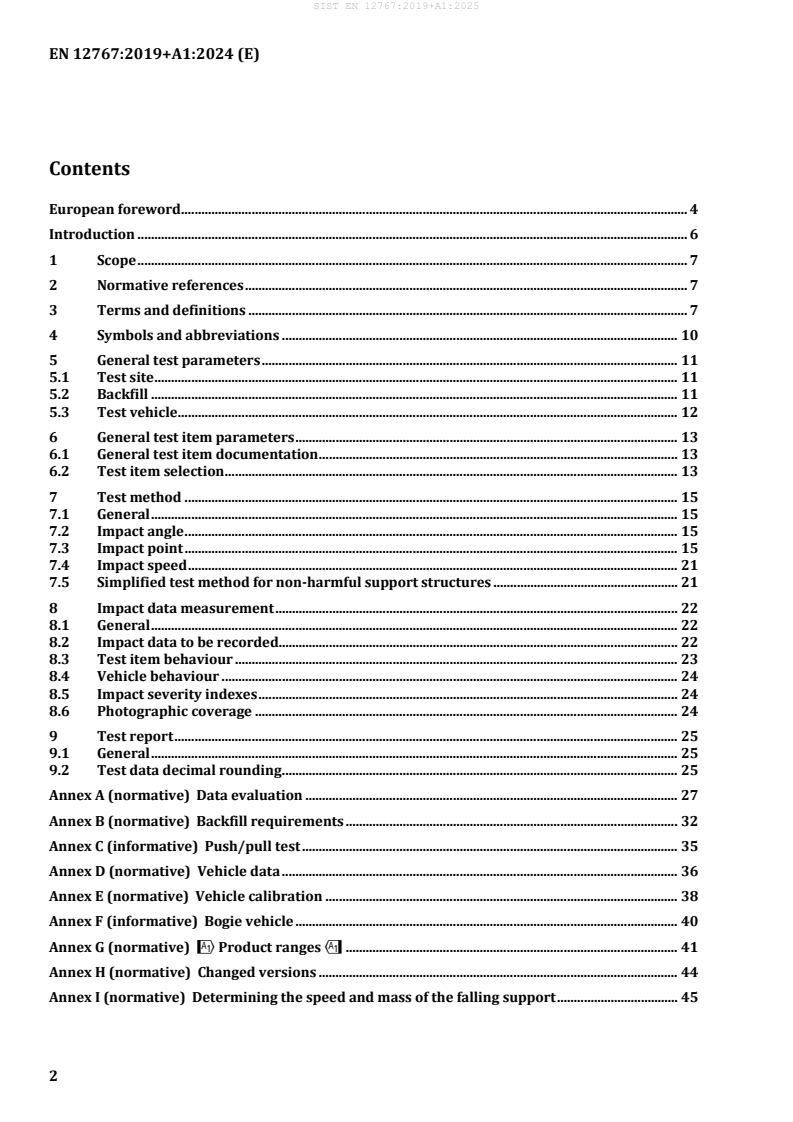
Contents
European foreword . 4
Introduction . 6
1 Scope . 7
2 Normative references . 7
3 Terms and definitions . 7
4 Symbols and abbreviations . 10
5 General test parameters . 11
5.1 Test site . 11
5.2 Backfill . 11
5.3 Test vehicle . 12
6 General test item parameters . 13
6.1 General test item documentation . 13
6.2 Test item selection . 13
7 Test method . 15
7.1 General . 15
7.2 Impact angle . 15
7.3 Impact point . 15
7.4 Impact speed . 21
7.5 Simplified test method for non-harmful support structures . 21
8 Impact data measurement . 22
8.1 General . 22
8.2 Impact data to be recorded. 22
8.3 Test item behaviour . 23
8.4 Vehicle behaviour . 24
8.5 Impact severity indexes . 24
8.6 Photographic coverage . 24
9 Test report . 25
9.1 General . 25
9.2 Test data decimal rounding . 25
Annex A (normative) Data evaluation . 27
Annex B (normative) Backfill requirements . 32
Annex C (informative) Push/pull test . 35
Annex D (normative) Vehicle data . 36
Annex E (normative) Vehicle calibration . 38
Annex F (informative) Bogie vehicle . 40
Annex G (normative) !Product ranges" . 41
Annex H (normative) Changed versions . 44
Annex I (normative) Determining the speed and mass of the falling support . 45
Annex J (informative) Test report . 46
Annex K (normative) Deemed to comply . 52
Annex L (normative) Use of test results performed in accordance with previous versions of
EN 12767 . 53
Annex M (normative) !Virtual testing" . 55
Bibliography . 69
European foreword
This document (EN 12767:2019+A1:2024) has been prepared by Technical Committee CEN/TC 226
“Road Equipment”, the secretariat of which is held by AFNOR.
This document shall be given the status of a national standard, either by publication of an identical text
or by endorsement, at the latest by June 2025, and conflicting national standards shall be withdrawn at
the latest by June 2025.
Attention is drawn to the possibility that some of the elements of this document may be the subject of
patent rights. CEN shall not be held responsible for identifying any or all such patent rights.
This document includes Amendment 1 approved by CEN on 24 August 2024.
This document supersedes !EN 12767:2019".
The start and finish of text introduced or altered by amendment is indicated in the text by tags !".
! The significant technical changes incorporated in this revision are:
— incorporation of the Regulation (EU) No 305/2011 of the European Parliament and of the Council of
9 March 2011 laying down harmonized conditions for the marketing of construction products and
repealing Council Directive 89/106/EEC terminology;
— introduction of a push-pull test to enable a comparison to be made between the backfills used in the
test and those on-site;
— harmonization of the boundary values for occupant safety (ASI and THIV) independent of the energy
absorption category;
— replacement of the occupant safety level by an alphanumeric character instead of a number to make
a clear distinction with the old (EN 12767:2007) approach. Now, NE-C, LE-C and HE-C have the same
occupant safety. The best occupant safety is achieved for A;
— introduction of collapse modes to classify if test items become detached or do not become detached;
— introduction of direction sensitivities to take into account any sensitiveness to impact angle;
— improved test description, include installation manual and translation of roof deformation into a
measurable value, to reduce the influence of the vehicle structure on the test results;
— introduction of an extra test at 50 km/h for cases where the test-item is not activated at low speed.
An explanation of the definition of “activated” is also given;
— better rules for the determination of product ranges (former product families) based on the tested
limit(s);
— introduction of a risk assessment approach, in line with the EN 1317-1:2010, for assessing changes
of a version, and the use of (for example) virtual testing in this;
— possibility to declare, under certain conditions, intermediate speed levels."
Most of the comments collected from all CEN members to the previous version of this norm are
implemented or solved. The definition and use of newer technologies has to be developed before
introduction into the standard.
!Some added changes mentioned above are expressed in a new performance classification for the
product. This results in a longer description of the overall passive safety performance, but at the end, it
gives a clearer indication of product performance. For example, an old performance classification like
“100, HE, 3” could be translated to “100-HE-C-S-SE-MD-1”. In this example, the last 4 sub-indications
stands for backfill type (S), collapse mode (SE), direction sensitivity (MD) and risk of roof indentation
(1)."
Translation of older tests to this new standard is possible when sufficient information is available in the
reports, photographs and videos of the tests.
The previous version of EN 12767 included test acceptance criteria – this is now, for convenience,
repeated in Annex A.
When this standard is used as a supporting standard for a product standard under CPR (e.g. sign
supports) relevant clauses of Annexes A, G and H are supposed to be copied inside the product standard,
and the product standard refers to the rest of this standard.
When this standard is used for testing constructions with no product standard the specifying authority is
supposed to refer to whole EN 12767, including Annexes A, G and H.
Annexes A, B, D, E, G, H, I, K, L, M of this document are normative, Annexes C, F, J are informative.
Any feedback and questions on this document should be directed to the users’ national standards body.
A complete listing of these bodies can be found on the CEN website.
According to the CEN-CENELEC Internal Regulations, the national standards organizations of the
following countries are bound to implement this European Standard: Austria, Belgium, Bulgaria, Croatia,
Cyprus, Czech Republic, Denmark, Estonia, Finland, France, Germany, Greece, Hungary, Iceland, Ireland,
Italy, Latvia, Lithuania, Luxembourg, Malta, Netherlands, Norway, Poland, Portugal, Republic of North
Macedonia, Romania, Serbia, Slovakia, Slovenia, Spain, Sweden, Switzerland, Türkiye and the United
Kingdom.
Introduction
The severity of accidents for the occupant(s) of a vehicle is affected (in part) by the performance of the
support structures for items of road equipment under impact. Based on safety considerations, support
structures can be designed to behave in controlled ways to reduce the overall risk.
!Passive safety is intended to reduce the severity of injury to vehicle occupants of a car in an impact
with support structures of road equipment. Passive safety for vulnerable road users, e.g. motorcyclists, is
not covered by this document."
This document has been developed in order to provide:
— test methods for determining impact safety performance; and
— methods to handle the data resulting from the impact tests;
— technical background about passive safety that can be used in the product standard.
!The test procedure includes guidelines:
— for test item selection, test parameters, detailed test methods with different test conditions, the data
to record, and requirements for reporting;
— to assess the performance within product ranges and for modified products (called “changed
versions”)."
!This document considers:
— two kinds of test inputs:
— three speed levels (50, 70 and 100);
— three Backfill types (standard aggregates (S), special (X) and Rigid (R)).
— five kinds of test outcomes:
— three energy absorption categories: high energy absorbing (HE), low energy absorbing (LE) and
non-energy absorbing (NE);
— five occupant safety levels (from A to E);
— two modes of collapse for support structures (Separation mode (SE) and No separation collapse
mode (NS));
— three direction sensitivities (single-directional (SD), bi-directional (BD) and multi-directional
(MD));
— two performance variables of risk of roof indentation (0 or 1)."
In order to help to evaluate the risk in case of a product modification, this document introduces Virtual
Testing through the definition of procedures for verification, validation, and development of numerical
models.
Based on the evaluation of the performance of each tested support structure, National and Local road
authorities will be able to specify the performance class of an item of road equipment support structure
in terms of the likely effect on the occupants of a vehicle in impact with the structure.
1 Scope
This document specifies performance test procedures to determine the passive safety properties of
support structures such as lighting columns, sign posts, signal supports, structural elements, foundations,
detachable products and any other components used to support a particular item of equipment on the
roadside.
This document provides a common basis for the vehicle impact testing of items of road equipment
support structures.
This document does not apply to road restraint systems.
2 Normative references
The following documents are referred to in the text in such a way that some or all of their content
constitutes requirements of this document. For dated references, only the edition cited applies. For
undated references, the latest edition of the referenced document (including any amendments) applies.
EN 1317-1:2010, Road restraint systems — Part 1: Terminology and general criteria for test methods
EN 13285, Unbound mixtures — Specifications
ISO 6487, Road vehicles — Measurement techniques in impact tests — Instrumentation
ISO 10392, Road vehicles — Determination of centre of gravity
3 Terms and definitions
For the purposes of this document, the following terms and definitions apply.
ISO and IEC maintain terminological databases for use in standardization at the following addresses:
— IEC Electropedia: available at http://www.electropedia.org/
— ISO Online browsing platform: available at http://www.iso.org/obp
3.1
impact test
test in which a test vehicle impacts a test item of road equipment support structure
3.2
impact angle
angle between the intended direction of traffic and the approach path of the test vehicle into the test item
3.3
vehicle impact point
initial point of impact on the test vehicle
3.4
test item impact point
initial point of impact on the test item
3.5
impact speed
ν
i
measured impact speed of the impacting vehicle, measured along the test vehicle approach path at a
distance no further than 6 m before the impact point
3.6
exit speed
ν
e
speed of the test vehicle after the impact with the test item, measured perpendicular to the extended
approach path at a point 12 m beyond the impact point
Note 1 to entry: For exit speed of non-harmful products as defined in !3.17", non-harmful support structure
see 7.5, simplified test method for non-harmful support structures.
3.7
test vehicle
production models representative of current traffic in Europe used in an impact test to evaluate the
performance of a test item
3.8
test item
complete system of a support structure including the road equipment to be supported and foundation (if
needed)
3.9
support structure
system used to support items of road equipment
Note 1 to entry: Items of road equipment may include luminaires, traffic signs, traffic signals and utility cables or
any other equipment. The system includes posts, poles, structural elements, foundations, detachable mechanisms,
if used, and any other components used to support the particular item of equipment.
3.10
sign support
support structure intended to hold one or more signs
3.11
signal support
support structure intended to hold one or more signals heads
3.12
lighting column
support structure intended to hold one or more luminaires, consisting of one or more parts: a post,
possibly an extension piece and, if necessary, a bracket
3.13
utility pole
support structure intended to hold power transmission, telecommunication cables or similar
3.14
cantilever support
support structure with one or more legs positioned on one side of the carriageway and a cantilever arm
supporting signs, signals or other equipment mounted over traffic lanes
3.15
gantry support
support structure spanning a carriageway with one or more legs on each side of carriageway supporting
signs, signals or other equipment
3.16
multi-legged support
support structures with several legs, either identical or different
Note 1 to entry: The term includes structures with legs aligned transverse to the road or along the road.
3.17
non-harmful support structure
small support structure (for example some types of bollards, self-righting signs, delineators) that causes
only minor damage and a small change of speed during impact
3.18
ASI
dimensionless impact severity index calculated from the tri-axial vehicle accelerations according to the
procedure given by EN 1317-1:2010, 8.1.2
3.19
THIV
velocity, expressed in km/h, at which a hypothetical “point mass” occupant impacts the surface of a
hypothetical occupant compartment and calculated in accordance with the procedure given by
EN 1317-1:2010, 8.1.3
3.20
ballast
!mass added to a test vehicle, including measurement and instrumentation, to simulate cargo and/or
to achieve desired test mass"
3.21
total mass
mass that includes all items in the test vehicle at the beginning of the test
3.22
collapse mode
mode by which the support structure deforms under vehicle impact
3.23
anthropomorphic test device
ATD
anthropomorphic device representative of a 50th percentile adult, specifically designed to represent in
form, size and mass, a vehicle occupant, and to reproduce the dynamic behaviour of an occupant in crash
testing
3.24
performance class
class for one speed class, one energy absorption level, one occupant safety class, one backfill type, one
collapse mode, one direction class and risk of roof indentation
3.25
product family
product series of the same type in various sizes, made from the same materials using the same design and
general construction method, and having the same performance class
3.26
object length
height of the support structure
!Note 1 to entry: For lighting columns, the object length is the height above ground level (h) plus half of the
longest horizontal bracket projection (w) in case of one or two bracket in top of the support structure. h and w are
defined by EN 40-2."
Note 2 to entry: For other support structures, the object length is the overall height of the structure including
signs, signal heads and other attachments.
3.27
object mass
mass of the part of the support structure above ground level included attachments such as signs and
luminaires
4 Symbols and abbreviations
ASI Acceleration Severity Index
THIV Theoretical Head Impact Velocity
SE Separation collapse mode
NS No separation collapse mode
HE High energy absorbing category
LE Low energy absorbing category
NE Non energy absorbing category
S Backfill type S, standard aggregates
X Backfill type X, special aggregates
R Backfill type R, rigid
SD Single-directional
BD Bi-directional
MD Multi-directional
C Circumscribed circle of supports
O Centre of C
L Clear opening for multi-legged supports
ν Velocity
t Time
VT Virtual testing
NR No requirement
ATD Anthropomorphic Test Device
5 General test parameters
5.1 Test site
!The test site shall be generally flat and have a level, hardened surface with a gradient not exceeding
2,5 %. The area around the test item until 15 m behind the impact point shall be clear of standing water,
ice or snow at the time of the test. The test site shall be of sufficient size to enable the test vehicle to be
accelerated up to the required speed and controlled so that its approach to the test object is stable."
The test vehicle shall run on a levelled (no steps allowed) hardened or paved surface over the backfill
volume without influencing the movement of the test item.
NOTE For the purposes of this standard, the term “paved” is used only for an installation with asphalt, brick
slabs/pavers or a concrete surface.
Appropriate measures shall be taken in order to minimize dust generation from the test area and the test
vehicle during the impact test so that photographic records will not be obscured.
5.2 Backfill
5.2.1 General
The manufacturer shall select the type(s) of backfill to be used in the Type Tests from those given in
Table 1.
Table 1 — Backfill type
Backfill type Name
S Standard aggregates
X Special
R Rigid
The backfill at the test site shall be well known, repeatable and described thoroughly, either in the test
report or as a reference to well-known and widely accepted geotechnical references or pavement
properties.
!Within one product range, the same backfill type shall be used for all tests."
The different backfill types are described in 5.2.2 and 5.2.3.
The backfill according to which the performance of the test item is determined is part of the performance
declaration (see Annex A).
5.2.2 Backfill type S and X
!Backfill type S and X identify the use of backfill material in the backfill volume.
— Backfill type S grading shall be in accordance with B.3.
— Backfill type X shall be described by a grading curve supplied by the manufacturer of the product to
be tested and included in the test report (grading shall be in accordance with EN 13285)."
The results of the push/pull test should be reported according to Annex C.
The minimum dimensions of the backfill volume, the positioning of the item in the volume and the
compaction of the backfill material shall comply with B.1 and B.2. The backfill volume shall not be frozen
at the time of test and shall be protected from rain before the impact test.
5.2.3 Backfill type R
Backfill type R identifies the use of a flat continuous rigid surface (such as asphalt and/or concrete) of a
sufficient thickness to provide anchoring of the tested item without being displaced according to B.4.
!NOTE The backfill can be locally damaged in the impact area as a result of the impact test."
5.3 Test vehicle
5.3.1 General
The test vehicle shall be a standard passenger car and shall also meet the following specifications:
— the total mass: 900 kg ± 40 kg. Of this, the maximum allowed combined mass of ballast and
instrumentation is 120 kg;
An ATD (or a driver for simplified test method) may be used; in this case the total mass includes the
ATD (or driver).
— the dimensions of the test vehicle are determined according to Annex D;
— front and rear wheel track: 1,35 m ± 0,20 m;
— longitudinal centre of gravity location in distance from front axle (CGx) 0,90 m ± 0,09 m. No ATD shall
be in the car when the centre of gravity is determined;
The centre of gravity shall be determined in accordance with the ISO 10392.
— lateral centre of gravity location (CGy) distance from vehicle centreline ±0,07 m;
— centre of gravity height from ground (CGz) 0,49 m ± 0,05 m;
— the vehicles to be used in the tests shall be production models representative of current traffic in
Europe;
— the vehicle shall not have a sunroof;
— additional equipment on the car, which might be important for the test, shall be of a type normally
delivered by the manufacturer or otherwise approved for use on the specific car type;
— a heavy car shall not be stripped of heavy standard equipment to fit into the mass restrictions of this
standard;
— the tyres shall be inflated to the vehicle manufacturer’s recommended pressures. The condition of
the vehicle shall satisfy the requirements for the issue of a vehicle certificate of road worthiness with
respect to tyres, suspension, wheel alignment and bodywork, including windows and features that
are expected to affect the test result. No repairs or modifications including reinforcement shall be
made that would alter the general characteristics of the vehicle or invalidate such a certification. Any
repairs shall conform to the original vehicle specification as defined by the vehicle manufacturer. The
vehicle shall be clean and mud deposits, which may cause dust on impact, shall be removed prior to
testing. Marker points shall be placed on external surfaces of the test vehicle to aid analysis;
— the vehicle shall not be restrained by control of the steering or any other means during impact and
within a distance of 12 m after the impact point (e.g. engine power, braking, anti-lock brakes,
blocking or fixing);
— all fluids shall be included in the test inertial mass;
— all ballast weights shall be securely fixed to the vehicle in such a way as not to exceed the
manufacturer's specifications for distribution of weight in the horizontal and vertical planes;
— ballast weights shall not be fixed in locations, which would modify the deformation of, or intrusions
into, the vehicle.
The test vehicle shall satisfy the vehicle calibration test requirements of Annex E.
NOTE The use of a bogie vehicle is not accepted for determining the performance class. Nevertheless, Annex F
is included in this document for technical background and stakeholders are invited to study the feasibility of
replacing a real car with a bogie vehicle in the future.
5.3.2 Test vehicle instrumentation
The minimum test vehicle instrumentation and the accuracy of the measurements taken during the test
shall be in accordance with EN 1317-1:2010.
Accelerometers shall be positioned as described in EN 1317-1:2010.
6 General test item parameters
6.1 General test item documentation
Before the test, the manufacturer shall supply drawings and full technical specifications for the test item.
The overall tested item mass and the various component masses shall be given by the manufacturer.
Full technical specification is the material specifications and drawings necessary to uniquely identify the
test item and the properties of all parts. It also includes installation and maintenance drawings and
instructions necessary to ensure the initial and continuing functioning of the device to the determined
safety class. Additional requirements such as foundation requirements, torque settings of brackets, sign
clamps, fixing systems, anchor bolts shall be defined in the installation instructions and checked before
the test.
The installation drawings shall illustrate the traffic direction. The impact safety performance of some
support structures might be affected by the orientation of the impact (vehicle direction in horizontal
plane). If the structure is designed to perform when hit in a particular direction, the features participating
to that behaviour shall be identified.
Each drawing shall have a unique number, version number and a date, in order to uniquely identify the
tested item. The drawings shall only include the tested configuration, not any untested options, sizes or
variations. The test laboratory shall verify if the test item corresponds with the information in the
drawings and specifications.
6.2 Test item selection
6.2.1 General
The client shall select the configuration of test items.
The item selected for testing shall be representative of actual or future production including, where
present, inspection or maintenance openings or any other device which will be in use when placed on the
market.
The installation of the test item at the test site shall be made in accordance with the manufacturer’s
specifications as described in 6.1. Any deviation of the installation with respect to the manufacturer’s
specifications shall be recorded in the test report.
!In those cases where several versions of a product are based on the same construction principle, the
manufacturer selects an item to be a parent member. Annex G gives explanations on how to choose the
other products in the range."
If a modification is applied to an already tested product, Annex H gives an explanation on how to assess
the risks associated with the modification, and how to evaluate the changed version.
Due to the risk of penetration of the windscreen of an impacting car, the untested reduced minimum
height of the lower edge of any attachment above 2,0 kg shall not be lower than 2,0 m. For lower
installations, the risk of windscreen penetration shall be evaluated.
Specific requirements for the selection of the test item are given in 6.2.2 to 6.2.7.
Multi-legged support structures are of two types: multi-legged support structures with identical legs and
multi-legged support structures with non-identical legs. Identical means that these legs refer to the same
drawing number.
6.2.2 Lighting column
A lighting column shall be tested with the longest and heaviest single arm bracket, and luminaire of the
greatest mass related to the bracket length, for which the column is designed.
Luminaires, and cables to luminaires, shall be installed when a lighting column is tested, including typical
underground cables and connection boxes and/or fuse units, if the lighting column is intended for use
with such items.
Overhead cables need not be installed for the impact tests. However, if they are used at test, the overhead
cables shall be installed so as to simulate the fixing on adjacent columns/posts in service.
Underground cables shall be securely fixed outside the backfill volume in such a way that the fixing does
not allow movement of the cable at the fixing point during the test.
Dedicated electrical disconnections might be installed during test, and their performance can be part of
additional voluntary information in a test report, however not forming basis for any pass/fail
considerations of the actual support structure.
6.2.3 Sign support
A sign support shall be tested with the largest area of symmetrically mounted sign plate for which that
height of support is designed. Any necessary electrical equipment, cables including underground cables
and connection boxes and/or fuse units (for example for transilluminated signs) shall be installed.
6.2.4 Signal support
A signal support shall be tested with the heaviest signal head(s), together with cables including
underground cables, connection boxes and/or fuse units.
Underground cables shall be securely fixed outside the backfill volume in such a way that the fixing does
not allow movement of the cable at the fixing point during the test.
6.2.5 Utility pole
A utility pole shall be tested with the heaviest intended load.
Overhead cables shall be installed unless the effect of overhead cables and its fixings on the performance
is known from other tests with similar utility poles.
When testing with overhead cables, at least three utility poles shall be installed and the central utility
pole shall be the one impacted.
6.2.6 Multipurpose support structures
When a support type is designed to be used in more than one configuration, such as lighting columns,
sign supports, traffic signal supports, etc., the result of the low speed test in one configuration may
substitute the low speed test of another configuration. The result is valid for systems with a lesser mass
and the same number of supports but only for supports with smaller bending moment resistance.
6.2.7 Other support structures
Other support structures shall be tested with the heaviest intended load. This includes non-harmful
support structures.
Support structures, such as mailboxes, gantries, cantilever supports, emergency telephones, camera
supports, weather and traffic monitoring device supports, advertisement installations, solar panels, wind
turbines or other items not specified above may also be tested in accordance with this document. In this
case, the test configuration should be based (as closely as possible) on the principles described in
Clauses 6 and 7 and the related sub clauses. The installation is as complete and realistic as possible.
7 Test method
7.1 General
The test shall be performed by a competent test laboratory.
For ensuring better reliability of test results the test may be performed by an accredited test laboratory
according to the EN ISO/IEC 17025. The test method is described in terms of:
— impact angle;
— impact point;
— impact speed.
7.2 Impact angle
The test vehicle shall follow an approach path oriented according to the manufacturer’s installation
specification and with respect to the impact angle. The installation of the test item shall reproduce the
installation on the road as documented by the manufacturer (see 6.1); for example the opening shall be
oriented in the direction most likely to reproduce the installation on the road.
The item shall be tested with an impact angle of 20° ± 2 °. The accuracy of the measurement shall
be ±0,5 °.
When required (by A.6, for bi-directional classification or other standard), an additional test shall be
performed with an impact angle of 160° ± 2° (all the way around 180 ° minus 20 °) as indicated in
Figure 1. This is equivalent to a vehicle leaving the road from the carriageway of the opposite side, hitting
the rear of the item. The tests shall be made under identical test conditions with the exception of the test
angle.
7.3 Impact point
7.3.1 General
The impact point of the vehicle is the foremost point of the vehicle along the vehicle’s centreline. The
vehicle centreline line and the impact point of the vehicle shall be directed towards the support
structure’s theoretical alignment point (O), with an allowed impact alignment tolerance of ±0,1 m.
The support structure’s theoretical alignment point shall be determined in accordance with 7.3.2 for
single legged support structures, and 7.3.3 for multi-legged support structures.
The accuracy of the measurement of the impact alignment and the lateral movement at the exit side of
the test item at the ground level shall be ±0,02 m. For rigid backfill (Type R) the accuracy of the
measurement of the lateral movement at the exit side of the test item at ground level shall be ±0,005 m.
7.3.2 Theoretical alignment point for single legged support structures
For single legged support structures, the support structure theoretical alignment point (O) is the centre
of the circle circumscribed around the cross section of the leg at a height of 0,3 m above ground level, in
the horizontal plane, see Figure 1.
Key
C circumscribed circle of the single support structure
O the support structure theoretical alignment point (centre of circle C)
1 leg of the single support structure
2 mandatory impact direction
3 carriageway
4 traffic flow
5 opposite traffic flow
6 impact direction opposite traffic flow (optional, see Annex A)
Figure 1 — Theoretical alignment point and impact angle of a single legged support structure
7.3.3 Theoretical alignment point for multilegged support structures
For multi-legged support structures, the projected distance at the 20 ° impact direction between two
adjacent support structure legs shall be determined and reported at a height of 0,3 m above ground level
in the horizontal plane. The clear opening (L) is the smallest distance as measured between the legs as
indicated in Figure 2.
NOTE The clear opening is generally shorter than the distance between two adjacent legs. Normally all the legs have a constant distance between each other.
Situation with identical legs and clear opening L ≥ 1,5 m. In this case, Situation with identical legs and clear opening L < 1,5 m. In this case,
the theoretical alignment point (O) shall be defined as for a single leg the theoretical alignment point (O) shall be defined between the legs.
(see Figure 1), against the second leg.
a) Legs parallel to the carriageway with L ≥ 1,5 m b) Legs parallel to the carriageway with L < 1, 5 m
Situation with identical legs and clear opening L ≥ 1,5 m. In this case, Situation with identical legs and clear opening L < 1,5 m. In this case,
the theoretical alignment point (O) shall be defined as for a single leg the theoretical alignment point (O) shall be defined between the legs.
(see Figure 1), against the second leg.
c) Legs perpendicular to the carriageway with L ≥ 1,5 m d) Legs perpendicular to the carriageway with L < 1, 5 m
A more complex situation with a matrix of legs. In this case, the theoretical alignment point (O) shall be determined by the maximum sum of
section area’s caught within the 1,5 m- scanning window over all sections, as indicated. If the matrix contains more than one maximum sum
of section areas, the impact shall be determined through the centre of sections within the second window. This is in line with the idea behind
Figure 2c) where the second leg shall be tested.
e) Complex construction with use of scanning window
Key
C circumscribed circle of the single support structure 2 mandatory impact direction
L clear opening 3 carriageway
O the support structure theoretical alignment point (centre of circle C) 4 traffic flow
1 leg of the support structure closest to the carriageway 5 adjacent leg in the multi-legged support structure
n all other legs in the multi-legged structure, can be between 0 and endless
Figure 2 — Theoretical alignment point and impact angle of multi-legged support structures
If in case b) or d) the car goes between 2 supports without activation (see A.2) of any of the supports, an
additional test shall be performed following case a) or case c).
For multi-legged support structures consisting of different support legs, at least one of the high speed
tests shall be on the strongest leg. If that is not the same leg as the one identified in Figure 2, Theoretical
alignment point and impact angle of multi-legged support structures two additional tests shall be
performed on the strongest leg (one high speed test and one low speed test).
!
7.4 Impact speed
The manufacturer shall select the speed level to which the support structure will be tested from Table 2.
The speed level identifies the impact speed in the high-speed test.
Table 2 — Support structure speed level
Speed level Impact speed Impact speed tolerance
km/h km/h
50 50 ±3
70 70 ±5
100 100 ±5
For any speed level, a low speed test shal
...