

EN 13898:2003+A1:2009
(Main + Amendment)Machine tools - Safety - Sawing machines for cold metal
- Abstract
1.1 This standard specifies the safety requirements and measures to be adopted by persons undertaking the design, construction and supply (including installation, setting–up, maintenance, and repair) of machines whose primary intended use is for sawing cold metal (ferrous and non-ferrous), or material partly of cold metal, by means of a saw blade.
1.2 This standard takes into account the intended use, reasonably foreseeable misuse, machine setting and blade fitting, maintenance and cleaning, and their effects on the safety of operators and other exposed persons. It presumes access to the machine from all directions at floor level and addresses both normal operation and unexpected or unintended starting.
1.3 This standard applies to the ancillary devices which form an integral part of the machine. Where such devices are not an integral part of the machine, the designer, manufacturer or supplier of the installation should take into account their intended use, and should make provision for the safe linking of such devices with the machine.
1.4 This standard applies to (metal) sawing machines which are manufactured after the date of publication by CEN of this standard.
- Status
- Withdrawn
- Publication Date
- 10-Feb-2009
- Withdrawal Date
- 06-Oct-2026
- Technical Committee
- CEN/TC 143 - Machine tools - Safety
- Drafting Committee
- CEN/TC 143/WG 6 - Metal cutting sawing machines - Safety
- Current Stage
- 9960 - Withdrawal effective - Withdrawal
- Start Date
- 12-Apr-2017
- Completion Date
- 07-Oct-2026
- Directive
- 2006/42/EC - Directive 2006/42/EC of the European Parliament and of the Council of 17 May 2006 on machinery, and amending Directive 95/16/EC (recast)OJ Ref: C, C 214 OJ Date: 08-Sep-2009

Relations
- Effective Date
- 22-Dec-2008
- Replaced By
EN ISO 16093:2017 - Machine tools - Safety - Sawing machines for cold metal (ISO 16093:2017) - Effective Date
- 16-Sep-2015
- Effective Date
- 25-Aug-2026
- Effective Date
- 25-Aug-2026
- Effective Date
- 18-Mar-2026
- Effective Date
- 09-Feb-2026
- Effective Date
- 09-Feb-2026
- Effective Date
- 09-Feb-2026
- Effective Date
- 09-Feb-2026
- Effective Date
- 28-Jan-2026
- Refers
EN 414:2000 - Safety of machinery - Rules for the drafting and presentation of safety standards - Effective Date
- 28-Jan-2026
- Effective Date
- 28-Jan-2026
- Effective Date
- 28-Jan-2026
- Effective Date
- 28-Jan-2026
- Effective Date
- 28-Jan-2026
Get Certified
Connect with accredited certification bodies for this standard

DVS-ZERT GmbH
German welding certification society.
CARES (UK Certification Authority for Reinforcing Steels)
UK certification for reinforcing steels and construction.
EWF/IIW (European/International Welding Federation)
International welding personnel certification.
Sponsored listings
Frequently Asked Questions
EN 13898:2003+A1:2009 is a standard published by the European Committee for Standardization (CEN). Its full title is "Machine tools - Safety - Sawing machines for cold metal". This standard covers: 1.1 This standard specifies the safety requirements and measures to be adopted by persons undertaking the design, construction and supply (including installation, setting–up, maintenance, and repair) of machines whose primary intended use is for sawing cold metal (ferrous and non-ferrous), or material partly of cold metal, by means of a saw blade. 1.2 This standard takes into account the intended use, reasonably foreseeable misuse, machine setting and blade fitting, maintenance and cleaning, and their effects on the safety of operators and other exposed persons. It presumes access to the machine from all directions at floor level and addresses both normal operation and unexpected or unintended starting. 1.3 This standard applies to the ancillary devices which form an integral part of the machine. Where such devices are not an integral part of the machine, the designer, manufacturer or supplier of the installation should take into account their intended use, and should make provision for the safe linking of such devices with the machine. 1.4 This standard applies to (metal) sawing machines which are manufactured after the date of publication by CEN of this standard.
1.1 This standard specifies the safety requirements and measures to be adopted by persons undertaking the design, construction and supply (including installation, setting–up, maintenance, and repair) of machines whose primary intended use is for sawing cold metal (ferrous and non-ferrous), or material partly of cold metal, by means of a saw blade. 1.2 This standard takes into account the intended use, reasonably foreseeable misuse, machine setting and blade fitting, maintenance and cleaning, and their effects on the safety of operators and other exposed persons. It presumes access to the machine from all directions at floor level and addresses both normal operation and unexpected or unintended starting. 1.3 This standard applies to the ancillary devices which form an integral part of the machine. Where such devices are not an integral part of the machine, the designer, manufacturer or supplier of the installation should take into account their intended use, and should make provision for the safe linking of such devices with the machine. 1.4 This standard applies to (metal) sawing machines which are manufactured after the date of publication by CEN of this standard.
EN 13898:2003+A1:2009 is classified under the following ICS (International Classification for Standards) categories: 25.080.60 - Sawing machines. The ICS classification helps identify the subject area and facilitates finding related standards.
EN 13898:2003+A1:2009 has the following relationships with other standards: It is inter standard links to EN 13898:2003, EN ISO 16093:2017, IEC 61496-2:1997, ISO 683-1:1987, EN ISO 3744:2026, EN IEC 61000-6-2:2019, EN 60204-1:1997, EN 61496-1:1997, EN IEC 61000-6-4:2019, EN ISO 4414:2010, EN 414:2000, EN ISO 11546-1:2009, EN 292-2:1991/A1:1995, EN 840-3:1997, EN ISO 3744:2010. Understanding these relationships helps ensure you are using the most current and applicable version of the standard.
EN 13898:2003+A1:2009 is associated with the following European legislation: EU Directives/Regulations: 2006/42/EC, 98/37/EC; Standardization Mandates: M/079, M/396. When a standard is cited in the Official Journal of the European Union, products manufactured in conformity with it benefit from a presumption of conformity with the essential requirements of the corresponding EU directive or regulation.
EN 13898:2003+A1:2009 is available in PDF format for immediate download after purchase. The document can be added to your cart and obtained through the secure checkout process. Digital delivery ensures instant access to the complete standard document.
Standards Content (Sample)
2003-01.Slovenski inštitut za standardizacijo. Razmnoževanje celote ali delov tega standarda ni dovoljeno.Obdelovalni stroji - Varnost - Žage za hladne kovineWerkzeugmaschinen - Sicherheit - Sägemaschinen für die Kaltbearteitung von MetallMachine-outils - Sécurité - Machines à scier les métaux à froidMachine tools - Safety - Sawing machines for cold metal25.080.60Strojne žageSawing machinesICS:Ta slovenski standard je istoveten z:EN 13898:2003+A1:2009SIST EN 13898:2004+A1:2009en,fr01-maj-2009SIST EN 13898:2004+A1:2009SLOVENSKI
STANDARD
EUROPEAN STANDARD NORME EUROPÉENNE EUROPÄISCHE NORM
EN 13898:2003+A1
February 2009 ICS 25.080.60 Supersedes EN 13898:2003English Version
Machine tools - Safety - Sawing machines for cold metal
Machine-outils - Sécurité - Machines à scier les métaux à froid
Werkzeugmaschinen - Sicherheit - Sägemaschinen für die Kaltbearteitung von Metall This European Standard was approved by CEN on 1 August 2003 and includes Amendment 1 approved by CEN on 29 December 2008.
CEN members are bound to comply with the CEN/CENELEC Internal Regulations which stipulate the conditions for giving this European Standard the status of a national standard without any alteration. Up-to-date lists and bibliographical references concerning such national standards may be obtained on application to the CEN Management Centre or to any CEN member.
This European Standard exists in three official versions (English, French, German). A version in any other language made by translation under the responsibility of a CEN member into its own language and notified to the CEN Management Centre has the same status as the official versions.
CEN members are the national standards bodies of Austria, Belgium, Bulgaria, Cyprus, Czech Republic, Denmark, Estonia, Finland, France, Germany, Greece, Hungary, Iceland, Ireland, Italy, Latvia, Lithuania, Luxembourg, Malta, Netherlands, Norway, Poland, Portugal, Romania, Slovakia, Slovenia, Spain, Sweden, Switzerland and United Kingdom.
EUROPEAN COMMITTEE FOR STANDARDIZATION
COMITÉ EUROPÉEN DE NORMALISATION EUROPÄISCHES KOMITEE FÜR NORMUNG
Management Centre:
Avenue Marnix 17,
B-1000 Brussels © 2009 CEN All rights of exploitation in any form and by any means reserved worldwide for CEN national Members. Ref. No. EN 13898:2003+A1:2009: ESIST EN 13898:2004+A1:2009
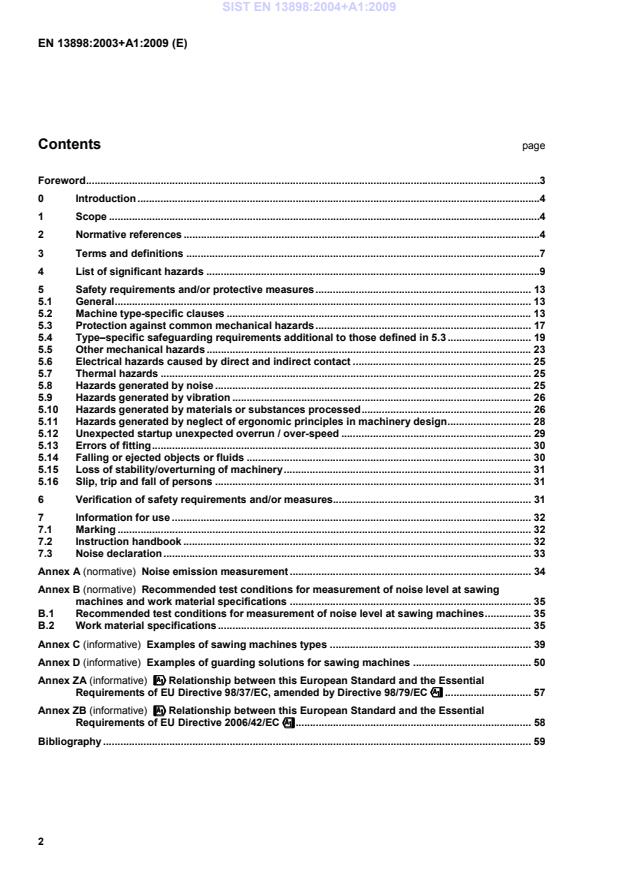
Noise emission measurement . 34 Annex B (normative)
Recommended test conditions for measurement of noise level at sawing machines and work material specifications . 35 B.1 Recommended test conditions for measurement of noise level at sawing machines . 35 B.2 Work material specifications . 35 Annex C (informative)
Examples of sawing machines types . 39 Annex D (informative)
Examples of guarding solutions for sawing machines . 50 Annex ZA (informative)
!!!!Relationship between this European Standard and the Essential Requirements of EU Directive 98/37/EC, amended by Directive 98/79/EC"""" . 57 Annex ZB (informative)
!!!!Relationship between this European Standard and the Essential Requirements of EU Directive 2006/42/EC"""" . 58 Bibliography . 59
Complementary requirements and guidance are given in type A and type B standards to which reference is made in the text. The figures are intended to be examples and not to give the only interpretation of the text. 1 Scope 1.1 This standard specifies the safety requirements and measures to be adopted by persons undertaking the design, construction and supply (including installation, setting–up, maintenance, and repair) of machines whose primary intended use is for sawing cold metal (ferrous and non-ferrous), or material partly of cold metal, by means of a saw blade. 1.2 This standard takes into account the intended use, reasonably foreseeable misuse, machine setting and blade fitting, maintenance and cleaning, and their effects on the safety of operators and other exposed persons. It presumes access to the machine from all directions at floor level and addresses both normal operation and unexpected or unintended starting. 1.3 This standard applies to the ancillary devices which form an integral part of the machine. Where such devices are not an integral part of the machine, the designer, manufacturer or supplier of the installation should take into account their intended use, and should make provision for the safe linking of such devices with the machine. 1.4 This standard applies to (metal) sawing machines which are manufactured after the date of publication by CEN of this standard. 2 Normative references This European Standard incorporates by dated or undated reference, provisions from other publications. These normative references are cited at the appropriate places in the text, and the publications are listed hereafter. For dated references, subsequent amendments to or revisions of any of these publications apply to this European Standard only when incorporated in it by amendment or revision. For undated references the latest edition of the publication referred to applies (including amendments). EN 292-1:1991, Safety of machinery - Basic concepts, general principles for design – Part 1: Basic terminology, methodology. EN 292-2:1991, Safety of machinery – Basic concepts, general principles for design – Part 2: Technical principles and specifications. EN 292-2/A1:1995, Safety of machinery – Basic concepts, general principles for design – Part 2: Technical principles and specifications, Amendment A1. SIST EN 13898:2004+A1:2009
3 Terms and definitions For the purposes of this European Standard, the terms and definitions given in EN 292-1:1991 and EN 1070:1998 and the following. 3.1 saw blade toothed cutting tool used with a circular–, band–, and hack–sawing machine 3.2 saw blade mounting position area or zone of the machine where provision exists for operators to mount, adjust/align and dismount saws; access is not required during sawing, but access is a normal requirement for setting and maintenance 3.3 load/unload positions areas or zones of the machine where provision exists for manual loading onto, or unloading work material(s) from the machine, frequent, but not continuous access, is required of operators during normal operation of the machine 3.4 manual sawing process operation of the machine under manual control, all process steps in the machining sequence are controlled or started by the operator 3.5 semi-automatic or single-cycle machine machine in which the power-operated elements perform a single cycle initiated by the operator NOTE A typical cycle can be:
- clamp work material
- feed saw blade to work material
- sawing process SIST EN 13898:2004+A1:2009
- saw blade retraction
- unclamp work material 3.6 automatic machine machine in which the power-operated elements perform continuous or repeat cycles, the first cycle initiated by a control system start from the operator until either an automatically-determined condition is achieved, or a stop signal is given by the operator NOTE A typical cycle can be:
-
feeding of work material
- clamping of work material
- feeding of saw blade through work material
- saw blade retraction
- unclamping of work piece
- unloading of work piece
- unclamping of work material
- repeat above cycle until stop signal 3.7 back jaw feed (hitch feed) power-operated work material feeding device having a carriage-mounted vice which grips the work material at any point along its length and traverses it to the sawing position, the required work material length is determined by the stroke of the feed carriage 3.8 push feed power-operated work material feeding device pushing on the tail end of the work material to advance it to a position or length stop which determines the required work material length 3.9 roller feed power-operated work material feeding device in which the work material is fed by a roller or rollers, such devices can incorporate work piece gripping and length measuring systems 3.10
Kinds of sawing processes 3.10.1 profile and contour cutting work material is pushed either by hand or under power through the saw blade, following a path which is not parallel to the plane of the saw blade, profile and contour cutting uses a vertical band-sawing machine, fixed saw frame, contour cutting type 3.10.2 mitre-sawing work material is cut out of square to the longitudinal axis 3.11 work area danger zone through which the saw blade traverses to process the work material and includes the work material holding mechanism (where applicable) 3.12
Metalworking fluid systems
3.12.1 recirculating system metalworking fluid system with collection and pumped recirculation of the fluid SIST EN 13898:2004+A1:2009
In addition, the user of this standard (i.e. the designer, manufacturer, supplier) shall validate that the risk assessment is complete for the machine under consideration with particular attention to: the intended use of the machine including maintenance, setting and cleaning, and its reasonably foreseeable misuse; the identification of the significant hazards associated with the machine.
Table 1 — List of significant hazards and major sources of these hazards a Hazard Examples of hazardous situation/activity Danger zone(s) 1 Mechanical hazards (for safety requirements, see 5.3, 5.4, 5.5) 1.1 Crushing hazard Power-operated work material clamping during loading/re-orientating/ unloading work material Between clamps and work material
Power-operated in feed during running, sawing, machine setting, saw blade changing, maintenance, repair Between material and work support; between fixed and moving parts of the machine 1.2 Shearing hazard Power-operated and manual work material feeding during loading, unloading, machine setting, saw blade fitting Between saw blade and work support; work material and work support 1.3 Cutting or severing hazard Moving saw blade during operation, machine setting, saw blade changing, maintenance, repair At the saw blade 1.4 Entanglement hazardPower-operated and manual saw blade feed during operation
At the saw blade and adjacent stationary parts of machine. Between saw blade cleaning device and saw blade
Machine elements in powered motion (e.g. power transmission elements).
At moving machine elements 1.5 Drawing-in or trapping hazard Power-operated and manual work material feeding or moving saw blade during operation At work material and infeed mechanism and adjacent
parts of machine
Machine elements in powered motion (e.g. power transmission elements). At load/unload and operating positions and near sawing zones. 1.6 Impact hazard Power-operated work handling during operation, machine setting, saw blade fittingGravity fall
Machine elements in powered motion (e.g. hack saw during operation)At work material and work handling mechanisms 1.7 Stabbing or puncture hazard Handling saw blade(s) At saw blade (especially during changing) 2 Electrical hazards (for safety requirements, see 5.6) 2.1 Direct electrical contact Contact with live parts during operation, machine setting, saw blade changing, and maintenance. Control and other electrical equipment.
2.2
Contact of persons with parts which have become live under fault During fault conditions.
Conductive parts of the machine 3 Thermal hazards (for safety requirements, see 5.7) 3.1 Contact with hot surfaces Ejection of hot swarf or work pieces during sawing At and/or near machine, saw blade and cut surfaces of the work piece
5 Hazards generated by vibration (for safety requirements, see 5.9) 5.1 Contact of persons with vibrating machine manual controls or work material Work material or handle held by operator. (feeding or damping vibration) during running or sawing.
At work material. At machine manual controls 7
Hazards generated by materials and substances processed, used or exhausted (for safety requirements, see 5.10) 7.1 Hazards from contact,
Skin contact with harmful materials At and/or near machine
inhalation, or ingestion of harmful substances
Inhalation and ingestion of substances (e.g. metalworking fluid) used or generated during operation. At and/or near machine
(fluids, mists, gases, fumes, dust) Ejection of dust, mist and fumes during operation. At and/or near machine 7.2 Fire or explosion hazard – Flammable work material (e.g. magnesium). – Loss of cooling fluid supply to sawing. At and/or near machine 7.3 Biological and microbiological (viral or bacterial) hazard Contact with contaminated fluids or work material. At and/or near machine 8 Hazards generated by neglecting ergonomic principles (for safety requirements, see 5.11) 8.1 Unhealthy postures or excessive effort (repetitive strain)
Feeding work material by hand into saw blade during running, sawing. At the saw blade
Excessive efforts, and/or repetitive strain. Lifting and reaching while handling work material, saw blades and/or machine parts. At load/unload and saw blade mounting positions and maintenance action points 8.2 Inadequate consideration of hand–arm anatomy Operating manual machines. At operating position while working 8.3 Neglected use of personal protection equipment Handling of work material, saw blades, machine assemblies during loading, unloading, sawing, machine fitting, maintenance, repair. At machine, saw blade(s) and metalworking fluid SIST EN 13898:2004+A1:2009
At machine 10.2 Restoration of energy supply after an interruption during setting, cleaning or maintenance At or near machine 10.3 External influences on the electrical equipment during setting or operating cycle of the machine At or near machine 11 Impossibility of stopping the machine in the best possible conditions (for safety requirements, see 5.3.3.4) Failure of malfunction of control system during setting or operating cycle of the machine At or near machine 15 Errors of fitting (for safety requirements, see 5.13) Saw blade or part of saw blade ejected during running. At and/or near machine 17 Falling or ejected objects or fluids (for safety requirements, see 5.14) Ejection or fall of parts of work material and swarf. during running, sawing, machine setting, saw blade changing, maintenance
At and/or near sawing zone and work material
Saw blade break or saw blade teeth stripping and ejection. Pressurised fluid system line ruptures. Ejected broken machine part(s). At and/or near machine 18 Loss of stability (for safety requirements, see 5.15) Unrestrained machine or machine part falls or overturns. At machine SIST EN 13898:2004+A1:2009
5 Safety requirements and/or protective measures 5.1 General Sawing machines shall comply with the safety requirements and/or protective measures of this clause. In addition, sawing machines shall be designed according to the principles of EN 292 for hazards relevant but not significant which are not dealt with by this standard. For guidance on risk reduction by design see clause 3 of EN 292-2:1991, and for safeguarding measures see clause 4 of EN 292-2:1991. 5.2 Machine type-specific clauses Since this standard addresses various types of sawing machines, Tables 2, 3, 4 and 5 provide the relationship between these types of machines and the specific safety clauses to be implemented for mechanical hazards (see 5.3 - 5.5). Risk reduction requirements for non mechanical hazards shall also be applied to all machines (5.6 to 5.16). The requirements of Table 2 shall be applied to all machines. SIST EN 13898:2004+A1:2009
Tables 2 to 5: Relationship of sawing machine type to safety requirements Table 2 — Common requirements for all machines Machine type Description Clause 5 reference Associated figure Sawing machines Machines for cutting 'cold' metal using a saw blade or saw blades of one or more of the following types: a) band saw blade; b) circular saw blade; c) hacksaw blade. Machines may be manual, semi-automatic or fully automatic in operation and include the types described in this table. Figures show only the machine layout/configuration.
5.3.1 5.3.2 5.3.3
Auxiliary equipment
5.5
– Work feeding and work holding
5.5.2
– Power-operated work material–feeding devices
5.5.3
Table 3 — Band sawing machines
A band sawing machine uses band saw blades, which comprise a continuous (endless) flexible band with the sawing edges in the form of teeth along one edge. Machine type
Description Clause 5 reference Associated figure horizontal band-sawing machine The band saw blade is mounted horizontally. 5.4.1
– pivot type The head of the machine is pivoted at one end and descends in an arc 5.4.1 C.1 – swing-head type This is a specific pivot type of band saw in which the saw head is at the operator's shoulder height
5.4.1 C.2 – column type The saw head is carried on one or more vertical columns (or pillars) and feeds in a straight vertical downward movement
5.4.1 C.3 vertical band-sawing machine
5.4.1
– fixed saw frame, contour cutting type (also called vertical contour type) The frame assembly is fixed and work material may be fed by hand or under power, into the saw blade. The sawing path may be straight or contour. Mitre sawing is achieved by tilting the work table and/or the body. 5.4.1 C.4 – front cutting type These machines have a horizontally-moving frame assembly. The work material is clamped to the table and the feed motion of the saw is towards the front of the machine into the back of the work material. The bandsaw blade is twisted through 90° at the cutting region, to align the saw blade with the direction of feed motion. On some machines, provision is made to tilt the head on which the saw blade is mounted for mitre sawing. 5.4.1
C.5 – traversing type The work material is clamped (where necessary) to the table which incorporates a slot. The bandsaw blade passes through the slot in the table. Either the table or the frame carrying the bandsaw blade traverses laterally to provide the feed motion. This type is commonly used for plate sawing. 5.4.1, plus:
5.4.1.1 table – C.6a frame – C.6b SIST EN 13898:2004+A1:2009
Table 4 — Circular sawing machines A circular-sawing machine uses circular saw blades with the cutting edges in the form of teeth around the periphery. Machine type Description Clause 5 reference Associated figure Pivoting head type The spindle and circular saw blade are mounted on a fulcrum arm which pivots. The plane of the circular saw blade is aligned with the ‘front to back’ axis of the machine. The saw blade approaches the work material in an arc. The head which carries the saw blade may be fixed or capable of swivelling or tilting. The down feed of the sawing head can be manual or powered. A turntable may be incorporated to permit mitre sawing. This type of machine can be fully-automatic or semi-automatic. A fully automatic pivoting head machine normally incorporates power feed of the saw blade, power in-feed and powered clamping of the work material. A large semi-automatic machine, usually supplied for use with saw blades of 760 mm diameter and above, normally incorporates power feed of the saw blade and power clamping of the work material. Provision is often made for swivelling the whole machine to make mitre cuts. 5.4.2.1, plus:
manual/power –operated -5.4.2.2
automatic/semi automatic – 5.4.2.3
l manual – C.7a powered – C.7b Vertical type – down–stroking There are two variations of this type of machine, the generally-larger heavier-duty, twin pillar type and the single column type. The head carrying the saw blade slides vertically on the pillars or the column to feed the saw blade down into the work material. Provision for mitre sawing is made on some machines, usually the single column type, by allowing either the head to swivel on the column, or the head and column to swivel on the base. This type of machine can be provided with manual, semi-automatic or fully-automatic control. 5.4.2.1, plus 5.4.2.4 twin pillar – C.8a single column – C.8b Rising/up-stroking type On this type of machine the plane of the circular-saw blade is aligned with the 'front-to-back' axis of the machine. The circular-saw blade is mounted on a spindle within the base frame of the machine and rises through a slot in the work table. For mitre sawing, the whole machine may be mounted on a turntable, or the head which carries the saw blade may rotate about one or more axes. Some machines have provision for locking the cutting head in the raised position to allow rip-sawing (see 3.10.1). This type of machine can be provided with semi-automatic or fully-automatic operation. 5.4.2.1 5.4.2.5, plus:
manual cutting head feed – 5.4.2.5.1
powered cutting head feed – 5.4.2.5.2 C.9 Longitudinal traversing - table type The spindle and circular-saw blade are mounted in a carriage which travels below the plane of the table. The plane of the circular-saw blade is aligned with the 'side-to-side' axis of the machine. The saw blade travels horizontally towards and into the work material. This type of machine can be provided with manual, semi-automatic or fully-automatic control. 5.4.2.1 5.4.2.6 C.10 SIST EN 13898:2004+A1:2009
- twin saw/single head type The two saw blades are aligned in the head at 90° to each other, at 45° to the axis of work material feed. The head feeds the saw blades vertically into the top of the work material. This type of machine is usually for mitre sawing and can be provided with manual, semi-automatic or fully-automatic control. 5.4.2.1 5.4.2.9 C.15 - 'twin head' type This type of machine is supplied for double-ended sawing and may be provided with more than 2 heads. In some machines the saw blade approaches the work material in an arc from the back and the heads may enable the plane of the saw blade to be tilted from the vertical. In other machines, usually for mitre sawing, the heads feed the saw blades vertically into the top of the work material (similar to Figure C.15). This type of machine can be provided with semi-automatic or fully-automatic operation. 5.4.2.1, plus:
vertical feed – twin mitre sawing –5.4.2.10
front sawing – semi automatic- 5.4.2.10 C.16 - multiple head type This type of machine is supplied for large quantity, high productivity, cut–to–length operations (see Figure C.17). The saw blades are aligned across the axis of the work material and the head(s) feed the saw blades, selectively or simultaneously, into the back of the work material. This type of machine can be provided with semi-automatic or fully-automatic operation. 5.4.2.1 5.4.2.10
C.17 SIST EN 13898:2004+A1:2009
Table 5 — Hack sawing machines.
A hack sawing machine uses hack saw blades, which have a linear form with the cutting edges in the form of teeth along one edge Machine type Description Clause 5 reference Associated figure Horizontal-pivot type The head which carries the reciprocating frame and saw blade is pivoted at one end, feed motion is a downward arc into the top of the work material. 5.4.3
C.18
5.3 Protection against common mechanical hazards 5.3.1 Safeguarding Access to the moving sawblade shall be prevented by a combination of fixed and movable interlocking guards except where alternative less demanding measures are specified in 5.4. Access to other mechanical hazards shall be prevented by application of the measures specified in 5.5. Guards shall be selected in accordance with clause 6 of EN 953:1997 and be designed and constructed in accordance with clause 5 of EN 953:1997. All openings in guards shall meet the requirements of Table 4 of EN 294:1992. Interlocking devices associated with guards shall have at least one well tried (category 1 of EN 954-1) positive opening electro-mechanical position detector in accordance with 5.1 of EN 1088:1995. Opening an interlocked guard shall initiate a category 0 or category 1 stop in accordance with 9.2.2 of EN 60204 - 1:1997. Where, due to saw blade run-down time, it is possible to access the moving saw blade after the interlocked movable guard has been opened, the guard shall be fitted with guard locking (see 7.4 of EN 1088:1995). Relevant reach distance can be determined from EN 999. Verification: visual inspection, performance check/test & drawing/specifications/calculations NOTE In circumstances where work materials are normally expected to be loaded/unloaded using mechanised handling equipment, (e.g. cranes, fork lift trucks), the designer should give particular consideration to these service conditions and provide additional mechanical protection for parts of the guarding system which may be susceptible to mechanical damage (see 5.2.5 and 5.3.2 of EN 953:1997). 5.3.2 Modes of operation 5.3.2.1 Mode selection Automatic and semi-automatic sawing machines shall be provided with a ‘production operating’ mode and a ‘setting’ mode. The selection of these modes of operation shall be achieved either by a key switch, an access code, or other equally secure means. 5.3.2.2 Production mode Guards shall be closed and/or protective devices active to permit execution of an automatic sawing cycle. SIST EN 13898:2004+A1:2009
...