

EN 353-1:2014
(Main)Personal fall protection equipment - Guided type fall arresters including an anchor line - Part 1: Guided type fall arresters including a rigid anchor line
- Abstract
This European Standard specifies the requirements, test methods, marking, information supplied by the manufacturer and packaging for guided type fall arresters including a rigid anchor line. This anchor line is usually attached to or integrated in ladders or rungs adequately fixed to suitable structures. Guided type fall arresters including a rigid anchor line conforming to this European Standard are components of one of the fall arrest systems covered by EN 363.
This European Standard applies to rigid anchor lines which are intended to be installed vertically and/or with a combination of forward-leaning angle and/or sideways leaning angle between the true vertical and the vertical +15° (see Figure 2).
Multi-user applications, i.e. rigid anchor lines that allow more than one user to be attached at any one time, are not addressed in this document.
- Status
- Withdrawn
- Publication Date
- 30-Sep-2014
- Withdrawal Date
- 06-Oct-2026
- Technical Committee
- CEN/TC 160 - Protection against falls from height including working belts
- Current Stage
- 9960 - Withdrawal effective - Withdrawal
- Start Date
- 20-Dec-2017
- Completion Date
- 07-Oct-2026
89/686/EEC - Personal protective equipment (PPE)OJ Ref: C, C 412 OJ Date: 11-Dec-2015

Relations
- Effective Date
- 08-Oct-2014
- Effective Date
- 19-Jan-2023
- Effective Date
- 28-Jan-2026
- Effective Date
- 28-Jan-2026
- Effective Date
- 28-Jan-2026
- Effective Date
- 28-Jan-2026
- Effective Date
- 28-Jan-2026
- Refers
EN ISO 9227:2022 - Corrosion tests in artificial atmospheres - Salt spray tests (ISO 9227:2022) - Effective Date
- 28-Jan-2026
- Effective Date
- 28-Jan-2026
- Effective Date
- 17-Aug-2016
Get Certified
Connect with accredited certification bodies for this standard

CIS Institut d.o.o.
Personal Protective Equipment (PPE) certification body. Notified Body NB-2890 for EU Regulation 2016/425 PPE.

Kiwa BDA Testing
Building and construction product certification.
Kmetijski inštitut Slovenije
Agricultural Institute of Slovenia. Soil testing, plant health, agricultural product analysis.
Sponsored listings
Frequently Asked Questions
EN 353-1:2014 is a standard published by the European Committee for Standardization (CEN). Its full title is "Personal fall protection equipment - Guided type fall arresters including an anchor line - Part 1: Guided type fall arresters including a rigid anchor line". This standard covers: This European Standard specifies the requirements, test methods, marking, information supplied by the manufacturer and packaging for guided type fall arresters including a rigid anchor line. This anchor line is usually attached to or integrated in ladders or rungs adequately fixed to suitable structures. Guided type fall arresters including a rigid anchor line conforming to this European Standard are components of one of the fall arrest systems covered by EN 363. This European Standard applies to rigid anchor lines which are intended to be installed vertically and/or with a combination of forward-leaning angle and/or sideways leaning angle between the true vertical and the vertical +15° (see Figure 2). Multi-user applications, i.e. rigid anchor lines that allow more than one user to be attached at any one time, are not addressed in this document.
This European Standard specifies the requirements, test methods, marking, information supplied by the manufacturer and packaging for guided type fall arresters including a rigid anchor line. This anchor line is usually attached to or integrated in ladders or rungs adequately fixed to suitable structures. Guided type fall arresters including a rigid anchor line conforming to this European Standard are components of one of the fall arrest systems covered by EN 363. This European Standard applies to rigid anchor lines which are intended to be installed vertically and/or with a combination of forward-leaning angle and/or sideways leaning angle between the true vertical and the vertical +15° (see Figure 2). Multi-user applications, i.e. rigid anchor lines that allow more than one user to be attached at any one time, are not addressed in this document.
EN 353-1:2014 is classified under the following ICS (International Classification for Standards) categories: 13.340.60 - Protection against falling and slipping; 13.340.99 - Other protective equipment. The ICS classification helps identify the subject area and facilitates finding related standards.
EN 353-1:2014 has the following relationships with other standards: It is inter standard links to EN 353-1:2002, EN 353-1:2014+A1:2017, EN 362:2004, EN 365:2004, EN 13411-5:2003+A1:2008, EN 10264-2:2021, EN 361:2002, EN ISO 9227:2022, EN ISO 14122-4:2016, EN 353-1:2014/prA1:2017. Understanding these relationships helps ensure you are using the most current and applicable version of the standard.
EN 353-1:2014 is associated with the following European legislation: EU Directives/Regulations: 2016/425, 89/686/EEC; Standardization Mandates: M/031, M/472. When a standard is cited in the Official Journal of the European Union, products manufactured in conformity with it benefit from a presumption of conformity with the essential requirements of the corresponding EU directive or regulation.
EN 353-1:2014 is available in PDF format for immediate download after purchase. The document can be added to your cart and obtained through the secure checkout process. Digital delivery ensures instant access to the complete standard document.
Standards Content (Sample)
2003-01.Slovenski inštitut za standardizacijo. Razmnoževanje celote ali delov tega standarda ni dovoljeno.Persönliche Schutzeinrichtung gegen Absturz - Mitlaufende Auffanggeräte einschließlich fester Führung - Teil 1: Mitlaufende Auffanggeräte einschließlich fester FührungÉquipement de protection individuelle contre les chutes de hauteur - Antichutes mobiles incluant un support d'assurage - Partie 1 : Antichutes mobiles incluant un support d'assurage rigidePersonal fall protection equipment - Guided type fall arresters including an anchor line - Part 1: Guided type fall arresters including a rigid anchor line13.340.60Protection against falling and slippingICS:Ta slovenski standard je istoveten z:EN 353-1:2014SIST EN 353-1:2014en,fr,de01-december-2014SIST EN 353-1:2014SLOVENSKI
STANDARDSIST EN 353-1:20021DGRPHãþD
EUROPEAN STANDARD NORME EUROPÉENNE EUROPÄISCHE NORM
EN 353-1
October 2014 ICS 13.340.60 Supersedes EN 353-1:2002English Version
Personal fall protection equipment - Guided type fall arresters including an anchor line - Part 1: Guided type fall arresters including a rigid anchor line
Équipement de protection individuelle contre les chutes de hauteur - Antichutes mobiles incluant un support d'assurage - Partie 1 : Antichutes mobiles incluant un support d'assurage rigide
Persönliche Schutzeinrichtung gegen Absturz - Mitlaufende Auffanggeräte einschließlich fester Führung - Teil 1: Mitlaufende Auffanggeräte einschließlich fester Führung This European Standard was approved by CEN on 18 July 2014.
CEN members are bound to comply with the CEN/CENELEC Internal Regulations which stipulate the conditions for giving this European Standard the status of a national standard without any alteration. Up-to-date lists and bibliographical references concerning such national standards may be obtained on application to the CEN-CENELEC Management Centre or to any CEN member.
This European Standard exists in three official versions (English, French, German). A version in any other language made by translation under the responsibility of a CEN member into its own language and notified to the CEN-CENELEC Management Centre has the same status as the official versions.
CEN members are the national standards bodies of Austria, Belgium, Bulgaria, Croatia, Cyprus, Czech Republic, Denmark, Estonia, Finland, Former Yugoslav Republic of Macedonia, France, Germany, Greece, Hungary, Iceland, Ireland, Italy, Latvia, Lithuania, Luxembourg, Malta, Netherlands, Norway, Poland, Portugal, Romania, Slovakia, Slovenia, Spain, Sweden, Switzerland, Turkey and United Kingdom.
EUROPEAN COMMITTEE FOR STANDARDIZATION
COMITÉ EUROPÉEN DE NORMALISATION EUROPÄISCHES KOMITEE FÜR NORMUNG
CEN-CENELEC Management Centre:
Avenue Marnix 17,
B-1000 Brussels © 2014 CEN All rights of exploitation in any form and by any means reserved worldwide for CEN national Members. Ref. No. EN 353-1:2014 ESIST EN 353-1:2014
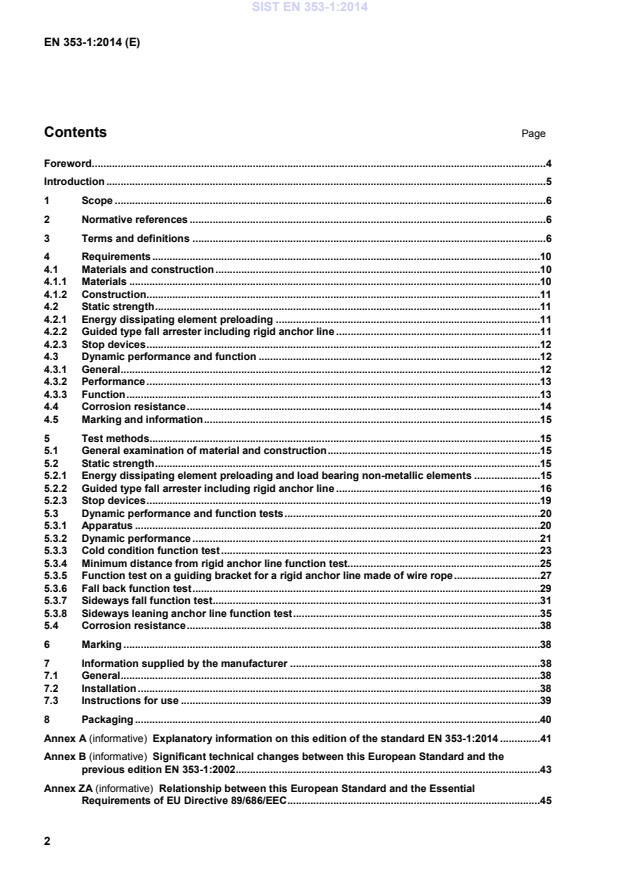
Explanatory information on this edition of the standard EN 353-1:2014 .41 Annex B (informative)
Significant technical changes between this European Standard and the previous edition EN 353-1:2002.43 Annex ZA (informative)
Relationship between this European Standard and the Essential Requirements of EU Directive 89/686/EEC .45 SIST EN 353-1:2014
EN 362,
EN 364:1992,
EN 365, Personal protective equipment against falls frfor usef maintenancef periodic examinationf repairf marking and packaging EN 10264-2, for ropes for general applications EN 13411-5, -bolt wire rope grips EN ISO 9227,
3 Terms and definitions For the purposes of this document, the following terms and definitions apply (for examples see Figure 1). 3.1 guided type fall arrester including a rigid anchor line part of a fall arrest system, consisting of a guided type fall arrester and a rigid anchor line Note 1 to entry: The guided type fall arrester and rigid anchor line form one product i.e. they are tested, certified and intended to be used together. Note 2 to entry: An energy dissipating function may be part of the guided type fall arrester and/or the rigid anchor line. 3.2 guided type fall arrester device with a self-locking function, a guide facility, a connecting element for connection to the appropriate attachment element of a full body harness, which accompanies the user during both upward and downward changes in position without requiring manual adjustment and locks automatically on the anchor line when a fall occurs SIST EN 353-1:2014
a) Example of a rigid anchor line made of rail b) Examples of a rigid anchor line made of wire rope Key 1 rigid anchor line 4 stop type A or B 7 energy dissipating element 2 joint 5 stop type A 8 tensioner 3 bracket 6 guided type fall arrester 9 guiding bracket
10 connecting element Figure 1 — Examples of guided type fall arresters including rigid anchor lines SIST EN 353-1:2014
Key 1 rigid anchor line . (alpha) sideways leaning left angle (0 to 15°) 2 vertical
sideways leaning right angle (0 to 15°) 3 zone of possible configurations
forward leaning angle (0 to 15°) Figure 2 — Illustration of installation configurations of the rigid anchor line 4 Requirements 4.1 Materials and construction 4.1.1 Materials 4.1.1.1 The line part of a rigid anchor line shall be made of a rail or a wire rope. Wire rope used in the manufacture of a rigid anchor line shall have a minimum nominal diameter of 8 mm and shall be made either from stainless steel or steel galvanized conforming to EN 10264-2. 4.1.1.2 Terminations (e.g. a swaged ferrule) for a rigid anchor line made from wire rope shall be made from a metallic material and not known to cause an adverse reaction with the material of the wire rope (e.g. dissimilar metal corrosion, cracking). 4.1.1.3 Connecting or energy dissipating elements from fibre ropes, webbing and sewing threads shall be made from virgin filament or multifilament synthetic fibres suitable for their intended use. The breaking tenacity of the synthetic fibres shall be known to be at least 0,6 N/tex. 4.1.1.4 Materials that may come into contact with the skin of the user shall not be known to cause irritating or sensitization effects when used as intended. 4.1.1.5 When checked in accordance with 5.1, exposed edges or corners of elements shall be relieved either with a radius of at least 0,5 mm or a chamfer of at least 0,5 mm x 45°. SIST EN 353-1:2014
kN when tested in accordance with 5.2.1.2.9. 4.2.2.3 For rigid anchor lines made from wire rope that have been tested in accordance with 5.3.2 and have a peak load at the top anchor greater than 6 kN, the wire rope and all other elements from the top of the anchor line, e.g. an energy dissipating element, but excluding the guided type fall arrester, shall be tested in accordance with 5.2.2.3 and shall hold a load of 2,5 times the recorded peak load (permanent deformation without breaking is acceptable). 4.2.2.4 When tested in accordance with 5.2.2.4, if a guided type fall arrester cannot freely rotate around its rigid anchor line or on a guiding bracket it shall hold a lateral load of 1 kN without becoming detached SIST EN 353-1:2014
Rigid anchor line positioned vertically (±1°) Rigid anchor line positioned vertically (±1°)
NOT APPLICABLE NOT APPLICABLE NOT APPLICABLE NOT APPLICABLE NOT APPLICABLE Rigid test mass equivalent to the minimum rated load NOT APPLICABLE NOT APPLICABLE Rigid anchor line positioned vertically (±1°) Rigid anchor line positioned vertically (±1°)
NOT APPLICABLE NOT APPLICABLE Rigid anchor line positioned with a sideways leaning angle (15° max) Rigid test mass equivalent to the maximum rated load (not less than 100 kg) NOT APPLICABLE NOT APPLICABLE Rigid anchor line positioned vertically (±1°)
Rigid anchor line positioned vertically (±1°)
Rigid anchor line positioned vertically (±1°)
Rigid anchor line positioned vertically (±1°) and positioned with the maximum forward leaning angle allowed (15° max) where applicable Rigid anchor line positioned with a sideways leaning angle (15° max) 4.3.2 Performance When tested in accordance with 5.3.2 with a rigid test mass of 100 kg, the peak load cmax measured at the attachment point on the rigid test mass shall not exceed 6 kN. The rigid test mass shall be held clear of the ground and the arrest distance HAD shall not exceed 1 m. For a rigid anchor line made of wire rope the peak load measured at the position of the top anchor shall be recorded. 4.3.3 Function 4.3.3.1 Cold condition The guided type fall arrester shall be conditioned to at least −30°C unless a lower temperature is claimed by the manufacturer in which case the lowest claimed temperature shall be used. SIST EN 353-1:2014
Sideways leaning anchor line When tested in accordance with 5.3.8 with a rigid test mass equal to the minimum rated load the mass shall be held clear of the ground and the locking distance HLD shall not exceed 0,5 m or the arrest distance HAD shall not exceed 1 m. When tested in accordance with 5.3.8 with a rigid test mass equal to the maximum rated load but not less than 100 kg, the mass shall be held clear of the ground and the locking distance HLD shall not exceed 0,5 m or the arrest distance HAD shall not exceed 1 m. 4.4 Corrosion resistance After testing in accordance with 5.4, all metal parts of the guided type fall arrester including the rigid anchor line shall not show evidence of corrosion that would affect their function, e.g. the correct operation of moving elements, locking function. White scaling or tarnishing is acceptable if the function is not impaired. NOTE This test does not check resistance in highly corrosive environments e.g. offshore, chemical plants. SIST EN 353-1:2014
a) Example of test for rigid anchor line made of rail b) Example of test for rigid anchor line made of wire rope Key A max. allowed distance above top bracket 3 stop device type A B max. span 4 bracket c static load 5 tensioner 1 rigid anchor line 6 guided type fall arrester 2 joint 7 energy dissipating element (if applicable) Figure 3 — Preloading and static strength test arrangement 5.2.2.3 Method for a rigid anchor line made from wire rope where the dynamic load on the top anchor exceeds 6 kN Install the test sample of rigid anchor line made from wire rope with a minimum length of 1 m, including all other elements of the top of the anchor line and terminations, in the test apparatus such that the test load is applied simultaneously to the rigid anchor line and elements. Apply the test load as specified in 4.2.2.3 with a tolerance of (+ 1,00) kN. The test sample shall hold the load for a period of (3 + 0,250) min. See Figure 4. This test should be carried following the dynamic performance test. SIST EN 353-1:2014
Key c static load 3 optional ending element (e.g. energy absorber) 1 rigid anchor line 4 termination 2 load cell (depending static test apparatus) 5 same termination as 4 (for this test only) Figure 4 — Static strength test arrangement for a rigid anchor line made of wire rope where the dynamic load on the top anchor exceeds 6 kN 5.2.2.4 Method for a guided type fall arrester including rigid anchor line for lateral load Install the rigid anchor line with a maximum span in accordance with the information supplied by the manufacturer. Position the guided type fall arrester between two brackets or guiding brackets, at the mid-point of the maximum span permitted by the manufacturer. See Figure 5a and Figure 5d. Apply the test load of (1 + 0,20) kN to the attachment element of the guided type fall arrester in an orthogonal direction to the working axis of the guided type fall arrester. Hold the load for a period of (3 + 0,250) min and verify 4.2.2.4. Carry out the test with the guided type fall arrester positioned at a joint, if applicable. See Figure 5b. Carry out the test with the guided type fall arrester positioned at a bracket, if applicable. See Figure 5c. Carry out the test with the guided type fall arrester positioned on a guiding bracket, if applicable. See Figure 5e. SIST EN 353-1:2014
a) b) c) d) e) Key c static load 3 guided type fall arrester 1 bracket or guiding bracket 4 joint 2 rigid anchor line
Figure 5 — Examples of lateral load test arrangement 5.2.3 Stop devices 5.2.3.1 Method for stop type A Install the test sample of rigid anchor line including the stop type A and the guided type fall arrester in the test apparatus. Set the guided type fall arrester in the unlocked mode and position it in contact with the stop type A. Apply a static test load of (2 + 0,20) kN in each direction of use as permitted by the manufacturer to the guided type fall arrester via its connecting element such that the load is also applied to the stop type A. The stop type A shall hold the load for a period (3 + 0,250) min. See Figure 6. SIST EN 353-1:2014
a) Stop type A upward test b) Stop type A downward test Key c static load 2 stop type A 1 guided type fall arrester 3 rigid anchor line Figure 6 — Static strength test arrangement for stop type A 5.2.3.2 Method for stop type B Install the test sample of rigid anchor line including the stop type B and the guided type fall arrester in the test apparatus. Set the guided type fall arrester in the unlocked mode and position it immediately above and in contact with the stop type B. Apply a static test load of (12 + 1,00) kN to the guided type fall arrester via its connecting element such that the load is also applied to the stop type B. The stop type B shall hold the load for a period (3 + 0,250) min. See Figure 7.
Key c static load 2 stop type B 1 guided type fall arrester 3 rigid anchor line Figure 7 — Static strength test arrangement for stop type B 5.3 Dynamic performance and function tests 5.3.1 Apparatus The test apparatus for the dynamic performance test shall conform to EN 364:1992, 4.4, 4.5 and 4.6. SIST EN 353-1:2014
Key HAD arrest distance 4 rigid test mass 1 load cell 5 rigid anchor line 2 quick release device 6 connecting line 3 guided type fall arrester 7 bracket
8 energy dissipating element (if applicable) Figure 8 — Test arrangement for dynamic performance test for an anchor line made of rail SIST EN 353-
...