

EN 14067-6:2010
(Main)Railway applications - Aerodynamics - Part 6: Requirements and test procedures for cross wind assessment
- Abstract
This European Standard applies to the cross wind assessment of railways taking into consideration the recommendations given in Annex M on the application of the standard (migration rule). The methods presented have been applied to passenger vehicles with a maximum speed up to 360 km/h and to freight vehicles with a maximum speed up to 160 km/h. This European Standard applies to coaches, multiple units, freight wagons, locomotives and power cars.
- Status
- Withdrawn
- Publication Date
- 26-Jan-2010
- Withdrawal Date
- 06-Oct-2026
- Technical Committee
- CEN/TC 256 - Railway applications
- Drafting Committee
- CEN/TC 256/WG 6 - Aerodynamics
- Current Stage
- 9960 - Withdrawal effective - Withdrawal
- Start Date
- 25-Jul-2018
- Completion Date
- 07-Oct-2026

Relations
- Effective Date
- 20-May-2015
- Effective Date
- 28-Jan-2026
- Effective Date
- 28-Jan-2026
- Effective Date
- 28-Jan-2026
- Effective Date
- 28-Jan-2026
- Effective Date
- 28-Jan-2026
- Effective Date
- 28-Jan-2026
- Referred By
EN 12943:1999 - Filler materials for thermoplastics - Scope, designation, requirements, tests - Effective Date
- 28-Jan-2026
Get Certified
Connect with accredited certification bodies for this standard

IRIS Certification (UNIFE)
International Railway Industry Standard certification.

TÜV SÜD Rail GmbH
TÜV SÜD railway certification services.

Bureau Veritas Railway Certification
Railway and transportation certification.
Sponsored listings
Frequently Asked Questions
EN 14067-6:2010 is a standard published by the European Committee for Standardization (CEN). Its full title is "Railway applications - Aerodynamics - Part 6: Requirements and test procedures for cross wind assessment". This standard covers: This European Standard applies to the cross wind assessment of railways taking into consideration the recommendations given in Annex M on the application of the standard (migration rule). The methods presented have been applied to passenger vehicles with a maximum speed up to 360 km/h and to freight vehicles with a maximum speed up to 160 km/h. This European Standard applies to coaches, multiple units, freight wagons, locomotives and power cars.
This European Standard applies to the cross wind assessment of railways taking into consideration the recommendations given in Annex M on the application of the standard (migration rule). The methods presented have been applied to passenger vehicles with a maximum speed up to 360 km/h and to freight vehicles with a maximum speed up to 160 km/h. This European Standard applies to coaches, multiple units, freight wagons, locomotives and power cars.
EN 14067-6:2010 is classified under the following ICS (International Classification for Standards) categories: 45.060.01 - Railway rolling stock in general. The ICS classification helps identify the subject area and facilitates finding related standards.
EN 14067-6:2010 has the following relationships with other standards: It is inter standard links to EN 14067-6:2018, EN 14067-4:2024+A1:2025, EN 14067-1:2003, EN 14363:2016+A2:2022, EN 15663:2017+A2:2024, EN 14033-1:2017, EN 14752:2005, EN 12943:1999. Understanding these relationships helps ensure you are using the most current and applicable version of the standard.
EN 14067-6:2010 is associated with the following European legislation: EU Directives/Regulations: 2001/16/EC, 2008/57/EC, 96/48/EC; Standardization Mandates: M/275, M/334. When a standard is cited in the Official Journal of the European Union, products manufactured in conformity with it benefit from a presumption of conformity with the essential requirements of the corresponding EU directive or regulation.
EN 14067-6:2010 is available in PDF format for immediate download after purchase. The document can be added to your cart and obtained through the secure checkout process. Digital delivery ensures instant access to the complete standard document.
Standards Content (Sample)
2003-01.Slovenski inštitut za standardizacijo. Razmnoževanje celote ali delov tega standarda ni dovoljeno.Bahnanwendungen - Aerodynamik - Teil 6: Anforderungen und Prüfverfahren zur Bewertung von SeitenwindApplications ferroviaires - Aérodynamique - Partie 6 : Exigences et procédures d'essai pour l'évaluation de la stabilité vis-a-vis des vents traversiersRailway applications - Aerodynamics - Part 6: Requirements and test procedures for cross wind assessment45.060.01Železniška vozila na splošnoRailway rolling stock in generalICS:Ta slovenski standard je istoveten z:EN 14067-6:2010SIST EN 14067-6:2011en,fr,de01-februar-2011SIST EN 14067-6:2011SLOVENSKI
STANDARD
EUROPEAN STANDARD NORME EUROPÉENNE EUROPÄISCHE NORM
EN 14067-6
January 2010 ICS 45.060.01 English Version
Railway applications - Aerodynamics -Part 6: Requirements and test procedures for cross wind assessment
Applications ferroviaires - Aérodynamique - Partie 6 : Exigences et procédures d'essai pour l'évaluation de la stabilité vis-à-vis des vents traversiers
Bahnanwendungen - Aerodynamik - Teil 6: Anforderungen und Prüfverfahren für die Bewertung von Seitenwind This European Standard was approved by CEN on 24 October 2009.
CEN members are bound to comply with the CEN/CENELEC Internal Regulations which stipulate the conditions for giving this European Standard the status of a national standard without any alteration. Up-to-date lists and bibliographical references concerning such national standards may be obtained on application to the CEN Management Centre or to any CEN member.
This European Standard exists in three official versions (English, French, German). A version in any other language made by translation under the responsibility of a CEN member into its own language and notified to the CEN Management Centre has the same status as the official versions.
CEN members are the national standards bodies of Austria, Belgium, Bulgaria, Croatia, Cyprus, Czech Republic, Denmark, Estonia, Finland, France, Germany, Greece, Hungary, Iceland, Ireland, Italy, Latvia, Lithuania, Luxembourg, Malta, Netherlands, Norway, Poland, Portugal, Romania, Slovakia, Slovenia, Spain, Sweden, Switzerland and United Kingdom.
EUROPEAN COMMITTEE FOR STANDARDIZATION
COMITÉ EUROPÉEN DE NORMALISATION EUROPÄISCHES KOMITEE FÜR NORMUNG
Management Centre:
Avenue Marnix 17,
B-1000 Brussels © 2010 CEN All rights of exploitation in any form and by any means reserved worldwide for CEN national Members. Ref. No. EN 14067-6:2010: ESIST EN 14067-6:2011
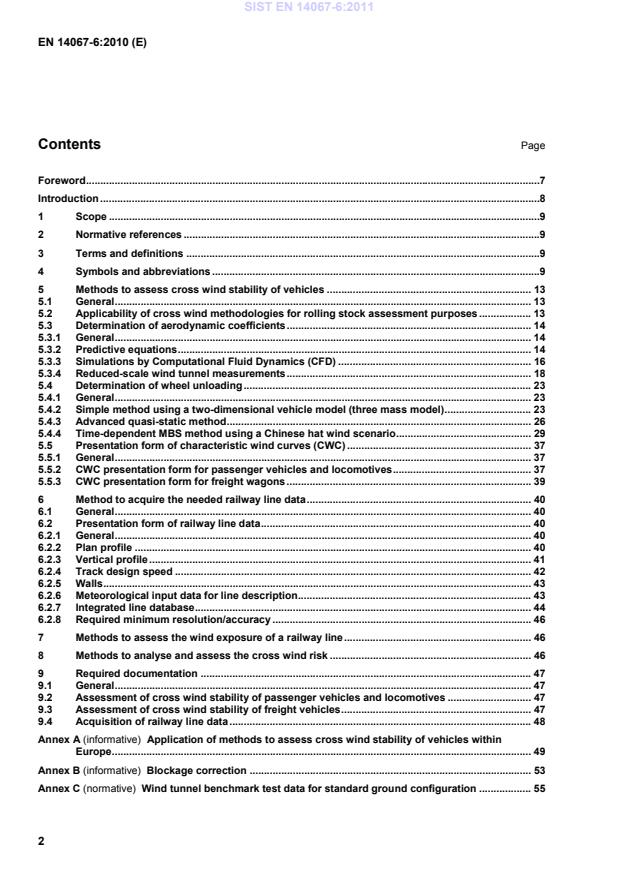
Application of methods to assess cross wind stability of vehicles within Europe . 49Annex B (informative)
Blockage correction . 53Annex C (normative)
Wind tunnel benchmark test data for standard ground configuration . 55SIST EN 14067-6:2011
Other ground configurations for wind tunnel testing . 59Annex E (informative)
Wind tunnel benchmark test data for other ground configurations . 63Annex F (informative)
Embankment overspeed effect . 76Annex G (informative)
Atmospheric boundary layer wind tunnel testing . 77Annex H (informative)
Five mass model . 83Annex I (normative)
Mathematical model for the Chinese hat . 98Annex J (informative)
Stochastic wind model . 105Annex K (informative)
Stability of passenger vehicles and locomotives against overturning at standstill according to national guidelines . 113Annex L (informative)
Information on methods to assess the wind exposure of a railway line . 116Annex M (informative)
Migration rule for this European Standard . 119Annex ZA (informative)
Relationship between this European Standard and the Essential Requirements of EU Directive 2008/57/EC . 120Bibliography . 124 Figures Figure 1 — Sketch of the wind tunnel configuration single track ballast (front view, 1:1 scale) . 22Figure 2 — Sketch of the wind tunnel configuration single track ballast (side and top view, 1:1 scale) . 22Figure 3 — Illustration of three mass model . 24Figure 4 — Illustration of contact point . 28Figure 5 — Example of the spatial distribution of the wind using a Chinese hat gust model . 30Figure 6 — Illustration of wind decay within Chinese hat gust model . 32Figure 7 — Application of Chinese hat wind scenario: Example of temporal wind distribution for vtr = 200 km/h, vW = 30 m/s, vehicle length = 24 m . 33Figure 8 — Illustration of geometric approach considering the angle of attack . 36Figure 9 — Illustration of geometric approach considering the angle of attack of CWC on straight track . 37Figure C.1 — Contour of a wind tunnel model of the ICE 3 endcar . 55Figure C.2 — Contour of a wind tunnel model of the TGV Duplex powercar . 57Figure C.3 — Contour of a wind tunnel model of the ETR 500 powercar . 58Figure D.1 — Sketch of the wind tunnel configuration flat ground with 235 mm gap . 59Figure D.2 — Sketch of ballast geometry . 60Figure D.3 — Sketch of the embankment geometry . 60Figure D.4 — Sketch of the wind tunnel configuration flat ground without gap . 61Figure D.5 — Ballast and rail configuration for uncanted track in Great Britain . 62Figure D.6 — Saw tooth canted ballast and rail in Great Britain . 62Figure F.1 — Illustration of embankment overspeed effect . 76Figure G.1 — Upper and lower limits for mean velocity profiles . 78Figure H.1 — Illustration of five mass model . 84SIST EN 14067-6:2011
am s/m Dispersion Dispersion determined by extreme value analysis of wind tunnel data SIST EN 14067-6:2011
Axz m2 Reference side area of the model vehicle The side area of the model vehicle A0 m2 Reference normalisation area 10 m2 bA
Lateral contact spacing
bA,min
Minimum lateral contact spacing
Fic - Non-dimensional force coefficient based on A0 0AvFciFi22⋅⋅=ρ, i = x, y, z Mic - Non-dimensional moment coefficient based on A0 and d0 00dAvMciMi22⋅⋅=ρ, i = x, y, z leex,Mc - Non-dimensional rolling moment coefficient around leeward rail
bmklee,x,Mc - Benchmark value of rolling moment coefficient around leeward rail Rolling moment coefficient determined from the benchmark tests d0 m Reference normalisation length 3 m F Hz Frequency
fh
Function of the embankment blockage ratio, BE
ûQf - Relative windward wheel unloading factor 0,9 fm
Method factor To account for uncertainties in the 3 mass model. h m Vehicle height
hcant m Cant
hVEH m Height of the vehicle from top of rail to roof
hBL m Boundary layer height
Ii
Turbulence index for the i-wind componenti = u, v, w Iu(z)
- Turbulence intensity The standard deviation of the wind tunnel velocity at height z divided by the mean velocity at that height L m Vehicle length
LVEH m Length parameter of the vehicle car body
ixL m Longitudinal integral length scale of the i-wind velocity component along the x direction i = u, v, w
Longitudinal streamwise velocity turbulence length scale in the core stream u_FSxL m Full scale turbulence length scale
Mm Nm Restoring moment due to the vehicles masses
Mla Nm Moment due to uncompensated lateral acceleration
MCoG Nm Moment due to the lateral movement of the centre of gravity of suspended masses
Mx,lee Nm Rolling moment around leeward rail
m kg Vehicle mass (to be considered for cross wind assessment) Refers to operational mass in working order according to EN 15663 m0 kg Unsprung masses Refers to operational mass in working order according to EN 15663 m1 kg Primary suspended masses Refers to operational mass in working order according to EN 15663 m2 kg Secondary suspended masses Refers to operational mass in working order according to EN 15663 ∆Q N Wheel unloading
Q0 N Average static wheel load
∆Q/Q0 - Relative wheel unloading
RC m Radius of curve
Remax
Maximum Reynolds number The maximum achievable Reynolds number in a wind tunnel test SU m2/s2/Hz Power spectral density
St - Model time scale The ratio of time at model scale to time at full scale Tsamp s Data acquisition duration The sampling duration for acquiring data Tux
Turbulence level α)0,522x/'uuTu=
U(t) m/s Instantaneous wind (tunnel) velocity
Uturb m/s Wind velocity turbulent component along the mean wind direction
va m/s Relative wind velocity
vmax m/s Maximum train speed
vW m/s Wind speed
Vx m/s Magnitude of wind speed vector Refers to the upwind at 4 m height above ground xB % Blockage ratio at β = 30° Total modelled configuration projected side area to the wind tunnel cross section yB m (Maximum) displacement of the contact point on the wheel in the wheel flange direction
z m Height from the ground
zCoG m Height of the centre of gravity of the total vehicle
zCoG,0 m Height of the centre of gravity of the unsprung masses
zCoG,1 m Height of the centre of gravity of the primary suspended masses
zCoG,2 m Height of the centre of gravity of the secondary suspended masses
z0 m Roughness height
o Yaw angle The angle between the vehicle axis and the relative wind acting on the train. In a wind tunnel with stationary train model, it is the angle between the train axis and the wind tunnel axis δ99%Θm Boundary layer thickness z coordinate at which the local velocity equals 99 % of the free stream velocity εmaxΘ Maximum tolerance target value
εmeanΘ Mean tolerance target value
ρ0 kg/m3 Reference air density ρ0 = 1,225 kg/m3
It has to be noted that the CWC indicate the cross wind stability of the train related to a characteristic state of the wheel vertical forces; the characteristic wind curves do not indicate an overturning threshold. For a given train running at a range of speeds, the CWC define the maximum natural wind speed that a train can withstand before a characteristic limit for wheel unloading is exceeded. The criterion that defines the CWC is the average value of wheel unloading, ∆Q, of the most critical running gear. The term "average" means that, in case of bogies, wheel unloading is averaged over the wheel sets of the bogie. For the relative assessment of cross wind stability of vehicles the reference air density ρ0 is fixed at 1,225 kg/m³. Further, the vehicle mass to be considered is defined as the “operational mass in working order” according to EN 15663.
The assessment of cross wind stability of vehicles separates into evaluations of the aerodynamic characteristics (i.e. the aerodynamic coefficients) and the vehicle dynamic characteristics. Subclause 5.2 states the applicability of the various methods for the purpose of rolling stock assessment. Subclause 5.3 provides various methods for the determination of aerodynamic coefficients of passenger and freight vehicles and locomotives. Subclause 5.4 provides various methods for the determination of wheel unloading.
Subclause 5.5 gives information on the required presentation form of CWC of passenger and freight vehicles and locomotives. 5.2 Applicability of cross wind methodologies for rolling stock assessment purposes Subclauses 5.3 and 5.4 provide various methods for the assessment of the aerodynamic and vehicle dynamic characteristics. In general, these methods divide into simple and complex methods. The simpler methods are easier to apply, but imply an extra uncertainty supplement because they are tuned to be conservative in comparison to the complex ones. Table 2 specifies which method shall be applied for rolling stock assessment purposes depending on type of rolling stock and its maximum speed vmax. If various methods are permitted, the choice of the method depends on the degree of accuracy necessary for the problem. As a general principle, however, it is logical to start with the simplest appropriate procedures and then to shift to more complex methods if necessary.
All vehicles shall be assessed using any of the methods in Table 2. In case of a fixed train composition it is sufficient to prove the cross wind stability of only the most cross wind sensitive vehicle in the train consist. In other cases, it is necessary to prove the cross wind stability of each vehicle. SIST EN 14067-6:2011
Passenger rolling stock and locomotives Freight wagons Speed range vmax ≤ 140 km/h 140 km/h < vmax ≤ 200 km/h
200 km/h < vmax ≤ 360 km/h a vmax ≤ 80 km/h 80 km/h < vmax
≤ 160 km/h Simplified proof of cross wind stability
Yes, Regulated by national require-ments (see Annex K for more information). Yes, Subclause 5.3.2 + 5.4.2 or
5.3.3 + 5.4.2 or
5.3.3 + 5.4.3 or 5.3.4 + 5.4.2 Restrictions:
5.3.2 not appli-cable for trains with active tilting mode 5.4.2 not appli-cable for articulated trains Yes, Subclause 5.3.4 + 5.4.2
Restrictions:
5.4.2 not appli-cable for articulated trains Yes, Regulated by national requirements (see Annex K for more information). Yes, Subclause 5.3.2 + 5.4.2 or 5.3.3 + 5.4.2
Full proof of cross wind stability No Yes, Subclause 5.3.4 + 5.4.3 or
5.3.4 + 5.4.4 Yes, Subclause 5.3.4 + 5.4.3 or
5.3.4 + 5.4.4
No Yes, Subclause 5.3.4 + 5.4.2 or 5.3.4 + 5.4.3 a Above 360 km/h the methods shall be adapted taking into account also compressibility effects. Annex A indicates how these approaches are combined for practical cross wind stability analysis in various European countries. 5.3 Determination of aerodynamic coefficients 5.3.1 General Various methods are available to determine the aerodynamic loading on passenger or freight vehicles. Static wind tunnel test data often serve as a part of the proof that the vehicle fulfils given specifications or requirements for rolling stock assessment. Data obtained from Computation Fluid Dynamics (CFD) simulations are often used for feasibility studies in the early vehicle design process. Data obtained with predictive equations are usually used for a first analysis. The following subclauses describe how these methods are to be applied. Table 2 indicates their applicability for rolling stock assessment purposes. 5.3.2 Predictive equations The predictive equations can only be used subject to the following restrictions: The method may not be valid for vehicles which differ much in their shape from the shape of current vehicles. The method is not valid for leading end cars with a length L greater than 28 m or less than 10 m. SIST EN 14067-6:2011
when the parameters z0, z1, z2, z3, z4, z5, fL, and fVEH are given (see Table 3). leex,Mc is based on A0 and d0, this normalization differs from EN 14067-1. Table 3 — Parameter set for the standard ground configuration (standard gauge) Parameter Passenger vehicle (leading endcar) and locomotive Passenger vehicle (midcar) Freight vehicle z0 0 For 0° ≤ β ≤ 40°: z0 = 0 For β > 40°: z0 = 0,55 z1 4,3·10-3 For 0° ≤ β ≤ 40°:
z1 = 0,01375 For β > 40°: z1 = 0 z2 2,2·10-4 0 z3 -2,1·10-6 0 z4 1,2 1 z5 1,2 1 LVEH Length of the vehicle car body without buffer and inter car gap Length over buffer fL 0VEH2LLfL−=with L0 = 25 m 1 1 fVEH 1 0,75 1 A0 10 m2 d0 3 m ß Yaw angle in degrees hVEH Height of the vehicle from top of rail to roof according to EN 14067-1
...