

EN 3155-001:2025
(Main)Aerospace series - Electrical contacts used in elements of connection - Part 001: Technical specification
- Abstract
This document specifies:
- the electrical, mechanical, environmental and dimensional characteristics of electrical contacts used in elements of connection, including coaxial, triaxial and quadrax contacts;
- the conditions for qualification, acceptance testing and quality assurance;
- the test programs and groups.
It is applicable to removable crimp contacts, wrap contacts, solder contacts used in connectors or in other elements of electrical connection.
In case of conflict or missing information between the EN 3155-001 and the product standards, the product standard takes precedence.
- Status
- Published
- Publication Date
- 22-Apr-2025
- Technical Committee
- ASD-STAN - Aerospace
- Current Stage
- 6060 - Definitive text made available (DAV) - Publishing
- Start Date
- 23-Apr-2025
- Completion Date
- 23-Apr-2025

Overview
EN 3155-001:2025 - Aerospace series - Electrical contacts used in elements of connection - Part 001: Technical specification - defines the electrical, mechanical, environmental and dimensional requirements for electrical contacts used in aerospace connectors and other connection elements. It covers coaxial, triaxial and quadrax contacts and sets conditions for qualification, acceptance testing and quality assurance, including test programmes and grouped test sequences. The standard applies to removable crimp, wrap and solder contacts. Where product-specific standards exist, the product standard takes precedence.
Key topics and requirements
- Scope of application: removable crimp, wrap and solder contacts for connectors and connection elements; includes coaxial/triaxial/quadrax assemblies.
- Performance characteristics: electrical, mechanical, environmental and dimensional characteristics required for reliable aerospace use.
- Contact types: definitions for Type A (general removable), Type B (non-removable), Type C (thermocouple), Type D (screened/coaxial/triaxial/bifilar) and Type E.
- Design and materials: requirements for mating ends, solder buckets, crimp barrels, terminations and plating (active, transition and crimping areas).
- Testing and qualification: structured test programmes and groups, acceptance tests and type-approval sequences - including sampling, specimen preparation and maintenance of qualification.
- Quality assurance: lot inspection, manufacturing controls and maintenance of qualification consistent with aerospace quality systems.
- Documentation and marking: designation, marking, delivery, packaging and storage conditions.
Note: EN 3155-001:2025 updates earlier editions (supersedes 2016), introduces contact size 23 with barrel 22 and revisions to specific tests and test sequences.
Applications and users
Who uses EN 3155-001:2025:
- Aerospace connector manufacturers and component suppliers (crimp, solder and wrap contact producers)
- Aerospace OEMs and systems integrators specifying connector performance and procurement criteria
- Quality, testing and certification laboratories performing qualification and acceptance testing
- Design and electrical engineers defining interconnection solutions for aircraft and spacecraft
Practical uses: - Design validation of connector contacts (dimensional, electrical and mechanical compliance)
- Developing and executing qualification and acceptance test programs
- Supplier quality agreements and product procurement specifications
Related standards
Key normative references include:
- EN 2083, EN 2242, EN 2591 (test methods), EN 3197, EN 4434, EN 9133, EN ISO 27874, IEC 60352-1, ISO 2859-1, ISO 8843, TR 3198.
Keywords: EN 3155-001:2025, electrical contacts, aerospace connectors, crimp contacts, coaxial contacts, qualification testing, quality assurance, triaxial, quadrax.
Relations
- Effective Date
- 18-Jan-2023
- Effective Date
- 25-Aug-2026
- Effective Date
- 25-Aug-2026
- Effective Date
- 09-Feb-2026
- Effective Date
- 28-Jan-2026
- Effective Date
- 28-Jan-2026
- Effective Date
- 28-Jan-2026
- Effective Date
- 28-Jan-2026
- Effective Date
- 28-Jan-2026
- Effective Date
- 28-Jan-2026
- Effective Date
- 28-Jan-2026
- Effective Date
- 28-Jan-2026
- Effective Date
- 28-Jan-2026
- Effective Date
- 28-Jan-2026
- Effective Date
- 28-Jan-2026
Get Certified
Connect with accredited certification bodies for this standard

BUREAU VERITAS Certification Germany
Bureau Veritas certification in Germany.

Element Materials Technology
Materials testing and product certification.

AQMS Ltd.
AQMS provides ISO certification to SMEs across the UK.
Sponsored listings
Frequently Asked Questions
EN 3155-001:2025 is a standard published by the European Committee for Standardization (CEN). Its full title is "Aerospace series - Electrical contacts used in elements of connection - Part 001: Technical specification". This standard covers: This document specifies: - the electrical, mechanical, environmental and dimensional characteristics of electrical contacts used in elements of connection, including coaxial, triaxial and quadrax contacts; - the conditions for qualification, acceptance testing and quality assurance; - the test programs and groups. It is applicable to removable crimp contacts, wrap contacts, solder contacts used in connectors or in other elements of electrical connection. In case of conflict or missing information between the EN 3155-001 and the product standards, the product standard takes precedence.
This document specifies: - the electrical, mechanical, environmental and dimensional characteristics of electrical contacts used in elements of connection, including coaxial, triaxial and quadrax contacts; - the conditions for qualification, acceptance testing and quality assurance; - the test programs and groups. It is applicable to removable crimp contacts, wrap contacts, solder contacts used in connectors or in other elements of electrical connection. In case of conflict or missing information between the EN 3155-001 and the product standards, the product standard takes precedence.
EN 3155-001:2025 is classified under the following ICS (International Classification for Standards) categories: 49.060 - Aerospace electric equipment and systems. The ICS classification helps identify the subject area and facilitates finding related standards.
EN 3155-001:2025 has the following relationships with other standards: It is inter standard links to EN 3155-001:2016, ISO 8843:2005, ISO 2859-1:1999, IEC 60352-1:1997, EN 2591-709:2001, EN 2591-318:2018, EN 2591-704:2001, EN 2591-601:2001, EN 2591-607:2002, EN 2591-6301:2001, EN 2591-502:2001, EN 2591-409:1999, EN 2591-312:1997, EN 2591-222:2007, EN 2591-427:2001. Understanding these relationships helps ensure you are using the most current and applicable version of the standard.
EN 3155-001:2025 is available in PDF format for immediate download after purchase. The document can be added to your cart and obtained through the secure checkout process. Digital delivery ensures instant access to the complete standard document.
Standards Content (Sample)
SLOVENSKI STANDARD
01-junij-2025
Aeronavtika - Električni kontakti za uporabo v veznih elementih - 001. del:
Tehnična specifikacija
Aerospace series - Electrical contacts used in elements of connection - Part 001:
Technical Specification
Luft- und Raumfahrt - Elektrische Kontakte zur Verwendung in Verbindungselementen -
Teil 001: Technische Lieferbedingungen
Série aérospatiale - Contacts électriques utilisés dans les organes de connexion - Partie
001: Spécification technique
Ta slovenski standard je istoveten z: EN 3155-001:2025
ICS:
49.060 Letalska in vesoljska Aerospace electric
električna oprema in sistemi equipment and systems
2003-01.Slovenski inštitut za standardizacijo. Razmnoževanje celote ali delov tega standarda ni dovoljeno.
EN 3155-001
EUROPEAN STANDARD
NORME EUROPÉENNE
April 2025
EUROPÄISCHE NORM
ICS 49.060 Supersedes EN 3155-001:2016
English Version
Aerospace series - Electrical contacts used in elements of
connection - Part 001: Technical specification
Série aérospatiale - Contacts électriques utilisés dans Luft- und Raumfahrt - Elektrische Kontakte zur
les organes de connexion - Partie 001 : Spécification Verwendung in Verbindungselementen - Teil 001:
technique Technische Lieferbedingungen
This European Standard was approved by CEN on 17 February 2025.
CEN members are bound to comply with the CEN/CENELEC Internal Regulations which stipulate the conditions for giving this
European Standard the status of a national standard without any alteration. Up-to-date lists and bibliographical references
concerning such national standards may be obtained on application to the CEN-CENELEC Management Centre or to any CEN
member.
This European Standard exists in three official versions (English, French, German). A version in any other language made by
translation under the responsibility of a CEN member into its own language and notified to the CEN-CENELEC Management
Centre has the same status as the official versions.
CEN members are the national standards bodies of Austria, Belgium, Bulgaria, Croatia, Cyprus, Czech Republic, Denmark, Estonia,
Finland, France, Germany, Greece, Hungary, Iceland, Ireland, Italy, Latvia, Lithuania, Luxembourg, Malta, Netherlands, Norway,
Poland, Portugal, Republic of North Macedonia, Romania, Serbia, Slovakia, Slovenia, Spain, Sweden, Switzerland, Türkiye and
United Kingdom.
EUROPEAN COMMITTEE FOR STANDARDIZATION
COMITÉ EUROPÉEN DE NORMALISATION
EUROPÄISCHES KOMITEE FÜR NORMUNG
CEN-CENELEC Management Centre: Rue de la Science 23, B-1040 Brussels
© 2025 CEN All rights of exploitation in any form and by any means reserved Ref. No. EN 3155-001:2025 E
worldwide for CEN national Members.
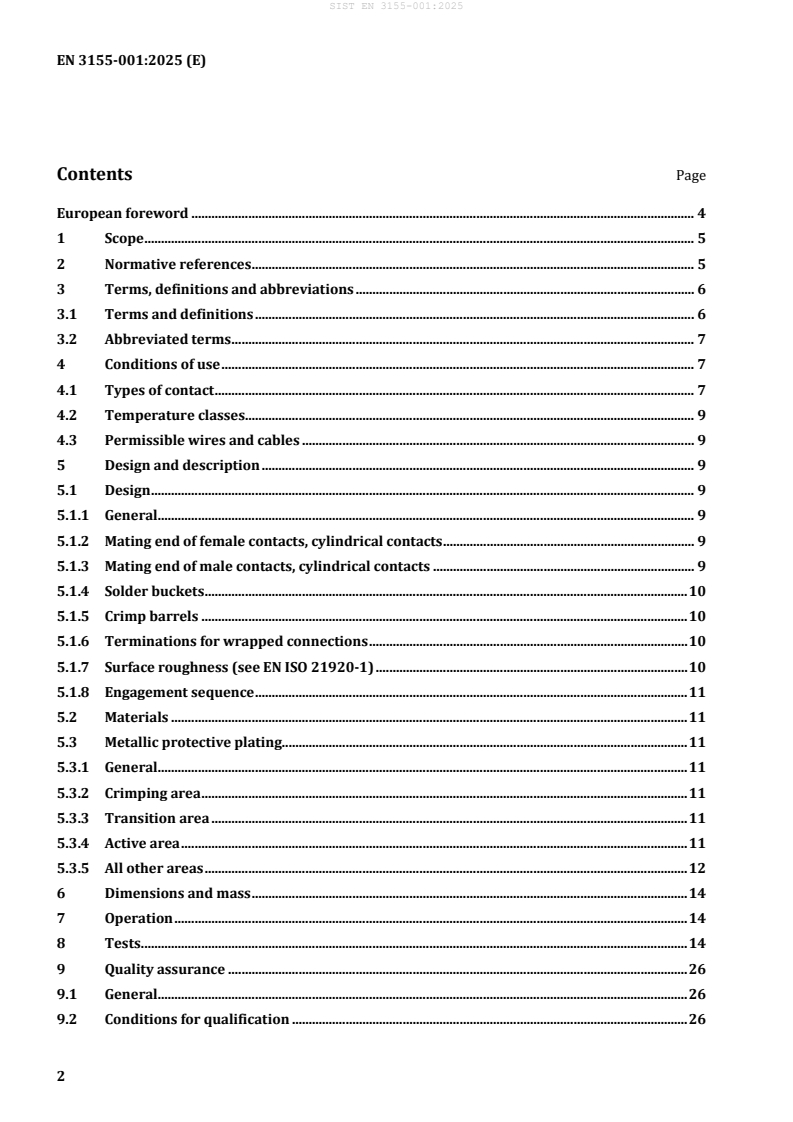
Contents Page
European foreword . 4
1 Scope . 5
2 Normative references . 5
3 Terms, definitions and abbreviations . 6
3.1 Terms and definitions . 6
3.2 Abbreviated terms . 7
4 Conditions of use . 7
4.1 Types of contact . 7
4.2 Temperature classes. 9
4.3 Permissible wires and cables . 9
5 Design and description . 9
5.1 Design . 9
5.1.1 General. 9
5.1.2 Mating end of female contacts, cylindrical contacts . 9
5.1.3 Mating end of male contacts, cylindrical contacts . 9
5.1.4 Solder buckets . 10
5.1.5 Crimp barrels . 10
5.1.6 Terminations for wrapped connections . 10
5.1.7 Surface roughness (see EN ISO 21920-1) . 10
5.1.8 Engagement sequence . 11
5.2 Materials . 11
5.3 Metallic protective plating. 11
5.3.1 General. 11
5.3.2 Crimping area . 11
5.3.3 Transition area . 11
5.3.4 Active area . 11
5.3.5 All other areas . 12
6 Dimensions and mass . 14
7 Operation . 14
8 Tests . 14
9 Quality assurance . 26
9.1 General. 26
9.2 Conditions for qualification . 26
9.2.1 General . 26
9.2.2 Sampling and definition of specimens . 26
9.2.3 Preparation of specimens . 27
9.2.4 Test programme – Type A contacts . 28
9.2.5 Programme of qualification approval tests – Type C contacts . 34
9.2.6 Programme of qualification approval tests – Type D contacts. 36
9.2.7 Programme of qualification approval tests – Type E contacts . 38
9.3 Inspection conditions for manufacturing lots . 41
9.4 Maintenance of qualification . 41
9.4.1 General . 41
9.4.2 Type A contacts . 42
9.4.3 Type C contacts . 44
9.4.4 Type D contacts . 46
9.4.5 Type E contacts . 47
10 Designation and marking . 50
10.1 Designation . 50
10.2 Marking . 51
11 Delivery conditions . 51
12 Packaging . 51
13 Storage . 51
Bibliography . 53
European foreword
This document (EN 3155-001:2025) has been prepared by ASD-STAN.
After enquiries and votes carried out in accordance with the rules of this Association, this document has
received the approval of the National Associations and the Official Services of the member countries of
ASD-STAN, prior to its presentation to CEN.
This European Standard shall be given the status of a national standard, either by publication of an
identical text or by endorsement, at the latest by October 2025, and conflicting national standards shall
be withdrawn at the latest by October 2025.
Attention is drawn to the possibility that some of the elements of this document may be the subject of
patent rights. CEN shall not be held responsible for identifying any or all such patent rights.
This document supersedes EN 3155-001:2016.
This document includes the following significant technical changes with respect to EN 3155-001:2016:
— update of normative references;
— introduction of contact size 23 with barrel 22;
— revision of test 101 and 417 in Table 2;
— removal of remarks in Table 5, Table 6 and Table 7;
— introduction of test 418 prior to test 201 in group 2 of Table 8;
— removal of tests 221, 222 and 223 and introduction of test 508 in group 2 of Table 11;
— editorial revision of the document.
Any feedback and questions on this document should be directed to the users’ national standards body.
A complete listing of these bodies can be found on the CEN website.
According to the CEN-CENELEC Internal Regulations, the national standards organizations of the
following countries are bound to implement this European Standard: Austria, Belgium, Bulgaria,
Croatia, Cyprus, Czech Republic, Denmark, Estonia, Finland, France, Germany, Greece, Hungary, Iceland,
Ireland, Italy, Latvia, Lithuania, Luxembourg, Malta, Netherlands, Norway, Poland, Portugal, Republic of
North Macedonia, Romania, Serbia, Slovakia, Slovenia, Spain, Sweden, Switzerland, Türkiye and the
United Kingdom.
1 Scope
This document specifies:
— the electrical, mechanical, environmental and dimensional characteristics of electrical contacts used
in elements of connection, including coaxial, triaxial and quadrax contacts;
— the conditions for qualification, acceptance testing and quality assurance;
— the test programs and groups.
It is applicable to removable crimp contacts, wrap contacts, solder contacts used in connectors or in
other elements of electrical connection.
In case of conflict or missing information between the EN 3155-001 and the product standards, the
product standard takes precedence.
2 Normative references
The following documents are referred to in the text in such a way that some or all of their content
constitutes requirements of this document. For dated references, only the edition cited applies. For
undated references, the latest edition of the referenced document (including any amendments) applies.
EN 2083, Aerospace series — Copper or copper alloys conductors for electrical cables — Product standard
EN 2242, Aerospace series — Crimping of electric cables with conductors defined by EN 2083, EN 4434
and EN 2346
EN 2424, Aerospace series — Marking of aerospace products
EN 2591 (all parts), Aerospace series — Elements of electrical and optical connection — Test methods
EN 3197, Aerospace series — Design and installation of aircraft electrical and optical interconnection
systems
EN 4434, Aerospace series — Copper or copper alloy lightweight conductors for electrical cables —
Product standard (Normal and tight tolerances)
EN 9133, Aerospace series — Quality Management Systems — Qualification Procedure for Aerospace
Standard Products
EN ISO 27874, Metallic and other inorganic coatings — Electrodeposited gold and gold alloy coatings for
electrical, electronic and engineering purposes — Specification and test methods (ISO 27874)
IEC 60352-1, Solderless connections — Part 1: Wrapped connections — General requirements, test
methods and practical guidance
ISO 2859-1, Sampling procedures for inspection by attributes — Part 1: Sampling schemes indexed by
acceptance quality limit (AQL) for lot-by-lot inspection
ISO 8843, Aircraft — Crimp-removable contacts for electrical connectors — Identification system
Published by: IEC International Electrotechnical Commission https://www.iec.ch/
TR 3198, Aerospace series — Manufacturers' identification monograms and marks for EN aerospace
products
3 Terms, definitions and abbreviations
For the purposes of this document, the terms and definitions given in EN 2591-100 and the following
apply.
ISO and IEC maintain terminology databases for use in standardization at the following addresses:
— ISO Online browsing platform: available at https://www.iso.org/obp
— IEC Electropedia: available at https://www.electropedia.org/
3.1 Terms and definitions
3.1.1
point of electrical contact
position of point of application of the force which provides contact pressure
3.1.2
contact active area
part of the contact which allows current to pass between the contact male and female
3.1.3
contact transition area
all mechanical liaisons that contribute to electrical performance and which are different from contact
active area
Note 1 to entry: See 3.3 “contact active area”.
3.1.4
coaxial contact
assembly of two contacts arranged coaxially enabling the connection of coaxial, shielded or bifilar
cables
Note 1 to entry: According to Figure 1.
Note 2 to entry: Male coaxial contact where the outer contact is male; the central contact(s) may be male or
female.
Note 3 to entry: Female coaxial contact where the outer contact is female; the central contact(s) may be male or
female.
3.1.5
triaxial contact
assembly of three contacts arranged coaxially, enabling the connection of shielded triaxial or bifilar
cables
Note 1 to entry: According to Figure 2.
Note 2 to entry: Male triaxial contact where the outer contact is male; the central contact(s) may be male or
female.
Published as ASD-STAN TR, available at :https://www.asd-stan.org/
Note 3 to entry: Female triaxial contact where the outer contact is female; the central contact(s) may be male or
female.
3.1.6
bifilar contact
twinax contact
assembly of three contacts, two of which are parallel, the third being peripheral to these, enabling the
connection of shielded bifilar cables
Note 1 to entry: According to Figure 3.
Note 2 to entry: Male twinax contact where the outer contact is male; the central contacts may be male or female.
Note 3 to entry: Female twinax contact where the outer contact is female; the central contacts may be male or
female.
3.1.7
quadrax contact
assembly of five contacts, four of which are parallel, the fifth being peripheral to these, enabling the
connection of shielded quadrax cables
Note 1 to entry: According to Figure 4.
Note 2 to entry: Male quadrax contact where the outer contact is male; the central contacts may be male or female.
Note 3 to entry: Female quadrax contact where the outer contact is female; the central contacts may be male or
female.
3.2 Abbreviated terms
3.2.1
LSP
length of selective protection
4 Conditions of use
4.1 Types of contact
The contact specified shall be one of the following types:
— type A: removable contact for general application;
— type B: non-removable contact, see NOTE;
— type C: removable contact for thermocouple;
— type D: removable contact with screening feature (including the coaxial contacts, triaxial contacts
and bifilar contacts). These have no characteristic impedance and are therefore not recommended
for use at high frequency;
— type E: removable contact with screening feature, including coaxial, triaxial, bifilar and quadrax
contacts. These have matched impedance.
NOTE Type B contacts are specified in the connector specifications.
Key
1 Centre contact
2 Outer contact
Figure 1 — Coupling face of coaxial contact male or female
Key
1 Centre contact
2 Intermediate contact
3 Outer contact
Figure 2 — Coupling face of triaxial contact male or female
Key
1 Twin parallel contacts
2 Outer contact
Figure 3 — Coupling face of bifilar contact (twinax)
Key
1 Four parallel contacts
2 Outer contact
Figure 4 — Coupling face of quadrax contact
4.2 Temperature classes
The contacts specified shall be from one of the classes specified below:
— class P: maximum operating temperature 125 °C;
— class R: maximum operating temperature 150 °C;
— class S: maximum operating temperature 200 °C;
— class T: maximum operating temperature 260 °C;
— class U: maximum operating temperature 350 °C.
The minimum operating temperature shall be −65 °C, unless otherwise specified in the product
standard.
4.3 Permissible wires and cables
4.3.1 The conductors which are acceptable in the crimping barrels and the coding by means of colour
bands are specified in ISO 8843. The contact detail specification shall state the acceptable conductors
for each size of contact.
4.3.2 The type of cable, coaxial, triaxial, etc. shall be specified in the product standard.
5 Design and description
5.1 Design
5.1.1 General
This document covers male and female contacts of all types and technologies: cylindrical or rectangular
entry contacts, flat contacts of the blade type, etc., stamped, formed or machined contacts.
“Stamped and formed” technology for body contacts is not allowed.
See Annex A, Table A.1 on symbols of contact sizes in contact arrangement drawings.
5.1.2 Mating end of female contacts, cylindrical contacts
Unless otherwise stated in the product standard, the mating end of female contacts from size 08 to 24,
shall be of the restricted entry type and shall not permit the introduction of a gauge which has a
diameter 0,13 mm greater than the maximum diameter of the male contact.
5.1.3 Mating end of male contacts, cylindrical contacts
Unless otherwise stated in the product standard, the mating end of the male contacts shall be
approximately spherical. A flat is permitted at the end; its dimensions are given in Table 1.
Table 1 — Gauge dimensions for male contact
Pin active Pin active
Diameter of flat at Diameter of flat at
area contact area contact
Contact
Contact
the mating end the mating end
diameter diameter
size size
mm mm mm mm
0,394 2,01 0,99
a
28 0,19 max. 14
0,368 1,96 0,61
0,521 2,41 1,57
a
26 0,25 max. 12
0,495 2,36 1,19
0,65 3,20 2,08
a
24 0,30 max. 10
0,62 3,15 1,57
0,705 3,63 2,18
23 0,30 max. 8
0,659 3,58 1,68
0,775 4,55 2,44
22 0,35 max. 6
0,750 4,50 1,93
1,04 0,51 5,74 2,79
20 4
0,99 0,13 5,69 2,29
1,61 0,81
16 — — —
1,56 0,43
a
Inner contact of type D or type E.
5.1.4 Solder buckets
The buckets shall be designed so that during soft soldering operations, the liquid solder cannot run
towards the end of the contact.
5.1.5 Crimp barrels
Barrels shall be designed to accept the range of permissible conductors according to ISO 8843, EN 2083
and EN 4434.
The use of a reducing sleeve is not recommended; this remains the responsibility of the user and shall
be subject to acceptance by the relevant OEMs.
5.1.6 Terminations for wrapped connections
The terminations for wrapped connections shall comply with IEC 60352-1.
5.1.7 Surface roughness (see EN ISO 21920-1)
The surface roughness after coating in the male contact zone shall not exceed Ra = 0,8 µm (or N6); in
the other zones, it shall not exceed Ra = 1,6 µm (or N7).
5.1.8 Engagement sequence
The engagement sequence for coaxial and quadrax contacts shall be: outer contact, then inner contacts.
Unless otherwise specified in the product standard, the engagement sequence for triaxial contacts shall
be: outer contact, intermediate contact, centre contact.
5.2 Materials
The materials used in the manufacture of contacts shall be consistent with those indicated in the
definition document. When dissimilar metals are in close contact, the electromotive force of the
galvanic couple shall not exceed 0,25 V, as specified in EN 3197.
5.3 Metallic protective plating
5.3.1 General
Except type C contact.
The protective coating may be either uniform over the entire surface of the contact, or it may be
selective. The entire contact shall have a nickel undercoat and gold overcoat, with the exception of
fittings or retaining features such as springs or spring clips which shall be made of a corrosion resisting
material.
Three functional areas are specified with their minimum gold plating thickness requirements as
follows:
— crimping area;
— transition area;
— active area.
— See description in paragraph from 5.3.2 to 5.3.4.
5.3.2 Crimping area
Crimping area shall be protected as follows:
Inside barrel: EN ISO 27874 Ni 0,76 µm min./Au(99,0) 0,1 µm minimum in crimping area (from the
extremity of the crimp barrel to the inspection hole).
Inside barrel: EN ISO 27874 Ni 0,76 µm min./Au(99,0) 0,05 µm minimum after inspection hole up to the
bottom of the drilled barrel.
Outside barrel: EN ISO 27874 Ni 0,76 µm min./Au(99,0) 0,1 µm minimum in crimping area.
5.3.3 Transition area
Transition area are specified in 3.4 and Figure 7 and shall be protected as follows:
EN ISO 27874 Ni 0,76µm min./Au(99,0) 0,2 µm minimum (or 0,1 µm on each side of interfaces).
5.3.4 Active area
Active areas are specified in 3.3 and Figure 5, Figure 6 and shall be protected as follows:
EN ISO 27874 Ni 0,76µm min./Au(99,0) 0,8 µm minimum.
As specified in the product standards, the gold plating on contact for the LSP areas shall be in
accordance with the above requirements. In the other zones, the thickness of the protections is
generally not specified, but the minimum shall be as per 5.3.1 and 5.3.2.
A change in colour of the gold plating is not a reason for rejection excepted in active areas Y [see
Figure 5b), key 4, male active area] and X [see Figure 5c), key 6, female active area].
The gold plating thickness shall be sufficient to fulfil the performances required in this specification.
However, and unless otherwise specified in the product standard, it shall never be lower than 0,8 µm.
It is a supplier responsibility to define the right gold thickness to meet the performances tests required
in this technical specification if the 0,8 µm minimum are not sufficient to pass the expected
requirements.
5.3.5 All other areas
All other areas shall be protected as follows:
EN ISO 27874 Ni 0,76 µm min./Au(99,0) 0,1 µm minimum.
a) Engaged pin/ socket contact
b) Detail A: male contact c) Detail A: female contact
d) Detail male active area e) Detail female active area
Key
1 Male contact with maximum diameter
2 Pressure element
3 Engagement of contacts (given in connector technical specification)
4 Male active area (Y) see product standard
5 First point of electrical contact (Point at which a square ended minimum gauge pin of the same basic
diameter as the mating contact first engages the female contact spring member)
6 Female active area (X = 1 mm length min. of gold plating)
7 Position of the first point and the maximum length of electrical contact (Point at which a square ended
minimum gauge pin of the same basic diameter as the mating contact first engages the female contact
spring member as specified in the contact product standard)
8 Length of Selective Protection “LSP” which shall include the length of the Key 4 (for male) or 6 (for female)
and the radius/chamfer at the extremity
Figure 5 — Contact with integrated pressure element
Key
1 Contact active area X = contact active area Y
Figure 6 — Female contact with separate pressure elements
Key
1 Electrical contact transition area
NOTE See Figure 5 for Detail A.
Figure 7 — Contact with separate pressure element
For contact types D and E.
Inner contact and outer contact bodies according to Figure 5, Figure 6 and applicable product
standards.
6 Dimensions and mass
The dimensions of the contacts and their mass are specified in the product standard.
7 Operation
The tools for connecting and installing the contacts are specified in the product standard.
8 Tests
Tests shall be in accordance with Table 2.
Table 2 — Qualification tests
Part of the
EN 2591 Test Details
series
EN 2591-101 Visual examination Initial examination: before and after wiring
Details to be examined and documented:
— identification of materials in accordance with
definition document;
— identification;
— aspect before and after wiring (no breaking
strand at the rear of the barrel);
— marking;
— surface roughness in accordance with 5.1.7.
For crimped terminations, after wiring, the crimp
joint shall be examined (10 times magnification)
for cracking exposing the base metal, except type C
contact.
Intermediate and final examination:
Details to be examined and documented:
— gold plating shall be present at electrical
contact point and transition area.
There shall be no crack, burr, peeling or blister.
No breaking strand at the rear of the barrel.
No displacement (rotation is accepted without
disassembly) of the hood on body socket contact.
EN 2591-102 Examination of dimensions and
In accordance with the product standard.
mass
EN 2591-201 Contact resistance - low level Applicable to type A contacts of size 20 and smaller
and to types D and E contacts.
— Types A, D and E contacts Unless otherwise specified in the product standard,
the contact resistance shall not exceed the
maximum values given below (in mΩ).
Part of the
EN 2591 Test Details
series
Type A
Contact size
Initially After tests
a a
≤ 24 — —
23 8 11
22 8 11
20 5 7
a
To be specified in the product
standard.
The contact resistance values for types D and E
shall be specified in the product standard.
EN 2591-202 Contact resistance at rated current Applicable to types A, D and E contacts.
— Types A, D and E contacts
Unless otherwise specified in the product standard,
the contact resistance shall not exceed the
maximum values given below (in mΩ).
— Type A
At ambient
At high temperature
temperature
Contact size
After Class P Class R Class S Class T Class U
Initially
tests 125 °C 150 °C 200 °C 260 °C 350 °C
a a a a a a a
24 — — — — — — —
a a a a
23 8 11 — — 14 — —
a
22 8 11 12 12,8 13,6 14,4 —
a
20 5 7 7,5 8 8,5 9 —
a
16 3 5 4,5 4,8 5,1 5,4 —
a
≥ 12 2 3 3 3,2 3,4 3,6 —
a
To be specified in the product standard.
— Types D and E: The contact resistance values shall be specified in the product
standard.
EN 2591-203 Electrical continuity at microvolt
See product standard.
level
Part of the
EN 2591 Test Details
series
EN 2591-204 Discontinuity of contacts in the No discontinuity ≥ 1 µs
microsecond range
For types D and E contacts: duration of
discontinuity specified in the product standard.
Method A
Test duration: throughout the duration of tests
EN 2591-402 (Shock) and EN 2591-403
(Vibrations).
EN 2591-205 Housing (shell) electrical continuity Not applicable
EN 2591-206 Measurement of insulation Method C – Contact type D or E
resistance
Otherwise specified in the product standard, the
value shall be:
— at room temperature ≥ 5 GΩ;
— at high temperature ≥ 2 GΩ at the maximum
temperature specified.
EN 2591-207 Voltage proof test Method C – Contact types D and E
The values for:
— voltage to apply;
— pressure;
— leakage current
shall be specified in the product standard.
EN 2591-208 Temperature rise due to rated
Not applicable
current
EN 2591-209 Current temperature derating Not applicable
EN 2591-210 Electrical overload Contact wired and not fitted into the connector
Cylindrical contacts type A.
Current Duration Current Duration
Contact size Contact size
A s A s
66 40
28 Not applicable 10
330 0,6
92 40
26 Not applicable 8
460 0,6
5 40 120 40
24 6
25 0,6 600 0,6
10 40 160 40
23 4
50 0,6 800 0,6
Part of the
EN 2591 Test Details
series
10 40 200 40
22 2
50 0,6 1 000 0,6
15 40 300 40
20 0
75 0,6 1 500 0,6
26 40 370 40
16 2/0
130 0,6 1 850 0,6
36 40 450 40
14 4/0
180 0,6 2 250 0,6
46 40
12 — — —
230 0,6
Other types of contacts: in accordance with the
product standard.
EN 2591-211 Capacitance Applicable to types D and E contacts unless
otherwise specified in the product standard.
EN 2591-212 Surface transfer impedance Types D and E, see product standard.
EN 2591-213 Shielding effectiveness from
Types D and E, see product standard.
100 MHz to 1 GHz
Lightning strike, current and voltage
EN 2591-214 Not applicable
pulse
EN 2591-216 Engagement depth of contacts Not applicable
EN 2591-217 Voltage drop under specified Not applicable
current for terminal lugs and in-line
splices
EN 2591-218 Ageing of terminal lugs and in-line Not applicable
splices by temperature and current
cycling
EN 2591-219 Voltage strength for insulated Not applicable
terminal lugs and in-line splices
EN 2591-220 Contact/conductor joint ageing by See product standard.
current and temperature cycling
EN 2591-221 Voltage Standing Wave Ratio
Type E, see product standard.
(VSWR)
EN 2591-222 Insertion Loss (I.L.) Type E, see product standard.
EN 2591-223 Measurement of characteristic Type E, see product standard.
impedance of a coaxial connector or
contact
EN 2591-224 RF leakage Not applicable
Part of the
EN 2591 Test Details
series
EN 2591-225 RF high potential withstanding
Not applicable
voltage
EN 2591-226 Corona level Not applicable
EN 2591-301 Endurance at temperature Method B,
Except:
Mated contact shall not be fitted into the connector.
Contact shall not be wired in serial.
Test under load not applicable
Temperature: according to product standard.
Duration: according to product standard.
EN 2591-302 Climatic sequence Not applicable
EN 2591-303 Cold/low pressure and damp heat Not applicable
EN 2591-304 Damp heat steady-state Not applicable
EN 2591-305 Rapid change of temperature Contacts shall be wired and mated
Mated contact shall not be fitted into the connector.
Types A, C, D and E
TA = maximum temperature specified in the
product standard
TB = minimum temperature specified in the
product standard
+5
T1 = 15 min, 500 cycles applicable for test
group 1
+5
T1 = 30 min, 10 cycles applicable for test group 2
EN 2591-306 Mould growth Applicable to non-metallic elements
Types D and E contacts.
Method A
Duration: 28 d
Nil growth.
No prior washing.
No surface etching.
EN 2591-307 Salt mist Contacts wired and connector unmated
Duration: 48 h
Corrosion due to the cable is not taken into
account.
EN 2591-308 Sand and dust Not applicable
EN 2591-309 Dry heat Not applicable
Part of the
EN 2591 Test Details
series
EN 2591-310 Cold Not applicable
EN 2591-311 Low air pressure Not applicable
EN 2591-312 Air leakage Not applicable
EN 2591-313 Artificial rain Not applicable
EN 2591-314 Immersion at low air pressure Not applicable
EN 2591-315 Fluid resistance Types A and C contacts which have a plastic link
between the cable and the contact.
Types A, D and E contacts which are fitted with
non-metallic elements.
Fluids and test conditions in accordance with the
product standard.
EN 2591-316 Ozone resistance Types A, D and E contacts which are fitted with
non-metallic elements.
EN 2591-317 Flammability Not applicable
EN 2591-318 Fire-resistance Not applicable
EN 2591-319 Gastightness of solderless wrapped Applicable
connections
EN 2591-320 Simulated solar radiation at ground Not applicable
level
EN 2591-321 Damp heat, cyclic test Not applicable
EN 2591-322 Hermeticity Not applicable
EN 2591-323 Thermal shock Not applicable
EN 2591-324 Interfacial sealing Not applicable
EN 2591-325 Ice resistance Not applicable
EN 2591-401 Acceleration, steady-state Not applicable
Part of the
EN 2591 Test Details
series
EN 2591-402 Shock Unless otherwise specified in the product
standards,
— the elements of connection fitted with
appropriate backshell shall be mated and
mounted on the vibration apparatus using
appropriate mounting systems;
— the cables are clamped on the shaker at a
minimum of 200 mm from the rear of the
backshell.
— Method A: 300 gn or as specified in the product
standard.
Two shocks in the three mutual perpendicular axes,
one in each direction, total: six shocks; or as
specified in the product standard.
EN 2591-403 Sinusoidal and random vibration Unless otherwise specified in the product
standards,
— the elements of connection fitted with
appropriate backshell shall be mated and
mounted on the vibration apparatus using
appropriate mounting systems;
— the cables are clamped on the shaker at a
minimum of 200 mm from the rear of the
backshell.
Method, duration and temperature shall be
according to the most severe and applicable
connector as specified in product standards.
After test and before unmating the connectors the
EN 2591-202 tests shall be performed.
EN 2591-404 Transverse load Not applicable
EN 2591-405 Axial load Not applicable
EN 2591-406 Mechanical endurance Unless otherwise specified in the product standard,
the contacts shall undergo 500 mating and
unmating operations; the rate shall not exceed five
cycles per minute.
EN 2591-407 Durability of contact retention Not applicable
system and seals
EN 2591-408 Mating and unmating forces Not applicable
EN 2591-409 Contact retention in insert Not applicable
EN 2591-410 Insert retention in housing (axial) Not applicable
Part of the
EN 2591 Test Details
series
EN 2591-411 Insert retention in housing
Not applicable
(torsional)
EN 2591-412 Contact insertion and extraction
Not applicable
forces
EN 2591-413 Holding force of grounding spring
Not applicable
system
EN 2591-414 Unmating of lanyard release
Not applicable
connectors
EN 2591-415 Test probe damage (female
Contact types A and C.
contacts)
Length of probe: 1/2 of total length of tines in order
to test the elastic portion of the female contacts
under test fitted in a connector or in a
representative assembly.
Note: A1 dimension not needed; the test probe
handle insertion shall be flushed to the socket
contact mating end.
Speed rotation uniform rate of no less than
5 second rotation and no more than 15 second
rotation.
Probe B diameter and value of bending moment
unless otherwise specified in product standard:
Contact size B ± 0,01 Moment Contact size B ± 0,01 Moment
mm Nm mm Nm
24 0,64 0,014 8 3,61 0,454
23 0,69 0,014 6 4,52 0,454
22 0,76 0,014 4 5,72 0,454
20 1,02 0,057 2 7,19 0,454
16 1,59 0,227 0 9,07 0,908
14 1,98 0,227 2/0 10,31 0,908
12 2,39 0,227 4/0 12,70 0,908
10 3,18 0,227 — — —
EN 2591-416 Contact bending strength Type A contacts.
Size 20 and smaller.
Moment
Contact size
Nm
20 0,060
Part of the
EN 2591 Test Details
series
22 0,025
23 0,018
24 0,015
Maximum permitted permanent set: 0,13 mm.
For type C contacts the values shall be indicated in
the product standard.
EN 2591-417 Tensile strength (crimped Crimping tool and wire gauge in accordance with
connection) the product standard.
Tensile strength according to EN 2242
For Contact Type A:
After thermal endurance and rapid change of
temperature tests, a 5 % decrease of tensile
strength value is acceptable
EN 2591-418 Gauge insertion/extraction forces Unless otherwise specified, the gauges to be used
are specified in Table 3 and Figure 8.
(female contacts)
Applicable to cylindrical contacts, types A and C.
For other types, see the product standard.
Maximum insertion and minimum extraction forces
in N.
Initially After tests
Contact Insertion Insertion Ex- Insertion Insertion Ex-
size average traction average traction
max. max. min. max. max. min.
24 2,5 1,64 0,14 2,8 2,01 0,11
23 2,27 1,93 0,14 2,83 2,30 0,11
22 3,4 2,64 0,20 4 3,16 0,17
20 5,1 3,33 0,20 6,2 3,89 0,17
16 8,5 6,67 0,60 10,2 8,06 0,425
14 8,5 NR 0,60 10,2 NR 0,425
12 8,5 6,67 0,85 10,2 8,06 0,70
10 17 NR 1,15 20,4 NR 0,85
8 45,4 NR 1,42 53,9 NR 1,15
6 45,4 NR 1,42 53,9 NR 1,15
4 68 NR 2,85 82,2 NR 2,30
2 68 NR 2,85 82,2 NR 2,30
Part of the
EN 2591 Test Details
series
0 90,7 NR 4,25 108 NR 3,40
2/0 90,7 NR 4,25 108 NR 3,40
4/0 90,7 NR 4,25 108 NR 3,40
NR: no requirement.
EN 2591-419 Stability of male contacts in insert Not applicable
EN 2591-420 Mechanical strength of rear Not applicable
accessories
EN 2591-421 Free fall Not applicable
EN 2591-422 Locking wire hole strength Not applicable
EN 2591-423 Connector rear accessories thread Not applicable
strength
EN 2591-424 Stripping force, solderless wrapped Applicable
connections
EN 2591-425 Unwrapping capability, solderless Applicable
wrapped connections
EN 2591-426 Contact retention system Not applicable
effectiveness
EN 2591-427 Robustness of protective cover Not applicable
attachment
EN 2591-428 Sinusoidal vibrations with passage Not applicable
of current for crimped terminal lugs
EN 2591-501 Soft solderability Applicable to solder contacts unless otherwise
specified in the product standard.
EN 2591-502 Restricted entry Female contacts (Applicable to cylindrical contacts
type A and C – for other types, see product
standard).
Contact size Diameter of test
pin
±0,005
mm
24 0,78
23 0,82
22 0,90
20 1,17
Part of the
EN 2591 Test Details
series
16 1,73
14 2,13
12 2,54
EN 2591-503 Contact deformation after crimping Maximum and minimum cable sizes in accordance
with product standard.
Axial deformation:
The eccentricity shall not exceed the following
values:
contact sizes 20 to 28 0,28 mm;
contact sizes 12 to 16 0,30 mm;
contact sizes 4/0 to 10 0,80 mm.
Expansion shall not exceed 0,15 mm in the
crimping zone.
EN 2591-505 Contact protection effectiveness Not applicable
(scoop-proof)
EN 2591-506 Use of tools Not applicable
EN 2591-507 Plating porosity Applicable to copper alloy contact
EN 2591-508 Measurement of thickness of coating Uniform and selective plating.
on contacts
The nickel and gold coating thickness shall be
checked in zones specified in 5.3 or by the product
standard.
After test
The gold coating thickness shall be checked in
zones specified in 5.3. Unless otherwise specified in
the product standard, the gold plating thickness
shall be greater than 0,05 µm on
...