


EN 15316-2:2017
(Main)Energy performance of buildings - Method for calculation of system energy requirements and system efficiencies - Part 2: Space emission systems (heating and cooling), Module M3-5, M4-5
Energy performance of buildings - Method for calculation of system energy requirements and system efficiencies - Part 2: Space emission systems (heating and cooling), Module M3-5, M4-5
This European Standard's scope is to standardize the required inputs, the outputs and the links (structure) of the calculation method in order to achieve a common European calculation method.
This standard covers energy performance calculation of heating systems and water based cooling space emission sub-systems.
Table 1 shows the relative position of this standard within the set of EPB standards in the context of the modular structure as set out in prEN ISO 52000 1.
NOTE 1 In prCEN ISO/TR 52000 2, the same table can be found, with, for each module, the numbers of the relevant EPB standards and accompanying technical reports that are published or in preparation.
NOTE 2 The modules represent EPB standards, although one EPB standard may cover more than one module and one module may be covered by more than one EPB standard, for instance a simplified and a detailed method respectively. See also Clause 2 and Tables A.1 and B.1.
Energetische Bewertung von Gebäuden - Verfahren zur Berechnung der Energieanforderungen und Nutzungsgrade der Anlagen - Teil 2: Wärmeübergabesysteme (Raumheizung und -kühlung), Modul M3-5, M4-5
Diese Norm legt die erforderlichen Eingaben, Ausgaben und Verbindungen (die Struktur) des Berechnungs-verfahrens fest, um zu einem gemeinsamen europäischen Berechnungsverfahren zu gelangen.
Diese Norm gilt für die Berechnung der Gesamtenergieeffizienz von wasserbasierten Wärmeübergabe-Teilsystemen zur Raumheizung und kühlung.
Diese Norm legt die Struktur für die Berechnung der zusätzlichen Wärmeverluste und Energieanforderungen eines Wärmeübergabe- oder Kühlsystems zur Deckung des Netto-Energiebedarfs des Gebäudes fest.
Das Berechnungsverfahren kann für die folgenden Anwendungen herangezogen werden:
- Berechnung der zusätzlichen Energieverluste im Wärmeübergabe- oder Kühlsystem;
- Optimierung der Gesamtenergieeffizienz eines geplanten Wärmeübergabe- oder Kühlsystems durch Anwendung des Verfahrens auf mehrere mögliche Optionen;
- Beurteilung der Auswirkungen möglicher Energiesparmaßnahmen auf bestehende Wärmeübergabe- oder Kühlsysteme durch Berechnung der Energieanforderungen mit und ohne Umsetzung der betreffenden Energiesparmaßnahme(n).
Performance énergétique des bâtiments - Méthode de calcul des besoins énergétiques et des rendements des systèmes - Partie 2 : Systèmes d’émission des locaux (chauffage et refroidissement), Module M3-5, M4-5
L’objet de la présente Norme européenne est de normaliser les entrées exigées, les sorties et les liaisons (structure) de la méthode de calcul afin d’obtenir une méthode de calcul européenne commune.
La présente norme traite du calcul des performances énergétiques des sous-systèmes d’émission de chauffage et de refroidissement à eau dans les locaux.
Le Tableau 1 indique la position relative de la présente norme au sein de l’ensemble de normes PEB dans le contexte de la structure modulaire décrite dans le prEN ISO 52000 1.
NOTE 1 Le prCEN ISO/TR 52000 2 fournit le même tableau avec, pour chaque module, les numéros des normes PEB pertinentes et les rapports techniques associés qui sont publiés ou en préparation.
NOTE 2 Les modules représentent les normes PEB, bien qu’une seule norme PEB puisse couvrir plusieurs modules et qu’un seul module puisse être couvert par plusieurs normes PEB, par exemple une méthode simplifiée et une méthode détaillée respectivement. Voir aussi l’Article 2 et les Tableaux A.1 et B.1.
Energijske lastnosti stavb - Metoda za izračun energijskih zahtev in učinkovitosti sistema - 2. del: Sistemi za prenos toplote (ogrevanje in hlajenje prostora) - Modula M3-5 in M4-5
Ta standard določa zahtevane vhode, izhode in povezave (struktura) računske metode za dosego evropske računske metode.
Ta standard zajema izračun energijske učinkovitosti podsistemov prostorskih emisij ogrevanja in hlajenja s pomočjo vode.
Ta standard določa strukturo za izračun dodatnih toplotnih izgub in energijskih zahtev sistema za emisijo toplote ali sistema hlajenja za izpolnjevanje neto zahtev stavbe po energiji.
To računsko metodo je mogoče uporabiti za naslednje namene:
– izračun dodatne energijske izgube v sistemu za emisijo toplote ali sistemu za hlajenje;
– optimizacija energijske učinkovitosti načrtovanih sistemov za emisijo toplote ali sistemov za hlajenje, z uporabo te metode na več različnih možnostih;
– ocenjevanje učinka morebitnih ukrepov shranjevanja energije v obstoječem sistemu za emisijo toplote ali sistemu za hlajenje z izračunom energijskih zahtev z uvedenim ukrepom shranjevanja energije ali brez njega.
General Information
Relations

Standards Content (Sample)
2003-01.Slovenski inštitut za standardizacijo. Razmnoževanje celote ali delov tega standarda ni dovoljeno.Energetische Bewertung von Gebäuden - Verfahren zur Berechnung der Energieanforderungen und Nutzungsgrade der Anlagen - Teil 2: Wärmeübergabesysteme (Raumheizung und -kühlung), Modul M3-5, M4-5Performance énergétique des bâtiments - Méthode de calcul des besoins énergétiques et des rendements des systèmes - Partie 2 : Systèmes d’émission des locaux (chauffage et refroidissement), Module M3-5, M4-5Energy performance of buildings - Method for calculation of system energy requirements and system efficiencies - Part 2: Space emission systems (heating and cooling), Module M3-5, M4-591.140.10Sistemi centralnega ogrevanjaCentral heating systemsICS:Ta slovenski standard je istoveten z:EN 15316-2:2017SIST EN 15316-2:2018en,fr,de01-maj-2018SIST EN 15316-2:2018SLOVENSKI
STANDARDSIST EN 15316-2-1:20071DGRPHãþD
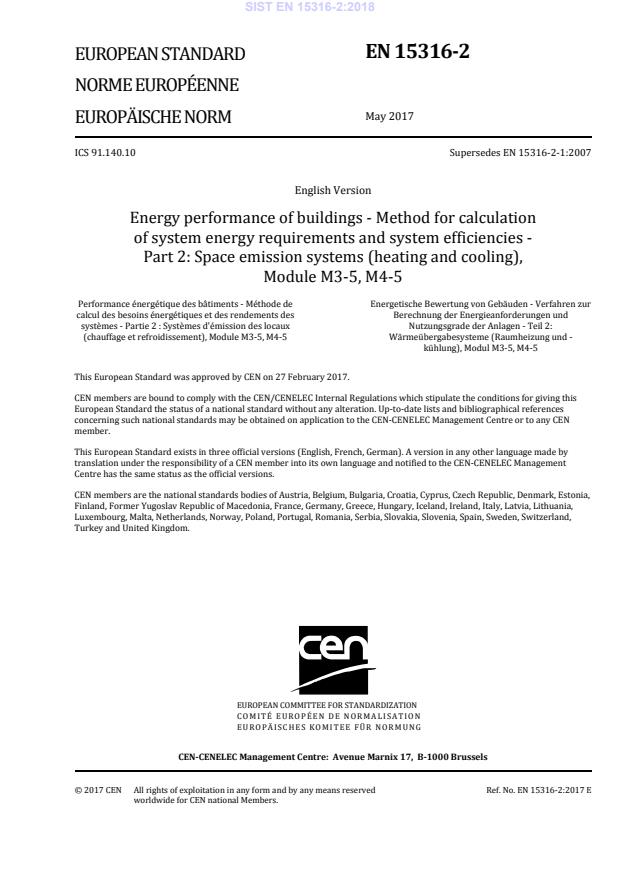
EUROPEAN STANDARD NORME EUROPÉENNE EUROPÄISCHE NORM
EN 15316-2
May
t r s y ICS
{ sä s v rä s r Supersedes EN
s w u s xæ tæ sã t r r yEnglish Version
Energy performance of buildings æ Method for calculation of system energy requirements and system efficiencies æ Module M uæ wá M væ w Performance énergétique des bâtiments æ Méthode de calcul des besoins énergétiques et des rendements des systèmes æ Partie
t ã Systèmes d 5émission des locaux
Energetische Bewertung von Gebäuden æ Verfahren zur Berechnung der Energieanforderungen und Nutzungsgrade der Anlagen æ Teil
tã This European Standard was approved by CEN on
t y February
t r s yä
egulations which stipulate the conditions for giving this European Standard the status of a national standard without any alterationä Upætoædate lists and bibliographical references concerning such national standards may be obtained on application to the CENæCENELEC Management Centre or to any CEN memberä
translation under the responsibility of a CEN member into its own language and notified to the CENæCENELEC Management Centre has the same status as the official versionsä
CEN members are the national standards bodies of Austriaá Belgiumá Bulgariaá Croatiaá Cyprusá Czech Republicá Denmarká Estoniaá Finlandá Former Yugoslav Republic of Macedoniaá Franceá Germanyá Greeceá Hungaryá Icelandá Irelandá Italyá Latviaá Lithuaniaá Luxembourgá Maltaá Netherlandsá Norwayá Polandá Portugalá Romaniaá Serbiaá Slovakiaá Sloveniaá Spainá Swedená Switzerlandá Turkey and United Kingdomä
EUROPEAN COMMITTEE FOR STANDARDIZATION COMITÉ EUROPÉEN DE NORMALISATION EUROPÄISCHES KOMITEE FÜR NORMUNG
CEN-CENELEC Management Centre:
Avenue Marnix 17,
B-1000 Brussels
t r s y CEN All rights of exploitation in any form and by any means reserved worldwide for CEN national Membersä Refä Noä EN
s w u s xæ tã t r s y ESIST EN 15316-2:2018
European foreword . 4 Introduction . 5 1 Scope . 7 2 Normative references . 9 3 Terms and definitions . 9 4 Symbols and abbreviations . 10 4.1 Symbols . 10 4.2 Subscripts . 10 5 Description of the method . 10 5.1 Output of the method . 10 5.2 General description of the method . 11 6 Calculation Method . 11 6.1 Output data . 11 6.2 Calculation time steps . 12 6.3 Input data . 12 6.4 Monthly and yearly calculation procedure . 15 6.5 Hourly calculation procedure . 20 7 Quality control . 24 8 Compliance check. 24 Annex A (normative)
Template for choices, input data and references (Additional heating and cooling losses / auxiliary energy) . 25 A.1 Introduction . 25 A.2 Temperature variation for free heating surfaces (radiators), room heights
¶ 4 m (heating case) . 26 A.3 Temperature Variation for component integrated heating surfaces (panel heaters) (room heights
¶ 4 m, heating case) . 28 A.4 Temperature variation for air heating systems; room heights
¶ 4 m (heating case) . 30 A.5 Temperature Variation for electrical heating (room heights
¶ 4 m, heating case) . 31 A.6 Temperature Variation air heating (ventilation systems, room heights
¶ 4 m, heating case) . 32 A.7 Temperature variation for room spaces with heights > 4 m (large indoor space buildings, heating case) . 32 A.8 Temperature variation for room heaters fired by solid fuel. 35 A.9 Temperature variation for water based cooling systems; room heights
¶ 4 m (cooling case) . 36 A.10 Auxiliary Energy . 37 SIST EN 15316-2:2018
Default choices, input data and references (additional heating and cooling losses / auxiliary energy) . 40 B.1 Introduction. 40 B.2 Temperature variation for free heating surfaces (radiators); room heights
¶ 4 m (heating case) . 41 B.3 Temperature Variation for component integrated heating surfaces (panel heaters) (room heights
¶ 4 m, heating case) . 43 B.4 Temperature variation for air heating systems; room heights
¶ 4 m (heating case) . 45 B.5 Temperature Variation for electrical heating (room heights
¶ 4 m, heating case) . 46 B.6 Temperature Variation air heating (ventilation systems, room heights
¶ 4 m, heating case) . 47 B.7 Temperature variation for room spaces with heights > 4 m (large indoor space buildings, heating case) . 47 B.8 Temperature variation for room heaters fired by solid fuel . 50 B.9 Temperature variation for water based cooling systems; room heights
¶ 4 m (cooling case) . 51 B.10 Auxiliary Energy . 52 B.11 Additional Information . 53 Bibliography . 55
— the individual user will apply the standard to assess the energy performance of a building, and thereby use the choices made by the regulators. Topics addressed in this standard can be subject to public regulation. Public regulation on the same topics can, for certain applications, override the default values in Annex B of this standard. Public regulation on the same topics can even, for certain applications override the use of this standard. Legal requirements and choices are in general not published in standards but in legal documents. In order to avoid double publications and difficult updating of double documents, the National Annex may refer to the legal texts where national choices have been made by public authorities. It is expected, if the default values and choices in Annex B are not followed due to national regulations, policy or traditions, that: — national or regional authorities prepare data sheets containing the choices and national or regional values, according to the model in Annex A. In this case the National Annex (e.g. NA) refers to this text; — or, by default, the national standards body will consider the possibility to add or include a National Annex in agreement with the template of Annex A, in accordance to the legal documents that give national or regional values and choices. Further target groups are users of the voluntary common European Union certification scheme for the energy performance of non-residential buildings (EPBD art.11.9) and any other Pan EU parties wanting to motivate their assumptions by classifying the building energy performance for a dedicated building stock. More information is provided in the Technical Report accompanying this standard (CEN/TR 15316-6-2,). SIST EN 15316-2:2018
Building (as such) Technical Building Systems
Descriptions
Descriptions
Descriptions Heating Cooling Ventilation Humidification Dehumidification Domestic Hot water Lighting Building automation and control Electricity
production sub1
M1 sub1 M2 sub1
M3 M4 M5 M6 M7 M8 M9 M10 M11 1 General
1 General 1 General 15316–1
15316–1
2 Common terms and definitions; symbols, units and subscripts
2 Building Energy Needs 2 Needs
12831–3
3 Applications
3 (Free) Indoor Conditions without
Systems 3 Maximum Load and Power 12831–1
12831–3
4 Ways to Express Energy
Performance
4 Ways to Express Energy Performance 4 Ways to Express Energy Performance 15316–1
15316–1
5 Building
Functions and Building Boundaries
5 Heat Transfer by Transmission 5 Emission and control 15316–2 15316–2
6 Building Occupancy and Operating Conditions
6 Heat Transfer by Infiltration and Ventilation 6 Distribution and control 15316–3 15316–3
15316–3
7 Aggregation of Energy Services and Energy Carriers
7 Internal
Heat Gains 7 Storage and control 15316–5
15316–5
15316–4-3
8 Building Partitioning
8 Solar
Heat Gains 8 Generation
8–1 Combustion boilers 15316–4-1
15316–4-1
8–2 Heat pumps 15316–4-2 15316–4-2
15316–4-2
8–3 Thermal solar Photovoltaics 15316–4-3
15316–4-3
15316–4-3
8–4 On-site cogeneration 15316–4-4
15316–4-4
15316–4-4
8–5 District heating and cooling 15316–4-5 15316–4-5
15316–4-5
8–6 Direct electrical heater 15316–4-6
15316–4-6
8–7 Wind turbines
15316–4-7
8–8 Radiant heating, stoves 15316–4-8
9 Calculated Energy Performance
9 Building Dynamics (thermal mass) 9 Load dispatching and operating conditions
10 Measured
Energy
Performance
10 Measured Energy Performance 10 Measured Energy Performance 15378–3
15378–3
11 Inspection
11 Inspection 11 Inspection 15378–1
15378–1
12 Ways to Express Indoor Comfort
12 – 12 BMS
13 External Environment Conditions
14 Economic Calculation 15459–1
rå » M3–1 YES additional energy losses of heat emission Qem,ls kWh
rå » M3–1 YES equivalent internal heating temperature H;int;inc °C
«5 … 40 M3–1 YES equivalent internal cooling temperature C;int;inc °C
«5 … 40 M4–1 YES temperature variation based on losses int;inc °C
«5 … 40 M3–1 YES annual expenditure factor for the heat and cooling emission
ε,,emlsan - 1…2 M3–1 NO convective fraction of the heating/cooling emitter fem,conv - 0.1 M3–1 / M2–2 NO SIST EN 15316-2:2018
unit Computed Unit Validity interval Ref. Varying control variation of temperature ctr K K
«5.5 6.4.2 No temperature variation based on control, not certified products ctr,1=K K
«5…+5 6.4.2 No temperature variation based on control, certified products ctr,2K K
«5…+5 6.4.2 No hysteresis of thermostatic valve HK K 0.1 6.4.2 No affect of supply water temperature on TRV head sensing element WK K 0.1 6.4.2 No temperature variation based on not balanced hydraulic systems hydrK K 0.1 6.4.2 No temperature variation based on intermittent controls operation system im,crtK K
«5 .+5 6.4.2 No temperature variation based on intermittent operation of the emission system im,emt=K K
«5 .+5 6.4.2 No SIST EN 15316-2:2018
unit Computed Unit Validity interval Ref. Varying temperature variation based on radiation by type of the emission system rad=K K
«5…+5 6.4.2 No temperature variation based on the stratification strK K
«5…+5 6.4.2 No temperature variation based on the stratification - part of influence due to “over-temperature” str,1=K K
«5c+5 6.4.2 No temperature variation based on the stratification - part of influence due to qspecific heat losses
via external componentsr str,2=K K
«5c+5 6.4.2 No temperature variation based on an additional heating / cooling loss by emitters embedded in the envelope emb=K K
«5c+5 6.4.2 No temperature variation based on an additional heating / cooling loss by emitters embedded in the envelope t part of influence due to the qsystemr emb,1=K K
«5…+5 6.4.2 No temperature variation based on an additional heating / cooling loss by emitters embedded in the envelope – part of influence due to “specific heat losses via laying surfaces” emb,2=K K
«5…+5 6.4.2 No temperature variation based on room automation roomout=K K
«5…+5 6.4.2 No radiant factor of radiant heaters for room heights
· 4m RF
0.1 6.4.2 No room height hR m m 2.50 6.4.2 No electrical rated power consumption of the control Pctr W W 0.500 6.4.4 No electrical rated power consumption of the equipment PH,aux W W 0.500 6.4.4 No electrical rated power consumption of the fan Pfan W W 0.500 6.4.4 No Design nominal useful emitter power Hemn kW W 0…
No SIST EN 15316-2:2018
K 5.60 M3–1 Yes 6.3.4 Operating or boundary conditions Required operating conditions data for this calculation procedure are listed in Table 7. SIST EN 15316-2:2018
initial internal temperature int,ini °C 0.50 M3–2 Yes calculation interval tci h 1…8760 M1–9 Yes total time of generator(s) operation tgnr h 0…8760 M1–6 Yes external temperature of the calculation interval e,avg °C
«50…+50 M1–13 Yes thermal output of the heating / cooling emission system Qem;out kWh 0… M3–3 / M4–3 Yes operation time of the fans in the calculation period th,rl h 0…8760 M1–6 Yes analytical running time (monthly or other period) th h 0…8760 M1–6 Yes 6.4 Monthly and yearly calculation procedure 6.4.1 Applicable calculation interval This calculation procedure can be used with the following calculation interval: — monthly; — yearly. 6.4.2 Operating conditions calculation Not relevant. 6.4.3 Energy calculation (additional heating / cooling losses) This section gives a detail method for calculation of losses in the heating / cooling emission systems or in the cooling system (for the cooling case the loss is a heat loss with a negative sign). The concept using equivalent internal temperature. The present standard will present an overall method to calculate the additional heat / cooling losses and energy efficiency. In Annex A only the structure of the tables are included. Default values for the calculation are given in Annex B. The internal temperature is affected by: — the spatial temperature variation due to the stratification, depending on the emitter; — the control variation depending on the capacity of the control device to ensure an homogeneous and constant temperature; — the temperature variation based on an additional heating / cooling losses by emitters embedded in the envelope; — the temperature variation based on radiation heat transfer of the emitter; SIST EN 15316-2:2018
temperature variation based on intermittent operation of controls and emitters; — the temperature variation based on not balanced hydraulic systems; — the temperature variation based on space automation system; — the temperature variation based on controls system stand alone or networked operation of the system; — the temperature variation based on type of emitter. int;inc taking into account the emitter, is calculated by: H;int;inc
= H;int;ini
+ int;inc [°C] (1a) C;int;inc
= C;int;ini
« int;inc [°C] (1b) where: H;int,ini is the initial internal heating temperature (°C); C;int,ini is the initial internal cooling temperature (°C); str is the spatial variation of temperature due to stratification (K); ctr is the control variation (K); (the control variation ctr ctr,1
ctr,2 . ctr,1 ctr,2 should be used for calculation with certified products. Alternatively product specific values can be used if proved by certification.); emb is the temperature variation based on an additional heating / cooling losses of embedded emitters or by undirected (flat) radiant emitters like radiant panels installed in the upper area of the room (K);
= ctr stremb
rad is the temperature variation based on radiation by type of the emission system (K); im is the temperature variation based on intermittent operation and based on the type of im = im,emt im,ctr im,ctr is the temperature variation based on intermittent operation of control (K); im,emt is the temperature variation based on intermittent operation on the type of the emission system (K); hydr is the temperature variation based on not balanced hydraulic systems (K); roomaut is the temperature variation based on stand alone or networked operation/ space automation of the system (K); int;inc is the temperature variation based on all losses (K); NOTE Room/space automation system covers room wide temperature controls including an individual timer function, timer function with self-adoption of start / stop or timer function with self-adoption of start / stop and interaction with other controls or heating / cooling system devices. int;inc strctrembradimhydr roomaut
[K] (2) SIST EN 15316-2:2018
= CA-value. Electronic controllers:
CA –
based on EN 15500 (see Table 8). TRV: based on EN 215 (see Table 8). with temperature variation based on emission system θθθθθ∆=∆+∆+∆+∆,,emtsyststrembradimemt [K] (3) where θ∆rad is calculated for radiators in EN 442 (see Table 8). θ∆,imemt is calculated for embedded systems in the EN 1264 series (see Table 8). and with temperature variation based on control system θθθθ∆=∆+∆+∆,,ctrsystctrimctrroomout [K] (4) int;inc taking into account the emitter, is calculated by: θθθθ∆=∆+∆+∆int,,,inchydemtsystctrsyst [K] (5) In case of rooms with ceiling heights
· 4 str is calculated as specific value for different emitter systems as: ()θθ∆=⋅⋅⋅−'100,5strstrRhba [K] (6) where
=16Ka and =1,1mb Rh is the the room height (m); θ'str is the air temperature gradient (K/m) taken from following Table A.8/B.8. In case of rooms with ceiling heights
· 4 rad is calculated as specific value for different ceiling heights and emitter systems of radiant luminous and tube heaters as: θ∆=⋅+⋅⋅−+0,120,150,367010100,3540,90,2radhRRFph [K]
(7) where RF is the Radiant Factor of radiant heaters according to EN 416–2 resp. EN 419–2 (product value) ph is the specific heat power in W/m2 based on product values; rad for radiant panels may be written in national annexes. The accordant values are determined on basis of radiant heat transfer according to EN 14037–3 (see Table 8).
Values for radiant heat transfer of radiant panels acc. EN 14037–2 cannot be compared directly with values of radiant factors of radiant heaters according to EN 416–2 resp. EN 419–2 (see Table 8). In case of using standard designs of radiant luminous or radiant tube heaters for ceiling heights
· 4m standard product values of RF are taken from Table A.9 or B.9. SIST EN 15316-2:2018
spatial variation of temperature due to stratification (K); ctr
ctr ctr,1
ctr,2 . ctr,1 ctr,2 should be used for calculation with certified products. Alternatively product specific values can be used if proved by certification.); rad temperature variation based on radiation by type of the emission system (K); hydr temperature variation based on not balanced hydraulic systems (K); roomaut temperature variation based on stand alone or networked operation/ space automation of the system (K); ctr
= CA-value.
Electronic controllers:
CA –
based on EN 15500 (see Table 8).
TRV: based on EN 215 (see Table 8). θ∆rad is calculated for radiators in EN 442 (see Table 8) In case of rooms with ceiling heights
· 4 str is calculated as specific value for different emitter systems as: ()θθ∆=⋅⋅⋅−'100,5strstrRhba [K] (18) where =16aK and =1,1bm Rh
is the room height (m), θ'str is the air temperature gradient (K/m) taken from following Table A.8/B.8 In case of rooms with ceiling heights
· 4 rad is calculated as specific value for different ceiling heights and emitter systems of radiant luminous and tube heaters as:
θ∆=⋅+⋅⋅−+0,120,150,367010100,3540,90,2radhRRFph [K] (19) With RF Radiant Factor of radiant heaters according to EN 416-2 resp. EN 419-2 (product value) ph specific heat power in W/m2 based on product values; In case of using standard designs of radiant luminous or radiant tube heaters for ceiling heights
· 4m standard product values of RF are taken from Table A.9 or B.9. rad for radiant panels may be written in national annexes. The accordant values are determined on basis of radiant heat transfer acc. EN 14037-3 (see Table 8).
Values for radiant heat transfer of radiant panels acc. EN 14037-2 cannot be compared directly with values of radiant factors of radiant heaters acc. EN 416-2 resp. EN 419-2 (see Table 8). SIST EN 15316-2:2018
The embedded losses are calculated
...
Questions, Comments and Discussion
Ask us and Technical Secretary will try to provide an answer. You can facilitate discussion about the standard in here.
Loading comments...