

EN ISO 5223:2015
(Main)Test sieves for cereals (ISO 5223:1995, including Amendment 1:1999)
- Abstract
Specifies requirements for test sieves for the laboratory determination of foreign matter in a sample of cereals. Does not apply to test sieves for testing cereals for insect infestation. Cancels and replaces the second edition, which has been technically revised.
- Status
- Published
- Publication Date
- 15-Dec-2015
- Withdrawal Date
- 29-Jun-2016
- Technical Committee
- CEN/TC 338 - Cereal and cereal products
- Drafting Committee
- CEN/TC 338 - Cereal and cereal products
- Current Stage
- 6060 - Definitive text made available (DAV) - Publishing
- Start Date
- 16-Dec-2015
- Due Date
- 12-Feb-2017
- Completion Date
- 16-Dec-2015

Overview
EN ISO 5223:2015 - Test sieves for cereals (ISO 5223:1995, incl. Am.1:1999) specifies requirements for laboratory test sieves used to determine foreign matter in cereal samples. Adopted by CEN, this standard defines the construction, dimensions, materials, marking and verification methods for the types of sieves most commonly used in cereal analysis. It explicitly does not apply to sieves used for insect-infestation testing.
Key topics and technical requirements
- Scope and purpose: Laboratory determination of undesirable substances in cereals using test sieves (commercial/contract/official practice).
- Nominal sieve types:
- Long rounded apertures: typical sizes include 1.00, 1.70, 1.80, 1.90, 2.00, 2.20, 2.50, 2.80 and 3.55 mm (aperture × 20.0 mm length format in the standard).
- Round apertures: diameter 4.50 mm (commonly used for separating broken maize kernels).
- Materials and construction:
- All parts shall be metal; sieving medium made of stainless steel, plated mild steel or other suitable material, attached to the frame (welded or equivalent secure method).
- Frames are round with a nominal internal diameter of 200 mm ±1.0 mm. Frame depth (distance between sieving media) shall be 25–55 mm; 25–35 mm depth commonly used for manual on-site sieving.
- A lid and receiver of the same metal/gauge are required; a flange prevents grain lodging between medium and frame.
- Aperture arrangement & dimensions:
- Long rounded apertures arranged in lines (linear or staggered as specified); round apertures in staggered rows.
- For 4.50 mm apertures: aperture tolerance ±0.14 mm, nominal pitch 6.3 mm (max 7.2 mm, min 5.3 mm).
- Identification & marking:
- Sieve label must indicate the standard reference, size/ID, nominal aperture size and manufacturer/supplier.
- Verification and testing:
- Aperture sizes checked along two straight lines ≥10 cm, including at least five apertures each; angle between lines: 90° for long rounded, 60° for round.
- Apertures inspected with a cross-section projector (min. ×50 magnification); plate thickness and pitch measured per the standard. Any single aperture outside tolerances leads to rejection.
Applications and users
- Who uses EN ISO 5223: cereal testing laboratories, grain trade quality control, food industry QA/QC teams, cereal equipment manufacturers, and testing/inspection bodies.
- Practical uses: laboratory separation of shriveled kernels, broken grains, calibration sieves for malting barley, routine foreign-matter determination in cereals and contract/commercial grain inspections.
Related standards
- ISO 2395 - Test sieves and test sieving: Vocabulary
- ISO 3310-2 - Test sieves: Technical requirements and testing (perforated metal plate)
- ISO 683-13 referenced for stainless steel details
Keywords: EN ISO 5223:2015, test sieves for cereals, laboratory sieving, aperture sizes, sieve construction, cereal quality control, ISO 3310-2, ISO 2395.
Relations
- Effective Date
- 25-Aug-2026
- Effective Date
- 25-Aug-2026
- Effective Date
- 28-Jan-2026
- Effective Date
- 28-Jan-2026
- Effective Date
- 28-Jan-2026
Get Certified
Connect with accredited certification bodies for this standard

BSI Group
BSI (British Standards Institution) is the business standards company that helps organizations make excellence a habit.

Bureau Veritas
Bureau Veritas is a world leader in laboratory testing, inspection and certification services.

DNV
DNV is an independent assurance and risk management provider.
Sponsored listings
Frequently Asked Questions
EN ISO 5223:2015 is a standard published by the European Committee for Standardization (CEN). Its full title is "Test sieves for cereals (ISO 5223:1995, including Amendment 1:1999)". This standard covers: Specifies requirements for test sieves for the laboratory determination of foreign matter in a sample of cereals. Does not apply to test sieves for testing cereals for insect infestation. Cancels and replaces the second edition, which has been technically revised.
Specifies requirements for test sieves for the laboratory determination of foreign matter in a sample of cereals. Does not apply to test sieves for testing cereals for insect infestation. Cancels and replaces the second edition, which has been technically revised.
EN ISO 5223:2015 is classified under the following ICS (International Classification for Standards) categories: 67.260 - Plants and equipment for the food industry. The ICS classification helps identify the subject area and facilitates finding related standards.
EN ISO 5223:2015 has the following relationships with other standards: It is inter standard links to ISO 3310-2:1990, ISO 2395:1990, EN 14801:2006, ENV ISO 10722-1:1998, EN 15587:2018. Understanding these relationships helps ensure you are using the most current and applicable version of the standard.
EN ISO 5223:2015 is available in PDF format for immediate download after purchase. The document can be added to your cart and obtained through the secure checkout process. Digital delivery ensures instant access to the complete standard document.
Standards Content (Sample)
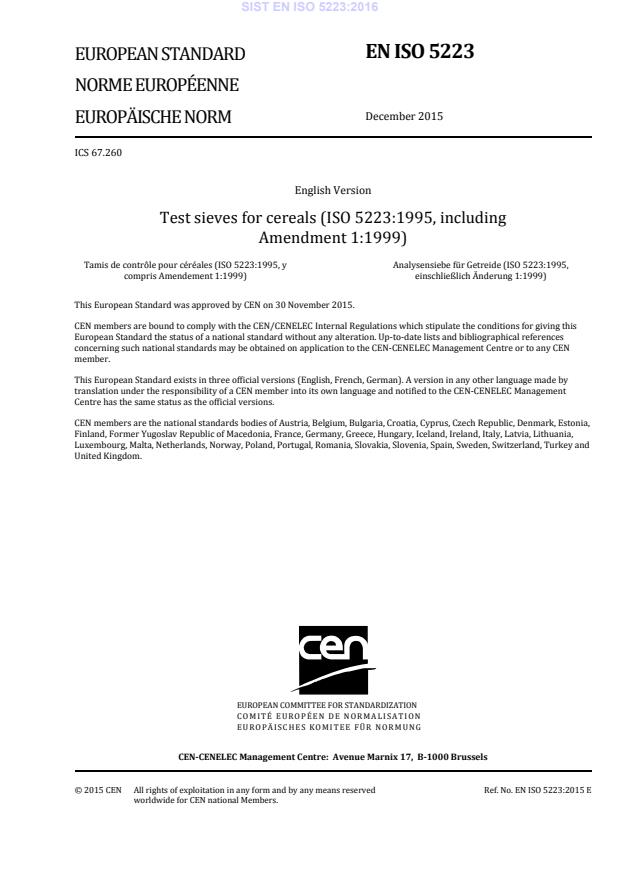
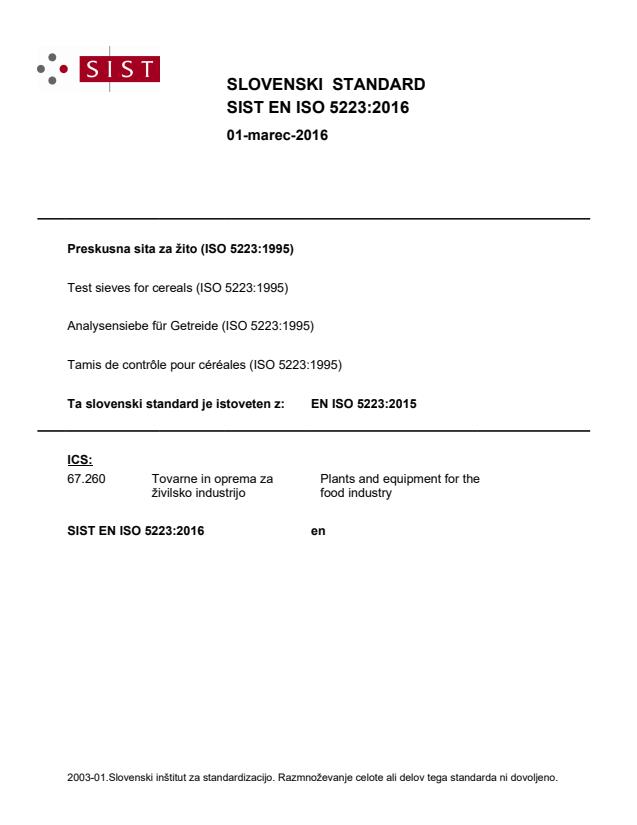
SLOVENSKI STANDARD
01-marec-2016
Preskusna sita za žito (ISO 5223:1995)
Test sieves for cereals (ISO 5223:1995)
Analysensiebe für Getreide (ISO 5223:1995)
Tamis de contrôle pour céréales (ISO 5223:1995)
Ta slovenski standard je istoveten z: EN ISO 5223:2015
ICS:
67.260 Tovarne in oprema za Plants and equipment for the
živilsko industrijo food industry
2003-01.Slovenski inštitut za standardizacijo. Razmnoževanje celote ali delov tega standarda ni dovoljeno.
EN ISO 5223
EUROPEAN STANDARD
NORME EUROPÉENNE
December 2015
EUROPÄISCHE NORM
ICS 67.260
English Version
Test sieves for cereals (ISO 5223:1995, including
Amendment 1:1999)
Tamis de contrôle pour céréales (ISO 5223:1995, y Analysensiebe für Getreide (ISO 5223:1995,
compris Amendement 1:1999) einschließlich Änderung 1:1999)
This European Standard was approved by CEN on 30 November 2015.
CEN members are bound to comply with the CEN/CENELEC Internal Regulations which stipulate the conditions for giving this
European Standard the status of a national standard without any alteration. Up-to-date lists and bibliographical references
concerning such national standards may be obtained on application to the CEN-CENELEC Management Centre or to any CEN
member.
This European Standard exists in three official versions (English, French, German). A version in any other language made by
translation under the responsibility of a CEN member into its own language and notified to the CEN-CENELEC Management
Centre has the same status as the official versions.
CEN members are the national standards bodies of Austria, Belgium, Bulgaria, Croatia, Cyprus, Czech Republic, Denmark, Estonia,
Finland, Former Yugoslav Republic of Macedonia, France, Germany, Greece, Hungary, Iceland, Ireland, Italy, Latvia, Lithuania,
Luxembourg, Malta, Netherlands, Norway, Poland, Portugal, Romania, Slovakia, Slovenia, Spain, Sweden, Switzerland, Turkey and
United Kingdom.
EUROPEAN COMMITTEE FOR STANDARDIZATION
COMITÉ EUROPÉEN DE NORMALISATION
EUROPÄISCHES KOMITEE FÜR NORMUNG
CEN-CENELEC Management Centre: Avenue Marnix 17, B-1000 Brussels
© 2015 CEN All rights of exploitation in any form and by any means reserved Ref. No. EN ISO 5223:2015 E
worldwide for CEN national Members.
Contents Page
European foreword . 3
European foreword
The text of ISO 5223:1995, including Amendment 1:1999 has been prepared by Technical Committee
ISO/TC 34 “Food products” of the International Organization for Standardization (ISO) and has been
taken over as EN ISO 5223:2015 by Technical Committee CEN/TC 338 “Cereal and cereal products” the
secretariat of which is held by AFNOR.
This European Standard shall be given the status of a national standard, either by publication of an
identical text or by endorsement, at the latest by June 2016, and conflicting national standards shall be
withdrawn at the latest by June 2016.
Attention is drawn to the possibility that some of the elements of this document may be the subject of
patent rights. CEN [and/or CENELEC] shall not be held responsible for identifying any or all such patent
rights.
According to the CEN-CENELEC Internal Regulations, the national standards organizations of the
following countries are bound to implement this European Standard: Austria, Belgium, Bulgaria,
Croatia, Cyprus, Czech Republic, Denmark, Estonia, Finland, Former Yugoslav Republic of Macedonia,
France, Germany, Greece, Hungary, Iceland, Ireland, Italy, Latvia, Lithuania, Luxembourg, Malta,
Netherlands, Norway, Poland, Portugal, Romania, Slovakia, Slovenia, Spain, Sweden, Switzerland,
Turkey and the United Kingdom.
Endorsement notice
The text of ISO 5223:1995, including Amendment 1:1999 has been approved by CEN as EN
ISO 5223:2015 without any modification.
ISO
INTERNATIONAL
STANDARD
Third edition
1995-08-15
Test sieves for cereals
Tamis de contr6le pour ckrbales
Reference number
ISO 52237 995(E)
ISO 5223: 1995(E)
Foreword
ISO (the International Organization for Standardization) is a worldwide
federation of national Standards bodies (ISO member bodies). The work
of preparing International Standards is normally carried out through ISO
technical committees. Esch member body interested in a subject for
which a technical committee has been established has the right to be
represented on that committee. International organizations, governmental
and non-governmental, in liaison with ISO, also take part in the work. ISO
collaborates closely with the International Electrotechnical Commission
(1 EC) on all matters of electrotechnical standardization.
Draft International Standards adopted by the technical committees are
circulated to the member bodies for voting. Publication as an International
Standard requires approval by at least 75 % of the member bodies casting
a vote.
International Standard ISO 5223 was prepared by Technical Committee
lSO/TC 34, Agricultural food products, Subcommittee SC 4, Cereals and
pulses, in collaboration with the International Association for Cereal Sci-
ence and Technology (ICC).
This third edition cancels and replaces the second edition
(ISO 5223:1983), which has been technically revised.
0 ISO 1995
All rights reserved. Unless otherwise specified, no part of this publication may be reproduced
or utilized in any form or by any means, electronie or mechanical, including photocopying and
microfilm, without Permission in writing from the publisher.
International Organization for Standardization
Case Postale 56 l CH-1 211 Geneve 20 l Switzerland
Printed in Switzerland
ii
0 ISO
ISO 5223: 1995(E)
Introduction
The commercial value of a batch of cereals is affected by the presence
of undesirable substances. The amount of these substances in a Sample
is measured by carrying out various separating processes, of which the
principal one is test sieving.
The test sieving procedure is carried out under conditions determined by
commercial practice, contracts or official regulations, with low accuracy.
Consequently, more often than not, the only dimensions given for test
sieves are the diameter or the width of the apertures in the perforated
plate. The other features of test sieves are not normally specified, despite
their effect on the results.
Therefore, this international Standard describes those test sieves most
frequently used in commerce.
. . .
Ill
This page intentionally left blank
ISO 5223:1995(E)
INTERNATIONAL STANDARD 0 ISO
Test sieves for cereals
2 Normative references
1 Scope
This International Standard specifies requirements for The follow
...