

EN 9101:2008
(Main)Aerospace series - Quality management systems - Assessment (based on ISO 9001:2000)
- Abstract
The purpose of this document is to define the content and the presentation of the Assessment Report for the EN 9100 standard.
- Status
- Withdrawn
- Publication Date
- 08-Apr-2008
- Withdrawal Date
- 19-Jul-2011
- Technical Committee
- ASD-STAN - Aerospace
- Drafting Committee
- ASD-STAN/D 6 - Quality
- Current Stage
- 9960 - Withdrawal effective - Withdrawal
- Start Date
- 20-Jul-2011
- Completion Date
- 20-Jul-2011

Relations
- Effective Date
- 23-Jul-2011
Get Certified
Connect with accredited certification bodies for this standard

BSI Group
BSI (British Standards Institution) is the business standards company that helps organizations make excellence a habit.

Bureau Veritas
Bureau Veritas is a world leader in laboratory testing, inspection and certification services.

DNV
DNV is an independent assurance and risk management provider.
Sponsored listings
Frequently Asked Questions
EN 9101:2008 is a standard published by the European Committee for Standardization (CEN). Its full title is "Aerospace series - Quality management systems - Assessment (based on ISO 9001:2000)". This standard covers: The purpose of this document is to define the content and the presentation of the Assessment Report for the EN 9100 standard.
The purpose of this document is to define the content and the presentation of the Assessment Report for the EN 9100 standard.
EN 9101:2008 is classified under the following ICS (International Classification for Standards) categories: 03.100.70 - Management systems; 03.120.10 - Quality management and quality assurance; 03.120.20 - Product and company certification. Conformity assessment; 49.020 - Aircraft and space vehicles in general. The ICS classification helps identify the subject area and facilitates finding related standards.
EN 9101:2008 has the following relationships with other standards: It is inter standard links to EN 9101:2011. Understanding these relationships helps ensure you are using the most current and applicable version of the standard.
EN 9101:2008 is available in PDF format for immediate download after purchase. The document can be added to your cart and obtained through the secure checkout process. Digital delivery ensures instant access to the complete standard document.
Standards Content (Sample)
SLOVENSKI STANDARD
01-julij-2008
Aeronavtika - Sistemi vodenja kakovosti - Ocenjevanje (na podlagi ISO 9001:2000)
Aerospace series - Quality management systems - Assessment (based on ISO
9001:2000)
Luft- und Raumfahrt - Qualitätsmanagementsysteme - Audit (basiert auf ISO 9001:2000)
Série aérospatiale - Systèmes de management de la qualité - Évaluation (basé sur ISO
9001:2000)
Ta slovenski standard je istoveten z: EN 9101:2008
ICS:
03.120.10 Vodenje in zagotavljanje Quality management and
kakovosti quality assurance
49.020 Letala in vesoljska vozila na Aircraft and space vehicles in
splošno general
2003-01.Slovenski inštitut za standardizacijo. Razmnoževanje celote ali delov tega standarda ni dovoljeno.
EUROPEAN STANDARD
EN 9101
NORME EUROPÉENNE
EUROPÄISCHE NORM
April 2008
ICS 03.120.10; 49.020
English Version
Aerospace series - Quality management systems - Assessment
(based on EN ISO 9001:2000)
Série aérospatiale - Systèmes de management de la Luft- und Raumfahrt - Qualitätsmanagementsysteme -
qualité - Évaluation (basé sur EN ISO 9001:2000) Audit (basiert auf EN ISO 9001:2000)
This European Standard was approved by CEN on 28 December 2007.
CEN members are bound to comply with the CEN/CENELEC Internal Regulations which stipulate the conditions for giving this European
Standard the status of a national standard without any alteration. Up-to-date lists and bibliographical references concerning such national
standards may be obtained on application to the CEN Management Centre or to any CEN member.
This European Standard exists in three official versions (English, French, German). A version in any other language made by translation
under the responsibility of a CEN member into its own language and notified to the CEN Management Centre has the same status as the
official versions.
CEN members are the national standards bodies of Austria, Belgium, Bulgaria, Cyprus, Czech Republic, Denmark, Estonia, Finland,
France, Germany, Greece, Hungary, Iceland, Ireland, Italy, Latvia, Lithuania, Luxembourg, Malta, Netherlands, Norway, Poland, Portugal,
Romania, Slovakia, Slovenia, Spain, Sweden, Switzerland and United Kingdom.
EUROPEAN COMMITTEE FOR STANDARDIZATION
COMITÉ EUROPÉEN DE NORMALISATION
EUROPÄISCHES KOMITEE FÜR NORMUNG
Management Centre: rue de Stassart, 36 B-1050 Brussels
© 2008 CEN All rights of exploitation in any form and by any means reserved Ref. No. EN 9101:2008: E
worldwide for CEN national Members.
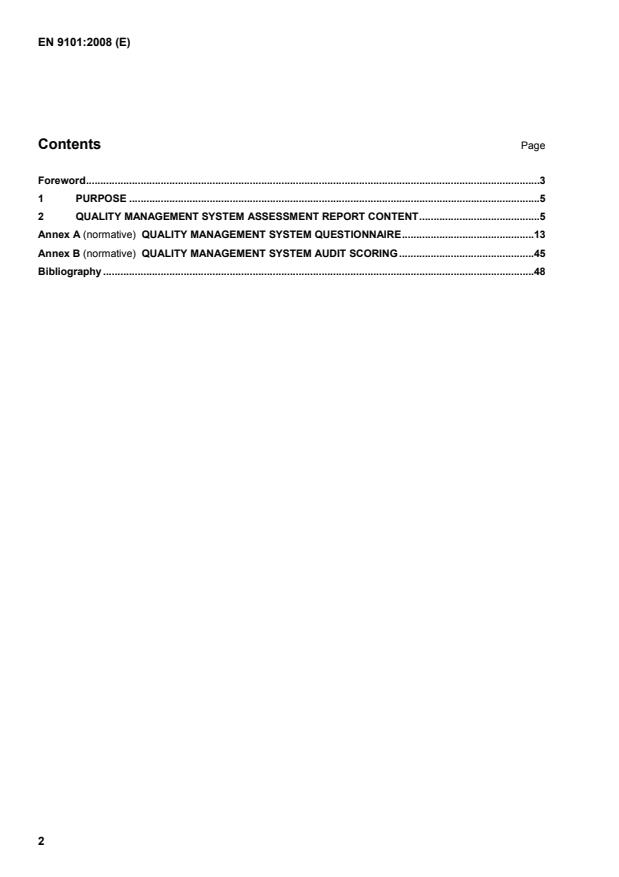
Contents Page
Foreword.3
1 PURPOSE .5
2 QUALITY MANAGEMENT SYSTEM ASSESSMENT REPORT CONTENT.5
Annex A (normative) QUALITY MANAGEMENT SYSTEM QUESTIONNAIRE.13
Annex B (normative) QUALITY MANAGEMENT SYSTEM AUDIT SCORING.45
Bibliography .48
Foreword
This document (EN 9101:2008) has been prepared by the Aerospace and Defence Industries Association of
Europe - Standardization (ASD-STAN).
After enquiries and votes carried out in accordance with the rules of this Association, this Standard has
received the approval of the National Associations and the Official Services of the member countries of ASD,
prior to its presentation to CEN.
This European Standard shall be given the status of a national standard, either by publication of an identical
text or by endorsement, at the latest by October 2008, and conflicting national standards shall be withdrawn at
the latest by October 2008.
Attention is drawn to the possibility that some of the elements of this document may be the subject of patent
rights. CEN [and/or CENELEC] shall not be held responsible for identifying any or all such patent rights.
To assure customer satisfaction, aerospace industry organizations must produce, and continually improve,
safe, reliable products that meet or exceed customer and regulatory authority requirements. The globalization
of the aerospace industry, and the resulting diversity of regional/national requirements and expectations, has
complicated this objective. End-product organizations face the challenge of assuring the quality of, and
integrating, product purchased from suppliers throughout the world and at all levels within the supply chain.
Aerospace suppliers and processors face the challenge of delivering product to multiple customers having
varying quality expectations and requirements.
The aerospace industry has established the International Aerospace Quality Group (IAQG) for the purpose of
achieving significant improvements in quality and safety, and reductions in cost, throughout the value stream.
This organization includes representatives from aerospace companies in the Americas, Asia/Pacific, and
Europe. This international standard has been prepared by the IAQG.
According to the CEN/CENELEC Internal Regulations, the national standards organizations of the following
countries are bound to implement this European Standard: Austria, Belgium, Bulgaria, Cyprus, Czech
Republic, Denmark, Estonia, Finland, France, Germany, Greece, Hungary, Iceland, Ireland, Italy, Latvia,
Lithuania, Luxembourg, Malta, Netherlands, Norway, Poland, Portugal, Romania, Slovakia, Slovenia, Spain,
Sweden, Switzerland and the United Kingdom.
Page intentionally left blank
1 PURPOSE
The purpose of this document is to define the content and the presentation of the Assessment Report
for the EN 9100 standard.
2 QUALITY MANAGEMENT SYSTEM ASSESSMENT REPORT CONTENT
The Assessment Report is made up of:
• Page 6 (required)
General Assessment Information
• Page 7 (required)
Assessment Conclusions
• Page 8 (optional)
Specific Organization Information
• Page 9 (required)
QMS Assessment Result Summary
• Page 10 (required)
QMS Assessment Scoring
• Page 11 (required when nonconformities are identified during assessment)
Corrective Action Request
• Page 12 (required when observations/comments are identified during assessment)
Observations/Comments
• Annex A
Quality Management System Questionnaire
Audit Report No.:
Assessing company
ASSESSMENT REPORT
logo
GENERAL ASSESSMENT INFORMATION
1 Organization & Work Address
Company Name: Tel Number:
Fax Number:
Subsidiary of: E-mail:
Organization Identification: CAGE code:
Assessed Site Address: Assessment Representative & Title:
Management Representative & Title:
Product Types or Codes:
Main activities:
No. of employees at assessed site:
2 QMS Registration
[ ] ISO Standard / Revision: [ ] Aerospace Standard / Revision:
Expiration Date (if applicable):
Expiration Date (if applicable):
Registrar Name:
Registrar Name:
3 Assessment Team
Lead Assessor Name: Other Assessment Team Members:
[ ] Certified Auditor – Type & No.
[ ] Qualified Auditor
4 Assessment Dates:
5 Assessment Scope
[ ] Total facility assessed [ ] Initial assessment [ ] All EN 9100 clauses assessed
[ ] Partial facility assessed [ ] Re-assessment [ ] Partial EN 9100 clauses assessed
[ ] Other: Clauses not assessed:
[ ] Activity assessed:
6 Assessment Disposition 7 Scoring
[ ] Conforming Scoring result:
[ ] Conforming with minor (mi) corrective action
[ ] Nonconforming with Major (Ma) corrective action
8 Assessment Approval
Assessing Company Date Lead Assessor Name Signature
Distribution Agreement
This Assessment Report is the property of the Assessed Organization and the Assessing Company. Distribution to other companies or
individuals is authorized only after written agreement of the assessed Organization and of the Assessing Company.
To that end, a signature below by an Authorized Representative of the Assessing Company indicates that this report may be copied by
the Organization for other customers.
If copied, the report must be disclosed in full including findings and any corrective actions.
Authorized Representative
Assessing Company Name _________________________ Signature _________________________________ Date ___________
Audit Report No.:
Assessing company
ASSESSMENT REPORT
logo
ASSESSMENT CONCLUSIONS
General comments about the organization and the quality management system of the assessed
organization:
Strong points:
Improvement Opportunities:
Audit Report No.:
Assessing company
ASSESSMENT REPORT
logo
SPECIFIC ORGANIZATION INFORMATION
1 Legal and Financial Aspects
ˆ Date of Formation:
ˆ Legal Status:
ˆ Capital:
ˆ Other Data:
Third Prior Second Prior First Prior Current
Financial Year Financial Year Financial Year Financial Year
( ) ( ) ( ) ( )
Sales
Earnings
Earnings used for Re-Investment
Workforce
2 Turnover breakdown and main Customers
Activities Main Customers Sales Percentage
Aircraft, Space and
Defense Industry
Other Activity
(be specific)
3 Clearances or Approvals granted by Authorities
Name of the Authority Types and References End of Validity
(date)
Audit Report No.:
Assessing company
ASSESSMENT REPORT
logo
QMS ASSESSMENT RESULT SUMMARY
Organization:
Observation / Corrective Action Request
Result
Clauses*
Number
S Ma mi N/A N/E
(Ma/mi)
4 - Quality Management System
4.1 General requirements
4.2 Documentation requirements
4.3 Configuration management
5 - Management responsibility
5.1 Management commitment
5.2 Customer focus
5.3 Quality policy
5.4 Planning
5.5 Responsibility, authority and
communication
5.6 Management review
6 - Resource management
6.1 Provision of resources
6.2 Human resources
6.3 Infrastructure
6.4 Work environment
7 - Product realization
7.1 Planning of product realization
7.2 Customer-related processes
7.3 Design and development
7.4 Purchasing
7.5 Production and service provision
7.6 Control of monitoring and
measuring devices
8 - Measurement, analysis and improvement
8.1 General
8.2 Monitoring and measurement
8.3 Control of nonconforming
product
8.4 Analysis of data
8.5 Improvement
Assessed Organization: Assessing Company:
Results
Management Rep’s name: Lead Assessor Name:
Signature: Signature:
* For each clause, indicate with an “X” the results of assessment: “S” for Satisfactory, “Ma” for major corrective action, “mi” for
minor, “N/A” for not applicable, or N/E for not evaluated.
Audit Report No.:
Assessing company
QMS ASSESSMENT SCORING
logo
Organization: Result
Major CAR or minor Minor CAR on non
CAR on Key
SCORING CHART
Key requirement
NO CAR RESULT
requirement
(Col. A) (Col. B) (Col. C) (Col. D)
Multiple Single Multiple Single
findings finding findings finding
4 Quality management system (100)
4.1 General requirements 0 10 25 40 50
4.2 & 4.3 Documentation requirements & Configuration management 0 10 25 40 50
5 Management responsibility (150)
5.1 Management commitment
5.2 Customer focus 0 5 15 20 30
5.3 Quality policy
5.4 Planning 0 10 20 30 40
5.5 Responsibility, authority and communication 0 5 15 20 30
5.6 Management review 0 10 25 40 50
6 Resource Management (100)
6.1 Provision of resources
0 10 25 40 50
6.2 Human resources
6.3 Infrastructure
0 10 25 40 50
6.4 Work environment
7 Product realization (450)
7.1 Planning of product realization 0 5 15 20 30
7.2 Customer-related processes 0 10 30 50 60
7.3 Design and development
7.3.1 Design and development planning 0 5 15 20 30
7.3.2-3-4 Inputs, outputs & review 0 5 15 20 30
7.3.5-6 Design and development verification & validation 0 5 15 20 30
7.3.7 Control of design and development changes 0 5 15 20 30
7.4 Purchasing 0 10 30 50 60
7.5 Production and service provision
7.5.1 Control of production and service provision 0 10 25 40 50
7.5.2 Validation of processes for production and service provision 0 10 20 30 40
7.5.3 Identification and traceability 0 10 20 30 40
7.5.4-5 Customer property & Preservation of product 0 5 15 20 30
7.6 Control of monitoring and measuring devices 0 5 10 15 20
8 Measurement, analysis and improvement (200)
8.1 General 0 5 10 15 20
8.2 Monitoring and measurement
8.2.1 Customer satisfaction 0 5 10 15 20
8.2.2 Internal audit 0 5 15 20 30
8.2.3 Monitoring and measurement of processes 0 5 15 20 30
8.2.4 Monitoring and measurement of product 0 5 15 20 30
8.3 Control of nonconforming product 0 5 15 20 30
8.4 Analysis of data 0 5 10 15 20
8.5 Improvement 0 5 10 15 20
Total Points Possible
The assessed organization agrees on the quality management
system scoring and corrective action requests
Total Points Achieved
Name of Representative: Signature: Date:
Score
(pts achieved/pts possible)
× 100
Audit Report No.:
CORRECTIVE ACTION REQUEST
Assessing company
logo
(CAR)
Organization: Identification C.A.R. No.:
Site: Date issued:
Reference Standard: Referenced Standard Clause concerned:
Criticality Nonconformance Description
Ma / mi
Assessor Name: Assessor Signature:
Assessed Organization to complete the CAR with root cause analysis, corrective action, and
Due date:
planned completion date of corrective action, and return to the Assessing Company by due date.
Action Root Cause:
No.:
Planned completion
Action Corrective Action:
date of corrective
No.:
action:
Organization Representative Name: Signature: Current date:
Verification of the implementation of the completed Corrective Action by the Assessed Organization
Organization Representative Name: Signature: Current date:
Verification of the implementation of the completed Corrective Action to be filled out by the Assessing Company
Verification date: Accepted: Assessor Name: Assessor Signature:
Yes ˆ No ˆ
S: Satisfactory – CAR: Corrective action request – Ma: Major corrective action – mi: Minor corrective action
N/A: Not applicable – N/E: Not evaluated – P: Product – M: Management
Audit Report No.:
Assessing company
OBSERVATIONS/COMMENTS
logo
Organization:
Site: Issued date:
Item Number Section Observation/Comment
Lead Assessor Name: Signature:
Annex A
(normative)
QUALITY MANAGEMENT SYSTEM
QUESTIONNAIRE
1 PURPOSE
The purpose of this annex is to present the questionnaire to be used during the “on-site” quality
management system assessment of Organizations in order to ensure common practices for these
assessments.
2 USE OF THE QUESTIONNAIRE
The use of this questionnaire is mandatory and will be a part of the Assessment Report.
The audit is undertaken by review of the organization’s QMS against the requirements of the
EN 9100 standard, using the questionnaire as a guide. Findings are recorded as appropriate by the
following annotations in the respective columns of the questionnaire:
¾ Satisfactory (S)
¾ Not applicable (N/A) the reason shall be documented at the bottom of the page
¾ Not evaluated (N/E)
¾ Corrective Action Request (CAR) Major (Ma) or Minor (mi) nonconformity:
The CAR number shall be referenced in the “CAR number” column. The category Ma for Major CAR
or mi for Minor CAR shall also be included.
Additional information on questionnaire
Key Requirements: Some requirements are deemed to be very significant and are so identified by
the presence of “P” or “M” against the specific section or question within the questionnaire:
¾ “P” – direct link with Product
¾ “M” – direct link with Management
The extent of Key Requirement applicability is determined by the location of the “M” or “P”.
In the example below all of question 14 is considered as a Key Requirement.
M
14 Does the output from the management review include any decisions and actions related to:
a) Improvement of the effectiveness of the quality management system and its processes?
b) Improvement of product related to customer requirements? and
c) Resource needs?
In the second example below, only part of question 03, item d), is considered a Key Requirement.
03 In planning product realization, does the organization determine the following, as appropriate:
a) Quality objectives and requirements for the product?
b) The need to establish processes, documents, and provide resources specific to the
product?
c) Required verification, validation, monitoring, inspection and test activities specific to the
product and the criteria for product acceptance?
d) Records needed to provide evidence that the realization processes and resulting product P
meet requirements (see 4.2.4)?
e) The identification of resources to support operation and maintenance of the product?
Guidance Notes: Certain questions will have a numeric reference to additional guidance located in
the “Guidance Notes” section located after the questions on each page. The guidance notes provide
the auditor with further insight on type of objective evidence and/or review expectations, etc. In the
example below, note (1) provides the auditor with additional guidance pertaining to question 48
part a).
48 Does the analysis of data provide information relating to:
a) Customer satisfaction (see 8.2.1) (1)?
b) Conformity to product requirements (see 7.2.1)?
c) Characteristics and trends of processes and products including opportunities for
preventive action? and
d) Organizations?
Guidance Note
1) Give examples and check how the organization measures the effectiveness.
References: When a reference (e.g. 4.1) is added to a question, it is linked to the appropriate clause
(e.g. 4.1) of EN 9100 standard.
Objective evidence assessed / Observations / Comments / N/A explanation
Record the objective evidence reviewed during the assessment or reason for not applicable.
Nonconformities:
Major: The absence of, or total breakdown of, a management clause specified in the EN 9100
standard or any nonconformities where the effect is judged to be detrimental to the integrity
of the product or service.
Minor: A single system failure or lapse in conformance with a procedure relating to the EN 9100
standard.
Note: A number of minor nonconformities against one requirement can represent a total
breakdown of the system and this can be considered as a major nonconformity.
3 USE OF THE ASSESSMENT SCORING CHART
Refer to Annex B for instructions and guidance on how to score the EN 9100 audit.
Summary
Section headings Page numbers
4 QUALITY MANAGEMENT SYSTEM 16
4.1 General requirements 16
4.2 Documentation requirements 17 to 18
4.3 Configuration management 18
5 MANAGEMENT RESPONSIBILITY 19
5.1 Management commitment 19
5.2 Customer focus 19
5.3 Quality policy 19
5.4 Planning 19
5.5 Responsibility, authority and communication 20
5.6 Management review 21
6 RESOURCE MANAGEMENT 22
6.1 Provision of resources 22
6.2 Human resources 22
6.3 Infrastructure 22
6.4 Work environment 22
7 PRODUCT REALIZATION 23
7.1 Planning of product realization 23
7.2 Customer-related processes 24
7.3 Design and development 25 to 28
7.4 Purchasing 29 to 31
7.5 Production and service provision 32 to 36
7.6 Control of monitoring and measuring devices 37
8 MEASUREMENT, ANALYSIS AND IMPROVEMENT 38
8.1 General 38
8.2 Monitoring and measurement 39 to 41
8.3 Control of nonconforming product 42
8.4 Analysis of data 43
8.5 Improvement 44
QUALITY MANAGEMENT SYSTEM QUESTIONNAIRE
KEY S CAR N/A N/E
ASSESSMENT QUESTIONS
Requirements Number
Ma or mi
4 QUALITY MANAGEMENT SYSTEM
4.1 General requirements
01 Has the organization established, documented, implemented and maintained a quality
management system and continually improved its effectiveness in accordance with the
requirements of this International Standard?
02 Does the organization:
a) identify the processes needed for the quality management system and their application
throughout the organization? (1)
b) determine the sequence and interaction of these processes? (1)
c) determine criteria and methods needed to ensure that both the operation and control of
these processes are effective?
d) ensure the availability of resources and information necessary to support the operation and
monitoring of these processes?
e) monitor, measure and analyze these processes?
f) implement actions necessary to achieve planned results and continual improvement of these
processes?
03 Are these processes managed by the organization in accordance with the requirements of this
International Standard?
04 Where an organization chooses to outsource any process that affects product conformity with
P
requirements, does the organization ensure control over such processes?
05 Is the control of such outsourced processes identified within the quality management system?
Note: Processes needed for the quality management system referred to above should include processes for management activities,
provision or resources, product realization and measurement.
Guidance Notes
1) Main processes formally identified (e.g. list, flow diagram).
Objective evidence assessed / Observations / Comments / N/A explanation
S: Satisfactory – CAR: Corrective action request – Ma: Major corrective action – mi: Minor corrective action
N/A: Not applicable – N/E: Not evaluated – P: Product – M: Management
QUALITY MANAGEMENT SYSTEM QUESTIONNAIRE
KEY S CAR N/A N/E
ASSESSMENT QUESTIONS
Requirements Number
Ma or mi
4.2 Documentation requirements
4.2.1 General
06 Does the quality management system documentation include:
a) documented statements of a quality policy and quality objectives?
b) a quality manual?
c) documented procedures required by this International Standard?
d) documents needed by the organization to ensure the effective planning, operation and
control of its processes?
e) records required by this International Standard (see 4.2.4)?
f) quality system requirements imposed by the applicable regulatory authorities?
07 Does the organization ensure that personnel have access to quality management system
documentation and are aware of relevant procedures?
08 Do Customer and/or regulatory authority representatives have access to quality
management system documentation?
Note 1: Where the term “documented procedure” appears within this International Standard, this means that the procedure is established,
documented, implemented and maintained.
Note 2: The extent of the quality management system documentation can differ from one organization to another due to
a) the size of organization and type of activities,
b) the complexity of processes and their interactions, and
c) the competence of personnel.
Note 3: The documentation can be in any form or type of medium.
4.2.2 Quality manual
09 Has the organization established and maintained a quality manual that includes (1):
a) the scope of the quality management system, including details of, and justification for, any
exclusions?
b) the documented procedures established for the quality management system, or reference to
them, and when referencing the documented procedures, is the relationship between
the requirements of this International Standard and the documented procedures
clearly shown? (2)
c) a description of the interaction between the processes of the quality management system?
Guidance Notes
1) Quality manual reference and issue.
2) Check the procedure list.
Objective evidence assessed / Observations / Comments / N/A explanation
S: Satisfactory – CAR: Corrective action request – Ma: Major corrective action – mi: Minor corrective action
N/A: Not applicable – N/E: Not evaluated – P: Product – M: Management
QUALITY MANAGEMENT SYSTEM QUESTIONNAIRE
KEY S CAR N/A N/E
ASSESSMENT QUESTIONS
Requirements Number
Ma or mi
4.2 Documentation requirements (concluded)
4.2.3 Control of documents
10 Are the documents required by the quality management system controlled? M
11 Are records controlled according to the requirements given in 4.2.4?
12 Has a documented procedure been established to define the controls needed to:
a) approve documents for adequacy prior to issue?
b) review and update as necessary and re-approve documents?
c) ensure that changes and the current revision status of documents are identified?
d) ensure that relevant versions of applicable documents are available at points of use?
e) ensure that documents remain legible and readily identifiable?
f) ensure that documents of external origin are identified and their distribution controlled?
g) prevent the unintended use of obsolete documents, and to apply suitable identification to
them if they are retained for any purpose?
13 Does the organization coordinate document changes with customers and/or regulatory
authorities in accordance with contract or regulatory requirements?
4.2.4 Control of records
14 Are records established and maintained to provide evidence of conformity to requirements and
of the effective operation of the quality management system?
15 Do records remain legible, readily identifiable and retrievable? (1)
16 Has a documented procedure been established to define the controls needed for the
identification, storage, protection, retrieval, retention time and disposition of records?
17 Does the documented procedure define the method for controlling records that are
created by and/or retained by suppliers?
18 Are records available for review by customers and regulatory authorities in accordance
with contract or regulatory requirements?
4.3 Configuration management
19 Has the organization established, documented and maintained a configuration management P
process appropriate to the product?
Note: Guidance on configuration management is given in EN ISO 10007.
Guidance Note
1) List records reviewed.
Objective evidence assessed / Observations / Comments / N/A explanation
S: Satisfactory – CAR: Corrective action request – Ma: Major corrective action – mi: Minor corrective action
N/A: Not applicable – N/E: Not evaluated – P: Product – M: Management
QUALITY MANAGEMENT SYSTEM QUESTIONNAIRE
KEY S CAR N/A N/E
ASSESSMENT QUESTIONS
Requirements Number
Ma or mi
5 MANAGEMENT RESPONSIBILITY
5.1 Management commitment
01 Has top management provided evidence of its commitment to the development and implementation M
of the quality management system and continually improving its effectiveness by (1):
a) communicating to the organization the importance of meeting customer as well as statutory
and regulatory requirements?
b) establishing the quality policy?
c) ensuring that quality objectives are established?
d) conducting management reviews?
e) ensuring the availability of resources?
5.2 Customer focus
02 Has top management ensured that customer requirements are determined and are met with the
aim of enhancing customer satisfaction (see 7.2.1 and 8.2.1)?
5.3 Quality policy
03 Has top management ensured that the quality policy:
a) is appropriate to the purpose of the organization?
b) includes a commitment to comply with requirements and continually improve the effectiveness
of the quality management system?
c) provides a framework for establishing and reviewing quality objectives?
d) is communicated and understood within the organization? (2)
e) is reviewed for continuing suitability?
5.4 Planning
5.4.1 Quality objectives
04 Has top management ensured that quality objectives, including those needed to meet
requirements for product [see 7.1 a)] are established at relevant functions and levels within the
organization? (3)
05 Are the quality objectives measurable and consistent with the quality policy? M
5.4.2 Quality management system planning
06 Has top management ensured that:
a) the planning of the quality management system is carried out in order to meet the requirements
given in 4.1, as well as the quality objectives?
b) the integrity of the quality management system is maintained when changes to the quality
management system are planned and implemented?
Guidance Notes
1) Evidence of management commitment.
2) Identify and records method of communication.
3) Review objectives and status of their implementation.
Objective evidence assessed / Observations / Comments / N/A explanation
S: Satisfactory – CAR: Corrective action request – Ma: Major corrective action – mi: Minor corrective action
N/A: Not applicable – N/E: Not evaluated – P: Product – M: Management
QUALITY MANAGEMENT SYSTEM QUESTIONNAIRE
KEY S CAR N/A N/E
ASSESSMENT QUESTIONS
Requirements Number
Ma or mi
5.5 Responsibility, authority and communication
5.5.1 Responsibility and authority
07 Has top management ensured that the responsibilities and authorities are defined and
communicated within the organization? (1)
5.5.2 Management representative
08 Has top management appointed a member of management who, irrespective of other M
responsibilities, has responsibility and authority that includes:
a) ensuring that processes needed for the quality management system are established,
implemented and maintained?
b) reporting to top management on the performance of the quality management system and
any need for improvement?
c) ensuring the promotion of awareness of customer requirements throughout the
organization?
d) the organizational freedom to resolve matters pertaining to quality?
Note: The responsibility of the management representative can include liaison with external parties on matters relating to the quality
management system.
5.5.3 Internal communication
09 Has top management ensured that appropriate communication processes are established within
the organization and that communication takes place regarding the effectiveness of the quality
management system?
Guidance Note
1) Identify and record the method(s) of communication within the organization.
Objective evidence assessed / Observations / Comments / N/A explanation
S: Satisfactory – CAR: Corrective action request – Ma: Major corrective action – mi: Minor corrective action
N/A: Not applicable – N/E: Not evaluated – P: Product – M: Management
QUALITY MANAGEMENT SYSTEM QUESTIONNAIRE
KEY S CAR N/A N/E
ASSESSMENT QUESTIONS
Requirements Number
Ma or mi
5.6 Management review
5.6.1 General
10 Has top management reviewed the organization's quality management system, at planned
intervals, to ensure its continuing suitability, adequacy and effectiveness? (1)
11 Does this review include assessing opportunities for improvement and the need for changes to
the quality management system, including the quality policy and quality objectives?
12 Are records from management reviews maintained (see 4.2.4)?
5.6.2 Review input
13 Does the input to management review include information on (2): M
a) results of audits?
b) customer feedback?
c) process performance and product conformity?
d) status of preventive and corrective actions?
e) follow-up actions from previous management reviews?
f) changes that could affect the quality management system?
g) recommendations for improvement?
5.6.3 Review output
14 Does the output from the management review include any decisions and actions related to (2): M
a) improvement of the effectiveness of the quality management system and its processes?
b) improvement of product related to customer requirements?
c) resource needs?
Guidance Notes
1) Record management review frequency and functions involved (e.g. quality, production).
2) Verify the availability of input / output data (e.g. statistical data; graphics; summary tables; reports).
Objective evidence assessed / Observations / Comments / N/A explanation
S: Satisfactory – CAR: Corrective action request – Ma: Major corrective action – mi: Minor corrective action
N/A: Not applicable – N/E: Not evaluated – P: Product – M: Management
QUALITY MANAGEMENT SYSTEM QUESTIONNAIRE
KEY S CAR N/A N/E
ASSESSMENT QUESTIONS
Requirements Number
Ma or mi
6 RESOURCE MANAGEMENT
6.1 Provision of resources
01 Has the organization determined and provided the resources needed:
a) to implement and maintain the quality management system and continually improve its
effectiveness? and
b) to enhance customer satisfaction by meeting customer requirements?
6.2 Human resources
6.2.1 General
02 Are personnel performing work affecting product quality competent on the basis of appropriate
education, training, skills and experience? (1)
6.2.2 Competence, awareness and training
03 Does the organization:
a) determine the necessary competence for personnel performing work affecting product
P
quality? (2)
b) provide training or take other actions to satisfy these needs?
c) evaluate the effectiveness of the actions taken?
d) ensure that its personnel are aware of the relevance and importance of their activities and
how they contribute to the achievement of the quality objectives?
e) maintain appropriate records of education, training, skills and experience (see 4.2.4)? (3)
6.3 Infrastructure
04 Does the organization determine, provide and maintain the infrastructure needed to achieve
conformity to product requirements?
Infrastructure includes, as applicable:
a) buildings, workspace and associated utilities?
b) process equipment (both hardware and software)?
c) supporting services (such as transport or communication)?
6.4 Work environment
05 Does the organization determine and manage the work environment needed to achieve P
conformity to product requirements?
Note: Factors that may affect the conformity of the product include temperature, humidity, lighting, cleanliness, protection from
electrostatic discharge, etc.
Guidance Notes
1) Review training records and plan (status of the current year and of the previous year).
2) Give examples of methods used to determine competence (e.g. competence matrix, multi-skill).
3) Review training certificates for the certified personnel and training records (internal and external training courses).
Objective evidence assessed / Observations / Comments / N/A explanation
S: Satisfactory – CAR: Corrective action request – Ma: Major corrective action – mi: Minor corrective action
N/A: Not applicable – N/E: Not evaluated – P: Product – M: Management
QUALITY MANAGEMENT SYSTEM QUESTIONNAIRE
KEY S CAR N/A N/E
ASSESSMENT QUESTIONS
Requirements Number
Ma or mi
7 PRODUCT REALIZATION
7.1 Planning of product realization
01 Does the organization plan and develop the processes needed for product realization
(see 4.1)?
02 Is planning of product realization consistent with the requirements of the other processes of the
quality management system (see 4.1)?
03 In planning product realization, does the organization determine the following, as appropriate:
a) quality objectives and requirements for the product?
b) the need to establish processes, documents, and provide resources specific to the product?
c) required verification, validation, monitoring, inspection and test activities specific to the
product and the criteria for product acceptance?
d) records needed to provide evidence that the realization processes and resulting product P
meet requirements (see 4.2.4)?
e) the identification of resources to support operation and maintenance of the product?
04 Is the output of this planning in a form suitable for the organization's method of operations?
Note 1: A document specifying the processes of the quality management system (including the product realization processes) and the
resources to be applied to a specific product, project or contract, can be referred to as a quality plan.
Note 2: The organization may also apply the requirements given in 7.3 to the development of product realization processes.
Objective evidence assessed / Observations / Comments / N/A explanation
S: Satisfactory – CAR: Corrective action request – Ma: Major corrective action – mi: Minor corrective action
N/A: Not applicable – N/E: Not evaluated – P: Product – M: Management
QUALITY MANAGEMENT SYSTEM QUESTIONNAIRE
KEY S CAR N/A N/E
ASSESSMENT QUESTIONS
Requirements Number
Ma or mi
7.2 Customer-related processes
7.2.1 Determination of requirements related to the product
05 Does the organization determine: M
a) requirements specified by the customer, including the requirements for delivery and post-
delivery activities?
b) requirements not stated by the customer but necessary for specified or intended use, where
known?
c) statutory and regulatory requirements related to the product?
d) any additional requirements determined by the organization?
7.2.2 Review of requirements related to the product
06 Does the organization review the requirements related to the product?
07 Is the review conducted prior to the organization's commitment to supply a product to the P
customer (e.g. submission of tenders, acceptance of contracts or orders, acceptance of changes
to contracts or orders) and does it ensure that (1):
a) product requirements are defined?
b) contract or order requirements differing from those previously expressed are resolved?
c) the organization has the ability to meet the defined requirements?
d) risks (e.g. new technology, short delivery time scale) have been evaluated?
08 Are records of the results of the review and actions arising from the review maintained
(see 4.2.4)? (2)
09 Where the customer provides no documented statement of requirement, are the customer
requirements confirmed by the organization before acceptance?
10 Where product requirements are changed, does the organization ensure that relevant P
documents are amended and that relevant personnel are made aware of the changed
requirements?
Note: In some situations, such as internet sales, a formal review is impractical for each order. Instead the review can cover the relevant
product information such as catalogues or advertising material.
7.2.3 Customer communication
11 Does the organization determine and implement effective arrangements for communicating with
customers in relation to:
a) product information?
b) enquiries, contracts or order handling, including amendments?
c) customer feedback, including customer complaints?
Guidance Notes
1) Check that all affected functions are involved in the review.
2) Give examples of records reviewed.
Objective evidence assessed / Observations / Comments / N/A explanation
S: Satisfactory – CAR: Corrective action request – Ma: Major corrective action – mi: Minor corrective action
N/A: Not applicable – N/E: Not evaluated – P: Product – M: Management
QUALITY MANAGEMENT SYSTEM QUESTIONNAIRE
KEY S CAR N/A N/E
ASSESSMENT QUESTIONS
Requirements Number
Ma or mi
7.3 Design and development
7.3.1 Design and development planning
12 Does the organization plan and control the design and development of product?
13 During the design and development planning, does the organization determine: M
a) the design and development stages? (1)
- in respect of organization, task sequence, mandatory steps, significant stages and
method of configuration control,
b) the review, verification and validation that are appropriate to each design and development
stage?
c) the responsibilities and authorities for design and development?
14 Where appropriate, due to complexity, does the organization give consideration to the
following activities:
- structuring the design effort into significant elements?
- for each element, analyzing the tasks and the necessary resources for its design and
development. Does this analysis consider an identified responsible person, design
content, input data, planning constraints, and performance conditions. Is the input
data specific to each clause reviewed to ensure consistency with requirements?
15 Does the organization manage the interfaces between different groups involved in design and
development to ensure effective communication and clear assignment of responsibility?
16 Is planning output updated, as appropriate, as the design and development progresses?
17 Are the different design and development tasks to be carried out defined according to P
specified safety or functional objectives of the product in accordance with customer
and/or regulatory authority requirements? (2)
7.3.2 Design and development inputs
18 Are inputs relating to product requirements determined and are records maintained M
(see 4.2.4)? (3)
Do these inputs include:
a) functional and performance requirements?
b) applicable statutory and regulatory requirements?
c) where applicable, information derived from previous similar designs?
d) other requirements essential for design and development?
19 Are these inputs reviewed for adequacy?
20 Are requirements completed, unambiguous and not in conflict with each other?
Guidance Notes
1) Give at least an example of a completed design and development plan, or an example of one in progress, that identifies the planning of
tasks and key events.
2) Give an example.
3) Review applicable input data (give examples).
Objective evidence assessed / Observations / Comments / N/A explanation
S: Satisfactory – CAR: Corrective action request – Ma: Major corrective action – mi: Minor corrective action
N/A: Not applicable – N/E: Not evaluated – P: Product – M: Management
QUALITY MANAGEMENT SYSTEM QUESTIONNAIRE
KEY S CAR N/A N/E
ASSESSMENT QUESTIONS
Requirements Number
Ma or mi
7.3 Design and development (continued)
7.3.3 Design and development outputs
21 Are the outputs of design and development provided in a form that enables verification against
the design and development input and approved prior to release?
22 Do the design and development outputs:
M
a) meet the input requirements for design and development?
b) provide appropriate information for purchasing, production and for service provision?
c) contain or reference produ
...