

EN 17394-2:2020
(Main)Textiles and textile products - Part 2: Safety of children's clothing - Security of attachment of buttons - Test method
- Abstract
This document defines a test method for security of attachment of functional and decorative buttons to clothing including garments such as gloves, hats, scarves, hosiery, ties, and textile belts.
This document does not apply to:
a) child care articles;
b) shoes, boots and similar footwear;
c) toys (see NOTE 2);
d) other articles sold with clothing.
NOTE 1 The above items are covered by other CEN Technical Committees and as such are out of scope of this document.
NOTE 2 Disguise costumes including carnival costumes are examples of clothing which are also toys and fall within the scope of the Toy Safety Directive.
The scope of this document is limited to sewn-on buttons, toggle buttons and tack buttons.
Assessment of other garment components are considered in:
- CEN/TS 17394-3, or
- CEN/TS 17394-4.
Performance requirements are provided in CEN/TS 17394-1.
- Status
- Published
- Publication Date
- 06-Oct-2020
- Withdrawal Date
- 29-Apr-2021
- Technical Committee
- CEN/TC 248 - Textiles and textile products
- Drafting Committee
- CEN/TC 248/WG 20 - Safety of children's clothing
- Current Stage
- 9093 - Decision to confirm - Review Enquiry
- Start Date
- 03-Sep-2026
- Completion Date
- 07-Oct-2026


Overview
EN 17394-2:2020 - published by CEN - defines a laboratory test method for the security of attachment of buttons on children’s clothing. The standard covers functional and decorative sewn‑on buttons, toggle buttons and tack buttons on garments and accessories (gloves, hats, scarves, hosiery, ties, textile belts). It is a reference method to determine the removal force and failure mode of attached buttons for compliance assessment. Excluded items include child care articles, footwear, toys and other articles sold with clothing.
Key Topics and Requirements
- Test principle: An attached button is gripped in an upper “button box” and the garment panel in a lower clamp. A constant rate of extension (CRE) tensile-testing machine separates the grips until detachment; removal force and failure mode are recorded.
- Apparatus:
- CRE tensile-testing machine with recording of force; accuracy Class 1 per EN ISO 7500‑1 and metrological confirmation per EN ISO 10012.
- Machine rate: (100 ± 10) mm/min; gauge length adjustable between 1.0 mm and 75 mm.
- Upper button box: steel slotted plate (thickness 1.50–1.75 mm; tack buttons 1.80–2.10 mm); recommended slot widths 3.0 ±0.2 mm, 5.0 ±0.2 mm, 7.0 ±0.2 mm.
- Lower clamp: flat-faced clamp with front jaw face ≈ 25.0 ±1.0 mm × 25.0 ±1.0 mm.
- Conditioning and atmosphere: specimens conditioned at 20 °C, 65 % RH per EN ISO 139 for at least 4 hours before testing.
- Sampling: minimum 5 specimens per button type/size/substrate combination (adjust guidance for design stage when fewer samples).
- Reporting: record removal force, mode of detachment and test setup details. Annexes provide an interlaboratory trial, an in‑line production control method (Annex B) and interpretation guidance (Annex C).
Applications and Who Uses It
- Quality control and lab testing: textile and garment testing laboratories use EN 17394-2:2020 to quantify button attachment strength.
- Manufacturers and designers: clothing producers and product designers use the method during development and production to verify attachment security and avoid loose‑button hazards on children’s garments.
- Compliance and regulatory teams: safety officers and compliance teams use results to demonstrate conformity with children’s clothing safety expectations and related performance specifications.
- Production process control: Annex B provides a simplified procedure for routine in‑line checks (not a replacement for the reference test).
Related Standards
- CEN/TS 17394-1 (performance requirements for infants’ clothing)
- CEN/TS 17394-3 (metal mechanically applied press fasteners)
- CEN/TS 17394-4 (other components)
- EN ISO 139 (conditioning atmosphere), EN ISO 7500‑1 and EN ISO 10012 (machine accuracy and metrological confirmation)
Keywords: EN 17394-2:2020, children's clothing safety, security of attachment, button test method, sewn-on buttons, CRE tensile-testing machine, removal force, CEN.
Relations
- Effective Date
- 23-Sep-2026
- Effective Date
- 28-Jan-2026
- Effective Date
- 28-Jan-2026
- Referred By
EN 12586:2025 - Child care articles - Soother holder - Safety requirements and test methods - Effective Date
- 28-Jan-2026
- Effective Date
- 28-Jan-2026
- Effective Date
- 28-Jan-2026
Frequently Asked Questions
EN 17394-2:2020 is a standard published by the European Committee for Standardization (CEN). Its full title is "Textiles and textile products - Part 2: Safety of children's clothing - Security of attachment of buttons - Test method". This standard covers: This document defines a test method for security of attachment of functional and decorative buttons to clothing including garments such as gloves, hats, scarves, hosiery, ties, and textile belts. This document does not apply to: a) child care articles; b) shoes, boots and similar footwear; c) toys (see NOTE 2); d) other articles sold with clothing. NOTE 1 The above items are covered by other CEN Technical Committees and as such are out of scope of this document. NOTE 2 Disguise costumes including carnival costumes are examples of clothing which are also toys and fall within the scope of the Toy Safety Directive. The scope of this document is limited to sewn-on buttons, toggle buttons and tack buttons. Assessment of other garment components are considered in: - CEN/TS 17394-3, or - CEN/TS 17394-4. Performance requirements are provided in CEN/TS 17394-1.
This document defines a test method for security of attachment of functional and decorative buttons to clothing including garments such as gloves, hats, scarves, hosiery, ties, and textile belts. This document does not apply to: a) child care articles; b) shoes, boots and similar footwear; c) toys (see NOTE 2); d) other articles sold with clothing. NOTE 1 The above items are covered by other CEN Technical Committees and as such are out of scope of this document. NOTE 2 Disguise costumes including carnival costumes are examples of clothing which are also toys and fall within the scope of the Toy Safety Directive. The scope of this document is limited to sewn-on buttons, toggle buttons and tack buttons. Assessment of other garment components are considered in: - CEN/TS 17394-3, or - CEN/TS 17394-4. Performance requirements are provided in CEN/TS 17394-1.
EN 17394-2:2020 is classified under the following ICS (International Classification for Standards) categories: 61.020 - Clothes; 97.190 - Equipment for children. The ICS classification helps identify the subject area and facilitates finding related standards.
EN 17394-2:2020 has the following relationships with other standards: It is inter standard links to EN 16781:2026, EN ISO 5840-1:2021, EN 16779-2:2022, EN 12586:2025, CEN/TS 17394-1:2021, EN ISO 5840-2:2021. Understanding these relationships helps ensure you are using the most current and applicable version of the standard.
EN 17394-2:2020 is available in PDF format for immediate download after purchase. The document can be added to your cart and obtained through the secure checkout process. Digital delivery ensures instant access to the complete standard document.
Standards Content (Sample)
SLOVENSKI STANDARD
01-februar-2021
Tekstilije in tekstilni izdelki - 2. del: Varnost otroških oblačil - Varnost pritrditve
gumbov - Preskusna metoda
Textiles and textile products - Part 2: Safety of children's clothing - Security of attachment
of buttons - Test method
Textilien und textile Produkte - Teil 2: Sicherheit von Kinderbekleidung - Sicherheit der
Befestigung von Knöpfen - Prüfverfahren
Textiles et produits textiles - Partie 2 : Sécurité des vêtements d’enfants — Sécurité
d’attache des boutons - Méthode d’essai
Ta slovenski standard je istoveten z: EN 17394-2:2020
ICS:
61.020 Oblačila Clothes
97.190 Otroška oprema Equipment for children
2003-01.Slovenski inštitut za standardizacijo. Razmnoževanje celote ali delov tega standarda ni dovoljeno.
EN 17394-2
EUROPEAN STANDARD
NORME EUROPÉENNE
October 2020
EUROPÄISCHE NORM
ICS 61.020; 97.190
English Version
Textiles and textile products - Part 2: Safety of children's
clothing - Security of attachment of buttons - Test method
Textiles et produits textiles - Partie 2 : Sécurité des Textilien und textile Produkte - Teil 2: Sicherheit von
vêtements d'enfants - Sécurité d'attache des boutons - Kinderbekleidung - Sicherheit der Befestigung von
Méthode d'essai Knöpfen - Prüfverfahren
This European Standard was approved by CEN on 24 August 2020.
CEN members are bound to comply with the CEN/CENELEC Internal Regulations which stipulate the conditions for giving this
European Standard the status of a national standard without any alteration. Up-to-date lists and bibliographical references
concerning such national standards may be obtained on application to the CEN-CENELEC Management Centre or to any CEN
member.
This European Standard exists in three official versions (English, French, German). A version in any other language made by
translation under the responsibility of a CEN member into its own language and notified to the CEN-CENELEC Management
Centre has the same status as the official versions.
CEN members are the national standards bodies of Austria, Belgium, Bulgaria, Croatia, Cyprus, Czech Republic, Denmark, Estonia,
Finland, France, Germany, Greece, Hungary, Iceland, Ireland, Italy, Latvia, Lithuania, Luxembourg, Malta, Netherlands, Norway,
Poland, Portugal, Republic of North Macedonia, Romania, Serbia, Slovakia, Slovenia, Spain, Sweden, Switzerland, Turkey and
United Kingdom.
EUROPEAN COMMITTEE FOR STANDARDIZATION
COMITÉ EUROPÉEN DE NORMALISATION
EUROPÄISCHES KOMITEE FÜR NORMUNG
CEN-CENELEC Management Centre: Rue de la Science 23, B-1040 Brussels
© 2020 CEN All rights of exploitation in any form and by any means reserved Ref. No. EN 17394-2:2020 E
worldwide for CEN national Members.
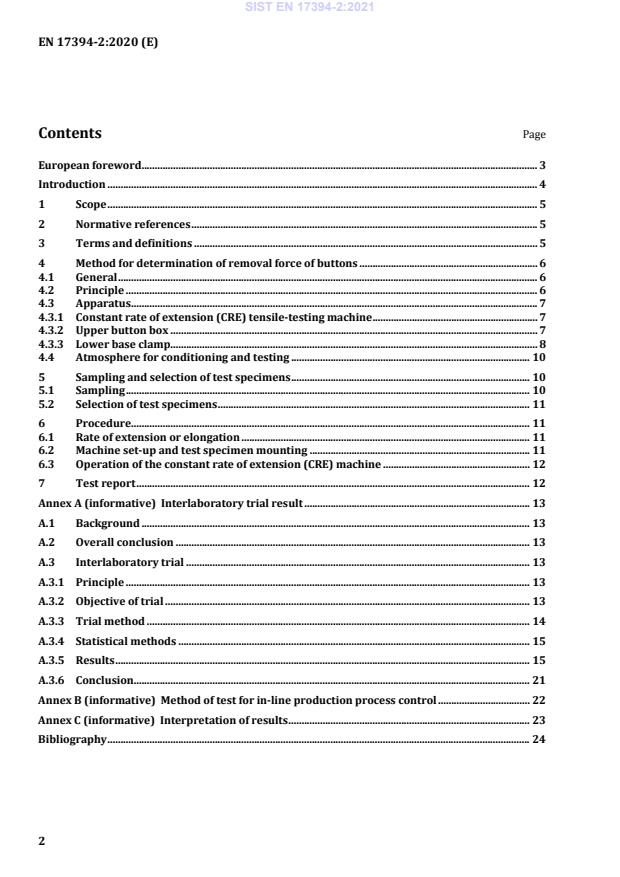
Contents Page
European foreword . 3
Introduction . 4
1 Scope . 5
2 Normative references . 5
3 Terms and definitions . 5
4 Method for determination of removal force of buttons . 6
4.1 General . 6
4.2 Principle . 6
4.3 Apparatus . 7
4.3.1 Constant rate of extension (CRE) tensile-testing machine . 7
4.3.2 Upper button box . 7
4.3.3 Lower base clamp. 8
4.4 Atmosphere for conditioning and testing . 10
5 Sampling and selection of test specimens . 10
5.1 Sampling . 10
5.2 Selection of test specimens . 11
6 Procedure. 11
6.1 Rate of extension or elongation . 11
6.2 Machine set-up and test specimen mounting . 11
6.3 Operation of the constant rate of extension (CRE) machine . 12
7 Test report . 12
Annex A (informative) Interlaboratory trial result . 13
A.1 Background . 13
A.2 Overall conclusion . 13
A.3 Interlaboratory trial . 13
A.3.1 Principle . 13
A.3.2 Objective of trial . 13
A.3.3 Trial method . 14
A.3.4 Statistical methods . 15
A.3.5 Results . 15
A.3.6 Conclusion. 21
Annex B (informative) Method of test for in-line production process control . 22
Annex C (informative) Interpretation of results . 23
Bibliography . 24
European foreword
This document (EN 17394-2:2020) has been prepared by Technical Committee CEN/TC 248 “Textiles
and textile products”, the secretariat of which is held by BSI.
This European Standard shall be given the status of a national standard, either by publication of an
identical text or by endorsement, at the latest by April 2021, and conflicting national standards shall be
withdrawn at the latest by April 2021.
Attention is drawn to the possibility that some of the elements of this document may be the subject of
patent rights. CEN shall not be held responsible for identifying any or all such patent rights.
This is Part 2 of a series of four documents:
— CEN/TS 17394-1, Textiles and textile products — Part 1: Safety of children's clothing — Security of
attachment of attached components to infants' clothing — Specification
— CEN/TS 17394-3, Textiles and textile products — Part 3: Safety of children's clothing — Security of
attachment of metal mechanically applied press fasteners — Test method
— CEN/TS 17394-4, Textiles and textile products — Part 4: Safety of children's clothing — Security of
attachment of components except buttons and metal mechanically applied press fasteners — Test
method
According to the CEN-CENELEC Internal Regulations, the national standards organisations of the
following countries are bound to implement this European Standard: Austria, Belgium, Bulgaria,
Croatia, Cyprus, Czech Republic, Denmark, Estonia, Finland, France, Germany, Greece, Hungary, Iceland,
Ireland, Italy, Latvia, Lithuania, Luxembourg, Malta, Netherlands, Norway, Poland, Portugal, Republic of
North Macedonia, Romania, Serbia, Slovakia, Slovenia, Spain, Sweden, Switzerland, Turkey and the
United Kingdom.
Under preparation. Stage at the time of publication: FprCEN/TS 17394-1.
Under preparation. Stage at the time of publication: FprCEN/TS 17394-3.
Under preparation. Stage at the time of publication: FprCEN/TS 17394-4.
Introduction
The aim of this document is to assess the attachment strength of buttons.
This document provides a reference method of test for compliance assessment. A document providing
performance specification for infants' clothing is under development.
For the convenience of the clothing industry, a simplified method is provided in Annex B for routine in-
house process control, however this does not replace the reference method.
This document has been developed from Annex B of CEN/TR 16792:2014.
1 Scope
This document defines a test method for security of attachment of functional and decorative buttons to
clothing including garments such as gloves, hats, scarves, hosiery, ties, and textile belts.
This document does not apply to:
a) child care articles;
b) shoes, boots and similar footwear;
c) toys (see NOTE 2);
d) other articles sold with clothing.
NOTE 1 The above items are covered by other CEN Technical Committees and as such are out of scope of this
document.
NOTE 2 Disguise costumes including carnival costumes are examples of clothing which are also toys and fall
within the scope of the Toy Safety Directive.
The scope of this document is limited to sewn-on buttons, toggle buttons and tack buttons.
Assessment of other garment components are considered in:
— CEN/TS 17394-3, or
— CEN/TS 17394-4.
Performance requirements are provided in CEN/TS 17394-1.
2 Normative references
The following documents are referred to in the text in such a way that some or all of their content
constitutes requirements of this document. For dated references, only the edition cited applies. For
undated references, the latest edition of the referenced document (including any amendments) applies.
EN ISO 139, Textiles - Standard atmospheres for conditioning and testing (ISO 139)
3 Terms and definitions
For the purposes of this document, the following terms and definitions apply.
ISO and IEC maintain terminological databases for use in standardization at the following addresses:
— IEC Electropedia: available at http://www.electropedia.org/
— ISO Online browsing platform: available at https://www.iso.org/obp
3.1
child or young person
person aged from birth up to age 14 years (that is up to and including 13 years and 11 months) which
includes all boys of height up to 182 cm and all girls of height up to 176 cm
[SOURCE: EN 14682:2014, merged subclauses 2.1 and 2.2]
3.2
children's clothing
all garments intended by design, production route or selling route to be worn by children up to the age
of 14 years
[SOURCE: EN 14682:2014, 2.3]
3.3
sewn-on button
knob or disc which can be attached to the garment by means of, for example, a sewing thread
Note 1 to entry: The sewn-on button may be a means of fastening or decoration.
3.4
toggle button
cylindrical, elliptical or similar shaped button, made from hard material often wood, plastic or horn,
often attached to the garment by means of passing a cord or sewing thread through one or more holes
in the toggle button
Note 1 to entry: Toggle button may be a means of fastening or decoration.
3.5
tack button
fastening or decorative device comprising a button with a hollow shank on the back and a separate
sharp tack, which is attached to a garment by pushing the sharp end of the tack through the fabric from
the reverse side into the shank of the button
Note 1 to entry: Tack buttons are also known as stud buttons.
3.6
garment assembly
section of a garment, made under production conditions, using the production equipment and the
components that will be used in production
[SOURCE: CEN/TR 16792:2014, 3.10]
4 Method for determination of removal force of buttons
4.1 General
This is a laboratory-based method designed for testing of the security of attachments of buttons of all
kinds, both functional and decorative. It can be used to test finished garments or garment assemblies at
the relevant stages of garment design and production.
4.2 Principle
An attached button is held in the upper grip of a constant rate of extension (CRE) tensile testing
machine and the garment or garment panel to which it is attached is held in the lower grip. The grips
are separated at a constant rate until the component is removed from the garment. The removal force
and the mode of detachment are recorded.
4.3 Apparatus
4.3.1 Constant rate of extension (CRE) tensile-testing machine
The machine shall be provided with means for indicating and recording the force applied to the test
specimen in stretching it to rupture. The metrological confirmation system for the tensile testing
machine should be in accordance with EN ISO 10012. Under conditions of use, the accuracy of the
machine should be Class 1 in accordance with EN ISO 7500-1. The error of the indicated or recorded
maximum force at any point in the range in which the machine is used should not exceed 1 %. The
machine should be capable of maintaining a constant rate of extension of (100 ± 10) mm/min.
The machine should be such that it is possible to set the gauge length to any value between 1,0 mm and
75 mm, to an accuracy of 0,5 mm.
4.3.2 Upper button box
Button box with a slotted plate is the upper grip used for the testing of buttons. Example of a button box
is shown in Figure 1. The box should be of sufficient size to accommodate the attachment to be tested
but the shape and dimensions of the box are not critical.
The slotted plate shall be as shown in Figures 2 and 3 made from steel of thickness between 1,50 mm to
1,75 mm. This can be an integral part of the button box or be interchangeable to allow for the testing of
buttons of different sizes or types. The slot width, W, is critical and shall be such that the button being
tested can slide onto the plate without damaging the means of attachment (e.g. sewing thread or shank).
Slot widths of (3,0 ± 0,2) mm, (5,0 ± 0,2)mm and (7,0 ± 0,2)mm have been found most suitable for most
sizes and types of buttons.
For tack buttons, the steel plate used should have a thickness between 1,80 mm and 2,10 mm.
Figure 1 — Example of button box grip
It is recommended that the button box attachment to the load cell be articulated to make it easier to
slide in the button under test.
Key
W slot width
Figure 2 — Slotted plate for use in button box -plan view
Key
U upper side of slotted plate to support button
T thickness of plate
Figure 3 — Slotted plate for use in button box -side view
4.3.3 Lower base clamp
Flat-faced clamping device, for use as the lower grip comprising a clamping device fitted with a front
jaw face (25,0 ± 1,0) mm x (25,0 ± 1,0) mm, and a back-jaw face not less than 25,0mm x 25,0mm
The Figures 4 and 5 show the arrangement to illustrate how the button should be supported during
testing.
Key
1 button box
2 slotted plate
3 button under test
4 flat faced clamping device
5 garment fabric
Figure 4 — Example of sewn-on button under test
Key
1 button box
2 slotted plate
3 button under test
4 flat faced clamping device
5 garment fabric
Figure 5 — Example of button box with tack button under test
4.4 Atmosphere for conditioning and testing
The atmosphere for conditioning and testing shall be as defined in EN ISO 139 (20°C, 65 % relative
humidity)
All test specimens should be conditioned in this atmosphere for at least 4 h before testing.
5 Sampling and selection of test specimens
5.1 Sampling
A sufficient number of representative garments or garment assemblies should be taken to provide the
minimum number of 5 test specimens where the same button type and size is affixed to the same
substrate or layers. This should include interfacing where used.
5.2 Selection of test specimens
Testing should be car
...