

CEN/TS 17394-1:2021
(Main)Textiles and textile products - Part 1: Safety of children's clothing - Security of attachment of attached components to infants' clothing - Specification
- Abstract
This document provides requirements for security of attachment for clothing components that are considered as small parts such as buttons, press fasteners, rivets, sequins, diamantes (or pieces of these components) which fit entirely within the small parts cylinder without compression, for infants' clothing.
Release of these small components from clothing is considered to present hazards of choking, swallowing, ingestion, inhaling (aspiration) or insertion into eyes, nose or ears for infants. This age group is particularly vulnerable as they often do not have the language skills to convey the accident to their carers.
In older children and adults, incidents of accidental insertion or swallowing etc are significantly reduced, predominantly due to the ability of the child to remove the component themselves or to explain and obtain medical help.
This document does not apply to:
a) child care articles;
b) shoes, boots and similar footwear;
c) toys (see NOTE 2);
d) other articles sold with clothing.
NOTE 1 The above items are covered by other CEN Technical Committees and as such are out of the scope of this document.
NOTE 2 Disguise costumes including carnival costumes are examples of clothing which are also toys and fall within the scope of the Toy Safety Directive.
- Status
- Published
- Publication Date
- 12-Jan-2021
- Technical Committee
- CEN/TC 248 - Textiles and textile products
- Drafting Committee
- CEN/TC 248/WG 20 - Safety of children's clothing
- Current Stage
- 9093 - Decision to confirm - Review Enquiry
- Start Date
- 07-Apr-2026
- Completion Date
- 07-Oct-2026

Overview
CEN/TS 17394-1:2021 is a technical specification developed by the European Committee for Standardization (CEN) aimed at enhancing the safety of infants’ clothing. This standard sets requirements for the secure attachment of small clothing components such as buttons, press fasteners, rivets, sequins, and diamantes on garments designed for infants up to 36 months old. The standard addresses critical safety concerns where loose or detached small parts could pose choking, swallowing, aspiration, or insertion hazards for infants who are particularly vulnerable due to limited language and motor skills.
By establishing stringent criteria for the mechanical strength of attachments and securing methods, CEN/TS 17394-1:2021 helps manufacturers reduce risks associated with detached small parts, supporting safer clothing design and production practices.
Key Topics
Scope and Applicability:
The standard specifically targets infants' clothing components that fit entirely within the “small parts cylinder,” indicating potential choking hazards if detached. It excludes child care articles, footwear, toys, and other non-clothing items.Small Parts Definition:
Components like buttons, tack buttons, toggle buttons, press fasteners, rivets, and eyelets are defined with specific dimensional criteria. The “small parts cylinder” test simulates the size of parts that pose ingestion or inhalation risks.Attachment Strength Requirements:
- Sewn-on buttons must withstand a removal force of at least 50 N or 70 N, depending on size, and must be sewn using secure stitch types (lock stitch recommended, chain stitch prohibited).
- Metal mechanically applied press fasteners have similar minimum removal force requirements to ensure they do not detach unintentionally.
- Other components, including textile and stitched-on accessories, must resist detachment even after aggressive wash and dry tests.
Test Methods Reference:
Supported by companion documents specifying detailed test methods:- EN 17394-2:2020 for buttons
- CEN/TS 17394-3:2021 for metal press fasteners
- CEN/TS 17394-4:2021 for other components
Rationale and Best Practices:
The standard draws from toy safety standards (EN 71-1) and adapts tests to the specific textile context. It emphasizes the need for production monitoring to maintain attachment integrity.
Applications
Infant Garment Manufacturing:
Textile and apparel producers use this specification to guide the secure attachment of small parts on infants’ clothing, reducing risks of choking incidents and compliant product offerings for the European market.Safety Compliance:
Retailers and quality assurance teams incorporate CEN/TS 17394-1:2021 in their safety compliance protocols to meet European safety regulations and assure consumers of the safety of infants’ apparel.Product Design and Development:
Designers evaluate and select fastening components and sewing techniques meeting the mechanical strength and safety requirements of the standard early in the product development cycle.Regulatory Alignment:
This document supports manufacturers in aligning with European directives on toy safety and child product safety by addressing overlapping hazards specific to infants’ clothing.
Related Standards
- EN 17394-2:2020 – Test methods for security of attachment of buttons on children’s clothing
- CEN/TS 17394-3:2021 – Test methods for security of attachment of metal mechanically applied press fasteners
- CEN/TS 17394-4:2021 – Test methods for security of attachment of components other than buttons and metal press fasteners
- EN 71-1:2014+A1:2018 – Safety of toys – Mechanical and physical properties, a basis for test methods and safety principles
- ISO 4915 – Classification and terminology of stitch types used in textile and garment production
Keywords: infants clothing safety, secure attachment, small parts choking hazard, CEN standard for children’s garments, button attachment safety, press fastener security, European textiles safety, infant garment testing, toddler apparel safety standards
Relations
- Effective Date
- 15-Apr-2026
- Effective Date
- 28-Jan-2026
- Effective Date
- 28-Jan-2026
- Effective Date
- 28-Jan-2026
- Effective Date
- 28-Jan-2026
- Effective Date
- 23-Sep-2026
- Effective Date
- 28-Jan-2026
Frequently Asked Questions
CEN/TS 17394-1:2021 is a technical specification published by the European Committee for Standardization (CEN). Its full title is "Textiles and textile products - Part 1: Safety of children's clothing - Security of attachment of attached components to infants' clothing - Specification". This standard covers: This document provides requirements for security of attachment for clothing components that are considered as small parts such as buttons, press fasteners, rivets, sequins, diamantes (or pieces of these components) which fit entirely within the small parts cylinder without compression, for infants' clothing. Release of these small components from clothing is considered to present hazards of choking, swallowing, ingestion, inhaling (aspiration) or insertion into eyes, nose or ears for infants. This age group is particularly vulnerable as they often do not have the language skills to convey the accident to their carers. In older children and adults, incidents of accidental insertion or swallowing etc are significantly reduced, predominantly due to the ability of the child to remove the component themselves or to explain and obtain medical help. This document does not apply to: a) child care articles; b) shoes, boots and similar footwear; c) toys (see NOTE 2); d) other articles sold with clothing. NOTE 1 The above items are covered by other CEN Technical Committees and as such are out of the scope of this document. NOTE 2 Disguise costumes including carnival costumes are examples of clothing which are also toys and fall within the scope of the Toy Safety Directive.
This document provides requirements for security of attachment for clothing components that are considered as small parts such as buttons, press fasteners, rivets, sequins, diamantes (or pieces of these components) which fit entirely within the small parts cylinder without compression, for infants' clothing. Release of these small components from clothing is considered to present hazards of choking, swallowing, ingestion, inhaling (aspiration) or insertion into eyes, nose or ears for infants. This age group is particularly vulnerable as they often do not have the language skills to convey the accident to their carers. In older children and adults, incidents of accidental insertion or swallowing etc are significantly reduced, predominantly due to the ability of the child to remove the component themselves or to explain and obtain medical help. This document does not apply to: a) child care articles; b) shoes, boots and similar footwear; c) toys (see NOTE 2); d) other articles sold with clothing. NOTE 1 The above items are covered by other CEN Technical Committees and as such are out of the scope of this document. NOTE 2 Disguise costumes including carnival costumes are examples of clothing which are also toys and fall within the scope of the Toy Safety Directive.
CEN/TS 17394-1:2021 is classified under the following ICS (International Classification for Standards) categories: 61.020 - Clothes; 97.190 - Equipment for children. The ICS classification helps identify the subject area and facilitates finding related standards.
CEN/TS 17394-1:2021 has the following relationships with other standards: It is inter standard links to ISO 4915:1991, CEN/TS 17394-4:2021, EN 1170-7:1997, CEN/TS 17394-3:2021, EN 17394-2:2020, EN 16781:2026, EN 16779-2:2022. Understanding these relationships helps ensure you are using the most current and applicable version of the standard.
CEN/TS 17394-1:2021 is available in PDF format for immediate download after purchase. The document can be added to your cart and obtained through the secure checkout process. Digital delivery ensures instant access to the complete standard document.
Standards Content (Sample)
SLOVENSKI STANDARD
01-maj-2024
Tekstilije in tekstilni izdelki - 1. del: Varnost otroških oblačil - Varnost pritrditve
pritrjenih delov na oblačila za majhne otroke - Specifikacija
Textiles and textile products - Part 1: Safety of children's clothing - Security of
attachment of attached components to infants' clothing - Specification
Textilien und textile Produkte - Teil 1: Sicherheit von Kinderbekleidung - Sicherheit der
Befestigung von befestigten Komponenten an Kleinkinderbekleidung - Spezifikation
Textiles et produits textiles - Partie 1 : Sécurité des vêtements d’enfants - Sécurité
d’attache des composants fixés aux vêtements pour enfants en bas âge - Spécification
Ta slovenski standard je istoveten z: CEN/TS 17394-1:2021
ICS:
61.020 Oblačila Clothes
97.190 Otroška oprema Equipment for children
2003-01.Slovenski inštitut za standardizacijo. Razmnoževanje celote ali delov tega standarda ni dovoljeno.
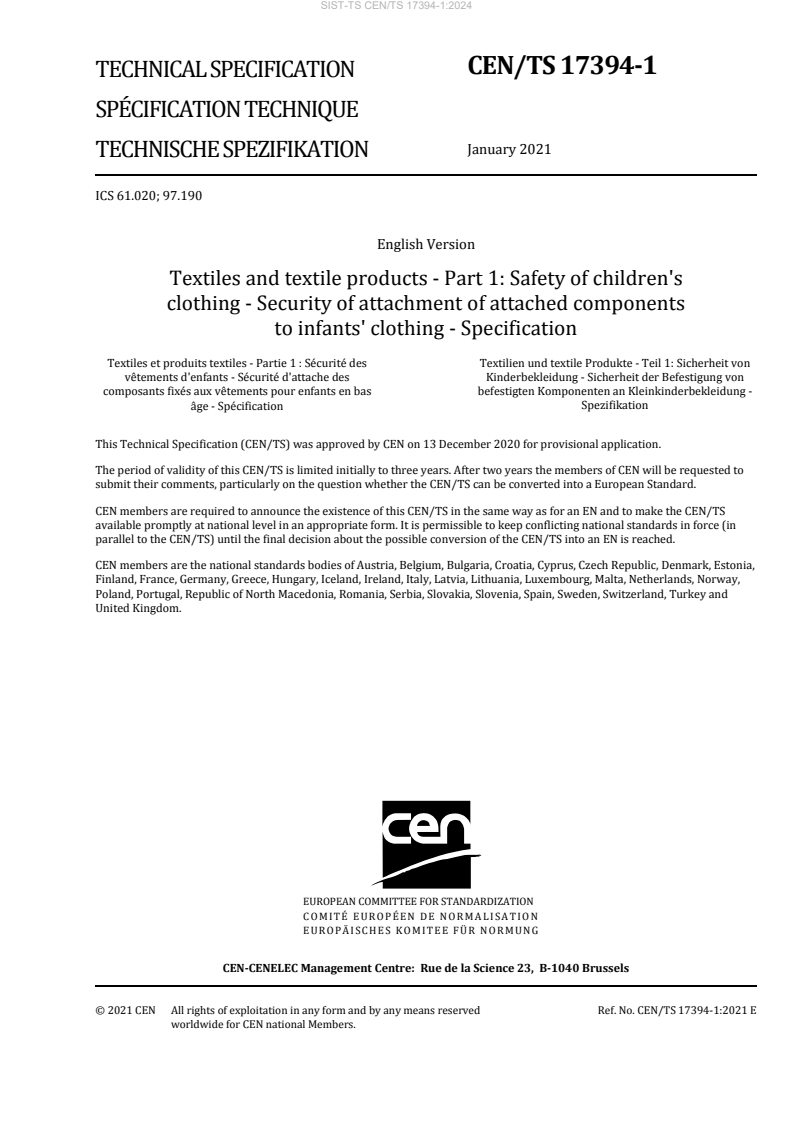
CEN/TS 17394-1
TECHNICAL SPECIFICATION
SPÉCIFICATION TECHNIQUE
January 2021
TECHNISCHE SPEZIFIKATION
ICS 61.020; 97.190
English Version
Textiles and textile products - Part 1: Safety of children's
clothing - Security of attachment of attached components
to infants' clothing - Specification
Textiles et produits textiles - Partie 1 : Sécurité des Textilien und textile Produkte - Teil 1: Sicherheit von
vêtements d'enfants - Sécurité d'attache des Kinderbekleidung - Sicherheit der Befestigung von
composants fixés aux vêtements pour enfants en bas befestigten Komponenten an Kleinkinderbekleidung -
âge - Spécification Spezifikation
This Technical Specification (CEN/TS) was approved by CEN on 13 December 2020 for provisional application.
The period of validity of this CEN/TS is limited initially to three years. After two years the members of CEN will be requested to
submit their comments, particularly on the question whether the CEN/TS can be converted into a European Standard.
CEN members are required to announce the existence of this CEN/TS in the same way as for an EN and to make the CEN/TS
available promptly at national level in an appropriate form. It is permissible to keep conflicting national standards in force (in
parallel to the CEN/TS) until the final decision about the possible conversion of the CEN/TS into an EN is reached.
CEN members are the national standards bodies of Austria, Belgium, Bulgaria, Croatia, Cyprus, Czech Republic, Denmark, Estonia,
Finland, France, Germany, Greece, Hungary, Iceland, Ireland, Italy, Latvia, Lithuania, Luxembourg, Malta, Netherlands, Norway,
Poland, Portugal, Republic of North Macedonia, Romania, Serbia, Slovakia, Slovenia, Spain, Sweden, Switzerland, Turkey and
United Kingdom.
EUROPEAN COMMITTEE FOR STANDARDIZATION
COMITÉ EUROPÉEN DE NORMALISATION
EUROPÄISCHES KOMITEE FÜR NORMUNG
CEN-CENELEC Management Centre: Rue de la Science 23, B-1040 Brussels
© 2021 CEN All rights of exploitation in any form and by any means reserved Ref. No. CEN/TS 17394-1:2021 E
worldwide for CEN national Members.
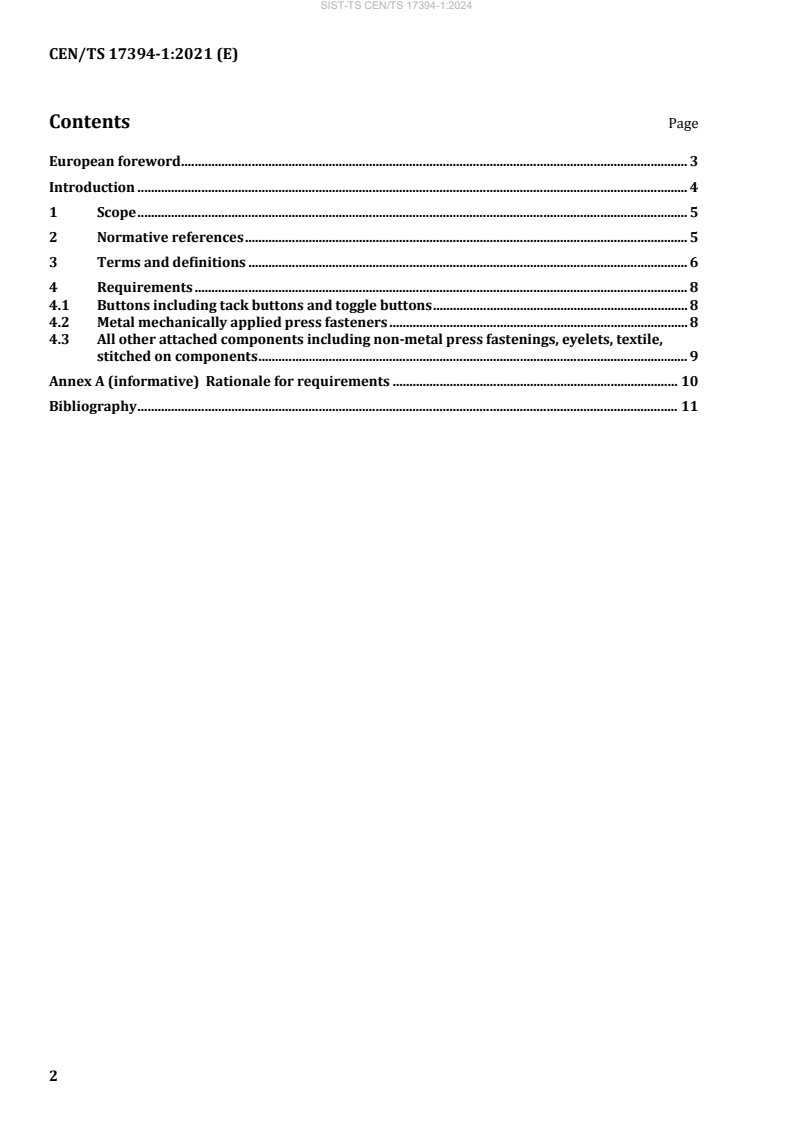
Contents Page
European foreword . 3
Introduction . 4
1 Scope . 5
2 Normative references . 5
3 Terms and definitions . 6
4 Requirements . 8
4.1 Buttons including tack buttons and toggle buttons . 8
4.2 Metal mechanically applied press fasteners . 8
4.3 All other attached components including non-metal press fastenings, eyelets, textile,
stitched on components . 9
Annex A (informative) Rationale for requirements . 10
Bibliography . 11
European foreword
This document (CEN/TS 17394-1:2021) has been prepared by Technical Committee CEN/TC 248
“Textiles and textile products”, the secretariat of which is held by BSI.
Attention is drawn to the possibility that some of the elements of this document may be the subject of
patent rights. CEN shall not be held responsible for identifying any or all such patent rights.
According to the CEN/CENELEC Internal Regulations, the national standards organisations of the
following countries are bound to announce this Technical Specification: Austria, Belgium, Bulgaria,
Croatia, Cyprus, Czech Republic, Denmark, Estonia, Finland, France, Germany, Greece, Hungary, Iceland,
Ireland, Italy, Latvia, Lithuania, Luxembourg, Malta, Netherlands, Norway, Poland, Portugal, Republic of
North Macedonia, Romania, Serbia, Slovakia, Slovenia, Spain, Sweden, Switzerland, Turkey and the United
Kingdom.
Introduction
This document has been developed from CEN/TR 16792, Safety of children's clothing – Recommendations
for the design and manufacture of children's clothing – Mechanical safety, and is intended to be supported
by:
— EN 17394-2:2020, Textiles and textile products - Part 2: Safety of children's clothing - Security of
attachment of buttons - Test method;
— CEN/TS 17394-3:2021, Textiles and textile products - Part 3: Safety of children's clothing - Security of
attachment of metal mechanically applied press fasteners - Test method; and
— CEN/TS 17394-4:2021, Textiles and textile products - Part 4: Safety of children's clothing - Security of
attachment of components except buttons and metal mechanically applied press fasteners - Test
method.
It is anticipated that this document will become an EN in due course.
1 Scope
This document provides requirements for security of attachment for clothing components that are
considered as small parts such as buttons, press fasteners, rivets, sequins, diamantes (or pieces of these
components) which fit entirely within the small parts cylinder without compression, for infants' clothing.
Release of these small components from clothing is considered to present hazards of choking, swallowing,
ingestion, inhaling (aspiration) or insertion into eyes, nose or ears for infants. This age group is
particularly vulnerable as they often do not have the language skills to convey the accident to their carers.
In older children and adults, incidents of accidental insertion or swallowing etc are significantly reduced,
predominantly due to the ability of the child to remove the component themselves or to explain and
obtain medical help.
This document does not apply to:
a) child care articles;
b) shoes, boots and similar footwear;
c) toys (see NOTE 2);
d) other articles sold with clothing.
NOTE 1 The above items are covered by other CEN Technical Committees and as such are out of the scope of this
document.
NOTE 2 Disguise costumes including carnival costumes are examples of clothing which are also toys and fall
within the scope of the Toy Safety Directive.
2 Normative references
The following documents are referred to in the text in such a way that some or all of their content
constitutes requirements of this document. For dated references, only the edition cited applies. For
undated references, the latest edition of the referenced document (including any amendments) applies.
EN 17394-2:2020, Textiles and textile products - Part 2: Safety of children's clothing - Security of
attachment of buttons - Test method
CEN/TS 17394-3:2021, Textiles and textile products - Part 3: Safety of children's clothing - Security of
attachment of metal mechanically applied press fasteners - Test method
CEN/TS 17394-4:2021, Textiles and textile products - Part 4: Safety of children's clothing - Security of
attachment of components except buttons and metal mechanically applied press fasteners - Test method
ISO 4915, Textiles - Stitch types - Classification and terminology
3 Terms and definitions
For the purposes of this document, the following terms and definitions apply.
ISO
...