


prEN 14682
(Main)Safety of children's clothing - Cords and drawstrings on children's clothing - Specifications
General Information
- Abstract
This European Standard specifies requirements for cords and drawstrings on children's clothing, including disguise costumes and ski apparel, up to the age of 14 years.
Within the scope of this European Standard, it is not possible to cover all potential hazards that may create an unsafe garment.
Conversely, identifiable specific hazards in certain styles/design of garment might not present a risk for certain age groups.
It is recommended that an individual risk assessment be carried out on any garment in order to ensure that it does not present a hazard to the wearer
This European Standard does not apply to the following (see Annex C for rationale):
a) child use and care articles, for example bibs, nappies and soother holders;
b) shoes, boots and similar footwear;
c) gloves, hats, bonnets and scarves;
d) neckties designed to be worn with a shirt or blouse;
e) belts, with the exception of tied belts which are within scope;
f) braces;
g) religious clothing;
h) celebratory clothing such as that worn at civil or religious ceremonies, national or regional festivals provided this is worn for limited periods and under supervision;
i) specialist sportswear and activity wear generally worn for limited periods and under supervision, for example rugby shorts, wet suits, and dancewear, except where those garments are commonly worn as day wear or night wear;
j) theatrical costumes used for theatrical performances;
k) aprons intended to be worn over day wear, for limited periods and under supervision, to protect clothing from soiling during activities such as painting, cooking, or during meal times;
l) bags and purses.
- Status
- Not Published
- Publication Date
- 19-Sep-2024
- Technical Committee
- CEN/TC 248 - Textiles and textile products
- Drafting Committee
- CEN/TC 248/WG 20 - Safety of children's clothing
- Current Stage
- 4098 - Decision to abandon - Enquiry
- Start Date
- 29-Jan-2025
- Completion Date
- 17-Sep-2026
- Directive
- Harmonized Standard2001/95/EC - General product safety

Overview
prEN 14682 (draft) establishes safety specifications for cords and drawstrings on children's clothing intended for children up to 14 years of age. Prepared by CEN/TC 248, this European draft standard aims to minimise risk of accidental entrapment, strangulation and other injuries associated with cords, drawstrings, toggles and decorative features on garments. The scope covers day wear, disguise costumes and ski apparel and emphasises that individual risk assessment remains essential for every garment.
Key Topics
- Age-based requirements: The standard recognises two main groups - young children (birth to 7 years) and older children and young persons (7 to 14 years) - and tailors requirements to typical behaviour and anthropometrics for each group.
- Garment zones: Specific provisions apply to different areas of a garment (head/neck/upper chest, chest/waist, below crotch, back, arms and all other parts). These zones guide acceptable cord and drawstring placement and design.
- Cord types and functions: Definitions and distinctions are provided for functional cords, drawstrings, decorative cords, elastic cords, toggles, loops and sashes. The standard differentiates safety expectations depending on whether a cord is functional or purely decorative.
- Measurement and assessment: Annex D covers measurement methods for cord lengths and configurations while Annex E provides guidance on performing a documented risk assessment for individual garments.
- Exclusions and rationale: Certain items are explicitly out of scope (for example shoes, face coverings, some specialist sportswear and specific child-care articles). Annex C explains the rationale behind exclusions and the decision logic for requirements.
Applications
Manufacturers, designers, retailers, test laboratories and compliance teams can use prEN 14682 to:
- Design safer children's clothing by avoiding hazardous cord placements in sensitive zones.
- Apply age-appropriate restraints on cord length, termination and fixings to reduce entrapment and strangulation risk.
- Develop internal risk assessment processes for novel styles, trims or decorative features.
- Prepare technical documentation and testing plans aligned with European safety expectations.
Benefits include reduced product liability, improved consumer safety and clearer guidance for product development.
Related Standards
- EN 14682:2014 - the current edition that prEN 14682 is intended to supersede.
- EN 71 series - relevant where toy disguise costumes overlap with toy safety rules.
For detailed measurement procedures, definitional clarity and the rationale for exclusions, consult the normative and informative annexes (Annexes C, D, E and F) included in the draft. Implementing prEN 14682 supports safer garment design and helps manufacturers demonstrate due diligence through documented risk assessment and compliance practices.
Relations
- Effective Date
- 28-Jan-2023
Frequently Asked Questions
prEN 14682 is a draft published by the European Committee for Standardization (CEN). Its full title is "Safety of children's clothing - Cords and drawstrings on children's clothing - Specifications". This standard covers: This European Standard specifies requirements for cords and drawstrings on children's clothing, including disguise costumes and ski apparel, up to the age of 14 years. Within the scope of this European Standard, it is not possible to cover all potential hazards that may create an unsafe garment. Conversely, identifiable specific hazards in certain styles/design of garment might not present a risk for certain age groups. It is recommended that an individual risk assessment be carried out on any garment in order to ensure that it does not present a hazard to the wearer This European Standard does not apply to the following (see Annex C for rationale): a) child use and care articles, for example bibs, nappies and soother holders; b) shoes, boots and similar footwear; c) gloves, hats, bonnets and scarves; d) neckties designed to be worn with a shirt or blouse; e) belts, with the exception of tied belts which are within scope; f) braces; g) religious clothing; h) celebratory clothing such as that worn at civil or religious ceremonies, national or regional festivals provided this is worn for limited periods and under supervision; i) specialist sportswear and activity wear generally worn for limited periods and under supervision, for example rugby shorts, wet suits, and dancewear, except where those garments are commonly worn as day wear or night wear; j) theatrical costumes used for theatrical performances; k) aprons intended to be worn over day wear, for limited periods and under supervision, to protect clothing from soiling during activities such as painting, cooking, or during meal times; l) bags and purses.
This European Standard specifies requirements for cords and drawstrings on children's clothing, including disguise costumes and ski apparel, up to the age of 14 years. Within the scope of this European Standard, it is not possible to cover all potential hazards that may create an unsafe garment. Conversely, identifiable specific hazards in certain styles/design of garment might not present a risk for certain age groups. It is recommended that an individual risk assessment be carried out on any garment in order to ensure that it does not present a hazard to the wearer This European Standard does not apply to the following (see Annex C for rationale): a) child use and care articles, for example bibs, nappies and soother holders; b) shoes, boots and similar footwear; c) gloves, hats, bonnets and scarves; d) neckties designed to be worn with a shirt or blouse; e) belts, with the exception of tied belts which are within scope; f) braces; g) religious clothing; h) celebratory clothing such as that worn at civil or religious ceremonies, national or regional festivals provided this is worn for limited periods and under supervision; i) specialist sportswear and activity wear generally worn for limited periods and under supervision, for example rugby shorts, wet suits, and dancewear, except where those garments are commonly worn as day wear or night wear; j) theatrical costumes used for theatrical performances; k) aprons intended to be worn over day wear, for limited periods and under supervision, to protect clothing from soiling during activities such as painting, cooking, or during meal times; l) bags and purses.
prEN 14682 is classified under the following ICS (International Classification for Standards) categories: 61.020 - Clothes; 97.190 - Equipment for children. The ICS classification helps identify the subject area and facilitates finding related standards.
prEN 14682 has the following relationships with other standards: It is inter standard links to EN 14682:2014. Understanding these relationships helps ensure you are using the most current and applicable version of the standard.
prEN 14682 is associated with the following European legislation: EU Directives/Regulations: 2001/95/EC, 2023/988/EU; Standardization Mandates: M/309. When a standard is cited in the Official Journal of the European Union, products manufactured in conformity with it benefit from a presumption of conformity with the essential requirements of the corresponding EU directive or regulation.
prEN 14682 is available in PDF format for immediate download after purchase. The document can be added to your cart and obtained through the secure checkout process. Digital delivery ensures instant access to the complete standard document.
Standards Content (Sample)
SLOVENSKI STANDARD
01-junij-2023
Varnost otroških oblačil - Vrvice in vezalke na otroških oblačilih - Specifikacije
Safety of children's clothing - Cords and drawstrings on children's clothing -
Specifications
Sicherheit von Kinderbekleidung - Kordeln und Zugbänder an Kinderbekleidung -
Anforderungen
Sécurité des vêtements d'enfants - Cordons et cordons coulissants - Spécifications
Ta slovenski standard je istoveten z: prEN 14682
ICS:
61.020 Oblačila Clothes
97.190 Otroška oprema Equipment for children
2003-01.Slovenski inštitut za standardizacijo. Razmnoževanje celote ali delov tega standarda ni dovoljeno.
DRAFT
EUROPEAN STANDARD
NORME EUROPÉENNE
EUROPÄISCHE NORM
April 2023
ICS Will supersede EN 14682:2014
English Version
Safety of children's clothing - Cords and drawstrings on
children's clothing - Specifications
Sécurité des vêtements d¿enfants - Cordons et cordons Sicherheit von Kinderbekleidung - Kordeln und
coulissants - Spécifications Zugbänder an Kinderbekleidung - Anforderungen
This draft European Standard is submitted to CEN members for enquiry. It has been drawn up by the Technical Committee
CEN/TC 248.
If this draft becomes a European Standard, CEN members are bound to comply with the CEN/CENELEC Internal Regulations
which stipulate the conditions for giving this European Standard the status of a national standard without any alteration.
This draft European Standard was established by CEN in three official versions (English, French, German). A version in any other
language made by translation under the responsibility of a CEN member into its own language and notified to the CEN-CENELEC
Management Centre has the same status as the official versions.
CEN members are the national standards bodies of Austria, Belgium, Bulgaria, Croatia, Cyprus, Czech Republic, Denmark, Estonia,
Finland, France, Germany, Greece, Hungary, Iceland, Ireland, Italy, Latvia, Lithuania, Luxembourg, Malta, Netherlands, Norway,
Poland, Portugal, Republic of North Macedonia, Romania, Serbia, Slovakia, Slovenia, Spain, Sweden, Switzerland, Türkiye and
United Kingdom.
Recipients of this draft are invited to submit, with their comments, notification of any relevant patent rights of which they are
aware and to provide supporting documentation.
Warning : This document is not a European Standard. It is distributed for review and comments. It is subject to change without
notice and shall not be referred to as a European Standard.
EUROPEAN COMMITTEE FOR STANDARDIZATION
COMITÉ EUROPÉEN DE NORMALISATION
EUROPÄISCHES KOMITEE FÜR NORMUNG
CEN-CENELEC Management Centre: Rue de la Science 23, B-1040 Brussels
© 2023 CEN All rights of exploitation in any form and by any means reserved Ref. No. prEN 14682:2023 E
worldwide for CEN national Members.
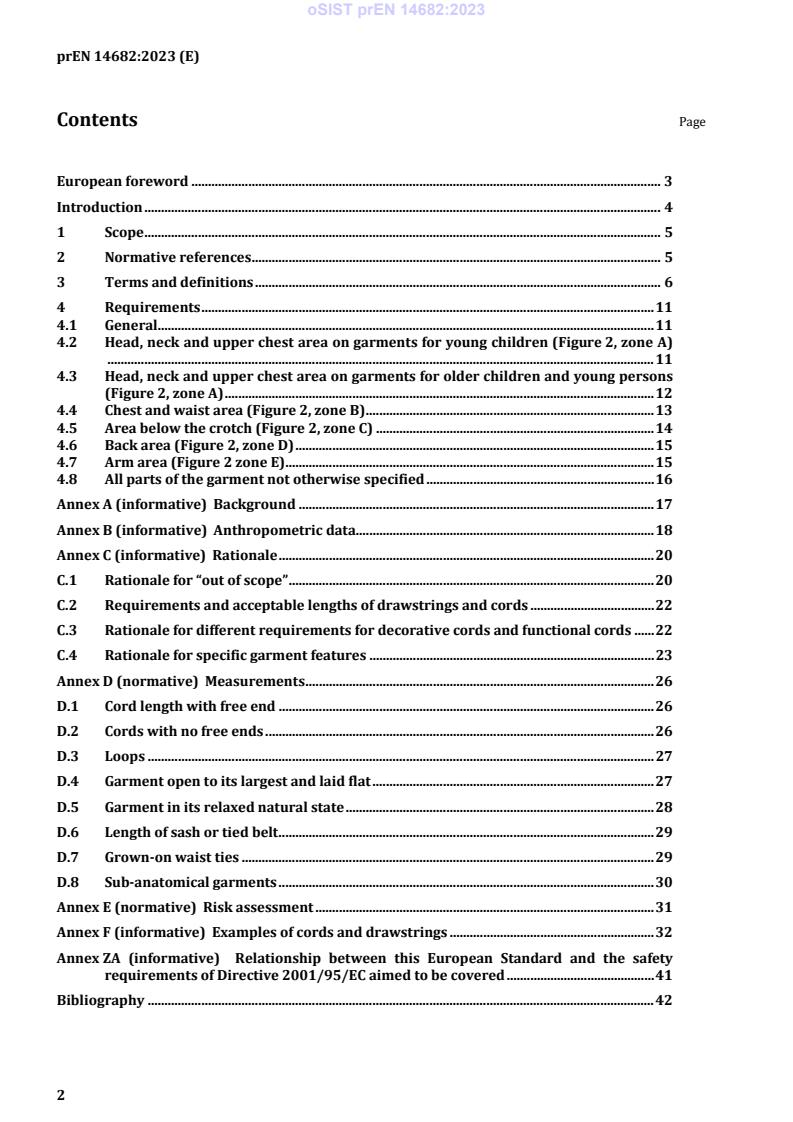
Contents Page
European foreword . 3
Introduction . 4
1 Scope . 5
2 Normative references . 5
3 Terms and definitions . 6
4 Requirements . 11
4.1 General. 11
4.2 Head, neck and upper chest area on garments for young children (Figure 2, zone A)
................................................................................................................................................................... 11
4.3 Head, neck and upper chest area on garments for older children and young persons
(Figure 2, zone A) . 12
4.4 Chest and waist area (Figure 2, zone B) . 13
4.5 Area below the crotch (Figure 2, zone C) . 14
4.6 Back area (Figure 2, zone D) . 15
4.7 Arm area (Figure 2 zone E) . 15
4.8 All parts of the garment not otherwise specified . 16
Annex A (informative) Background . 17
Annex B (informative) Anthropometric data . 18
Annex C (informative) Rationale . 20
C.1 Rationale for “out of scope” . 20
C.2 Requirements and acceptable lengths of drawstrings and cords . 22
C.3 Rationale for different requirements for decorative cords and functional cords . 22
C.4 Rationale for specific garment features . 23
Annex D (normative) Measurements . 26
D.1 Cord length with free end . 26
D.2 Cords with no free ends . 26
D.3 Loops . 27
D.4 Garment open to its largest and laid flat . 27
D.5 Garment in its relaxed natural state . 28
D.6 Length of sash or tied belt . 29
D.7 Grown-on waist ties . 29
D.8 Sub-anatomical garments . 30
Annex E (normative) Risk assessment . 31
Annex F (informative) Examples of cords and drawstrings . 32
Annex ZA (informative) Relationship between this European Standard and the safety
requirements of Directive 2001/95/EC aimed to be covered . 41
Bibliography . 42
European foreword
This document (prEN 14682:2023) has been prepared by Technical Committee CEN/TC 248, “Textiles
and Textile Products”, the secretariat of which is held by BSI.
This document is currently submitted to the CEN Enquiry.
This document will supersede EN 14682:2014.
In comparison with the previous edition, EN 14682:2014, the following significant technical changes
have been made:
a) The scope has been revised to:
1) exclude community face coverings; and
2) emphasize that while certain products have no specific requirement, these still require safety
risk assessment.
b) New definitions for arm area and raw edges. Several definitions have been revised to improve clarity.
c) Many requirement clauses have been updated reflecting new and evolving fashion styles and features
on clothing for children. Requirements have been introduced to consider:
1) cords emerging on head or neck area of garments;
2) decorative features on hoods of garments;
3) raw edges on garments;
4) cords on bootees and socks for pre-walking children; and
5) cords in lower leg area of garments including socks and hosiery.
d) Annex C has been revised and text added improve rationales for requirements.
e) Annex D has been revised improve clarity with additions for how to measure new features and styles.
f) Annex F some diagrams revised to improve clarity.
g) Annex ZA has been introduced.
The standard has been prepared under a standardization request given to CEN/CENELEC by the
European Commission and the European Free Trade Association and support essential requirements of
EU Directive / Regulation.
For relationship with EU Directive / Regulation, see informative Annex ZA, which is an integral part of
this document.
Introduction
The European Commission Mandate No. M/309, related to the safety of consumers of drawstrings or
cords on children’s clothing and issued on 9 March 2001, requested that CEN develops standards or
specifications to consider cords and drawstrings on clothing intended for children up to age 14 years.
The aim of this European Standard is to minimize the risk of accidental entrapment by cords or
drawstrings on children’s clothing taking into account:
a) the child’s age;
b) behaviour and activities of children for their age and stage of development, for example playing in
playgrounds, climbing trees, travelling by bus or train, ability to look after themselves, and where
relevant, level of supervision;
c) national accident statistics indicate that serious accidents involving cords and drawstrings on
children’s clothing fall into two main groups by age of child;
1) younger children: entrapment of hood cords in playground equipment such as slides, resulting
in fatalities;
2) older children and young persons: entrapment of cords and strings from the waist and lower
hems of garments in moving vehicles such as bus doors, ski lifts and bicycles resulting in severe
injuries or death from being dragged along or run over by the vehicle.
In addition, elasticated hood or neck cords have resulted in a number of facial injuries.
See Annex A for more information on the background to this standard.
Children’s clothing sold in the EU is usually sold by height as the primary measurement, sometimes with
age as an additional indicator. Clothing for babies (up to around 1 year of age) is generally sold by length
of the baby although some countries use the baby's weight. All chest, waist, and hip measurements are
secondary measurements.
1 Scope
This document specifies requirements for cords and drawstrings on clothing to minimize the risk of
accidental strangulation or entrapment, for children up to the age of 14 years. This includes disguise
costumes and ski apparel.
This document does not apply to the following (see Annex C for rationale):
a) child use and care articles, for example bibs, nappies and soother holders; see C.1, a)
b) shoes, boots and similar footwear; see C.1, b)
c) community face coverings; see C.1, c)
The following are also out of scope however attention is drawn to Annex C for further information, gloves,
hats, bonnets and scarves; see C.1, d)
d) neckties and bow ties which encircle the neck not attached to the shirt or blouse; see C.1, e)
e) removable belts, with the exception of tied belts which are within scope; see C.1, f)
f) removable braces (suspenders); see C.1, f)
g) religious clothing; see C.1, g)
h) celebratory clothing such as that worn at civil or religious ceremonies, national or regional festivals
provided this is worn for limited periods and under supervision; see C.1, h)
i) specialist sportswear and activity wear generally worn for limited periods and under supervision,
for example rugby shorts, wet suits, and dancewear, except where those garments are commonly
worn as day wear or night wear; see C.1, i)
j) theatrical costumes used for theatrical performances; see C.1, j)
k) aprons intended to be worn over day wear, for limited periods and under supervision, to protect
clothing from soiling during activities such as painting, cooking, or during meal times; see C.1, k), and
l) bags and purses; see C.1, l).
2 Normative references
There are no normative references in this document.
Toy disguise costumes are covered by EN 71-1.
3 Terms and definitions
For the purposes of this document, the following terms and definitions apply.
ISO and IEC maintain terminology databases for use in standardization at the following addresses:
— ISO Online browsing platform: available at https://www.iso.org/obp
— IEC Electropedia: available at https://www.electropedia.org
3.1
young child
person aged from birth up to age 7 years (that is up to and including 6 years and 11 months) which
includes all children up to and including a height of 134 cm
Note 1 to entry: See Annex B.
3.2
older child and young person
person aged from 7 years up to age 14 years (that is up to and including 13 years and 11 months) which
includes all boys of height greater than 134 cm up to 182 cm and girls of height greater than 134 cm up
to 176 cm
Note 1 to entry: See Annex B.
3.3
children's clothing
all garments intended by design, production route or selling route to be worn by children up to the age
of 14 years
3.4
functional cord
cord, chain, ribbon, string or tape, made of any textile or non-textile material including elastic material,
which is used to adjust the size of the opening, or part of the garment or to fasten the garment itself
Note 1 to entry: The protruding length of a functional cord is fixed, except for elastic materials.
3.5
drawstring
cord, chain, ribbon, string or tape, made of any textile or non-textile material including elastic material,
which passes through a channel, loop(s) or eyelet(s) or similar, to adjust the size of the opening or part
of the garment, or to fasten the garment itself
Note 1 to entry: The protruding length of the drawstring can increase or decrease when closure is effected.
Note 2 to entry: For some garments, a drawstring can be a loop with a tightening device rather than a single length
with two ends that can be tied.
3.6
decorative cord
non-functional cord, chain, ribbon, string or tape, made of any textile or non-textile material including
elastic material, with free end with or without embellishment such as toggle, pom-pom, feather or bead,
which is not intended to be used to adjust the size of the garment opening or fasten the garment itself
Note 1 to entry: Fringes are considered as a series of decorative cords.
Note 2 to entry: Free ends of fixed bows are considered as decorative cords.
Note 3 to entry: Decorative features on garments for example animal-like features are not considered decorative
cords See C.4.3.
3.7
elastic cord
cord containing yarns of rubber or elastodiene or elastane polymer or similar, having high extensibility
and complete or near complete recovery
3.8
shoulder strap
cord, chain, ribbon, string or tape, made of any textile or non-textile material including elastic material,
joining the front and back of a top part of the garment together, which is close fitting and passes over the
shoulder
3.9
halter neck cord
cord, chain, ribbon, string or tape, made of any textile or non-textile material including elastic material,
worn round the back of the neck holding the garment (for example dress, blouse or bikini) top leaving
the shoulder and back bare
3.10
belt
strip of any material, with fastening mechanism such as buckle, worn round chest or waist area used to
hold up clothing or as decoration
3.11
sash
tied belt
decorative or functional piece of any material of not less than 3 cm width tied round the chest or waist
area of a garment
Note 1 to entry: Tied belt or sash can partially or fully encircle the body.
Note 2 to entry: If the width is less than 3 cm, these are considered as cords or drawstrings.
Note 3 to entry: The ends of the tied belt or sash can be shaped.
3.12
braces
suspenders
pair of shoulder straps, often elasticated, joining the front and back of a pair of trousers or skirt or similar
garments covering the lower body used to hold the garment up
Note 1 to entry: Braces can be removable or permanently attached.
3.13
stirrup
strip of textile or non-textile material attached to both sides of the lower hem of a trouser such that it
passes under the foot or shoe to create a close fit to the wearer
3.14
toggle
wooden, plastic, metal or otherwise composed piece attached to or present on, a drawstring, functional
cord or decorative cord
Note 1 to entry: Toggles can be decorative or functional.
3.15
loop
cord or narrow strip of fabric, which can be fixed or adjustable in length, where both ends are
permanently attached to the garment
3.16
zip puller
fitting attached to the slider body to facilitate manipulation
Note 1 to entry: The zip puller can be made of metal, plastic or textile material.
3.17
zip slider
moving component consisting essentially of a slider body and, normally, a puller, which opens or closes
the fastener by separating or engaging the interlocking members
3.18
adjusting tab
strip of textile or non-textile material not less than 2 cm in width intended to close or adjust the size of
opening on a garment or for decoration, for example at the ankle or sleeve cuff
3.19
open to its largest and laid flat
garment or part of a garment extended to its fullest size to remove gathering or effect of elastication
without deforming or stretching the fabric beyond its natural state, or damaging the garment
construction or stitching
Note 1 to entry: See D.4.
3.20
relaxed natural state
measurement when garment or component is laid flat with garment part, for example waistband, in its
natural position (neither extended nor contracted)
Note 1 to entry: See D.5.
3.21
three-dimensional embellishment
item attached to a cord that is thicker and/or wider than the cord itself
Note 1 to entry: Thin materials such as plastic sleeving (boot lace ends) which are not thicker than the cord itself
are not considered as three-dimensional embellishments.
3.22
short sleeve
sleeve designed to end at or above the elbow
3.23
long sleeve
sleeve designed to end below the elbow
3.24
raw edge
frayed hem of the fabric that is cut or unfinished
Note 1 to entry: See Figure 1.
Figure 1 — Example of raw edge or frayed hem
3.25
head, neck and upper chest area
whole of head, neck and throat, and upper front chest from shoulder points (acromia) to the top of the
arm pits (axillae) excluding arms
Note 1 to entry: See Figure 2, zone A.
3.26
chest and waist area
front part of the body from the chest level with the armpits (axillae) to the hip level with the crotch, level
with the hip
Note 1 to entry: See Figure 2, zone B.
3.27
area below crotch
front part of the body below the crotch
Note 1 to entry: See Figure 2, zone C.
3.28
back area
posterior part of the body and legs, excluding head, neck and arms
Note 1 to entry: See Figure 2, zone D.
3.29
arm area
whole arm (including hand), from the shoulder point (acromion) to the tip of the fingers
Note 1 to entry: See Figure 2, zone E.
Key
A head, neck and upper chest area
B chest and waist area
C area below crotch
D back area
E arm area
Figure 2 — Body zones
4 Requirements
4.1 General
It is not possible to consider all potential hazards that can create an unsafe garment.
Conversely, identifiable specific hazards in certain styles/design of garment might not present a risk for
certain age groups.
It is recommended that an individual risk assessment be carried out on any garment in order to ensure
that it does not present a hazard to the wearer.
IMPORTANT - The requirements provided in this document are applicable to the inside and outside of
the garment, including any removable garment parts intended to be attached to the garment. It is possible
through risk assessment of the specific style that some features which are wholly inside the garment
when worn may be acceptable as they are not a hazard to the wearer.
Where it is ambiguous which clause is applicable, apply the strictest requirement to ensure the garment
is safe.
4.1.1 The free ends of drawstrings, functional cords, and tied belts or sashes shall have no knots or
three-dimensional embellishments and shall be secured to prevent unravelling, for example by heat
sealing or bar tacking. The ends may be doubled or folded provided no hazard of entrapment is created.
Knots and three- dimensional embellishments along the length of the free ends are not permitted.
Free ends of decorative cords shall be secured to prevent unravelling.
4.1.2 Toggles used on drawstrings without free ends shall be permanently attached to the garment
with, for example, a piece of ribbon, cord or tape. (for example, see Figures F.1). Toggles may be used on
decorative cords.
4.1.3 Drawstrings shall be attached to the garment, for example using a bar tack, in at least one point
positioned equidistant from the final exit points (for example, see Figure F.3).
4.1.4 Fixed loops, which protrude from the garment, for example to fasten, or loops on fixed bows, shall
be no more than 7,5 cm in circumference. Flat fixed loops which do not protrude from the garments, for
example belt loops, shall be no more than 7,5 cm in length, between the fixed points of attachment to the
garment (for example, see Figure F.4).
Functional hanger loops and other loops inside the garment are permitted if a risk assessment shows that
they are not a hazard to the wearer (see Annex E).
4.1.5 Zip pullers including any embellishment shall be no longer than 7,5 cm in length from zip slider.
4.1.6 Zip pullers with or without embellishment shall not hang below the lower edge of garments
designed to finish at the ankle (for example, see Figure F.5).
4.1.7 Raw edges shall be no more than 2,0 cm in length, and the fabric shall be secured to prevent further
fraying or unravelling.
4.1.8 Measurements shall be carried out in accordance with Annex D.
4.2 Head, neck and upper chest area on garments for young children (Figure 2, zone A)
4.2.1 Garments intended for young children shall not be designed, manufactured, or supplied with
drawstrings or functional cords in the head, neck or upper chest area.
4.2.2 Decorative cords shall not be permitted anywhere on the hood or at the back of the neck.
4.2.3 In other parts of neck and upper chest areas, decorative cords shall have free ends no longer than
7,5 cm, shall have no knots, toggles or three-dimensional embellishments and shall not be positioned so
they can tie across the throat.
Decorative cords shall not be made from elastic cords.
NOTE The hazard from elastic cords is that the free ends can “snap” back to face or neck resulting in injury.
Elasticated shoulder straps and halter necks fit close to the body and do not pose the same risk.
4.2.4 Adjusting tabs are permissible provided that the length is no more than 7,5 cm, and shall have no
button, toggle, buckle on the free end which can present an entrapment hazard. Where a button, toggle
or buckle is used, these shall be attached to the garment.
4.2.5 Shoulder straps can be permanently fixed to the front and back of the garment or attached with
for example buttons, press fasteners, to permit adjustment of the strap length. When the straps are
fastened, any free ends external to the garment shall not exceed 2,0 cm. The use of a clip or fastening of
two cords is acceptable, provided these do not result in free ends of cords when the garment is worn.
There shall be no additional embellishments at the ends of the shoulder straps.
Where a mechanism, for example ring and slider, is used to adjust the length of the shoulder strap, the
strap including the loop shall lie flat to the body when worn.
Where this mechanism is used, the loop will be of variable length. The general requirement for flat loop
length 4.1.4 is not applicable, as the loop is close fitting to the body when worn.
Decorative cords attached to a shoulder strap shall not have free ends longer than 7,5 cm and fixed loops
shall be no more than 7,5 cm in circumference (for example, see Figure F.6).
4.2.6 Halter neck-style garments shall be constructed with no free ends in the neck and throat (for
example, see Figure F.7).
The use of a clip or fastening of two cords is acceptable, provided these do not result in free ends of cords
when garment is worn.
Where a mechanism, for example ring and slider, is used to adjust the length of the halter neck, the strap
including the loop shall lie flat to the body when worn. Where this mechanism is used, the loop is of
variable length and 4.1.4 is not applicable
4.3 Head, neck and upper chest area on garments for older children and young persons
(Figure 2, zone A)
4.3.1 Drawstrings shall not have free ends.
4.3.2 Garments shall not be designed, manufactured, or supplied with drawstrings or functional cords
which exit or protrude at the top or back of the head, or back of neck.
4.3.3 Where permitted, drawstrings with no free ends shall have no protruding loop when the garment
is open to its largest and laid flat. When the garment opening is at its smallest, i.e. the size it is intended
to fit, the maximum protruding loop circumference shall be 15 cm (for example, see Figure F.8).
4.3.4 Where permitted, functional cords shall be not more than 7,5 cm in length. Functional cords shall
not be made from elastic cords.
NOTE The hazard from elastic cords is that the free ends can “snap” back to face or neck resulting in injury.
Elasticated shoulder straps and halter necks fit close to the body and do not pose the same risk.
4.3.5 Decorative cords shall not be more than 7,5 cm in length including any attachment or three-
dimensional embellishment. Decorative cords shall not be made from elastic cords.
Decorative cords on the hood or back of the neck shall not have three dimensional embellishments.
NOTE The hazard from elastic cords is that the free ends can “snap” back to face or neck resulting in injury,
especially if they have a toggle.
4.3.6 Adjusting tabs are permissible provided that the length is no more than 7,5 cm, and shall have no
button, toggle, buckle on the free end which can present an entrapment hazard. Where a button, toggle
or buckle is used, these shall be attached to the garment.
4.3.7 Shoulder straps are permissible provided any free ends are no longer than 14 cm from the point
at which they are to be tied and fixed loops are no more than 7,5 cm in circumference (for example, see
Figure F.6).
Where a mechanism, for example ring and slider, is used to adjust the length of the shoulder strap, the
strap including the loop shall lie flat to the body when worn. Where this mechanism is used, the loop is of
variable length and 4.1.4 is not applicable
4.3.8 Halter neck-style garments shall be constructed with no free ends at the neck and throat (for
example, see Figure F.7). The use of a clip or fastening of two cords is acceptable, provided these do not
result in free ends of cords when garment is worn.
Where a mechanism, for example ring and slider, is used to adjust the length of the halter neck strap, the
strap including the loop shall lie flat to the body when worn. Where this mechanism is used, the loop is of
variable length and 4.1.4 is not applicable
4.4 Chest and waist area (Figure 2, zone B)
4.4.1 Garments worn from waist down without shoulder straps, braces, or sleeves, such as trousers,
shorts, skirts, briefs, bikini bottoms, shall not have:
a) free ends of drawstrings longer than 20 cm at each end when the garment is in a relaxed natural state
(for example, see Figure F.9);
b) protruding loops on drawstrings with no free ends, when the garment is open to its largest and laid
flat. Where toggles are used for adjustment of drawstrings with no free ends, the toggles shall be
fixed to the garment (for example see Figure F.1);
c) functional cords longer than 20 cm;
d) decorative cords longer than 14 cm including any embellishment.
4.4.2 Garments other than those listed in 4.4.1 such as shirts, coats, dresses, and dungarees shall not
have:
a) free ends of drawstrings longer than 14 cm at each end when the garment is open to its largest and
laid flat;
b) protruding loops on drawstrings with no free ends when the garment is open to its largest and laid
flat. Where toggles are used for adjustment of drawstrings with no free ends, the toggles shall be
fixed to the garment (for example see Figure F.1);
c) functional cords longer than 14 cm; or
d) decorative cords longer than 14 cm, including any embellishment.
4.4.3 For all garments, where the adjusting tab is attached at the front of the garment in the waist area
it shall be a maximum of 14 cm.
Where the adjusting tab is permanently attached in zone B, the requirements of this zone are applicable
even if the adjusting tab closure is in zone D. This also applies where the adjusting tab is attached at the
side seam. Where the adjusting tab is permanently attached in zone B with the adjusting tab closure is in
zone D, the requirements of the D zone are applicable.”
4.4.4 For young children, tied belts or sashes intended to be tied at the back of the garment are
permissible provided that when untied and measured from the point where they are to be tied, they shall
be no more than 36 cm in length. When untied, they shall not hang below the hem of the garment (for
example, see Figures F.10).
4.4.5 For older children and young persons, tied belts or sashes intended to be tied at the back of the
garment are permissible provided that, when untied and measured from the point where they are to be
tied they shall be no more than 36 cm in length (for example, see Figures F.10).
4.4.6 For both age groups, tied belts or sashes intended to be tied at the front or at the side of the
garment shall be acceptable provided that when untied they shall be no more than 36 cm in length
measured from the point where they are to be tied (for example, see Figure F.11).
4.5 Area below the crotch (Figure 2, zone C)
4.5.1 Drawstrings or functional cords including any toggle shall not hang below the lower edge of the
garment (for example, see Figure F.12).
Where it is unclear if the lower edge of a garment is below the crotch, the requirements of 4.5 apply.
4.5.2 Drawstrings or functional cords at the lower edges of garments shall lie flat against the garment,
when the garment is tightened or fastened.
4.5.3 Decorative cords up to 7,5 cm, with no toggle or three-dimensional embellishment are acceptable
below the lower edge of the garment, provided the end of the decorative cord is above the knee.
4.5.4 In garments that are designed to finish at the ankle such as trousers, skirts and coats, the
drawstrings, functional cords and decorative cords at the lower edge shall not be outside the garment.
Stirrups at the hem of trousers are permissible.
4.5.5 Adjusting tabs attached at the front of the garment shall be no longer than 14 cm, shall not hang
below the lower edge of the garment and shall have no button, toggle, buckle on the free end which can
present an entrapment hazard (for example, see Figure F.13). Where a button, toggle or buckle is used,
these shall be attached to the garment.
4.5.6 Bootees and socks for pre-walking children shall not have drawstrings, functional cords or
decorative cords with free ends longer than 14 cm when measured in the relaxed natural state.
Where drawstrings with no free ends are used, there shall be no protruding loop when the garment is
open to its largest and laid flat.
4.5.7 All other hosiery shall not have drawstrings, functional cords or adjusting tabs. Decorative cords
shall not be more than 7,5cm in length and shall have no knot toggle or three-dimensional embellishment
(see C.2 for rationale).
4.6 Back area (Figure 2, zone D)
4.6.1 Children’s garments shall not be designed to have drawstrings or functional cords that emerge
from the back of the garment or to be tied at the back (for example, see Figure F.2).
4.6.2 Decorative cords up to 7,5 cm, with no knot, toggle or three-dimensional embellishment are
acceptable. Decorative cords may hang below the lower edge of the garment provided the lower end of
the decorative cord does not hang below the knee.
4.6.3 Adjusting tabs attached at the back of the garment shall be no longer than 7,5 cm, shall not hang
below the lower edge of the garment and shall have no button, toggle, buckle on the free end which can
present an entrapment hazard. Where a button, toggle or buckle is used, these shall be attached to the
garment.
Where the adjusting tab is permanently attached in zone D, the requirements of this zone are applicable,
even if the adjusting tab closure is in zone B.
4.6.4 Tied belts or sashes are permissible (see 4.4.4, and 4.4.5).
4.6.5 Bootees and socks for pre-walking children shall not have drawstrings, functional cords or
decorative cords with free ends longer than 14 cm long when measured in the relaxed natural state.
Where drawstrings with no free ends are used, there shall be no protruding loop when the garment is
open to its largest and laid flat.
4.6.6 All other hosiery shall not have drawstrings, functional cords or adjusting tabs . Decorative cords
shall not be more than 7,5cm in length and shall have no knot toggle or three-dimensional embellishment
(see C.2 for rationale).
4.7 Arm area (Figure 2 zone E)
4.7.1 Drawstrings, functional cords and decorative cords at the lower edge of long sleeves shall not be
outside the garment, when the garment is fastened (for examples, see Figure F.14).
4.7.2 Drawstrings, functional cords and decorative cords positioned below the elbow on long sleeves,
shall not hang below the lower edge and free ends shall be no longer than 7,5 cm.
4.7.3 For young children, drawstrings, functional cords and decorative cords are permissible on short
sleeves provided the sleeve finishes above the elbow and the maximum protruding length is 7,5 cm
measured when the sleeve is open to its largest and laid flat (for example, see Figure F.15).
4.7.4 For older children and young persons, drawstrings, functional cords and decorative cords are
permissible on short sleeves provided the sleeve finishes above the elbow and the maximum protruding
length is 14 cm measured when the sleeve is open to its largest and laid flat (for example, see Figure F.15).
4.7.5 Where drawstrings, functional cords or decorative cords are positioned above the elbow on long
sleeved garments, the requirements of 4.7.3 or 4.7.4 shall apply.
4.7.6 For both age groups, adjusting tabs are permissible on sleeves provided that they are no longer
than 10 cm in length and when open shall not hang below the edge of the sleeve (for example, see
Figure F.16).
4.8 All parts of the garment not otherwise specified
In all other areas of the garment, not previously addressed,
• functional or decorative cords shall protrude by no more than 14 cm-and shall have no three -
dimensional embellishment.
• the free ends of drawstrings shall protrude by no more than 14 cm when closed to intended fit and
shall have no three-dimensional embellishment
Annex A
(informative)
Background
National accident statistics indicate accidents to children involving drawstrings, functional cords and
decorative cords on children's clothing fall into two main groups.
Approximate age range 2 years to 8 years. Entrapment of hood or neck cords in playground equipment
such as slides, resulting in strangulation.
Approximate age range 10 years to 14 years. Entrapment of cords and strings from waist and garment
lower edges in moving vehicles such as bus doors, ski lifts and bicycles resulting in severe injuries or
death either from being dragged or run over by a vehicle.
National legislation and voluntary agreements.
a) In 1976, the UK introduced the Children's Clothing (Hood Cords) Regulations (since repealed in
2012) which provided that the hood of a child's outer garment (coat or similar) must not be designed
to be secured by means of a cord drawn through the material. The Regulations significantly reduced
the number of fatalities through strangulation. However, the garment size was defined by the chest
measurement of the garment. Changing fashion to loose fit and wadded garments allows clothing
intended for children aged 5 years and upwards to fall outside the scope of the legalisation.
b) In 1998, the Consumer Agency in Finland made an agreement with Finnish importers and
manufacturers to avoid import and development of children's clothing with drawstrings or cords in
the hood and neck area. This concerns especially small children under 120 cm in height.
c) In 1999, the French Committee for Consumer Safety, Commission de la Sécurité des Consommateurs,
introduced an experimental standard requesting manufacturers to restrict the use of cords on
children's clothing. Recommendations included elimination of drawstrings and elasticated cords
from the hood and neck area of garments, and restrictions on length, strength and elongation of cords
and drawstrings on other areas of garments.
d) In 2000, the German Federal Ministry of Economic and Technology reached a joint voluntary
agreement with German manufacturers, importers and retailers of children's clothing to refrain from
producing or distributing children's clothing sizes 0 to minimum 146 with continuous tear proof
cords and drawstrings in the neck area. If decorative cords or drawstrings are used, they have to be
non-functional and the length of these cords and drawstrings is limited to 8 cm.
e) In 2002, the Swedish Consumer Agency and the Consumer Ombudsman reached an agreement with
the textile industry and retailers of Sweden, to limit the use and length of drawstrings and cords on
clothing for children up to size 170 cm.
Annex B
(informative)
Anthropometric data
Anthropometric data was consulted to establish height guidance in relation to key age ranges used in this
European Standard. To ensure protection of the relevant group, the 97-percentile data was used, taking
into account both the tallest population of children in Europe (Netherlands and Germany) and the size
intervals typically used in children clothing.
For all children aged 7 years, a figure of 134 cm was selected.
For children aged 14 years, a figure of 182 cm was used for boys and 176 cm used for girls.
The data in Tables B.1 and B.2 was used to set the definitions of children's stature in EN 14682:2004, the
first edition of this European Standard.
Table B.1 — Stature of children aged 14 years by country
Country Source Female Female Female Male Male Male
mean 95 97 mean 95 97
percentile percentile percentile percentile
cm cm cm cm cm cm
Netherlands TNO/LUMC 1
165 178 168 184
Germany Der Kinderarz
t 162,69 174,53 176,06 164,3 180 182,03
Finland Stakes
164 170
Germany DIN 1981 161,7 172,9 167,8 180,4
Norway Waaler
162,1 163,8
UK Pheasant
159 170 163 178
Hungary Budavari
157,4 162,8
France Joubert
156 162
Belgium Ostyn
158,4 174,2
Table B.2 — Stature of children aged 7 years by country
Country Source Female Female Female Male Male Male
mean 95 97 mean 95 97
percentile percentile percentile percentile
cm cm cm cm cm cm
Netherlands Steenbekkers
128,6 139,7 128,7 137,7
Germany DIN 33402
128,00 137,6 128,00 137,60
Finland Sihvola
126 127
France Joubert
126 126
Germany Der Kinderarzt
123,62 133,55 134,84 124,50 133,95 135,18
Norway Waaler
123,2 124,3
UK Pheasant
122 131,50 123 132
Hungary Budavari
120,4 121,9
Annex C
(informative)
Rationale
C.1 Rationale for “out of scope”
a) Child use and care articles, for example bibs, nappies and soother holders.
These are out of scope of CEN/TC 248 “Textiles and textile products” and are therefore out of scope
of EN 14682. These items fall in the scope of CEN/TC 252 “Child use and care articles.”
b) Shoes, boots and similar footwear.
These items fall out of scope of CEN/TC 248 “Textile and textile products” and are therefore out of
scope of EN 14682. These items are in scope of CEN/TC 309 “Footwear”.
c) Community face coverings.
These are fully considered in CEN/TS 17553 which is under development at time of drafting this
document.
d) Gloves, hats, bonnets and scarves.
1) Gloves.
Generally, gloves do not have long strings and present no hazard. If, however, a string is provided to
join the pair of gloves, such that the cord passes through the sleeves of an outer garment, or the gloves
are attached to a garment in other ways, a hazard can be introduced. A full risk assessment will be
necessary by the producer.
2) Hats and bonnets.
The only information available involving cords and drawstrings in relation to hats, bonnets, caps etc.
appears to be relating to the strength of an elastic cord which can recoil on the face resulting in
discomfort. No information was available at time of drafting this European Standard to suggest cords
and strings on hats and bonnets presented a hazard of entrapment. However, if excessively long
functional or decorative cords or drawstrings are attached to hats or bonnets, a hazard might be
introduced. A full risk assessment will be necessary b
...