


prEN 3645-001
(Main)Aerospace series - Connectors, electrical, circular, scoop-proof, triple start threaded coupling, operating temperature 175 °C or 200 °C continuous - Part 001: Technical specification
Aerospace series - Connectors, electrical, circular, scoop-proof, triple start threaded coupling, operating temperature 175 °C or 200 °C continuous - Part 001: Technical specification
This document specifies the general characteristics, the conditions for qualification, acceptance and quality assurance, as well as the test programs and groups for threaded ring coupling circular connectors, fire resistant, intended for use in a temperature range from −65 °C to 175 °C continuous or 200 °C continuous according to the classes.
Luft- und Raumfahrt - Elektrische Rundsteckverbinder, kontaktgeschützt, dreigängige Gewinde-Schnellkupplung, Betriebstemperatur 175 °C oder 200 °C konstant - Teil 001: Technische Lieferbedingungen
Dieses Dokument legt die allgemeinen Eigenschaften, die Bedingungen für Qualifikation, Annahme und Qualitätssicherung sowie Prüfprogramme und -gruppen für Rundsteckverbinder mit Gewinde-Schnellkupplung, feuerbeständig, bestimmt für die Anwendung in einem Temperaturbereich von −65 °C bis 175 °C konstant oder 200 °C konstant, entsprechend den Klassen, fest.
Série aérospatiale - Connecteurs électriques circulaires, à contacts protégés, à accouplement par filetage, à pas rapide à trois filets, température d'utilisation 175 °C ou 200 °C continu - Partie 001 : Spécification technique
Le présent document spécifie les caractéristiques générales, les conditions de qualification, de réception et d’assurance qualité, ainsi que les programmes et les groupes d’essais des connecteurs circulaires à accouplement par bague filetée, résistant au feu, destinés à une utilisation dans une plage de températures comprises entre −65 °C et 175 °C continu, ou 200 °C continu suivant les classes.
Aeronavtika - Konektorji, električni, okrogli, zaščiten kontakt, hitra spojka z navojem, stalna delovna temperatura 175 °C ali 200 °C - 001. del: Tehnična specifikacija
General Information
- Status
- Not Published
- Publication Date
- 06-Jul-2027
- Technical Committee
- ASD-STAN - Aerospace
- Current Stage
- 4020 - Submission to enquiry - Enquiry
- Start Date
- 08-Jan-2026
- Completion Date
- 08-Jan-2026
Relations
- Effective Date
- 29-Mar-2023
Overview
prEN 3645-001 is a draft European Standard from CEN, titled "Aerospace series - Connectors, electrical, circular, scoop-proof, triple start threaded coupling, operating temperature 175 °C or 200 °C continuous - Part 001: Technical specification". This standard defines the essential requirements, qualification conditions, acceptance criteria, and quality assurance processes for circular, scoop-proof, threaded ring coupling electrical connectors designed for demanding aerospace environments. These connectors are engineered to maintain reliable performance in continuous operating temperatures ranging from −65 °C up to either 175 °C or 200 °C, tailored to designated classes.
The standard ensures that connectors provide robust, fire-resistant solutions essential for modern aircraft and aerospace systems, thus supporting both operational safety and long-term durability in harsh conditions.
Key Topics
prEN 3645-001 covers the following central aspects related to aerospace electrical connectors:
- General Characteristics: Defines key features such as fire resistance, scoop-proof design, triple start threaded coupling, and compatibility with power and quadrax contacts.
- Qualification and Acceptance: Specifies the requirements and procedures for product qualification, including necessary test programs and acceptance criteria.
- Quality Assurance: Outlines measures for continuous production control, maintenance of qualification, routine production tests, and inspections.
- Design and Construction: Provides guidance on materials, surface treatments, and connector architecture, supporting cables of reduced diameter and fuel-resistant inserts.
- Testing Requirements: Lists referenced EN standards describing test methods for properties like contact resistance, insulation resistance, temperature endurance, sealing, vibration, and more.
- Marking and Traceability: Details on connector designation and marking to ensure traceability and regulatory compliance.
- Packaging and Storage: Stipulates minimum requirements for delivery, packaging, and storage conditions of qualified connectors.
Applications
The connectors defined in prEN 3645-001 are engineered primarily for the following uses:
- Aircraft Electrical Systems: Suitable for onboard electrical circuits where high thermal stability, fire resistance, and environmental sealing are critical.
- Aerospace Equipment and Systems: Provides robust interconnection for systems operating in extreme environments-such as control units, power distribution panels, and avionic subsystems.
- High-Performance Environments: The standard supports applications demanding continuous reliability at high or variable temperatures, exposure to fluids, and mechanical stress.
- Retrofit and Intermateability: The connectors are derived from the MIL-DTL-38999 series III, ensuring interchangeability for both new designs and legacy system upgrades.
By adopting the requirements in prEN 3645-001, manufacturers, airlines, and systems integrators ensure reliable, safe, and maintainable electrical connectivity in advanced aerospace applications.
Related Standards
Implementing prEN 3645-001 often involves alignment with associated European and international standards, including:
- EN 2591 Series: Test methods for electrical and optical connection elements, ensuring connectors meet rigorous aerospace performance criteria (e.g., insulation resistance, contact resistance, environmental tests).
- EN 2346: Specifications for fire-resistant cables used with these connectors.
- EN 2282: General requirements for aerospace series connectors.
- MIL-DTL-38999: US military specification for similar high-performance, threaded circular connectors used in aerospace and defense sectors.
Staying current with prEN 3645-001 and related standards supports compliance, safety, and optimal performance for aerospace electrical connectors in demanding operational environments.

Frequently Asked Questions
prEN 3645-001 is a draft published by the European Committee for Standardization (CEN). Its full title is "Aerospace series - Connectors, electrical, circular, scoop-proof, triple start threaded coupling, operating temperature 175 °C or 200 °C continuous - Part 001: Technical specification". This standard covers: This document specifies the general characteristics, the conditions for qualification, acceptance and quality assurance, as well as the test programs and groups for threaded ring coupling circular connectors, fire resistant, intended for use in a temperature range from −65 °C to 175 °C continuous or 200 °C continuous according to the classes.
This document specifies the general characteristics, the conditions for qualification, acceptance and quality assurance, as well as the test programs and groups for threaded ring coupling circular connectors, fire resistant, intended for use in a temperature range from −65 °C to 175 °C continuous or 200 °C continuous according to the classes.
prEN 3645-001 is classified under the following ICS (International Classification for Standards) categories: 49.060 - Aerospace electric equipment and systems. The ICS classification helps identify the subject area and facilitates finding related standards.
prEN 3645-001 has the following relationships with other standards: It is inter standard links to EN 3645-001:2022. Understanding these relationships helps ensure you are using the most current and applicable version of the standard.
prEN 3645-001 is available in PDF format for immediate download after purchase. The document can be added to your cart and obtained through the secure checkout process. Digital delivery ensures instant access to the complete standard document.
Standards Content (Sample)
SLOVENSKI STANDARD
01-marec-2026
Aeronavtika - Konektorji, električni, okrogli, zaščiten kontakt, hitra spojka z
navojem, stalna delovna temperatura 175 °C ali 200 °C - 001. del: Tehnična
specifikacija
Aerospace series - Connectors, electrical, circular, scoop-proof, triple start threaded
coupling, operating temperature 175 °C or 200 °C continuous - Part 001: Technical
specification
Luft- und Raumfahrt - Elektrische Rundsteckverbinder, kontaktgeschützt, dreigängige
Gewinde-Schnellkupplung, Betriebstemperatur 175 °C oder 200 °C konstant - Teil 001:
Technische Lieferbedingungen
Série aérospatiale - Connecteurs électriques circulaires, à contacts protégés, à
accouplement par filetage, à pas rapide à trois filets, température d'utilisation 175 °C ou
200 °C continu - Partie 001 : Spécification technique
Ta slovenski standard je istoveten z: prEN 3645-001
ICS:
31.220.10 Vtiči in vtičnice, konektorji Plug-and-socket devices.
Connectors
49.060 Letalska in vesoljska Aerospace electric
električna oprema in sistemi equipment and systems
2003-01.Slovenski inštitut za standardizacijo. Razmnoževanje celote ali delov tega standarda ni dovoljeno.
DRAFT
EUROPEAN STANDARD
NORME EUROPÉENNE
EUROPÄISCHE NORM
January 2026
ICS 49.060 Will supersede EN 3645-001:2022
English Version
Aerospace series - Connectors, electrical, circular, scoop-
proof, triple start threaded coupling, operating
temperature 175 °C or 200 °C continuous - Part 001:
Technical specification
Série aérospatiale - Connecteurs électriques Luft- und Raumfahrt - Elektrische Rundsteckverbinder,
circulaires, à contacts protégés, à accouplement par kontaktgeschützt, dreigängige Gewinde-
filetage, à pas rapide à trois filets, température Schnellkupplung, Betriebstemperatur 175 °C oder 200
d'utilisation 175 °C ou 200 °C continu - Partie 001 : °C konstant - Teil 001: Technische Lieferbedingungen
Spécification technique
This draft European Standard is submitted to CEN members for enquiry. It has been drawn up by the Technical Committee ASD-
STAN.
If this draft becomes a European Standard, CEN members are bound to comply with the CEN/CENELEC Internal Regulations
which stipulate the conditions for giving this European Standard the status of a national standard without any alteration.
This draft European Standard was established by CEN in three official versions (English, French, German). A version in any other
language made by translation under the responsibility of a CEN member into its own language and notified to the CEN-CENELEC
Management Centre has the same status as the official versions.
CEN members are the national standards bodies of Austria, Belgium, Bulgaria, Croatia, Cyprus, Czech Republic, Denmark, Estonia,
Finland, France, Germany, Greece, Hungary, Iceland, Ireland, Italy, Latvia, Lithuania, Luxembourg, Malta, Netherlands, Norway,
Poland, Portugal, Republic of North Macedonia, Romania, Serbia, Slovakia, Slovenia, Spain, Sweden, Switzerland, Türkiye and
United Kingdom.
Recipients of this draft are invited to submit, with their comments, notification of any relevant patent rights of which they are
aware and to provide supporting documentation.
Warning : This document is not a European Standard. It is distributed for review and comments. It is subject to change without
notice and shall not be referred to as a European Standard.
EUROPEAN COMMITTEE FOR STANDARDIZATION
COMITÉ EUROPÉEN DE NORMALISATION
EUROPÄISCHES KOMITEE FÜR NORMUNG
CEN-CENELEC Management Centre: Rue de la Science 23, B-1040 Brussels
© 2026 CEN All rights of exploitation in any form and by any means reserved Ref. No. prEN 3645-001:2026 E
worldwide for CEN national Members.
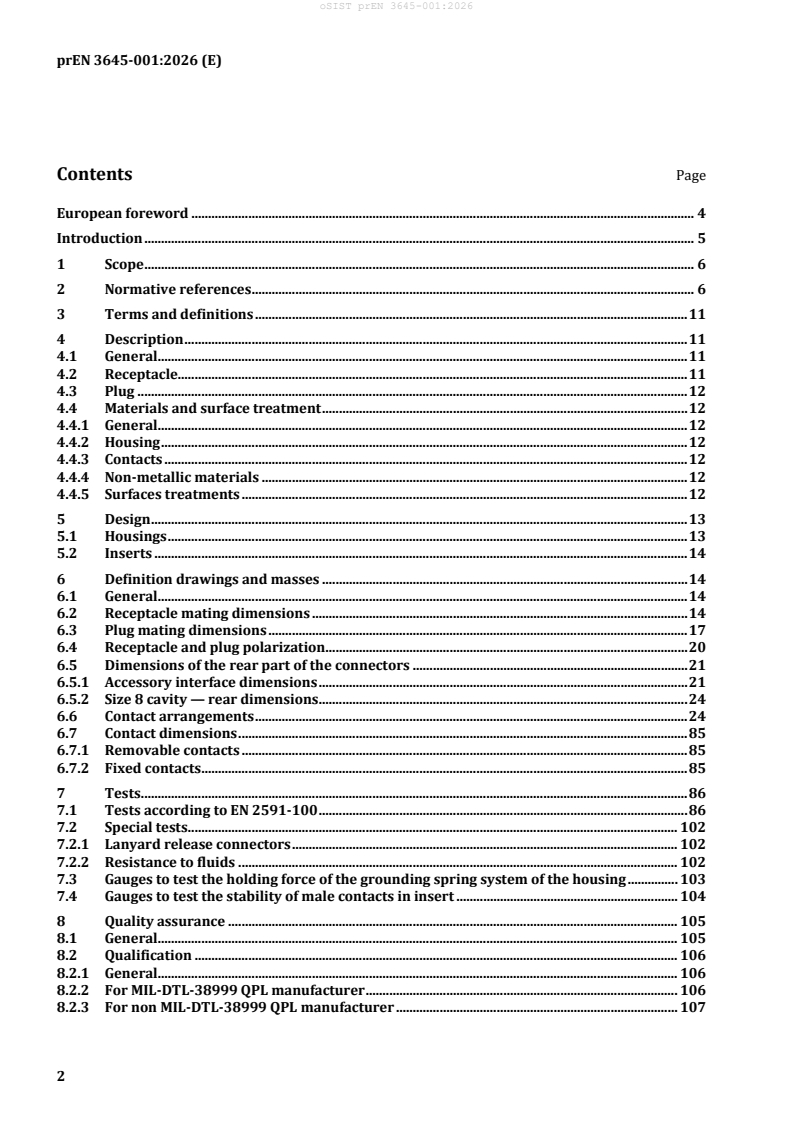
Contents Page
European foreword . 4
Introduction . 5
1 Scope . 6
2 Normative references . 6
3 Terms and definitions . 11
4 Description . 11
4.1 General. 11
4.2 Receptacle. 11
4.3 Plug . 12
4.4 Materials and surface treatment . 12
4.4.1 General. 12
4.4.2 Housing . 12
4.4.3 Contacts . 12
4.4.4 Non-metallic materials . 12
4.4.5 Surfaces treatments . 12
5 Design . 13
5.1 Housings . 13
5.2 Inserts . 14
6 Definition drawings and masses . 14
6.1 General. 14
6.2 Receptacle mating dimensions . 14
6.3 Plug mating dimensions . 17
6.4 Receptacle and plug polarization . 20
6.5 Dimensions of the rear part of the connectors . 21
6.5.1 Accessory interface dimensions . 21
6.5.2 Size 8 cavity — rear dimensions . 24
6.6 Contact arrangements . 24
6.7 Contact dimensions . 85
6.7.1 Removable contacts . 85
6.7.2 Fixed contacts . 85
7 Tests . 86
7.1 Tests according to EN 2591-100 . 86
7.2 Special tests . 102
7.2.1 Lanyard release connectors . 102
7.2.2 Resistance to fluids . 102
7.3 Gauges to test the holding force of the grounding spring system of the housing . 103
7.4 Gauges to test the stability of male contacts in insert . 104
8 Quality assurance . 105
8.1 General. 105
8.2 Qualification . 106
8.2.1 General. 106
8.2.2 For MIL-DTL-38999 QPL manufacturer . 106
8.2.3 For non MIL-DTL-38999 QPL manufacturer . 107
8.2.4 Sampling and definition of specimens . 108
8.2.5 Preparation of specimens . 109
8.2.6 Program of qualification tests . 109
8.3 Maintenance of qualification . 122
8.3.1 General . 122
8.3.2 Recognition of MIL-DTL-38999 . 122
8.3.3 Fuel resistant class . 123
8.3.4 Sampling distribution . 123
8.4 Routine tests during production . 123
8.5 Inspections . 124
8.6 Value added distributors . 124
9 Designation and marking . 124
9.1 General principle of designation . 124
9.2 Marking . 124
10 Delivery conditions . 125
11 Packaging . 125
12 Storage . 125
Bibliography . 126
European foreword
This document (prEN 3645-001:2026) has been prepared by ASD-STAN.
After enquiries and votes carried out in accordance with the rules of this Association, this document has
received the approval of the National Associations and the Official Services of the member countries of
ASD-STAN, prior to its presentation to CEN.
This document is currently submitted to the CEN Enquiry.
This document will supersede EN 3645-001:2022.
This document includes the following significant technical changes with respect to EN 3645-001:2022:
— document updated according to the introduction of tin-zinc plating and associated introduction of
updated Class V and Classes D, L and P;
— update of Table 11 Qualification tests;
— update of Table 13, Table 14 and Table 15: Numbering in accordance with EN 3909;
— update of Table 21 to Table 25 qualification tests for layouts with additional constraints;
— additional details added to 8.3.2 Recognition of MIL-DTL-38999.
Introduction
This family of connectors is derived from MIL-DTL-38999 series III, with which it is intermateable and
interchangeable. It is particularly suitable for use in zones of severe environmental conditions on board
aircraft, applying EN 2282.
These connectors are distinguishable from MIL-DTL-38999 by:
— a compatibility with size 8 power and quadrax contacts;
— self-extinguishing materials;
— compatibility with reduced diameter cables;
— additional reinforced fuel resistant insert type;
— additional insert with grounded cavities.
1 Scope
This document specifies the general characteristics, the conditions for qualification, acceptance and
quality assurance, as well as the test programs and groups for threaded ring coupling circular connectors,
fire resistant, intended for use in a temperature range from −65 °C to 175 °C continuous or 200 °C
continuous according to the classes.
2 Normative references
The following documents are referred to in the text in such a way that some or all of their content
constitutes requirements of this document. For dated references, only the edition cited applies. For
undated references, the latest edition of the referenced document (including any amendments) applies.
EN 2267-002, Aerospace series — Cables, electrical, for general purpose — Operating temperatures
between −55 °C and 260 °C — Part 002: General
EN 2346 (all parts), Aerospace series — Cable, electrical, fire resistant — Operating temperatures between
−65 °C and 260 °C
EN 2591-100, Aerospace series — Elements of electrical and optical connection — Test methods —
Part 100: General
EN 2591-101, Aerospace series — Elements of electrical and optical connection — Test methods —
Part 101: Visual examination
EN 2591-102, Aerospace series — Elements of electrical and optical connection — Test methods —
Part 102: Examination of dimensions and mass
EN 2591-201, Aerospace series — Elements of electrical and optical connection — Test methods —
Part 201: Contact resistance — Low level
EN 2591-202, Aerospace series — Elements of electrical and optical connection — Test methods —
Part 202: Contact resistance at rated current
EN 2591-204, Aerospace series — Elements of electrical and optical connection — Test methods —
Part 204: Discontinuity of contacts in the microsecond range
EN 2591-205, Aerospace series — Elements of electrical and optical connection — Test methods —
Part 205: Housing (shell) electrical continuity
EN 2591-206, Aerospace series — Elements of electrical and optical connection — Test methods —
Part 206: Measurement of insulation resistance
EN 2591-207, Aerospace series — Elements of electrical and optical connection — Test methods —
Part 207: Voltage proof test
EN 2591-209, Aerospace series — Elements of electrical and optical connection — Test methods —
Part 209: Current temperature derating
EN 2591-210, Aerospace series — Elements of electrical and optical connection — Test methods —
Part 210: Electrical overload
EN 2591-212, Aerospace series — Elements of electrical and optical connection — Test methods —
Part 212: Surface transfer impedance
EN 2591-213, Aerospace series — Elements of electrical and optical connection — Test methods —
Part 213: Shielding effectiveness from 100 MHz to 1 GHz
EN 2591-214, Aerospace series — Elements of electrical and optical connection — Test methods —
Part 214: Lightning strike, current and voltage pulse
EN 2591-301, Aerospace series — Elements of electrical and optical connection — Test methods —
Part 301: Endurance at temperature
EN 2591-303, Aerospace series — Elements of electrical and optical connection — Test methods —
Part 303: Cold/low pressure and damp heat
EN 2591-305, Aerospace series — Elements of electrical and optical connection — Test methods —
Part 305: Rapid change of temperature
EN 2591-306, Aerospace series — Elements of electrical and optical connection — Test methods —
Part 306: Mould growth
EN 2591-307, Aerospace series — Elements of electrical and optical connection — Test methods —
Part 307: Salt mist
EN 2591-308, Aerospace series — Elements of electrical and optical connection — Test methods —
Part 308: Sand and dust
EN 2591-311, Aerospace series — Elements of electrical and optical connection — Test methods —
Part 311: Low air pressure
EN 2591-312, Aerospace series — Elements of electrical and optical connection — Test methods —
Part 312: Air leakage
EN 2591-314, Aerospace series — Elements of electrical and optical connection — Test methods —
Part 314: Immersion at low air pressure
EN 2591-315, Aerospace series — Elements of electrical and optical connection — Test methods —
Part 315: Fluid resistance
EN 2591-316, Aerospace series — Elements of electrical and optical connection — Test methods —
Part 316: Ozone resistance
EN 2591-317, Aerospace series — Elements of electrical and optical connection — Test methods —
Part 317: Flammability
EN 2591-318, Aerospace series — Elements of electrical and optical connection — Test methods —
Part 318: Fire-resistance
EN 2591-321, Aerospace series — Elements of electrical and optical connection — Test methods —
Part 321: Damp heat, cyclic test
EN 2591-322, Aerospace series — Elements of electrical and optical connection — Test methods —
Part 322: Hermeticity
EN 2591-323, Aerospace series — Elements of electrical and optical connection — Test methods —
Part 323: Thermal shock
EN 2591-324, Aerospace series — Elements of electrical and optical connection — Test methods —
Part 324: Interfacial sealing
EN 2591-325, Aerospace series — Elements of electrical and optical connection — Test methods —
Part 325: Ice resistance
EN 2591-402, Aerospace series — Elements of electrical and optical connection — Test methods —
Part 402: Shock
EN 2591-403, Aerospace series — Elements of electrical and optical connection — Test methods —
Part 403: Sinusoidal and random vibration
EN 2591-404, Aerospace series — Elements of electrical and optical connection — Test methods —
Part 404: Transverse load
EN 2591-406, Aerospace series — Elements of electrical and optical connection — Test methods —
Part 406: Mechanical endurance
EN 2591-407, Aerospace series — Elements of electrical and optical connection — Test methods —
Part 407: Durability of contact retention system and seals
EN 2591-408, Aerospace series — Elements of electrical and optical connection — Test methods —
Part 408: Mating and unmating forces
EN 2591-409, Aerospace series — Elements of electrical and optical connection — Test methods —
Part 409: Contact retention in insert
EN 2591-410, Aerospace series — Elements of electrical and optical connection — Test methods —
Part 410: Insert retention in housing (axial)
EN 2591-412, Aerospace series — Elements of electrical and optical connection — Test methods —
Part 412: Contact insertion and extraction forces
EN 2591-413, Aerospace series — Elements of electrical and optical connection — Test methods —
Part 413: Holding force of grounding spring system
EN 2591-414, Aerospace series — Elements of electrical and optical connection — Test methods —
Part 414: Unmating of lanyard release connectors
EN 2591-419, Aerospace series — Elements of electrical and optical connection — Test methods —
Part 419: Stability of male contacts in insert
EN 2591-421, Aerospace series — Elements of electrical and optical connection — Test methods —
Part 421: Free fall
EN 2591-422, Aerospace series — Elements of electrical and optical connection — Test methods —
Part 422: Locking wire hole strength
EN 2591-423, Aerospace series — Elements of electrical and optical connection — Test methods —
Part 423: Connector rear accessories thread strength
EN 2591-426, Aerospace series — Elements of electrical and optical connection — Test methods —
Part 426: Contact retention system effectiveness
EN 2591-427, Aerospace series — Elements of electrical and optical connection — Test methods —
Part 427: Robustness of protective cover attachment
EN 2591-428, Aerospace series — Elements of electrical and optical connection; test methods — Part 428:
Sinusoidal vibrations with passage of current for crimped terminal lugs
EN 2591-501, Aerospace series — Elements of electrical and optical connection — Test methods —
Part 501: Soft solderability
EN 2591-502, Aerospace series — Elements of electrical and optical connection — Test methods —
Part 502: Restricted entry
EN 2591-503, Aerospace series — Elements of electrical and optical connection — Test methods —
Part 503: Contact deformation after crimping
EN 2591-505, Aerospace series — Elements of electrical and optical connection — Test methods —
Part 505: Contact protection effectiveness (scoop-proof)
EN 2591-506, Aerospace series — Elements of electrical and optical connection — Test methods —
Part 506: Use of tools
EN 2591-508, Aerospace series — Elements of electrical and optical connection — Test methods —
Part 508: Measurement of thickness of coating on contacts
EN 2591-509, Aerospace series — Elements of electrical and optical connection — Test methods —
Part 509: Adhesion of coating on contacts
EN 2591-512, Aerospace series — Elements of electrical and optical connection — Test methods —
Part 512: Effectiveness of non-removable fixing of hermetically sealed connector shell
EN 2591-513, Aerospace series — Elements of electrical and optical connection — Test methods —
Part 513: Magnetic permeability
EN 2591-514, Aerospace series — Elements of electrical and optical connection — Test methods —
Part 514: Solderability of contacts with self-contained solder and flux
EN 2591-515, Aerospace series — Elements of electrical and optical connection — Test methods —
Part 515: Hydrolytic stability
EN 3155-001, Aerospace series — Electrical contacts used in elements of connection — Part 001: Technical
specification
EN 3155-008, Aerospace series — Electrical contacts used in elements of connection — Part 008: Contacts,
electrical, male, type A, crimp, class S — Product standard
EN 3155-009, Aerospace series — Electrical contacts used in elements of connection — Part 009: Contacts,
electrical, female 009, type A, crimp, class S — Product standard
EN 3197, Aerospace series — Design and installation of aircraft electrical and optical interconnection
systems
EN 3645-002, Aerospace series — Connectors, electrical, circular, scoop-proof, triple start threaded
coupling, operating temperature 175 °C or 200 °C continuous — Part 002: Specification of performance and
contact arrangements
EN 3909, Aerospace series — Test fluids and test methods for electrical and optical components and sub-
assemblies
ISO 68-1, ISO general purpose screw threads — Basic and design profiles — Part 1: Metric screw threads
ISO 261, ISO general purpose metric screw threads — General plan
ISO 262, ISO general purpose metric screw threads — Selected sizes for bolts, screws, studs and nuts
ISO 2813, Paints and varnishes — Determination of gloss value at 20°, 60° and 85°
ISO 965-2, ISO general purpose metric screw threads — Tolerances — Part 2: Limits of sizes for internal
and external threads (tolerance classes 6H and 6g for M1,6 to M100 and 5H and 6h for M1 to M1,4)
ISO/CIE 11664-4, Colorimetry — Part 4: CIE 1976 L*a*b* colour space
ISO 27874, Metallic and other inorganic coatings — Electrodeposited gold and gold alloy coatings for
electrical, electronic and engineering purposes — Specification and test methods
MIL-DTL-38999, Connectors, electrical, circular, miniature, high density, quick disconnect (bayonet,
threaded, and breech coupling), environment resistant with crimp removable contacts or hermetically
sealed with fixed, solderable contacts, general specification for
MIL-DTL-38999/62, Sealing boot, size 8, pin or socket, shielded crimp contacts, electrical connector,
circular, metric
MIL-HDBK-454, General guidelines for electronic equipment
MIL-STD-1373, Screw-thread, modified, 60°, stub, double
MIL-STD-1560, Insert Arrangements for MIL-DTL-38999, MIL-DTL-27599, and SAE-AS29600 Series A
Electrical Circular Connectors
TR 4732:2015, Aerospace series — Compatibility validation procedure between components with
cadmium and/or chromium VI with their “green” substitute
TR 4865, Aerospace series — Suitable cable outlet to be mated on EN 3645 connector (layout type: 21R48)
for the qualification of electrical contact Product standards EN 3155-065 and EN 3155-083
Published by Department of Defense (DoD), available at: https://assist.dla.mil/online/start/.
Published as ASD-STAN TR, available at: https://www.asd-stan.org.
3 Terms and definitions
For the purposes of this document, the terms and definitions given in EN 2591-100 apply.
ISO and IEC maintain terminology databases for use in standardization at the following addresses:
— ISO Online browsing platform: available at https://www.iso.org/obp
— IEC Electropedia: available at https://www.electropedia.org/
4 Description
4.1 General
Different variants of materials, housings and contact arrangements are provided according to the classes
depending on the service conditions.
The pair of connectors is characterized:
— by shell-to-shell bottoming;
— by its triple threaded and self-locking coupling system;
— by plugs with shielding ring providing protection against radioelectrical interference;
— by the scoop-proof shells.
These connectors use the following contacts:
— crimped sizes 22, 20, 16, 12, 10 and 8;
— soldered (model Y) sizes 22, 20, 16 and 12;
— coaxial crimped or soldered sizes 16, 12 and 8; For arrangements comprising the
letter G or Q, all contacts are grounded
— triaxial crimped or soldered size 8;
to the receptacle housing
— quadrax crimped size 8.
The receptacles and plugs contain either male contacts or female contacts.
The contacts fitted in the class Y receptacles are exclusively of the male solder type.
The connectors are polarized by means of keyways and keys; polarization shall be obtained before the
male contacts enter the insert of the female contacts and before the coupling ring is engaged. The position
of the keying arrangement is given in Table 7.
The visual check of coupling is obtained by masking of a red colour band on the receptacle.
4.2 Receptacle
The receptacle housing may be attached:
— square flange;
— nut, with sealing by O-ring at the attachment; round soldered or brazed flange for class Y connectors.
4.3 Plug
The coupling ring is permanently fitted to the plug and allows coupling and uncoupling of the connectors.
The lanyard release version may also be uncoupled by pulling on the lanyard.
The plug is fitted with a self-locking mechanism and a grounding spring device ensuring electrical
continuity between the coupled connector housings.
An anti-decoupling device shall be provided to maintain complete coupling.
4.4 Materials and surface treatment
4.4.1 General
When dissimilar metals are in close contact, adequate protection against corrosion shall be used for the
electromotive force of the cell not to exceed 0,25 V (see EN 3197).
4.4.2 Housing
The material of the housings for the connectors and fittings may be either aluminium alloy, passivated
stainless steel or composite. Aluminium alloy and composite shall be plated as specified by the class
(composite coupling rings and Hex nuts may be unplated) (see EN 3645-002).
Non-conductive plated can be accepted on aluminium Hex nut.
4.4.3 Contacts
Unless otherwise specified, the non-removable contacts shall be in ferrous alloy for class Y and in copper
alloy for the other classes.
They shall be gold-plated on an appropriate undercoat. Selective protection is authorized provided that
it is sufficient to ensure that the specified performance is achieved.
Measurement of the thickness of the protective plating shall be effected in accordance with ISO 27874.
NOTE In the past, the determination of coating thickness was described in ISO 4524-1, which has been
withdrawn.
For removable contacts, see EN 3645-002.
4.4.4 Non-metallic materials
The materials used for insert, seals and grommets shall have a hardness and mechanical and electrical
characteristics consistent with the required use.
4.4.5 Surfaces treatments
Label chrome 6 free (not applicable for class W & J):
None of the hexavalent chromium compounds listed in Table 1 shall be added by any actor of the Supply
Chain or used in the manufacturing process.
The manufacturing process begins with the creation of the materials from which the design is made.
Manufacturing processes include treating (such as heat treating or plating), machining, moulding or
reshaping the material.
Table 1 — Hexavalent chromium compound list
Substance name CAS number
Acids generated from chromium trioxide and their
7738-94-5
oligomers. Names of the acids and their oligomers:
chromic acid, dichromic acid, oligomers of chromic
13530-68-2
acid and dichromic acid.
Chromium trioxide 1333-82-0
Potassium dichromate 7778-50-9
Sodium chromate 7775-11-3
7789-12-0
Sodium dichromate
10588-01-9
Dichromium tris(chromate) 24613-89-6
Pentazinc chromate octahydroxide 49663-84-5
Potassium hydroxyoctaoxodizincatedichromate 11103-86-9
Strontium chromate 7789-06-2
5 Design
5.1 Housings
The connector housings shall be one-piece. They shall contain teeth at the rear over their entire periphery
and shall accommodate the rear accessories. The receptacle shall be fitted with a seal for sealing the
coupled housings.
Jam-nut receptacles shall contain an O-ring seal. The nut shall have holes for the passage of locking wire.
During coupling the grounding spring shall be engaged a minimum of 1,02 mm in the receptacle before
the contacts engage.
Except for the triple start threads, which shall conform to standard MIL-STD-1373, threads shall conform
to standards ISO 68-1, ISO 261, ISO 262 and ISO 965-2.
The coupling ring shall be designed so that the male and female contacts engage when it is turned in a
clockwise direction and disengage when turned anticlockwise. The coupling threads may have a lubricant
applied during manufacture.
Full locking of the connectors shall occur at about 360°. On completion of tightening of the coupling ring,
mechanical contact shall exist between the receptacle and plug housings. A red band shall be located on
the receptacle so as to be visible when unmated and fully covered when completely mated.
The receptacle has five keyways which engage with corresponding keys on the plug. The major key is
fixed and is wider than the others. Polarization is ensured by the different positions which the minor keys
may take. The position of the insert is fixed relative to the major key.
The CAS Registry Number, also referred to as CASRN or CAS Number, is a unique numerical identifier assigned
by the Chemical Abstracts Service, a division of the American Chemical Society.
A blue-coloured band indicating that the crimped contacts of the connectors are rear-releasable shall be
provided:
— in front of the flange on square flange receptacles;
— on the flange of jam-nut receptacles;
— on the coupling ring of plugs.
This band shall be positioned so that at least one is visible when the connectors are fitted and when they
are mated or unmated. Hermetic receptacles do not require blue colour band.
5.2 Inserts
The insert for contacts shall be non-removable; it shall be mechanically held in the housing. Sealing shall
be provided between the housing and insert.
The front face of the insert shall be such that sealing is ensured when the connectors are coupled.
The interfacial seal of the insert of the male contacts shall be bonded on the hard insert.
The grommet shall permit sealing for all cable diameters indicated in EN 3645-002 and shall not be
removable.
— The mechanical contacts retention system shall be integrated in the hard insert.
— The design of non-hermetic connectors shall permit individual installation of the contacts without
removal of the insert or grommet. Fitting and removal of the contacts shall be from the rear with the
tools specified in the contact product standards.
Contact position identification shall be permanent and contrasted on the front face of the insert or the
interfacial seal and on the rear face of the grommet as indicated in 6.6.
The marking shall not be recessed or raised on the surfaces providing a seal.
6 Definition drawings and masses
6.1 General
The general dimensions and the masses of receptacles, plugs and protective covers are given in the
product standards.
6.2 Receptacle mating dimensions
The mating dimensions of receptacles are shown in Figure 1 and details V and W as well as in Table 2,
Table 3 and Table 4.
Dimensions and tolerances are in millimetres.
a
The distance between the front face of the shell and the point where the right end of a gauge with
a diameter equal to the nominal diameter of a male contact comes into contact with the elastic
part of the female contact.
Figure 1 — Receptacle — Coupling dimensions
Table 2 — Receptacle — Housing dimensions
A dia. B dia. C dia. D dia. D dia. E dia. E dia. F dia.
(except (composite (except (composite
composite classes composite classes)
Housing
classes) only) classes)
size
+𝟎𝟎,𝟏𝟏𝟏𝟏
max. max.
−𝟎𝟎,𝟐𝟐𝟐𝟐
14,42 11,36 11,43 12,63 12,70
09 14,55 7,24 15,88
14,14 11,20 11,20 12,34 12,34
17,60 14,61 14,68 15,88 15,95
11 17,73 10,49 19,05
17,32 14,45 14,45
15,60 15,60
20,77 17,45 17,52 19,66 19,73
13 20,90 13,39 22,23
20,49 17,30 17,30 19,38 19,38
23,95 20,63 20,70 22,84 22,91
15 24,08 16,56 25,40
23,67 20,44 20,44 22,56 22,56
28,30 23,80 23,87 26,01 26,08
17 28,52 19,74 30,16
27,97 23,64 23,64 25,73 25,73
29,89 26,47 28,63 28,70
26,54
19 30,12 22,00 31,75
29,56 26,31 26,31 28,40 28,40
33,07 29,64 29,71 31,85 31,92
21 33,30 25,17 34,73
32,74 29,49 29,49 31,57 31,57
36,24 32,82 32,89 35,03 35,10
23 36,47 28,35 38,10
35,91 32,66 32,66 34,75 34,75
39,42 35,99 35,06 38,20 38,27
25 39,65 31,52 41,28
39,09 35,84 35,84 37,92 37,92
Table 3 — Receptacle — Contact dimensions
M dia. N dia. P dia. R dia. S dia.
Contact size
max.
1,35 1,88 0,97 1,70
22 0,71
1,27 1,75 0,89 1,60
1,91 2,44 1,32 2,26
20 0,97
1,83 2,31 1,24 2,16
2,49 3,02 1,88 2,84
16 1,52
2,41 2,90 1,80 2,74
M dia. N dia. P dia. R dia. S dia.
Contact size
max.
3,30 3,84 2,69 3,66
12 2,34
3,23 3,71 2,62 3,56
4,09 4,62 3,48 4,45
10 3,12
4,01 4,50 3,40 4,34
6,50 7,06 5,84 6,81
8 5,49
6,38 6,93 5,77 6,71
Table 4 — Receptacle — Thread
BB — Thread
a
Designation Class 2A External threading Class 2A
thread
Housing See
Thread Apparent Actual External Diameter on Diameter at
b
size Note
size pitch pitch diameter side thread end
inch inch inch max. min. max. min. max. min.
09 0,625 0 15,83 15,63 15,17 14,97 14,41 14,05
11 0,750 0 19,01 18,80 18,35 18,14 17,58 17,23
13 0,875 0 0,038 1 22,18 21,98 21,52 21,32 20,76 20,41
15 1,000 0 25,36 25,15 24,70 24,49 23,94 23,58
17 1,187 5 0,100 0,300 30,11 29,80 29,24 28,99 28,28 27,82
19 1,250 0 31,69 31,39 30,83 30,58 29,87 29,41
21 1,375 0 34,87 34,56 34,01 33,75 33,05 32,59
0,050 8
23 1,500 0 38,04 37,74 37,18 36,93 36,22 35,76
25 1,625 0 41,22 40,91 40,36 40,10 39,40 38,94
a
According to MIL-STD-1373.
b
Gauges for protected threads: it is permissible to increase the maximum limit for gauge diameters by the value
specified in this column.
6.3 Plug mating dimensions
The mating dimensions of plugs are shown in Figure 2 and detail X in details V and W of Figure 1 and in
Table 5 and Table 6.
Dimensions and tolerances are in millimetres.
Key
1 spring finger
a
The distance between the shell shoulder and the point where the right end of a gauge with a diameter equal to
the nominal diameter of a male contact comes into contact with the elastic part of the female contact.
b
V and W: see Figure 1.
c
metallic
d
composite
e
over strap
Figure 2 — Plug — Coupling dimensions
Table 5 — Plug — Dimensions
BB C G H H J K K K L
1 1 1
dia. dia. dia. dia. dia. dia. dia. dia. dia. dia.
min.
between between
Housing
front of
keys keys
size +0,13 +0,25 com- keys
metallic over keys (except (classes J
posite metallic
−0,25 −0,03
classes J and M
and com-
and M) only)
posite
min min./max. min. min.
9,96 12,27 11,13 11,13
09 11,48 7,24 16,51 8,51 10,59 7,92
9,55 11,99 10,97 10,85
13,19 15,52 14,38 14,38
11 14,73 10,49 19,69 11,74 13,84 10,92
12,61 15,24 14,22 14,10
16,08 19,31 17,22 17,22
13 17,58 13,39 22,86 14,63 16,68 13,81
15,45 19,02 17,07 16,95
19,26 22,48 20,40 20,40
15 20,75 16,56 26,04 17,81 19,86 16,99
18,63 22,20 20,24 20,12
22,43 25,66 23,57 23,57
17 23,92 19,74 30,89 20,98 23,03 20,16
21,80 25,37 23,42 23,30
24,82 28,32 26,24 26,24
19 26,59 22,00 32,49 23,57 25,70 22,42
24,47 28,04 26,09 25,97
27,99 31,50 29,42 29,42
21 29,77 25,17 35,66 26,74 28,87 25,60
27,64 31,22 29,26 29,14
31,17 34,67 32,59 32,59
23 32,94 28,35 38,84 29,92 32,05 28,77
30,82 34,39 32,44 32,32
34,34 37,85 35,77 35,77
25 36,12 31,52 42,01 33,09 35,22 31,92
33,99 37,57 35,61 35,49
NOTE Diameter “K ” (dia. between keys) is for metallic and composite plugs, diameter “K (K min. – dia. front of
keys)” is for metallic and composite plugs, diameter “H” is for metallic plugs, and diameter “H1 (H1 min.)” is for
composite plugs.
Table 6 — Plug — Thread
DD dia. – Thread
a
Designation Class 2B thread Internal thread
Housing
size
Class 2B
Thread Apparent Actual Internal Diameter on Diameter at
size pitch pitch diameter side thread end
inch max. min. max. min. max. min.
09 0,625 0 14,96 14,71 15,46 15,21 16,38 15,97
11 0,750 0 18,14 17,88 18,64 18,38 19,55 19,15
0,100 0,300
13 0,875 0 21,31 21,06 21,81 21,56 22,73 22,32
15 1,000 0 24,49 24,23 24,99 24,73 25,90 25,50
DD dia. – Thread
a
Designation Class 2B thread Internal thread
Housing
size
Class 2B
Thread Apparent Actual Internal Diameter on Diameter at
size pitch pitch diameter side thread end
inch max. min. max. min. max. min.
17 1,187 5 28,94 28,63 29,60 29,29 30,77 30,26
19 1,250 0 30,53 30,22 31,19 30,88 32,35 31,85
21 1,375 0 33,70 33,40 34,36 34,06 35,53 35,02
23 1,500 0 36,88 36,57 37,54 37,23 38,70 38,20
25 1,625 0 40,05 39,75 40,71 40,41 41,88 41,37
a
In accordance with MIL-STD-1373.
6.4 Receptacle and plug polarization
Receptacle and plug polarization shall be in accordance with Figure 3 and Table 7.
Dimensions and tolerances are in millimetres.
a) Receptacle b) Plug
Figure 3 — Receptacle and plug polarization
Table 7 — Position of the keys and keyways for receptacle and plug
Values in degrees
Housing size Polarization index
a b c d
N 105 140 215 265
A 102 132 248 320
B 80 118 230 312
C 35 140 205 275
D 64 155 234 304
E 91 131 197 240
N 95 141 208 236
A 113 156 182 292
B 90 145 195 252
C 53 156 220 255
D 119 146 176 298
E 51 141 184 242
N 80 142 196 293
A 135 170 200 310
B 49 169 200 244
C 66 140 200 257
D 62 145 180 280
E 79 153 197 272
6.5 Dimensions of the rear part of the connectors
6.5.1 Accessory interface dimensions
The dimensions of the rear part of receptacles and plugs with threads for mounting accessories are shown
in Figure 4 and Table 8.
a) rear part dimensions
c) optional design for Jam-nut receptacles
b) for metallic housing Classes J and M
d) for composite housing; enlarged v
...
Questions, Comments and Discussion
Ask us and Technical Secretary will try to provide an answer. You can facilitate discussion about the standard in here.
Loading comments...