

EN ISO 15616-1:2003
(Main)Acceptance tests for CO2-laser beam machines for high quality welding and cutting - Part 1: General principles, acceptance conditions (ISO 15616-1:2003)
- Abstract
ISO 15616-1:2003 is applicable to CO2-laser beam machines for welding and cutting in two operating directions.
The main purpose of this International Standard is to provide requirements for acceptance testing of CO2-laser beam machines prior to or during installation at the user's premises. The acceptance tests are used to document the ability of CO2-laser beam machines to produce welded joints and cuts of consistent quality.
ISO 15616-1:2003 is intended to be used for preparation of the technical specification for CO2-laser beam machines for high quality welding and cutting in two operating directions. It specifies basic requirements. However, this International Standard may also be used for testing as part of maintenance, as appropriate.
- Status
- Published
- Publication Date
- 28-Feb-2003
- Technical Committee
- CEN/TC 121 - Welding
- Drafting Committee
- CEN/TC 121/SC 4 - Quality management in the field of welding
- Current Stage
- 9093 - Decision to confirm - Review Enquiry
- Start Date
- 02-Mar-2009
- Completion Date
- 02-Mar-2009

Overview
EN ISO 15616-1:2003 - Acceptance tests for CO2-laser beam machines for high quality welding and cutting (Part 1: General principles, acceptance conditions) specifies the general requirements and acceptance-test principles for CO2‑laser beam machines used for high‑quality 2D welding and cutting. Its main purpose is to define how manufacturers, buyers and installers document that a CO2‑laser beam machine can produce welded joints and cuts of consistent quality before or during installation and, where appropriate, during maintenance.
Key topics and requirements
- Scope and purpose: Applies to CO2‑laser beam machines operating in two directions (2D). Used to prepare technical specifications and to form acceptance criteria in contracts.
- Installation and setup: Environmental and installation conditions (vibration, temperature, contamination) and electrical supply requirements (voltage fluctuations within ±10 %) must meet manufacturer specifications.
- Systems to verify: cooling, gas supply (laser and working gases), exhaust and safety arrangements, operation instructions and stabilisation periods before measurement.
- Measured properties and tests:
- Laser beam power: maximum/minimum power, medium- and long‑term stability, repeatability. (Example limits in the standard: maximum power deviation +5 %/–2 %; minimum power +10 %/–3 %.)
- Beam characteristics: enclosed beam diameter, focused beam waist diameter and position, beam propagation factor (K or M2), beam positional stability.
- Opto‑mechanical performance: manipulation system precision, positioning accuracy, trajectory exactness (dynamic and static tests - see Part 2).
- Processing performance: welding/cutting speed stability and repeatability.
- Gas systems: flow and pressure testing and calibration (see Part 3).
- Acceptance documentation: Results are recorded in test reports and a final acceptance report that references all measured values and any additional contract-specified tests.
- Precision levels: The standard defines recommended precision classes (A–D) for different quality needs (special high precision to large industrial installations).
Applications and users
Who uses EN ISO 15616-1:2003:
- Manufacturers - to define and prove machine performance at delivery.
- End users / purchasers - to specify acceptance criteria in procurement contracts.
- Installers and commissioning teams - to verify correct setup and performance on site.
- Quality engineers and test labs - to document compliance, perform maintenance checks and validate repairs. Practical applications include acceptance testing of CO2 laser systems used in automotive, aerospace, sheet‑metal fabrication and other industries where high‑quality laser welding and cutting are required.
Related standards
Normative references and related parts include:
- EN ISO 11145, 11146, 11554, 11670 (laser terminology and beam test methods)
- EN 60204‑1 (electrical safety)
- EN ISO 15616‑2 (static and dynamic accuracy measurement)
- EN ISO 15616‑3 (calibration of gas flow/pressure instruments)
- ISO 230‑2 (NC positioning accuracy)
Relations
- Effective Date
- 25-Aug-2026
- Effective Date
- 09-Feb-2026
- Effective Date
- 28-Jan-2026
- Effective Date
- 28-Jan-2026
- Effective Date
- 28-Jan-2026
- Effective Date
- 28-Jan-2026
- Effective Date
- 28-Jan-2026
- Effective Date
- 28-Jan-2026
- Effective Date
- 28-Jan-2026
- Effective Date
- 28-Jan-2026
- Effective Date
- 12-Feb-2026
Get Certified
Connect with accredited certification bodies for this standard

DVS-ZERT GmbH
German welding certification society.
CARES (UK Certification Authority for Reinforcing Steels)
UK certification for reinforcing steels and construction.
EWF/IIW (European/International Welding Federation)
International welding personnel certification.
Sponsored listings
Frequently Asked Questions
EN ISO 15616-1:2003 is a standard published by the European Committee for Standardization (CEN). Its full title is "Acceptance tests for CO2-laser beam machines for high quality welding and cutting - Part 1: General principles, acceptance conditions (ISO 15616-1:2003)". This standard covers: ISO 15616-1:2003 is applicable to CO2-laser beam machines for welding and cutting in two operating directions. The main purpose of this International Standard is to provide requirements for acceptance testing of CO2-laser beam machines prior to or during installation at the user's premises. The acceptance tests are used to document the ability of CO2-laser beam machines to produce welded joints and cuts of consistent quality. ISO 15616-1:2003 is intended to be used for preparation of the technical specification for CO2-laser beam machines for high quality welding and cutting in two operating directions. It specifies basic requirements. However, this International Standard may also be used for testing as part of maintenance, as appropriate.
ISO 15616-1:2003 is applicable to CO2-laser beam machines for welding and cutting in two operating directions. The main purpose of this International Standard is to provide requirements for acceptance testing of CO2-laser beam machines prior to or during installation at the user's premises. The acceptance tests are used to document the ability of CO2-laser beam machines to produce welded joints and cuts of consistent quality. ISO 15616-1:2003 is intended to be used for preparation of the technical specification for CO2-laser beam machines for high quality welding and cutting in two operating directions. It specifies basic requirements. However, this International Standard may also be used for testing as part of maintenance, as appropriate.
EN ISO 15616-1:2003 is classified under the following ICS (International Classification for Standards) categories: 25.160.30 - Welding equipment. The ICS classification helps identify the subject area and facilitates finding related standards.
EN ISO 15616-1:2003 has the following relationships with other standards: It is inter standard links to ISO 230-2:1997, EN 60204-1:2018, EN ISO 15616-3:2003, EN ISO 11554:2025, EN ISO 11670:2003, EN ISO 11145:2001, EN ISO 11146:1999, EN 13084-1:2007, EN ISO 15616-2:2003, EN 4678:2011, ISO 15616-1:2003. Understanding these relationships helps ensure you are using the most current and applicable version of the standard.
EN ISO 15616-1:2003 is available in PDF format for immediate download after purchase. The document can be added to your cart and obtained through the secure checkout process. Digital delivery ensures instant access to the complete standard document.
Standards Content (Sample)
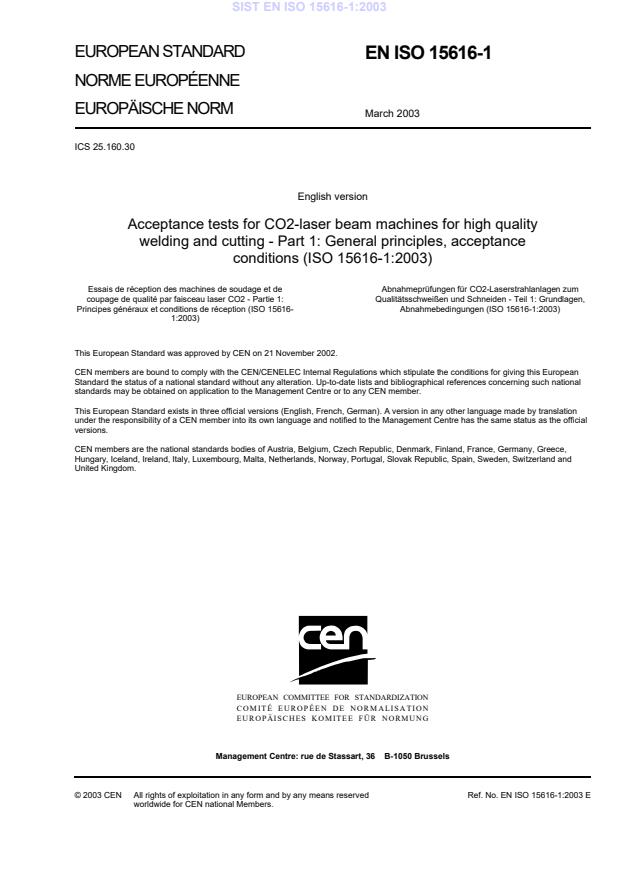
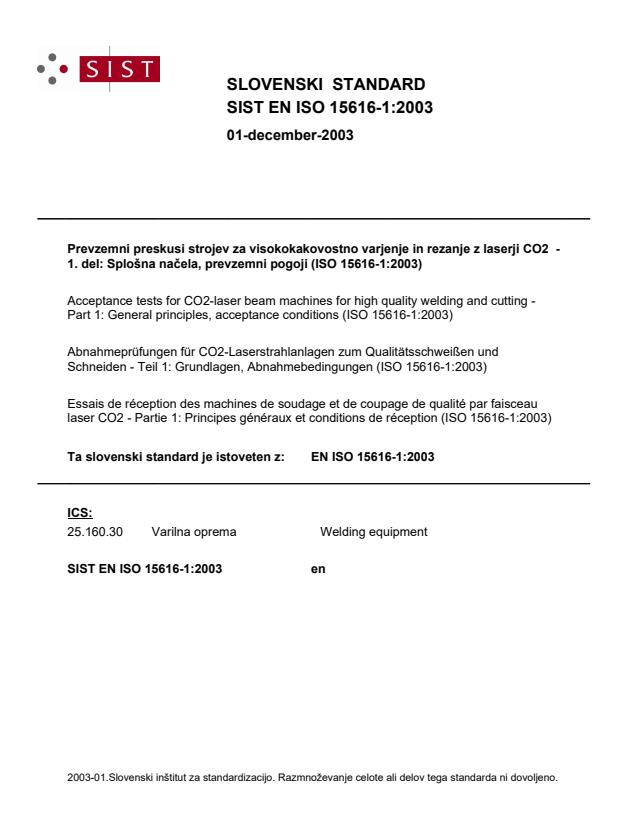
2003-01.Slovenski inštitut za standardizacijo. Razmnoževanje celote ali delov tega standarda ni dovoljeno.Abnahmeprüfungen für CO2-Laserstrahlanlagen zum Qualitätsschweißen und Schneiden - Teil 1: Grundlagen, Abnahmebedingungen (ISO 15616-1:2003)Essais de réception des machines de soudage et de coupage de qualité par faisceau laser CO2 - Partie 1: Principes généraux et conditions de réception (ISO 15616-1:2003)Acceptance tests for CO2-laser beam machines for high quality welding and cutting - Part 1: General principles, acceptance conditions (ISO 15616-1:2003)25.160.30Varilna opremaWelding equipmentICS:Ta slovenski standard je istoveten z:EN ISO 15616-1:2003SIST EN ISO 15616-1:2003en01-december-2003SIST EN ISO 15616-1:2003SLOVENSKI
STANDARD
EUROPEAN STANDARDNORME EUROPÉENNEEUROPÄISCHE NORMEN ISO 15616-1March 2003ICS 25.160.30English versionAcceptance tests for CO2-laser beam machines for high qualitywelding and cutting - Part 1: General principles, acceptanceconditions (ISO 15616-1:2003)Essais de réception des machines de soudage et decoupage de qualité par faisceau laser CO2 - Partie 1:Principes généraux et conditions de réception (ISO 15616-1:2003)Abnahmeprüfungen für CO2-Laserstrahlanlagen zumQualitätsschweißen und Schneiden - Teil 1: Grundlagen,Abnahmebedingungen (ISO 15616-1:2003)This European Standard was approved by CEN on 21 November 2002.CEN members are bound to comply with the CEN/CENELEC Internal Regulations which stipulate the conditions for giving this EuropeanStandard the status of a national standard without any alteration. Up-to-date lists and bibliographical references concerning such nationalstandards may be obtained on application to the Management Centre or to any CEN member.This European Standard exists in three official versions (English, French, German). A version in any other language made by translationunder the responsibility of a CEN member into its own language and notified to the Management Centre has the same status as the officialversions.CEN members are the national standards bodies of Austria, Belgium, Czech Republic, Denmark, Finland, France, Germany, Greece,Hungary, Iceland, Ireland, Italy, Luxembourg, Malta, Netherlands, Norway, Portugal, Slovak Republic, Spain, Sweden, Switzerland andUnited Kingdom.EUROPEAN COMMITTEE FOR STANDARDIZATIONCOMITÉ EUROPÉEN DE NORMALISATIONEUROPÄISCHES KOMITEE FÜR NORMUNGManagement Centre: rue de Stassart, 36
B-1050 Brussels© 2003 CENAll rights of exploitation in any form and by any means reservedworldwide for CEN national Members.Ref. No. EN ISO 15616-1:2003 ESIST EN ISO 15616-1:2003
...