


EN 16009:2011
(Main)Flameless explosion venting devices
General Information
- Abstract
This European Standard specifies the requirements for flameless explosion venting devices used to protect enclosures against the major effects of internal explosions arising from the rapid burning of suspended dust, vapour or gas contained within. It includes the requirements for the design, inspection, testing, marking, documentation, and packaging. This standard is applicable to flameless explosion venting devices which are put on the market as autonomous protective systems.
Explosion venting devices are protective systems comprised of a pressure sensitive membrane fixed to and forming part of the structure that it protects. They are designed to intervene in the event of an explosion at a predetermined pressure, to immediately open a vent area sufficient to ensure that the maximum pressure attained by an explosion within the enclosure does not exceed the maximum pressure the structure is designed to withstand.
Flameless explosion venting devices typically consist of an explosion venting device in combination with a flame quenching element to avoid the transmission of flames into the surroundings. They are used to allow explosion venting in situations where otherwise the hazards of flames and pressure resulting from the venting would harm personnel or damage structures.
The application and specification of explosion venting devices is outlined for dust explosion protection in EN 14491 and for gas explosion protection in EN 14994.
This standard covers the flameless explosion venting of dust, vapour and gas explosions.
This standard does not cover details for the avoidance of ignition sources from detection devices or other parts of the flameless explosion venting devices.
- Status
- Published
- Publication Date
- 19-Jul-2011
- Withdrawal Date
- 30-Jan-2012
- Current Stage
- 9060 - Closure of 2 Year Review Enquiry - Review Enquiry
- Start Date
- 15-Mar-2017
- Completion Date
- 15-Mar-2017
- Directive
- Harmonized Standard2014/34/EU - Directive 2014/34/EU Of The European Parliament And Of The Council of 26 February 2014 on the harmonisation of the laws of the Member States relating to equipment and protective systems intended for use in potentially explosive atmospheres (recast)OJ Ref: C, C 126, C 293/52, HARMONIZIRAN OJ Date: 08-Apr-2016
Not Harmonized94/9/EC - Equipment and protective systems intended for use in potentially explosive atmospheres (ATEX)OJ Ref: C, C 338 OJ Date: 18-Nov-2011



Overview
EN 16009:2011 - Flameless explosion venting devices (CEN) specifies requirements for flameless explosion venting devices used to protect enclosures from internal explosions of suspended dust, vapour or gas. The standard covers design, inspection, type testing, marking, documentation and packaging for flameless vents marketed as autonomous protective systems. Flameless devices combine a pressure‑sensitive explosion vent (membrane) with a flame quenching element to prevent flame transmission while relieving pressure.
Key topics and technical requirements
- Scope and purpose: Protect enclosures against major effects of internal explosions while preventing flame propagation to the surroundings.
- Design requirements: Materials and construction must withstand expected mechanical, thermal and chemical loads; vent devices are designed per EN 14797.
- Components: Pressure‑sensitive membrane, flame quenching element, optional particle retention element (for dust). Examples of flame quenching types: ribbon, parallel plate, mesh/gauze, ceramic.
- Performance limits: Manufacturer must state maximum reduced explosion pressure (pred,max), static activation pressure (pstat) and maximum volume per device (Vmax, FV). Single‑device protection is limited to the tested vessel volume; the protected volume shall not exceed 4 × Vmax,FV.
- Testing and verification: Type testing covers mechanical integrity, flame quenching (no flame transmission), venting efficiency, external effects and functional vent activation. Test fuels (dust/gas) and test vessel configuration are specified.
- Operation & safety: Detection devices that sense vent operation are mandatory; their signals must be used to bring the process to a safe state. Note: detailed functional safety of detection systems is outside EN 16009.
- Documentation & marking: Requirements for manufacturer documentation, marking and packaging to support safe selection, installation and maintenance.
Applications
EN 16009 is applied where vented explosions must not release flames or hot combustion products into the surroundings, for example:
- Powder processing, pneumatic conveying, grain handling and dust collectors
- Chemical and pharmaceutical processes with flammable vapours
- Storage vessels and enclosures located in occupied or sensitive areas
- Facilities requiring combined pressure relief and flame suppression to protect personnel and adjacent equipment
Who should use this standard
- Manufacturers of flameless explosion venting devices (design, type testing, CE marking)
- Plant designers & process safety engineers selecting protective systems for dust/gas hazards
- Safety managers & maintenance teams implementing inspection and replacement regimes
- Notified bodies / test laboratories performing type tests and conformity assessments
Related standards
- EN 14797 - Explosion venting devices
- EN 14491 - Dust explosion venting protective systems
- EN 14994 - Gas explosion venting protective systems
- EN ISO 16852 - Flame arresters (performance & tests)
- EN ISO/IEC 17025 - Laboratory competence
- EN 13237 - Terms & definitions for equipment in explosive atmospheres
Keywords: EN 16009, flameless explosion venting devices, explosion protection, flame quenching, dust explosion, gas explosion, venting efficiency, type testing.
Relations
- Effective Date
- 28-Jan-2026
- Effective Date
- 28-Jan-2026
- Effective Date
- 28-Jan-2026
- Effective Date
- 28-Jan-2026
- Effective Date
- 28-Jan-2026
- Effective Date
- 28-Jan-2026
- Effective Date
- 28-Jan-2026
- Effective Date
- 28-Jan-2026
- Effective Date
- 28-Jan-2026
Get Certified
Connect with accredited certification bodies for this standard

NSF International
Global independent organization facilitating standards development and certification.

CIS Institut d.o.o.
Personal Protective Equipment (PPE) certification body. Notified Body NB-2890 for EU Regulation 2016/425 PPE.

Kiwa BDA Testing
Building and construction product certification.
Sponsored listings
Frequently Asked Questions
EN 16009:2011 is a standard published by the European Committee for Standardization (CEN). Its full title is "Flameless explosion venting devices". This standard covers: This European Standard specifies the requirements for flameless explosion venting devices used to protect enclosures against the major effects of internal explosions arising from the rapid burning of suspended dust, vapour or gas contained within. It includes the requirements for the design, inspection, testing, marking, documentation, and packaging. This standard is applicable to flameless explosion venting devices which are put on the market as autonomous protective systems. Explosion venting devices are protective systems comprised of a pressure sensitive membrane fixed to and forming part of the structure that it protects. They are designed to intervene in the event of an explosion at a predetermined pressure, to immediately open a vent area sufficient to ensure that the maximum pressure attained by an explosion within the enclosure does not exceed the maximum pressure the structure is designed to withstand. Flameless explosion venting devices typically consist of an explosion venting device in combination with a flame quenching element to avoid the transmission of flames into the surroundings. They are used to allow explosion venting in situations where otherwise the hazards of flames and pressure resulting from the venting would harm personnel or damage structures. The application and specification of explosion venting devices is outlined for dust explosion protection in EN 14491 and for gas explosion protection in EN 14994. This standard covers the flameless explosion venting of dust, vapour and gas explosions. This standard does not cover details for the avoidance of ignition sources from detection devices or other parts of the flameless explosion venting devices.
This European Standard specifies the requirements for flameless explosion venting devices used to protect enclosures against the major effects of internal explosions arising from the rapid burning of suspended dust, vapour or gas contained within. It includes the requirements for the design, inspection, testing, marking, documentation, and packaging. This standard is applicable to flameless explosion venting devices which are put on the market as autonomous protective systems. Explosion venting devices are protective systems comprised of a pressure sensitive membrane fixed to and forming part of the structure that it protects. They are designed to intervene in the event of an explosion at a predetermined pressure, to immediately open a vent area sufficient to ensure that the maximum pressure attained by an explosion within the enclosure does not exceed the maximum pressure the structure is designed to withstand. Flameless explosion venting devices typically consist of an explosion venting device in combination with a flame quenching element to avoid the transmission of flames into the surroundings. They are used to allow explosion venting in situations where otherwise the hazards of flames and pressure resulting from the venting would harm personnel or damage structures. The application and specification of explosion venting devices is outlined for dust explosion protection in EN 14491 and for gas explosion protection in EN 14994. This standard covers the flameless explosion venting of dust, vapour and gas explosions. This standard does not cover details for the avoidance of ignition sources from detection devices or other parts of the flameless explosion venting devices.
EN 16009:2011 is classified under the following ICS (International Classification for Standards) categories: 13.230 - Explosion protection. The ICS classification helps identify the subject area and facilitates finding related standards.
EN 16009:2011 has the following relationships with other standards: It is inter standard links to EN ISO 16852:2010, EN 14994:2007, EN 13237:2024, EN 14797:2006, EN 14491:2012, EN 12779:2015, EN ISO 21182:2006, EN 2328:2006, EN ISO 1514:2004. Understanding these relationships helps ensure you are using the most current and applicable version of the standard.
EN 16009:2011 is associated with the following European legislation: EU Directives/Regulations: 2014/34/EU, 94/9/EC. When a standard is cited in the Official Journal of the European Union, products manufactured in conformity with it benefit from a presumption of conformity with the essential requirements of the corresponding EU directive or regulation.
EN 16009:2011 is available in PDF format for immediate download after purchase. The document can be added to your cart and obtained through the secure checkout process. Digital delivery ensures instant access to the complete standard document.
Standards Content (Sample)
2003-01.Slovenski inštitut za standardizacijo. Razmnoževanje celote ali delov tega standarda ni dovoljeno.Neplamenske naprave za razbremenitev tlaka eksplozijEinrichtungen zur flammenlosen ExplosionsdruckentlastungDispositifs de décharge d'explosion sans flammeFlameless explosion venting devices13.230Varstvo pred eksplozijoExplosion protectionICS:Ta slovenski standard je istoveten z:EN 16009:2011SIST EN 16009:2011en,fr,de01-oktober-2011SIST EN 16009:2011SLOVENSKI
STANDARD
EUROPEAN STANDARD NORME EUROPÉENNE EUROPÄISCHE NORM
EN 16009
July 2011 ICS 13.230 English Version
Flameless explosion venting devices
Dispositifs de décharge d'explosion sans flamme
Einrichtungen zur flammenlosen Explosionsdruckentlastung This European Standard was approved by CEN on 11 June 2011.
CEN members are bound to comply with the CEN/CENELEC Internal Regulations which stipulate the conditions for giving this European Standard the status of a national standard without any alteration. Up-to-date lists and bibliographical references concerning such national standards may be obtained on application to the CEN-CENELEC Management Centre or to any CEN member.
This European Standard exists in three official versions (English, French, German). A version in any other language made by translation under the responsibility of a CEN member into its own language and notified to the CEN-CENELEC Management Centre has the same status as the official versions.
CEN members are the national standards bodies of Austria, Belgium, Bulgaria, Croatia, Cyprus, Czech Republic, Denmark, Estonia, Finland, France, Germany, Greece, Hungary, Iceland, Ireland, Italy, Latvia, Lithuania, Luxembourg, Malta, Netherlands, Norway, Poland, Portugal, Romania, Slovakia, Slovenia, Spain, Sweden, Switzerland and United Kingdom.
EUROPEAN COMMITTEE FOR STANDARDIZATION
COMITÉ EUROPÉEN DE NORMALISATION EUROPÄISCHES KOMITEE FÜR NORMUNG
Management Centre:
Avenue Marnix 17,
B-1000 Brussels © 2011 CEN All rights of exploitation in any form and by any means reserved worldwide for CEN national Members. Ref. No. EN 16009:2011: ESIST EN 16009:2011
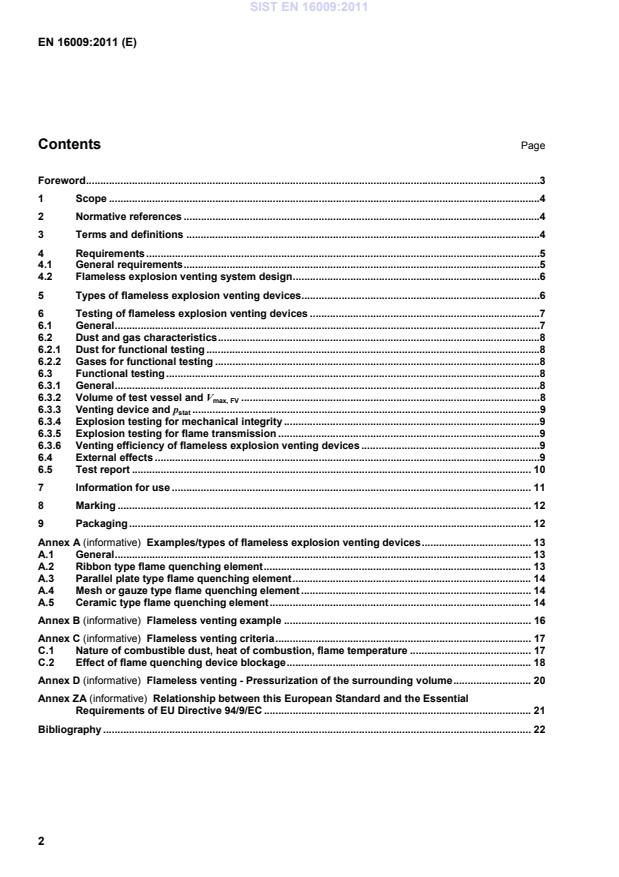
Examples/types of flameless explosion venting devices . 13A.1 General . 13A.2 Ribbon type flame quenching element . 13A.3 Parallel plate type flame quenching element . 14A.4 Mesh or gauze type flame quenching element . 14A.5 Ceramic type flame quenching element . 14Annex B (informative)
Flameless venting example . 16Annex C (informative)
Flameless venting criteria . 17C.1 Nature of combustible dust, heat of combustion, flame temperature . 17C.2 Effect of flame quenching device blockage . 18Annex D (informative)
Flameless venting - Pressurization of the surrounding volume . 20Annex ZA (informative)
Relationship between this European Standard and the Essential Requirements of EU Directive 94/9/EC . 21Bibliography . 22 SIST EN 16009:2011
(ISO 16852:2008, including Cor 1:2008 and Cor 2:2009) EN ISO/IEC 17025, General requirements for the competence of testing and calibration laboratories
(ISO/IEC 17025:2005) 3 Terms and definitions For the purposes of this document, the terms and definitions given in EN 13237, EN 14491, EN 14994, EN 14797 and the following apply. SIST EN 16009:2011
4 Requirements 4.1 General requirements Flameless explosion venting devices consist of an explosion venting device and a flame quenching element as a minimum. Flame quenching elements shall be suitable for the intended use (e.g. temperature range, mechanical strength, fuel type). Explosion venting devices shall be designed according to EN 14797. Material used for the parts of explosion venting devices shall be selected on the basis of their suitability with regard to the chemical and physical conditions to which they will be subjected in service. Dust leaking from the process into the flame quenching element can impair the efficiency of the venting, which shall be avoided. The performance capability of a flameless explosion venting device can be influenced by e.g.: a) the fuel characteristics (gas, vapour, dust): 1) minimum ignition temperature (MIT), minimum ignition energy (MIE) (dusts); 2) maximum experimental safe gap (MESG) (gases, vapours); 3) the maximum KG or KSt-values specified by the manufacturer; 4) the heat of combustion liberated during the explosion event; 5) flame temperature; 6) particle size and distribution, shape (dusts); SIST EN 16009:2011
...