

EN 12101-6:2022
(Main)Smoke and heat control systems - Part 6: Specification for pressure differential systems - Kits
- Abstract
This document applies to pressure differential system kits and components, positioned on the market and intended to operate as part of a pressure differential system. The purpose of a pressure differential system is to prevent protected spaces from smoke spread by using pressure difference and airflow. This document specifies characteristics and test methods for components and kits for pressure differential systems to produce and control the required pressure differential and airflow between protected and unprotected space.
- Status
- Published
- Publication Date
- 12-Apr-2022
- Technical Committee
- CEN/TC 191 - Fixed firefighting systems
- Current Stage
- 6060 - Definitive text made available (DAV) - Publishing
- Start Date
- 13-Apr-2022
- Due Date
- 04-Jul-2021
- Completion Date
- 13-Apr-2022

Overview - EN 12101-6:2022 (Smoke and heat control systems - Pressure differential systems - Kits)
EN 12101-6:2022 is the European (SIST-adopted) standard that defines requirements and test methods for pressure differential system (PDS) kits and components used in smoke and heat control. Published in 2022 and superseding the 2005 edition, the standard applies to marketed kits intended to produce and control the pressure differential and airflow that prevent smoke spread between protected and unprotected spaces (e.g., stairwells, lobbies, firefighting shafts).
Keywords: EN 12101-6:2022, pressure differential systems, smoke and heat control, pressure differential system kits, pressurization, depressurization, fire protection.
Key technical topics and requirements
The standard specifies characteristics, test methods and verification procedures for PDS kits. Major technical topics include:
- Scope and definitions: Terms such as pressurization, depressurization, air release, activation signal and control panel.
- Performance characteristics:
- Nominal activation conditions / sensitivity
- Response delay (response time)
- Operational reliability
- Effectiveness of smoke / hot gas extraction (air release)
- Pressurization / depressurization performance
- Durability and maintenance of cross-section
- Fire resistance requirements:
- Integrity (E), Insulation (I), Smoke leakage (S) and mechanical stability
- Test methods: Detailed procedures for sensitivity, response time, operational reliability, hot-gas conditions, elevated-temperature tests for dampers and ventilators, and durability tests.
- Verification and quality control:
- Type testing
- Factory production control (FPC)
- Marking, labelling and packaging requirements.
- Annexes: Normative annexes include kit type schematics, test methods for elevated-temperature components, and an installation & maintenance document.
Practical applications and users
EN 12101-6:2022 is used to ensure PDS kits reliably protect escape routes and firefighting access from smoke. Typical applications:
- Staircases, lobbies, corridors, firefighting lift shafts and other protected spaces requiring smoke-free conditions.
- Integration into Smoke and Heat Exhaust Ventilation Systems (SHEVS) and building HVAC strategies for fire safety.
Who uses this standard:
- Manufacturers of PDS kits, dampers and ventilators
- Fire safety engineers and system designers
- Installation contractors and commissioning authorities
- Testing laboratories and certification bodies
- Building owners, facility managers and regulators specifying fire protection performance
Related standards
- EN 12101-13 (PDS design, calculation, acceptance and maintenance)
- EN 12101 series (Parts 1–3, 5, 7–8, 10, etc.), EN 13501-4, EN ISO 13943 and relevant EN 1366 parts for duct and damper testing.
EN 12101-6:2022 provides the technical foundation for specifying, testing and verifying pressure differential system kits to support reliable smoke control and compliant fire protection design.
Relations
- Effective Date
- 08-Jun-2022
- Effective Date
- 08-Jun-2022
- Effective Date
- 12-Feb-2026
- Effective Date
- 28-Jan-2026
- Effective Date
- 28-Jan-2026
- Effective Date
- 28-Jan-2026
- Refers
EN 1366-8:2024 - Fire resistance tests for service installations - Part 8: Smoke extraction ducts - Effective Date
- 28-Jan-2026
- Effective Date
- 28-Jan-2026
- Effective Date
- 28-Jan-2026
- Effective Date
- 28-Jan-2026
- Effective Date
- 28-Jan-2026
- Effective Date
- 28-Jan-2026
- Effective Date
- 28-Jan-2026
- Effective Date
- 28-Jan-2026
Get Certified
Connect with accredited certification bodies for this standard

CIS Institut d.o.o.
Personal Protective Equipment (PPE) certification body. Notified Body NB-2890 for EU Regulation 2016/425 PPE.

Kiwa BDA Testing
Building and construction product certification.
Kmetijski inštitut Slovenije
Agricultural Institute of Slovenia. Soil testing, plant health, agricultural product analysis.
Sponsored listings
Frequently Asked Questions
EN 12101-6:2022 is a standard published by the European Committee for Standardization (CEN). Its full title is "Smoke and heat control systems - Part 6: Specification for pressure differential systems - Kits". This standard covers: This document applies to pressure differential system kits and components, positioned on the market and intended to operate as part of a pressure differential system. The purpose of a pressure differential system is to prevent protected spaces from smoke spread by using pressure difference and airflow. This document specifies characteristics and test methods for components and kits for pressure differential systems to produce and control the required pressure differential and airflow between protected and unprotected space.
This document applies to pressure differential system kits and components, positioned on the market and intended to operate as part of a pressure differential system. The purpose of a pressure differential system is to prevent protected spaces from smoke spread by using pressure difference and airflow. This document specifies characteristics and test methods for components and kits for pressure differential systems to produce and control the required pressure differential and airflow between protected and unprotected space.
EN 12101-6:2022 is classified under the following ICS (International Classification for Standards) categories: 13.220.99 - Other standards related to protection against fire. The ICS classification helps identify the subject area and facilitates finding related standards.
EN 12101-6:2022 has the following relationships with other standards: It is inter standard links to EN 12101-6:2005/AC:2006, EN 12101-6:2005, ISO 21927-6:2026, EN ISO 13943:2023, EN 12101-8:2011, EN 1366-9:2024, EN 1366-8:2024, EN 1366-10:2022+A1:2024, EN 13501-4:2016, EN 12101-3:2015, EN 12101-2:2017, EN 1363-1:2020, CEN/TR 12101-4:2009, EN 12101-13:2022. Understanding these relationships helps ensure you are using the most current and applicable version of the standard.
EN 12101-6:2022 is associated with the following European legislation: EU Directives/Regulations: 305/2011; Standardization Mandates: M/109. When a standard is cited in the Official Journal of the European Union, products manufactured in conformity with it benefit from a presumption of conformity with the essential requirements of the corresponding EU directive or regulation.
EN 12101-6:2022 is available in PDF format for immediate download after purchase. The document can be added to your cart and obtained through the secure checkout process. Digital delivery ensures instant access to the complete standard document.
Standards Content (Sample)
SLOVENSKI STANDARD
01-junij-2022
Nadomešča:
SIST EN 12101-6:2005
SIST EN 12101-6:2005/AC:2006
Sistemi za nadzor dima in toplote - 6. del: Sistemi za zagotovitev tlačnih razlik -
Oprema
Smoke and heat control systems - Part 6: Specification for pressure differential systems -
Kits
Rauch- und Wärmefreihaltung - Teil 6: Festlegungen für Differenzdrucksysteme -
Bausätze
Systèmes pour le contrôle des fumées et de la chaleur - Partie 6 : Spécifications
relatives aux systèmes à différentiel de pression - Kits
Ta slovenski standard je istoveten z: EN 12101-6:2022
ICS:
13.220.20 Požarna zaščita Fire protection
2003-01.Slovenski inštitut za standardizacijo. Razmnoževanje celote ali delov tega standarda ni dovoljeno.
EN 12101-6
EUROPEAN STANDARD
NORME EUROPÉENNE
April 2022
EUROPÄISCHE NORM
ICS 13.220.99 Supersedes EN 12101-6:2005
English Version
Smoke and heat control systems - Part 6: Specification for
pressure differential systems - Kits
Systèmes pour le contrôle des fumées et de la chaleur - Rauch- und Wärmefreihaltung - Teil 6: Festlegungen
Partie 6 : Spécifications relatives aux systèmes à für Differenzdrucksysteme - Bausätze
différentiel de pression - Kits
This European Standard was approved by CEN on 14 February 2022.
CEN members are bound to comply with the CEN/CENELEC Internal Regulations which stipulate the conditions for giving this
European Standard the status of a national standard without any alteration. Up-to-date lists and bibliographical references
concerning such national standards may be obtained on application to the CEN-CENELEC Management Centre or to any CEN
member.
This European Standard exists in three official versions (English, French, German). A version in any other language made by
translation under the responsibility of a CEN member into its own language and notified to the CEN-CENELEC Management
Centre has the same status as the official versions.
CEN members are the national standards bodies of Austria, Belgium, Bulgaria, Croatia, Cyprus, Czech Republic, Denmark, Estonia,
Finland, France, Germany, Greece, Hungary, Iceland, Ireland, Italy, Latvia, Lithuania, Luxembourg, Malta, Netherlands, Norway,
Poland, Portugal, Republic of North Macedonia, Romania, Serbia, Slovakia, Slovenia, Spain, Sweden, Switzerland, Turkey and
United Kingdom.
EUROPEAN COMMITTEE FOR STANDARDIZATION
COMITÉ EUROPÉEN DE NORMALISATION
EUROPÄISCHES KOMITEE FÜR NORMUNG
CEN-CENELEC Management Centre: Rue de la Science 23, B-1040 Brussels
© 2022 CEN All rights of exploitation in any form and by any means reserved Ref. No. EN 12101-6:2022 E
worldwide for CEN national Members.
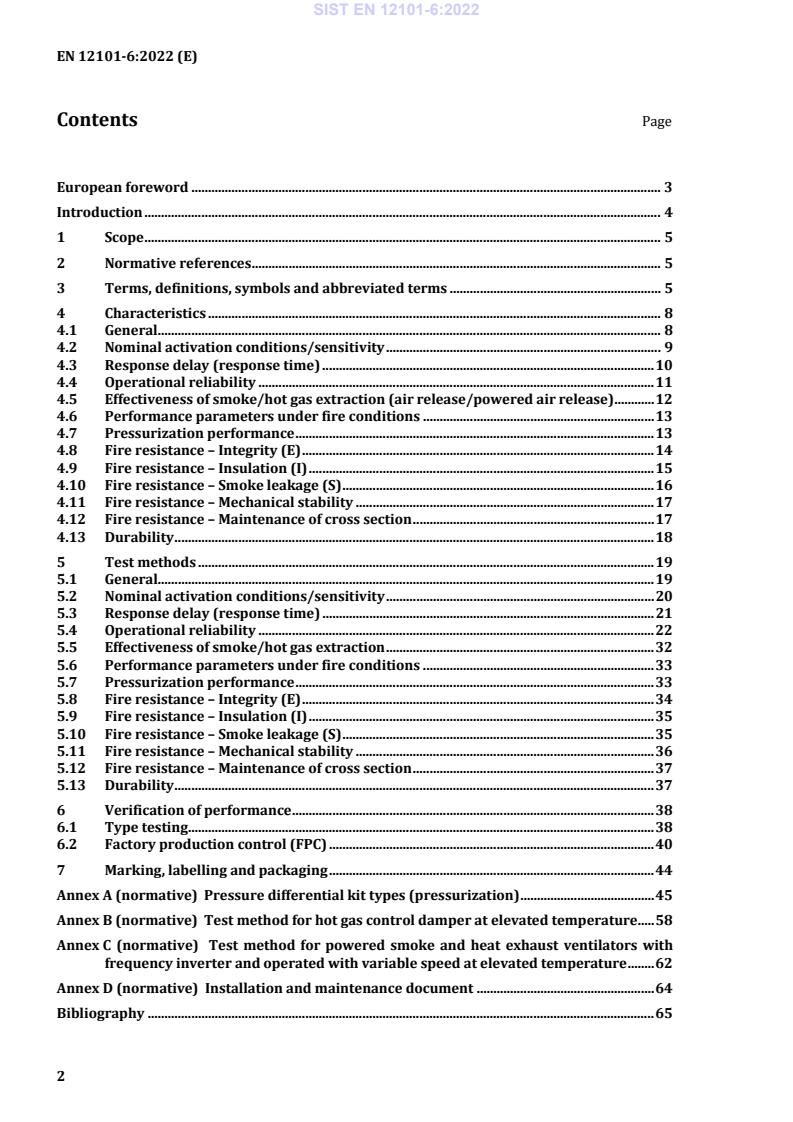
Contents Page
European foreword . 3
Introduction . 4
1 Scope . 5
2 Normative references . 5
3 Terms, definitions, symbols and abbreviated terms . 5
4 Characteristics . 8
4.1 General. 8
4.2 Nominal activation conditions/sensitivity . 9
4.3 Response delay (response time) . 10
4.4 Operational reliability . 11
4.5 Effectiveness of smoke/hot gas extraction (air release/powered air release) . 12
4.6 Performance parameters under fire conditions . 13
4.7 Pressurization performance . 13
4.8 Fire resistance – Integrity (E) . 14
4.9 Fire resistance – Insulation (I) . 15
4.10 Fire resistance – Smoke leakage (S) . 16
4.11 Fire resistance – Mechanical stability . 17
4.12 Fire resistance – Maintenance of cross section . 17
4.13 Durability . 18
5 Test methods . 19
5.1 General. 19
5.2 Nominal activation conditions/sensitivity . 20
5.3 Response delay (response time) . 21
5.4 Operational reliability . 22
5.5 Effectiveness of smoke/hot gas extraction . 32
5.6 Performance parameters under fire conditions . 33
5.7 Pressurization performance . 33
5.8 Fire resistance – Integrity (E) . 34
5.9 Fire resistance – Insulation (I) . 35
5.10 Fire resistance – Smoke leakage (S) . 35
5.11 Fire resistance – Mechanical stability . 36
5.12 Fire resistance – Maintenance of cross section . 37
5.13 Durability . 37
6 Verification of performance . 38
6.1 Type testing . 38
6.2 Factory production control (FPC) . 40
7 Marking, labelling and packaging . 44
Annex A (normative) Pressure differential kit types (pressurization) . 45
Annex B (normative) Test method for hot gas control damper at elevated temperature . 58
Annex C (normative) Test method for powered smoke and heat exhaust ventilators with
frequency inverter and operated with variable speed at elevated temperature . 62
Annex D (normative) Installation and maintenance document . 64
Bibliography . 65
European foreword
This document (EN 12101-6:2022) has been prepared by Technical Committee CEN/TC 191 “Fixed
firefighting systems”, the secretariat of which is held by BSI.
This European Standard shall be given the status of a national standard, either by publication of an
identical text or by endorsement, at the latest by October 2022, and conflicting national standards shall
be withdrawn at the latest by January 2024.
Attention is drawn to the possibility that some of the elements of this document may be the subject of
patent rights. CEN shall not be held responsible for identifying any or all such patent rights.
This document supersedes EN 12101-6:2005.
This document is to be read in conjunction with EN 12101-13.
The EN12101 series has the general title “Smoke and heat control systems” and currently consists of the
following parts, which may be expanded in the future:
— Part 1: Specification for smoke barriers;
— Part 2: Natural smoke and heat exhaust ventilators;
— Part 3: Specification for powered smoke and heat exhaust ventilators (fans);
— Part 4: Installed SHEVS systems for smoke and heat ventilation (published as CEN/TR 12101-4);
— Part 5: Design and calculation for smoke and heat exhaust ventilation systems using a steady-state fire
(published as CEN/TR 12101-5);
— Part 6: Specification for pressure differential systems – Kits;
— Part 7: Smoke duct sections;
— Part 8: Smoke control dampers;
— Part 10: Power supplies;
— Part 13: Pressure differential systems (PDS) design and calculation methods, acceptance testing,
maintenance and routine testing of installation.
Any feedback and questions on this document should be directed to the users’ national standards body.
A complete listing of these bodies can be found on the CEN website.
According to the CEN-CENELEC Internal Regulations, the national standards organisations of the
following countries are bound to implement this European Standard: Austria, Belgium, Bulgaria, Croatia,
Cyprus, Czech Republic, Denmark, Estonia, Finland, France, Germany, Greece, Hungary, Iceland, Ireland,
Italy, Latvia, Lithuania, Luxembourg, Malta, Netherlands, Norway, Poland, Portugal, Republic of North
Macedonia, Romania, Serbia, Slovakia, Slovenia, Spain, Sweden, Switzerland, Turkey and the United
Kingdom.
Introduction
Objectives of pressure differential systems
Pressure differential systems offer the facility of maintaining tenable conditions in protected spaces, for
example: escape routes, firefighting access routes, firefighting lift shafts, lobbies, staircases, and other
spaces that require being kept free of smoke. It is necessary to determine not only where the fresh air
supply for pressurization is to be introduced into a building, but also where that air and smoke will leave
the building and what paths it will follow in the process.
The aim therefore is to establish a pressure gradient from the protected space to the unprotected space
(fire room) while the doors are closed, and an airflow while the doors are open.
Smoke control methods
The effect of the air movement forces, described above, are to create pressure differentials across the
partitions, walls and floors and can cause smoke to spread to spaces remote from the fire source. The
technique most commonly used to limit the degree of smoke spread, or to control its effects, is
pressurization.
System components
A typical pressure differential system will comprise three basic components:
a) components for providing supply air and to extract air;
b) components for controlling the pressure difference between the space with higher pressure and the
adjoining space with lower pressure;
c) components for releasing air flowing through the door between the space with higher pressure to
those with lower pressure (to prevent unwanted pressure build up in this space).
Installations of pressure differential systems (PDS) may comprise:
— fans (temperature rated) if necessary;
— air or smoke control ducts to provide a passageway for the transmission of air or smoke;
— ventilation openings to provide leakage of air (including dampers, active or passive controlled);
— power supply;
— connecting cables;
— means of activation;
— means of pressure control;
— control panel;
— smoke control dampers in branches from the ductwork where the ductwork is situated outside the
protected enclosure;
— grilles and diffusers;
— door closers.
The design of pressure differential systems is covered in EN 12101-13.
1 Scope
This document applies to pressure differential system kits and components, positioned on the market
and intended to operate as part of a pressure differential system. The purpose of a pressure differential
system is to prevent protected spaces from smoke spread by using pressure difference and airflow. This
document specifies characteristics and test methods for components and kits for pressure differential
systems to produce and control the required pressure differential and airflow between protected and
unprotected space.
2 Normative references
The following documents are referred to in the text in such a way that some or all of their content
constitutes requirements of this document. For dated references, only the edition cited applies. For
undated references, the latest edition of the referenced document (including any amendments) applies.
EN 1363-1, Fire resistance tests - Part 1: General requirements
EN 12101-2, Smoke and heat control systems - Part 2: Natural smoke and heat exhaust ventilators
EN 12101-3, Smoke and heat control systems - Part 3: Specification for powered smoke and heat control
ventilators (Fans)
EN 12101-8, Smoke and heat control systems - Part 8: Smoke control dampers
EN 13501-4, Fire classification of construction products and building elements - Part 4: Classification using
data from fire resistance tests on components of smoke control systems
EN ISO 13943, Fire safety - Vocabulary (ISO 13943)
EN 1366-8, Fire resistance tests for service installations - Part 8: Smoke extraction ducts
EN 1366-9, Fire resistance tests for service installations - Part 9: Single compartment smoke extraction
ducts
EN 1366-10, Fire resistance tests for service installations - Part 10: Smoke control dampers
3 Terms, definitions, symbols and abbreviated terms
3.1 Terms, definitions and abbreviated terms
For the purposes of this document, the terms and definitions given in EN ISO 13943 and the following
apply.
ISO and IEC maintain terminological databases for use in standardization at the following addresses:
— IEC Electropedia: available at https://www.electropedia.org/
— ISO Online browsing platform: available at https://www.iso.org/obp
3.1.1
air release
means by which pressurizing air or a mixture of pressurizing air and smoke is able to escape from the
accommodation or other unpressurized space to outside the building
3.1.2
control panel
multi-operational device to activate and/or control a PDS
3.1.3
depressurization
smoke control using pressure differentials between the protected space and the unprotected space with
a lower pressure in the unprotected space
3.1.4
pressure differential system
PDS
combination of at least one kit and additional components intended to produce pressure differential and
airflow between protected and unprotected spaces
3.1.5
pressurization
smoke control using pressure differentials between the protected space and the unprotected space with
a higher pressure in the protected space
3.1.6
pressure differential system (PDS)
combination of at least two components which are necessary to produce and control the required
pressure differential and airflow-between protected and unprotected space
Note 1 to entry: The type of kit is dictated by the PDS design and objectives. Schematic overviews of different
types are given in Annex A.
3.1.7
active control
pressure control actuated from measured pressure and using external energy (e.g. motor driven damper,
frequency inverter-controlled fans, etc.)
3.1.8
barometric relief damper
damper activated by local pressure difference that opens to permit airflow and therefore controls the
pressure
3.1.9
activation signal
signal to initiate from stand-by to the active mode of the pressure differential system
3.2 Symbols
The symbols and abbreviations below are used in the document:
Symbol Unit Description
measured air release volume flow rate from space 1 (representing the
protected space in the building) to space 2 (representing the unprotected
V
m /h
ar
space in the building) via open air release path during the test (nominal
value given by the manufacturer)
required leakage flow rate if necessary for the function of the PDS kit. If
the building leakages (always present) are at the same rate or larger,
V
m /h
RL
during the test (nominal value given by the manufacturer), the component
to produce the defined leakage is part of the PDS kit under test
m /h volume flow rate through temporary openings (e.g. open doors from
staircases on different levels from fire level, open escape/exit door) in
V
TO
ps
case of pressurization during the test (nominal value given by the
manufacturer)
m /h volume flow rate through temporary openings (e.g. open doors from
staircases on different levels from fire level, open escape/exit door) in
V
TO
dp
case of depressurization during the test (nominal value given by the
manufacturer)
m /h
V
exhaust volume flow rate out of space 2 for combined systems
ex
m /h required minimum leakage volume flow rate at nominal pressure
V
rl
difference ∆p
Nom
m /h lower limit of volume flow rate through air release
V
ar,ll
VV= 09, *
ar,ll ar
m /h
V
supply air volume flow rate measured at inlet nozzle
sa
m /h total controlled volume flow rate of the PDS kit as sum of flow rate air
V release V + flow rate through temporary openings V (nominal value
TC ar TC
given by the manufacturer)
3
m /h
V
bypass air volume flow rate
BP
Pa pressure differential between space 1 and reference pressure (static
∆p
tr1
pressure in test hall)
Pa pressure differential between space 2 and reference pressure (static
∆p
tr2
pressure in test hall)
Pa nominal pressure differential to be maintained by the PDS kit with closed
∆p
nom
air release opening and closed temporary openings (static conditions)
Pa
∆p
pressure difference across the open-air release path
ar
∗
Pa
∆p
Upper limit of nominal pressure differential ∆p = 12, ∆P
Nom,ul
Nom,ul Nom
Symbol Unit Description
s
Time period needed to establish volume flow rate (flow criteria – see
V
ar,ll
∆t
V
Figure 6)
s
∆t
Pressure stabilizing time period (pressure criteria - see 5.7)
p
s
∆t
time to establish volume flow rate in TCS cycle i
V ,i
s
∆t
pressure stabilizing time in TCS cycle i
p,i
−1
fr s frequency of the frequency inverter from the PDS kit where equipped
−1
s minimal frequency of the frequency inverter at the passed test with all
fr openings closed and at lowest required leakage – shall be stated in the test
min
report
−1
s highest frequency of the frequency inverter at the passed test with air
fr release path and temporary opening open and at highest required
max
leakage – shall be stated in the test report
I A absorbed current of the fan (motor)
fan
TCS test cycle sequence
4 Characteristics
4.1 General
This clause gives details of the characteristics and additional test details. The structure of this clause is
mirrored in Clause 5. The characteristics are listed here, with the corresponding test reference in
Clause 5.
NOTE This structure was used, as it mirrors the requirements for harmonized product standards to ensure all
the relevant subjects are covered.
For example, in Clause 4.2.2.1 the characteristics for natural smoke and heat exhaust dampers are shown and
the matching Clause 5.2.2.1 provides the test method. This is continued throughout these 2 clauses.
The kit shall be shown to be able to fulfil the specific pressure differential application that it is designed
to provide. To demonstrate this, certain components have their own requirements and will need to fulfil
these. Any component with no specific characteristics shown below shall be listed as part of the kit and
included in the kit testing.
— Where there is a need for air or smoke release (cold or hot) to the outside through an opening fitted
with a natural smoke and heat exhaust ventilator shall be used;
— Where air volume and pressure are to be controlled using mechanical pressure relief a barometric
damper or controlled damper in accordance with this document shall be used;
— Where ambient air is to be supplied using fans, the fans shall be further shown to be in accordance
with this document;
— Where air or smoke is to be extracted by the pressure differential systems (cold or hot) this shall be
done using powered heat exhaust ventilators (smoke control fans);
— Where air or smoke is to be extracted (cold or hot) using ductwork, the ductwork shall be smoke
control duct (Builders work shafts may be used as an option and this is not within the scope of this
document);
— Where dampers are needed to open and close to provide a path for air or smoke (cold or hot) to the
outside and maintain compartmentation, these shall be smoke control dampers;
— Where volume control around high temperature fans is to be provided using motorized control
dampers these shall be hot gas control dampers in accordance with this document.
NOTE fans/shafts/ductwork used to balance stack effects in the staircase do not need to have a temperature
rating.
4.2 Nominal activation conditions/sensitivity
4.2.1 Kit
The PDS kit shall be activated automatically by smoke detectors and it shall be possible to trigger it
manually by an external switch.
The following proxy characteristics shall be taken into account:
a) the response time – see 4.3; and
b) the operational reliability – see 4.4.
In addition, the following components shall have their own characteristics when functioning as a part of
the kit.
4.2.2 Components
4.2.2.1 Natural smoke and heat exhaust ventilators
The characteristics for nominal activation conditions/sensitivity in EN 12101-2 shall be met – see 5.2.2.1.
4.2.2.2 Pressure control dampers (e.g. barometric dampers, motorized control dampers)
The following proxy characteristics shall be taken into account:
a) the response time – see 4.3; and
b) the operational reliability – see 4.4.
4.2.2.3 Fans
4.2.2.3.1 Ambient air supply fans
The following proxy characteristics shall be taken into account:
a) the response time – see 4.3; and
b) the operational reliability – see 4.4.
4.2.2.3.2 Smoke control fans (powered smoke and heat exhaust ventilators)
In addition to any response time required by the kit (4.3.1), the characteristics for nominal activation
conditions/sensitivity in EN 12101-3 shall be met – see 5.2.2.3.2.
See also Annex C for additional tests with smoke fans controlled by frequency inverters.
4.2.2.4 Smoke control ducts
Smoke control ducts have no nominal activation conditions/sensitivity requirements as they have no
moving parts.
4.2.2.5 Smoke control dampers
The characteristics for nominal activation conditions/sensitivity in EN 12101-8 shall be met– see 5.2.2.5.
4.2.2.6 Hot gas control dampers
The following proxy characteristics shall be taken into account:
a) the response time – see 4.3; and
b) the operational reliability – see 4.4; and
c) characteristics as determined in Annex B.
4.3 Response delay (response time)
4.3.1 Kit
4.3.1.1 General
The proxy characteristics in 4.3.1.2 and 4.3.1.3 shall be taken into account.
4.3.1.2 Initial response time
The kit shall achieve operating status within a time period of less than 60 s after the activation signal.
This shall be tested in accordance with 5.4.1.
4.3.1.3 Response time of door opening and door closing
The kit shall achieve at least 90 % of the nominal airflow rate within 3 s of a door being fully opened
(opening angle 90°) in accordance with test method in 5.4.1.2.
The kit shall reach the nominal pressure differential in the protected space Δp ± 20 % within 3 s after
nom
a door to the unprotected space or a temporary opening is closed completely. The pressure differential
shall not exceed Δp = Δp ⋅ 1,2 for a time period of more than 3 s. This shall be demonstrated in
nom,ul nom
accordance with the test method in 5.4.1.
The kit shall re-establish behaviour under the conditions of the oscillating test in 5.4.1.11 even in the case
of several door closing/opening cycles in accordance with test method in 5.4.1.11.
4.3.2 Components
4.3.2.1 General
In addition, the following components shall have their own requirements when functioning as a part of
the kit.
4.3.2.2 Natural smoke and heat exhaust ventilators
The characteristics for response delay (response time) in EN 12101-2 shall be met – see 5.3.2.1.
4.3.2.3 Pressure control dampers (e.g. barometric dampers, motorized control dampers)
The pressure control dampers shall meet the response time characteristics as shown in 4.3.1 when tested
as part of the kit – see 5.3.2.2.
4.3.2.4 Fans
4.3.2.4.1 Ambient air supply fans
The ambient supply fans shall meet the response time characteristics as shown in 4.3.1 when tested as
part of the kit – see 5.3.2.3.1.
4.3.2.4.2 Smoke control fans (powered smoke and heat exhaust ventilators)
In addition to any response time required by the kit (4.3.1), if the product requires it, the characteristics
for nominal activation conditions/sensitivity in EN 12101-3 shall be met – see 5.3.2.3.2.
4.3.2.5 Smoke control ducts
Smoke control ducts have no response delay requirements as they have no moving parts.
4.3.2.6 Smoke control dampers
The characteristics for response delay (response time) in EN 12101-8 shall be met – see 5.3.2.5.
4.3.2.7 Hot gas control dampers
The characteristics shown in Annex B shall be reported against the listed classifications. The dampers
shall meet the requirements in 4.3.1 and move to the required position in less than 3 s (4.3.1) and be
proven that the average operation time as determined in Annex B under elevated temperature conditions
and is no more than plus 20 % of that determined at ambient temperature.
4.4 Operational reliability
4.4.1 Kit
The following proxy characteristics shall be taken into account: the ability of the kit to fulfil the volume
flow rate and pressurization values as part of the functionality test – see 5.4.1.
Complete the 10 000 cycles requirement.
In addition, the following components shall have their own requirements when functioning as a part of
the kit.
4.4.2 Components
4.4.2.1 Natural smoke and heat exhaust ventilators
The characteristics for operational reliability in EN 12101-2 shall be met – see 5.4.2.1.
4.4.2.2 Pressure control dampers (e.g. barometric dampers, motorized control dampers)
The pressure control dampers shall meet the operational reliability as shown in 4.4.1 when tested as part
of the kit – see 5.4.2.2.
4.4.2.3 Fans
4.4.2.3.1 Ambient air supply fans
The ambient supply fans shall meet the operational reliability characteristics as shown in 4.4.1 when
tested as part of the kit – see 5.4.2.3.1.
4.4.2.3.2 Smoke control fans (Powered smoke and heat exhaust ventilators)
In addition to any operational reliability required by the kit test (4.4.1), the smoke control fans shall meet
the operational reliability requirements of EN 12101-3 – see 5.4.2.3.2.
See also Annex C for additional tests with smoke fans controlled by frequency inverters
4.4.2.4 Smoke control ducts
Smoke control ducts have no operational reliability requirements as they have no moving parts.
4.4.2.5 Smoke control dampers
The characteristics for operational reliability in EN 12101-8 shall be met – see 5.4.2.5.
4.4.2.6 Hot gas control dampers
The 10 operations at ambient and 10 operations at elevated temperature (see Annex B) shall be met
before being part of the kit test – see 4.4.1.
4.5 Effectiveness of smoke/hot gas extraction (air release/powered air release)
4.5.1 Kit
The following proxy characteristic shall be taken into account:
— the ability of the kit to fulfil the operational reliability requirements – see 4.4.
4.5.2 Components
4.5.2.1 Natural smoke and heat exhaust ventilators
The aerodynamic free area and relevant loading reliability requirements of EN 12101-2 shall be met –
see 5.5.2.1.
4.5.2.2 Pressure control dampers (e.g. barometric dampers, motorized control dampers)
As a proxy characteristic the pressure control dampers shall meet the response time (4.3.1) and
operational reliability (4.4.1) when tested as part of the kit – see 5.5.2.2.
4.5.2.3 Fans
4.5.2.3.1 Ambient air supply fans
The ambient supply fans shall meet the operational reliability characteristics as shown in 4.4.1 when
tested as part of the kit – see 5.5.2.3.1.
4.5.2.3.2 Smoke control fans (Powered smoke and heat exhaust ventilators)
In addition to any operational reliability required by the kit test (see 4.4.1), the smoke control fans shall
meet the operational reliability requirements of EN 12101-3 – see 5.5.2.3.2.
See also Annex C for additional tests with smoke fans controlled by frequency inverters.
4.5.2.4 Smoke control ducts
The maintenance of cross-sectional area and no collapse requirements of the duct fire resistance tests
EN 1366-8 (multi-compartment) or EN 1366-9 (single compartment) shall be met (not necessarily the
section requirements) – see 5.5.2.4.
4.5.2.5 Smoke control dampers
The maintenance of cross-sectional area requirements of EN 12101-8 shall be met – see 5.5.2.4.
4.5.2.6 Hot gas control dampers
As a proxy characteristic, the hot gas control dampers shall meet the response time (see 4.3.1) and
operational reliability (4.4.1) when tested as part of the kit – see 5.5.2.6.
4.6 Performance parameters under fire conditions
4.6.1 Kit
The following proxy characteristic shall be taken into account:
— the ability of the kit to fulfil the operational reliability requirements – see 4.4.
4.6.2 Components
4.6.2.1 Natural smoke and heat exhaust ventilators
The aerodynamic free area and relevant loading reliability requirements of EN 12101-2 shall be met– see
5.6.2.1.
4.6.2.2 Pressure control dampers (e.g. barometric dampers, motorized control dampers)
As a proxy characteristic the pressure control dampers shall meet the response time (4.3.1) and
operational reliability (4.4.1) when tested as part of the kit – see 5.6.2.2.
4.6.2.3 Fans
4.6.2.3.1 Ambient air supply fans
The ambient supply fans shall meet the operational reliability characteristics as shown in 4.4.1 when
tested as part of the kit – see 5.6.2.3.1.
4.6.2.3.2 Smoke control fans (powered smoke and heat exhaust ventilators)
In addition to any operational reliability required by the kit test (4.4.1), the smoke control fans shall meet
the operational reliability requirements of EN 12101-3 – see 5.6.2.3.2.
See also Annex C for additional tests with smoke fans controlled by frequency inverters.
4.6.2.4 Smoke control ducts
The maintenance of cross-sectional area and no collapse requirements of the duct fire resistance tests
EN 1366-8 (multi-compartment) or EN 1366-9 (single compartment) shall be met (not necessarily the
section requirements) – see 5.5.2.4.
4.6.2.5 Smoke control dampers
The maintenance of cross-sectional area requirements of EN 12101-8 shall be met – see 5.6.2.5.
4.6.2.6 Hot gas control dampers
As a proxy characteristic, the hot gas control dampers shall meet the response time (see 4.3.1) and
operational reliability (see 4.4.1) when tested as part of the kit – see 5.6.2.6.
4.7 Pressurization performance
4.7.1 Kit
The following proxy characteristic shall be taken into account:
— the ability of the kit to fulfil the operational reliability requirements – see 4.4.
4.7.2 Components
4.7.2.1 Natural smoke and heat exhaust ventilators
The natural smoke and heat exhaust ventilators shall open in less than 60 s to meet the requirements of
EN 12101-2 – see 5.7.2.1.
4.7.2.2 Pressure control dampers (e.g. barometric dampers, motorized control dampers)
As a proxy characteristic the pressure control dampers shall meet the response time (see 4.3.1) and
operational reliability (4.4.1) when tested as part of the kit – see 5.7.2.2.
4.7.2.3 Fans
4.7.2.3.1 Ambient air supply fans
As a proxy characteristic, if the fan is controlled to change the pressure, it shall meet the response time
(see 4.3.1) and operational reliability (see 4.4.1) when tested as part of the kit – see 5.7.2.3.1.
4.7.2.4 Smoke control ducts
The relevant leakage requirements of the duct fire resistance tests EN 1366-8 (multi-compartment) or
EN 1366-9 (single compartment) shall be met (not necessarily the section requirements) – see 5.7.2.4.
4.7.2.5 Smoke control dampers
The S classification leakage requirements of EN 12101-8 shall be met – see 5.7.2.
4.7.2.6 Hot gas control dampers
As a proxy characteristic, the hot gas control dampers shall meet the response time (see 4.3.1) and
operational reliability (4.4.1) when tested as part of the kit – see 5.7.2.6.
4.8 Fire resistance – Integrity (E)
4.8.1 Kit
The kit has no inherent fire resistance integrity, but the following proxy characteristics for specific
components shall be taken into account where this is described in the relevant standard.
4.8.2 Components
4.8.2.1 Natural smoke and heat exhaust ventilators
No fire resistance requirements – EN 12101-2 tests only the ability to open.
4.8.2.2 Pressure control dampers (e.g. barometric dampers, motorized control dampers)
No fire resistance requirements.
4.8.2.3 Fans
4.8.2.3.1 Ambient air supply fans
No fire resistance requirements.
4.8.2.3.2 Smoke control fans (powered smoke and heat exhaust ventilators)
No fire resistance requirements – elevated temperature only – shall demonstrate the characteristics
required by EN 12101-3.
4.8.2.4 Smoke control ducts
Single compartment Smoke control ducts shall have an E classification in accordance with
EN 13501-4having been tested in accordance with the duct elevated temperature test EN 1366-9 (single
compartment) and not necessarily the section requirements– see 5.8.2.4.
Multi compartment Smoke control ducts shall have an E classification in accordance with EN 13501-4
having been tested in accordance with the duct fire resistance test EN 1366-8 (multi-compartment) and
not necessarily the section requirements– see 5.8.2.4.
4.8.2.5 Smoke control dampers
Single compartment Smoke control dampers shall have an E classification in accordance with
EN 13501-4 and meet the requirements of EN 12101-8 – see 5.8.2.5.
Multi compartment Smoke control dampers shall have an E classification in accordance with EN 13501-4
and meet the requirements of EN 12101-8 – see 5.8.2.5.
4.8.2.6 Hot gas control dampers
No fire resistance requirements – elevated temperature only.
4.9 Fire resistance – Insulation (I)
4.9.1 Kit
The kit has no inherent fire resistance insulation but the following proxy characteristics for specific
components shall be taken into account where this is described in the relevant standard.
4.9.2 Components
4.9.2.1 Natural smoke and heat exhaust ventilators
No fire resistance insulation requirements.
4.9.2.2 Pressure control dampers (e.g. barometric dampers, motorized control dampers)
No fire resistance insulation requirements.
4.9.2.3 Fans
4.9.2.3.1 Ambient air supply fans
No fire resistance insulation requirements.
4.9.2.3.2 Smoke control fans (powered smoke and heat exhaust ventilators)
No fire resistance insulation requirements.
4.9.2.4 Smoke control ducts
Single compartment smoke control ducts: No fire resistance insulation requirements.
Multi compartment smoke control ducts shall have an EI classification in accordance with EN 13501-4
and the duct fire resistance test EN 1366-8 (multi-compartment) and not necessarily the section
requirements – see 5.9.2.4.
4.9.2.5 Smoke control dampers
Single compartment smoke control dampers: no fire resistance insulation requirements.
Multi compartment smoke control dampers shall have an EI classification in accordance with EN 13501-4
and meet the requirements of EN 12101-8 – see 5.9.2.5.
4.9.2.6 Hot gas control dampers
No fire resistance requirements – elevated temperature only.
4.10 Fire resistance – Smoke leakage (S)
4.10.1 Kit
The kit has no inherent fire resistance leakage, but the following proxy characteristics for specific
components shall be taken into account where this is described in the relevant standard.
4.10.2 Components
4.10.2.1 Natural smoke and heat exhaust ventilators
No fire resistance leakage requirements.
4.10.2.2 Pressure control dampers (e.g. barometric dampers, motorized control dampers)
No fire resistance leakage requirements.
4.10.2.3 Fans
4.10.2.3.1 Ambient air supply fans
No fire resistance leakage requirements.
4.10.2.3.2 Smoke control fans (powered smoke and heat exhaust ventilators)
No fire resistance leakage requirements.
4.10.2.4 Smoke control ducts
Single compartment smoke control ducts shall have an E S classification in accordance with
EN 13501-4 and the duct elevated temperature test EN 1366-9 (single compartment) and not necessarily
the section requirements– see 5.10.2.4.
Multi compartment smoke control ducts shall have an EI S classification in accordance with EN 13501-4
and the duct fire resistance test EN 1366-8 (multi-compartment) and not necessarily the section
requirements – see 5.10.2.4.
4.10.2.5 Smoke control dampers
Single compartment smoke control dampers shall have an E S classification in accordance with
EN 13501-4 and meet the requirements of EN 12101-8 – see 5.10.2.5.
Multi-compartment smoke control dampers shall have an E S or EI S classification in accordance with
EN 13501-4 and meet the requirements of EN 12101-8 – see 5.10.2.5.
4.10.2.6 Hot gas control dampers
No fire resistance leakage requirements.
NOTE Ambient leakage test information is available from the leakage test required in Annex B.
4.11 Fire resistance – Mechanical stability
4.11.1 Kit
The kit has no inherent fire resistance mechanical stability, but the following proxy characteristics for
specific components shall be taken into account where this is required by the relevant standard.
4.11.2 Components
4.11.2.1 Natural smoke and heat exhaust ventilators
No fire resistance mechanical stability requirements – elevated temperature EN 12101-2 tests only.
4.11.2.2 Pressure control dampers (e.g. barometric dampers, motorized control dampers)
No fire resistance requirements.
4.11.2.3 Fans
4.11.2.3.1 Ambient air supply fans
No fire resistance requirements for mechanical stability.
4.11.2.3.2 Smoke control fans (powered smoke and heat exhaust ventilators)
No fire resistance requirements for mechanical stability – elevated temperature only – EN 12101-3.
4.11.2.4 Smoke control ducts
Single compartment smoke control ducts shall have an E classification in accordance with EN 13501-4
and the duct elevated temperature test EN 1366-9 (single compartment) and not necessarily the section
requirements – see 5.11.2.4.
Multi compartment smoke control ducts shall have an E classification in accordance with EN 13501-4 and
the duct fire resistance test EN 1366-8 (multi-compartment) and not necessarily the section
requirements – see 5.11.2.4.
4.11.2.5 Smoke control dampers
Single compartment smoke control dampers shall have an E classification in accordance with
EN 13501-4 and meet the requirements of EN 12101-8 – see 5.11.2.5.
Multi compartment smoke control dampers shall have an E classification in accordance with EN 13501-4
and meet the requirements of EN 12101-8 – see 5.11.2.5.
4.11.2.6 Hot gas control dampers
No fire resistance requirements mechanical stability – elevated temperature only.
4.12 Fire resistance – Maintenance of cross section
4.12.1 Kit
The kit has no inherent fire resistance maintenance of cross section, but the following proxy
characteristics for specific components shall be taken into account where this is required by the relevant
standard.
4.12.2 Components
4.12.2.1 Natural smoke and heat exhaust ventilators
No fire resistance requirements for the maintenance of cross sections – elevated temperature
EN 12101-2 tests only.
4.12.2.2 Pressure control dampers (e.g. barometric dampers, motorized control dampers)
No fire resistance requirements for the maintenance of cross sections.
4.12.2.3 Fans
4.12.2.3.1 Ambient air supply fans
No fire resistance requirements for the maintenance of cross sections.
4.12.2.3.2 Smoke control fans (powered smoke and heat exhaust ventilators)
No fire resistance requirements for the maintenance of a cross section.
4.12.2.4 Smoke control ducts
Single compartment smoke control ducts shall have an E classification in accordance with EN 13501-4
and the duct elevated temperature test EN 1366-9 (single compartment) and not necessarily the section
requirements – see 5.12.2.4.
Multi compartment smoke control ducts shall have an E classification in accordance with EN 13501-4 and
the duct fire resistance test EN 1366-8 (multi-compartment) and not necessarily the section
requirements – see 5.12.2.4.
4.12.2.5 Smoke control dampers
Single compartment Smoke control dampers shall have an E classification in accordance with
EN 12101-8 – see 5.12.2.5.
Multi compartment Smoke control dampers shall have an E classification in accordance with EN 13501-4
and meet the requirements of EN 12101-8 – see 5.12.2.5.
4.12.2.6 Hot gas control dampers
No fire resistance maintenance of cross section requirements – elevated temperature only.
4.13 Durability
4.13.1 Kit
The following proxy characteristic shall be taken into account:
a) the ability of the kit to fulfil the operational reliability requirements – see 4.4.
In addition, the following components shall have their own requirements when functioning as a part of
the kit.
4.13.2 Components
4.13.2.1 Natural smoke and heat exhaust ventilators
The characteristics for durability in EN 12101-2 shall be met – see 5.
...