

EN 571-1:1997
(Main)Non destructive testing - Penetrant testing - Part 1: General principles
- Abstract
This standard defines a method of penetrant testing used to detect discontinuities, e.g. cracks, laps, folds, porosity and lack of fusion, which are open to the surface of the material to be tested. It is maily applied to metallic materials, but can also be performed on other materials, provided that are inert to the test media and they are not excessively porous. Examples of which are castings, forgings, welds, ceramics, etc. This standard is not intended to be used for acceptance criteria and gives no information relating to the suitability of individual test systems for specific applications nor requirements for test equipement. The term "discontinuity" is used here in the sense that no evaluation concerning acceptability or non-acceptability is included. Metods for determining and monitoring the essential properties of penetrant testing products to be used are specified in EN 571-2 and EN 571-3.
- Status
- Withdrawn
- Publication Date
- 21-Jan-1997
- Withdrawal Date
- 04-Jun-2013
- Technical Committee
- CEN/TC 138 - Non-destructive testing
- Drafting Committee
- CEN/TC 138/WG 4 - Penetrant testing
- Current Stage
- 9960 - Withdrawal effective - Withdrawal
- Start Date
- 05-Jun-2013
- Completion Date
- 05-Jun-2013
- Directive
- 87/404/EEC - Simple pressure vesselsOJ Ref: C, C 222 OJ Date: 04-Aug-1999
Buy Documents
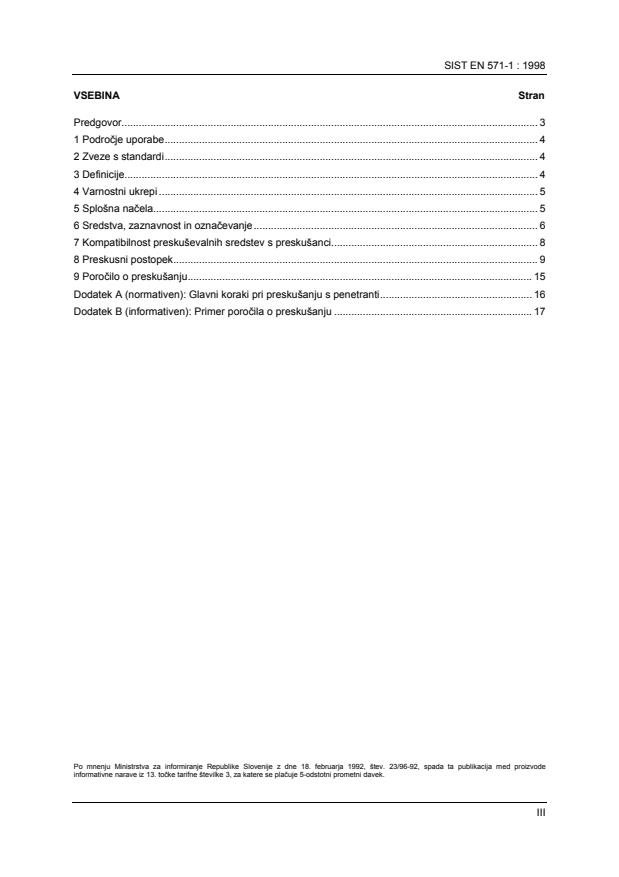
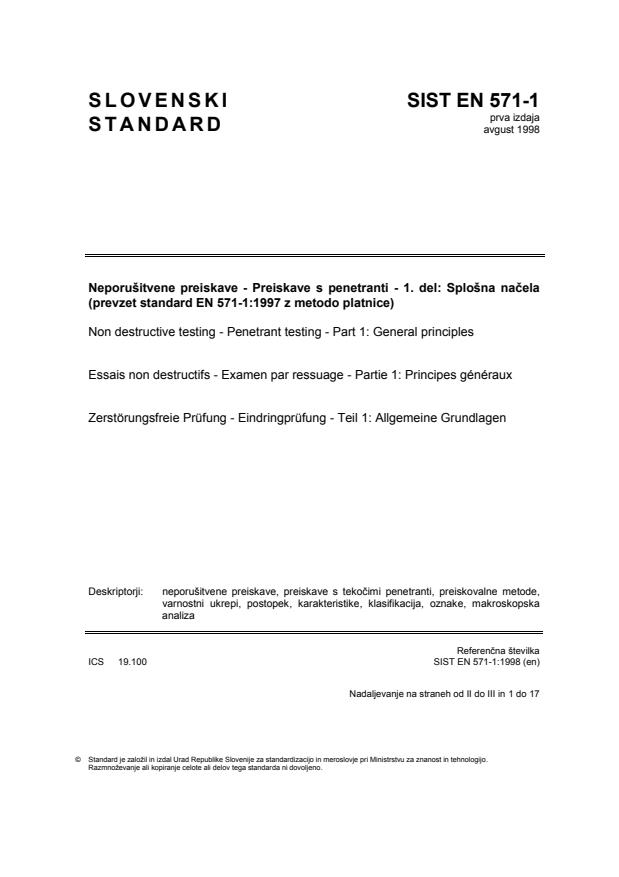
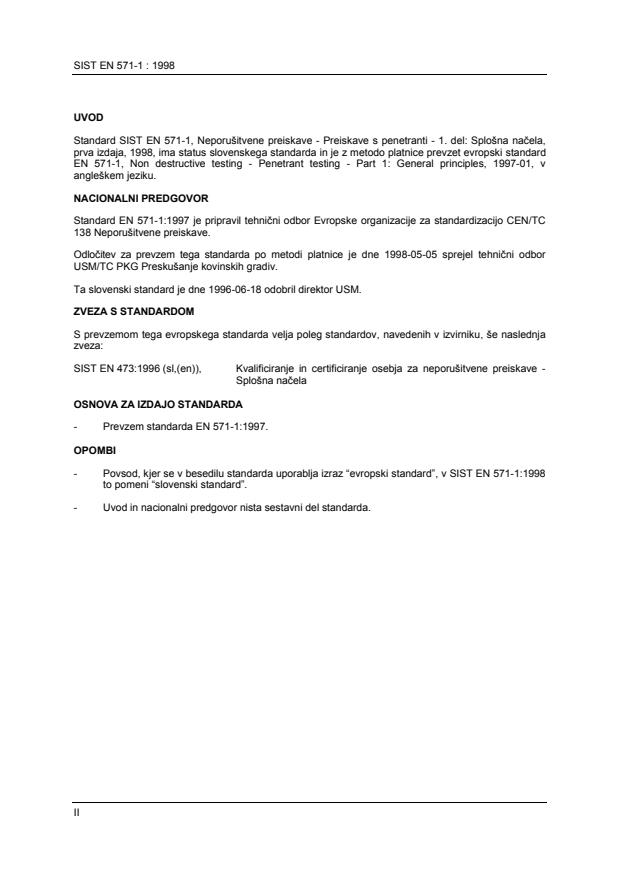

EN 571-1:1998
Relations
- Effective Date
- 12-Jun-2013
- Effective Date
- 09-Feb-2026
- Effective Date
- 09-Feb-2026
- Effective Date
- 09-Feb-2026
- Effective Date
- 09-Feb-2026
- Effective Date
- 09-Feb-2026
- Effective Date
- 09-Feb-2026
- Effective Date
- 09-Feb-2026
- Effective Date
- 09-Feb-2026
- Effective Date
- 09-Feb-2026
- Effective Date
- 09-Feb-2026
- Effective Date
- 09-Feb-2026
- Effective Date
- 09-Feb-2026
- Effective Date
- 09-Feb-2026
- Effective Date
- 09-Feb-2026
Buy Documents
EN 571-1:1998
Get Certified
Connect with accredited certification bodies for this standard

IMP NDT d.o.o.
Non-destructive testing services. Radiography, ultrasonic, magnetic particle, penetrant, visual inspection.
Inštitut za kovinske materiale in tehnologije
Institute of Metals and Technology. Materials testing, metallurgical analysis, NDT.
Q Techna d.o.o.
NDT and quality assurance specialist. 30+ years experience. NDT personnel certification per ISO 9712, nuclear and thermal power plant inspections, QA/
Sponsored listings
Frequently Asked Questions
EN 571-1:1997 is a standard + national annex and/or foreword published by the European Committee for Standardization (CEN). Its full title is "Non destructive testing - Penetrant testing - Part 1: General principles". This standard covers: This standard defines a method of penetrant testing used to detect discontinuities, e.g. cracks, laps, folds, porosity and lack of fusion, which are open to the surface of the material to be tested. It is maily applied to metallic materials, but can also be performed on other materials, provided that are inert to the test media and they are not excessively porous. Examples of which are castings, forgings, welds, ceramics, etc. This standard is not intended to be used for acceptance criteria and gives no information relating to the suitability of individual test systems for specific applications nor requirements for test equipement. The term "discontinuity" is used here in the sense that no evaluation concerning acceptability or non-acceptability is included. Metods for determining and monitoring the essential properties of penetrant testing products to be used are specified in EN 571-2 and EN 571-3.
This standard defines a method of penetrant testing used to detect discontinuities, e.g. cracks, laps, folds, porosity and lack of fusion, which are open to the surface of the material to be tested. It is maily applied to metallic materials, but can also be performed on other materials, provided that are inert to the test media and they are not excessively porous. Examples of which are castings, forgings, welds, ceramics, etc. This standard is not intended to be used for acceptance criteria and gives no information relating to the suitability of individual test systems for specific applications nor requirements for test equipement. The term "discontinuity" is used here in the sense that no evaluation concerning acceptability or non-acceptability is included. Metods for determining and monitoring the essential properties of penetrant testing products to be used are specified in EN 571-2 and EN 571-3.
EN 571-1:1997 is classified under the following ICS (International Classification for Standards) categories: 19.100 - Non-destructive testing. The ICS classification helps identify the subject area and facilitates finding related standards.
EN 571-1:1997 has the following relationships with other standards: It is inter standard links to EN ISO 3452-1:2013, EN 61400-25-2:2015, EN 61158-6-2:2014, EN IEC 61158-5-2:2019, EN 62298-2:2005, EN 62766-2-2:2017, EN IEC 61158-6-2:2023, EN 62541-3:2010, EN 61804-3:2015, EN IEC 61139-2:2022, EN IEC 61158-6-2:2019, EN 62541-3:2015, EN 62455:2011, EN 61360-2:2013, EN 61400-25-4:2017. Understanding these relationships helps ensure you are using the most current and applicable version of the standard.
EN 571-1:1997 is associated with the following European legislation: EU Directives/Regulations: 87/404/EEC, 97/23/EC; Standardization Mandates: M/071, M/BC/CEN/89/2. When a standard is cited in the Official Journal of the European Union, products manufactured in conformity with it benefit from a presumption of conformity with the essential requirements of the corresponding EU directive or regulation.
EN 571-1:1997 is available in PDF format for immediate download after purchase. The document can be added to your cart and obtained through the secure checkout process. Digital delivery ensures instant access to the complete standard document.
Standards Content (Sample)
6/29(16., 6,67(18:404
SUYDL]GDMD
67$1'$5'
DYJXVW4<<;
1HSRUXãLWYHQH SUHLVNDYH 0 3UHLVNDYH V SHQHWUDQWL041 GHO= 6SORãQD QDþHOD
+SUHY]HWVWDQGDUG(18:404=4<<:]PHWRGRSODWQLFH,
1RQ GHVWUXFWLYH WHVWLQJ0 3HQHWUDQW WHVWLQJ0 3DUW4= *HQHUDO SULQFLSOHV
(VVDLV QRQ GHVWUXFWLIV0 ([DPHQ SDU UHVVXDJH0 3DUWLH4= 3ULQFLSHV JpQpUDX[
=HUVW|UXQJVIUHLH 3UIXQJ0 (LQGULQJSUIXQJ0 7HLO4= $OOJHPHLQH *UXQGODJHQ
'HVNULSWRUML= QHSRUXãLWYHQH SUHLVNDYH/ SUHLVNDYH V WHNRþLPL SHQHWUDQWL/ SUHLVNRYDOQH PHWRGH/
YDUQRVWQL XNUHSL/ SRVWRSHN/ NDUDNWHULVWLNH/ NODVLILNDFLMD/ R]QDNH/ PDNURVNRSVND
DQDOL]D
5HIHUHQþQD ãWHYLOND
,&6 4<1433 6,67 (18:404=4<<;+HQ,
1DGDOMHYDQMH QD VWUDQHK RG ,, GR ,,, LQ4 GR4:
‹ 6WDQGDUGMH]DORåLOLQL]GDO8UDG5HSXEOLNH6ORYHQLMH]DVWDQGDUGL]DFLMRLQPHURVORYMHSUL0LQLVWUVWYX]D]QDQRVWLQWHKQRORJLMR1
5D]PQRåHYDQMHDOLNRSLUDQMHFHORWHDOLGHORYWHJDVWDQGDUGDQLGRYROMHQR1
6,67(18:404=4<<;
892'
6WDQGDUG 6,67 (18:404/ 1HSRUXãLWYHQH SUHLVNDYH0 3UHLVNDYH V SHQHWUDQWL041 GHO= 6SORãQD QDþHOD/
SUYD L]GDMD/4<<;/ LPD VWDWXV VORYHQVNHJD VWDQGDUGD LQ MH ] PHWRGR SODWQLFH SUHY]HW HYURSVNL VWDQGDUG
(1 8:404/ 1RQ GHVWUXFWLYH WHVWLQJ 0 3HQHWUDQW WHVWLQJ 0 3DUW 4= *HQHUDO SULQFLSOHV/ 4<<:034/ Y
DQJOHãNHP MH]LNX1
1$&,21$/1,35('*2925
6WDQGDUG (18:404=4<<: MH SULSUDYLO WHKQLþQL RGERU (YURSVNH RUJDQL]DFLMH ]D VWDQGDUGL]DFLMR &(127&
46;1HSRUXãLWYHQHSUHLVNDYH1
2GORþLWHY ]D SUHY]HP WHJD VWDQGDUGD SR PHWRGL SODWQLFH MH GQH 4<<;038038 VSUHMHO WHKQLþQL RGERU
86027& 3.* 3UHVNXãDQMH NRYLQVNLK JUDGLY1
7DVORYHQVNLVWDQGDUGMHGQH4<<903904; RGREULOGLUHNWRU8601
=9(=$667$1'$5'20
6 SUHY]HPRP WHJD HYURSVNHJD VWDQGDUGD YHOMD SROHJ VWDQGDUGRY/ QDYHGHQLK Y L]YLUQLNX/ ãH QDVOHGQMD
]YH]D=
6,67 (17:6=4<<9+VO/+HQ,,/ .YDOLILFLUDQMH LQ FHUWLILFLUDQMH RVHEMD ]D QHSRUXãLWYHQH SUHLVNDYH 0
6SORãQDQDþHOD
26129$=$,='$-267$1'$5'$
0 3UHY]HPVWDQGDUGD(18:404=4<<:1
2320%,
0 3RYVRG/ NMHU VH Y EHVHGLOX VWDQGDUGD XSRUDEOMD L]UD] ³HYURSVNL VWDQGDUG´/Y6,67(18:404=4<<;
WR SRPHQL³VORYHQVNLVWDQGDUG´1
0 8YRGLQQDFLRQDOQLSUHGJRYRUQLVWDVHVWDYQLGHOVWDQGDUGD1
,,
------------
...