

EN 15232:2007
(Main)Energy performance of buildings - Impact of Building Automation, Controls and Building Management
General Information
- Abstract
This European Standard specifies:
– a structured list of control, building automation and technical building management functions which have an impact on the energy performance of buildings;
– a method to define minimum requirements regarding the control, building automation and technical building management functions to be implemented in buildings of different complexities;
– detailed methods to assess the impact of these functions on a given building. These methods enable to introduce the impact of these functions in the calculations of energy performance ratings and indicators calculated by the relevant standards;
– a simplified method to get a first estimation of the impact of these functions on typical buildings.
This European Standard is defined for:
– building owners, architects or engineers defining the functions to be implemented for a given new building or for the renovation of an existing building;
– public authorities defining minimum requirements for control, building automation and energy management function for new buildings as well as for renovation as defined in the relevant standard;
– public authorities defining inspection procedures of technical systems as well as inspectors applying these procedures to check if the level of control, building automation and technical building management functions implemented is appropriate;
– public authorities defining calculation methods which take into account the impact of control building automation and technical building management functions on the energy performance of buildings as well as software developers implementing these calculation methods and designers using them;
– designers checking that the impact of all control, building automation and technical building management functions are taken into account when assessing the energy performance of a building.
- Status
- Withdrawn
- Publication Date
- 24-Jul-2007
- Withdrawal Date
- 24-Jan-2012
- Technical Committee
- CEN/TC 247 - Controls for mechanical building services
- Current Stage
- 9960 - Withdrawal effective - Withdrawal
- Start Date
- 25-Jan-2012
- Completion Date
- 25-Jan-2012

Relations
- Effective Date
- 30-Oct-2010
- Effective Date
- 28-Jan-2026
Get Certified
Connect with accredited certification bodies for this standard

DIBt (Deutsches Institut für Bautechnik)
German Institute for Building Technology.
DIN CERTCO
DIN Group product certification.

Aboma Certification B.V.
Specialized in construction, metal, and transport sectors.
Sponsored listings
Frequently Asked Questions
EN 15232:2007 is a standard published by the European Committee for Standardization (CEN). Its full title is "Energy performance of buildings - Impact of Building Automation, Controls and Building Management". This standard covers: This European Standard specifies: – a structured list of control, building automation and technical building management functions which have an impact on the energy performance of buildings; – a method to define minimum requirements regarding the control, building automation and technical building management functions to be implemented in buildings of different complexities; – detailed methods to assess the impact of these functions on a given building. These methods enable to introduce the impact of these functions in the calculations of energy performance ratings and indicators calculated by the relevant standards; – a simplified method to get a first estimation of the impact of these functions on typical buildings. This European Standard is defined for: – building owners, architects or engineers defining the functions to be implemented for a given new building or for the renovation of an existing building; – public authorities defining minimum requirements for control, building automation and energy management function for new buildings as well as for renovation as defined in the relevant standard; – public authorities defining inspection procedures of technical systems as well as inspectors applying these procedures to check if the level of control, building automation and technical building management functions implemented is appropriate; – public authorities defining calculation methods which take into account the impact of control building automation and technical building management functions on the energy performance of buildings as well as software developers implementing these calculation methods and designers using them; – designers checking that the impact of all control, building automation and technical building management functions are taken into account when assessing the energy performance of a building.
This European Standard specifies: – a structured list of control, building automation and technical building management functions which have an impact on the energy performance of buildings; – a method to define minimum requirements regarding the control, building automation and technical building management functions to be implemented in buildings of different complexities; – detailed methods to assess the impact of these functions on a given building. These methods enable to introduce the impact of these functions in the calculations of energy performance ratings and indicators calculated by the relevant standards; – a simplified method to get a first estimation of the impact of these functions on typical buildings. This European Standard is defined for: – building owners, architects or engineers defining the functions to be implemented for a given new building or for the renovation of an existing building; – public authorities defining minimum requirements for control, building automation and energy management function for new buildings as well as for renovation as defined in the relevant standard; – public authorities defining inspection procedures of technical systems as well as inspectors applying these procedures to check if the level of control, building automation and technical building management functions implemented is appropriate; – public authorities defining calculation methods which take into account the impact of control building automation and technical building management functions on the energy performance of buildings as well as software developers implementing these calculation methods and designers using them; – designers checking that the impact of all control, building automation and technical building management functions are taken into account when assessing the energy performance of a building.
EN 15232:2007 is classified under the following ICS (International Classification for Standards) categories: 91.140.10 - Central heating systems. The ICS classification helps identify the subject area and facilitates finding related standards.
EN 15232:2007 has the following relationships with other standards: It is inter standard links to EN 15232:2012, EN 15603:2008. Understanding these relationships helps ensure you are using the most current and applicable version of the standard.
EN 15232:2007 is associated with the following European legislation: Standardization Mandates: M/343. When a standard is cited in the Official Journal of the European Union, products manufactured in conformity with it benefit from a presumption of conformity with the essential requirements of the corresponding EU directive or regulation.
EN 15232:2007 is available in PDF format for immediate download after purchase. The document can be added to your cart and obtained through the secure checkout process. Digital delivery ensures instant access to the complete standard document.
Standards Content (Sample)
2003-01.Slovenski inštitut za standardizacijo. Razmnoževanje celote ali delov tega standarda ni dovoljeno.Grelni sistemi v stavbah - Vpliv avtomatizacije stavb in izvršnih elementov ter upravljanja stavbEnergieeffizienz von Gebäuden - Auswirkungen der Gebäudeautomation und des GebäudemanagementsPerformance énergétique des bâtiments - Impact de l'automatisation de la régulation et de la gestion technique du bâtimentEnergy performance of buildings - Impact of Building Automation, Controls and Building Management97.120Avtomatske krmilne naprave za domAutomatic controls for household use91.140.10Sistemi centralnega ogrevanjaCentral heating systemsICS:Ta slovenski standard je istoveten z:EN 15232:2007SIST EN 15232:2007en,de01-december-2007SIST EN 15232:2007SLOVENSKI
STANDARD
EUROPEAN STANDARDNORME EUROPÉENNEEUROPÄISCHE NORMEN 15232July 2007ICS 91.140.10 English VersionEnergy performance of buildings - Impact of BuildingAutomation, Controls and Building ManagementPerformance énergétique des bâtiments - Impact del'automatisation de la régulation et de la gestion techniquedu bâtimentEnergieeffizienz von Gebäuden - Auswirkungen derGebäudeautomation und des GebäudemanagementsThis European Standard was approved by CEN on 16 May 2007.CEN members are bound to comply with the CEN/CENELEC Internal Regulations which stipulate the conditions for giving this EuropeanStandard the status of a national standard without any alteration. Up-to-date lists and bibliographical references concerning such nationalstandards may be obtained on application to the CEN Management Centre or to any CEN member.This European Standard exists in three official versions (English, French, German). A version in any other language made by translationunder the responsibility of a CEN member into its own language and notified to the CEN Management Centre has the same status as theofficial versions.CEN members are the national standards bodies of Austria, Belgium, Bulgaria, Cyprus, Czech Republic, Denmark, Estonia, Finland,France, Germany, Greece, Hungary, Iceland, Ireland, Italy, Latvia, Lithuania, Luxembourg, Malta, Netherlands, Norway, Poland, Portugal,Romania, Slovakia, Slovenia, Spain, Sweden, Switzerland and United Kingdom.EUROPEAN COMMITTEE FOR STANDARDIZATIONCOMITÉ EUROPÉEN DE NORMALISATIONEUROPÄISCHES KOMITEE FÜR NORMUNGManagement Centre: rue de Stassart, 36
B-1050 Brussels© 2007 CENAll rights of exploitation in any form and by any means reservedworldwide for CEN national Members.Ref. No. EN 15232:2007: ESIST EN 15232:2007
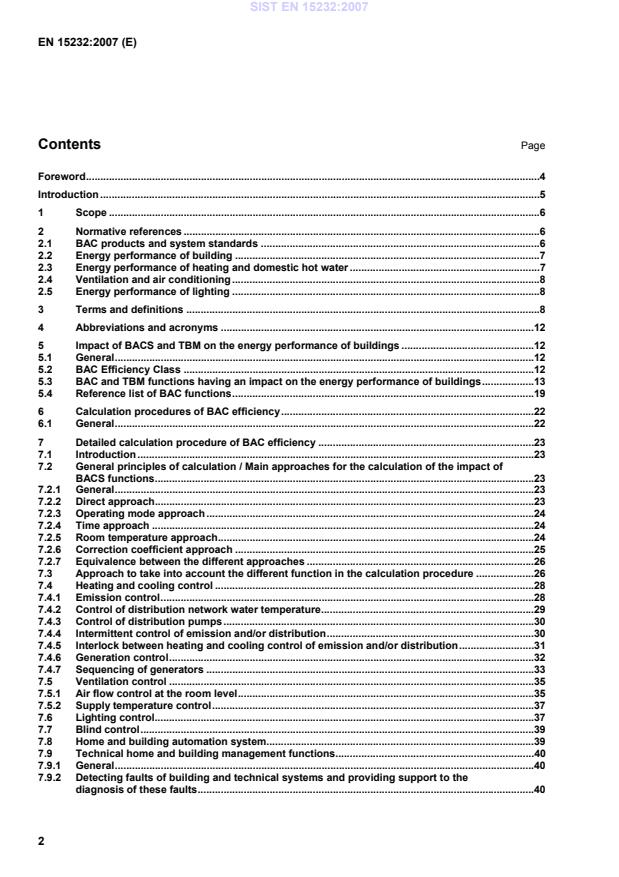
Determination of the BAC efficiency factors.49 A.1 Determination procedure.49 A.2 Detailed modelling approaches and user profiles.49 A.3 Boundary conditions.53 Annex B (informative)
Examples of how to use the BACS function list of EN ISO 16484-3 to describe functions from this European Standard.68 B.1 General.68 B.2 Direct representation by a function defined in EN ISO 16484-3.68 B.2.1 Example 1 - Night cooling.68 B.2.2 Example 2 - h,x- directed control.68 B.3 Representation by a combination of functions defined in EN ISO 16484-3.69 B.3.1 Example 3 - Individual room automatic control.69 B.3.2 Example 4 - Outside temperature compensated control.71 Annex C (informative)
The impact of innovative integrated BAC functions (examples).73 C.1 General.73 C.2 Examples of integrated functions.73 C.2.1 Overview.73 C.2.2 The use of window contacts in individual room temperature control in heated zones.73 C.2.3 Optimized blind and lighting control.78 Bibliography.84
16484-3:2005) 2.2 Energy performance of building EN 13363-1:2003, Solar protection devices combined with glazing - Calculation of solar and light transmittance - Part 1: Simplified method EN 15217:2007, Energy performance of buildings - Methods for expressing energy performance and for energy certification of buildings EN 15255, Thermal performance of buildings - Sensible room cooling load calculation - General criteria and validation procedures prEN 15203:2005, Energy performance of buildings - Overall energy use and definition of energy ratings EN ISO 13790:2004, Thermal performance of buildings - Calculation of energy use for space heating (ISO 13790:2004) 2.3 Energy performance of heating and domestic hot water EN 15316-1:2007, Heating systems in buildings - Method for calculation of system energy requirements and system efficiencies - Part 1: General EN 15316-2-1:2007, Heating systems in buildings - Method for calculation of system energy requirements and system efficiencies - Part 2-1: Space heating emission systems EN 15316-2-3:2007, Heating systems in buildings - Method for calculation of system energy requirements and system efficiencies - Part 2-3: Space heating distribution systems prEN 15316-4-1, Heating systems in buildings - Method for calculation of system energy requirements and system efficiencies - Part 4-1: Space heating generation systems, boilers prEN 15316-4-2, Heating systems in buildings - Method for calculation of system energy requirements and system efficiencies - Part 4-2: Space heating generation systems, heat pump systems EN 15316-4-3, Heating systems in buildings - Method for calculation of system energy requirements and system efficiencies - Part 4-3: Space heating generation systems, thermal solar systems prEN 15316-3-2, Heating systems in buildings - Method for calculation of system energy requirements and system efficiencies - Part 3-2: Domestic hot water systems, distribution
prEN 15316-3-3, Heating systems in buildings - Method for calculation of system energy requirements and system efficiencies - Part 3-3: Domestic hot water systems, generation EN 15316-4-4, Heating systems in buildings - Method for calculation of system energy requirements and system efficiencies - Part 4-4: Heat generation systems, building-integrated cogeneration systems EN 15316-4-5, Heating systems in buildings - Method for calculation of system energy requirements and system efficiencies - Part 4-5: Space heating generation systems, the performance and quality of district heating and large volume systems EN 15316-4-6, Heating systems in buildings - Method for calculation of system energy requirements and system efficiencies - Part 4-6: Heat generation systems, photovoltaic systems SIST EN 15232:2007
prEN 15316-4-7, Heating systems in buildings - Method for calculation of system energy requirements and system efficiencies - Part 4-7: Space heating generation systems, biomass combustion systems prEN 15378, Heating systems in buildings - Inspection of boilers and heating systems EN 60675, Household electric direct-acting room heaters - Methods for measuring performance (IEC
60675:1994) 2.4 Ventilation and air conditioning EN 13779, Ventilation for non-residential buildings — Performance requirements for ventilation and room-conditioning systems EN 15239, Ventilation for buildings — Energy performance of buildings — Guidelines for inspection of ventilation systems EN 15240, Ventilation for buildings — Energy performance of buildings — Guidelines for inspection of air-conditioning systems EN 15241:2007, Ventilation for buildings — Calculation method for energy losses due to ventilation and infiltration in commercial buildings EN 15242:2007, Ventilation for buildings — Calculation methods for the determination of air flow rates in buildings including infiltration prEN 15243:2005, Ventilation for buildings — Calculation of room temperatures and of load and energy for buildings with room conditioning systems 2.5 Energy performance of lighting EN 15193:2007, Energy performance of buildings — Energy requirements for lighting 3 Terms and definitions For the purposes of this document, the following terms and definitions apply. NOTE 1 The terms and definitions listed in this standard but defined by other relevant ISO/IEC International Standards and/or European Standards are repeated below for convenience in most cases. NOTE 2 Other language versions may contain an alphabetical index in national annexes. 3.1 auxiliary energy electrical energy used by heating, cooling and/or domestic water systems to transform and transport the delivered energy into the useful energy [CEN/TR 15615] NOTE 1 This includes energy for fans, pumps, electronics etc., but not the energy that is transformed. Pilot flames are considered as part of the energy use by the system. NOTE 2 In EN ISO 9488 the energy used for pumps and valves is called "parasitic energy". SIST EN 15232:2007
3.9 energy use for space heating or cooling or domestic hot water energy input to the heating, cooling or hot water system to satisfy the energy need for heating, cooling or hot water respectively. It is the sum of the energy needs and the non-recovered technical system thermal losses [prEN 15306] NOTE The energy use for lighting is also considered in this European Standard. 3.10 energy performance of a building calculated or measured amount of weighted net delivered energy actually used or estimated to meet different needs associated with a standardised use of a building, which may include, inter alia, energy used for heating, cooling, ventilation, domestic hot water and lighting [CEN/TR 15615] . 3.11 control function BACS effect of programs and parameters [EN ISO 16484-2:2004] NOTE 1 Functions within a BACS are referred to as control functions, I/O, processing, optimization, management and operator functions. They are listed in the BACS FL (function list) for a specification of work. [EN ISO 16484-2:2004] NOTE 2 Function is a program unit that delivers exactly one data element, which can be a multiple value (i.e. an array or a structure). Functions can be an operand in a program. [IEC 61131-3:2003] SIST EN 15232:2007
the impact of the accuracy of the control system on the energy performance to be taken into account.
4 Abbreviations and acronyms For the purposes of this document, the following abbreviations and acronyms apply. BAC Building Automation and Control
BACS Building Automation and Control System BM
Building Management HVAC Heating, Ventilation and Air Conditioning TBM
Technical Building Management 5 Impact of BACS and TBM on the energy performance of buildings 5.1 General Building Automation and Control (BAC) equipment and systems provides effective control functions of heating, ventilating, cooling, hot water and lighting appliances etc., that lead to increased operational and energy efficiencies. Complex and integrated energy saving functions and routines can be configured on the actual use of a building depending on the real user needs to avoid unnecessary energy use and CO2 emissions. Technical Building Management (TBM) functions as part of Building Management (BM) provide information about operation, maintenance, services and management of buildings especially for energy management – Measurement, recording trending, and alarming capabilities and diagnosis of unnecessary energy use. Energy management is a requirement about documentation, controlling, monitoring, optimisation, determination and to support corrective action and preventive action to improve the energy performance of buildings.
5.2 BAC Efficiency Class
Functions having an impact on the energy performance of buildings are listed in Table 1. They are split in three groups: functions for automatic control, functions for home automation system/building automation and control system and functions for technical home and building management. Four different BAC efficiency classes (A, B, C, D) of functions are defined either for non – residential and residential building. – Class D corresponds to non energy efficient BACS. Building with such systems shall be retrofitted. New buildings shall not be built with such systems. – Class C corresponds to standard BACS. – Class B corresponds to advanced BACS and some specific TBM functions. – Class A corresponds to high energy performance BACS and TBM. Table 1 defines the list of functions corresponding to each level. To be in class C minimum functions defined in Table 1 shall be implemented.
NOTE In addition the hydraulic system shall be properly balanced. SIST EN 15232:2007
One is in class D if the minimum functions to be in class C are not implemented. 5.3 BAC and TBM functions having an impact on the energy performance of buildings The most common BAC and TBM functions having an impact on the energy performance of buildings have been summarized in Table 1. Functions are assigned to the BAC efficiency classes as defined in clause 5.2 depending on their use in residential or non-residential buildings.
Table 1 should be applied in the following way by: a) building owners, architects or engineers defining the building automation and controls (BAC) and technical building management (TBM) functions to be implemented for a given new building or for the renovation of an existing building: 1) They can put an X in front of each of the functions they want to be implemented. They will use the shaded boxes as an help tool to determine in which class A, B, C, D the function they have specified is located. To achieve for example category B the X shall all be put in a shaded box for category B; 2) It will be a simplified alternative especially for specification at an early stage of a project to specify only the classes of function A, B, C, D; b) public authorities defining minimum requirements for BAC and TBM functions for new buildings as well as for renovations as defined in EN 15217:2005, D.3: 1) They can define the minimum class to be achieved. Unless differently specified this class is C; c) public authorities defining inspection procedures of technical systems as well as inspectors applying these procedures to check if the level of BAC and TBM functions implemented is appropriate: 1) Public authorities can request the use of the table to inspect the BACS in place; 2) Inspectors can put an X in front of each of the BAC functions which are implemented; 3) They will then be able to determine the class A, B, C, D of functions already implemented. To be in a given class all the X shall correspond to shaded boxes for this cclass; d) public authorities defining calculation methods which take into account the impact of BAC and TBM functions on the energy performance of buildings as well as software developers implementing these calculation methods and designers using them: 1) Public authorities can request that the impact of the BAC and TBM functions defined in the list is taken into account; 2) Software developers can develop software user interfaces enabling to input the list of BAC and TBM functions which are implemented according to Table 1. They can provide a simplified input mode based on the class of functions A, B, C, D; SIST EN 15232:2007
Definition of classes
Residential Non residential
D C B A D C B A AUTOMATIC CONTROL HEATING CONTROL
Emission control
The control system is installed at the emitter or room level, for case 1 one system can control several rooms
0 No automatic control
1 Central automatic control
2 Individual room automatic control by thermostatic valves or electronic controller
3 Individual room control with communication between controllers and to BACS
4 Integrated individual room control including demand control (by occupancy, air quality, etc.)
Control of distribution network hot water temperature (supply or return)
Similar function can be applied to the control of direct electric heating networks
0 No automatic control
1 Outside temperature compensated control
2 Indoor temperature control
Control of distribution pumps
The controlled pumps can be installed at different levels in the network
0 No control
1 On off control
2 Variable speed pump control with constant ∆p
3 Variable speed pump control with proportional ∆p
Intermittent control of emission and/or distribution
One controller can control different rooms/zone having same occupancy patterns
0 No automatic control
1 Automatic control with fixed time program
2 Automatic control with optimum start/stop
Generator control
0 Constant temperature
1 Variable temperature depending on outdoor temperature
2 Variable temperature depending on the load
Sequencing of different generators
0 Priorities only based on loads
1 Priorities based on loads and generator capacities
2 Priorities based on generator efficiency (check other standard)
Definition of classes
Residential Non residential
D C B A D C B A COOLING CONTROL
Emission control
The control system is installed at the emitter or room level, for case 1 one system can control several rooms
0 No automatic control
1 Central automatic control
2 Individual room automatic control by thermostatic valves or electronic controller
3 Individual room control with communication between controllers and to BACS
4 Integrated individual room control including demand control (by occupancy, air quality, etc.)
Control of distribution network cold water temperature (supply or return)
Similar function can be applied to the control of direct electric heating networks
0 No automatic control
1 Outside temperature compensated control
2 Indoor temperature control
Control of distribution pumps
The controlled pumps can be installed at different levels in the network
0 No control
1 On off control
2 Variable speed pump control with constant ∆p
3 Variable speed pump control with proportional ∆p
Intermittent control of emission and/or distribution
One controller can control different rooms/zone having same occupancy patterns
0 No automatic control
1 Automatic control with fixed time program
2 Automatic control with optimum start/stop
Interlock between heating and cooling control of emission and/or distribution
0 No interlock
1 Partial interlock (dependant of the HVAC system)
2 Total interlock
Generator control
0 Constant temperature
1 Variable temperature depending on outdoor temperature
2 Variable temperature depending on the load
Sequencing of different generators
0 Priorities only based on loads
1 Priorities based on loads and generator capacities
2 Priorities based on generator efficiency (check other standard)
Definition of classes
Residential Non residential
D C B A D C B A VENTILATION AND AIR CONDITIONING CONTROL
Air flow control at the room level
0 No control
1 Manual control
2 Time control
3 Presence control
4 Demand control
Air flow control at the air handler level
0 No control
1 On off time control
2 Automatic flow or pressure control with or without pressure reset
Heat exchanger defrost control
0 Without defrost control
1 With defrost control
Heat exchanger overheating control
0 Without overheating control
1 With overheating control
Free mechanical cooling
0 No control
1 Night cooling
2 Free cooling
3 H,x- directed control
Supply Temperature control
0 No control
1 Constant set point
2 Variable set point with outdoor temperature compensation
3 Variable set point with load dependant compensation
Humidity control
0 No control
1 Supply air humidity limitation
2 Supply air humidity control
3 Room or exhaust air humidity control
Definition of classes
Residential Non residential
D C B A D C B A LIGHTING CONTROL
Occupancy control
0 Manual on/off switch
1 Manual on/off switch + additional sweeping extinction signal
2 Automatic detection Auto On / Dimmed
3 Automatic detection Auto On / Auto Off
4 Automatic detection Manual On / Dimmed
5 Automatic detection Manual On / Auto Off
Daylight control
0 Manual
1 Automatic
BLIND CONTROL
0 Manual operation
1 Motorized operation with manual control
2 Motorized operation with automatic control
3 Combined light/blind/HVAC control (also mentioned above)
HOME AUTOMATION SYSTEM BUILDING AUTOMATION AND CONTROL SYSTEM
0 No home automation
No building automation and control system
1 Centralized adapting of the home & building automation and control system to users needs: e.g. time schedule, set points…
2 Centralized optimizing of the home and building automation and control system: e.g. tuning controllers, set points…
TECHNICAL HOME AND BUILDING MANAGEMENT
Detecting faults of home and building systems and providing support to the diagnosis of these faults
0 No
1 Yes
Reporting information regarding energy consumption, indoor conditions and possibilities for improvement
0 No
1 Yes
5.4 Reference list of BAC functions A reference list of BAC functions is defined in Table 2. That table defines the minimum requirements of BAC and TBM functions according to BAC efficiency class C of Table 1. Unless differently specified this list shall be used for the following: – to specify the minimum functions to be implemented for a project; – to define the BAC function to take into account for the calculation of energy consumption of a building when the BAC functions are not defined in detail. – to calculate the energy use for the reference case in step 1 of the BAC efficiency factor method (first box in Figure 2 in chapter 8). Unless differently specified by public authorities the minimum level of functions to be implemented corresponds to the functions defined in Table 2. Public authorities wishing to modify the reference list or minimum requirements respectively shall adapt this table. Table 2 — Reference list of BAC functions
Residential Non residential AUTOMATIC CONTROL HEATING CONTROL
Emission control
The control system is installed at the emitter or room level, for case 1 one system can control several rooms
2 Individual room automatic control by thermostatic valves or electronic controller
Control of distribution network water temperature (supply or return)
Similar function can be applied to the control of direct electric heating networks
1 Outside temperature compensated control
Control of distribution pumps
The controlled pumps can be installed at different levels in the network
1 On off control
2 Variable speed pump control with constant ∆p
Intermittent control of emission and/or distribution
One controller can control different rooms/zone having same occupancy patterns
1 Automatic control wi
...