

EN ISO 14644-3:2019
(Main)Cleanrooms and associated controlled environments - Part 3: Test methods (ISO 14644-3:2019, Corrected version 2020-06)
- Abstract
This document provides test methods in support of the operation for cleanrooms and clean zones to meet air cleanliness classification, other cleanliness attributes and related controlled conditions.
Performance tests are specified for two types of cleanrooms and clean zones: those with unidirectional airflow and those with non-unidirectional airflow, in three possible occupancy states: as-built, at-rest and operational.
The test methods, recommended test apparatus and test procedures for determining performance parameters are provided. Where the test method is affected by the type of cleanroom or clean zone, alternative procedures are suggested.
For some of the tests, several different methods and apparatus are recommended to accommodate different end-use considerations. Alternative methods not included in this document can be used by agreement between customer and supplier. Alternative methods do not necessarily provide equivalent measurements.
This document is not applicable to the measurement of products or of processes in cleanrooms, clean zones or separative devices.
NOTE This document does not purport to address safety considerations associated with its use (for example, when using hazardous materials, operations and equipment). It is the responsibility of the user of this document to establish appropriate safety and health practices and to determine the applicability of regulatory limitations prior to use.
- Status
- Published
- Publication Date
- 15-Oct-2019
- Withdrawal Date
- 29-Apr-2020
- Technical Committee
- CEN/TC 243 - Cleanroom technology
- Drafting Committee
- CEN/TC 243 - Cleanroom technology
- Current Stage
- 6060 - Definitive text made available (DAV) - Publishing
- Start Date
- 16-Oct-2019
- Completion Date
- 16-Oct-2019


Overview
EN ISO 14644-3:2019 (ISO 14644-3:2019, corrected 2020-06) specifies standardized test methods for assessing the performance of cleanrooms and associated controlled environments (clean zones). It supports the operation and verification needed to meet air cleanliness classification, related cleanliness attributes and controlled environmental conditions. The standard covers performance testing for two airflow types - unidirectional and non‑unidirectional - in three occupancy states: as‑built, at‑rest and operational.
Key technical topics and requirements
- Performance test scope: Methods, recommended test apparatus and procedures for determining cleanroom performance parameters.
- Airflow types and occupancy states: Alternative procedures are provided where test methods depend on airflow pattern or occupancy (unidirectional vs non‑unidirectional; as‑built, at‑rest, operational).
- Test areas covered (selected topics from the standard):
- Air pressure difference, airflow rate and airflow direction/visualization
- Recovery testing (cleanroom recovery after contamination)
- Temperature and relative humidity measurements
- Installed filter system leakage and containment leak tests
- Electrostatic/ion generator evaluation and particle deposition tests
- Segregation and supporting tests to evaluate functionality
- Test apparatus options: Several recommended methods and instruments are included to suit different end‑use considerations; alternative methods may be used by agreement between customer and supplier (note: alternative methods may not be equivalent).
- Reporting: Requirements for test reports and checklists to document test methods and results.
- Limitations: The standard is not applicable to measurement of products or specific processes conducted within cleanrooms, and it does not address safety practices related to hazardous materials or operations.
Practical applications and who uses this standard
ISO 14644-3 is used by organizations that design, build, commission, validate and operate contamination‑sensitive environments, including:
- Cleanroom designers and HVAC engineers
- Validation, quality assurance and compliance teams in pharmaceuticals, medical devices, microelectronics, aerospace, food and healthcare industries
- Facility managers, test laboratories and third‑party auditors performing performance qualification and periodic retesting
Use cases include commissioning and acceptance testing, periodic performance verification, troubleshooting airflow/containment issues, and documenting compliance with air cleanliness classes.
Related standards
- ISO 14644-1 (air cleanliness classification by particle concentration)
- ISO 14644-4 (design, construction and start‑up)
- ISO 14644-7 (separative devices)
- ISO 14644-8 / -9 / -10 (other cleanliness attributes: chemical and surface metrics)
- ISO 14644-12 and ISO 14698 (nanoscale and viable particle considerations)
Keywords: ISO 14644-3, EN ISO 14644-3:2019, cleanroom test methods, air cleanliness classification, unidirectional airflow, operational qualification, filter leakage testing, clean zones.
Relations
- Effective Date
- 23-Oct-2019
- Effective Date
- 28-Jan-2026
- Effective Date
- 28-Jan-2026
- Consolidated By
ISO 14644-3:2019 - Cleanrooms and associated controlled environments — Part 3: Test methods - Effective Date
- 12-Feb-2026
Get Certified
Connect with accredited certification bodies for this standard

CIS Institut d.o.o.
Personal Protective Equipment (PPE) certification body. Notified Body NB-2890 for EU Regulation 2016/425 PPE.

Kiwa BDA Testing
Building and construction product certification.
Kmetijski inštitut Slovenije
Agricultural Institute of Slovenia. Soil testing, plant health, agricultural product analysis.
Sponsored listings
Frequently Asked Questions
EN ISO 14644-3:2019 is a standard published by the European Committee for Standardization (CEN). Its full title is "Cleanrooms and associated controlled environments - Part 3: Test methods (ISO 14644-3:2019, Corrected version 2020-06)". This standard covers: This document provides test methods in support of the operation for cleanrooms and clean zones to meet air cleanliness classification, other cleanliness attributes and related controlled conditions. Performance tests are specified for two types of cleanrooms and clean zones: those with unidirectional airflow and those with non-unidirectional airflow, in three possible occupancy states: as-built, at-rest and operational. The test methods, recommended test apparatus and test procedures for determining performance parameters are provided. Where the test method is affected by the type of cleanroom or clean zone, alternative procedures are suggested. For some of the tests, several different methods and apparatus are recommended to accommodate different end-use considerations. Alternative methods not included in this document can be used by agreement between customer and supplier. Alternative methods do not necessarily provide equivalent measurements. This document is not applicable to the measurement of products or of processes in cleanrooms, clean zones or separative devices. NOTE This document does not purport to address safety considerations associated with its use (for example, when using hazardous materials, operations and equipment). It is the responsibility of the user of this document to establish appropriate safety and health practices and to determine the applicability of regulatory limitations prior to use.
This document provides test methods in support of the operation for cleanrooms and clean zones to meet air cleanliness classification, other cleanliness attributes and related controlled conditions. Performance tests are specified for two types of cleanrooms and clean zones: those with unidirectional airflow and those with non-unidirectional airflow, in three possible occupancy states: as-built, at-rest and operational. The test methods, recommended test apparatus and test procedures for determining performance parameters are provided. Where the test method is affected by the type of cleanroom or clean zone, alternative procedures are suggested. For some of the tests, several different methods and apparatus are recommended to accommodate different end-use considerations. Alternative methods not included in this document can be used by agreement between customer and supplier. Alternative methods do not necessarily provide equivalent measurements. This document is not applicable to the measurement of products or of processes in cleanrooms, clean zones or separative devices. NOTE This document does not purport to address safety considerations associated with its use (for example, when using hazardous materials, operations and equipment). It is the responsibility of the user of this document to establish appropriate safety and health practices and to determine the applicability of regulatory limitations prior to use.
EN ISO 14644-3:2019 is classified under the following ICS (International Classification for Standards) categories: 13.040.35 - Cleanrooms and associated controlled environments. The ICS classification helps identify the subject area and facilitates finding related standards.
EN ISO 14644-3:2019 has the following relationships with other standards: It is inter standard links to EN ISO 14644-3:2005, EN 17242:2025, EN 12469-1:2025, ISO 14644-3:2019. Understanding these relationships helps ensure you are using the most current and applicable version of the standard.
EN ISO 14644-3:2019 is available in PDF format for immediate download after purchase. The document can be added to your cart and obtained through the secure checkout process. Digital delivery ensures instant access to the complete standard document.
Standards Content (Sample)
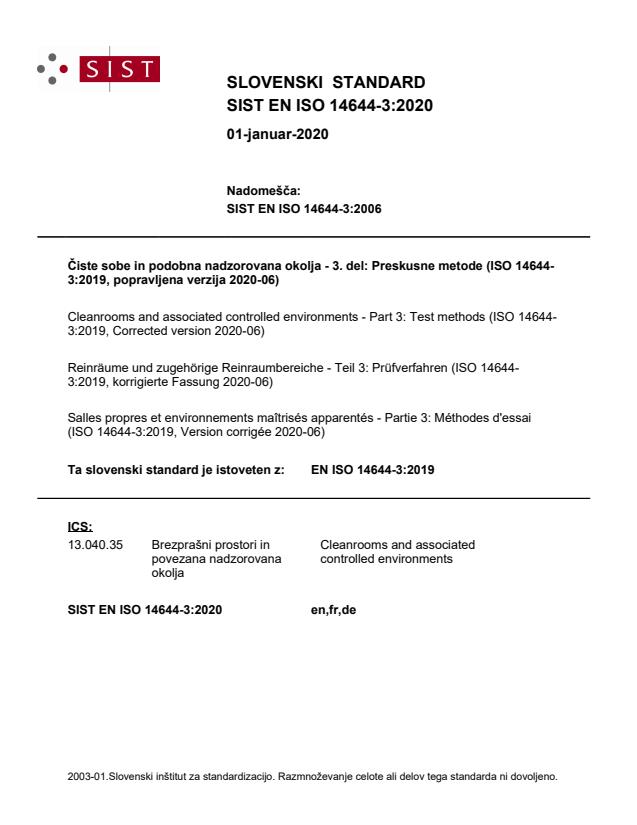
SLOVENSKI STANDARD
01-januar-2020
Nadomešča:
SIST EN ISO 14644-3:2006
Čiste sobe in podobna nadzorovana okolja - 3. del: Preskusne metode (ISO 14644-
3:2019, popravljena verzija 2020-06)
Cleanrooms and associated controlled environments - Part 3: Test methods (ISO 14644-
3:2019, Corrected version 2020-06)
Reinräume und zugehörige Reinraumbereiche - Teil 3: Prüfverfahren (ISO 14644-
3:2019, korrigierte Fassung 2020-06)
Salles propres et environnements maîtrisés apparentés - Partie 3: Méthodes d'essai
(ISO 14644-3:2019, Version corrigée 2020-06)
Ta slovenski standard je istoveten z: EN ISO 14644-3:2019
ICS:
13.040.35 Brezprašni prostori in Cleanrooms and associated
povezana nadzorovana controlled environments
okolja
2003-01.Slovenski inštitut za standardizacijo. Razmnoževanje celote ali delov tega standarda ni dovoljeno.
EN ISO 14644-3
EUROPEAN STANDARD
NORME EUROPÉENNE
October 2019
EUROPÄISCHE NORM
ICS 13.040.35 Supersedes EN ISO 14644-3:2005
English Version
Cleanrooms and associated controlled environments - Part
3: Test methods (ISO 14644-3:2019, Corrected version
2020-06)
Salles propres et environnements maîtrisés apparentés Reinräume und zugehörige Reinraumbereiche - Teil 3:
- Partie 3: Méthodes d'essai (ISO 14644-3:2019, Prüfverfahren (ISO 14644-3:2019, korrigierte Fassung
Version corrigée 2020-06) 2020-06)
This European Standard was approved by CEN on 24 July 2019.
This European Standard was corrected and reissued by the CEN-CENELEC Management Centre on 17 June 2020.
CEN members are bound to comply with the CEN/CENELEC Internal Regulations which stipulate the conditions for giving this
European Standard the status of a national standard without any alteration. Up-to-date lists and bibliographical references
concerning such national standards may be obtained on application to the CEN-CENELEC Management Centre or to any CEN
member.
This European Standard exists in three official versions (English, French, German). A version in any other language made by
translation under the responsibility of a CEN member into its own language and notified to the CEN-CENELEC Management
Centre has the same status as the official versions.
CEN members are the national standards bodies of Austria, Belgium, Bulgaria, Croatia, Cyprus, Czech Republic, Denmark, Estonia,
Finland, France, Germany, Greece, Hungary, Iceland, Ireland, Italy, Latvia, Lithuania, Luxembourg, Malta, Netherlands, Norway,
Poland, Portugal, Republic of North Macedonia, Romania, Serbia, Slovakia, Slovenia, Spain, Sweden, Switzerland, Turkey and
United Kingdom.
EUROPEAN COMMITTEE FOR STANDARDIZATION
COMITÉ EUROPÉEN DE NORMALISATIO N
EUROPÄISCHES KOMITEE FÜR NORMUN G
CEN-CENELEC Management Centre: Rue de la Science 23, B-1040 Brussels
© 2019 CEN All rights of exploitation in any form and by any means reserved Ref. No. EN ISO 14644-3:2019 E
worldwide for CEN national Members.
Contents Page
European foreword . 3
European foreword
This document (EN ISO 14644-3:2019) has been prepared by Technical Committee ISO/TC 209
"Cleanrooms and associated controlled environments" in collaboration with Technical Committee
CEN/TC 243 “Cleanroom technology” the secretariat of which is held by BSI.
This European Standard shall be given the status of a national standard, either by publication of an
identical text or by endorsement, at the latest by April 2020, and conflicting national standards shall be
withdrawn at the latest by April 2020.
Attention is drawn to the possibility that some of the elements of this document may be the subject of
patent rights. CEN shall not be held responsible for identifying any or all such patent rights.
This document supersedes EN ISO 14644-3:2005.
According to the CEN-CENELEC Internal Regulations, the national standards organizations of the
following countries are bound to implement this European Standard: Austria, Belgium, Bulgaria,
Croatia, Cyprus, Czech Republic, Denmark, Estonia, Finland, France, Germany, Greece, Hungary, Iceland,
Ireland, Italy, Latvia, Lithuania, Luxembourg, Malta, Netherlands, Norway, Poland, Portugal, Republic of
North Macedonia, Romania, Serbia, Slovakia, Slovenia, Spain, Sweden, Switzerland, Turkey and the
United Kingdom.
Endorsement notice
The text of ISO 14644-3:2019, Corrected version 2020-06 has been approved by CEN as EN ISO 14644-
3:2019 without any modification.
INTERNATIONAL ISO
STANDARD 14644-3
Second edition
2019-08
Corrected version
2020-06
Cleanrooms and associated controlled
environments —
Part 3:
Test methods
Salles propres et environnements maîtrisés apparentés —
Partie 3: Méthodes d'essai
Reference number
ISO 14644-3:2019(E)
©
ISO 2019
ISO 14644-3:2019(E)
© ISO 2019
All rights reserved. Unless otherwise specified, or required in the context of its implementation, no part of this publication may
be reproduced or utilized otherwise in any form or by any means, electronic or mechanical, including photocopying, or posting
on the internet or an intranet, without prior written permission. Permission can be requested from either ISO at the address
below or ISO’s member body in the country of the requester.
ISO copyright office
CP 401 • Ch. de Blandonnet 8
CH-1214 Vernier, Geneva
Phone: +41 22 749 01 11
Fax: +41 22 749 09 47
Email: copyright@iso.org
Website: www.iso.org
Published in Switzerland
ii © ISO 2019 – All rights reserved
ISO 14644-3:2019(E)
Contents Page
Foreword .iv
Introduction .v
1 Scope . 1
2 Normative references . 1
3 Terms and definitions . 1
3.1 General terms . 1
3.2 Terms related to airborne particles . 3
3.3 Terms related to air filters and systems . 3
3.4 Terms related to airflow and other physical states . 4
3.5 Terms related to electrostatic measurement . 5
3.6 Terms related to measuring apparatus and measuring conditions . 5
3.7 Terms related to occupancy states . 6
4 Test procedures . 6
4.1 Cleanroom tests . 6
4.1.1 General. 6
4.1.2 Supporting tests . 7
4.2 Principle . 7
4.2.1 Air pressure difference test . 7
4.2.2 Airflow test . 7
4.2.3 Airflow direction test and visualization . 8
4.2.4 Recovery test . 8
4.2.5 Temperature test . 8
4.2.6 Humidity test . 8
4.2.7 Installed filter system leakage tests . 8
4.2.8 Containment leak test . . 8
4.2.9 Electrostatic and ion generator tests . 8
4.2.10 Particle deposition test . . 8
4.2.11 Segregation test . 9
5 Test reports . 9
Annex A (informative) Choice of supporting tests and checklist .10
Annex B (informative) Supporting test methods .14
Annex C (informative) Test apparatus .43
Bibliography .51
ISO 14644-3:2019(E)
Foreword
ISO (the International Organization for Standardization) is a worldwide federation of national standards
bodies (ISO member bodies). The work of preparing International Standards is normally carried out
through ISO technical committees. Each member body interested in a subject for which a technical
committee has been established has the right to be represented on that committee. International
organizations, governmental and non-governmental, in liaison with ISO, also take part in the work.
ISO collaborates closely with the International Electrotechnical Commission (IEC) on all matters of
electrotechnical standardization.
The procedures used to develop this document and those intended for its further maintenance are
described in the ISO/IEC Directives, Part 1. In particular, the different approval criteria needed for the
different types of ISO documents should be noted. This document was drafted in accordance with the
editorial rules of the ISO/IEC Directives, Part 2 (see www .iso .org/ directives).
Attention is drawn to the possibility that some of the elements of this document may be the subject of
patent rights. ISO shall not be held responsible for identifying any or all such patent rights. Details of
any patent rights identified during the development of the document will be in the Introduction and/or
on the ISO list of patent declarations received (see www .iso .org/ patents).
Any trade name used in this document is information given for the convenience of users and does not
constitute an endorsement.
For an explanation of the voluntary nature of standards, the meaning of ISO specific terms and
expressions related to conformity assessment, as well as information about ISO's adherence to the
World Trade Organization (WTO) principles in the Technical Barriers to Trade (TBT) see www .iso .org/
iso/ foreword .html.
This document was prepared by ISO/TC 209, Cleanrooms and associated controlled environments.
Any feedback or questions on this document should be directed to the user’s national standards body. A
complete listing of these bodies can be found at www .iso .org/ members .html.
This second edition of ISO 14644-3 cancels and replaces the first edition (ISO 14644-3:2005), which has
been technically revised. The main changes compared to the previous edition are as follows:
— Clause B.7 has been simplified and corrected to address concerns over its complexity and noted errors;
— guidance concerning classification of air cleanliness by airborne particle concentration has been
[1]
moved to 14644-1
— the text of the whole document has been revised or clarified to aid in application.
A list of all parts in the ISO 14644 series can be found on the ISO website.
This corrected version of ISO 14644-3:2019 incorporates the following corrections:
— cross-references have been corrected in Table A.1, B.4.4, C.1, C.4.2 and C.4.3;
— the wording has been changed in B.2.1 a), Table B.2;
— old Figure B.2 has been removed.
iv © ISO 2019 – All rights reserved
ISO 14644-3:2019(E)
Introduction
Cleanrooms and associated controlled environments provide control of contamination to levels
appropriate for accomplishing contamination-sensitive activities. Products and processes that
benefit from the control of airborne contamination include those in such industries as aerospace,
microelectronics, pharmaceuticals, medical devices, healthcare and food.
This document sets out appropriate test methods for measuring the performance of a cleanroom, a
clean zone or an associated controlled environment, including separative devices and controlled zones,
together with all associated structures, air treatment systems, services and utilities.
NOTE Not all cleanroom parameter test procedures are shown in this document. The procedure and
apparatus for the test carried out for the air cleanliness classes by particle concentration and for macroparticles
[1]
are provided in ISO 14644-1, and specifications for monitoring air cleanliness by nanoscale particle
[8]
concentrations are provided in ISO 14644-12. The procedures and apparatus to characterize other parameters,
of concern in cleanrooms and clean zones used for specific products or processes, are discussed elsewhere
in other documents prepared by ISO/TC 209 [for example, procedures for control and measurement of viable
[3]
materials (ISO 14698 series), testing cleanroom functionality (ISO 14644-4 ), and testing of separative devices
[4]
(ISO 14644-7 )]. In addition, other standards can be considered to be applicable. Other cleanliness attribute
[5] [6]
levels can be determined using ISO 14644-8 (levels of air cleanliness by chemicals), ISO 14644-9 (levels
[7]
of surface cleanliness by particle concentration) and ISO 14644-10 (levels of surface cleanliness by chemical
concentration).
INTERNATIONAL STANDARD ISO 14644-3:2019(E)
Cleanrooms and associated controlled environments —
Part 3:
Test methods
1 Scope
This document provides test methods in support of the operation for cleanrooms and clean zones to
meet air cleanliness classification, other cleanliness attributes and related controlled conditions.
Performance tests are specified for two types of cleanrooms and clean zones: those with unidirectional
airflow and those with non-unidirectional airflow, in three possible occupancy states: as-built, at-rest
and operational.
The test methods, recommended test apparatus and test procedures for determining performance
parameters are provided. Where the test method is affected by the type of cleanroom or clean zone,
alternative procedures are suggested.
For some of the tests, several different methods and apparatus are recommended to accommodate
different end-use considerations. Alternative methods not included in this document can be used by
agreement between customer and supplier. Alternative methods do not necessarily provide equivalent
measurements.
This document is not applicable to the measurement of products or of processes in cleanrooms, clean
zones or separative devices.
NOTE This document does not purport to address safety considerations associated with its use (for example,
when using hazardous materials, operations and equipment). It is the responsibility of the user of this document
to establish appropriate safety and health practices and to determine the applicability of regulatory limitations
prior to use.
2 Normative references
There are no normative references in this document.
3 Terms and definitions
For the purposes of this document, the following terms and definitions apply.
ISO and IEC maintain terminological databases for use in standardization at the following addresses:
— ISO Online browsing platform: available at https:// www .iso .org/ obp
— IEC Electropedia: available at http:// www .electropedia .org/
3.1 General terms
3.1.1
cleanroom
room within which the number concentration of airborne particles (3.2.1) is controlled and classified,
and which is designed, constructed and operated in a manner to control the introduction, generation
and retention of particles inside the room
Note 1 to entry: The class of airborne particle concentration (3.2.4) is specified.
ISO 14644-3:2019(E)
Note 2 to entry: Levels of other cleanliness attributes such as chemical, viable or nanoscale concentrations in the
air, and also surface cleanliness in terms of particle, nanoscale, chemical and viable concentrations might also be
specified and controlled.
Note 3 to entry: Other relevant physical parameters might also be controlled as required, e.g. temperature,
humidity, pressure, vibration and electrostatic.
[SOURCE: ISO 14644-1:2015, 3.1.1]
3.1.2
clean zone
defined space within which the number concentration of airborne particles (3.2.1) is controlled and
classified, and which is constructed and operated in a manner to control the introduction, generation
and retention of contaminants inside the space
Note 1 to entry: The class of airborne particle concentration (3.2.4) is specified.
Note 2 to entry: Levels of other cleanliness attributes such as chemical, viable or nanoscale concentrations in the
air, and also surface cleanliness in terms of particle, nanoscale, chemical and viable concentrations might also be
specified and controlled.
Note 3 to entry: A clean zone(s) can be a defined space within a cleanroom (3.1.1) or might be achieved by a
separative device. Such a device can be located inside or outside a cleanroom.
Note 4 to entry: Other relevant physical parameters might also be controlled as required, e.g. temperature,
humidity, pressure, vibration and electrostatic.
[SOURCE: ISO 14644-1:2015, 3.1.2]
3.1.3
installation
cleanroom (3.1.1) or one or more clean zones (3.1.2), together with all associated structures, air-
treatment systems, services and utilities
[SOURCE: ISO 14644-1:2015, 3.1.3]
3.1.4
separative device
equipment utilizing constructional and dynamic means to create assured levels of separation between
the inside and outside of a defined volume
Note 1 to entry: Some industry-specific examples of separative devices are clean air hoods, containment
enclosures, glove boxes, isolators and mini-environments.
[SOURCE: ISO 14644-7:2004, 3.17]
3.1.5
resolution
smallest change in a quantity being measured that causes a perceptible change in the corresponding
indication
Note 1 to entry: Resolution can depend on, for example, noise (internal or external) or friction. It may also depend
on the value of a quantity being measured.
[SOURCE: ISO 14644-1:2015, 3.4.1]
3.1.6
sensitivity
quotient of the change in an indication of a measuring system and the corresponding change in a value
of the quantity being measured
2 © ISO 2019 – All rights reserved
ISO 14644-3:2019(E)
3.2 Terms related to airborne particles
3.2.1
airborne particle
solid or liquid object suspended in air, viable or non-viable, sized between 1 nm and 100 µm
Note 1 to entry: For classification purposes, refer to ISO 14644-1:2015, 3.2.1.
3.2.2
count median particle diameter
median particle diameter based on the number of particles
Note 1 to entry: For the count median, one half of the particle number is contributed by the particles with a size
smaller than the count median size, and one half by particles larger than the count median size.
3.2.3
mass median particle diameter
median particle diameter based on the particle mass
Note 1 to entry: For the mass median, one half of mass of all particles is contributed by particles with a size
smaller than the mass median size, and one half by particles larger than the mass median size.
3.2.4
particle concentration
number of individual particles per unit volume of air
[SOURCE: ISO 14644-1:2015, 3.2.3]
3.2.5
particle size
diameter of a sphere that produces a response, by a given particle-sizing instrument, that is equivalent
to the response produced by the particle being measured
Note 1 to entry: For light-scattering airborne-particle instruments, the equivalent optical diameter is used.
[SOURCE: ISO 14644-1:2015, 3.2.2]
3.2.6
particle size distribution
cumulative distribution of particle concentration (3.2.4) as a function of particle size (3.2.5)
[SOURCE: ISO 14644-1:2015, 3.2.4]
3.2.7
test aerosol
gaseous suspension of solid and/or liquid particles with known and controlled size distribution and
concentration
3.3 Terms related to air filters and systems
3.3.1
aerosol challenge
challenging of a filter or an installed filter system (3.3.6) by test aerosol (3.2.7)
3.3.2
designated leak
maximum allowable penetration, which is determined by agreement between customer and supplier,
through a leak (3.3.8), detectable during scanning (3.3.9) of a filter installation (3.1.3) with light-
scattering airborne-particle counters (LSAPC) or aerosol photometers (3.6.2)
ISO 14644-3:2019(E)
3.3.3
dilution system
system wherein aerosol is mixed with particle-free dilution air in a known volumetric ratio to reduce
concentration
3.3.4
filter system
assembly composed of filter, frame and other support mechanism or other housing
3.3.5
final filter
filter in a final position before the air enters the cleanroom (3.1.1) or clean zone (3.1.2)
3.3.6
installed filter system
filter system (3.3.4) mounted in the ceiling, wall, apparatus or duct
3.3.7
installed filter system leakage test
test performed to confirm that the filters are properly installed by verifying that there is absence of
bypass leakage of the filter installation (3.1.3), and that the filters and the grid system are free of defects
and leaks (3.3.8)
3.3.8
leak
penetration of contaminants that exceed an expected value of downstream
concentration through lack of integrity or defects
3.3.9
scanning
method for disclosing leaks (3.3.8) in filters and parts of units, whereby the probe inlet of an aerosol
photometer (3.6.2) or a light-scattering airborne-particle counter is moved in overlapping strokes
across the defined test area
3.4 Terms related to airflow and other physical states
3.4.1
air change rate
air exchange rate
rate expressing number of air changes per unit of time and calculated by dividing the volume of air
delivered in the unit of time by the volume of the cleanroom (3.1.1) or clean zone (3.1.2)
3.4.2
measuring plane
cross-sectional area for testing or measuring a performance parameter such as the airflow velocity
3.4.3
non-unidirectional airflow
air distribution where the supply air entering the cleanroom (3.1.1) or clean zone (3.1.2) mixes with the
internal air by means of induction
[SOURCE: ISO 14644-1:2015, 3.2.8]
3.4.4
supply air volume flow rate
air volume per unit of time supplied into a cleanroom (3.1.1) or clean zone (3.1.2) from final filters (3.3.5)
or air ducts
4 © ISO 2019 – All rights reserved
ISO 14644-3:2019(E)
3.4.5
total air volume flow rate
air volume per unit of time that passes through a section of a cleanroom (3.1.1) or clean zone (3.1.2)
3.4.6
unidirectional airflow
controlled airflow through the entire cross-section of a cleanroom (3.1.1) or a clean zone (3.1.2) with a
steady velocity and airstreams that are considered to be parallel
[SOURCE: ISO 14644-1:2015, 3.2.7]
3.4.7
uniformity of velocity
unidirectional airflow (3.4.6) pattern in which the point-to-point readings of velocity (speed and
direction of airflow) are within a defined percentage of the average airflow velocity
3.5 Terms related to electrostatic measurement
3.5.1
discharge time
time required to reduce the voltage to the level, positive or negative, to which an isolated conductive
monitoring plate was originally charged
3.5.2
offset voltage
voltage that accumulates on an initially uncharged isolated conductive plate when that plate is exposed
to an ionized air environment
3.5.3
static-dissipative property
capability for reducing electrostatic charge on work or product surface, as a result of conduction or
other mechanism to a specific value or nominal zero charge level
3.5.4
surface voltage level
positive or negative voltage level of electrostatic charging on work or product surface, as indicated by
use of suitable apparatus
3.6 Terms related to measuring apparatus and measuring conditions
3.6.1
aerosol generator
apparatus capable of generating particulate matter having appropriate size range (e.g. 0,05 µm to
2 µm) at a constant concentration, which can be produced by thermal, hydraulic, pneumatic, acoustic or
electrostatic means
3.6.2
aerosol photometer
light-scattering airborne particle (3.2.1) mass concentration measuring apparatus, which uses a
forward-scattered-light optical chamber to make measurements
3.6.3
airflow capture hood with measuring device
device with apparatus to completely cover the filter or air diffuser, and collect the air to directly
measure the air volume flow rate
ISO 14644-3:2019(E)
3.6.4
LSAPC
light scattering airborne particle counter
apparatus capable of counting and sizing single airborne particles (3.2.1) and reporting size data in
terms of equivalent optical diameter
Note 1 to entry: The specifications for a particle counter are given in ISO 21501-4.
[SOURCE: ISO 14644-1:2015, 3.5.1, modified — The term "light scattering discrete airborne particle
counter" has been removed. Note 1 to entry has been reworded.]
3.6.5
witness plate
material of defined surface area used in lieu of direct evaluation of a specific surface that is either
inaccessible or too sensitive to be handled
3.7 Terms related to occupancy states
3.7.1
as-built
condition where the cleanroom (3.1.1) or clean zone (3.1.2) is complete with all services connected and
functioning but with no equipment, furniture, materials or personnel present
[SOURCE: ISO 14644-1:2015, 3.3.1]
3.7.2
at-rest
condition where the cleanroom (3.1.1) or clean zone (3.1.2) is complete with equipment installed and
operating in a manner agreed upon, but with no personnel present
[SOURCE: ISO 14644-1:2015, 3.3.2]
3.7.3
operational
agreed condition where the cleanroom (3.1.1) or clean zone (3.1.2) is functioning in the specified
manner, with equipment operating and with the specified number of personnel present
[SOURCE: ISO 14644-1:2015, 3.3.3]
4 Test procedures
4.1 Cleanroom tests
4.1.1 General
[1]
ISO 14644-1 shall be carried out in order to classify a cleanroom or clean zone by airborne particle
concentration. Additional cleanliness attributes should be chosen if required (see Table 1).
NOTE Each standard contains specifications for test methods based on the characteristics of specific
attributes, guidance on evaluating the test data and specifications for test apparatus.
Table 1 — Cleanliness attribute tests for cleanrooms and clean zones
General description Referenced in
[6]
Levels of surface cleanliness by particle concentration ISO 14644-9
[5]
Levels of air cleanliness by chemical concentration ISO 14644-8
[7]
Levels of surface cleanliness by chemical concentration ISO 14644-10
[8]
Monitoring air cleanliness by nanoscale particle concentration ISO 14644-12
6 © ISO 2019 – All rights reserved
ISO 14644-3:2019(E)
4.1.2 Supporting tests
Table 2 lists other appropriate tests that can be used for measuring the performance of a cleanroom or
clean zone installation. These tests may be applied in each of the three designated occupancy states;
refer to details in Annex B for suggested applications. These tests may not be all-inclusive. Also, they
may not all be required for any given project. Tests and test methods should be selected in a manner
agreed between the customer and supplier. Selected tests can also be repeated on a regular basis as
part of routine monitoring or periodic testing. Guidelines for the selection of tests and a checklist of
tests are given in Annex A. Test methods are outlined in Annex B.
NOTE The test methods described in Annex B are in outline form only. Specific methods can be developed to
meet the needs of the particular application.
Table 2 — Supporting tests
Reference in ISO 14644-3
Supporting tests
Principle Procedure Apparatus
Air pressure difference test 4.2.1 B.1 C.2
Airflow test 4.2.2 B.2 C.3
Airflow direction test and visualization 4.2.3 B.3 C.4
Recovery test 4.2.4 B.4 C.5
Temperature test 4.2.5 B.5 C.6
Humidity test 4.2.6 B.6 C.7
Installed filter system leakage test 4.2.7 B.7 C.8
Containment leak test 4.2.8 B.8 C.9
Electrostatic and ion generator tests 4.2.9 B.9 C.10
a
Particle deposition test 4.2.10 B.10 C.11
Segregation test 4.2.11 B.11 C.12
NOTE These supporting tests are not presented in order of importance or chronological order. The order in which tests
are performed can be based on the requirements of a specific document or after agreement between the customer and
supplier.
a
The particle deposition test can also be considered a test for cleanroom performance in the operational state.
4.2 Principle
4.2.1 Air pressure difference test
The purpose of the air pressure difference test is to verify the capability of the cleanroom air movement
system to maintain the specified pressure differential between the cleanroom and its surroundings.
The air pressure difference test should be performed after the cleanroom has met the acceptance
criteria for airflow velocity or air volume flow rate, uniformity of velocity and other applicable tests.
Details of the air pressure difference test are given in B.1.
4.2.2 Airflow test
This test is performed to measure the supply airflow introduced into both unidirectional and non-
unidirectional cleanrooms or clean zones. In unidirectional applications, the supply airflow velocity can
be measured with individual point readings to allow for the measurement of velocity and determination
of uniformity of velocity. The average of the individual velocity point readings may be used to calculate
the supply airflow volume and air change rate (air changes per hour). In non-unidirectional applications,
individual velocity point readings are typically not required as uniformity of velocity is generally
not necessary. In these cases, airflow volume readings may be measured directly and then used in
calculating the air change rate (air changes per hour) for the cleanroom or clean zone. Test procedures
for the airflow test are given in B.2.
ISO 14644-3:2019(E)
4.2.3 Airflow direction test and visualization
The purpose of this test is to demonstrate that the airflow direction and its uniformity of velocity
conform to the design and performance specifications. The airflow direction test can be conducted
in the at-rest state to determine the basic cleanroom airflow patterns and can be repeated in the
operational state simulating actual operations. Procedures for this test are given in B.3.
4.2.4 Recovery test
The recovery test is performed to determine whether the cleanroom or clean zone is capable of
returning to a specified cleanliness level within a finite time, after being exposed briefly to a source of
airborne particulate challenge. This test is not recommended for unidirectional airflow. The procedure
for this test is given in B.4. When an artificial aerosol is used, the risk of residue contamination of the
cleanroom or clean zone should be considered.
4.2.5 Temperature test
The purpose of this test is to verify the air temperature levels are within the control limits over the time
period specified by the customer for the area being tested. Procedures for these tests are given in B.5.
4.2.6 Humidity test
The purpose of this test is to verify moisture (expressed as relative humidity or dew point) levels are
within the control limits over the time period specified by the customer for the area being tested.
Procedures for these tests are given in B.6.
4.2.7 Installed filter system leakage tests
These tests are performed to confirm that the final high efficiency air filter system is properly installed
by verifying the absence of bypass leakage in the air filter installation, and that the filters are free of
defects (small holes and other damage in the filter medium, frame, seal and leaks in the filter bank
framework). These tests are not used to determine the efficiency of the filter medium. The tests are
performed by introducing an aerosol challenge upstream of the filters and scanning downstream of the
filters and support frame or sampling in a downstream duct. Leak detection methods are given in B.7.
4.2.8 Containment leak test
This test is performed to determine if there is intrusion of unfiltered air into the cleanroom or clean
zone(s) from outside the cleanroom or clean zone enclosure(s) through joints, seams, doorways and
pressurized ceilings. The procedure for this test is given in B.8.
4.2.9 Electrostatic and ion generator tests
The purpose of these tests is to evaluate electrostatic voltage levels on objects, static-dissipative
properties of materials and the performance of ion generators (i.e. ionizers) used for electrostatic
control in cleanrooms or clean zones. Electrostatic testing is performed to evaluate the electrostatic
voltage level on work and product surfaces, and the static dissipative properties of floors, workbench
tops, etc. The ion generator test is performed to evaluate the ionizer performance in eliminating static
charges on surfaces. Procedures for these tests are given in B.9.
4.2.10 Particle deposition test
The purpose of this test is to verify the quantity and size of particles deposited from the air in the
cleanroom onto a surface over an agreed period of time. Procedures for this test are given in B.10.
8 © ISO 2019 – All rights reserved
ISO 14644-3:2019(E)
4.2.11 Segregation test
The purpose of this test is to assess the separation effectiveness achieved by a specific airflow,
challenging the lesser classified area with particles and determining the particle concentration in the
protected area at the other side of the segregation. Procedures for this test are given in B.11.
5 Test reports
The result of each test shall be recorded in a test report, and the test report shall include the following
information:
a) the name and address of the testing organization, and the date on which the test was performed;
b) a reference to this document (ISO 14644-3:2019);
c) clear identification of the physical location of the cleanroom or clean zone tested (including
reference to adjacent areas if necessary), and specific designations for coordinates of all sampling
locations;
d) the specified designation criteria for the cleanroom or clean zone, including the ISO classification,
the relevant occupancy state(s), and the considered particle size(s);
e) the details of the test method used, with any special conditions relating to the test or departures
from the test method, and identification of the test apparatus and its current calibration certificate;
f) the test result, including data reported as specifically required in the relevant clause of Annex B,
and a statement regarding compliance with the claimed designation;
g) any other specific requirements defined relevant to the clause of Annex B for particular tests.
ISO 14644-3:2019(E)
Annex A
(informative)
Choice of supporting tests and checklist
A.1 General
Special care should be taken when determining the sequence for carrying out tests for cleanroom, clean
zone or controlled zone performance.
The selection and sequence of tests should be determined between customer and supplier and should
detect noncompliance at the earliest stage possible and not compromise other tests in the sequence.
A.2 Test checklist
Table A.1 provides a checklist of tests and apparatus.
Table A.1 — Checklist of supporting tests
Selection of Test procedure Test pro- Selection Test apparatus Apparatus Comments
test procedure cedure of test ap- reference
a b
and sequence reference paratus
Air pressure dif- B.1 Electronic micro- C.2.2
ference manometer
Inclined manometer C.2.3
Mechanical differen- C.2.4
tial pressure gauge
Airflow B.2 C.3
Uniformity of B.2.2.2 Thermal anemometer C.3.1.2
velocity within
Three-dimensional C.3.1.3
the cleanroom or
ultrasonic anemome-
clean zone (for
ter, or equivalent
unidirectional
Vane-type anemom- C.3.1.4
airflow)
eter
Tube array C.3.1.6
Supply airflow B.2.2.3 Thermal anemometer C.3.1.2
velocity (for
Three-dimensional C.3.1.3
unidirectional
ultrasonic anemome-
airflow)
ter, or equivalent
Vane-type anemom- C.3.1.4
eter
Tube array C.3.1.6
Supply air volume B.2.2.4 Thermal anemometer C.3.1.2
flow rate meas-
Three-dimensional C.3.1.3
ured by filter
ultrasonic anemome-
face velocity (for
ter, or equivalent
unidirectional
Vane-type anemom- C.3.1.4
airflow)
eter
Tube array C.3.1.6
10 © ISO 2019 – All rights reserved
ISO 14644-3:2019(E)
Table A.1 (continued)
Selection of Test procedure Test pro- Selection Test apparatus Apparatus Comments
test procedure cedure of test ap- reference
a b
and sequence reference paratus
Supply air volume B.2.2.5 Orifice meter C.3.2.3
flow rate in air
Venturi meter C.3.2.4
ducts (for unidi-
Pitot-static tubes and C.3.1.5
rectional airflow)
manometer
Thermal anemometer C.3.1.2
Supply air volume B.2.3.2 Airflow capture hood C.3.2.2
flow rate meas- with measuring device
ured at the inlet
(for non- unidi-
rectional airflow
installation)
Supply air volume B.2.3.3 Thermal anemometer C.3.1.2
flow rate calcu-
Three-dimensional C.3.1.3
lated from filter
ultrasonic anemome-
face velocity (for
ter, or equivalent
non-unidirection-
Vane-type anemom- C.3.1.4
al airflow i)
eter
Supply air vol- B.2.3.4 Orifice meter C.3.2.3
ume flow rate
Venturi meter C.3.2.4
in air ducts (for
Pitot-static tubes and C.3.1.5
non-unidirection-
manometer
al airflow)
Thermal anemometer C.3.1.2
Airflow direction B.3 Tracers C.4.4.1
and visualization
Thermal anemometer C.4.2
Three-dimensional C.4.3
ultrasonic anemome-
ter, or equivalent
Aerosol generator C.4.4
Ultrasonic nebulizer C.4.4.2
Fog generator C.4.4.3
Recovery B.4 Light-scattering C.5.1
airborne-particle
counter (LSAPC
Aerosol generator C.5.2
Aerosol source sub- C.5.3
stances
Dilution system, C.5.4
equipment
Thermometer C.6
Temperature B.5 Expansion Thermom- C.6 a)
eter
Electrical Thermom- C.6 b)
eter
Thermomanometers C.6 c)
Humidity B.6 Dewpoint hygrometer C.7 a)
Electrical conductivity C.7 b)
variation hygrometer
ISO 14644-3:2019(E)
Table A.1 (continued)
Selection of Test procedure Test pro- Selection Test apparatus Apparatus Comments
test procedure cedure of test ap- reference
a b
and sequence reference paratus
Installed filter B.7 C.8
system leakage
Installed filter B.7.2 Aerosol photometer C.8.1
system leakage
Aerosol generator C.8.3
scan test with an
Test aerosol source C.8.4
aerosol photom-
substances
eter
Installed filter sys- B.7.3 Light-scattering C.8.2
tem leakage scan airborne- particle
test with a LSAPC counter (LSAPC)
Aerosol generator C.8.3
Test aerosol source C.8.4
substances
Dilution system, C.8.5
equipment
Overall leak test B.7.4 Aerosol photometer C.8.1
of filters mount-
Light-scattering C.8.2
ed in ducts or
airborne- particle
air-handling units
counter (LSAPC)
Aerosol generator C.8.3
Test aerosol source C.8.4
substances
Dilution system, C.8.5
equipment (LSAPC
method only)
Containment leak B.8 C.9
Light-scattering B.8.2.1 Light-scattering C.9.1
airborne-particle airborne-particle
counter (LSAPC) counter (LSAPC)
method
Aerosol generator C.9.2
Test aerosol source C.9.3
substances
Dilution system, C.9.4
equipment
Aerosol photome- B.8.2.2 Aerosol generator C.9.2
ter method
Test aerosol source C.9.3
substances
Aerosol photometer C.9.5
Electrostatic and B.9 C.10
ion generator
Electrostatic B.9.2.1 Electrostatic voltme- C.10.1
ter
High r
...