

EN 15807:2011
(Main)Railway applications - Pneumatic half couplings
- Abstract
This European Standard applies to pneumatic half couplings designed to couple either the brake pipes or main reservoir pipes of railway vehicles, without taking the type of vehicles and track-gauge into consideration.
This European Standard gives the requirements for the design, dimensions, testing and quality assurance of pneumatic half couplings.
- Status
- Withdrawn
- Publication Date
- 18-Jan-2011
- Withdrawal Date
- 06-Oct-2026
- Technical Committee
- CEN/TC 256 - Railway applications
- Drafting Committee
- CEN/TC 256/SC 3/WG 24 - Components
- Current Stage
- 9960 - Withdrawal effective - Withdrawal
- Start Date
- 10-Mar-2021
- Completion Date
- 07-Oct-2026

Relations
- Effective Date
- 17-Mar-2021
- Effective Date
- 25-Aug-2026
- Effective Date
- 25-Aug-2026
- Refers
ISO 188:2007 - Rubber, vulcanized or thermoplastic — Accelerated ageing and heat resistance tests - Effective Date
- 25-Aug-2026
- Effective Date
- 25-Aug-2026
- Effective Date
- 25-Aug-2026
- Effective Date
- 25-Aug-2026
- Effective Date
- 09-Feb-2026
- Effective Date
- 09-Feb-2026
- Effective Date
- 09-Feb-2026
- Effective Date
- 09-Feb-2026
- Effective Date
- 28-Jan-2026
- Effective Date
- 28-Jan-2026
- Effective Date
- 28-Jan-2026
- Effective Date
- 28-Jan-2026
Get Certified
Connect with accredited certification bodies for this standard

IRIS Certification (UNIFE)
International Railway Industry Standard certification.

TÜV SÜD Rail GmbH
TÜV SÜD railway certification services.

Bureau Veritas Railway Certification
Railway and transportation certification.
Sponsored listings
Frequently Asked Questions
EN 15807:2011 is a standard published by the European Committee for Standardization (CEN). Its full title is "Railway applications - Pneumatic half couplings". This standard covers: This European Standard applies to pneumatic half couplings designed to couple either the brake pipes or main reservoir pipes of railway vehicles, without taking the type of vehicles and track-gauge into consideration. This European Standard gives the requirements for the design, dimensions, testing and quality assurance of pneumatic half couplings.
This European Standard applies to pneumatic half couplings designed to couple either the brake pipes or main reservoir pipes of railway vehicles, without taking the type of vehicles and track-gauge into consideration. This European Standard gives the requirements for the design, dimensions, testing and quality assurance of pneumatic half couplings.
EN 15807:2011 is classified under the following ICS (International Classification for Standards) categories: 45.040 - Materials and components for railway engineering; 45.060.01 - Railway rolling stock in general. The ICS classification helps identify the subject area and facilitates finding related standards.
EN 15807:2011 has the following relationships with other standards: It is inter standard links to EN 15807:2021, ISO 815:1991, ISO 37:2005, ISO 188:2007, ISO 23529:2004, ISO 1431-1:2004, ISO 48:2007, ISO 1431-3:2000, ISO 8573-1:2010, ISO 2285:2007, EN 50125-1:1999, prEN ISO 7042, EN ISO 8033:2006, EN 13171:2012/FprA1, EN ISO 12153:2012. Understanding these relationships helps ensure you are using the most current and applicable version of the standard.
EN 15807:2011 is associated with the following European legislation: EU Directives/Regulations: 2001/16/EC, 2008/57/EC; Standardization Mandates: M/334. When a standard is cited in the Official Journal of the European Union, products manufactured in conformity with it benefit from a presumption of conformity with the essential requirements of the corresponding EU directive or regulation.
EN 15807:2011 is available in PDF format for immediate download after purchase. The document can be added to your cart and obtained through the secure checkout process. Digital delivery ensures instant access to the complete standard document.
Standards Content (Sample)
2003-01.Slovenski inštitut za standardizacijo. Razmnoževanje celote ali delov tega standarda ni dovoljeno.Železniške naprave - Pnevmatske polspojkeBahnanwendungen - BremskupplungenApplications ferroviaires - Demi-accouplementsRailway applications - Pneumatic half couplings45.040Materiali in deli za železniško tehnikoMaterials and components for railway engineeringICS:Ta slovenski standard je istoveten z:EN 15807:2011SIST EN 15807:2011en,fr,de01-oktober-2011SIST EN 15807:2011SLOVENSKI
STANDARD
EUROPEAN STANDARD NORME EUROPÉENNE EUROPÄISCHE NORM
EN 15807
January 2011 ICS 45.060.01; 45.040 English Version
Railway applications - Pneumatic half couplings
Applications ferroviaires - Demi-accouplements
Bahnanwendungen - Bremskupplungen This European Standard was approved by CEN on 3 December 2010.
CEN members are bound to comply with the CEN/CENELEC Internal Regulations which stipulate the conditions for giving this European Standard the status of a national standard without any alteration. Up-to-date lists and bibliographical references concerning such national standards may be obtained on application to the CEN-CENELEC Management Centre or to any CEN member.
This European Standard exists in three official versions (English, French, German). A version in any other language made by translation under the responsibility of a CEN member into its own language and notified to the CEN-CENELEC Management Centre has the same status as the official versions.
CEN members are the national standards bodies of Austria, Belgium, Bulgaria, Croatia, Cyprus, Czech Republic, Denmark, Estonia, Finland, France, Germany, Greece, Hungary, Iceland, Ireland, Italy, Latvia, Lithuania, Luxembourg, Malta, Netherlands, Norway, Poland, Portugal, Romania, Slovakia, Slovenia, Spain, Sweden, Switzerland and United Kingdom.
EUROPEAN COMMITTEE FOR STANDARDIZATION
COMITÉ EUROPÉEN DE NORMALISATION EUROPÄISCHES KOMITEE FÜR NORMUNG
Management Centre:
Avenue Marnix 17,
B-1000 Brussels © 2011 CEN All rights of exploitation in any form and by any means reserved worldwide for CEN national Members. Ref. No. EN 15807:2011: ESIST EN 15807:2011
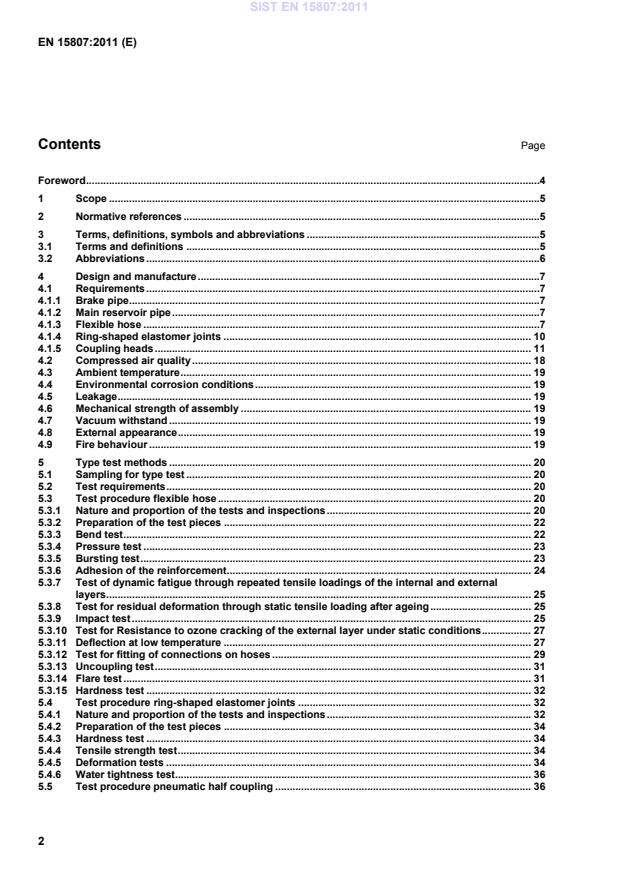
Vacuum withstand . 42Annex B (informative)
MRP pneumatic half coupling for emergency coupling hoses . 43B.1 General . 43B.2 Coupling head . 43B.3 Identification . 43Annex C (informative)
In-service trial . 45C.1 General . 45C.2 Test set-up and sampling . 45C.3 Procedure . 45C.4 Pass/fail criteria . 45Annex ZA (informative)
Relationship between this European Standard and the Essential Requirements of EU Directive 2008/57/EC . 46Bibliography . 50 SIST EN 15807:2011
(ISO 8033:2006) EN ISO 9227, Corrosion tests in artificial atmospheres — Salt spray tests (ISO 9227:2006) ISO 37:2005, Rubber, vulcanized or thermoplastic — Determination of tensile stress-strain properties ISO 48:2007, Rubber, vulcanized or thermoplastic — Determination of hardness (hardness between 10 IRHD and 100 IRHD) ISO 188, Rubber, vulcanized or thermoplastic — Accelerated ageing and heat resistance tests ISO 815, Rubber, vulcanized or thermoplastic — Determination of compression set at ambient, elevated or low temperatures ISO 1431-1, Rubber, vulcanized or thermoplastic — Resistance to ozone cracking — Part 1: Static and dynamic strain testing ISO 1431-3, Rubber, vulcanized or thermoplastic — Resistance to ozone cracking — Part 3: Reference and alternative methods for determining the ozone concentration in laboratory test chambers ISO 2285, Rubber, vulcanized or thermoplastic — Determination of tension set under constant elongation, and of tension set, elongation and creep under constant tensile load ISO 8573-1:2010, Compressed air — Part 1: Contaminants and purity classes ISO 23529:2004, Rubber — General procedures for preparing and conditioning test pieces for physical test methods 3 Terms, definitions, symbols and abbreviations 3.1 Terms and definitions For the purposes of this document, the terms and definitions given in EN 14478:2005 and the following apply. SIST EN 15807:2011
3.1.2.1 brake coupling head components that when mechanically coupled together allow a flow of pressurised air between them 3.1.2.2 nipple component at one end of the pneumatic half coupling that connects it to the end cock, or pipe, located on the vehicle 3.1.2.3 hose clip component that mechanically fixes the hose to the coupling head or the nipple in order to assembly the pneumatic half coupling 3.1.2.4 sealing washer component that is installed in the coupling head to prevent unacceptable loss of air when two coupling heads are connected to one another 3.1.2.5 flexible hose and constituents 3.1.2.5.1 flexible hose component that is connected between the brake coupling head and the nipple to convey the pressurised air and give the required flexibility between vehicles, and that is generally made up of a elastomeric tube, textile reinforcement and a elastomeric covering bonded together 3.1.2.5.2 tube interior layer of the flexible hose 3.1.2.5.3 reinforcement intermediate layer that provides the strength to maintain the general shape of the hose whilst giving the flexibility 3.1.2.5.4 covering external layer of the flexible hose which protects the interior constituents from mechanical and environmental damage 3.1.3 bar 1 bar = 105 N/m2 = 105 Pa = 10-1 MPa 3.2 Abbreviations BP Brake Pipe MRP Main Reservoir Pipe SIST EN 15807:2011
4 times the external nominal diameter of the hose, without using a force greater than 130 N for this operation, without folds appearing on the peripheral surface and without the maximum flattening recorded amounting to more than 16 % of the nominal external diameter of the hose. This requirement shall be tested in accordance with 5.3.3. 4.1.3.3 Pressure test After being subjected to an internal pressure of 13 bar for a period of 5 min, there shall be no apparent leak, swelling, or tear on the hose. The dimensional variations admitted under pressure conditions shall be as follows: variation in external diameter
± 10 %; variation in length
≤ 3,5 %; twist ≤ 20 °/m. In addition, after discontinuation of the test pressure, no permanent deformation of the hose shall be apparent, after a waiting period of 3 min. This requirement shall be tested in accordance with 5.3.4. 4.1.3.4 Bursting pressure The bursting pressure, measured on the hose in delivery condition, shall not be less than 70 bar. This requirement shall be tested in accordance with 5.3.5. 4.1.3.5 Adhesion of the reinforcement The mean value of the force needed to separate the reinforcement and each of the layers shall not be less than: 70 N for hoses tested in accordance with EN ISO 8033:2006, type 1 in delivery condition, and 87 N for hoses tested in accordance with EN ISO 8033:2006, type 2 in delivery condition; 55 N for hoses tested in accordance with EN ISO 8033:2006, type 1 after ageing for 7 days at 70 °C, and 75 N for hoses tested in accordance with EN ISO 8033:2006, type 2 after ageing for 7 days at 70 °C. This requirement shall be tested in accordance with 5.3.6. NOTE if the methods from EN ISO 8033:2006, types 1 or 2 are not appropriate to a specific design of half coupling another method from EN ISO 8033 can be used. The criteria of acceptance shall be defined before the test on a case-by-case basis. 4.1.3.6 Resistance of the internal and external layers of the hose to repeated tensile loads The internal and external layers of the hose, when subjected to successive repeated tensile loads, shall withstand, in accordance with the conditions defined in 5.3.7: 400 tensile loadings for hoses tested in delivery condition; 350 tensile loadings for hoses tested after ageing for 7 days at 70 °C. SIST EN 15807:2011
20 N at – 30 °C, shall not be less than 20 mm. This requirement shall be tested in accordance with 5.3.11. 4.1.3.11 Ease of assembly of connections on the hoses It shall be possible for the connections to be easily mounted on the hoses under the conditions stipulated in 5.3.11, so that the end of the hose makes clean contact with the shoulder of the connection. The centre lines of the hose and connection shall be in alignment after assembly. This requirement shall be tested in accordance with 5.3.12. 4.1.3.12 Resistance to uncoupling of connections on the hoses Uncoupling of the connection of the hose to the end fittings shall not occur when the pressure is less than
20 bar when the hose has been inserted as prescribed in 4.1.3.11 and the hose clamp has been tightened using the minimum force prescribed in the assembly instructions for the pneumatic half coupling. This requirement shall be tested in accordance with 5.3.13. 4.1.3.13 Flare test After the test provided for in 5.3.14, the linings and layers shall neither tear nor become detached. The inspection shall cover the visible outer surfaces and it shall be performed with the naked eye. Moreover, the residual widening shall not exceed 2 % after a period of rest. This requirement shall be tested in accordance with 5.3.14. SIST EN 15807:2011
Figure 1 — Brake pipe pneumatic half coupling SIST EN 15807:2011
Key 1 alternative view in direction of arrow B 2 part view in direction of arrow C 3 part view in direction of arrow B 4 alternative view in direction of arrow C 5 alternative form for end nipple of coupling head A) mandatory dimension Figure 2 — Brake pipe coupling head SIST EN 15807:2011
Key 1 bevelled edge
NOTE All dimensions are mandatory. Figure 3 — Sealing washer Dimensions in millimetres
NOTE All dimensions are mandatory. Figure 4 — Sealing washer SIST EN 15807:2011
Figure 5 — Main reservoir pipe pneumatic half coupling SIST EN 15807:2011
Key 1 alternative view in direction of arrow B 2 part view in direction of arrow C 3 part view in direction of arrow B 4 alternative view in direction of arrow C 5 alternative form for end nipple of coupling head A) mandatory dimension Figure 6 — Main reservoir pipe coupling head SIST EN 15807:2011
Figure 7 — Main reservoir pipe pneumatic half coupling with valve Dimensions in millimetres
Figure 8 (to be continued) SIST EN 15807:2011
Key 1 preferred arrangement 2 alternative arrangement B bore of hose C outer diameter of hose D wall thickness of hose E textile reinforcement F1 inner rubber lining F2 outer rubber covering G area of hose where the identification marking is to be located L length of hose Figure 9 Flexible hose 4.2 Compressed air quality It shall be possible to operate the pneumatic half coupling without restrictions with at least the compressed air quality according to the following classes defined by ISO 8573-1:2010: class 4 – for the maximum particle size and the maximum concentration of solid contaminants; class 4– for the water dewpoint; SIST EN 15807:2011
EN 50125-1:1999. The pneumatic half coupling may be tested in accordance with 5.5.5. NOTE This test is not normally carried out and is only conducted when required by the customer. 4.5 Leakage The sealing arrangement with the pneumatic half coupling assembly shall prevent any significant loss of air dependent on the temperature. Between – 25 °C and + 70 °C the pneumatic half coupling shall not leak at a greater rate than 0,030 Nl/min when tested at a pressure of 10 bar. This requirement shall be tested in accordance with 5.5.4.3. Between – 40 °C and – 25 °C a pair of pneumatic half couplings shall have a leakage rate of not greater than 0,2 l/min when tested at a pressure of 10 bar in accordance with 5.5.4.3. 4.6 Mechanical strength of assembly The pneumatic half coupling shall withstand an overpressure of 15 bar for 15 min, and 40 bar for 15 s without detachment of the hose from the coupling head or the nipple, or leakage. This requirement shall be tested in accordance with 5.5.3. The pneumatic half coupling shall withstand a pull test when the coupling head is screwed on to a fixture and the nipple is pulled with a force of 5 kN for 30 s. The hose shall not move on the nipple or coupling head, the hose shall not suffer damage and there shall be no leakage greater than 0,030 Nl/min. This requirement shall be tested in accordance with 5.5.6. 4.7 Vacuum withstand This is not a standard European requirement and is referenced for information in Annex A. 4.8 External appearance The external surfaces of the pneumatic half coupling shall be free of sharp edges that could be a danger to those persons handling the pneumatic half coupling or to other equipment in the proximity of the pneumatic half coupling. This requirement shall be checked while testing the other constructional features in accordance with 5.5.2. 4.9 Fire behaviour The materials used in the manufacture of the pneumatic half coupling shall prevent the emission of fumes or gases, or minimise where the materials to give compliance with this standard do not allow prevention, which are harmful and dangerous to the environment, particularly in the event of fire. The pneumatic half coupling shall limit fire ignition, propagation and the production of smoke in the event of fire on primary ignition from a source of 7 kW for 3 min. SIST EN 15807:2011
4-4-4 specified in ISO 8573-1:2010. The tests marked with a « * » in Table 3 in 5.5.1 shall be performed additionally at TX specified in EN 50125-1, with the upper temperature limit of 70 °C and at a wider temperature range if otherwise agreed between customer and supplier (pass/fail criteria for this case shall be agreed between customer and supplier). The tests on non-elastomeric composite hoses shall be carried out on three hoses from the sample before their assembly into the pneumatic half coupling. The tests marked with a « ++ » in Table1 in 5.3.1 and Table 3 in 5.5.1 are not mandatory and are only performed if required. The pneumatic half coupling satisfies this European Standard provided it passes all the type tests 5.3.3 to 5.3.13, 5.4.3 to 5.4.6, 5.5.2, 5.5.3, 5.5.4.1 and 5.5.6. 5.3 Test procedure flexible hose 5.3.1 Nature and proportion of the tests and inspections The hoses shall be subjected to the tests and inspections indicated in Table 1 as shown below. The batch size that the samples are taken from is unlimited, provided measures shall be taken to provide identical material for the whole batch. SIST EN 15807:2011
- in submission condition
Test pieces: hose section 35 mm to 40 mm in length - after ageing
3 Test for dynamic fatigue through repeated tensile loadings: 5.3.7
- in submission condition
3 per external layer 3 per internal layer
Dumb-bell shaped test pieces removed from hoses used for the bursting test, in accordance with 5.3.2. - after ageing
3 per external layer 3 per internal layer Test for residual deformation through static tensile loading after ageing
5.3.8 3 Dumb-bell shaped test pieces removed, in accordance with 5.3.2, from hoses used for the bursting test Impact test 5.3.9 3 The hose itself Test for resistance to ozone cracking of the external layer under static conditions 5.3.10 3 Dumb-bell shaped test pieces removed from hoses used for the bursting test, in accordance with 5.3.2 Deformation test at low temperature 5.3.11 3 The hose itself Connection assembly test
5.3.12 5.3.13 3 The hose itself Flare test (++) 5.3.14 3 The hose itself
Figure 10 — H2 ISO/37 test piece 5.3.3 Bend test The bend test shall be carried out by means of two handles and a disc as shown in Figure 11. The disc shall contain a small A-shaped opening for insertion of the recording instrument in order to determine the flattening of the hose during bending. The bending force is measured at the ends of the hose. The length of the hose is 620 mm. SIST EN 15807:2011
Key A shaped opening for measuring diameter = 30 ± 2 mm B hose for testing C diameter 180 mm, approximately 4 times the external nominal diameter of the hose D disc thickness 30 mm E handles F length of the hose (calculated from the external nominal diameter of the hose) G length of fixing piece = 70 mm J application of bending force Figure 11 — Example of assembly for the bend test The result shall be consistent with those stipulated in 4.1.3.2. 5.3.4 Pressure test The hose shall be fitted at one of its ends with a cap and at the other with a connection suitably clamped in order to permit the application of an internal hydraulic or air pressure of 13 bar for a period of 55,00+ min. The end fitted with a cap shall be left free to follow the deformation of the hose. The result shall be consistent with those stipulated in 4.1.3.3. 5.3.5 Bursting test The hose which has undergone the pressure test is then subjected to an internal hydraulic pressure increased gradually by (10 ± 1) bar per min, until bursting occurs. SIST EN 15807:2011
Figure 12 Ring shaped test piece The wrappers and reinforcement are separated by means of a dynamometer, in accordance with the provisions in EN ISO 8033, and the tearing force necessary is recorded. b) Test pieces in strips. A length of 160 mm of the hose section is slit in half longitudinally. In the centre part of the test piece parallel to the axis, two cuts 25 mm ± 0,5 mm wide are made in the test piece surface without damaging the reinforcement. Detachment of the centre strip is begun, leaving the two marginal areas intact on either side of this strip. This is shown in Figure 13. Dimensions in millimetres
Figure 13 Strip test piece SIST EN 15807:2011
0,1 mm, by means of a magnifying micrometer with a minimum magnifying power of 7 X. The residual deformation through static tensile loading of the internal layer shall be calculated using the following formula: 100 X (L - L0) / L0. The result shall be consistent with those stipulated in 4.1.3.7. 5.3.9 Impact test The test shall be carried out with the device shown in Figure 14. A mass of 10 kg ± 0,1 kg, retained in the inoperative position by a pin is released and falls freely from a height of 1 m ± 0,001 m in a guiding tube. The tube, in which the end piece shown in Figure 15 has been inserted beforehand, is placed on a V-shaped block, so that the weight falls on the distended portion caused by the thickened ring on the end piece. SIST EN 15807:2011
Key h height of free fall of mass m falling mass
Figure 14 — Example of test rig for the impact test SIST EN 15807:2011
General tolerance ± 0,1 Material: case – hardened steel to 68 Rockwell “A” Figure 15 — Example of end-piece for the impact test 5.3.10 Test for Resistance to ozone cracking of the external layer under static conditions The test shall be carried out in accordance with the provisions of ISO 1431-1 and ISO 1431-3. The test piece taken from the external layer of the hose used for the bursting test, in accordance with Figure
10 and subjected to an elongation of 20 %, shall be placed for 2402− h, in a chamber where the ozone concentration is (200 ± 20) part
...