

prEN 18171
(Main)Railway applications – Rolling stock vehicles – Digital automatic coupler for freight traffic — Performance requirements, specific interface geometry and test method
- Abstract
This document specifies the requirements for the digital automatic coupler (DAC) for freight wagons and freight locomotives. Other vehicles to be coupled in normal service with freight wagons or freight locomotives also have to be compliant with this document.
This document specifies the minimum interface requirements to allow automatic coupling (mechanical and pneumatic) of two digital automatic couplers. This document further specifies the mechanical interfaces needed for the interoperability of electrical couplers; it does not cover the electrical contacts needed. The digital and electric components are covered in EN 50746 and EN 50747 series.
This document covers the requirements for DACs integrated into locomotives.
- Status
- Not Published
- Publication Date
- 10-Oct-2027
- Technical Committee
- CEN/TC 256 - Railway applications
- Drafting Committee
- CEN/TC 256/WG 33 - Coupling devices
- Current Stage
- 4060 - Closure of enquiry - Enquiry
- Start Date
- 19-Jun-2025
- Due Date
- 22-Nov-2024
- Completion Date
- 19-Jun-2025

Overview
The European Standard prEN 18171:2025, titled "Railway applications - Railway Rolling stock - Digital Freight Automatic Coupler - Performance requirements specific interface geometry and test method", establishes comprehensive performance requirements for the Digital Automatic Coupler (DAC) used in freight railway rolling stock. Developed by CEN/TC 256 and aligned with EU legislation including Commission Regulation (EU) No 321/2013 and EU regulation 2019/776, the standard defines essential specifications for mechanical, pneumatic, and partial electrical interface geometries to ensure safe, efficient, and interoperable automatic coupling between freight wagons.
This draft standard specifically addresses the interface geometry and test methods for DAC systems integrated into freight wagons and locomotives, including hybrid coupler solutions. It supports the EU’s goal of enhancing railway interoperability and automating freight handling operations throughout the European Union.
Key Topics
Interface Geometry
The standard specifies strict geometric requirements for the mechanical interface of DACs to guarantee compatibility between different couplers and rolling stock. This includes the shape, size, and positioning parameters of the coupler heads ensuring reliable automatic coupling and uncoupling.Performance Requirements
Detailed criteria cover coupling conditions such as mechanical coupling positions, uncoupling procedures, prevention of unintended coupling, and the behavior of pneumatic systems associated with the coupler.Mechanical and Pneumatic Interfaces
Mechanical coupling and uncoupling functions are rigorously defined. Pneumatic interfaces are specified to align hose and valve connections effectively, ensuring seamless integration with existing freight wagon systems.Electrical Coupler Compatibility
While the standard focuses on mechanical and pneumatic interfaces, it references coordination with CENELEC/TC9X/WG 15-10 for digital and electrical requirements, underscoring the modularity and extensibility of the DAC system.Hybrid Couplers
The standard accommodates hybrid coupler technologies merging DAC functionality with traditional screw coupler systems to enhance transition capabilities.Testing Methods
It prescribes comprehensive testing protocols including routine tests, type validation, mechanical strength assessments, endurance testing, and environmental condition evaluations to certify coupler performance and durability.
Applications
Freight Wagons in EU Rail Networks
Implementing DACs compliant with prEN 18171 facilitates faster, safer, and automatic coupling operations, reducing manual labor risks and turnaround times.Locomotive Integration
The standard includes provisions for DACs installed on locomotives, promoting system-wide interoperability within freight operations.Hybrid Coupler Solutions
Designed to ensure seamless compatibility between DACs and conventional coupling systems, supporting a gradual migration towards full DAC adoption without disrupting existing rolling stock.Rail System Interoperability
Supports the EU’s strategic interoperability regulation goals by harmonizing coupling interfaces across different member states, enabling cross-border freight transport without compatibility issues.Maintenance and Safety Protocols
Precise design and test methods enable predictable maintenance schedules and enhance operational safety by ensuring coupler reliability under various operational stressors.
Related Standards
Commission Regulation (EU) No 321/2013
Technical specifications relating to rolling stock – freight wagons subsystem, forming the legal basis for DAC technical design.Commission Regulation (EU) No 1302/2014
Interoperability specifications relating to locomotives and passenger rolling stock providing complementary requirements for rolling stock interfaces.CENELEC/TC9X/WG 15-10
Defines electrical and digital interface requirements for DAC systems, ensuring full communication capabilities between coupled units.UIC Leaflets
Legacy international standards influencing the geometric and operational requirements of coupler components such as draft gears and pivot points.
Conclusion
prEN 18171:2025 is a critical standard for railway manufacturers, operators, and regulators targeting modernized freight rolling stock coupling systems. By specifying digital automatic couplers’ interface geometry, performance, and testing methods, it ensures interoperable, safe, and efficient freight operations aligned with European Union rail policy objectives. This standard supports the advancement of railway automation and cross-border freight transport within the European rail system, driving modernization and sustainability in freight logistics.
Get Certified
Connect with accredited certification bodies for this standard

IRIS Certification (UNIFE)
International Railway Industry Standard certification.

TÜV SÜD Rail GmbH
TÜV SÜD railway certification services.

Bureau Veritas Railway Certification
Railway and transportation certification.
Sponsored listings
Frequently Asked Questions
prEN 18171 is a draft published by the European Committee for Standardization (CEN). Its full title is "Railway applications – Rolling stock vehicles – Digital automatic coupler for freight traffic — Performance requirements, specific interface geometry and test method". This standard covers: This document specifies the requirements for the digital automatic coupler (DAC) for freight wagons and freight locomotives. Other vehicles to be coupled in normal service with freight wagons or freight locomotives also have to be compliant with this document. This document specifies the minimum interface requirements to allow automatic coupling (mechanical and pneumatic) of two digital automatic couplers. This document further specifies the mechanical interfaces needed for the interoperability of electrical couplers; it does not cover the electrical contacts needed. The digital and electric components are covered in EN 50746 and EN 50747 series. This document covers the requirements for DACs integrated into locomotives.
This document specifies the requirements for the digital automatic coupler (DAC) for freight wagons and freight locomotives. Other vehicles to be coupled in normal service with freight wagons or freight locomotives also have to be compliant with this document. This document specifies the minimum interface requirements to allow automatic coupling (mechanical and pneumatic) of two digital automatic couplers. This document further specifies the mechanical interfaces needed for the interoperability of electrical couplers; it does not cover the electrical contacts needed. The digital and electric components are covered in EN 50746 and EN 50747 series. This document covers the requirements for DACs integrated into locomotives.
prEN 18171 is classified under the following ICS (International Classification for Standards) categories: 45.040 - Materials and components for railway engineering; 45.060.01 - Railway rolling stock in general. The ICS classification helps identify the subject area and facilitates finding related standards.
prEN 18171 is associated with the following European legislation: EU Directives/Regulations: 2016/797/EU, 2016/797/EU, 2016/797/EU, 2016/797/EU, 2016/797/EU, 2016/797/EU, 2016/797/EU, 2016/797/EU, 2016/797/EU, 2016/797/EU, 2016/797/EU, 2016/797/EU; Standardization Mandates: M/483, M/591. When a standard is cited in the Official Journal of the European Union, products manufactured in conformity with it benefit from a presumption of conformity with the essential requirements of the corresponding EU directive or regulation.
prEN 18171 is available in PDF format for immediate download after purchase. The document can be added to your cart and obtained through the secure checkout process. Digital delivery ensures instant access to the complete standard document.
Standards Content (Sample)
SLOVENSKI STANDARD
01-maj-2025
Železniške naprave - Železniška vozila - Digitalna tovorna avtomatska spenjača -
Zahteve za izdelavo posebne geometrije vmesnika in preskusna metoda
Railway applications - Railway Rolling stock - Digital Freight Automatic Coupler -
Performance requirements specific interface geometry and test method
Bahnanwendungen - Schienenfahrzeuge - Digitale automatische Kupplung für
Güterwagen - Spezifische Schnittstellengeometrie und Prüfverfahren
Applications ferroviaires - Matériel roulant ferroviaire - Coupleur automatique numérique
pour le fret - Exigences de performance, géométrie spécifique de l'interface et méthode
d'essai
Ta slovenski standard je istoveten z: prEN 18171
ICS:
45.040 Materiali in deli za železniško Materials and components
tehniko for railway engineering
45.060.01 Železniška vozila na splošno Railway rolling stock in
general
2003-01.Slovenski inštitut za standardizacijo. Razmnoževanje celote ali delov tega standarda ni dovoljeno.
DRAFT
EUROPEAN STANDARD
NORME EUROPÉENNE
EUROPÄISCHE NORM
March 2025
ICS 45.060.01
English Version
Railway applications - Railway Rolling stock - Digital
Freight Automatic Coupler - Performance requirements
specific interface geometry and test method
Applications ferroviaires - Matériel roulant ferroviaire Bahnanwendungen - Schienenfahrzeuge - Digitale
- Coupleur automatique numérique pour le fret - automatische Kupplung für Güterwagen - Spezifische
Exigences de performance, géométrie spécifique de Schnittstellengeometrie und Prüfverfahren
l'interface et méthode d'essai
This draft European Standard is submitted to CEN members for enquiry. It has been drawn up by the Technical Committee
CEN/TC 256.
If this draft becomes a European Standard, CEN members are bound to comply with the CEN/CENELEC Internal Regulations
which stipulate the conditions for giving this European Standard the status of a national standard without any alteration.
This draft European Standard was established by CEN in three official versions (English, French, German). A version in any other
language made by translation under the responsibility of a CEN member into its own language and notified to the CEN-CENELEC
Management Centre has the same status as the official versions.
CEN members are the national standards bodies of Austria, Belgium, Bulgaria, Croatia, Cyprus, Czech Republic, Denmark, Estonia,
Finland, France, Germany, Greece, Hungary, Iceland, Ireland, Italy, Latvia, Lithuania, Luxembourg, Malta, Netherlands, Norway,
Poland, Portugal, Republic of North Macedonia, Romania, Serbia, Slovakia, Slovenia, Spain, Sweden, Switzerland, Türkiye and
United Kingdom.
Recipients of this draft are invited to submit, with their comments, notification of any relevant patent rights of which they are
aware and to provide supporting documentation.
Warning : This document is not a European Standard. It is distributed for review and comments. It is subject to change without
notice and shall not be referred to as a European Standard.
EUROPEAN COMMITTEE FOR STANDARDIZATION
COMITÉ EUROPÉEN DE NORMALISATION
EUROPÄISCHES KOMITEE FÜR NORMUNG
CEN-CENELEC Management Centre: Rue de la Science 23, B-1040 Brussels
© 2025 CEN All rights of exploitation in any form and by any means reserved Ref. No. prEN 18171:2025 E
worldwide for CEN national Members.
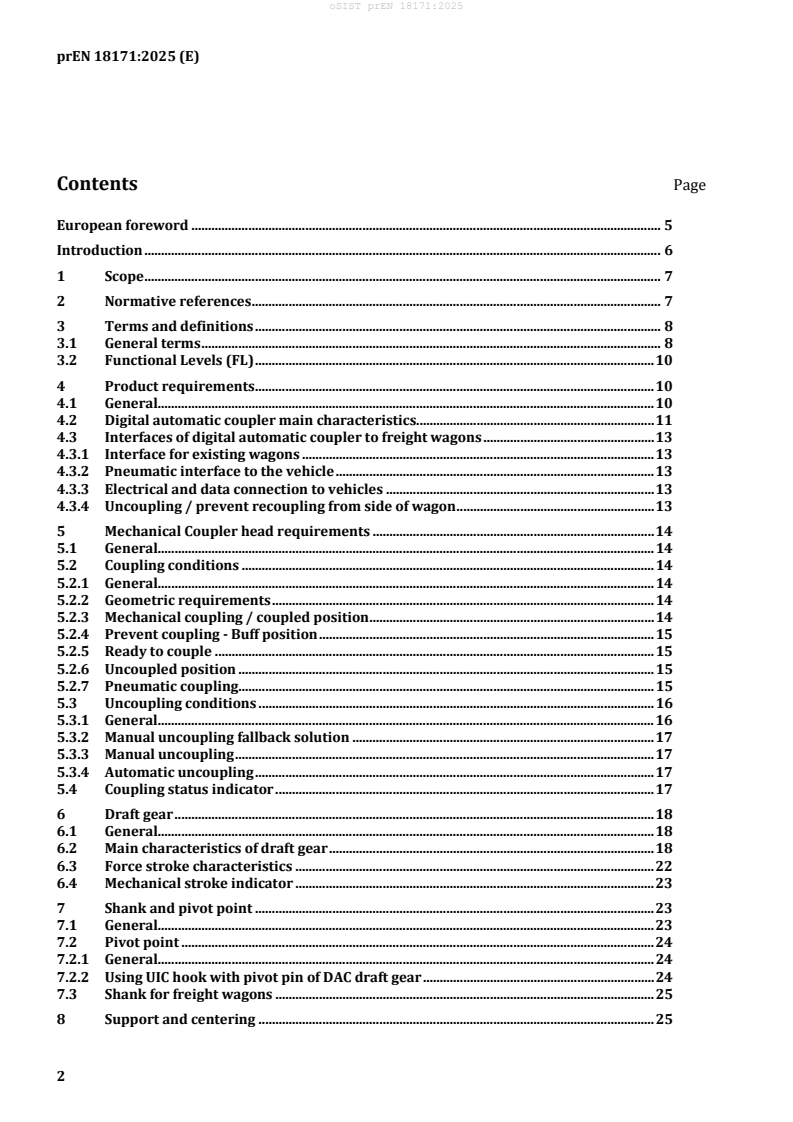
Contents Page
European foreword . 5
Introduction . 6
1 Scope . 7
2 Normative references . 7
3 Terms and definitions . 8
3.1 General terms . 8
3.2 Functional Levels (FL) . 10
4 Product requirements . 10
4.1 General. 10
4.2 Digital automatic coupler main characteristics. 11
4.3 Interfaces of digital automatic coupler to freight wagons . 13
4.3.1 Interface for existing wagons . 13
4.3.2 Pneumatic interface to the vehicle . 13
4.3.3 Electrical and data connection to vehicles . 13
4.3.4 Uncoupling / prevent recoupling from side of wagon . 13
5 Mechanical Coupler head requirements . 14
5.1 General. 14
5.2 Coupling conditions . 14
5.2.1 General. 14
5.2.2 Geometric requirements . 14
5.2.3 Mechanical coupling / coupled position . 14
5.2.4 Prevent coupling - Buff position . 15
5.2.5 Ready to couple . 15
5.2.6 Uncoupled position . 15
5.2.7 Pneumatic coupling. 15
5.3 Uncoupling conditions . 16
5.3.1 General. 16
5.3.2 Manual uncoupling fallback solution . 17
5.3.3 Manual uncoupling . 17
5.3.4 Automatic uncoupling . 17
5.4 Coupling status indicator . 17
6 Draft gear . 18
6.1 General. 18
6.2 Main characteristics of draft gear . 18
6.3 Force stroke characteristics . 22
6.4 Mechanical stroke indicator . 23
7 Shank and pivot point . 23
7.1 General. 23
7.2 Pivot point . 24
7.2.1 General. 24
7.2.2 Using UIC hook with pivot pin of DAC draft gear . 24
7.3 Shank for freight wagons . 25
8 Support and centering . 25
9 Electrical coupler . 25
10 Hybrid coupler Digital Automatic Coupler – Screw coupler . 26
10.1 General . 26
10.2 DAC mode . 26
10.3 Screw coupler system mode . 27
11 Test methods . 27
11.1 Routine testing . 27
11.2 Type test . 28
11.2.1 General . 28
11.2.2 Mechanical head and gathering range . 28
11.2.3 Manual uncoupling system. 28
11.2.4 Test of uncoupling under different temperature conditions . 28
11.2.5 DAC level 5 Actuator device . 29
11.2.6 Prevent coupling test . 29
11.3 BP valve and hose connection – Measurement of the pressure fall time . 29
11.4 Electrical coupler testing . 29
11.5 Strength test . 29
11.5.1 General . 29
11.5.2 Test principle . 29
11.5.3 Test procedure for static yield-strength test . 30
11.5.4 Tension load . 31
11.5.5 Compression load . 31
11.5.6 Test principle . 31
11.5.7 Fatigue test . 32
11.5.8 Nominal breaking force . 33
11.5.9 Vertical strength test . 33
11.6 Static test of draft gear elastic element characteristic . 34
11.7 Endurance test . 35
11.8 Test on track / Vehicle . 35
11.8.1 General . 35
11.8.2 Installation on wagon . 35
11.8.3 Operations . 35
11.8.4 Interoperability test . 35
11.8.5 Dynamic test of spring characteristic. 35
11.8.6 Propelling Test . 35
11.8.7 Examination of running safety under longitudinal compressive forces by driving tests
in curves . 36
Annex A (informative) Electrical coupler . 37
Annex B (informative) Example of manual uncoupling handle from the side of the wagon 41
Annex C (informative) Support and centering . 42
Annex D (informative) Mechanical stroke indicator . 43
Annex E (informative) Test bench test for longitudinal compressive forces . 44
Annex F (normative) Endurance testing under service load for elastic system . 49
F.1 Aim of the test . 49
F.2 Test principle . 49
F.3 Test results to be obtained . 49
Annex G (informative) Gathering range . 50
Annex H (informative) Electrical Coupler (as defined at the state of Enquiry) . 51
H.1 For information . 51
H.2 Electrical Coupler General . 51
H.3 Additional requirements for explosion protection . 53
H.3.1 insulating materials . 53
H.3.2 Avoidance of hot surfaces and uncontrollable surface overheating . 53
Annex ZA (informative) Relationship between this European Standard and the Essential
Requirements of EU Directive (EU) 2016/797 aimed to be covered . 54
Bibliography . 57
European foreword
This document (prEN 18171:2025) has been prepared by Technical Committee CEN/TC 256 “Railway
applications”, the secretariat of which is held by DIN.
This document is currently submitted to the CEN Enquiry.
This document has been prepared under a standardization request addressed to CEN by the European
Commission. The Standing Committee of the EFTA States subsequently approves these requests for its
Member States.
For the relationship with EU Legislation, see informative Annex ZA, which is an integral part of this
document.
This standardization request is based on the Technical Specification relating to the subsystem ‘rolling
stock — freight wagons’ of the rail system in the European Union Commission Regulation (EU) No
321/2013 of 13 March 2013 and repealing Decision 2006/861/EC and EU regulation 2019/776.
Introduction
This document is presented to the public with the intention of obtaining validated knowledge and data
during the CEN enquiry. With the knowledge gained, among other things, Annex H will be moved to
Section 9 and a second CEN enquiry is planned.
1 Scope
This document specifies the requirements for the digital automatic coupler (DAC) for freight compliant
with the Technical Specification relating to the subsystem ‘rolling stock — freight wagons’ of the rail
system in the European Union Commission Regulation (EU) No 321/2013 of 13 March 2013 and
repealing Decision 2006/861/EC and EU regulation 2019/776.
This document specifies the minimum interface requirements to allow automatic coupling (mechanical
and pneumatic) of two digital automatic couplers. This document further specifies the mechanical
interfaces needed for the interoperability of electrical couplers, it does not cover the electrical contacts
needed.
This document covers the requirements for DACs integrated into locomotives.
2 Normative references
The following documents are referred to in the text in such a way that some or all of their content
constitutes requirements of this document. For dated references, only the edition cited applies. For
undated references, the latest edition of the referenced document (including any amendments) applies.
EN 1005-3:2002+A1:2008, Safety of machinery — Human physical performance — Part 3: Recommended
force limits for machinery operation
EN 10204:2004, Metallic products - Types of inspection documents
EN 10228-1:2016, Non-destructive testing of steel forgings - Part 1: Magnetic particle inspection
EN 10228-2:2016, Non-destructive testing of steel forgings - Part 2: Penetrant testing
EN 12663-2:2024, Railway applications — Structural requirements of railway vehicle bodies — Part 2:
Freight wagons
prEN 14198:2023, Railway applications — Braking — Requirements for the brake system of trains hauled
by locomotives
EN 14601:2024, Railway applications — Straight and angled end cocks for brake pipe and main reservoir
pipe
EN 15227:2020+A1:2024, Railway applications — Crashworthiness requirements for rail vehicles
EN 15085-1:2023, Railway applications - Welding of railway vehicles and components - Part 1: General
EN 15085-2:2020+A1:2023, Railway applications — Welding of railway vehicles and components — Part
2: Requirements for welding manufacturer
EN 15085-3:2022+A1:2023, Railway applications — Welding of railway vehicles and components — Part
3: Design requirements
EN 15085-4:2023, Railway applications - Welding of railway vehicles and components - Part 4: Production
requirements
EN 15085-5:2023, Railway applications - Welding of railway vehicles and components - Part 5: Inspection,
testing and documentation
EN 15551:2022, Railway applications - Railway rolling stock - Buffers
EN 15566:2022, Railway applications - Railway Rolling stock - Draw gear and screw coupling
EN 15839:2024, Railway applications - Testing and simulation for the acceptance of running characteristics
of railway vehicles - Running safety under longitudinal compressive force
EN 16019:2014, Railway applications - Automatic coupler - Performance requirements, specific interface
geometry and test method
EN 16839:2022, Railway applications - Rolling stock - Head stock layout
EN 17976:2024, Railway applications - Bolting of rail vehicles and components
EN 50125-1:2014, Railway applications — Environmental conditions for equipment — Part 1: Rolling stock
and on-board equipment
EN 50124-1:2017, Railway applications — Insulation coordination — Part 1: Basic requirements -
Clearances and creepage distances for all electrical and electronic equipment
EN 60529:1991, Degrees of protection provided by enclosures (IPCode) (IEC 60529:1989/A2:2013/
COR1:2019)
EN ISO 228-1:2003, Pipe threads where pressure-tight joints are not made on the threads — Part 1:
Dimensions, tolerances and designation (ISO 228-1:2003)
3 Terms and definitions
For the purposes of this document, the following terms and definitions apply.
ISO and IEC maintain terminological databases for use in standardization at the following addresses:
— ISO Online browsing platform: available at https://www.iso.org/obp/
— IEC Electropedia: available at https://www.electropedia.org/
3.1 General terms
3.1.1
Digital Automatic Coupler
DAC
central buffer end coupling system for freight applications that couples automatically
Note 1 to entry: The degree of automation is defined in functional levels 1 to 5 see 3.2.
Note 2 to entry: The requirements described in this standard are valid for digital automatic couplers for use in
freight trains. For digital automatic couplers for use in passenger trains there exist different or additional
requirements.
Note 3 to entry: The mechanical housing for the electrical coupler will be covered in this standard.
Document impacted by EN 60529:2019/A1:2000, /A2:2013 and /AC:2019.
3.1.2
electrical coupler
system that is used for connecting or disconnecting the electrical lines automatically which transfer
control signals or power supply / current from one railway vehicle to another within a train
Note 1 to entry: If relevant the Electrical coupler will also house data connections and lines. The electrical
components of the electrical coupler are defined in prEN 50746 and prEN 50747.
Note 2 to entry: For clarity, the mechanical interfaces but not the transmission conduits (pins) and their
configuration of the electrical coupler are covered in this standard.
3.1.3
horizontal and vertical support
system that moves or aids - in the uncoupled condition - the complete coupler back into the central
position after being deflected
3.1.4
split collar
fastening element consisting of two metal half-shells that are joined by fasteners
Note 1 to entry this is not a standardized interface covered by this standard.
3.1.5
draft gear
element of the coupler that can transfer compressive and tensile forces into freight wagon or locomotive
Note 1 to entry the draft gear can handle regenerative and non-regenerative energy
3.1.6
crash element
non-regenerative energy absorption devices that absorb energy in the event of a collision
Note 1 to entry These devices are used to protect the main structure of the wagon, load or other rail device it is
attached to. These elements may be sacrificial.
3.1.7
coupler shank
connection between the coupler head and the draft gear
3.1.8
pivot pin
pin used to connect the coupler shank to the draft gear
3.1.9
manual uncoupling mechanism
device which provides manual rotation of the locking mechanism from the coupled position in to the
ready to couple position
Note 1 to entry It can be a lever, handle, rope or other tool which is connected to the coupling mechanism and is
pulled until the ready to couple position is attained.
3.1.10
uncoupling actuator
device which provides automatic rotation of the locking mechanism from the coupled position in to the
ready to couple position
3.1.11
prevent coupling
state when the mechanical mechanism of the coupler is retained in an uncoupled state preventing
coupling of the couplers even if two couplers are put in contact (buffed) with each other – which normally
would result in coupling
Note 1 to entry this enables buffing in hump and yard operations.
3.1.12
Berne or Berner rectangle
area between the vehicles ends defined in EN 16839:2022, 3.1 and 4.2
3.2 Functional Levels (FL)
3.2.1
functional level 1
FL1
automated coupling of the mechanical connection; manual uncoupling possible
3.2.2
functional level 2
FL2
FL 1 plus automatic coupling of air pipe(s)
3.2.3
functional level 3
FL3
FL 2 plus automatic coupling of electrical power line(s)
3.2.4
functional level 4
FL4
FL 3 plus automatic coupling of data line(s)
3.2.5
functional level 5
FL5
FL 4 plus full automated uncoupling
Note 1 to entry The full automated can be by means of remote access
4 Product requirements
4.1 General
This document specifies the product requirements of a digital freight automatic coupler intended to be
equipped into freight wagons and locomotives.
For the components of the digital freight automatic coupler which transfer forces in the draw and buff
line (for example coupler head, shank, pin and draft gear) the:
— inspection documents of materials used for the manufacture shall be according to 3.1 or 3.2 in
EN 10204:2004,
— bolted connections shall be in accordance to EN 17976:2024,
— welded parts shall be in accordance with EN 15085-1:2023, EN 15085-2:2020+A1:2023,
EN 15085-3:2022+A1:2023, EN 15085-4:2023 and EN 15085-5:2023.
The couplers shall be prepared for upgradability from a lower functional level to a higher functional level.
NOTE For example, from FL2 to FL4 without major reworks.
For the main components of a Digital Freight Automatic Coupler see Figure 1.
Key
1 Mechanical coupler 5 Electrical coupler
2 Coupler shank 6 Horizontal and Vertical Support
3 Pivot pin 7 Split Collar
4 Draft gear 8 Manual uncoupling
Figure 1 — Main components of a Digital Freight Automatic Coupler
4.2 Digital automatic coupler main characteristics
The digital automatic coupler shall be able to withstand the following static loads without any plastic
deformations (Rp ):
0,2
NOTE 1 see also EN 12663-1:2010+A2:2023 or EN 12663-2:2024.
— tensile load = 1 000 kN
— compressive load = 2 000 kN
+10 %
A nominal breaking point for tensile loads of 1 500 kN shall be located in the draw line, located
−15 %
in the tensile chain between the pivot pin and the front plate of the coupler head.
NOTE 2 The couplers are not designed to withstand continues use at high forces (2 000 kN).
NOTE 3 Recommended max operational force in day use 850 kN.
For new designs the proof of the fatigue loading shall be carried out.
NOTE 4 The dynamic test procedures can be supported by the methods described in EN 15566:2022, Annex A,
for tensile loads and in EN 15551:2022 for compressive loads.
The DAC shall fulfil a fatigue loading of at least ± 300 kN, with view to a lifetime of 30 years.
The proof of the fatigue loading shall be carried out by a dynamic test.
The load collective shall cover a damage equivalent load of at least 300 kN.
For an unwelded steel structure following load collective F shall be applied:
— ΔF1 = ± 300 kN
— F = 0 kN ± 300 kN and N1 = 1 500 000 cycles
NOTE 5 In case of welding connections in the load path, adjustments of the load collective are required with
regard to appropriate S-N diagrams (see EN 17149-3 or FKM Guideline) depending on the weld type, in order to
cover a damage equivalent load of at least 300 kN.
NOTE 6 The declared service life of the coupler is defined by an assumed distribution of loads. Real service life
may be affected depending on real distribution of loads. Please see UIC B 51 RP 21 (ERRI B 51 RP 21) for an
assumed load spectrum.
For evolved designs the proof of the fatigue load can alternatively be carried out by simulation with a
validated FE-model.
The whole air connection system of the digital freight automatic coupler shall be suitable for a nominal
5 bar pressure on the brake pipe (BP).
For an optional main reservoir pipe (MRP) the air connection system of the digital automatic coupler
shall be suitable for a nominal 10 bar pressure. If no mating MRP exists the valve of the MRP shall remain
closed.
The digital automatic coupler shall work reliably under normal European operational conditions, e.g.
rain, pollution, washing water, snow, ice and particularly in hot summers as well as in cold winters. The
coupler shall follow the requirements set out EN 50125-1:2014. The temperature shall at least match the
temperature range of the vehicle.
Coupler (excluding the regenerative energy absorption components) should be designed to
commensurate with the service life of a vehicle.
The service life of the digital freight automatic coupler is defined as 30 years under the premises that all
necessary maintenance and overhaul have been carried out. Based on 70 000 km per years, three
coupling cycles per day, 250 operation days per year.
The service life of digital Automatic hybrid couples or digital automatic couplers for mainline locomotives
is based on 150 000 km per year, five coupling cycles per day, and 360 days per year .
The service life of digital Automatic hybrid couples or digital automatic couplers for shunting locomotives
is based on 50 000 km per year, 80 coupling cycles per day, and 320 days per year .
The height of the coupler shall not lead to restrictions on the ability to drive over end boards on wagons.
The distance between the centre line of the coupler and the top of the coupler shall not exceed 200 mm
from the centre line of the coupler.
NOTE 7 The height of the coupler is including additional components (such as e-coupler, valves levers, etc).
The permissible longitudinal compressive forces of the wagons, equipped with automatic couplers, when
passing a 150 m s-curve with 6 m intermediate straights, shall be above 500 kN according to
EN 15839:2024. This can also be proven via calculation or similarity.
NOTE 8 Annex E test bench set up can be used to aid in calculations of endurable longitudinal compressive forces.
The coupler shall be designed so that greasing outside the planned minor and major overhauls shall be
possible without removing any parts of the coupler.
4.3 Interfaces of digital automatic coupler to freight wagons
4.3.1 Interface for existing wagons
DAC is intended for the installation on a freight wagon that meets the relevant requirements for centre
buff freight wagons set out in 4.3.2.
NOTE For information on the height of the couple see EN 16839:2022, 6.2, Interface for existing wagons.
The installation space is decisive for the design of the coupling with cross beam support (see UIC 530-
1:1982-04, Appendix 4a). For wagons with spring strut support (see UIC 530-1: 1982-04, Appendix 6a
and 6b) are recommended. Contact point b is not required and can be neglected. It shall not be required
to remove the contact point b to install a digital automatic coupler draft gear into the installation space.
Adaptations may be done for existing and new wagons that are not compatible and not conform to a
standard such as UIC 530-1:1982-04. The characteristics defined for the draft gears and pivot point
defined in this standard shall be maintained.
For information on force transmission into the underframe, see UIC 530-1:1982-04, Appendix 1 to the
tension and compression stops according to Section 5 or Appendix 4 and 6 (UIC 530-1:1982-04).
For wagons with modified installation space a maximum height of 120 mm above the centre line of the
coupler draft gear should be considered.
4.3.2 Pneumatic interface to the vehicle
The vehicle shall be fitted with a pneumatic hose for the brake pipe (BP) which can be attached via a
screw connection G 1 1/4 inches to the coupler according to EN ISO 228-1:2003.
Optionally the vehicle can be fitted with a pneumatic hose for the main reservoir pipe (MRP) which can
be attached via a screw connection G 1 inch to the coupler according to EN ISO 228-1:2003.
4.3.3 Electrical and data connection to vehicles
The electrical and data connections to vehicles are defined in EN 16839:2022, Clause 9.
NOTE Future plug and connection box please refer to prEN 50746 and prEN 50747.
4.3.4 Uncoupling / prevent recoupling from side of wagon
A manually operated device can be used to enable uncoupling and prevent recoupling position from both
sides of the wagon. Annex B shows an example of such a lever mechanism.
5 Mechanical Coupler head requirements
5.1 General
Figure 2 shows the mechanical parts of a coupler head
Key
1 Manual uncoupling fallback solution 4 Brake pipe valve (BP)
2 Coupler head 5 Main reservoir valve (MRP)
3 Guiding horn
Figure 2 — Mechanical coupler head
5.2 Coupling conditions
5.2.1 General
For conflicting requirements, between this standard and EN 16019:2014 the DAC couplers shall comply
to the values defined in this standard.
The coupler head shall have four positions: Coupled position, ready to couple position, prevent coupling
position and uncoupled position.
5.2.2 Geometric requirements
The geometric requirements for the DAC coupler head are found in EN 16019:2014. Clause 5 of this
standard specifies additional functional requirements.
5.2.3 Mechanical coupling / coupled position
On straight tracks the couplers shall couple automatically without manual intervention.
The digital automatic coupler shall be designed to ensure that coupling is possible when the height
mismatch between the centre lines of the couplers to 125 mm on straight tracks. The horizontal gathering
range of the coupler head shall be 220 mm minimum at each side. Use of guiding horn is not compulsory
if this requirement is fulfilled.
To prevent an overriding of impacting wagons, the couplers shall be designed to withstand a vertical load
of at least 150 kN in the centre of two mating couplers and shall safely connect at impact speeds up to
36 km/h in relation to conditions defined in EN 15227:2020+A1:2024. The vertical load can be proven
with a semi static test (see 11.5) or calculations.
NOTE 1 This is related to the dangerous goods wagons safety requirements.
On straight tracks and in curves down to R150 m (in transition zones manual intervention might be
necessary) the couplers shall be designed to be able to couple automatically without manual intervention.
Couplers shall be designed for the following operational procedures:
a) During normal coupling operations on straight tracks the minimum coupling speed shall be 0,6 km/h
up to coupling speed of 5 km/h.
b) maximum coupling speed of 12 km /h shall not be exceeded.
c) In all other infrastructural conditions like curves, s-curves the couplers are designed for a maximum
coupling speed of 5 km/h.
Coupling above 12 km/h is considered as an incident and above 18 km/h as a collision; in both cases
appropriate steps shall be taken according to the user manual.
NOTE 2 Please consult the user’s manual.
5.2.4 Prevent coupling - Buff position
It shall be possible to set the locking mechanism in a position in which the coupler heads remain
uncoupled in the uncoupled position when mated with another coupler. This is, to prevent undesired
coupling e.g. at the hump or during push off operations.
In manual operations, if two mated couplers are uncoupled to enable that both couplers are in prevent
coupling, manual activation of prevent coupling the mated (opposite) coupler can be put into prevent
coupling in a separate action.
For functional level 5 this shall be automated
It shall be possible by an external device to release the prevent coupling position.
NOTE For functional level 5 this can be an actuator.
5.2.5 Ready to couple
It shall be possible, by means of a manual operation, to set the locking mechanism in a position in which
the coupler head is ready to couple.
5.2.6 Uncoupled position
Is a position, after uncoupling operation, where the front face of the couplers is still in contact but not
connected.
5.2.7 Pneumatic coupling
The pneumatic connection and disconnection of the brake pipe (BP) of the automatic coupler shall be
done automatically synchronized with the mechanical coupling connection.
The coupler head shall be prepared for upgrading with a main air reservoir (MRP) (10 bar airpipe).
If the digital automatic coupler is unintentionally disconnected due to a failure, the brake pipe (BP) line
shall remain open.
The diameter of the main brake pipe (BP) and the valves inside the automatic coupler shall be minimum
32 mm (≈1 1/4 inches).
The diameter of the main reservoir pipe (MRP) shall be 25 mm (≈1 inch).
The DACs’ brake pipe (BP) curves and volume shall not degrade the propagation speed of the emergency
brake command signal according to prEN 14198:2023, Clause 5.
The venting capacity of the string of brake pipe components between two neighbouring vehicles shall be
equal or better to the venting capacity of the following string of components: End cock (EN 14601:2024)
– air hose – pneumatic half coupling (EN 15807:2021) – pneumatic half coupling (EN 15807:2021) – air
hose – end cock (EN 14601:2024).
Figure 2 shows a brake pipe interface in the mechanical front plate.
Dimensions in millimetre
Key
1 Sealing
2 Front plate coupler head
Figure 3 — Brake pipe interface
5.3 Uncoupling conditions
5.3.1 General
Uncoupling can be performed manually or automatically by releasing the coupler lock of a mated
automatic coupler. This means that under optimal conditions both couplers (mates) will be in the
uncoupled position after the uncoupling has been performed.
NOTE 1 Optimal uncoupling results are achieved when there are no tensile forces on the coupler. The larger the
tensile forces that are applied the higher the force will be needed for uncoupling (safety feature of design).
NOTE 2 Uncoupling under tension can lead to lower performance of the uncoupling device.
If the uncoupling device is a pneumatical device, it’s not allowed to take the pressure (air) from the brake
pipe (BP).
5.3.2 Manual uncoupling fallback solution
Manual uncoupling fallback solution shall always be possible from at least one wagon side. For one time
use a max value of 400 N is allowed.
For emergency uncoupling it is permitted to enter the safety zone between the wagons.
NOTE 1 The coupler is then in the state ready to couple.
NOTE 2 For level 5, surrounding equipment such as actuator and electrical coupler is allowed to be disconnected
manually prior to manually decoupling.
5.3.3 Manual uncoupling
For functional level 1 to functional level 4 a solution should be provided where the uncoupling can be
done from the side of the wagon with forces according to EN 1005-3:2002+A1:2008, when the couplers
are free of tension load. If a lever mechanism is used the length of the lever is allowed to be adapted to
ensure compliance with EN 1005-3.
The uncoupling shall be possible without any part of the operator’s body to enter between the wagons.
NOTE 1 150 N is presumed to be compliant with EN 1005-3.
NOTE 2 As in stated in 5.1.4 “It shall be possible by an external device to release the prevent coupling position”.
NOTE 3 Annex B shows a possible manual uncoupling device for uncoupling from the side of the wagon.
Interaction with the gauges should be considered with EN 15273.
5.3.4 Automatic uncoupling
For functional level 5 the automatic coupler shall be equipped with an automatically operated uncoupling
device.
If the uncoupling device is not in action, it shall be in a neutral position (ready to couple position).
5.4 Coupling status indicator
The coupling state for the DAC (coupled/uncoupled) shall be visible from the side of the wagon, even in
different weather conditions (darkness, snow, ice, etc.). A lamp commonly used by operations may be
used to detect the coupling state in the dark. See Figure 4.
The indicator, which show the coupling state shall be mechanically linked to the rotary movement of the
hooked plate, or main pin. The dimension of the movable indicator is shown in the following picture. The
indicator shall be orange and visible only in coupled position.
The colour of the coupled position indicator shall be Orange RAL 2005.
Dimensions in millimetre
Key
1 Moveable indicator
a uncoupled position
b coupled position
Figure 4 — Example of a status indicator
The indicator shall be mounted on the coupler head. The indicator shall be clearly visible without
stepping between the wagons entering the Berne rectangle, under normal weather conditions as
specified in EN 50125-1:2014, T1.
6 Draft gear
6.1 General
The coupler draft gear contains an energy absorption element and represents the mechanical connection
between the DAC and the freight wagon.
The standard coupler draft gears with a buff stroke of 110 mm are generally used for general freight
wagons and category L rear parts are designed f
...