

EN 1856-2:2004
(Main)Chimneys - Requirements for metal chimneys - Part 2: Metal liners and connecting flue pipes
- Abstract
This European Standard specifies the performance requirements for rigid or flexible metal liners, rigid connecting flue pipes and rigid fittings used to convey the products of combustion from appliances to the outside atmosphere (including their supports).
Vitreous enamelled connecting flue pipes are also covered by this standard.
Rigid liners can be used as flue liners for renovation or adaptation of existing chimneys and as flue liners of custom built chimneys.
Flexible metal liners described in this European Standard are exclusively for renovation or adaptation of existing chimneys.
This European Standard also specifies the requirements for marking, manufacturer's instructions, product information and evaluation of conformity.
Flexible connecting flue pipes and extensible flexible products designed to be compressed or extended along their length are excluded from the scope of this standard.
Single wall and multi-wall system chimney products are covered by EN 1856-1.
- Status
- Withdrawn
- Publication Date
- 20-Jul-2004
- Withdrawal Date
- 02-Jun-2009
- Technical Committee
- CEN/TC 166 - Chimneys
- Current Stage
- 9960 - Withdrawal effective - Withdrawal
- Start Date
- 03-Jun-2009
- Completion Date
- 03-Jun-2009
89/106/EEC - Construction productsOJ Ref: C, C 139, C 263, C 319 OJ Date: 26-Oct-2004

Relations
- Effective Date
- 06-Jun-2009
- Effective Date
- 28-Jan-2026
- Effective Date
- 28-Jan-2026
Get Certified
Connect with accredited certification bodies for this standard

DIBt (Deutsches Institut für Bautechnik)
German Institute for Building Technology.
DIN CERTCO
DIN Group product certification.

Aboma Certification B.V.
Specialized in construction, metal, and transport sectors.
Sponsored listings
Frequently Asked Questions
EN 1856-2:2004 is a standard published by the European Committee for Standardization (CEN). Its full title is "Chimneys - Requirements for metal chimneys - Part 2: Metal liners and connecting flue pipes". This standard covers: This European Standard specifies the performance requirements for rigid or flexible metal liners, rigid connecting flue pipes and rigid fittings used to convey the products of combustion from appliances to the outside atmosphere (including their supports). Vitreous enamelled connecting flue pipes are also covered by this standard. Rigid liners can be used as flue liners for renovation or adaptation of existing chimneys and as flue liners of custom built chimneys. Flexible metal liners described in this European Standard are exclusively for renovation or adaptation of existing chimneys. This European Standard also specifies the requirements for marking, manufacturer's instructions, product information and evaluation of conformity. Flexible connecting flue pipes and extensible flexible products designed to be compressed or extended along their length are excluded from the scope of this standard. Single wall and multi-wall system chimney products are covered by EN 1856-1.
This European Standard specifies the performance requirements for rigid or flexible metal liners, rigid connecting flue pipes and rigid fittings used to convey the products of combustion from appliances to the outside atmosphere (including their supports). Vitreous enamelled connecting flue pipes are also covered by this standard. Rigid liners can be used as flue liners for renovation or adaptation of existing chimneys and as flue liners of custom built chimneys. Flexible metal liners described in this European Standard are exclusively for renovation or adaptation of existing chimneys. This European Standard also specifies the requirements for marking, manufacturer's instructions, product information and evaluation of conformity. Flexible connecting flue pipes and extensible flexible products designed to be compressed or extended along their length are excluded from the scope of this standard. Single wall and multi-wall system chimney products are covered by EN 1856-1.
EN 1856-2:2004 is classified under the following ICS (International Classification for Standards) categories: 91.060.40 - Chimneys, shafts, ducts. The ICS classification helps identify the subject area and facilitates finding related standards.
EN 1856-2:2004 has the following relationships with other standards: It is inter standard links to EN 1856-2:2009, EN 14989-2:2007, EN 14989-1:2007. Understanding these relationships helps ensure you are using the most current and applicable version of the standard.
EN 1856-2:2004 is associated with the following European legislation: EU Directives/Regulations: 305/2011, 89/106/EEC; Standardization Mandates: M/105. When a standard is cited in the Official Journal of the European Union, products manufactured in conformity with it benefit from a presumption of conformity with the essential requirements of the corresponding EU directive or regulation.
EN 1856-2:2004 is available in PDF format for immediate download after purchase. The document can be added to your cart and obtained through the secure checkout process. Digital delivery ensures instant access to the complete standard document.
Standards Content (Sample)
2003-01.Slovenski inštitut za standardizacijo. Razmnoževanje celote ali delov tega standarda ni dovoljeno.Chimneys - Requirements for metal chimneys - Part 2: Metal liners and connecting flue pipesSULNOMXþNLConduits de fumée - Prescriptions relatives aux conduits de fumée métalliques - Partie 2: Tubages et éléments de raccordement métalliquesAbgasanlagen - Anforderungen an Metall-Abgasanlagen - Teil 2: Innenrohre und Verbindungsstücke aus Metall91.060.40Dimniki, jaški, kanaliChimneys, shafts, ductsICS:SIST EN 1856-2:2004en,fr,deTa slovenski standard je istoveten z:EN 1856-2:200401-oktober-2004SIST EN 1856-2:2004SLOVENSKI
STANDARD
EUROPEAN STANDARDNORME EUROPÉENNEEUROPÄISCHE NORMEN 1856-2July 2004ICS 91.060.40English versionChimneys - Requirements for metal chimneys - Part 2: Metalliners and connecting flue pipesConduits de fumée - Prescriptions relatives aux conduits defumée métalliques - Partie 2: Tubages et éléments deraccordement métalliquesAbgasalagen - Anforderungen an Metall-Abgasanlagen -Teil 2: Innenrohre und VerbindungsstückeThis European Standard was approved by CEN on 30 April 2004.CEN members are bound to comply with the CEN/CENELEC Internal Regulations which stipulate the conditions for giving this EuropeanStandard the status of a national standard without any alteration. Up-to-date lists and bibliographical references concerning such nationalstandards may be obtained on application to the Central Secretariat or to any CEN member.This European Standard exists in three official versions (English, French, German). A version in any other language made by translationunder the responsibility of a CEN member into its own language and notified to the Central Secretariat has the same status as the officialversions.CEN members are the national standards bodies of Austria, Belgium, Cyprus, Czech Republic, Denmark, Estonia, Finland, France,Germany, Greece, Hungary, Iceland, Ireland, Italy, Latvia, Lithuania, Luxembourg, Malta, Netherlands, Norway, Poland, Portugal, Slovakia,Slovenia, Spain, Sweden, Switzerland and United Kingdom.EUROPEAN COMMITTEE FOR STANDARDIZATIONCOMITÉ EUROPÉEN DE NORMALISATIONEUROPÄISCHES KOMITEE FÜR NORMUNGManagement Centre: rue de Stassart, 36
B-1050 Brussels© 2004 CENAll rights of exploitation in any form and by any means reservedworldwide for CEN national Members.Ref. No. EN 1856-2:2004: E
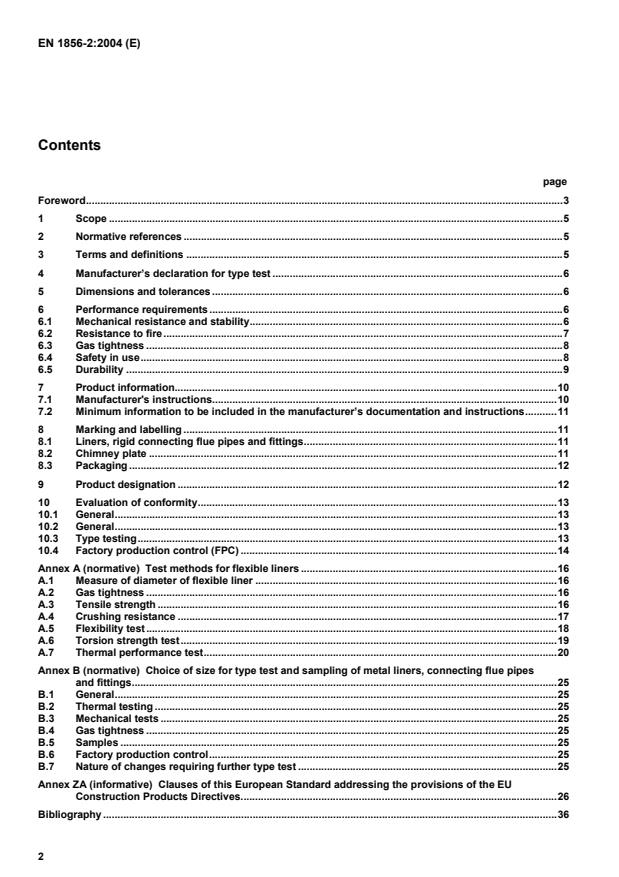
Test methods for flexible liners.16 A.1 Measure of diameter of flexible liner.16 A.2 Gas tightness.16 A.3 Tensile strength.16 A.4 Crushing resistance.17 A.5 Flexibility test.18 A.6 Torsion strength test.19 A.7 Thermal performance test.20 Annex B (normative)
Choice of size for type test and sampling of metal liners, connecting flue pipes and fittings.25 B.1 General.25 B.2 Thermal testing.25 B.3 Mechanical tests.25 B.4 Gas tightness.25 B.5 Samples.25 B.6 Factory production control.25 B.7 Nature of changes requiring further type test.25 Annex ZA (informative)
Clauses of this European Standard addressing the provisions of the EU Construction Products Directives.26 Bibliography.36
This document (EN 1856-2:2004) has been prepared by Technical Committee CEN /TC 166, "Chimneys", the secretariat of which is held by UNI. This European Standard shall be given the status of a national standard, either by publication of an identical text or by endorsement, at the latest by January 2005, and conflicting national standards shall be withdrawn at the latest by April 2006. This document has been prepared under a mandate given to CEN by the European Commission and the European Free Trade Association, and supports essential requirements of EU Directive(s). For relationship with EU Directive(s), see informative Annex ZA, which is an integral part of this document. According to the CEN/CENELEC Internal Regulations, the national standards organizations of the following countries are bound to implement this European Standard: Austria, Belgium, Cyprus, Czech Republic, Denmark, Estonia, Finland, France, Germany, Greece, Hungary, Iceland, Ireland, Italy, Latvia, Lithuania, Luxembourg, Malta, Netherlands, Norway, Poland, Portugal, Slovakia, Slovenia, Spain, Sweden, Switzerland and United Kingdom.
3 Terms and definitions For the purposes of this document, the terms and definitions given in EN 1856-1:2003 and the following apply. 3.1 bending radius minimum radius measured on the inner side of a flexible liner when bent
Table 1 — Leakage rate Pressure type Test pressure Pa Leakage rate/Flue surface area l × s-1 × m-2 N1 40 < 2,0 N2 20 < 3,0 P1 200 < 0,006 P2 200 < 0,120 H1 200 and 5 000 < 0,006 H2 200 and 5 000 < 0,120
6.4 Safety in use 6.4.1 Thermal performance at normal operating conditions 6.4.1.1 Rigid liners and fittings When a liner and its fittings are tested according to the heat stress test method of EN 1859 with the exception of the test rig (Figures 4 and 5) which shall be (replaced by the test rig) described in A.7.2, they shall meet the gas tightness of 6.3. 6.4.1.2 Rigid connecting flue pipes and fittings When a rigid connecting flue pipe and its fittings are tested according to heat stress test method of EN 1859 with the exception of the test rig (Figures 4 and 5) which shall be replaced by the test rig described in A.7.2, the maximum surface temperature of combustible material adjacent to the test sample at the distance declared shall not exceed 85°C when related to an ambient temperature of 20°C and shall meet the gas tightness of 6.3. In addition, vitreous enamelled connecting flue pipe shall not exhibit any cracking or any sign of flaking of their surface after heat stress test according to EN 10209. 6.4.1.3 Flexible liners and fittings When a flexible liner and its fittings are tested according to heat stress test method described in A 7.4.2, they shall meet the gas tightness of 6.3. The test sample shall allow the test ball of A.7.3.1.2 to move freely down. 6.4.2 Accidental human contact In case of accidental human contact for a connecting part, individual member states regulations are applicable. 6.4.3 Thermal resistance Where connecting flue pipes are insulated, their thermal resistance value, declared by the manufacturer, shall be determined in accordance with 6.4.3 of EN 1856-1:2003.
80 Cast iron
Normal steel EN 10025
Aluminium coated steel
EN AW – 4047A
EN AW - 1200
EN AW - 6060
1.4301
1.4307
1.4401
1.4404 2)
1.4432
1.4539
Double sided vitreous enamelled steel
S 235 JRG 2
EN 10154
EN AW Al Si 12A1)
EN AW-AL 99,0A
EN AW-Al MgSi
X5CrNi 18-10
X2CrNi 18-9
X5CrNiMo 17-12-2
X2CrNiMo 17-12-2
X2CrNiMo 17-12-3
X1NiCrMoCu 25-20-5
1) Cu < 0,1 %, Zn < 0,15 %. 2) Equivalent for material no. 1.4404 = 1.4571 (symbol X6CrNiMoTi 17-12-2).
Example: L 40045 represents a liner made of 1.4401 stainless steel with a thickness of 0,45 mm. 6.5.2 Freeze thaw resistance Metal liners and connecting flue pipes are considered to satisfy freeze thaw resistance requirements. 7 Product information 7.1 Manufacturer's instructions The manufacturer‘s instructions shall be available in the language of each country where the product is placed on the market.
Connecting flue pipe - EN 1856-2-T400-PI -W -Vx- L40045 - Gxx
Product description Document number
Temperature class (see Table 3)
Pressure level (N or P or H)
Condensate resistance (W: wet or D: dry)
Corrosion resistance (durability against corrosion) (see 6.5.1 and Annex A of EN 1856-1:2003)
Flue liner material specification (see Table 2)
Sootfire resistance (G: yes or O: no) and distance to combustible material xx only for connecting flue pipes (in mm)
* Inner skin for double skin flexible liners.
10 Evaluation of conformity 10.1 General Clause 10 of EN 1856-1:2003 shall apply where the words «system chimney products» shall be replaced by «liners, connecting flue pipes and fittings». 10.2 General The compliance of a liner, connecting flue pipe and fitting product with the requirements of this document and with the stated values (including classes) shall be demonstrated by: initial type testing; factory production control by the manufacturer, including product assessment. 10.3 Type testing 10.3.1 Initial type testing Initial type testing shall be performed to show conformity with this document. Tests previously performed in accordance with the provisions of this document [same product, same characteristic(s), test method, sampling procedure, system of attestation of conformity, etc.] may be taken into account. In addition, initial type testing shall be performed at the beginning of the production of a new system chimney product or at the beginning of a new method of production (where this may affect the stated properties). Where characteristics are determined on the basis of conformity with other product standards (for, metals including coatings, seals and sealants), these characteristics do not need to be reassessed provided that the designer ensures the validity of the results. Products CE marked in accordance with appropriate harmonised European specifications may be presumed to have the performances stated of them, although this does not replace the responsibility of the manufacturer to ensure that the liner, connecting flue pipe and fitting product as a whole is correctly designed and its component products have the necessary performance values. All characteristics defined in Clauses 5 and 6 shall be subject to initial type testing, with the following exception: release of dangerous substances which may be assessed indirectly by controlling the content of the substance concerned.
- the operations referred to under i) and j),
- only the operations under i) or,
- only those under j). The operations under i) centre as much on the intermediate states of the product as on manufacturing machines and their adjustment, and equipment, etc. These controls and tests and their frequency are chosen based on product type and composition, the manufacturing process and its complexity, the sensitivity of product features to variations in manufacturing parameters, etc. The manufacturer shall have or have available the installations, equipment and personnel which enable him to carry out the necessary verifications and tests. He may, as may his agent, meet this requirement by concluding a sub-contracting agreement with one or more organisations or persons having the necessary skills and equipment. The manufacturer has responsibility to calibrate or verify and maintain the control, measuring or test equipment in good operating condition, whether or not it belongs to him, with a view to demonstrating conformity of the product with its technical specification. The equipment shall be used in conformity with the specification or the test reference system to which the specification refers. If necessary, monitoring is carried out of the conformity of intermediate states of the product and at the main stages of its production. This monitoring of conformity focuses where necessary on the product throughout the process of manufacture, so that only products having passed the sche
...