


EN ISO 1628-5:2015
(Main)Plastics - Determination of the viscosity of polymers in dilute solution using capillary viscometers - Part 5: Thermoplastic polyester (TP) homopolymers and copolymers (ISO 1628-5:1998)
Plastics - Determination of the viscosity of polymers in dilute solution using capillary viscometers - Part 5: Thermoplastic polyester (TP) homopolymers and copolymers (ISO 1628-5:1998)
See N895
Kunststoffe - Bestimmung der Viskosität von Polymeren in verdünnter Lösung durch ein Kapillarviscosimeter - Teil 5: Thermoplastische Polyester(TP) Homopolymere und Copolymere (ISO 1628-5:1998)
Plastiques - Détermination de la viscosité des polymères en solution diluée à l'aide de viscosimètres à capillaires - Partie 5: Homopolymères et copolymères des polyesters thermoplastiques (TP) (ISO 1628-5:1998)
Polimerni materiali - Ugotavljanje viskoznosti polimerov v razredčenih raztopinah s kapilarnimi viskozimetri - 5. del: Plastomerni poliestri (TP) homo- in kopolimerov (ISO 1628-5:1998)
General Information
Overview
EN ISO 1628-5:2015 - Plastics: determination of the viscosity of polymers in dilute solution using capillary viscometers - Part 5 covers test methods for thermoplastic polyesters (TP) (homopolymers and copolymers). It specifies how to determine the viscosity number (reduced viscosity) of dilute polymer solutions - a standard metric used as an indicator of relative molecular mass for PET, PBT, PCT, PEN and related copolyesters. The procedure follows the general principles of ISO 1628‑1 and was adopted by CEN without modification (ISO 1628‑5:1998 → EN ISO 1628‑5:2015).
Key topics and technical requirements
- Scope: Applicable to TP polyesters soluble in specified solvents under defined conditions (e.g., PET, PBT, PCT, PEN and copolyesters).
- Measurement principle: Determine flow times of solvent and polymer solution at 25 °C using capillary viscometers; calculate viscosity number from flow times and solution concentration per ISO 1628‑1.
- Solvents (examples & ratios):
- Phenol/1,2‑dichlorobenzene (50/50)
- Phenol/1,1,2,2‑tetrachloroethane (50/50 or 60/40)
- o‑Chlorophenol, m‑cresol, dichloroacetic acid
- Phenol/2,4,6‑trichlorophenol (60/40) for crystalline PEN
- Safety note: solvents are hazardous - avoid inhalation/skin contact and store protected from light.
- Apparatus highlights:
- Ubbelohde suspended‑level capillary viscometers (No. 1B, 1C or 2) per ISO 3105 (Ubbelohde required in disputes)
- Thermostatic bath maintained at 25 ± 0.05 °C
- Steam bath (90–100 °C) and oil bath (135–140 °C) for dissolution when needed
- Analytical balance (high precision), sieves/filters, vacuum dryer
- Sample preparation:
- Predry samples (e.g., 120 °C under vacuum for 3 h) to avoid hydrolysis
- Account for inorganic fillers/additives (>0.5 % m/m) in solution concentration
- Two preparation procedures (weighing and volumetric dilution) are provided
- Measurement tolerances:
- Repeat flow times until two successive readings agree within 0.25 %
- Monitor solvent flow time daily; discard if it drifts >1 %
Applications - who uses it and why
- Plastics manufacturers (PET/PBT/PEN processors) for incoming material verification and lot acceptance
- Quality control and analytical laboratories for routine monitoring of molecular weight changes after processing, aging or recycling
- R&D teams for polymer characterization and process development
- Certification and specification preparation, where viscosity number is referenced as a performance indicator
Practical uses include assessing polymer chain degradation, verifying consistency between batches, and correlating viscosity number with mechanical properties.
Related standards
- ISO 1628‑1 - General principles for dilute‑solution viscosity measurement
- ISO 3105 - Glass capillary viscometers specifications (Ubbelohde)
- ISO 3451‑2 - Determination of ash (fillers) in polyalkylene terephthalates
- ISO 7792‑1 - Designation system and basis for specifications for thermoplastic polyesters
Keywords: EN ISO 1628-5:2015, viscosity number, thermoplastic polyester, capillary viscometer, Ubbelohde, PET viscosity testing, PBT, PEN, dilute solution viscosity, polymer molecular mass.
Frequently Asked Questions
EN ISO 1628-5:2015 is a standard published by the European Committee for Standardization (CEN). Its full title is "Plastics - Determination of the viscosity of polymers in dilute solution using capillary viscometers - Part 5: Thermoplastic polyester (TP) homopolymers and copolymers (ISO 1628-5:1998)". This standard covers: See N895
See N895
EN ISO 1628-5:2015 is classified under the following ICS (International Classification for Standards) categories: 83.080.10 - Thermosetting materials; 83.080.20 - Thermoplastic materials. The ICS classification helps identify the subject area and facilitates finding related standards.
You can purchase EN ISO 1628-5:2015 directly from iTeh Standards. The document is available in PDF format and is delivered instantly after payment. Add the standard to your cart and complete the secure checkout process. iTeh Standards is an authorized distributor of CEN standards.
Standards Content (Sample)
2003-01.Slovenski inštitut za standardizacijo. Razmnoževanje celote ali delov tega standarda ni dovoljeno.Kunststoffe - Bestimmung der Viskosität von Polymeren in verdünnter Lösung durch ein Kapillarviscosimeter - Teil 5: Thermoplastische Polyester(TP) Homopolymere und Copolymere (ISO 1628-5:1998)Plastiques - Détermination de la viscosité des polymères en solution diluée à l'aide de viscosimètres à capillaires - Partie 5: Homopolymères et copolymères des polyesters thermoplastiques (TP) (ISO 1628-5:1998)Plastics - Determination of the viscosity of polymers in dilute solution using capillary viscometers - Part 5: Thermoplastic polyester (TP) homopolymers and copolymers (ISO 1628-5:1998)83.080.20PlastomeriThermoplastic materialsICS:Ta slovenski standard je istoveten z:EN ISO 1628-5:2015SIST EN ISO 1628-5:2015en,de01-junij-2015SIST EN ISO 1628-5:2015SLOVENSKI
STANDARD
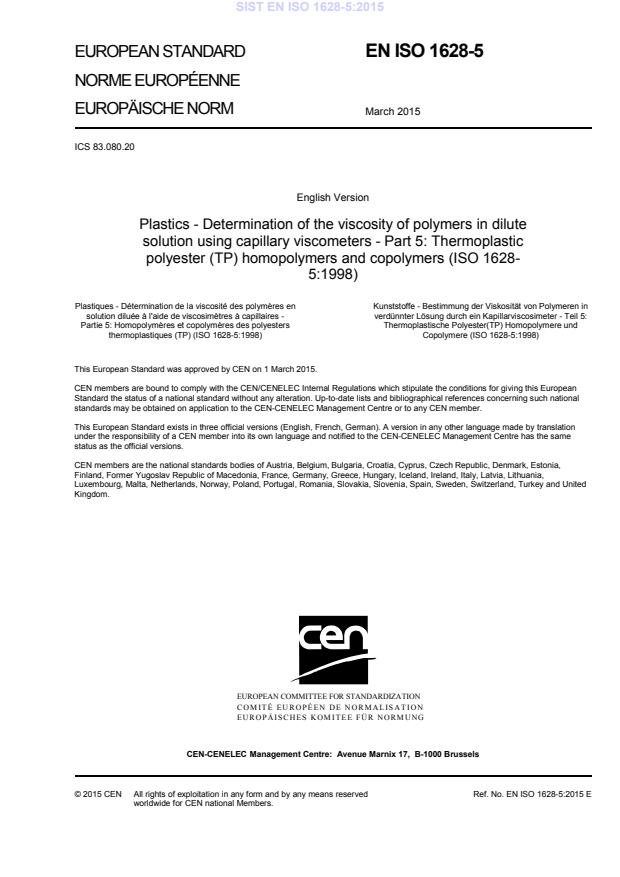
EUROPEAN STANDARD NORME EUROPÉENNE EUROPÄISCHE NORM
EN ISO 1628-5
March 2015 ICS 83.080.20 English Version
Plastics - Determination of the viscosity of polymers in dilute solution using capillary viscometers - Part 5: Thermoplastic polyester (TP) homopolymers and copolymers (ISO 1628-5:1998)
Plastiques - Détermination de la viscosité des polymères en solution diluée à l'aide de viscosimètres à capillaires - Partie 5: Homopolymères et copolymères des polyesters thermoplastiques (TP) (ISO 1628-5:1998)
Kunststoffe - Bestimmung der Viskosität von Polymeren in verdünnter Lösung durch ein Kapillarviscosimeter - Teil 5: Thermoplastische Polyester(TP) Homopolymere und Copolymere (ISO 1628-5:1998) This European Standard was approved by CEN on 1 March 2015.
CEN members are bound to comply with the CEN/CENELEC Internal Regulations which stipulate the conditions for giving this European Standard the status of a national standard without any alteration. Up-to-date lists and bibliographical references concerning such national standards may be obtained on application to the CEN-CENELEC Management Centre or to any CEN member.
This European Standard exists in three official versions (English, French, German). A version in any other language made by translation under the responsibility of a CEN member into its own language and notified to the CEN-CENELEC Management Centre has the same status as the official versions.
CEN members are the national standards bodies of Austria, Belgium, Bulgaria, Croatia, Cyprus, Czech Republic, Denmark, Estonia, Finland, Former Yugoslav Republic of Macedonia, France, Germany, Greece, Hungary, Iceland, Ireland, Italy, Latvia, Lithuania, Luxembourg, Malta, Netherlands, Norway, Poland, Portugal, Romania, Slovakia, Slovenia, Spain, Sweden, Switzerland, Turkey and United Kingdom.
EUROPEAN COMMITTEE FOR STANDARDIZATION
COMITÉ EUROPÉEN DE NORMALISATION EUROPÄISCHES KOMITEE FÜR NORMUNG
CEN-CENELEC Management Centre:
Avenue Marnix 17,
B-1000 Brussels © 2015 CEN All rights of exploitation in any form and by any means reserved worldwide for CEN national Members. Ref. No. EN ISO 1628-5:2015 ESIST EN ISO 1628-5:2015
AReference numberISO 1628-5:1998(E)INTERNATIONALSTANDARDISO1628-5Second edition1998-03-15Plastics — Determination of the viscosity ofpolymers in dilute solution using capillaryviscometers —Part 5:Thermoplastic polyester (TP) homopolymersand copolymersPlastiques — Détermination de la viscosité des polymères en solutiondiluée à l'aide de viscosimètres à capillaires —Partie 5: Homopolymères et copolymères des polyestersthermoplastiques (TP)SIST EN ISO 1628-5:2015
ISO 1628-5:1998(E)©
ISO 1998All rights reserved. Unless otherwise specified, no part of this publication may be reproducedor utilized in any form or by any means, electronic or mechanical, including photocopying andmicrofilm, without permission in writing from the publisher.International Organization for StandardizationCase postale 56 · CH-1211 Genève 20 · SwitzerlandInternetcentral@iso.chX.400c=ch; a=400net; p=iso; o=isocs; s=centralPrinted in SwitzerlandiiForewordISO (the International Organization for Standardization) is a worldwidefederation of national standards bodies (ISO member bodies). The work ofpreparing International Standards is normally carried out through ISOtechnical committees. Each member body interested in a subject for whicha technical committee has been established has the right to be representedon that committee. International organizations, governmental and non-governmental, in liaison with ISO, also take part in the work. ISOcollaborates closely with the International Electrotechnical Commission(IEC) on all matters of electrotechnical standardization.Draft International Standards adopted by the technical committees arecirculated to the member bodies for voting. Publication as an InternationalStandard requires approval by at least 75 % of the member bodies castinga vote.International Standard ISO 1628-5 was prepared by Technical CommitteeISO/TC 61, Plastics, Subcommittee SC 9, Thermoplastic materials.This second edition cancels and replaces the first edition(ISO 1628-5:1986), which has been technically revised.ISO 1628 consists of the following parts, under the general title Plastics —Determination of the viscosity of polymers in dilute solution using capillaryviscometers:—Part 1: General principles—Part 2: Poly(vinyl chloride) resins—Part 3: Polyethylenes and polypropylenes—Part 4: Polycarbonate (PC) moulding and extrusion materials—Part 5: Thermoplastic polyester (TP) homopolymers and copolymers—Part 6: Methyl methacrylate polymersAnnex A of this part of ISO 1628 is for information only.SIST EN ISO 1628-5:2015
INTERNATIONAL STANDARD
© ISOISO 1628-5:1998(E)1Plastics — Determination of the viscosity of polymers indilute solution using capillary viscometers —Part 5:Thermoplastic polyester (TP) homopolymers and copolymers1ScopeThis part of ISO 1628 specifies a method for the determination of the viscosity number (also referred toas “reduced viscosity”) of dilute solutions of thermoplastic polyesters (TPs) in certain specified solvents.The method is applicable to poly(ethylene terephthalate) (PET), poly(butylene terephthalate) (PBT),poly- (cyclohexylenedimethylene terephthalate) (PCT), and poly(ethylene naphthalate) (PEN), as well asto copolyesters and other polyesters, defined in ISO 7792-1, that are soluble in one of the specifiedsolvents under the specified conditions.The viscosity number is determined by the general procedure specified in ISO 1628-1, observing theparticular conditions specified in this part of ISO 1628.The determination of the viscosity number of a thermoplastic polyester provides a measure of therelative molecular mass of the polymer.2Normative referencesThe following standards contain provisions which, through reference in this text, constitute provisionsof this part of ISO 1628.
At the time of publication, the editions indicated were valid.
All standards aresubject to revision, and parties to agreements based on this part of ISO 1628 are encouraged toinvestigate the possibility of applying the most recent editions of the standards indicated below.Members of IEC and ISO maintain registers of current valid International Standards.ISO 1628-1:—1),
Plastics - Determination of the viscosity of polymers in dilute solution using capillaryviscometers - Part 1: General principles.ISO 3105:1994,
Glass capillary kinematic viscometers - Specifications and operating instructions.ISO 3451-2:1984,
Plastics - Determination of ash - Part 2: Polyalkylene terephthalates.ISO 7792-1:1997,
Plastics - Thermoplastic polyester (TP) moulding and extrusion materials - Part 1:Designation system and basis for specifications.________1)
To be published. (Revision of ISO 1628-1:1984)SIST EN ISO 1628-5:2015
ISO 1628-5:1998(E)© ISO23PrincipleThe times of flow of a solvent and a solution of resin in the solvent at a concentration of 0,005 g/ml aremeasured at 25 °C by conventional methods. The viscosity number is calculated from thesemeasurements and from the known concentration of the solution. Specific gravity difference and kineticenergy corrections are small in this method and are not applied.4SolventsWARNING - The solvents used are hazardous.
Avoid contact with the skin and inhalation of thevapours.4.1Phenol/1,2-dichlorobenzeneWeigh out 1 part by mass of phenol (analytical grade) and dissolve in 1 part by mass of 1,2-dichlorobenzene (analytical grade). Work to an accuracy of 1 % or better in the weighings.4.2Phenol/1,1,2,2-tetrachloroethaneWeigh out 6 parts by mass of phenol (analytical grade) and dissolve in 4 parts by mass of 1,1,2,2-tetrachloroethane (analytical grade), or weigh out 1 part by mass of phenol and dissolve in 1 part bymass of 1,1,2,2-tetrachloroethane. Work to an accuracy of 1 % or better in the weighings.4.3o-Chlorophenol, analytical grade.4.4m-Cresol, meeting the following specifications:appearance:
clear and colorless;m-cresol content:
99 % (m/m) min.;o-cresol content:
0,3 % (m/m) max.;water content:
0,1 % (m/m) max.NOTE - A solvent of the required purity can be obtained by distillation of chemically pure m-cresol,preferably in vacuo, pressure compensation being effected with nitrogen in order to avoid oxidation.The purity of the solvent may be checked by gas chromatography.4.5Dichloroacetic acid, analytical grade.4.6Phenol/2,4,6-trichlorophenolWeight out 6 parts by mass of phenol (analytical grade) and dissolve in 4 parts by mass of 2,4,6-trichlorophenol (analytical grade).NOTE - 2,4,6-trichlorophenol of the required purity can be obtained by distillation of chemically pure2,4,6-trichlorophenol.4.7Storage of the solventsProtect the solvents from light by storing them, for example, in stoppered brown-glass bottles.SIST EN ISO 1628-5:2015
© ISOISO 1628-5:1998(E)35Apparatus5.1Mill, to reduce the sample to a grain size of about 0,5 mm.5.2Volumetric flask, of capacity 100 ml, fitted with a ground-glass stopper.5.3 Conical flask, of capacity 150 ml, fitted with a ground-glass stopper.5.4Burette, graduated in divisions of 0,1 ml.5.5Steam bath, or other means to heat the contents of a flask to 90 to 100 °C.5.6Oil bath, capable of being controlled at 135 to 140 °C, or other means to heat the contents of a flaskto that temperature range.5.7Magnetic stirrer, or other equipment to continuously agitate the contents of a stoppered fla
...
기사 제목: EN ISO 1628-5:2015 - 플라스틱 - 관절 첨가제를 사용한 희석 용액에서 폴리머의 점도 측정 - 제5부: 열가소성 폴리에스터 (TP) 동성 고분자 및 공중합체 (ISO 1628-5:1998) 기사 내용: N895 참조 해당 기사는 EN ISO 1628-5:2015 표준에 대한 논의를 다루고 있습니다. 이 표준은 열가소성 폴리에스터 (TP) 동성 고분자 및 공중합체의 점도를 측정하는 데에 관여합니다. 이 표준은 희석 용액에서 이러한 고분자의 점도를 측정하기 위해 관 점도계를 사용합니다. 자세한 내용은 문서 N895에서 확인할 수 있습니다.
記事のタイトル:EN ISO 1628-5:2015 - プラスチック - キャピラリー粘度計を使用した希釈溶液中の高分子の粘度の決定 - 第5部:熱可塑性ポリエステル(TP)ホモポリマーおよび共重合体(ISO 1628-5:1998) 記事の内容:N895を参照 この記事では、EN ISO 1628-5:2015規格について議論しています。この規格は、熱可塑性ポリエステル(TP)ホモポリマーや共重合体の粘度を測定するためにキャピラリー粘度計を使用します。詳細は、文書N895を参照してください。
The article discusses the EN ISO 1628-5:2015 standard, which deals with the determination of viscosity of thermoplastic polyester (TP) homopolymers and copolymers. This standard uses capillary viscometers to measure the viscosity of these polymers in dilute solution. Further details can be found in document N895.
Questions, Comments and Discussion
Ask us and Technical Secretary will try to provide an answer. You can facilitate discussion about the standard in here.
Loading comments...