

EN 1483:2007
(Main)Water quality - Determination of mercury - Method using atomic absorption spectrometry
- Abstract
This European Standard specifies two methods for the determination of mercury. For the method described in Clause 4, tin(II) chloride is used as the reducing agent. For the method given in Clause 5, sodium borohydride serves as the reducing agent. The choice of method depends on the equipment available and the matrix (see Clause 3). Both methods are suitable for the determination of mercury in water, for example in drinking, ground, surface and waste waters, in a concentration range from 0,1 µg/l to 10 µg/l. Higher concentrations can be determined if the water sample is diluted. Lower concentrations in the range of 0,001 µg/l to 5 µg/l can be determined if special mercury analysers with an optimised instrument are used or if atomic fluorescence spectrometry is applied (see EN 13506 or ISO 17852).
- Status
- Withdrawn
- Publication Date
- 10-Apr-2007
- Withdrawal Date
- 14-Apr-2012
- Technical Committee
- CEN/TC 230 - Water analysis
- Drafting Committee
- CEN/TC 230 - Water analysis
- Current Stage
- 9960 - Withdrawal effective - Withdrawal
- Start Date
- 15-Apr-2012
- Completion Date
- 15-Apr-2012

Relations
- Effective Date
- 22-Dec-2008
- Effective Date
- 23-Jan-2013
- Effective Date
- 28-Jan-2026
Get Certified
Connect with accredited certification bodies for this standard

CIS Institut d.o.o.
Personal Protective Equipment (PPE) certification body. Notified Body NB-2890 for EU Regulation 2016/425 PPE.

Kiwa BDA Testing
Building and construction product certification.
Kmetijski inštitut Slovenije
Agricultural Institute of Slovenia. Soil testing, plant health, agricultural product analysis.
Sponsored listings
Frequently Asked Questions
EN 1483:2007 is a standard published by the European Committee for Standardization (CEN). Its full title is "Water quality - Determination of mercury - Method using atomic absorption spectrometry". This standard covers: This European Standard specifies two methods for the determination of mercury. For the method described in Clause 4, tin(II) chloride is used as the reducing agent. For the method given in Clause 5, sodium borohydride serves as the reducing agent. The choice of method depends on the equipment available and the matrix (see Clause 3). Both methods are suitable for the determination of mercury in water, for example in drinking, ground, surface and waste waters, in a concentration range from 0,1 µg/l to 10 µg/l. Higher concentrations can be determined if the water sample is diluted. Lower concentrations in the range of 0,001 µg/l to 5 µg/l can be determined if special mercury analysers with an optimised instrument are used or if atomic fluorescence spectrometry is applied (see EN 13506 or ISO 17852).
This European Standard specifies two methods for the determination of mercury. For the method described in Clause 4, tin(II) chloride is used as the reducing agent. For the method given in Clause 5, sodium borohydride serves as the reducing agent. The choice of method depends on the equipment available and the matrix (see Clause 3). Both methods are suitable for the determination of mercury in water, for example in drinking, ground, surface and waste waters, in a concentration range from 0,1 µg/l to 10 µg/l. Higher concentrations can be determined if the water sample is diluted. Lower concentrations in the range of 0,001 µg/l to 5 µg/l can be determined if special mercury analysers with an optimised instrument are used or if atomic fluorescence spectrometry is applied (see EN 13506 or ISO 17852).
EN 1483:2007 is classified under the following ICS (International Classification for Standards) categories: 13.060.30 - Sewage water. The ICS classification helps identify the subject area and facilitates finding related standards.
EN 1483:2007 has the following relationships with other standards: It is inter standard links to EN 1483:1997, EN ISO 12846:2012, EN 16192:2011. Understanding these relationships helps ensure you are using the most current and applicable version of the standard.
EN 1483:2007 is associated with the following European legislation: EU Directives/Regulations: 76/464/EEC; Standardization Mandates: M/BC/CEN/92/45. When a standard is cited in the Official Journal of the European Union, products manufactured in conformity with it benefit from a presumption of conformity with the essential requirements of the corresponding EU directive or regulation.
EN 1483:2007 is available in PDF format for immediate download after purchase. The document can be added to your cart and obtained through the secure checkout process. Digital delivery ensures instant access to the complete standard document.
Standards Content (Sample)
2003-01.Slovenski inštitut za standardizacijo. Razmnoževanje celote ali delov tega standarda ni dovoljeno.USFLMVNRVSHNWURPHWULMRWasserbeschaffenheit - Bestimmung von Quecksilber - Verfahren mittels AtomabsorptionsspektrometrieQualité de l'eau - Dosage du mercure - Méthode par spectrométrie d'absorption atomiqueWater quality - Determination of mercury - Method using atomic absorption spectrometry13.060.50VQRYLExamination of water for chemical substancesICS:Ta slovenski standard je istoveten z:EN 1483:2007SIST EN 1483:2007en,fr,de01-september-2007SIST EN 1483:2007SLOVENSKI
STANDARDSIST EN 1483:19981DGRPHãþD
EUROPEAN STANDARDNORME EUROPÉENNEEUROPÄISCHE NORMEN 1483April 2007ICS 13.060.30Supersedes EN 1483:1997
English VersionWater quality - Determination of mercury - Method using atomicabsorption spectrometryQualité de l'eau - Détermination du mercure - Méthode parspectrométrie d'absorption atomiqueWasserbeschaffenheit - Bestimmung von Quecksilber -Verfahren mittels AtomabsorptionsspektrometrieThis European Standard was approved by CEN on 28 February 2007.CEN members are bound to comply with the CEN/CENELEC Internal Regulations which stipulate the conditions for giving this EuropeanStandard the status of a national standard without any alteration. Up-to-date lists and bibliographical references concerning such nationalstandards may be obtained on application to the CEN Management Centre or to any CEN member.This European Standard exists in three official versions (English, French, German). A version in any other language made by translationunder the responsibility of a CEN member into its own language and notified to the CEN Management Centre has the same status as theofficial versions.CEN members are the national standards bodies of Austria, Belgium, Bulgaria, Cyprus, Czech Republic, Denmark, Estonia, Finland,France, Germany, Greece, Hungary, Iceland, Ireland, Italy, Latvia, Lithuania, Luxembourg, Malta, Netherlands, Norway, Poland, Portugal,Romania, Slovakia, Slovenia, Spain, Sweden, Switzerland and United Kingdom.EUROPEAN COMMITTEE FOR STANDARDIZATIONCOMITÉ EUROPÉEN DE NORMALISATIONEUROPÄISCHES KOMITEE FÜR NORMUNGManagement Centre: rue de Stassart, 36
B-1050 Brussels© 2007 CENAll rights of exploitation in any form and by any means reservedworldwide for CEN national Members.Ref. No. EN 1483:2007: ESIST EN 1483:2007
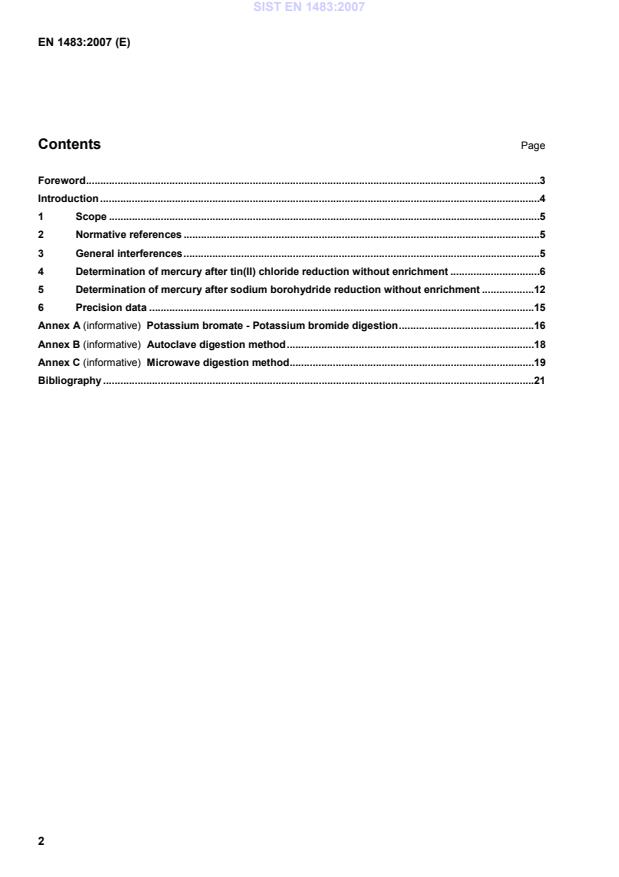
Potassium bromate - Potassium bromide digestion.16 Annex B (informative)
Autoclave digestion method.18 Annex C (informative)
Microwave digestion method.19 Bibliography.21
Both inorganic and organic compounds of mercury may be present as mercury can accumulate in sediment and sludge. To fully decompose all of the mercury compounds, a digestion procedure is necessary. Digestion can be omitted only if it is certain that the mercury concentration can be measured without this pre-treatment.
For measurements in the low concentration range, highest purity reagents, clean reaction vessels, mercury-free air in the laboratory and a very stable measurement system are essential.
WARNING — Persons using this European Standard should be familiar with normal laboratory practice. This standard does not purport to address all safety problems, if any, associated with its use. It is the responsibility of the user to establish appropriate safety and health practices and to ensure compliance with any national regulatory conditions. Mercury and mercury compounds are very toxic. Extreme caution should be exercised when handling samples and solutions which contain or may contain mercury. Potassium dichromate is toxic. Caution should be exercised when handling the solid material or its solutions. IMPORTANT — It is absolutely essential that tests conducted according to this European Standard be carried out by suitably trained staff. SIST EN 1483:2007
Volatile organic substances can absorb in the UV range and be mistaken for mercury. If present, these are, for the most part removed prior to reduction. Potassium permanganate is added until the solution is permanently coloured purple and an inert gas is bubbled through the solution for 10 min. Often, such interferences by non-specific absorption can also be eliminated by a background compensation system of atomic absorption equipment. It is necessary to bring all solutions to the same temperature (< 25 °C) before reducing and stripping the mercury vapour. Water condensation on the cuvette windows can be prevented by heating the cuvette to temperatures slightly above 100 °C. The interferences due to the presence of other elements in the matrix depend on the choice of reducing agent. Element concentrations in excess of those listed in Table 1 can cause negative bias.
directly directly directly Medium 0,5 mol/l HCl 5 mol/l HCl 0,5 mol/l HCl
+ 0,2 g/l Fe(III)
Element
Cu(II) 10 10 500 Ni(II) 1 500 500 Ag(I) 0,1 10 1 I¯ 100 10 0,1 As(V) 0,5 0,5 0,5 Bi(III) 0,05 0,5 0,5 Sb(III) 0,5 0,5 0,5 Se(IV) 0,005 0,05 0,05
Tin(II) chloride causes such extensive contamination of the apparatus with tin that considerable interferences occur if sodium borohydride is used afterwards. Therefore, use separate systems for reductions with tin(II) chloride and with sodium borohydride.
4 Determination of mercury after tin(II) chloride reduction without enrichment 4.1 Principle Mono- or di-valent mercury is reduced to the elemental form by tin(II) chloride in an acid medium. Elemental mercury is then stripped from the solution with the aid of a stream of inert gas or mercury-free air and, in the form of an atomic gas, transported into a cuvette. Absorbances are measured at a wavelength of 253,7 nm in the radiation beam of an atomic absorption spectrometer. Concentrations are calculated using a calibration curve. 4.2 Interferences (See also Clause 3). Iodide in concentrations > 0,1 mg/l causes interferences in the determination due to the formation of mercury complexes. In this case, use another method, such as reduction with sodium borohydride (see Clause 5). Because of the redox potential of the tin(II) chloride solution, various inorganic mercury compounds such as mercury sulfide and organic mercury compounds cannot be fully reduced without digestion (4.6). SIST EN 1483:2007
4.3.1 Water, Grade 1, as specified in EN ISO 3696.
4.3.2 Nitric acid, (HNO3) = 1,40 g/ml. 4.3.3 Sulfuric acid, (H2SO4) = 1,84 g/ml. 4.3.4 Hydrochloric acid, (HCl) = 1,16 g/ml. 4.3.5 Potassium permanganate solution Dissolve 50 g of potassium permanganate, KMnO4, in 1 000 ml of water (4.3.1).
4.3.6 Stabilizer solution Dissolve 5 g of potassium dichromate, K2Cr2O7, in 500 ml of nitric acid (4.3.2) and dilute to 1 000 ml with water (4.3.1).
4.3.7 Potassium peroxodisulfate solution Dissolve 40 g of potassium peroxodisulfate, K2S2O8, in 1 000 ml of water (4.3.1).
4.3.8 Hydroxylammonium chloride solution Dissolve 10 g of hydroxylammonium chloride, H4ClNO, in 100 ml of water (4.3.1).
4.3.9 Tin(II) chloride solution, (SnCl2 ⋅ 2H2O) = 50 g/l. Dissolve 5 g of tin(II) chloride dihydrate, SnCl2 ⋅ 2H2O, in 30 ml of hydrochloric acid (4.3.4) and dilute to 100 ml with water (4.3.1). In flow systems, use a solution of lower concentration (e.g. (SnCl2 ⋅ 2H2O) = 20 g/l).
The concentration of the tin(II) chloride depends on flow conditions of the system. Follow the manufacturer recommendations. If a high result for the blank (4.6) is obtained, pass nitrogen through the solution for 30 min to remove traces of mercury. 4.3.10 Mercury stock solution I, (Hg) = 1 000 mg/l. Use a commercially available quantitative stock solution with a mercury concentration of e.g. (1 000 ± 2) mg/l. This solution is considered to be stable for at least one year, but in reference to guaranteed stability, see the recommendations of the manufacturer. 4.3.11 Mercury stock solution II, (Hg) = 10 mg/l. Add 1 ml of stabilizer solution (4.3.6) to 1 ml of mercury stock solution I (4.3.10) and dilute to 100 ml with water (4.3.1).
The solution is stable for 1 week.
4.3.12 Mercury standard solution (1), (Hg) = 100 µg/l. Add 1 ml of stabilizer solution (4.3.6) to 1 ml of mercury stock solution II (4.3.11) and dilute to 100 ml with water (4.3.1).
4.3.14 Mercury calibration solutions Prepare the calibration solutions appropriate for the volume and expected mercury concentrations of the measurement sample solutions. For a concentration range from 0,5 µg/l to 5 µg/l, for example, proceed as follows:
Pipette into a series of six 100 ml volumetric flasks 1 ml, 2 ml, 4 ml, 6 ml, 8 ml and 10 ml, of mercury standard solution (4.3.13). Add 1 ml of stabilizer solution (4.3.6) to each 100 ml volumetric flask. Fill to the mark with water (4.3.1) and mix thoroughly.
These calibration solutions contain 0,5 µg/l, 1 µg/l, 2 µg/l, 3 µg/l, 4 µg/l and 5 µg/l mercury. Prepare freshly before each series of measurements. If calibration measurements are to be run in duplicate, prepare another set of solutions. Using dilutors (offline or integrated in the AAS system) for preparing the calibration solutions is also allowed. In this case the user shall prove that the performance criteria of the dilution system meet the specific requirements. 4.3.15 Reagent blank solution Prepare a volume of blank solution corresponding to that of the measurement solution by adding 10 ml of stabilizer solution (4.3.6) per 1 000 ml of water. Use the same digestion procedure as for the sample (4.6). Include the reagent blank in each batch of analyses.
4.3.16 Rinsing solution for glassware Add to 500 ml of water (4.3.1) 150 ml of nitric acid (4.3.2) and dilute with water to 1 000 ml. 4.4 Apparatus Before use, rinse all glassware thoroughly with diluted nitric acid (4.3.16) and then several times with water (4.3.1).
4.4.1 Atomic absorption spectrometer, equipped with a cold vapour generation system and a quartz or glass tube atomizer. An AAS system with background correction is recommended. Automated stand-alone mercury flow systems (flow injection systems or continuous flow systems) are also suitable. They allow a concentration range lower by about one order of magnitude. Manually operated or semi-automatic batch systems are adequate as well. 4.4.2 Radiation source, for the determination of mercury, e.g. a hollow cathode or electrodeless discharge lamp. Stand alone mercury systems are usually equipped with a built-in mercury radiation source. The high resolution continuum source; AAS uses a continuum radiation source (e.g. a Xenon short arc lamp) for the determination of all elements inclusively mercury. SIST EN 1483:2007
4.4.4 Volumetric flasks, 100 ml, 200 ml, and 1 000 ml. 4.4.5 Pipettes, 0,5 ml, 1 ml, 5 ml, and 10 ml. NOTE Instead of pipettes, it is advantageous to use a dispensing apparatus or a dilutor, as it can significantly reduce the risk of introducing trace contaminants. 4.5 Sampling and sample pre-treatment
Carry out sampling as specified in EN ISO 5667-1 and EN ISO 5667-3. For sampling, use vessels made of borosilicate glass, quartz, polysulfone (PSU) or fluoridized ethylene-propylene-polymerisate (FEP).
Make sure that the sampling vessel contains no mercury and does not cause a loss of mercury by adsorption.
In order to limit any loss by, for example, adsorption on the vessel walls, add 10 ml of stabilizer solution (4.3.6) and make up to 1 000 ml with the sample. Verify that the sample has a pH of 1 and shows a yellow-orange colour indicating an excess of dichromate.
If necessary, add additional stabilizer solution, and include the appropriate volume correction factor in the calculations.
4.6 Digestion method using potassium permanganate/potassium peroxodisulfate Carry out the wet chemical digestion procedure as given below. Alternatively, use one of the digestion methods indicated in Annex A, Annex B or Annex C but verify that the efficiency of that method compared with the digestion method described in the normative part of this standard is equivalent. Transfer 100 ml of the stabilized water sample (4.5) or an appropriate volume (maximum 1 000 ml) of sample to a flask made of one of the materials listed in 4.5. Carefully add 15 ml of potassium permanganate solution (4.3.5), 1 ml of nitric acid (4.3.2) and 1 ml of sulfuric acid (4.3.3).
Shake the mixture well after each addition.
Allow the solution to stand for 15 min, then add 10 ml of potassium peroxodisulfate solution (4.3.7).
Place the loosely stoppered flask on a suitable heating device (e.g. a heating block or a water bath) and digest
...