

prEN 12405-2
(Main)Gas meters - Conversion devices - Part 2: Energy conversion
- Abstract
This European Standard specifies the requirements and tests for the construction, performance, safety and conformity of conversion devices used to determine the energy of fuel gases described in the Table 1, including those of the 1st and 2nd families according to EN 437.
The energy conversion device (ECD) considered in this standard consists of an energy calculator (EC) and is associated with the following devices and/or functions:
- a volume conversion device (VCD) or a flow computer used as gas meter conversion, either conforming to EN 12405-1, or to prEN 12405-3, for high accuracy measurements;
- a calorific value determination device (CVDD).
Requirements for type approval tests of the devices, not included in the above-mentioned standards are described in appropriate annexes specified in Table 6.
For the purpose of this European Standard, the term "volume conversion devices" (VCDs) includes flow computers (FCs).
A single calculator may undertake the volume conversion functions for different metering lines.
- Status
- Not Published
- Publication Date
- 25-Apr-2027
- Technical Committee
- CEN/TC 237 - Gas meters
- Drafting Committee
- CEN/TC 237/WG 4 - Associated conversion devices
- Current Stage
- 4060 - Closure of enquiry - Enquiry
- Start Date
- 28-May-2026
- Due Date
- 06-Jun-2025
- Completion Date
- 28-May-2026

Overview
prEN 12405-2: Gas meters - Conversion devices - Part 2: Energy conversion is a European Standard developed by CEN to define the requirements and testing procedures for conversion devices that determine the energy content of fuel gases. This standard applies to conversion devices used with both 1st and 2nd family gases (as per EN 437), and covers devices such as energy calculators (EC), volume conversion devices (VCD), calorific value determination devices (CVDD), and integrated or modular system approaches. The standard is key to ensuring accurate gas energy measurement in utility, distribution, and industrial contexts, supporting energy billing, monitoring, and compliance with European directives.
Key Topics
- Energy Conversion Devices (ECDs): The standard covers ECDs comprising an energy calculator paired with a VCD/flow computer and possibly with a CVDD, ensuring accurate energy measurement from gas flow and calorific value inputs.
- Performance and Safety Requirements: It specifies essential construction, performance, and safety parameters including environmental robustness, cybersecurity, and data transmission integrity.
- System Approaches: Both modular and global system configurations are defined:
- Modular approach: Separate verification of VCD and CVDD with the EC.
- Global approach: Integrated system testing of all components as a whole.
- Type Testing and Conformity: Provides testing procedures for type approval, including metrological performance, environmental resilience, and interface compatibility.
- Gas Families and Applications: While primarily for conventional natural gas and LNG (1st and 2nd families), the standard is relevant to treated non-conventional gases (such as injected biomethane). It addresses challenges with new blends, including hydrogen and hydrogen-natural gas mixtures.
- Installation and Marking Requirements: Provides criteria for installation, configuration, and marking of energy conversion equipment to ensure traceability and user clarity.
Applications
prEN 12405-2 is critical for a range of applications where gas energy measurement is required, including:
- Gas Utility Billing: Accurate conversion from gas volume to energy content is essential for fair invoicing to commercial and residential customers.
- Industrial Gas Metering: Ensures process control and monitoring where precise energy measurement determines process safety and efficiency.
- Biomethane and Hydrogen Integration: Supports modern networks by ensuring metrological and physical integrity of gas measurement in systems carrying renewable or low-carbon gases.
- Network Operations: Energy data from ECDs provides key information for balancing supply and demand within gas grids and supports regulatory compliance.
- Metering System Upgrades: Facilitates modular upgrades by supporting both integrated packages and component-based systems, allowing utilities and network operators to adapt to evolving measurement needs and gas types.
- Regulatory Compliance: Ensures alignment with European directives (such as the Measuring Instruments Directive) for energy conversion devices used in trade and safety-critical contexts.
Related Standards
Adherence to prEN 12405-2 is often coupled with compliance to other international and European standards, such as:
- EN 12405-1: Gas meters - Conversion devices - Part 1: Volume conversion, detailing requirements for volume-based corrections.
- EN 12405-3: Specifies requirements for flow computers used in high-accuracy gas measurements.
- EN 437: Test gases - Defines categories and properties for the relevant gas families.
- EN ISO 6976: Calculation of calorific values, density, and Wobbe indices from gas composition.
- EN ISO 12213 series: Calculation methods for gas compression factors.
- EN 60079 (all parts): Explosive atmospheres, relevant for installation safety in hazardous areas.
Practical Value
Implementing prEN 12405-2 brings several operational benefits:
- Enhanced Measurement Accuracy: Standardized system architecture and testing lead to reliable and traceable energy conversion, reducing billing disputes and regulatory risks.
- Flexible System Integration: Supports both legacy (modular) and modern (integrated) gas metering solutions, promoting investment protection.
- Future-Readiness: Guidance for hydrogen blending and biomethane integration ensures continued relevance as Europe’s gas networks decarbonize.
- Verified Reliability: Type testing for environmental, electromagnetic, and operational resilience increase confidence in deployed systems.
By applying this standard, stakeholders in the gas supply chain - from equipment manufacturers to network operators and regulators - ensure robust, accurate, and interoperable energy measurement systems for all conventional and modern gas applications.
Relations
- Effective Date
- 23-Apr-2024
Get Certified
Connect with accredited certification bodies for this standard

DIBt (Deutsches Institut für Bautechnik)
German Institute for Building Technology.
DIN CERTCO
DIN Group product certification.

Aboma Certification B.V.
Specialized in construction, metal, and transport sectors.
Sponsored listings
Frequently Asked Questions
prEN 12405-2 is a draft published by the European Committee for Standardization (CEN). Its full title is "Gas meters - Conversion devices - Part 2: Energy conversion". This standard covers: This European Standard specifies the requirements and tests for the construction, performance, safety and conformity of conversion devices used to determine the energy of fuel gases described in the Table 1, including those of the 1st and 2nd families according to EN 437. The energy conversion device (ECD) considered in this standard consists of an energy calculator (EC) and is associated with the following devices and/or functions: - a volume conversion device (VCD) or a flow computer used as gas meter conversion, either conforming to EN 12405-1, or to prEN 12405-3, for high accuracy measurements; - a calorific value determination device (CVDD). Requirements for type approval tests of the devices, not included in the above-mentioned standards are described in appropriate annexes specified in Table 6. For the purpose of this European Standard, the term "volume conversion devices" (VCDs) includes flow computers (FCs). A single calculator may undertake the volume conversion functions for different metering lines.
This European Standard specifies the requirements and tests for the construction, performance, safety and conformity of conversion devices used to determine the energy of fuel gases described in the Table 1, including those of the 1st and 2nd families according to EN 437. The energy conversion device (ECD) considered in this standard consists of an energy calculator (EC) and is associated with the following devices and/or functions: - a volume conversion device (VCD) or a flow computer used as gas meter conversion, either conforming to EN 12405-1, or to prEN 12405-3, for high accuracy measurements; - a calorific value determination device (CVDD). Requirements for type approval tests of the devices, not included in the above-mentioned standards are described in appropriate annexes specified in Table 6. For the purpose of this European Standard, the term "volume conversion devices" (VCDs) includes flow computers (FCs). A single calculator may undertake the volume conversion functions for different metering lines.
prEN 12405-2 is classified under the following ICS (International Classification for Standards) categories: 91.140.40 - Gas supply systems. The ICS classification helps identify the subject area and facilitates finding related standards.
prEN 12405-2 has the following relationships with other standards: It is inter standard links to EN 12405-2:2012. Understanding these relationships helps ensure you are using the most current and applicable version of the standard.
prEN 12405-2 is associated with the following European legislation: EU Directives/Regulations: 2014/32/EU; Standardization Mandates: M/626. When a standard is cited in the Official Journal of the European Union, products manufactured in conformity with it benefit from a presumption of conformity with the essential requirements of the corresponding EU directive or regulation.
prEN 12405-2 is available in PDF format for immediate download after purchase. The document can be added to your cart and obtained through the secure checkout process. Digital delivery ensures instant access to the complete standard document.
Standards Content (Sample)
SLOVENSKI STANDARD
01-april-2026
Plinomeri - Korektorji - 2. del: Energijska korekcija
Gas meters - Conversion devices - Part 2: Energy conversion
Gaszähler - Umwerter - Teil 2: Energieumwertung
Compteurs à gaz - Dispositifs de conversion - Partie 2 : Conversion en énergie
Ta slovenski standard je istoveten z: prEN 12405-2
ICS:
91.140.40 Sistemi za oskrbo s plinom Gas supply systems
2003-01.Slovenski inštitut za standardizacijo. Razmnoževanje celote ali delov tega standarda ni dovoljeno.
DRAFT
EUROPEAN STANDARD
NORME EUROPÉENNE
EUROPÄISCHE NORM
March 2026
ICS 91.140.40 Will supersede EN 12405-2:2012
English Version
Gas meters - Conversion devices - Part 2: Energy
conversion
Compteurs à gaz - Dispositifs de conversion - Partie 2 : Gaszähler - Umwerter - Teil 2: Energieumwertung
Conversion en énergie
This draft European Standard is submitted to CEN members for enquiry. It has been drawn up by the Technical Committee
CEN/TC 237.
If this draft becomes a European Standard, CEN members are bound to comply with the CEN/CENELEC Internal Regulations
which stipulate the conditions for giving this European Standard the status of a national standard without any alteration.
This draft European Standard was established by CEN in three official versions (English, French, German). A version in any other
language made by translation under the responsibility of a CEN member into its own language and notified to the CEN-CENELEC
Management Centre has the same status as the official versions.
CEN members are the national standards bodies of Austria, Belgium, Bulgaria, Croatia, Cyprus, Czech Republic, Denmark, Estonia,
Finland, France, Germany, Greece, Hungary, Iceland, Ireland, Italy, Latvia, Lithuania, Luxembourg, Malta, Netherlands, Norway,
Poland, Portugal, Republic of North Macedonia, Romania, Serbia, Slovakia, Slovenia, Spain, Sweden, Switzerland, Türkiye and
United Kingdom.
Recipients of this draft are invited to submit, with their comments, notification of any relevant patent rights of which they are
aware and to provide supporting documentation.
Warning : This document is not a European Standard. It is distributed for review and comments. It is subject to change without
notice and shall not be referred to as a European Standard.
EUROPEAN COMMITTEE FOR STANDARDIZATION
COMITÉ EUROPÉEN DE NORMALISATION
EUROPÄISCHES KOMITEE FÜR NORMUNG
CEN-CENELEC Management Centre: Rue de la Science 23, B-1040 Brussels
© 2026 CEN All rights of exploitation in any form and by any means reserved Ref. No. prEN 12405-2:2026 E
worldwide for CEN national Members.
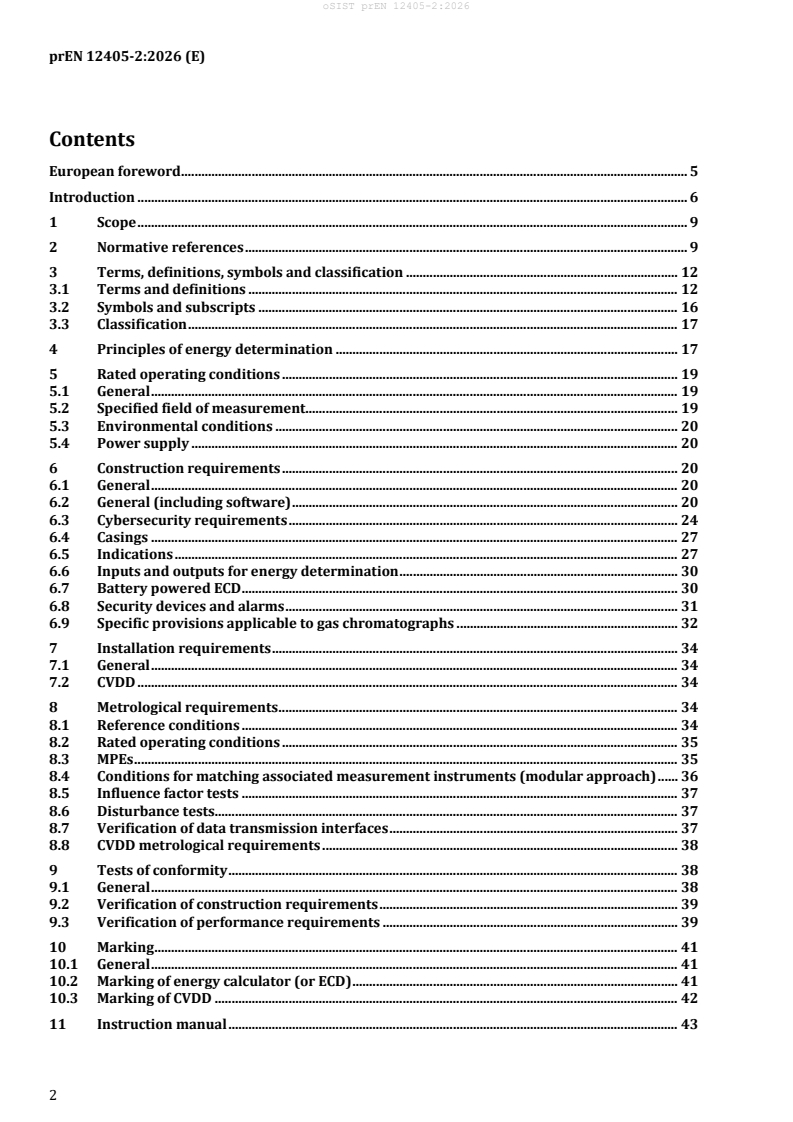
Contents
European foreword . 5
Introduction . 6
1 Scope . 9
2 Normative references . 9
3 Terms, definitions, symbols and classification . 12
3.1 Terms and definitions . 12
3.2 Symbols and subscripts . 16
3.3 Classification . 17
4 Principles of energy determination . 17
5 Rated operating conditions . 19
5.1 General . 19
5.2 Specified field of measurement. 19
5.3 Environmental conditions . 20
5.4 Power supply . 20
6 Construction requirements . 20
6.1 General . 20
6.2 General (including software) . 20
6.3 Cybersecurity requirements . 24
6.4 Casings . 27
6.5 Indications . 27
6.6 Inputs and outputs for energy determination . 30
6.7 Battery powered ECD . 30
6.8 Security devices and alarms . 31
6.9 Specific provisions applicable to gas chromatographs . 32
7 Installation requirements . 34
7.1 General . 34
7.2 CVDD . 34
8 Metrological requirements . 34
8.1 Reference conditions . 34
8.2 Rated operating conditions . 35
8.3 MPEs . 35
8.4 Conditions for matching associated measurement instruments (modular approach) . 36
8.5 Influence factor tests . 37
8.6 Disturbance tests . 37
8.7 Verification of data transmission interfaces . 37
8.8 CVDD metrological requirements . 38
9 Tests of conformity . 38
9.1 General . 38
9.2 Verification of construction requirements . 39
9.3 Verification of performance requirements . 39
10 Marking . 41
10.1 General . 41
10.2 Marking of energy calculator (or ECD) . 41
10.3 Marking of CVDD . 42
11 Instruction manual . 43
Annex A (normative) Type test of the energy calculator (EC) . 44
A.1 General conditions . 44
A.2 EC Performance tests. 44
Annex B (normative) Type test of the calorific value determination device (CVDD) . 48
B.1 Scope . 48
B.2 Performances tests. 48
Annex C (normative) Type approval tests of volume conversion device (VCD) . 55
C.1 Scope . 55
C.2 General . 55
C.3 Verification of data transmission interface . 55
Annex D (normative) Compatibility test for the set of VCD + CVDD + EC. 56
D.1 Objective . 56
D.2 Procedure . 56
D.3 Acceptance criteria . 56
Annex E (normative) Type approval test of the VCD/EC . 57
E.1 General . 57
E.2 Test procedures . 57
E.3 Performance tests. 58
Annex F (normative) Type approval test of the EC/CVDD . 60
F.1 General . 60
F.2 Performance tests. 60
Annex G (normative) Type approval test of the VCD/EC/CVDD . 65
G.1 General . 65
G.2 Performance tests. 65
Annex H (normative) Environmental influences (test procedures) . 70
H.1 General . 70
H.2 Effect of ambient temperature . 70
H.3 Effect of damp heat, steady-state . 70
H.4 Cyclic damp heat . 71
H.5 Electrical power variation . 72
H.6 Short time AC power reductions . 72
H.7 Electrical bursts . 73
H.8 Electromagnetic susceptibility . 73
H.9 Electrostatic discharges . 74
H.10 Short time DC power variations . 75
H.11 Surges on supply lines and/or signal lines . 75
H.12 Power frequency magnetic field . 76
H.13 Random vibrations . 76
H.14 Shocks . 77
H.15 Durability . 77
Annex I (normative) Testing of the data transmission interface of ECD . 79
I.1 General . 79
I.2 Data transmission interface tests procedure. 79
Bibliography . 80
European foreword
This document (prEN 12405-2:2026) has been prepared by Technical Committee CEN/TC 237 “Gas
meters”, the secretariat of which is held by BSI.
This document is currently submitted to the CEN enquiry.
This document will supersede EN 12405-2:2012.
EN 12405 consists of the following parts:
— Part 1: Volume conversion EN 12405-1:2021 to allow the harmonization of the standard with the
Measuring Instruments Directive 2004/22/EC);
— Part 2: Energy conversion (this document);
— Part 3: Flow computers used as gas meter conversion
In the preparation of this document, the content of OIML Publication, “Recommendation 140 —
measuring systems for gaseous fuel”, has been taken into account.
Introduction
This introduction presents important concepts used in this document.
Energy conversion systems
As an energy conversion device (ECD) comprises a number of different components and functions, for
the purpose of this document, two different systems are considered:
System 1, where
— the calorific value determination device (CVDD) is locally installed and is considered as being fully
part of the ECD, and
— the energy calculator (EC) will have the ability to utilize a signal generated by this locally installed
CVDD for determining energy.
Figure 1 shows the various components of ECD system 1.
Figure 1 — Description of ECD system 1
System 2, where
— the CVDD may not be locally installed and is considered as an external transducer of the system, and
— the calculator will have the ability to accept fixed or periodically updated signals for the calorific
value for determining energy.
Figure 2 shows the various components of ECD system 2.
Figure 2 — Description of ECD system 2
NOTE The various components of the ECD need to be supplied as a matched, ready-for–use, set of devices; this
applies to System 1 and System 2, and mechanically integrated or separated devices (see modular and global
approaches below).
Modular and global approaches
In the modular approach, the ECD is an assembly of separate associated measuring instruments (VCD and
CVDD) and an energy calculator (EC), which are verified separately. Each instrument is verified according
to its testing procedure, using the indication available on the energy calculator or on the associated
measuring instrument itself. In this case, the indication shall correspond to the one which is directly
processed in energy conversion. The verification of calculation consists in verifying the calculation
concerning each characteristic quantity of the gas and/or the calculation for the energy conversion.
The associated measuring instruments are approved for a type or some types of conversion device(s) in
order to ensure the compatibility of the association. If the associated measuring instruments deliver a
digital signal, they may be considered as interchangeable, provided the type examination certificate
provides all the necessary conditions of compatibility with the calculator of the conversion device.
In the global approach, the ECD is tested as a package, performing tests of the following functions: energy
calculation, volume conversion and CV determination.
The testing procedures are given in Clause 9.
For the purpose of this document, the following configurations of devices are accepted:
Table 1 — Description of systems 1 and 2
Global approach modular approach
System 1 VCD/CVDD/EC VCD + CVDD/EC
VCD/EC + CVDD
VCD + EC + CVDD
System 2 VCD/EC (signal CV) VCD + EC (signal CV)
VCD: volume conversion device
CVDD: calorific value determination device
EC: energy calculator
X/Y: devices X and Y integrated, able to perform their functions separately
X+Y: devices X and Y exchanging signals between them, verified separately
1 Scope
This document specifies the requirements and tests for the construction, performance, safety and
conformity of conversion devices used to determine the energy of fuel gases described in the Table 1,
including those of the 1st and 2nd families according to EN 437.
It is also applicable for treated non-conventional combustible gases complying with EN 437 and for which
a detailed technical evaluation of the functional requirements (such as injected biomethane) is performed
ensuring there are no other constituents or properties of the gases that can affect the metrological and
physical integrity of the measuring systems.
This document mentions technical topics to consider when hydrogen and natural gas / hydrogen blends
flow through the measuring systems.
This document can also be used as a guideline for measuring systems for other gases e.g. gaseous CO for
CCUS.
This document is not applicable for raw or sour gases.
This document is not applicable for gas measurement in CNG filling stations.
The energy conversion device (ECD) considered in this document consists of an energy calculator (EC)
and is associated with the following devices and/or functions:
— a volume conversion device (VCD) or a flow computer used as gas meter conversion, either
conforming to EN 12405-1:2021, or to EN 12405-3:2015, for high accuracy measurements;
— a calorific value determination device (CVDD).
Requirements for type approval tests of the devices, not included in the above-mentioned standards are
described in appropriate annexes specified in Table 6.
For the purpose of this document, the term “volume conversion devices” (VCDs) includes flow computers
(FCs).
A single calculator may undertake the volume conversion functions for different metering lines.
2 Normative references
The following documents are referred to in the text in such a way that some or all of their content
constitutes requirements of this document. For dated references, only the edition cited applies. For
undated references, the latest edition of the referenced document (including any amendments) applies.
EN 437:2021, Test gases - Test pressures - Appliance categories
EN 12405-1:2021, Gas meters - Conversion devices - Part 1: Volume conversion
EN 12405-3:2015, Gas meters - Conversion devices - Part 3: Flow computer
EN 55011:2016, Industrial, scientific and medical equipment - Radio-frequency disturbance characteristics
- Limits and methods of measurement
EN 60068-2-1:2007, Environmental testing - Part 2-1: Tests - Test A: Cold
EN 60068-2-2:2007, Environmental testing - Part 2-2: Tests - Test B: Dry heat
EN IEC 60068-2-30:2025, Environmental testing - Part 2-30: Tests - Test Db: Damp heat, cyclic (12 h + 12
h cycle)
EN 60068-2-31:2008, Environmental testing - Part 2-31: Tests - Test Ec: Rough handling shocks, primarily
for equipment-type specimens
EN 60068-2-47:2005, Environmental testing - Part 2-47: Tests - Mounting of specimens for vibration,
impact and similar dynamic tests
EN 60068-2-64:2008, Environmental testing - Part 2-64: Tests - Test Fh: Vibration, broadband random and
guidance
EN 60068-2-78:2013, Environmental testing - Part 2-78: Tests - Test Cab: Damp heat, steady state
EN IEC 60068-3-1:2023, Environmental testing - Part 3-1: Supporting documentation and guidance - Cold
and dry heat tests
EN IEC 60068-3-4:2023, Environmental testing - Part 3-4: Supporting documentation and guidance - Damp
heat tests
EN 60068-3-8:2003, Environmental testing - Part 3-8: Supporting documentation and guidance - Selecting
amongst vibration tests
EN 60079 (all parts), Explosive atmospheres
EN 60529:1991, Degrees of protection provided by enclosures (IP Code)
EN 60654-2:1997, Operating conditions for industrial-process measurement and control equipment - Part
2: Power
EN IEC 60730-1:2024, Automatic electrical controls - Part 1: General requirements (IEC 60730-1:2022)
EN 61000-1-2, Electromagnetic compatibility (EMC) Part 1-2: General - Methodology for the achievement
of functional safety of electrical and electronic systems including equipment with regard to electromagnetic
phenomena
EN 61000-2-2:2002, Electromagnetic compatibility (EMC) - Part 2-2: Environment - Compatibility levels
for low-frequency conducted disturbances and signalling in public low-voltage power supply systems
EN 61000-4-2:2009, Electromagnetic compatibility (EMC) - Part 4-2: Testing and measurement techniques
- Electrostatic discharge immunity test
EN IEC 61000-4-3:2020, Electromagnetic compatibility (EMC) - Part 4-3 : Testing and measurement
techniques - Radiated, radio-frequency, electromagnetic field immunity test (IEC 61000-4-3:2020)
EN 61000-4-4:2012, Electromagnetic compatibility (EMC) - Part 4-4: Testing and measurement techniques
- Electrical fast transient/burst immunity test
EN 61000-4-5:2014, Electromagnetic compatibility (EMC) - Part 4-5: Testing and measurement techniques
- Surge immunity test
EN IEC 61000-4-6:2023, Electromagnetic compatibility (EMC) - Part 4-6: Testing and measurement
techniques - Immunity to conducted disturbances, induced by radio-frequency fields
EN 61000-4-8:2010, Electromagnetic compatibility (EMC) - Part 4-8: Testing and measurement techniques
- Power frequency magnetic field immunity test
EN IEC 61000-4-11:2020, Electromagnetic compatibility (EMC) - Part 4-11: Testing and measurement
techniques - Voltage dips, short interruptions and voltage variations immunity tests for equipment with
input current up to 16 A per phase (IEC 61000-4-11:2020)
EN 61000-4-29:2000, Electromagnetic compatibility (EMC) - Part 4-29: Testing and measurement
techniques - Voltage dips, short interruptions and voltage variations on d.c. input power port immunity tests
EN IEC 61000-6-1:2019, Electromagnetic compatibility (EMC) - Part 6-1: Generic standards - Immunity
standard for residential, commercial and light-industrial environments (IEC 61000-6-1:2016)
EN IEC 61000-6-2, Electromagnetic compatibility (EMC) - Part 6-2: Generic standards - Immunity standard
for industrial environments
EN 62054-21, Electricity metering (a.c.) - Tariff and load control - Part 21: Particular requirements for time
switches
EN IEC 62368-1, Audio/video, information and communication technology equipment - Part 1: Safety
requirements
EN ISO 12213-2:2009, Natural gas - Calculation of compression factor - Part 2: Calculation using molar-
composition analysis (ISO 12213-2:2006)
EN ISO 12213-3:2009, Natural gas - Calculation of compression factor - Part 3: Calculation using physical
properties (ISO 12213-3:2006)
EN ISO 13443:2005, Natural gas - Standard reference conditions (ISO 13443:1996 including Corrigendum
1:1997)
EN ISO 6976:2016, Natural gas - Calculation of calorific values, density, relative density and Wobbe indices
from composition (ISO 6976:2016)
ISO 6141:2015, Gas analysis — Contents of certificates for calibration gas mixtures
ISO 6142 (all parts), Gas analysis — Preparation of calibration gas mixtures — Gravimetric method
ISO 6143:2025, Gas analysis — Comparison methods for determining and checking the composition of
calibration gas mixtures
ISO/TR 29922:2017, Natural gas — Supporting information on the calculation of physical properties
according to ISO 6976
3 Terms, definitions, symbols and classification
3.1 Terms and definitions
For the purposes of this document, the following terms and definitions apply.
ISO and IEC maintain terminology databases for use in standardization at the following addresses:
— ISO Online browsing platform: available at https://www.iso.org/obp
— IEC Electropedia: available at https://www.electropedia.org/
3.1.1
adjustment interval
time interval or number of measurements between two necessary adjustments of a calorific value
determining device
3.1.2
associated measuring instruments
instruments for measuring certain quantities which are characteristic of the gas (temperature, pressure,
calorific value etc.), whose indications are used by the calculator with a view to making a correction
and/or a conversion
Note 1 to entry: For the purpose of this document, when dealing with the ECD in modular approach, the VCD and
CVDD are considered as associated measuring instruments.
3.1.3
base conditions
fixed conditions used to express the volume of gas independently of the metering conditions and the
superior calorific value
Note 1 to entry: The pressure base for both volumetric metering and combustion is always 101,325 kPa. The
temperature needs to be specified
EXAMPLE Temperature of 273,15 K and absolute pressure of 1,013 25 bar or temperature of 288,15 K and
absolute pressure of 1,013 25 bar.
3.1.4
calorific value determining device
CVDD
measuring instrument for obtaining the calorific value of gas. The CVDD can comprise multiple devices
3.1.5
compression factor
parameter which indicates the deviation from the ideal gas
Note 1 to entry: The compression factor calculation needs to be carried out according to ISO 12213 part 2 or 3.
3.1.6
display
element or assembly of elements of the indicating device on which the results of measurement and
memorised values are displayed
3.1.7
disturbance
influence quantity having a value within the limits specified but outside the specified rated operating
conditions of the measuring instrument
Note 1 to entry: An influence quantity is a disturbance if the rated operating conditions for that influence quantity
are not specified.
3.1.8
energy conversion device
ECD
device which calculates, integrates and displays energy using volume at base conditions and the calorific
value or the gas composition
3.1.9
global approach
approach through which the performances of the energy conversion device (ECD) are verified and
approved with a completely integrated package, including the energy calculation, the associated
measuring instruments and other functions
3.1.10
influence factor
influence quantity having a value within the specified rated operating conditions of the measuring
instrument
3.1.11
influence quantity
quantity that is not a measurand but that affects the result of the measurement
EXAMPLE Ambient temperature.
3.1.12
maximum permissible error
extreme value of the measurement error, with respect to a known reference quantity value, permitted
by specifications or regulations for a given measurement, measuring instrument or measuring
system
Note 1 to entry: Generally, the two extreme values are taken together and are termed “maximum permissible
errors” or “limit of error”.
3.1.13
measurand
particular quantity subject to measurement
3.1.14
measurement repeatability
repeatability
measurement precision under a set of repeatable conditions of measurement
3.1.15
metering conditions
conditions of the gas at which the volume is measured at the point of measurement
Note 1 to entry: Metering conditions include the temperature and pressure of the measured gas.
3.1.16
modular approach
approach combining associated measuring instruments (VCD and CVDD) and an energy calculator (EC)
of the energy conversion device (ECD) which are verified and approved separately and conditions for the
matching of the associated measurement instruments which are verified appropriately
3.1.17
precision
closeness of agreement between indication obtained by replicate measurements on the same or similar
objects under specified conditions
3.1.18
rated operating conditions
values for the measurement and influence quantities making up the normal working conditions of an
instrument
3.1.19
reference conditions
set of reference values or reference ranges of influence factors prescribed for testing the performances
of a measuring system or a device or for inter comparisons of the results of measurements
3.1.20
repeatability condition of measurement
repeatability condition
condition of measurement in a set of conditions that includes the same measurement procedure, same
operators, same measuring system, same operating conditions and same location, and replicated
measurement on the same or similar objects over a short period of time
3.1.21
repeatability error
difference between the largest and the smallest results of successive measurements of the same quantity
carried out under the same conditions
3.1.22
representative calorific value
individual calorific value or a combination of calorific values that is considered to be, according to the
constitution of the measuring system, the most appropriate calorific value to be associated with the
metered quantity in order to calculate the energy
3.1.23
secured communication
communication, physical or non-physical, between elements of a measuring system ensuring that
information transferred from one of these elements to another one may not be tampered with by the
user, by external influences or by fault of the system
Note 1 to entry: Secured communication is ensured by providing sealing devices and/or checking facilities.
Note 2 to entry: WELMEC Guide 7.2 provides guidance with application of MID for software-equipped measuring
instruments [7].
3.1.24
signal
message made up of data or information, which can take many forms broadly classed as analogue or
digital, that enables the data or information to be conveyed from one apparatus to another
Note 1 to entry: Examples of signals are shown in Table 2.
Table 2 — Electronic interface descriptions
Measurand Example Transmission Conversion
representation as: between devices
Voltage
Proportional quantity,
Analogue-to-digital
analogue signals
Current Analogue
conversion
Analogue value
Frequency
Proportional quantity,
NAMUR-Sensor
digital signals
Digital Counting
Reed-Contact
Pulses
Coded (Binary) HART- Protocol
Coded (e.g. digital) Decoding
Data protocol Modbus - Protocol
3.1.25
superior calorific value
gross calorific value
the amount of heat which would be released by the complete combustion in air of a specified quantity of
gas, in such a way that the pressure at which the reaction takes place remains constant, and all the
products of combustion are returned to the same specified temperature as that of the reactants, all of
these products being in the gaseous state except for water formed by combustion, which is condensed to
the liquid state at this specified temperature
Note 1 to entry: In the following parts of this document, the term calorific value (CV) is used to mean superior
calorific value. The symbol HS is used for the formulae.
3.1.26
system 1
calorific value determination device (CVDD) which is locally installed and considered as being fully part
of the energy conversion device (ECD)
3.1.27
system 2
calorific value determination device (CVDD) which is not locally installed, and through which the energy
calculation, the calorific value is fixed or periodically updated with signals representative of the calorific
value
3.1.28
Volume Conversion Device
VCD
device that computes, integrates and indicates the volume increments measured by a gas meter as it were
operating at base conditions, using as inputs the volume at metering conditions and other parameters
such as gas temperature and gas pressure
Note 1 to entry: The conversion device can also compensate for the error curve of a gas meter and associated
measuring transducers.
Note 2 to entry: The deviation from the ideal gas law can be compensated by the compression factor.
[SOURCE: EN 12405-1:2021]
3.2 Symbols and subscripts
The symbols and subscripts used in this document are listed below in Table 3.
Table 3 — Symbols
Symbols Represented quantity Units
V volume m
C conversion factor -
C correction factor -
f
Q volumetric flow rate m /h
F(Q) correction function -
K, K', K”,K”' coefficients -
p absolute pressure at metering conditions bar or MPa
T absolute temperature at metering conditions K
Z compression factor of the gas at metering condition -
U nominal supply voltage V
nom
f nominal supply frequency Hz
nom
e error on the overall energy determination %
e error on the energy calculator %
C
e error on the calorific value determination device %
CV
e error on the volume conversion device %
v
E energy MJ, TJ or kWh
∆E incremented energy MJ, TJ or kWh
MJ/kg, MJ/m , kWh/kg or
H superior calorific value
s
kWh/m
Subscripts
metering conditions
m
Corrected
c
Ambient
am
base conditions
b
conventional true value
CT
Minimum
min
Maximum
max
time interval
t
3.3 Classification
3.3.1 Mechanical classes
M1: this class applies to instruments used in locations with vibration and shocks of low significance, e.g.
for instruments fastened to light supporting structures subject to negligible vibrations and shocks
transmitted from local blasting or pile-driving activities, slamming doors, etc.
M2: this class applies to instruments used in locations with significant or high levels of vibration and
shock, e.g. transmitted from machines and passing vehicles in the vicinity or adjacent to heavy machines,
conveyor belts, etc.
3.3.2 Electromagnetic Environmental classes
E1: this class applies to instruments used in locations with electromagnetic disturbances corresponding
to those likely to be found in residential, commercial and light industrial buildings.
E2: this class applies to instruments used in locations with electromagnetic disturbances corresponding
to those likely to be found in other industrial buildings.
4 Principles of energy determination
Energy determination can be characterized in numerous ways. The simplest way is where the totalised,
unconverted, volume passed by a gas meter is multiplied by a constant value of CV; the most complex is
where the volume passed by a gas meter is converted to base conditions and a live output from a CVDD
is continually inputted into the energy calculator. Shown below is a list of formulae for all combinations
of energy calculator associated with CVDDs and VCDs.
The CV calculation shall be carried out according to EN ISO 6976 and ISO/TR 29922 if the GCV for H2 is
calculated on volumetric basis. The standard base conditions of temperature, pressure and humidity
(state of saturation) to be used for measurements and calculations carried out on natural gases, natural-
gas substitutes and similar fluids in the gaseous state shall be in accordance to EN ISO 13443.
The calorific value will normally be determined on a volumetric basis by measurements performed by
CVDD. It can be also determined however by reconstruction systems. In all cases, the energy is calculated
from the product of a representative calorific value and a volume at the same base conditions.
The totalised energy E is calculated after the time interval t by the following formula:
t
EE+∆E (1)
t t-1 t
E is the totalised energy before the time interval, t.
t-1
=
Generally, the determination of the incremented energy, ∆E , calculated as ∆E = (H .V ), can be
S b t
t t
characterized following one of five approaches:
a) by summation of unconverted volume:
k
∆=E KH V (2)
( )
t S ∑ mi
t i=1
P
TZ[ ]
bb
K= (3)
TP Z
[ ] [ ]
b
Where
K is a constant, representative of the conversion factor to convert sum of volumetric increments V at
mi
metering conditions to volumetric increments at base conditions;.
[T], [P], [Z] are constants, representative of the (varying) parameters T, P and Z;
T , P Z are constants; index “b” means “at base conditions”;
b b, b
(Hs)t - HS is a constant, representative or the most updated value of the gas CV for the summation
period “t”;
V : volume increments at metering conditions for each “i” from i = 1 to i = k (adequate to each gas meter
mi
impulse).
During the summation time period, “t” the “k” volume increments V are added together.
mi
b) by application of volume summation at metering conditions and “T conversion”:
H k
S
∆=EK ' V (4)
t ∑ mi
i=1
T
t
where
P
[ ] Z
b
KT'= (5)
b
P Z
[ ]
b
T: representative value of the measured temperature over the summation period “t”;
Remaining symbols: as above.
c) by application of volume summation at metering conditions and “PT conversion”:
PH× k
S
∆=EK '' V (6)
t ∑ mi
i=1
T
t
Where
T Z
bb
K ''= (7)
PZ
[ ]
b
P: representative value of measured pressure over the summation period “t”;
Remaining symbols: as above.
d) by application of volume summation at metering conditions and “PTZ conversion”:
PH× k
S
′′′
∆=EK V (8)
t ∑ mi
i=1
TZ×
t
Where
T
b
′′′
K = Z (9)
b
P
b
Z: representative value of compressibility factor over the summation period “t”;
Remaining symbols: as above.
e) by application of volume summation at metering conditions and P T Z conversion including
determination of compressibility factor at base conditions Z for currant gas composition:
b
PH× ×Z k
Sb
∆=EK '''' V (10)
t ∑ mi
i=1
TZ×
t
Where
T
b
K ''''= (11)
P
b
Zb: representative value of compressibility factor at base conditions over the summation period “t”;
Remaining symbols: as above.
5 Rated operating conditions
5.1 General
The rated operating conditions for VCD shall comply with Clause 5 of EN 12405-1:2021. The following
requirements apply to the other components of the ECD.
5.2 Specified field of measurement
5.2.1 General
The field of measurement of the complete instrument shall be specified in the instruction manual.
5.2.2 Specified measurement range for gas pressure
The instruction manual shall indicate the maximum operating pressure.
5.2.3 Specified measurement range for gas temperature
The instruction manual shall specify the gas temperature range.
5.2.4 Gas characteristics
The instruction manual shall specify the characteristics (limits of chemical composition) of the gas to be
measured.
If the CVDD is a gas chromatograph, it shall be capable of measuring at least the components given in 6.8.
5.2.5 Base conditions
The instruction manual shall specify the base conditions or range of base conditions for converted
quantities.
The base conditions used for the calorific value and converted quantities shall conform to the various
possibilities given in EN ISO 13443.
5.3 Environmental conditions
5.3.1 Ambient temperature range
The instruction manual shall specify the ambient temperature range of the ECD wi
...